The Book of Azrael Summary, Characters and Themes
The Book of Azrael by Amber Nicole is a dark fantasy romance set in a fractured world where old gods, constructed celestials, and monstrous species fight over who gets to shape reality. At its center is Dianna, a lethal Ig’Morruthen bound by blood and debt to Kaden, a tyrant building an alliance to seize a legendary artifact: the Book of Azrael.
Her loyalty is enforced through fear and the safety of her sister, Gabby. When Dianna crosses paths with Liam, a celestial king linked to the book’s history, the story turns into a clash of duty, trauma, and a dangerous connection that could remake every realm.
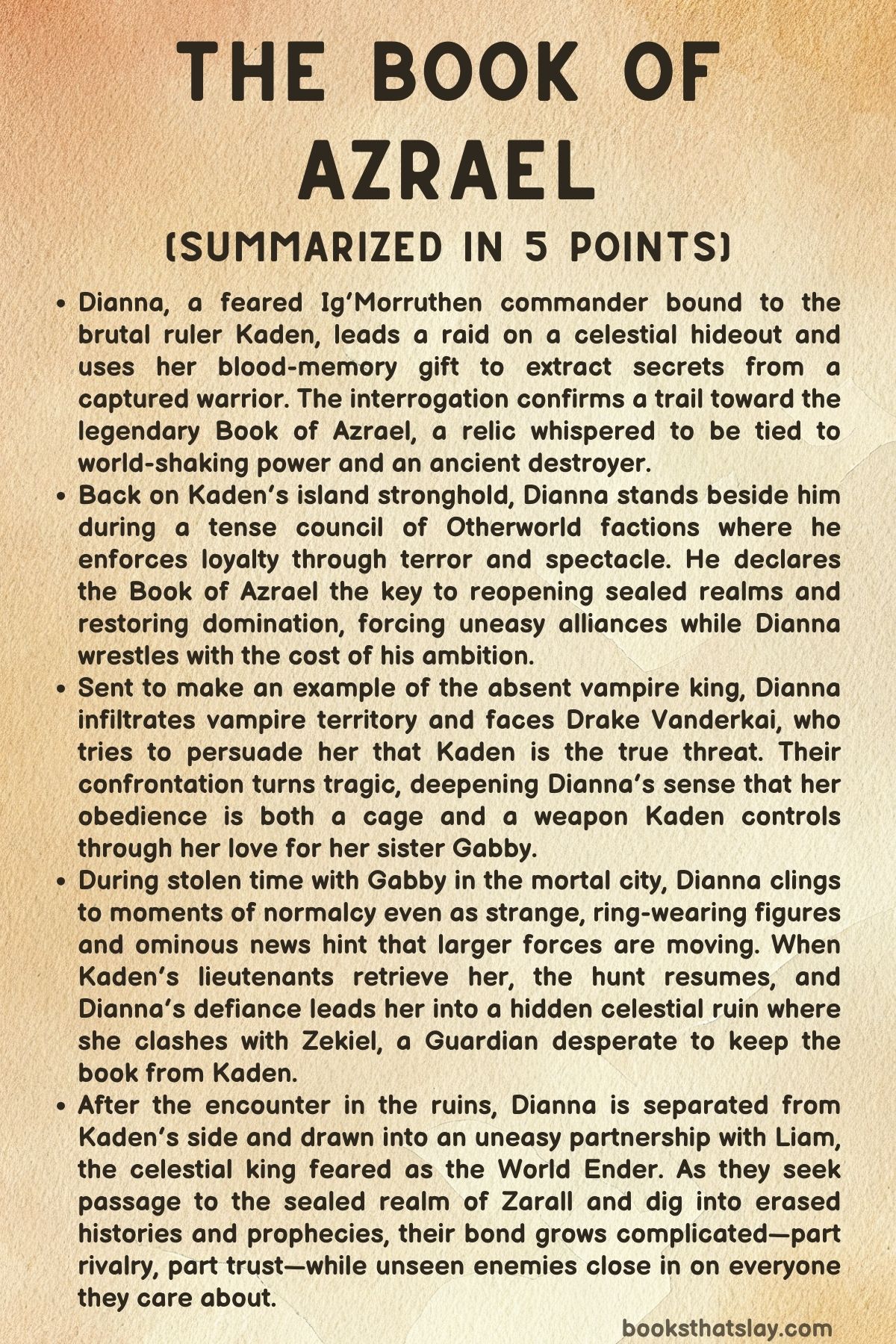
Summary
Dianna, an Ig’Morruthen commander in service to the ruthless Kaden, interrogates a captured celestial in a ruined mansion office after her team’s assault. She brutalizes him with practiced cruelty, masking hatred born from history: celestials fell into her world centuries ago, their arrival tied in her mind to plague, conquest, and the destruction of her people.
Searching for an artifact Kaden wants, she finds nothing, so she drinks the celestial’s blood to invade his memories. In the vision, she sees him among other celestials traveling through Arariel, discussing attacks on their kind and rumors that an ancient threat might be returning.
She confirms his identity and the location of a fortress linked to a celestial faction called the Hand.
Alistair, another of Kaden’s inner circle, arrives and finishes what Dianna started. Using his own terrifying magic, he tears through the captive’s mind and remakes him into a compliant spy, ordering him to return to Arariel and serve as their puppet.
Dianna feels a brief, unwanted flicker of pity but follows orders. She and Alistair return to Novas, Kaden’s volcanic island home.
His mansion is quiet in a way that signals danger. Tobias, third in command, scolds them for being late and rushes them into preparations for a summit of Otherworld leaders.
Dianna enters the hall in a black dress, adopting the persona that makes lesser factions fear her. The summit includes witches, banshees, nightmare-eating Baku, assassin Shades, werewolves, human politicians, and vampire envoys standing in for their absent king, Ethan.
Kaden’s temper snaps at the insult of the vampire king’s absence. To make his rule unmistakable, he opens a lava pit beneath the council table and orders the delegates into it.
Dianna, bound to him by an ancient bargain, drags each envoy to their death. Her hesitation with the last begs a memory of her sister, Gabby, but she completes the execution.
The message is clear: Kaden’s alliance runs on terror.
Kaden then announces their true objective: the mythical Book of Azrael. The room recoils.
The book is tied to the World Ender, a legendary destroyer from celestial lore, and to the Hand that guards celestial power. Kaden calls the legend propaganda meant to frighten them.
He claims the book will let him open long-sealed realms and restore dominion to those gathered. Elijah, the human leader, and Dianna’s infiltration provide evidence that they’re close.
With fear and ambition mixing in the air, the factions accept his plan.
Afterward, Dianna reflects on how her life became a cage. Years earlier she begged Kaden to save Gabby, and he turned Dianna into an Ig’Morruthen and bound her to him forever.
Kaden confronts her over her brief hesitation during the lava punishment, reminding her that he knows her weakness: Gabby. He forces Dianna to reaffirm loyalty, denying any hope of freedom.
Kaden orders her to eliminate Drake Vanderkai, brother to the missing vampire king. Dianna flies into vampire territory, storms Drake’s nightclub, and burns her way through guards.
Upstairs, Drake meets her without fear, calling Kaden a tyrant and urging Dianna to defect. Their fight is vicious and personal.
Dianna admits she doesn’t want to kill him, but her bondage wins. She tears out his heart and incinerates him from within.
Kaden immediately calls, granting her permission to visit Gabby, a reminder that he watched everything.
Dianna goes to Gabby’s apartment, where her sister is building a quieter life and dating Dr. Rick Evergreen.
Their reunion is warm but strained by everything Dianna cannot share. Over breakfast, Dianna explains that enslaving the celestial spy has given them a route into Arariel, bringing them closer to the Hand and the book.
Gabby worries about what Kaden will do if the book is real. She speaks excitedly about wanting a permanent future with Rick, even dreaming of an Otherworld bond, unaware Dianna has just killed Drake, the one who could have turned him.
During Dianna’s stay, news of a major earthquake damaging ancient temples alarms her; she suspects Kaden has found a related clue. She hides the fear from Gabby, knowing Kaden will summon her soon.
Dianna spends another day with Gabby in the city. They argue about celestials: Dianna blames them for the plague and the ruin of their homeland, while Gabby doubts the certainty of that story.
After shopping and dinner, fortune candies hint at looming change. They go clubbing.
Dianna notices a stunning woman wearing heavy silver rings who appears and vanishes unnaturally. Later, a flirtatious stranger at the bar wears similar rings.
Dianna senses something wrong but can’t place it. She leaves early, unsettled.
Two weeks pass in uneasy calm. Gabby begs Dianna to walk away from violence, but Dianna explains the truth: she is owned by Kaden through a blood bargain and cannot escape.
Their argument is cut short when Tobias and Alistair arrive to retrieve her. Alistair needles Gabby, but Dianna protects her, warning him off.
She leaves with them, promising Gabby she’ll return.
They travel to Ophanium based on intelligence from the enslaved celestial. While scouting a forest for a hidden monument, Dianna is drawn away by a strange pull.
She disobeys orders and enters abandoned mountain ruins, discovering a trapdoor that leads to an underground library decorated with old celestial relics. There she is attacked by Zekiel, a Guardian of the Hand of Samkiel.
He recognizes her as an Ig’Morruthen thought extinct. Their battle is brutal; Dianna is badly wounded but manages to break his blade and snap his neck.
He heals and fights on, until Kaden arrives. Furious at Dianna’s defiance, Kaden subdues Zekiel and demands the Book of Azrael.
Zekiel refuses, warning that Kaden can never have it. Kaden traps Dianna and his commanders in electrified silver circles with an ancient spell.
Zekiel tries to escape. Dianna forces herself into a full beast form, bursts free, and intercepts him outside.
Bleeding, Zekiel says his death will bring Samkiel back, then uses a small blade to open a passage and stabs himself. A blue beam erupts into the sky and Zekiel vanishes.
Kaden staggers from the ruins, shaken, demanding to know what Dianna has done and fearing what Zekiel’s sacrifice means.
Later, Dianna is traveling with Liam, a celestial king linked to the Hand and to the sealed realms. Though wary of each other, they share a night of guarded peace.
Dianna tries to comfort Liam through nightmares instead of seducing him. He explains celestials as created beings forged for war and service, loyal by design, and admits his own failure to understand politics when he ruled.
Their conversation grows more personal as Dianna offers simple comfort that helps him sleep. She confesses she didn’t kill Zekiel directly, describing how the fight spiraled after Kaden intervened.
Liam believes her but is hurt by the secrecy. Dianna asks if Liam could create a celestial for Gabby’s safety; he cannot, but offers Gabby refuge and work with him.
The next day Liam recounts how the realms were sealed: a blood-binding ritual tied him to the gates, ensuring that his death would reopen them, while his ascension ended travel between worlds. They go to meet a contact who can smuggle them into Zarall.
At a pop-up festival, Liam is rattled by the noise and crowds, reminded of past slaughter. Dianna distracts him with mortal games and small joys, and they share a fragile friendship.
The contact warns that Kaden is hunting Dianna, furious and willing to take her back by force. He gives them a plan to hide on a small cargo plane from the airport.
Waiting near the hangars under the stars, Dianna extracts a promise from Liam: if Kaden captures or kills her, Liam must protect Gabby. Liam swears he will protect them both.
That night Liam dreams of Dianna dying, of his own past violence against Ig’Morruthens, and of a future where Kaden rules over ruin. The chant in the dream insists Liam is destruction and that the world is headed for disaster.
Soon after, Dianna appears dead in Liam’s arms during a battle. Refusing to lose her, Liam breaks a forbidden law and resurrects her with his own power, rebuilding her heart and body.
The act drains him and seems to block his magic from reaching his closest allies. Dianna wakes angry and terrified after seeing his memories, calling him the World Ender for the slaughter he once carried out.
Liam admits the truth and the existence of his devastating sword, Oblivion, forged through grief and capable of annihilation. Unsure of the cost of resurrection, they decide to seek answers.
With Logan’s help, they infiltrate the Council realm library in disguise. They find that records about Azrael’s lost archives and a god-killing weapon have been removed.
They consult Roccurrem, the last Fate, who speaks in riddles but confirms terrifying pieces: Liam already knows what was in the book, a silver-blooded god erased the archives, Liam’s family hides ancient secrets, and Dianna is Ig’Morruthen, an agent tied to death and chaos. Roccurrem hints at a prophecy in which one falls, one rises, and the end begins.
Liam is central, and his death would reopen the realms. He spirals into guilt and dread, while Dianna refuses to accept destiny as fixed, urging him to hold to love and choice.
Their moment of closeness is shattered by Logan’s news: Neverra has been taken and Gabby is missing. Dianna and Liam race to Novas, but Kaden’s island is abandoned.
Dianna destroys the room where she was once imprisoned, shaking with rage and fear. Liam insists Gabby is alive because of the blood deal linking them, and because Kaden needs her as leverage.
Back in the Silver City, their search fails. Then a global broadcast hijacks every screen.
Tobias puppets dead anchors as Kaden appears holding the Book of Azrael. He reveals the Otherworld to mortals and boasts that he will open realms and bring apocalypse.
He mocks Liam’s past and Dianna’s loyalty, showing images of her with Liam and claiming she will be discarded by both sides. The audience behind him includes traitors, among them a living Drake and Camilla, who admit they fed him Dianna’s movements.
Kaden orders Tobias to drag out a hooded prisoner. It is Gabby.
Forced to speak on camera, Gabby manages only to say she loves Dianna. Kaden snaps her neck in front of the world.
The blood deal seals with a burning mark on Liam’s palm. Dianna’s grief detonates her restraint.
The Ig’Morruthen within her erupts to the surface, transforming her into a winged, scaled force of fire and ruin. Her scream becomes a storm that blasts Liam through walls as the city ignites.
As Liam struggles to rise, Roccurrem’s prophecy clicks into place: the catastrophe they feared is not a distant war. It is Dianna unleashed, and the end has begun.
Characters
Dianna
Dianna is the emotional and narrative core of The Book of Azrael, moving through the story as both predator and wounded survivor. As an Ig’Morruthen bound to Kaden, she carries an identity shaped by coercion, grief, and a ferocious will to endure.
Her blooddream ability makes her uniquely dangerous—she can violate minds and extract truth through intimacy with violence—yet that same power repeatedly drags her into the humanity of her enemies, forcing her to feel what she would rather destroy. Dianna’s hatred of celestials is not ideological so much as personal and ancestral: she believes their arrival caused the plague that killed her parents and erased her people, so every celestial she faces becomes a symbol of a stolen world.
Still, her cruelty is never simple sadism; it reads as armor layered over a longing for freedom and normalcy that she barely allows herself to name. Her love for Gabby exposes the most fragile part of her: Dianna can slaughter armies without blinking, but she hesitates over the fate of a begging vampire because she cannot unlearn what it means to lose family.
That soft spot is exactly how Kaden controls her, turning her devotion into a chain. Over time, her relationship with Liam cracks open another layer: she begins to imagine life beyond obedience, friendship, and even tenderness, but fate and prophecy tug her toward catastrophe.
By the end, when Gabby is murdered and Dianna’s full Ig’Morruthen nature erupts, she becomes the embodied consequence of every wound she’s carried—proof that love, in her world, is both salvation and the match that lights the apocalypse.
Kaden
Kaden is the central tyrannical force of The Book of Azrael, a ruler whose power is defined less by strategy than by domination as performance. His volcanic island stronghold and theatrical punishments mirror his psychology: he governs through spectacle, fear, and the crushing certainty that resistance is futile.
Kaden’s control over Dianna is especially insidious because it is rooted in a bargain that once looked like mercy—he saved Gabby, turned Dianna into an Ig’Morruthen, and made her survival contingent on her obedience. That origin lets him frame ownership as debt, twisting gratitude into slavery.
His leadership style reveals a man obsessed with absolute loyalty: even allies are disposable if they embarrass him, as seen when he orders the vampire delegates to a lava death simply to punish absence. The Book of Azrael, to Kaden, is not just a weapon but vindication: a means to reopen realms, rewrite cosmic hierarchies, and prove that legends like the World Ender are nothing compared to him.
Yet beneath the ruthlessness flickers something like fear—his reaction after Zekiel vanishes suggests Kaden understands the mythic stakes better than he admits. He represents the story’s cruelty of power without conscience, and his final broadcast, unveiling Otherworld to mortals while murdering Gabby as a message, shows his ultimate goal is not just rule but the reshaping of reality into a stage where only his will matters.
Alistair
Alistair operates as Kaden’s enforcer and a dark mirror to Dianna in The Book of Azrael. He is efficient, cold, and enjoys the intimacy of control, demonstrated through his ability to tear into Peter’s mind and rewrite him into obedience.
Unlike Dianna, who sometimes recoils from the cost of brutality, Alistair seems to experience no moral friction; violence and psychic violation are simply tools, and perhaps pleasures. His red-eyed power and command presence make him one of the few figures Dianna treats with wary respect, not because he outranks her emotionally but because he embodies what she could become if every human impulse were burned away.
His taunting of Gabby and casual threats underline his role as the boundary marker of Kaden’s regime: he reminds Dianna what happens when compassion becomes visible. Still, Alistair is not written as chaotic evil; he is loyal to hierarchy and rules, implying a belief system where obedience is virtue and softness is weakness.
That makes him a chilling stabilizer of tyranny—someone who doesn’t need to hate to destroy, only to follow orders well.
Tobias
Tobias is the polished, administrative cruelty of Kaden’s inner circle in The Book of Azrael, a figure who proves that oppression doesn’t always wear a savage face. He scolds, organizes, and manages Kaden’s world with the tone of a superior correcting subordinates, reinforcing the idea that their violence is routine governance.
His presence at Gabby’s removal from Dianna’s life shows how he functions as the hinge between Kaden’s will and Dianna’s forced compliance: he appears not to debate morality but to deliver outcomes. Tobias’s later role in the broadcast—puppeting dead news anchors to unveil apocalypse—pushes him into symbolic territory as well.
He becomes the literal animator of false narratives, turning the world’s information systems into a horror show. Where Kaden is spectacle, Tobias is procedure; he represents the quiet machinery that makes spectacle possible, and his calm compliance makes him especially terrifying because it suggests he sees atrocity as a job done correctly.
Peter McBridge
Peter McBridge is a minor character in screen time but a major pivot in plot dynamics within The Book of Azrael. As a second-tier celestial tied to The Hand of Rashearim, he is not a grand hero but a working part of celestial society—young enough to fear legends, low enough to be used.
His interrogation reveals the vulnerability of celestials despite their ancient-warrior reputation: beneath the myth, Peter is a person who panics, remembers his mother, and carries ordinary life alongside martial loyalty. The blooddream sequences push him into humanizing focus, showing how Dianna’s power blurs the line between violation and understanding.
When Alistair remakes his mind into a puppet, Peter becomes a living metaphor for the stakes of the conflict: identities in this world can be taken, rewritten, and weaponized, and even divine-born beings are not immune. He is also the narrative doorway into Arariel and the growing fear of the World Ender’s return, making him a reluctant messenger of prophecy.
Gabriella (Gabby)
Gabby is Dianna’s moral anchor and emotional homeland in The Book of Azrael, the embodiment of the life Dianna sacrificed to save. She is warm, practical, and grounded in ordinary joys—nursing work, markets, fortune candies, a boyfriend she wants to keep—yet she is not naive.
Gabby challenges Dianna’s worldview directly, refusing to accept hatred of celestials as unquestioned truth and pressing Dianna to imagine a safer, freer existence. Her insistence on evidence, compassion, and normalcy doesn’t just contrast Dianna’s violence; it reveals what Dianna could have been in another life.
Gabby’s value to the story is amplified by her vulnerability: she is a living weakness that tyrants can exploit, and she knows it, which makes her pleas for Dianna’s escape feel urgent rather than idealistic. Her death is the story’s most devastating turn because it collapses Dianna’s last tether to restraint.
Kaden kills Gabby not only to punish Dianna but to detonate her, and the narrative confirms Gabby’s role as the heart placed deliberately on a sacrificial altar to unleash the World Ender.
Liam
Liam is the story’s conflicted celestial king and the humanizing counterweight to Dianna in The Book of Azrael. He begins as a figure of mythic gravity—linked to sealed realms and cosmic law—but quickly becomes a man burdened by legacy, guilt, and loneliness.
His self-knowledge is raw: he admits he was spoiled as king, ignored politics, and now lives with the consequences of that blindness. Liam’s view of celestials as created beings designed for loyalty gives him a quiet sadness; he is both master and product of divine engineering, raised to serve a purpose rather than to choose one.
His history of slaughtering Ig’Morruthens and destroying Rashearim marks him as the “World Ender,” yet his present self is haunted by that title, suggesting that violence was once necessary or at least believed to be, but is now morally radioactive inside him. His bond with Dianna grows through vulnerability—nightmares, shared food, awkward comfort, reluctant trust—and this relationship becomes transformative.
He breaks taboo resurrection law to save her, not out of strategy but out of attachment and dread of loss, showing how deeply she has rewired his priorities. Liam’s arc is ultimately about the terror of prophecy versus the hope of choice: he hears fate naming him a key to catastrophe, yet he keeps trying to act with compassion anyway.
By the end, his realization that Dianna’s unleashing is “the end of his world” lands as a tragic climax for a man who wanted to be better than the gods who made him.
Zekiel
Zekiel appears briefly in The Book of Azrael but carries immense symbolic and catalytic weight. As a Guardian and member of the Hand of Samkiel, he is the embodiment of celestial duty sharpened into immediate violence.
His fight with Dianna shows the terrifying competence of The Hand, and his refusal to yield to Kaden positions him as a man whose loyalty is to a cause bigger than survival. What makes Zekiel memorable is his certainty: he believes the Book of Azrael must never fall into Kaden’s hands, and he is willing to die to enforce that belief.
His final act—opening passage to Asteraoth by stabbing himself—turns him into a sacrificial trigger, someone who would rather become a doorway for prophecy than a prisoner of tyranny. The line that his death will bring Samkiel back elevates him from soldier to herald; he is less a character to be understood psychologically and more a fuse that lights the next stage of the mythic conflict.
Logan
Logan functions as Liam’s closest confidant and stabilizer in The Book of Azrael, a figure who blends loyalty with pragmatic caution. His reaction to Liam’s resurrection of Dianna is crucial: shock and concern, not condemnation, which shows friendship deep enough to hold fear without betrayal.
Logan’s presence also signals that Liam is not isolated in power; he has people who know him before prophecy, who remind him of reality when he spirals. The concept of an amata—true bonded beloveds—anchors Logan in a world of intimate destiny, and his relationship with Neverra implies that love in this universe is not merely emotional but structurally magical.
Narratively, Logan is a tether for Liam’s humanity and a bridge into the Council’s political and archival systems, helping push the plot forward without hijacking it.
Neverra
Neverra is mostly off-stage in the summary of The Book of Azrael, but her significance is profound because she represents the personal cost of the coming war. As Logan’s amata, she exemplifies sacred, fated love—something stable and hopeful in a world spiraling toward ruin.
Her abduction serves as a narrative alarm bell: if someone as protected and central to The Hand can be taken, then no bond is safe and the conflict has escalated beyond ordinary power struggles. She is a symbol of what can be shattered to force heroes into motion.
Vincent
Vincent exists in The Book of Azrael as both rumor and wound, a celestial whose backstory adds texture to the moral ambiguity of The Hand. Created by Nismera and abused by her, Vincent embodies the idea that even divine creations can be victims of the gods who made them.
His resentment toward control parallels Dianna’s rage at enslavement, hinting that the cosmic war is filled with people damaged by hierarchy on all sides. Although he does not appear directly, the fear surrounding his name and the legend of a returning threat suggest he may become a hinge between old violence and new rebellion.
Santiago
Santiago, the witches’ leader in The Book of Azrael, represents the political realism of factions trapped under Kaden’s orbit. He is present in the meeting not as a devoted follower but as a negotiator weighing survival against tyranny.
His silence during the lava punishment and reluctant agreement to Kaden’s plan show the witches’ precarious position: powerful enough to matter, but not powerful enough to resist openly. Santiago functions as a reminder that Kaden’s empire is held together less by shared ideology and more by fear of what happens to dissenters.
Sasha
Sasha leads the banshees in The Book of Azrael and appears primarily as a factional presence, but her inclusion in the council underscores the breadth of Kaden’s reach. The banshees’ mythic association with death and forewarning gives her role a thematic resonance: she stands among those who sense doom but are forced to nod along anyway.
Sasha helps illustrate how Kaden has bent even supernatural species of omen and lament into a cage of political compliance.
Kash
Kash, leading the assassin Shades in The Book of Azrael, suggests a faction whose identity is already steeped in secrecy, violence, and contract loyalty. Under Kaden, that predisposition becomes another cog in tyranny.
Kash’s presence signals that Kaden doesn’t just rule through open force; he also commands the covert, surgical kinds of power that make rebellion feel impossible before it begins. The Shades’ allegiance reads less like admiration and more like the grim acceptance of a professional guild facing a monster who pays in survival.
Caleb
Caleb heads the werewolves in The Book of Azrael, offering another glimpse of reluctant alliance. Werewolves, often associated with pack loyalty and raw strength, are here folded into Kaden’s coalition, implying that even cultures built on unity can be bullied into serving a tyrant.
Caleb’s role reinforces the meeting’s atmosphere: each leader is calculating the cost of refusal while watching vampires die for a lesser offense.
Elijah
Elijah is the most visibly “human” political operator in The Book of Azrael, a council figure whose value lies in intelligence and access rather than supernatural might. He provides information that advances Kaden’s hunt for the Book of Azrael, which positions him as morally compromised or at least deeply pragmatic.
Elijah shows how mortals, once aware of Otherworld stakes, can become collaborators in apocalypse, whether through fear, ambition, or belief they can manage the uncontrollable.
Ethan Vanderkai
Ethan, the Vampire King absent from the council in The Book of Azrael, is defined through consequence rather than action. His refusal or inability to appear becomes a direct insult to Kaden, sparking the brutal lava punishment of his delegates.
Ethan’s unseen presence tells us he is either resisting Kaden, distracted by internal upheaval, or misjudging how lethal Kaden’s ego is. Either way, he is a power player whose choices ripple outward, costing lives and escalating conflict.
Drake Vanderkai
Drake is an important foil for Dianna in The Book of Azrael, representing the possibility of resistance that still carries honor. He confronts her without panic, labels Kaden a tyrant, and argues against reopening realms, placing moral limits above fear.
Drake’s calmness in the face of Dianna’s violence makes him feel like someone who has already decided what kind of man he will be, even if it gets him killed. His attempt to recruit Dianna is crucial because it shows that others can see her as more than Kaden’s weapon.
When Dianna kills him by burning out his heart, the tragedy lies not just in his death but in what it does to her: she commits an act she didn’t want to commit to prove loyalty she hates having, deepening her internal fracture.
Camilla
Camilla appears late in The Book of Azrael as one of the revealed traitors feeding Kaden information. Her betrayal signals how fear and self-interest corrode alliances, and her association with Drake makes the treachery feel personal rather than abstract.
She represents the rotating knife of politics in this world: loyalty is conditional, survival is currency, and even those close to power can decide the safer bet is to sell out someone like Dianna.
Xavier
Xavier, a member of The Hand in The Book of Azrael, is shown briefly yet tellingly through casual camaraderie and battlefield history. His easy presence alongside Cameron, and the way they praise past slaughter of Ig’Morruthens, remind us that The Hand’s heroism is built on atrocities from Dianna’s perspective.
Xavier is part of the living memory Liam must confront: friends who are good to him while carrying blood on their hands. His role adds complexity to the moral landscape, where kindness within one circle can coexist with genocide against another.
Cameron
Cameron brings a burst of warmth and impulsive affection into The Book of Azrael, acting like the least intimidating member of The Hand until the moment his instincts nearly expose Dianna. His enthusiasm, humor, and physical closeness to Liam suggest a bond forged through survival and affection, making The Hand feel like a family rather than a faceless order.
Yet his sharp sensory perception and immediate suspicion also reveal how dangerous that family can be to outsiders. Cameron’s duality—playful friend and lethal guardian—captures the story’s broader theme that love and threat often share the same body.
Imogen
Imogen is primarily a functional presence in The Book of Azrael, a Council member whose identity is used as a disguise. Still, her role highlights the Council’s authority and the risks Liam and Dianna take to pursue truth.
Imogen’s existence as a believable cover indicates she is high-ranking enough to grant access, which indirectly frames the Council as a powerful, bureaucratic counterpart to Kaden’s tyrannical empire.
Roccurrem
Roccurrem, the last Fate in The Book of Azrael, is the narrative mouthpiece of cosmic inevitability, a being whose cryptic speech destabilizes hope with revelation. He is not portrayed as cruel in a personal sense; instead, he is the impersonal universe speaking through a consciousness.
By telling Liam that he already knows what’s in the Book of Azrael and that his family hides secrets, Roccurrem shifts the story from a simple chase into a generational conspiracy. His dismissal of resurrection and insistence that Dianna “resurrected nothing” reframes her nature as something outside normal life and death.
Most importantly, he delivers the prophecy that casts Liam as the key and Dianna as the agent of chaos, pressurizing every choice they make afterward. Roccurrem embodies the terror of predetermined endings, forcing characters and readers to ask whether fate is a cage or a challenge.
Themes
Power, Control, and the Cost of Survival
In The Book of Azrael, power is never abstract; it is physical, political, and intimate, operating through fear, bargains, and constant surveillance. Dianna’s entire existence is shaped by the deal that saved Gabby, a bargain that turned her into an Ig’Morruthen and made Kaden her owner.
The theme becomes clearest in how Kaden weaponizes gratitude. What looked like rescue is revealed as a lifelong chain, and Dianna’s survival is tied to her willingness to be used.
This dynamic exposes a brutal truth about coerced loyalty: it often masks itself as duty until the subject can no longer separate choice from conditioning. Kaden’s authority is not only enforced through violence but through spectacle.
The meeting where he opens the lava pit and forces Dianna to execute the vampire envoys shows domination as performance; other leaders obey because they are made to witness what refusal means. Dianna’s role in that punishment is equally important.
She is not merely threatened into compliance; she is shaped into an instrument of terror whose identity as “Bloodthirsty Queen” depends on doing what Kaden wants before doubt can take root. Even her hesitation becomes another lever for him to pull, proving that control includes claiming ownership of her emotions.
The same structure appears again when she kills Drake. Her body acts, but her mind pauses, and Kaden’s call afterward makes it clear that privacy does not exist for her.
Power here is a system that invades time, space, and conscience, leaving Dianna with only narrow corridors of agency. The story also contrasts different kinds of authority.
Liam carries the burden of sealing realms and the moral weight of being the World Ender, yet his power is rooted in responsibility rather than possession. His leadership is shaky because he resists the godlike coldness expected of him.
Kaden, by contrast, thrives on contempt and ownership, building unity through terror rather than trust. The theme ultimately asks what survival means when it is bought by submission.
Dianna’s strength keeps her alive, but it also makes her valuable to a tyrant who exploits it. The tragedy is that the very act that saved her sister becomes the structure that destroys her peace, showing how power that promises protection can quietly become a prison.
Family, Love, and the Violence of Loss
The emotional spine of The Book of Azrael is Dianna’s bond with Gabby, a love so fierce it shapes every moral compromise she makes. Their relationship is not soft nostalgia; it is the living reason Dianna endures Kaden’s control, and the one place where her identity loosens enough to resemble the person she might have been.
When Dianna visits Gabby’s apartment, the narrative lingers on ordinary rituals—breakfast, teasing, shopping, clubbing—because these moments are rare breaths of humanity in a life built on blood. The theme turns on contrast: Dianna can incinerate guards without blinking, yet feels grief over missed years with her sister, and pride in the adulthood Gabby built without her.
Love becomes a kind of exile. Dianna stands close to normal life but cannot enter it, knowing that her presence puts Gabby at risk.
The protective instinct that once justified the bargain continues to drive her, but it now traps her in constant fear of what her world might do to Gabby. Gabby, meanwhile, represents stubborn hope.
She believes Dianna can leave, that violence is not fate, and that safety is not a fantasy. Their arguments show love as conflict as well as comfort; Gabby’s plea for escape is not judgment but desperation to reclaim her sister before she is swallowed entirely by Kaden’s shadow.
The cruelty of Tobias and Alistair arriving to end the visit underscores how family can be used as hostage, even when untouched. Kaden’s final broadcast makes that threat explicit.
By killing Gabby publicly, he does not only punish Dianna; he annihilates the last shelter in her soul, proving that love is the one vulnerability tyrants exploit most. The theme refuses to romanticize grief.
Gabby’s death is not a noble sacrifice; it is an atrocity meant to break a person and send shockwaves through every realm. The aftermath, where Dianna’s Ig’Morruthen nature erupts uncontrollably, shows grief as a transformative force that can birth catastrophe.
Her scream is not just mourning; it is the ignition of the world-ending power the story has been warning about. Liam’s reaction adds another layer.
His promise to protect Gabby, and the mark that sears into him on her death, binds him emotionally to Dianna’s loss, turning family love into shared destiny. The theme suggests that violence does not end when someone dies; it expands outward through the people left behind, rewriting who they are and what they are capable of.
In this world, love is both salvation and the sharpest weapon against those who feel it.
Prejudice, Historical Trauma, and the Inheritance of Hatred
Dianna’s hatred of celestials in The Book of Azrael is not a simple bias; it is a cultural wound that she carries like an heirloom. Her memories of the celestials’ arrival—worlds colliding, plague spreading, her homeland falling—frame them as colonizers who rebuilt on the ruins of her people.
Whether or not the celestials truly caused the plague becomes less important than how deeply the belief has shaped her identity. Trauma in the story is communal before it is personal.
Ig’Morruthens are considered extinct, their existence reduced to myth by those who won the Gods War. Dianna’s survival is therefore an act of historical defiance, but also a constant reminder that the victors wrote the narrative.
Every time a celestial recognizes her eyes and speaks of her kind as dead, the book highlights how oppression erases not only bodies but memory. Dianna’s sense of self is tied to being the last echo of a murdered people, and hate becomes a way to keep that echo alive.
Yet the theme also complicates her certainty. Gabby challenges the story Dianna has inherited, pointing out the lack of proof and her own encounters with celestials who do not resemble monsters.
This tension matters because it forces Dianna to confront the possibility that her hatred, while understandable, may also be a trap that prevents healing. The uncertainty about the plague is mirrored later in Liam’s revelations: celestials are created beings, designed for loyalty and war, capable of love but manufactured for service.
The structure that made them servants of gods parallels the structure that made Dianna a servant of Kaden. Both are products of systems that treat lives as tools.
The theme therefore moves from prejudice to the machinery beneath it. It shows how hatred often survives because it gives pain a target, and because it is easier to cling to a clear enemy than to face a history that might be more complex.
Dianna’s experiences with Zekiel and the Hand intensify this clash. She fights a celestial guardian who believes her kind is a legendary threat, while she sees him as proof of celestial aggression.
Both are shaped by ancestral narratives, and both are willing to kill for them. The theme asks what happens when the past becomes destiny.
The prophecy about Liam, the fear of the World Ender, and the legend of Azrael’s book all depend on old wars and old stories that still rule the present. By the time Kaden gains the Book of Azrael, the cycle of inherited hostility has reached a tipping point; the past is no longer just remembered, it is reenacted.
The narrative suggests that prejudice is not sustained only by ignorance but by grief that never found justice. Dianna’s rage is a monument to her people’s suffering, and the tragedy is that without truth or reconciliation, that monument becomes fuel for the next catastrophe.
Fate, Prophecy, and the Fight to Choose
The story of The Book of Azrael is threaded with prophecies, sealed realms, and cosmic bargains that present the future as something already written, yet the characters keep trying to pry open space for choice. Liam’s life is defined by a binding done when he was young and uninformed, a ritual meant to protect the world but also designed without his consent.
His immortality and the closure of inter-realm travel are not paths he selected; they are inheritances imposed by gods and parents who believed they knew better. This creates a deep skepticism in him toward destiny, even as he fears it.
The nightmares he experiences, the chant of “this is how the world ends,” and Roccurrem’s cryptic warnings form a chorus insisting that catastrophe is inevitable, hinged on Liam’s death and Dianna’s nature. Yet the book refuses to let prophecy sit unchallenged.
Dianna embodies the resistance to fixed outcomes. She has lived under a bargain that feels like fate, but she understands it as a system of coercion, not divine law.
That distinction is important: if her chains are human-made, they can be broken. Her insistence that fate is not fixed is not motivational fluff; it is the only way she has survived with her will intact.
Their relationship becomes a battleground between surrender and defiance. Liam spirals into self-blame after learning pieces of the prophecy, convinced that choosing Dianna over the book has already doomed them.
Dianna counters with a belief rooted in lived experience: caring, solidarity, and stubborn refusal are real forces, not sentimental illusions. The theme gains weight through the consequences of forbidden choice.
Liam resurrecting Dianna is clearly positioned as a violation of cosmic order, and the immediate wall he hits afterward shows that the universe does respond to defiance. Still, he chooses love and companionship anyway, accepting uncertainty rather than obeying a rule he did not consent to.
The narrative thereby draws a line between law and morality. The gods’ systems and prophecies may be powerful, but they are not automatically right.
Roccurrem’s statement that Dianna “resurrected nothing” hints that the universe itself does not interpret events the way humans do, making prophecy less a script than a riddle shaped by perspective. The theme also exposes how prophecy can be manipulated.
Kaden uses the legend of the World Ender and Azrael’s book to consolidate power, framing fear as proof that his conquest is necessary. In his hands, destiny becomes propaganda.
When Gabby is murdered and Dianna transforms into the catastrophe the prophecy foretold, the story lands its hardest question: did fate win because it was inevitable, or because cruelty forced it into being? The theme suggests fate is not a clean line from past to future; it is a pressure system.
Choices matter, but they are made inside cages built by history, gods, and tyrants. The tragedy is not that prophecy exists, but that people like Kaden exploit it to make the worst outcomes more likely.
Identity, Monstrosity, and the Search for Humanity
Dianna’s identity in The Book of Azrael is split between what she is and what she wants to be, and the narrative treats that split as both a wound and a source of strength. As an Ig’Morruthen, she carries a nature associated with death, hunger, and legend.
As a sister and a reluctant servant, she carries tenderness, humor, and exhaustion. The theme is not about choosing one self over another; it is about what it costs to live in a body that terrifies others while your heart still craves ordinary warmth.
Her feared persona, the Bloodthirsty Queen, is a performance built for survival in Kaden’s court. She uses it as armor, but armor can become skin after enough years.
The moments with Gabby show the self beneath the mask: she teases, worries, eats breakfast, watches the ocean. These scenes don’t just humanize her; they prove that monstrosity is not the absence of humanity but the distortion of it under oppression and war.
Liam mirrors this tension. He is called World Ender, tied to sealing realms, and responsible for genocide against Ig’Morruthens, yet he is also someone who starves himself from stress, flinches at carnival screams, and accepts comfort when Dianna runs her fingers through his hair.
Their conversations about celestials being created rather than born raise questions about what identity means when your origin is engineered for violence. Liam’s guilt over Rashearim and his reluctance to use Oblivion show a man terrified of becoming only the weapon people name him as.
The theme pushes against essentialism. Characters are not reduced to their species or their past massacres.
Instead, identity is shown as something contested daily through actions, relationships, and refusal to be only what history demands. Dianna’s growing friendship with Liam is a radical act in that context.
It threatens the stories both of them were raised on: that celestials and Ig’Morruthens cannot understand each other except through blood. Her willingness to help him sleep, feed him, and share fragile jokes creates a new identity for herself that is not defined by Kaden’s ownership or the war’s propaganda.
But the theme is also brutally honest about how fragile that reconstruction is. When Gabby dies, Dianna’s sense of self shatters.
The Ig’Morruthen within her does not appear as a chosen transformation but as grief detonating the boundary between her selves. The final image of her becoming unstoppable fire suggests that monstrosity is sometimes what remains when every human anchor is cut away.
The tragedy is that Dianna did not want to be a world-ending force; she wanted a normal kind of love and a life where her sister was safe. The theme therefore frames monstrosity not as destiny but as aftermath.
It asks how much humanity can survive in someone who is repeatedly denied safety, autonomy, and grief’s right to exist without punishment.