The Book Swap by Tessa Bickers Summary, Characters and Themes
The Book Swap by Tessa Bickers is a contemporary novel about grief, second chances, and the private lives readers leave inside books.
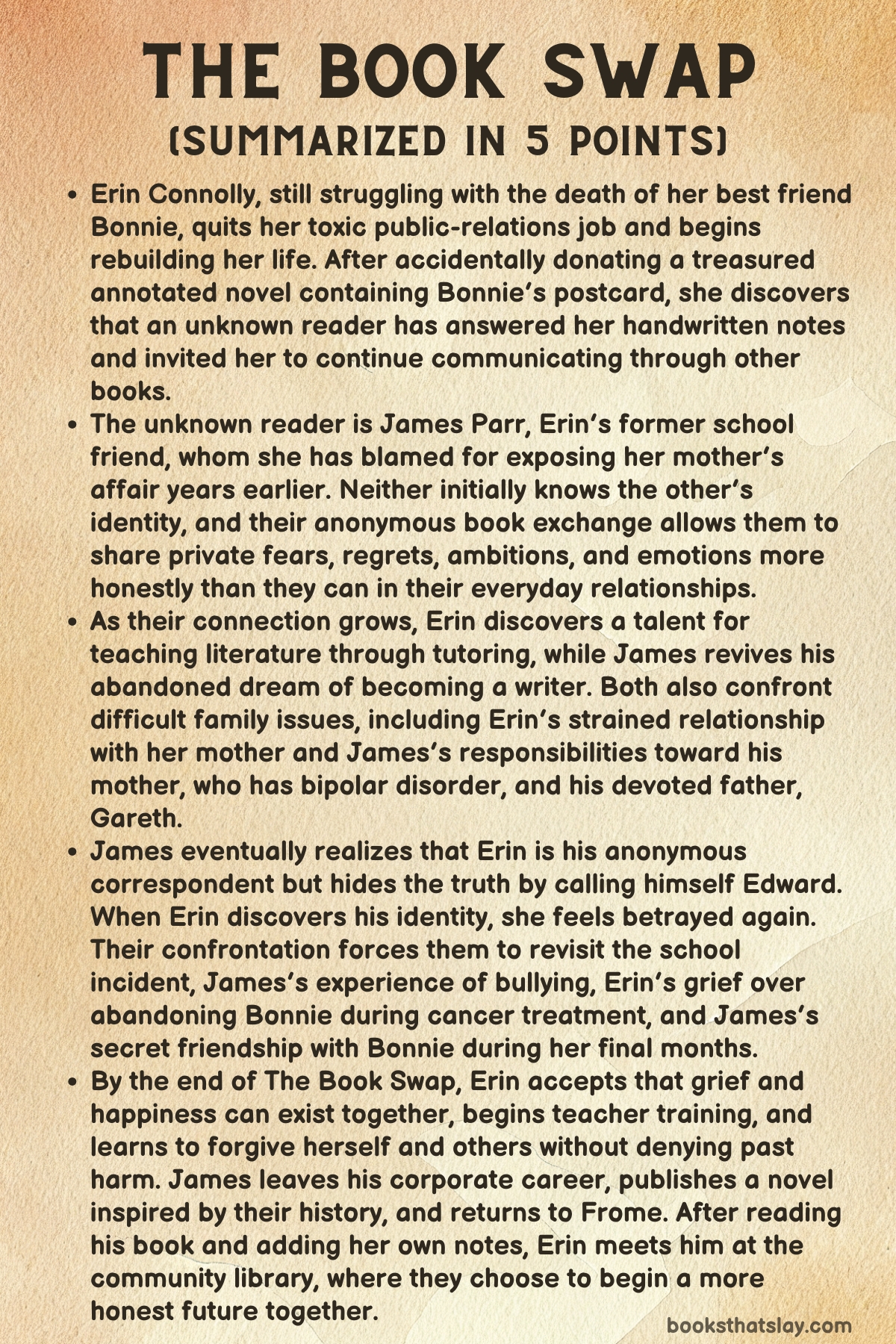
Erin Connolly and James Parr were once close friends, but a painful school incident separated them for years. When they unknowingly begin answering each other’s handwritten notes in novels left at a community library, both find the courage to reconsider the choices, fears, and misunderstandings that shaped them. Their exchange becomes a source of honesty that neither can manage elsewhere. Through family strain, buried ambition, bereavement, and renewed love, the story asks whether people can forgive the past without denying the harm it caused.
Summary
Three years after the death of her best friend Bonnie, Erin Connolly remains trapped in a life that makes her unhappy. She works in fashion public relations under Charlotte, a cruel manager who humiliates her, dismisses her efforts, and expects complete obedience from her staff.
On the anniversary of Bonnie’s death, Charlotte refuses Erin’s request for time away and publicly questions whether she has ever achieved anything worthwhile. Erin finally loses patience, condemns Charlotte’s treatment of the team, quits in front of everyone, and leaves the office with a sense of freedom she has not felt for years.
Back at her flat, Erin continues to see and speak to Bonnie in her imagination. Believing she needs a complete change, she clears her room of possessions connected to her unhappy former life and donates several books to a small community library.
Meanwhile, James Parr is staying with his parents in Frome after helping his father, Gareth, care for his mother, Patricia. Patricia has bipolar disorder and is recovering from a severe depressive episode, while James has once again placed his own life on hold to support the family.
James agrees to attend an annual hospice fundraiser held in Bonnie’s memory, although returning to his former school community forces him to face memories of relentless bullying. At the event, he announces that he has become a partner at his corporate training company, treating the promotion as proof that he has built a secure and respectable life.
Gareth reminds James that he once wanted to become a novelist. The comment unsettles James because he knows that storytelling remains the only part of his professional work that gives him genuine satisfaction.
Erin also attends the fundraiser and is forced to remember Bonnie’s final challenge to her: to discover what made her happy and build a life around it. The evening ends badly when James tries to help Erin after she cuts her foot, and she angrily accuses him of apologizing years too late for betraying her at school.
After returning to London, Erin discovers that her cherished copy of To Kill a Mockingbird was accidentally included in her donation. The book contains Bonnie’s final postcard, so Erin rushes to the community library, only to discover that someone has already taken it.
The reader is James, who has recently moved into a flat near the library. He is immediately fascinated by the extensive notes written in the margins and begins responding to them in another color, unaware that the original reader is Erin.
James calls the unknown woman Margins Girl and feels more intellectually alive while answering her observations than he has in years. The exchange also awakens his desire to write, and he begins working on the novel he abandoned as a teenager.
When Erin finds To Kill a Mockingbird returned, she is surprised to see that the stranger has responded to her annotations. Rather than feeling offended, she feels recognized, challenged, and understood, particularly when he invites her to continue their conversation through Great Expectations.
The two begin exchanging novels through the library, communicating through highlighted passages, questions, jokes, confessions, and observations. Neither knows the other’s identity, allowing them to discuss emotions they rarely express in ordinary relationships.
Erin is drawn to the stranger’s intelligence and honesty. James becomes increasingly attached to Margins Girl, whose comments begin influencing both his personal decisions and the female character in his unfinished novel.
Outside the exchange, Erin struggles to rebuild her life. A trial shift at a fabric shop confirms that she no longer wants to remain in jobs that make her miserable, while therapy helps her recognize that her mother’s departure and Bonnie’s death have made her afraid of attachment.
Erin unexpectedly begins tutoring Savannah, a teenager who dislikes English and cares far more about mathematics. By relating classic novels to Savannah’s concerns about independence, ambition, and adulthood, Erin discovers that she has a natural ability to make literature accessible.
James begins questioning his own choices as well. His relationship with Helena feels empty, his corporate success leaves him dissatisfied, and his conversations with his friend Joel force him to admit that he still wants to become an author.
The novel exchange becomes increasingly personal. James admits that he runs every day because he fears inheriting the emotional paralysis he has witnessed during his mother’s depressive episodes, while Erin admits that the exchange is one of the few things she genuinely anticipates.
James’s connection to Bonnie is gradually revealed through his memories. During Bonnie’s cancer treatment, he encountered her while trying to protect Patricia during a suicidal crisis, offered Bonnie a ride to chemotherapy, and became one of her most dependable companions.
Bonnie asked James to keep their friendship secret from Erin. She understood that Erin had withdrawn because she was frightened by the illness, and she wanted Erin to remember her as energetic and healthy rather than through the physical suffering of treatment.
Erin, however, remains consumed by guilt. She believes she abandoned Bonnie when her friend needed her most, not understanding that Bonnie recognized her fear and had already forgiven her.
As Erin’s tutoring work grows, she begins to imagine becoming a teacher. James submits several chapters of his novel to Sophia, a literary agent who once encouraged him, and starts considering whether he can leave the corporate career he built for financial security.
Their anonymous connection appears to offer each of them a new future until James sees Margins Girl on a London bus and discovers that she is Erin. He is horrified because he knows she may never have shared such private information had she known who was reading it.
Instead of telling Erin immediately, James gives her the name Edward, which is technically his first name even though everyone calls him James. He convinces himself that he is preserving the relationship, but he knows that he is withholding information Erin has a right to know.
Erin becomes increasingly serious about meeting Edward. Her emotional connection with him gives her the courage to end a meaningless sexual arrangement with Callum, deepen her friendship with Cassie, support Georgia through pregnancy, and reconsider the harsh judgments she has carried against her mother and James.
James visits his brother Elliot in New York and confronts him over leaving the family. Elliot explains that he spent years protecting James, needed distance to understand his sexuality, and has struggled with loneliness and responsibility while raising his son Jordan.
The brothers begin rebuilding their relationship, and James admits the truth about Erin. On returning to London, however, he remains afraid to identify himself and continues the exchange under the name Edward.
The deception ends when Erin and Georgia see James collecting the exchanged books from the library. Erin confronts him and feels that he has betrayed her trust for a second time, especially because he continued reading her private confessions after learning who she was.
James explains that he was terrified of losing her, but Erin insists that he took away her right to decide whether the exchange should continue. His confession that he loved her at school and may never have stopped cannot repair the immediate damage.
The confrontation forces both characters back toward the event that destroyed their teenage friendship. James had seen Erin’s mother having an affair with their English teacher, Derek Carter, but revealed it only after a group of bullies threatened to sexually humiliate him.
The bullies recorded Erin’s mother and Derek, and the footage spread through the school. Erin believed James had deliberately exposed her family, refused to hear his explanation, and left before receiving the letter he wrote to her.
While Erin retreats to Frome, James returns home as Patricia enters a manic episode. Gareth suffers a heart attack, and the family crisis forces James and Elliot to reconsider their father’s choices.
James once viewed Gareth’s work as a pizza delivery driver and his abandonment of music as evidence of failure. He finally understands that Gareth deliberately chose to care for Patricia and raise his sons, regarding fatherhood rather than fame as the greatest achievement of his life.
Erin also begins reassessing her past. After a pregnancy scare involving Georgia, she speaks honestly with her mother about the affair and learns that her mother had genuinely loved Derek and wanted Erin to remain part of her life.
Although Erin cannot offer immediate forgiveness, she agrees to try rebuilding their relationship. She also reads James’s teenage letter and finally understands the danger he faced when he revealed the affair.
At Bonnie’s next fundraiser, Erin apologizes to Bonnie’s parents for withdrawing during their daughter’s illness. They admit that they were once disappointed but explain that Bonnie also pushed people away and never considered herself abandoned.
Erin and James meet again and begin apologizing for the judgments and refusals that separated them. Their fragile reconciliation is damaged when James accidentally reveals his secret friendship with Bonnie and explains that he accompanied her to chemotherapy.
Erin is grateful that Bonnie was supported but devastated that such an important relationship was hidden from her. Overwhelmed by jealousy, grief, and shame, she leaves before she and James can reach a full understanding.
Believing their relationship is over, James completes his novel with an ending in which the central couple does not reunite. He names it The Perfect History and sends it to Sophia, while also beginning a children’s story inspired by Gareth, Elliot, and Jordan.
Six months later, Erin is preparing to return to Frome, complete her teacher training, and apply for work at her former college. She has stopped seeing the imagined Bonnie as a separate presence and understands that her friend will remain part of her memories rather than her daily conversations.
At the community library, Erin discovers an advance copy of James’s published novel. It is dedicated to her, printed with wide margins, and contains his final explanation of their shared history.
Erin reads and annotates the novel overnight. Recognizing that she never stopped loving James, she returns the copy to the library with a message asking him to meet her in a happy ending.
James finds her invitation and restores the neglected library before dawn. He has left his full-time corporate career, plans to return to Frome, and is finally building a life that allows space for writing, family, and meaningful work.
Erin arrives with the annotated novel and tells James that she wants a future with him. They kiss, thank each other for the ways they cared for Bonnie, and continue painting the library together.
Their reunion does not erase betrayal, grief, or missed years. Instead, it marks the beginning of a new relationship built on truth, forgiveness, shared history, and the willingness to choose a different future.
Characters
Erin Connolly
At the center of The Book Swap, Erin Connolly is intelligent, observant, humorous, and emotionally guarded. Her dissatisfaction with work appears to be a professional problem at first, but it reflects a deeper pattern of living defensively rather than deciding what she truly wants.
Erin’s resignation is her first major act of self-protection. Although quitting does not immediately solve her financial or emotional problems, it breaks her habit of accepting humiliation simply because change feels frightening.
Her relationship with Bonnie continues long after Bonnie’s death through imagined conversations. These encounters offer comfort, but they also reveal how Erin has allowed her dead friend to become the source of every brave thought, making it difficult for her to recognize her own strength.
Grief has made Erin fearful of emotional dependence. Her casual relationship with Callum, her distance from Cassie, and her reluctance to reconcile with her mother all allow her to avoid the risk of needing someone who might later leave.
The anonymous exchange changes Erin because it gives her intimacy without immediate exposure. Through the margins, she can be honest, intellectually playful, doubtful, and hopeful without worrying that Mystery Man will judge the damaged parts of her life.
Her greatest internal conflict concerns Bonnie’s illness. Erin interprets her withdrawal during the treatment period as unforgivable abandonment, and this guilt becomes central to her belief that she is selfish and unreliable.
Therapy helps Erin see that fear, grief, and abandonment are connected in her behavior. She gradually understands that explaining a failure does not remove responsibility, but it can allow a person to learn rather than remain permanently defined by shame.
Teaching provides Erin with a new identity founded on patience, creativity, and service. Her success with Savannah proves that she can influence another person’s life through her own abilities rather than through imitation of Bonnie.
Erin’s anger toward James is justified by his later deception, yet her refusal to hear his original explanation also shows her tendency to treat judgment as emotional protection. Her growth lies in learning that forgiveness does not require pretending that no harm occurred.
By the conclusion, Erin is capable of carrying grief without allowing it to govern every decision. She chooses teaching, family, friendship, and James not because Bonnie would have chosen them, but because they represent the life Erin herself wants.
James Parr
James is the second central figure in The Book Swap, and his life is shaped by the conflict between security and self-expression. He has built a financially successful career, but much of that success is an attempt to protect his family and prove that the bullied child he once was has become respectable.
His corporate role rewards his ability to communicate, yet it separates storytelling from the personal imagination that once made writing meaningful to him. His promotion therefore feels less like fulfillment than confirmation that he has moved further away from his original ambition.
James carries severe shame from his school years. The bullying damaged his confidence, while Erin’s refusal to hear his explanation convinced him that his fear-driven action made him entirely responsible for the destruction of their friendship.
His anonymous responses to Erin restore the part of his personality that school humiliation suppressed. He becomes curious, playful, emotionally honest, and creatively active because he initially believes Margins Girl has no expectations based on his past.
James’s care for Patricia and Bonnie shows that he is capable of sustained devotion. He repeatedly returns home during his mother’s crises and accompanies Bonnie to treatment without seeking praise, demonstrating that his fear of commitment is more accurately a fear of emotional rejection.
His decision to call himself Edward is still a serious violation of Erin’s trust. Although motivated by love and panic rather than cruelty, the lie repeats his habit of making decisions for other people because he believes the truth will produce abandonment.
James’s relationship with Gareth exposes his narrow understanding of achievement. He initially assumes that his father sacrificed a meaningful life, only to learn that Gareth considers caregiving and fatherhood more valuable than public recognition.
His conflict with Elliot has a similar source. James interprets his brother’s distance as selfish escape until he learns that Elliot protected him for years and faced private struggles involving sexuality, marriage, parenting, and loneliness.
Writing becomes James’s path toward accountability rather than a simple career change. His novel allows him to examine apology, memory, fear, and responsibility, but he can finish it only after acknowledging the new harm caused by his deception.
By the end, James no longer needs professional status to defend him from his past. He accepts uncertainty, values caregiving, reconnects with his family, and approaches Erin without pretending that love alone can cancel the consequences of his choices.
Bonnie
Bonnie remains one of the strongest presences in the book despite having died before the main action begins. She survives through Erin’s imagination, James’s memories, the annual fundraiser, and the choices both central characters make in response to her life and death.
Erin remembers Bonnie as fearless, energetic, confident, and emotionally generous. Because Erin idealizes her, Bonnie becomes an impossible standard against which Erin measures her own courage and loyalty.
The real Bonnie was more complicated than Erin’s imagined version. During her illness, she sometimes withdrew from people, concealed information, and made decisions that she believed would protect those she loved.
Her secret friendship with James reveals her compassion and independence. She initially distrusts him, but she recognizes his pain, accepts his support, and offers him a relationship in which neither person has to hide the most frightening parts of family illness.
Bonnie understands Erin’s withdrawal more clearly than Erin does. Rather than seeing Erin’s absence as proof that she never cared, Bonnie recognizes that Erin began grieving early and could not bear to witness the physical changes caused by cancer.
Her request that James keep their friendship secret is loving but also damaging. It preserves Erin’s preferred memories, yet it prevents Erin from knowing that Bonnie was supported and prevents James from offering the reassurance Erin desperately needs.
Bonnie’s imagined voice gradually changes as Erin changes. Early in the story, it gives Erin commands and judgments, but later it becomes clear that these conversations express Erin’s own developing courage.
Bonnie ultimately represents a continuing bond rather than an obstacle that must be forgotten. Erin’s final goodbye does not remove Bonnie from her life; it allows her to remember Bonnie without pretending that healing requires constant imagined contact.
Georgia Connolly
Georgia is Erin’s practical, direct, and emotionally persistent sister. She refuses to accept Erin’s explanations without examining the patterns beneath them, often challenging her more sharply than anyone else is willing to do.
Her honesty can appear harsh, particularly when she tells Erin that blaming Charlotte, their mother, James, and other people will not create a better life. However, Georgia’s criticism is usually accompanied by action, whether she is encouraging therapy, offering transport, or forcing Erin out of bed.
Georgia’s pregnancy gives her a storyline that parallels Erin’s movement from avoidance toward commitment. At first, Georgia is uncertain about becoming a mother and rejects the idea that pregnancy should automatically produce marriage.
Her refusal of Rishi’s proposal demonstrates independence and emotional clarity. She wants their relationship, if it develops, to be chosen freely rather than created by obligation or social expectation.
The hospital scare reveals how deeply Georgia already loves her unborn child. Her fear clarifies what she wants, just as moments of crisis often force Erin and James to identify the relationships they value most.
Georgia also provides comic energy and practical stability. Her willingness to wear ridiculous costumes, challenge Erin’s self-pity, and approach Mystery Man as a romantic possibility prevents the story from becoming emotionally closed.
Although she sometimes pushes too forcefully, Georgia understands that Erin repeatedly responds to pain by becoming inactive. Destroying Erin’s symbolic gray tracksuit bottoms is dramatic, but it represents Georgia’s refusal to let her sister turn withdrawal into a permanent identity.
Patricia Parr
Patricia is James and Elliot’s mother, and her bipolar disorder affects every member of the Parr family. Her depressive and manic episodes are presented as serious medical experiences rather than simple mood changes.
During depressive periods, Patricia may become withdrawn, suicidal, and unable to reassure her children. James’s childhood belief that he somehow caused her illness develops partly because she could not respond when he once apologized for being responsible.
Her manic episodes create a different form of danger. Her obsession with replacing the carpets, refusal to sleep, impulsive spending, and rejection of medication show how energy and enthusiasm can become destructive when separated from judgment.
Patricia’s illness does not remove her intelligence or emotional importance. At times she offers James valuable insight, including the advice that he must tell Erin the complete truth rather than continue protecting himself through concealment.
Her accusation that James caused Gareth’s heart attack is cruel and deeply damaging. The novel places this statement within her illness and distress without pretending that James is unaffected by hearing it.
Patricia also demonstrates the strain mental illness can place on family roles. Gareth becomes her primary caregiver, James repeatedly returns home, and Elliot leaves partly because he cannot continue carrying the same responsibilities.
She is neither a villain nor a romanticized sufferer. Her character asks readers to recognize both the person experiencing illness and the people whose lives are shaped by the care, fear, exhaustion, and loyalty surrounding it.
Gareth Parr
Gareth is one of the book’s clearest examples of quiet strength. James initially sees him as a failed musician who abandoned a promising career and now works delivering pizza, but this view reflects James’s limited definition of success.
Gareth does not consider family life an unfortunate replacement for fame. He believes that becoming a dependable husband and father required greater commitment than continuing along the easier path of musical recognition.
His devotion to Patricia is patient but not passive. He manages her medication, watches for changes in her condition, absorbs angry remarks, and understands when James needs permission to remain in London rather than return home immediately.
Gareth also recognizes James’s creative ability before James is willing to value it. By remembering the novel chapter James once wrote and encouraging him not to waste his true calling, Gareth separates practical security from genuine purpose.
His heart attack forces James to confront how much he has taken his father’s presence for granted. The possibility of losing Gareth changes James’s understanding of all the ordinary acts of care he once overlooked.
The later success of the remix of Gareth’s old song provides recognition without suggesting that fame validates his life. The royalties are welcome, but they do not make his years as a husband and father more meaningful than they already were.
Elliot Parr
Elliot initially appears to James as the brother who escaped. His life in New York seems wealthy and comfortable, while James believes he has been left with the repeated responsibility of supporting Patricia and Gareth.
The reality is more complicated. Elliot spent years protecting James from bullying and remained close to home until he believed Joel could provide the safety and friendship James needed.
Leaving Britain was partly an attempt to understand his sexuality and create a life in which he could live openly. His marriage to Carl and his role as Jordan’s primary caregiver are significant achievements, though James initially undervalues domestic work.
Elliot’s apparent freedom also conceals loneliness. Carl’s demanding job leaves him absent for long periods, and Elliot struggles with the emotional isolation of full-time parenting in another country.
His confrontation with James allows both brothers to revise the stories they have created about each other. Elliot apologizes for disappearing, while James acknowledges that responsibility and hardship can take forms he failed to recognize.
Elliot’s decision to consider returning to Britain offers the family a healthier future. It suggests that care no longer has to fall primarily on James and that the brothers can rebuild closeness through shared responsibility.
Joel
Joel is James’s closest friend and the person who once protected him after years of bullying. His wealth, confidence, and professional success initially make him appear to represent everything James believes he should become.
Beneath that image, Joel is dissatisfied with a life dominated by work and status. A colleague’s death by suicide forces him to recognize how rarely he asks the people around him whether they are genuinely coping.
Joel encourages emotional honesty between himself and James. Their conversations give James a space to admit his unhappiness, his feelings for Margins Girl, and his desire to write.
He also recognizes James’s talent without romanticizing the risks of a creative career. His support matters because it comes from someone James associates with safety, adulthood, and competence.
Joel’s decision to leave finance shows that his advice is not merely theoretical. He chooses to seek purpose, connection, and a sense of home rather than remain in a career that provides money without emotional meaning.
His later relationship with Cassie creates an optimistic secondary romance. Both characters are ready for commitment and direct about wanting a serious future, contrasting with Erin and James’s slower and more complicated path.
Cassie
Cassie begins as Erin’s former colleague but gradually becomes one of her most dependable friends. Her concern that their relationship existed only inside the workplace exposes Erin’s habit of dividing her life into separate compartments.
Unlike Erin, Cassie openly wants emotional connection. She speaks honestly about her search for a committed partner and does not treat vulnerability as embarrassing.
Cassie listens to Erin’s account of Bonnie without trying to solve her grief. Her acceptance allows Erin to speak about guilt and loss without expecting condemnation.
Moving into Callum’s room represents more than a practical housing arrangement. Cassie helps transform Erin’s flat from a place of avoidance and imagined companionship into a warmer home shared with a living friend.
She also immediately believes in Erin’s potential as a teacher. Her confidence helps Erin treat the ambition as a realistic future rather than another idea she is likely to abandon.
Cassie’s relationship with Joel reflects her directness. Because both characters understand what they want, they are able to move forward without the secrecy and fear that complicate the central romance.
Helena
Helena is connected to James’s school past and to the social group that failed to protect him from bullying. His relationship with her therefore reflects his attempt to gain acceptance from the world that once rejected him.
Although Helena wants greater commitment, James keeps their relationship undefined. His emotional distance is unfair to her, particularly because he continues seeing her while privately knowing that he cannot imagine a shared future.
Helena is not presented as malicious. She correctly identifies James’s difficulty with commitment, even though she does not fully understand that his avoidance comes from unresolved fear rather than indifference.
Her later kindness after James collapses demonstrates maturity. She listens without resentment, helps him identify his immediate needs, and offers support even after their relationship has ended.
Through Helena, James learns that apologizing involves more than explaining his own motives. He must also acknowledge the effect his emotional uncertainty had on someone who deserved honesty.
Erin’s Mother
Erin’s mother is initially defined through Erin’s anger over the affair that ended the family’s former life. Erin treats her departure as proof that love is unreliable and that people will eventually choose someone else.
Her mother’s actions caused genuine harm. The affair with Derek exposed the family to public humiliation, damaged her marriage, and left Erin feeling rejected during a vulnerable period.
However, the later conversation between mother and daughter complicates Erin’s version of events. Her mother explains that she loved Derek, made serious mistakes, and wanted Erin to live with her rather than disappear from her life.
She cannot demand immediate forgiveness, and the book does not suggest that explanation cancels responsibility. Instead, her character shows how parents can cause lasting damage while still loving the children they have hurt.
Small gestures of contact matter in their relationship. Erin complimenting her hair and agreeing to try rebuilding trust indicate that reconciliation begins through limited, honest steps rather than a dramatic erasure of anger.
Derek Carter
Derek Carter is Erin’s former English teacher and the man involved in the affair with her mother. His actions contribute to the collapse of Erin’s family and to the public scandal that destroys her friendship with James.
He also occupies a complicated place in James’s memories because he once encouraged James’s love of literature. This positive influence does not excuse the affair, but it prevents Derek from existing only as a symbol of betrayal.
When Erin reconnects with him, their shared love of books creates a narrow path toward conversation. The interaction suggests that people may hold contradictory roles in another person’s life, causing harm while also contributing something of value.
Derek’s presence supports the novel’s refusal to reduce adults to a single action. Erin does not need to approve of his past behavior in order to understand more clearly how her family changed.
Savannah
Savannah is the student who reveals Erin’s natural ability as a teacher. She begins with little interest in English and assumes that literature has limited relevance to her mathematical ambitions.
Erin gains her attention by connecting novels to choices Savannah understands, including independence, education, marriage, and professional identity. This approach shows that Erin teaches through conversation rather than authority.
Savannah’s gradual improvement provides practical evidence of Erin’s skill. Her movement from poor performance to a B demonstrates that Erin can help a student build both understanding and confidence.
The discovery that Savannah’s mother died creates an additional bond between them. Their shared experience of loss is not treated as identical, but it allows Erin to respond with greater sensitivity.
Savannah also helps turn tutoring into a viable career by recommending Erin to other families and encouraging her to charge properly. In this way, the student becomes one of the people who teaches Erin to value her own work.
Callum
Callum represents Erin’s preference for relationships without emotional demands. Their casual arrangement allows her physical closeness while protecting her from the vulnerability involved in love, commitment, or shared responsibility.
He becomes threatening when Erin ends the arrangement. His drunken expectation of sex and aggressive response to rejection reveal the lack of respect beneath the apparent convenience of their relationship.
Later, Callum attacks Erin’s unemployment, grief, imagined conversations, and connection with Mystery Man. His remarks target her deepest insecurities, but they also show how completely he misunderstands her emotional life.
Ending the relationship is an important act of self-respect. Erin stops accepting a connection that offers temporary distraction while reinforcing her loneliness.
Charlotte
Charlotte is Erin’s abusive manager and the immediate cause of her resignation. She uses public embarrassment, sarcasm, excessive demands, and personal criticism to maintain authority over her staff.
Her behavior has trained Erin to doubt her competence and accept mistreatment as an ordinary condition of professional life. The workplace therefore strengthens the same helplessness Erin already experiences in her personal relationships.
Erin’s public challenge briefly changes the office culture, as Cassie later reports that Charlotte becomes somewhat kinder. This does not redeem Charlotte, but it shows that naming abusive behavior can disrupt the silence that allows it to continue.
Charlotte’s role is limited but important. She represents a version of success based on power, fear, and appearance rather than purpose or respect.
Rishi
Rishi is Georgia’s colleague and the father of her child. His proposal after learning about the pregnancy appears responsible, but Georgia rejects the assumption that parenthood must automatically lead to marriage.
He is not portrayed as abandoning Georgia or refusing responsibility. Instead, his relationship with her remains open to development without being forced into a socially convenient form.
Rishi’s eventual movement closer to the family suggests continued involvement and care. His character supports the idea that commitment should arise from honest choice rather than pressure.
Sophia
Sophia is the literary agent who once recognized James’s writing ability. Her continued interest becomes external confirmation that his creative ambition is based on genuine talent rather than nostalgia.
By requesting chapters and later the complete manuscript, Sophia gives James a professional opportunity. However, the emotional work required to finish the novel must still come from James himself.
Her approval helps him imagine writing as a possible career, but she does not make the decision for him. James must choose uncertainty before he knows whether publication will provide success.
Sophia therefore represents opportunity arriving when preparation and personal honesty finally meet. Her support matters because James has begun writing for truthful reasons rather than merely seeking validation.
Carl
Carl is Elliot’s husband and Jordan’s father. His demanding career contributes to the family’s financial comfort, but his frequent absence leaves Elliot carrying much of the daily responsibility for their child.
The imbalance complicates James’s assumption that Elliot has an effortless life. Through Carl’s absence, James begins to recognize the loneliness and strain hidden behind his brother’s attractive home and apparent success.
Carl is not presented as uncaring, but his limited presence raises the same question faced by several characters: whether professional achievement is worth the relationships and responsibilities it displaces.
Jordan
Jordan is Elliot and Carl’s young son, and his openness gives James a new experience of family connection. James bonds with him through play, imagination, and children’s books.
Jordan helps James see storytelling as an act of attention rather than simply a route to publication. Creating stories for his nephew leads him toward writing for children and broadens his understanding of his creative identity.
The child also gives Elliot’s domestic work greater emotional visibility. Through Jordan, James understands that raising a child is not evidence that Elliot abandoned ambition but a meaningful form of responsibility.
Bonnie’s Parents
Bonnie’s parents carry grief differently from Erin. Their restrained behavior at the fundraiser initially convinces her that they blame her for withdrawing during Bonnie’s treatment.
When Erin finally apologizes, they admit that they were disappointed but also explain that Bonnie pushed people away. Their response gives Erin a fuller account of the illness and prevents her from treating herself as the only person who failed.
Their forgiveness does not dismiss Erin’s absence. Instead, it places her behavior within a wider experience of fear, exhaustion, helplessness, and anticipatory grief.
By preserving Bonnie’s memory through the fundraiser, they create a communal form of remembrance. Their actions allow Bonnie’s life to support other people rather than remain defined solely by her death.
Dorothy
Dorothy represents the corporate future James once believed he wanted. Her offer of a director position provides salary, status, and security at the exact moment he is beginning to question the value of those rewards.
She is not cruel or manipulative. The opportunity is genuine, which makes James’s decision more difficult because he cannot blame an abusive employer for his dissatisfaction.
Through Dorothy, the story shows that a respectable career can still be wrong for a particular person. Rejecting her offer becomes meaningful precisely because the position would appear successful to almost everyone else.
Themes
Grief, Memory, and Continuing Bonds
Grief in The Book Swap is not presented as a steady movement from sadness toward complete recovery. Erin’s imagined conversations with Bonnie show how the dead can remain active within a survivor’s thoughts, choices, habits, and private emotional language.
At first, Erin depends on Bonnie’s imagined voice because she does not trust her own judgment. Every brave action is attributed to what Bonnie would have done, which allows Erin to move forward while also preventing her from claiming responsibility for her progress.
James carries a different version of grief because he remembers Bonnie during treatment. He holds the hospital journeys, physical decline, fear, and conversations that Erin avoided, making him the guardian of memories Erin initially cannot bear to hear.
Neither set of memories is more authentic than the other. Erin preserves Bonnie’s energy and humor, while James preserves her vulnerability and endurance, and both perspectives are necessary to understand the whole person.
The story also examines anticipatory grief. Erin begins mourning when she learns that Bonnie’s cancer is terminal, and her withdrawal is partly an attempt to escape a loss that has already begun emotionally.
Healing occurs when Erin stops treating continued love as evidence that she must remain emotionally frozen. Saying goodbye to her imagined Bonnie does not mean forgetting her; it means accepting that memory can accompany new relationships, new work, and new forms of happiness.
Forgiveness, Accountability, and the Right to Know
Forgiveness is shown as a process that requires truthful explanation without allowing explanation to erase harm. James reveals Erin’s family secret because he is trying to escape sexual humiliation, but the danger he faced does not remove the devastating consequences for Erin.
Erin’s refusal to hear him is understandable in the immediate aftermath, yet it becomes damaging when she allows one event to define his entire character. Her anger protects her from uncertainty, but it also prevents her from learning what actually occurred.
James later repeats the pattern from another direction when he conceals his identity during the book exchange. His fear of losing Erin explains the deception, but Erin correctly argues that he had no right to decide what information she needed before continuing their intimate correspondence.
Accountability therefore depends on respecting another person’s agency. Love cannot justify withholding the truth, even when the person lying believes the deception will preserve something valuable.
The same principle shapes Erin’s relationship with her mother. Understanding the affair as a complicated adult relationship does not remove the betrayal, but it allows Erin to move beyond the belief that her mother simply stopped loving her.
Forgiveness finally becomes possible when the characters accept that several truths can exist together. A person can be frightened and harmful, loving and dishonest, injured and unfair, while still remaining capable of change.
Success, Purpose, and the Value of Care
James initially measures achievement through salary, promotion, property, and professional status. His corporate career offers protection from financial insecurity and from the shame of having once been powerless, but it provides little sense of personal meaning.
Gareth challenges this definition by treating fatherhood and caregiving as chosen accomplishments. James assumes his father surrendered music for an inferior life, while Gareth believes that remaining present for Patricia and his sons demanded the deepest form of commitment.
Elliot’s experience extends the same argument. His work as a full-time parent is easy for James to dismiss because it does not produce the visible rewards associated with Carl’s career, yet it requires patience, sacrifice, and constant emotional attention.
Erin’s professional development follows a similar path. Fashion public relations appears more glamorous than private tutoring, but the former empties her confidence while the latter allows her to witness another person’s growth.
Joel’s decision to leave finance reinforces the distinction between external success and internal purpose. Money can provide safety, but it cannot automatically create belonging, creativity, friendship, or a sense that one’s time has been used well.
The story does not reject financial responsibility. Instead, it argues that security becomes harmful when it is treated as the only legitimate reason to work, especially when it demands the permanent abandonment of talent, connection, and care.
Books, Marginal Notes, and Emotional Honesty
The exchanged novels create a form of communication that is both intimate and protected. Erin and James can respond to fictional characters before speaking about themselves, allowing literature to provide language for fears they cannot initially express directly.
Annotations turn reading into a shared experience across time. A sentence marked by one person becomes a question for another, and the margins preserve reactions that would otherwise disappear as soon as a book is closed.
Anonymity initially gives both characters freedom. Erin can discuss regret, loneliness, ambition, and happiness without fearing James’s judgment, while James can admit his anxiety, creative frustration, and complicated feelings about his family.
That same anonymity eventually becomes dangerous when James knows more than Erin does. The exchange can support honesty only while both participants possess the information necessary to choose their level of involvement.
The community library is equally significant because it transforms private possessions into opportunities for connection. Erin donates books while trying to remove the past, yet one of those books returns her to a person she believed belonged entirely to that past.
James’s published novel becomes the final exchanged book because it contains his complete account rather than another partial confession. Erin’s annotations answer him in the language through which they first learned to listen, turning reading from an escape into the foundation of a shared future.