The Bookshop Below Summary, Characters and Themes
The Bookshop Below by Georgia Summers is a modern fantasy set in London where rare books carry real power—and that power comes with rules, debts, and consequences. Cassandra Fairfax, hiding under an assumed name after a painful past, survives by appraising and trading stolen books.
When her former mentor Chiron dies, his secret bookshop chooses her as its next owner. The inheritance is not a gift so much as a responsibility: the shop is alive, the magic beneath it is failing, and dangerous people want what Cassandra now controls. To keep the shop—and the world—intact, she must decide what kind of owner she will be.
Summary
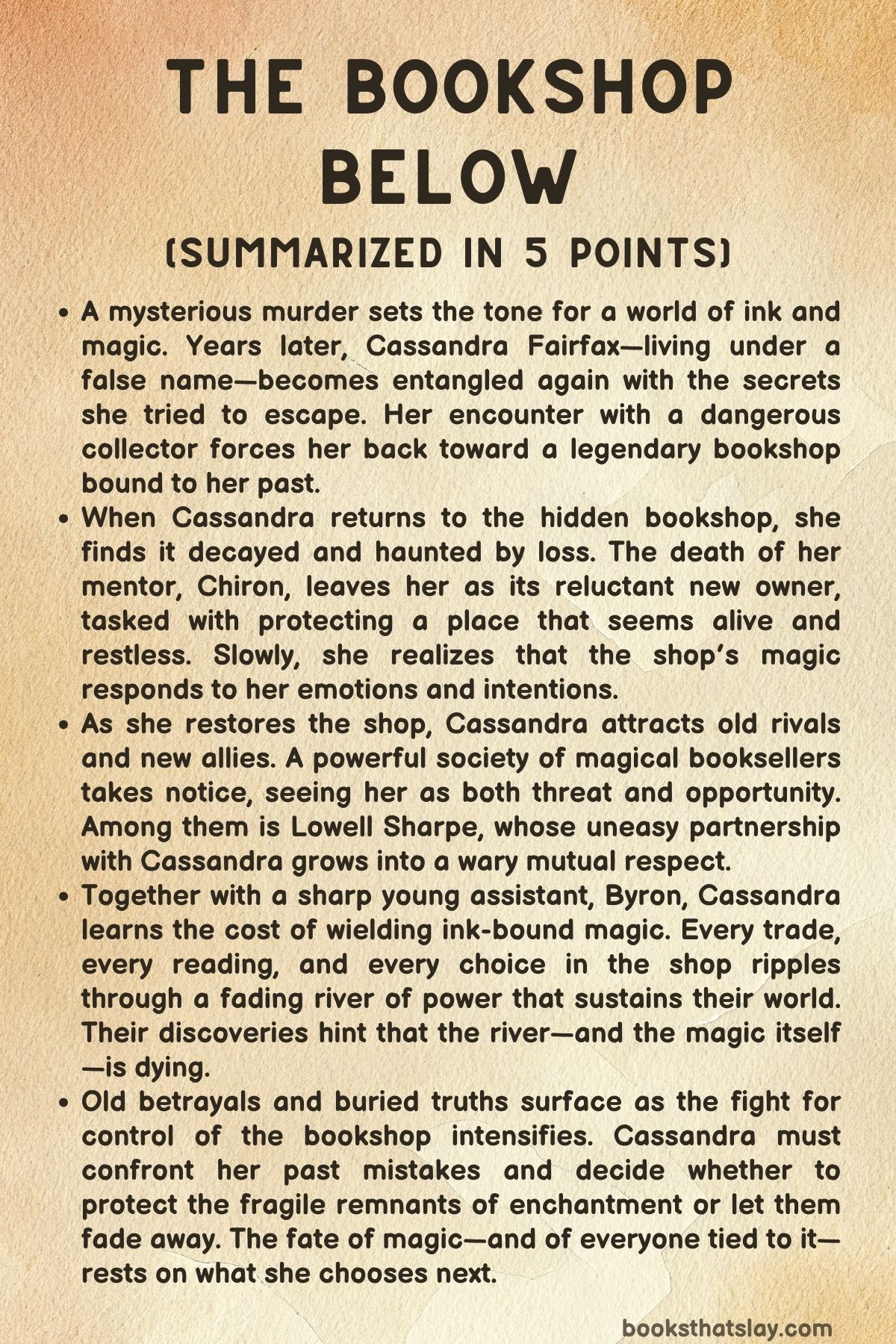
A masked intruder breaks into a hidden bookshop protected by living magic. Using ink that silences the shop’s defenses, the attacker reaches the owner, Chiron, and kills him as the bookshop whispers helplessly around them.
The murderer leaves behind only a taunt about “Lady Fate,” and a question Chiron asked with his last breath: how the intruder learned the truth.
Years later, Cassandra Fairfax lives as “Cass Holt,” taking risky jobs in London’s shadow economy. She is hired to appraise stolen books for Roth, a wealthy collector she distrusts but cannot refuse because she needs the money.
Roth delays paying her and corners her with something worse: he knows her real name and her connection to Chiron. When he uses ink magic to force answers, Cassandra fights it just long enough to escape, injuring him and fleeing through the city.
Roth shouts after her that Chiron is dead and warns that others will come now that her identity has been exposed.
Shaken and frightened, Cassandra returns to her small flat to find a letter waiting—written in Chiron’s hand and addressed to “Cassandra Fairfax.” She can’t bring herself to open it. The next day, she works and avoids home, wandering until she finds Cecil Court.
There, as if it has been waiting for her, the concealed entrance to Chiron’s bookshop appears. Cassandra climbs the steps and opens the door without a key.
Inside, the shop is dark, dusty, and strangely quiet, as though it has been holding its breath.
Cassandra searches the building, calling for Chiron, but only finds neglect: empty shelves, water damage, and a sense of abandonment. In the tower apartment, she discovers a garden grown into the shape of a seated man, a memorial formed from pale flowers and vines.
A key rests at its base. She finally opens Chiron’s letter, which confirms what she already suspects: he is gone, and he has left the bookshop to her.
He warns her that what follows will be the result of her own choices, and asks her to protect the shop.
Taking ownership isn’t symbolic—it’s binding. Cassandra signs the deed in ink mixed with her blood, and the bookshop responds, testing her with storms that happen indoors while the street outside stays dry.
A rival bookseller, Lowell Sharpe, arrives during one of these incidents, demanding to know why she is in the shop. He shows that he understands the shop’s moods and how to calm them, and he reveals he also received a letter from Chiron.
Lowell offers to buy the bookshop, implying Chiron prepared alternatives. Cassandra refuses, and Lowell leaves, warning that she will regret it.
As Cassandra tries to stabilize the shop, she realizes she cannot do it alone. She posts for an assistant and reaches out to old contacts, most of whom want nothing to do with her.
Eventually, Septimus—an associate from Chiron’s orbit—agrees to send help. His niece, Byron, arrives with confidence, skill, and a blunt understanding of what the shop is: a place where certain books draw power from a river-like source beneath the building, and reading or trading them can shift reality.
With Byron’s help, Cassandra cleans, repairs, and reorganizes, and the bookshop begins to accept her, revealing hidden stock and opening rooms that had been sealed.
Outside the shop, a masked society that styles its members after tarot figures meets to discuss its fading influence. They confirm the “Magician” is dead—Chiron—and learn that Cassandra Fairfax is the new owner.
The group decides she is a threat. Lowell, connected to the society, expects Cassandra to fail, but her progress enrages him, and he privately vows to take the shop from her.
Cassandra and Byron hunt for replacement stock at estate sales and auctions, where magic-laced books can surface. At one sale, Cassandra competes with Lowell for a rare set and wins it back after he tries to take the final volume.
The rivalry turns uneasy when Lowell, unexpectedly, hands her his umbrella to protect the books before walking away into the rain. Later, Cassandra visits Lowell’s shop to return it and finds his world controlled, precise, and emotionally barren.
Their tension is interrupted when a magical crisis calls for both of them: a family has misused an enchanted book and trapped their home in a fairy-tale scenario full of choking vines and unnatural sleep. Lowell and Cassandra work together to break the spell and retrieve the dangerous text.
Lowell makes it clear he thinks Cassandra’s inexperience will get people killed, and Cassandra responds by banning him from her shop.
Her personal danger rises when Roth tracks her down and demands access to the vault beneath the bookshop. Cassandra refuses, and the shop itself protects her, twisting iron railings to bar him.
Roth retreats, promising revenge. The bookshop’s defense confirms something Cassandra desperately needs to believe: it recognizes her as its owner.
At a book fair, Cassandra and Lowell compete again for a specific title tied to Chiron’s research. Cassandra loses focus for a moment—and loses the book.
Angry at herself, she later steals it from Lowell’s bag and reads it through the night, only to find it full of ink experiments without the answers she wants. Her guilt catches up quickly.
Lowell’s shop is attacked by two enforcers looking for information, and Cassandra rushes in with Byron and Lowell’s assistant. When violence erupts, Cassandra uses raw ink reading to freeze the attackers in place and save everyone.
In the aftermath, Lowell tells her the attackers are connected to the society and warns that her involvement has widened the target on her back. When she admits she stole the book and returns it, he’s more disappointed than furious—and offers help anyway.
As winter tightens, signs point to a larger crisis: the river source that powers the bookshops is sick, thinning, and vanishing. Cassandra learns that when a shop loses its connection, its “bookshop below” disappears, taking its magic—and sometimes its existence—with it.
She finds records suggesting paradox books, deals that change reality, were taken without proper payment. The unpaid costs are catching up, and if the river collapses, those unfinished changes could rupture the world.
Roth escalates, using blood and ink to force his own connection to the river. He murders the society’s former leader, Eveline, and prepares to seize control directly.
Cassandra gathers Byron and Lowell, sharing what she knows and insisting she must attempt a final reading to save what can be saved. Lowell begs to take her place.
Cassandra refuses, believing the shop chose her for a reason. They share a brief kiss that feels like both apology and goodbye.
In the tower garden, Byron reveals a betrayal that reframes everything: Chiron wasn’t killed by the society. Septimus killed him, claiming it was necessary to protect the wider network of bookshops.
Byron admits she was sent to watch Cassandra and stop her if needed. Cassandra is furious—but chooses trust, not because the betrayal is small, but because she cannot afford more isolation.
Cassandra writes a new reading aimed at preserving life while ending the river as a tool for power. At midnight she descends into the bookshop below, guided by the Keeper into the river’s depths until she meets Lady Fate herself.
Cassandra reaches the source, drinks enchanted ink, and begins to write a future that closes the door on paradox magic. Roth arrives and attacks, newly monstrous from corrupted readings.
Lowell fights to protect her and is nearly killed. Roth tries to claim the river, but the power turns on him, breaking him apart across time until he dissolves.
The cavern begins to collapse, and Cassandra starts to vanish—her existence tied to the river’s magic. Lowell refuses to let her be erased.
With the last ink, he completes the reading himself, choosing a future that removes the river entirely but keeps the world intact. Light consumes everything.
Cassandra wakes on a cold beach in a world where the river is gone. Byron finds her, alive.
Lowell is missing—sacrificed by his choice. Cassandra returns to the burned remains of her bookshop and faces Lowell’s brother Edmund, who demands answers.
Cassandra can only say Lowell saved everyone. Months later, still grieving, she and Byron buy an ordinary secondhand bookshop and rebuild.
The magic is mostly gone, but not completely: faint signs return in mist, whispers, and flowers blooming where they shouldn’t. One night, Cassandra finds proof that stories—and love—survived the rewrite: a page carried back to her, signed by Lowell, like a promise that endings can still leave something behind.
Characters
Cassandra Fairfax
Cassandra Fairfax stands at the heart of The Bookshop Below, a woman whose life is marked by loss, reinvention, and the haunting pull of destiny. Once Chiron’s gifted apprentice, she falls from grace and spends years surviving under the alias Cass Holt, entangled in the criminal trade of magical books.
Her journey from a fugitive forger to the rightful owner of Chiron’s legendary bookshop mirrors a gradual reclamation of self—an odyssey through guilt, grief, and rebirth. Cassandra is a complex blend of intellect and instinct: fiercely independent, yet haunted by the need for belonging; pragmatic, yet drawn irresistibly to the river’s mystical undercurrent.
Her bond with the bookshop reflects both inheritance and burden—it demands not only stewardship but moral reckoning. Her compassion and courage grow steadily through her battles against Roth, the secretive society, and ultimately Lady Fate herself.
By the novel’s close, Cassandra becomes a figure of quiet heroism—one who understands that true power lies not in dominance over magic, but in preserving it with humility.
Chiron
Chiron, the former keeper of the enchanted bookshop, is a mentor whose legacy defines much of the novel’s emotional and mystical core. He embodies the archetype of the wise teacher—patient, enigmatic, and deeply attuned to the living magic of the written word.
Beneath his calm exterior lies a man consumed by responsibility and secrecy. Chiron’s choice to shelter Cassandra and train her in the arts of reading and river magic shapes her fate irrevocably.
His later estrangement from her—and his murder—reveal the tragic cost of knowledge and trust in a world where power corrodes relationships. Even after death, his presence lingers in letters, memories, and the shop’s very structure, which mourns and protects in his stead.
Chiron represents the old guard of magical custodianship, whose faith in balance and duty contrasts sharply with the greed of the new order. His posthumous influence guides Cassandra toward not mastery, but moral clarity.
Lowell Sharpe
Lowell Sharpe serves as both foil and ally to Cassandra—a rival bookseller bound by pride, logic, and repressed longing. Initially introduced as austere and cold, Lowell’s rigid devotion to control and precision masks a deep fear of chaos and loss.
His early dealings with Cassandra bristle with rivalry and attraction; yet as the story unfolds, his antagonism gives way to reluctant respect and, ultimately, love. His intellectual curiosity and moral struggle make him one of the novel’s most compelling figures.
Lowell represents the rational world of rules and structure clashing with Cassandra’s intuitive, emotional connection to magic. His final act of sacrifice—rewriting the world at the cost of his own life—reveals his transformation from detached scholar to selfless believer.
Through Lowell, the novel explores the human need to find order within the unknowable and the redemption that can arise from surrendering control.
Byron
Byron brings vitality and wit to the otherwise shadowed atmosphere of The Bookshop Below. As Septimus’s niece and Cassandra’s eventual assistant, Byron bridges the gap between the old and new generations of booksellers.
Quick-minded and fearless, she embodies adaptability and optimism, traits that counterbalance Cassandra’s weary introspection. Byron’s loyalty is tested when her uncle’s betrayal is revealed, but her decision to stand by Cassandra signifies her independence from the manipulative legacy of her family.
Her friendship with Cassandra evolves into a sisterly bond rooted in shared resilience and mutual respect. Byron represents continuity—proof that magic and morality can survive corruption, and that hope endures even as the river’s power fades.
Roth
Roth is the novel’s primary antagonist, a man corrupted by his hunger for dominance and immortality. Once a minor figure in the magical underground, his descent into obsession with ink magic and the river’s power transforms him into a monstrous embodiment of greed.
His violence, coercion, and eventual metamorphosis into something inhuman underscore the destructive potential of unrestrained ambition. Roth’s fixation on Cassandra—first as a tool, later as an adversary—reflects his inability to comprehend power as anything but possession.
His final confrontation with Cassandra and Lowell exposes him as both terrifying and pitiful, consumed by the very magic he sought to command. Through Roth, the novel personifies the moral rot at the heart of the society that exploits knowledge for control.
Septimus
Septimus is a man whose duality defines much of the story’s hidden tension. Outwardly the pragmatic broker of magical texts and Byron’s guardian, he is ultimately revealed as Chiron’s killer—a betrayal rooted not in hatred but in desperate preservation.
His belief that killing Chiron could save the bookshops makes him both villain and victim of his own faith. Septimus embodies the dangerous rationalizations that arise when loyalty is twisted by fear.
His relationship with Cassandra is marked by manipulation and guilt, yet his final interactions suggest a man burdened by regret. In him, Summers crafts a study of moral compromise—how love and ideology can coexist with unforgivable acts.
Eveline (Judgement)
Eveline, once the leader of the secret society under the title Judgement, embodies corrupted authority and decaying order. Once a guardian of balance, she becomes complicit in the society’s ruthless pursuit of control over the river.
Her manipulation of Roth and her eventual death at his hands reveal the cyclical nature of power: those who seek to command Fate are ultimately consumed by it. Eveline’s fall mirrors the disintegration of the magical hierarchy and contrasts Cassandra’s emergent morality.
Her demise marks the end of the old order and clears the path for renewal—albeit at a terrible cost.
Lady Fate
Lady Fate stands as both myth and reality—the divine intelligence that governs the river, the bookshops, and the destinies intertwined with them. Neither benevolent nor cruel, she represents inevitability and consequence, a cosmic force indifferent to human desires.
Cassandra’s confrontation with Lady Fate marks the novel’s philosophical climax, transforming her understanding of destiny from fatalism to agency. Fate’s revelation that multiple futures exist dismantles the illusion of predetermination, allowing Cassandra to choose restoration over dominance.
Through Lady Fate, the story reaches beyond fantasy into metaphysical reflection, questioning whether creation itself can exist without loss.
Edmund Sharpe
Edmund, Lowell’s brother, serves as a shadowed mirror to him—cynical, corrupt, and self-preserving. Unlike Lowell, Edmund embraces manipulation, blackmail, and deceit as survival tools within the decaying magical world.
His interactions with Cassandra are laced with hostility and grudging fascination, revealing his fear of obsolescence as magic fades. Yet beneath his cruelty lies grief—for the world he cannot save and the brother he cannot emulate.
Edmund’s moral decay is a warning of what Lowell might have become without Cassandra’s influence.
Themes
Identity and Reinvention
Cassandra Fairfax’s journey in The Bookshop Below is defined by a continual struggle with identity, guilt, and transformation. Living under the alias Cass Holt, she tries to bury her past, severing ties with her former life as Chiron’s protégé and her involvement with dangerous magical circles.
Yet, no matter how far she runs, fragments of her true self return—through the lingering power of the bookshop, her memories of Chiron, and the name “Cassandra Fairfax” that refuses to disappear. Her multiple identities symbolize the instability of self when guilt and survival intertwine.
Each name she bears represents an attempt at reinvention: Cassandra, the student; Cass Holt, the fugitive; and finally, the Keeper of the bookshop. The novel treats identity as fluid rather than fixed, showing how every act of creation—every “reading” or manipulation of magic—reshapes who one becomes.
By the end, Cassandra’s acceptance of her layered self marks her redemption. Her willingness to rebuild, even in a diminished world stripped of overt magic, demonstrates that identity is not only memory but also choice.
The process of reclaiming her name and taking ownership of Chiron’s legacy underscores how authenticity is often forged in the aftermath of deception and survival. Summers presents selfhood as something written and rewritten, like the pages of the magical books themselves, where past mistakes do not define the ending but remain inked into it forever.
Power, Knowledge, and Corruption
The pursuit of knowledge and power through magic sits at the moral heart of The Bookshop Below. Every character—Chiron, Cassandra, Lowell, Roth, and the secret society—believes they can control the river’s magic, yet all are consumed by it.
The river, a metaphor for creation and destiny, rewards curiosity but punishes hubris. Chiron’s experiments with paradox books reveal how even noble intentions can decay into obsession, while Roth’s descent into violence and manipulation exposes the dangers of ambition untempered by conscience.
Magic in the novel functions like forbidden knowledge: seductive, transformative, and deeply corruptive. The more the characters attempt to master it, the more it masters them.
Cassandra’s final act—writing a restrained future where magic survives only in whispers—demonstrates maturity born of suffering. She refuses absolute power, understanding that knowledge without humility breeds ruin.
Summers critiques the allure of control that runs through academia, artistry, and even love. In this world, knowledge is both salvation and poison, and those who seek to wield it must confront the ethical weight of their desires.
The secret society’s rituals, Chiron’s hidden experiments, and Cassandra’s own readings all mirror humanity’s relentless hunger to command what should perhaps remain mysterious. By stripping the river of its manipulable magic, Cassandra redefines power not as domination but as stewardship—a recognition that some knowledge must exist beyond ownership.
Legacy, Loss, and the Burden of Inheritance
The death of Chiron and Cassandra’s reluctant inheritance of his bookshop establish a recurring tension between legacy and loss. The shop itself is both a sanctuary and a haunting—a living embodiment of memory, loyalty, and grief.
Cassandra inherits not only physical ownership but the weight of Chiron’s secrets, the unfinished work, and the consequences of choices he never explained. Through her struggle to restore the decaying bookshop, Summers explores how inheritance is never clean; it binds the inheritor to both beauty and ruin.
The decaying shelves, the leaking ceiling, and the whispering walls symbolize the deterioration of what once was grand and the immense labor required to preserve meaning from the past. Cassandra’s gradual acceptance of her role parallels the process of mourning—she must rebuild the world even when it cannot return to its former glory.
The relationship between Cassandra and Lowell, too, becomes an echo of legacy: two heirs of different philosophies, bound by shared grief and duty. When Lowell sacrifices himself to save the world, his act completes the cycle of inheritance that began with Chiron’s death, passing the burden of remembrance solely to Cassandra.
Summers portrays legacy as both gift and curse, reminding readers that to inherit is to be haunted, but also to bear witness—to keep alive the stories others began even when the magic fades.
Fate, Choice, and the Illusion of Control
Throughout The Bookshop Below, destiny is not an immutable force but a living dialogue between choice and inevitability. The presence of Lady Fate, worshipped and feared, casts a shadow over every decision.
Yet Cassandra’s actions challenge the idea that fate alone dictates outcomes. From the opening murder—where the killer invokes Lady Fate—to the final confrontation in the river’s heart, the novel interrogates whether destiny is written or rewritten by human will.
Cassandra’s evolution from fugitive to creator reveals that fate is not a prison but a canvas of possibilities shaped by courage and sacrifice. Even the society’s belief in prophetic readings crumbles when confronted with Cassandra’s defiance; her final act of rewriting the river proves that free will persists even in a world structured by prophecy.
Summers positions fate as an external language of inevitability, while choice becomes the act of rewriting that language. By removing paradox books and restoring balance, Cassandra chooses limitation over omnipotence, proving that freedom sometimes means surrendering the illusion of total control.
The final image of her rebuilding a modest, ordinary bookshop suggests that the truest mastery over fate lies not in changing the world’s grand design but in quietly living within it, choosing compassion over power, and meaning over certainty.
Redemption and the Possibility of Renewal
Every arc in The Bookshop Below circles back to the question of whether redemption is possible for those who have destroyed as much as they have loved. Cassandra’s life as Cass Holt is built on betrayal and loss, and her return to the shop forces her to confront the wreckage left behind.
Through work, grief, and connection, she learns that redemption is not a singular act but a continuous rebuilding. Her decision to save the river rather than exploit it, to forgive Byron despite deception, and to mourn rather than seek revenge, all mark her rebirth.
The motif of restoration—cleaning, repairing, reopening—mirrors her emotional healing. Even when magic fades and the bookshops collapse into memory, the faint reappearance of whispers and blooms in her rebuilt store suggests that redemption extends beyond death and ruin.
Summers closes the story with quiet hope: renewal does not erase the past, but integrates it. By surviving the river’s end and carrying forward fragments of love and wonder, Cassandra reclaims her humanity.
The novel ends not with triumph but with endurance, affirming that forgiveness—of self and others—is the most enduring kind of magic left in a world that has lost its enchantment.