The Burn Line Summary, Characters and Themes
The Burn Line by Jonathan Sims is a supernatural horror novel that transforms London’s Underground into the setting for a disturbing exploration of class inequality, institutional corruption, and survival.
The story follows five strangers whose lives become connected after they witness an inexplicable disappearance aboard a Central Line train. As they investigate the terrifying creature responsible, they uncover a hidden system of exploitation sustained by some of the city’s wealthiest and most influential people. Combining visceral horror with social criticism, the novel examines how ordinary individuals respond when the institutions they depend upon prove incapable of protecting them, and how solidarity becomes essential when survival itself is uncertain.
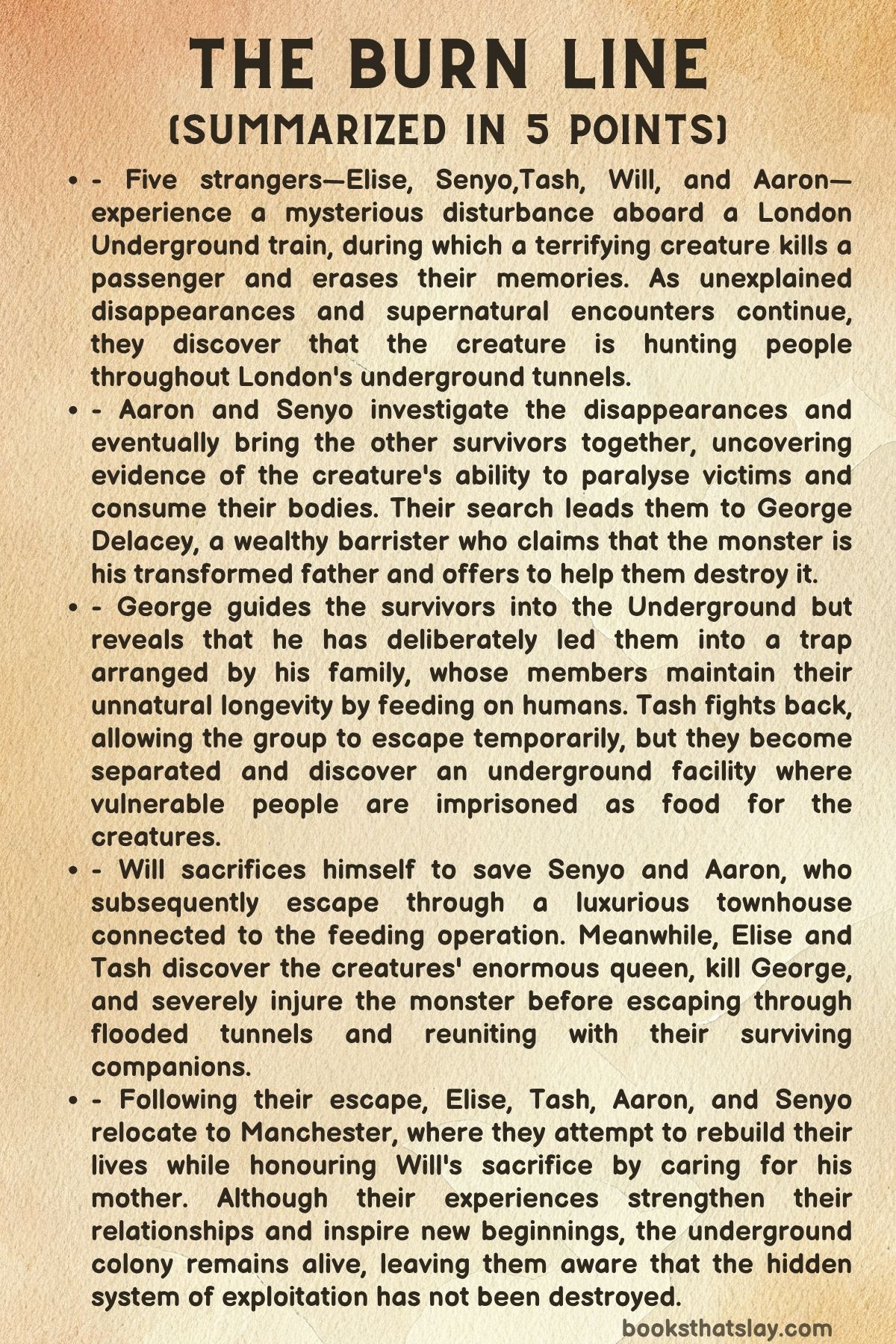
Summary
During an oppressive London heatwave, six passengers aboard a Central Line train experience a strange interruption in their journey. A sickly, rotten smell fills the carriage, their bodies become immobilised, and several minutes disappear from their memories.
Although they eventually continue their journeys, the passengers carry the effects of the incident into their separate lives. None initially understands that their shared experience has made them targets of something living beneath London.
Elise Nanda, a programmer beginning a new position at the Department for Transport, hopes that government employment will provide stability after her experiences in the private sector. Instead, she discovers an office burdened by bureaucratic restrictions and increasingly unsettling phenomena.
A mysterious smell near a fire escape leads her into a dark stairwell, where she encounters a pale figure and experiences a terrifying vision of someone burning alive. She returns to work determined to dismiss the experience, but the disturbance follows her.
Senyo Amoah, an experienced Underground driver, encounters similarly inexplicable events. After returning home with an injured leg, he discovers a greasy, ash-like substance on his work jacket and experiences disturbing dreams.
When his teenage child, Lea, hears something moving inside their bedroom closet, Senyo investigates. Although he finds nothing, the strange smell and unexplained noises convince him that his family may be in danger.
Natasha Dixon, known as Tash, faces her own difficulties while working exhausting shifts at a London hotel. Her strained relationship with her housemates and the possibility of losing her affordable accommodation make her increasingly anxious about her future.
After experiencing paralysis and strange noises inside her bedroom, she discovers that the back door of her house has mysteriously opened. Her attempts to investigate only intensify the hostility between her and her housemate Siobhan.
Will Whittaker, a wealthy portfolio manager, also struggles with the consequences of the Underground incident. Already overwhelmed by his demanding career, he encounters a mysterious open doorway near his office and becomes paralysed when something approaches from the darkness.
He narrowly escapes being struck by a car. The experience leaves him terrified, but he attempts to preserve the professional life that has become central to his identity.
Aaron Hirsch, a young man experiencing homelessness, recognises that something extraordinary happened aboard the train. His suspicions become more urgent when his friend Harris disappears during the night, leaving only greasy residue and grey ash inside his sleeping bag.
Aaron remembers seeing a grotesque creature wearing a decaying military uniform. Convinced that Harris has been killed, he begins investigating the mysterious disturbances and eventually reconnects with Senyo.
Together, they examine surveillance footage from the original train journey. The recording shows that seven passengers occupied their carriage before the interruption, but only six remained afterwards.
They cannot remember the missing person. Their investigation reveals that something has interfered not only with their bodies but also with their memories.
Meanwhile, the creature continues hunting throughout the Underground. Senyo witnesses passengers becoming immobilised inside his train and notices that the attacks frequently coincide with unexplained signalling delays.
Elise encounters a pale figure while accompanying engineers through maintenance tunnels beneath King’s Cross. Tash discovers deteriorated handprints and evidence of an intruder around her hotel, while Will sees the creature approaching a closed Underground station.
Aaron eventually encounters Tash and Elise aboard another train. When he shows them the surveillance footage, their suppressed memories begin returning.
The missing passenger was a man named Rahim. A grotesque creature had entered their carriage, examined the passengers, and selected him as its victim.
It forced its hands into Rahim’s chest, causing his body to disintegrate into filthy ash. After consuming his remains, the creature disappeared, leaving the survivors unable to remember the murder.
Will initially refuses to accept the others’ explanations. However, a subsequent attack inside his apartment building forces him to recognise the reality of their situation.
He deliberately throws himself down a staircase to escape the creature’s paralysing influence. Injured and hospitalised, he finally contacts the others for help.
Aaron gathers the five survivors in Finsbury Park, where they compare their experiences. They establish that the monster can move through narrow spaces, immobilise its victims, and interfere with their memories.
They also discover that heat, adrenaline, and repeated exposure may offer some resistance. Although they have no reliable means of killing the creature, they agree to work together.
Their investigation turns towards the mysterious sixth survivor, an impeccably dressed man who appeared unusually comfortable during the original attack.
Elise’s research provides the breakthrough. Realising that the man might belong to London’s wealthy social circles, she searches photographic records and identifies him as George Delacey, a prominent barrister.
The five survivors arrange a meeting at George’s prestigious law firm. Initially suspicious, he eventually admits that he knows about the creature.
George claims that the monster is his father, William Delacey, who supposedly died several years earlier. According to George, William underwent a supernatural transformation following a business trip to Armenia and subsequently escaped into London’s subterranean passages.
George explains that his blood relationship makes him resistant to the creature’s hypnotic powers. He proposes that they enter the Underground after closing time and destroy his father together.
Will enthusiastically accepts George’s explanation, reassured by his wealth and apparent authority. The others remain more sceptical, but their desperation eventually persuades them to participate.
Before the expedition, their personal relationships deepen. Aaron temporarily moves into Senyo’s family home, while Tash moves into Elise’s apartment, where their mutual attraction gradually develops.
The five companions meet George at Old Street Station. He distributes wooden stakes, garlic, holy water, and torches before leading them into the abandoned tunnels.
As they descend, the passages become increasingly unfamiliar. Senyo notices that George possesses suspicious knowledge of restricted areas, while the surrounding tunnels suggest the existence of a much larger subterranean system.
Eventually, the creatures’ paralysing influence overwhelms the group. George remains unaffected and turns his shotgun against them.
He reveals that his father is not an isolated monster. Members of the Delacey family have undergone the same transformation, gaining extraordinary longevity through the consumption of human beings.
George’s presence aboard the original train was deliberate. His relatives arranged the attack so that he could witness the existence he expects to inherit, and the surviving passengers have been brought underground because they now know too much.
The supposed vampire remedies are useless. George has exploited the survivors’ desperation to deliver them directly to the creatures.
However, Tash has secretly brought a knife and taken a stimulant to resist their influence. She attacks one of the monsters, breaking the paralysis and allowing the others to fight back.
George shoots Tash, but she wounds his hand and forces him to flee. Will seizes the abandoned shotgun and saves Elise from a creature that has begun destroying her face.
The survivors manage to kill several attackers, proving that the monsters are vulnerable to physical violence. Unfortunately, the resulting disturbance attracts more creatures, forcing them to flee.
During their escape, a shotgun blast temporarily damages Tash’s and Elise’s hearing. The two women take the wrong passage and become separated from Will, Senyo, and Aaron.
The three men discover an expensive security door leading into a sophisticated underground facility. Beyond it, they find transparent cells containing imprisoned people who are being kept as food.
Aaron recognises a prisoner named Gary, who explains that supposed charity workers brought him there. The discovery reveals an organised system in which vulnerable people are deliberately collected and delivered to the creatures.
As the monsters enter through the ventilation system, Will attacks them to give Senyo and Aaron time to escape. He kills several creatures before being overwhelmed and consumed.
His sacrifice allows his friends to reach a security office. Senyo and Aaron eventually discover that the feeding facility connects directly to the luxurious London townhouse of Transport Secretary David Gayle.
Unable to open the heavily secured front door, they retreat upstairs while the creatures pursue them.
Elsewhere, Elise and Tash continue through the underground passages. After killing another ghoul, they discover that coating themselves in its blood can disguise their presence from the creatures, which rely heavily on smell and taste.
When Elise realises she has lost her insulin kit, Tash risks her life to retrieve it. Their determination to protect each other strengthens the relationship developing between them.
They eventually enter an enormous chamber containing numerous sleeping creatures surrounded by extraordinary accumulated wealth. At its centre lies a gigantic, grotesque being that appears to control the colony.
Tash believes they have discovered the creatures’ queen. Although she initially wants to destroy it, Elise persuades her that escaping alive and exposing the hidden operation must take priority.
Before they can leave, George enters the chamber and approaches the monstrous figure. Addressing it as both mother and father, he apologises for failing to kill the survivors.
His suggestion that the colony relocate because London’s rising temperatures are making concealment difficult provokes the queen’s anger. The exchange reveals that George possesses far less authority than he pretends.
Tash prepares to kill him, but Elise’s ringing telephone awakens the surrounding creatures. George turns towards Tash, who fires the shotgun and kills him instantly.
With the nest descending into chaos, Elise damages a pressurised pipe and electrical cable, causing flooding and an electrical fire.
The creatures scramble to protect their accumulated possessions. During the fighting, Elise discovers that gold resists their destructive influence.
The queen consumes George’s corpse and transforms him into a ghoul. When he attacks Tash, Elise strikes him with a heavy gold ingot, killing him again.
The women finally acknowledge their feelings through a kiss, but the queen suddenly seizes Elise. Tash fires the shotgun’s remaining shell into its mouth, severely wounding it.
The monster summons its offspring, which rush back into its body. Elise and Tash seize the opportunity to escape.
Meanwhile, Senyo and Aaron fight their way out of Gayle’s townhouse. During their escape, the military-uniformed creature responsible for Harris’s death pursues them into the street.
A police car, apparently affected by the creature’s influence, crashes into it after Aaron pulls Senyo out of danger. The impact destroys their pursuer.
Elise and Tash eventually escape through the underground facility, passing through the security door Will deliberately left open for them. They reunite with Senyo and Aaron in a nearby park.
Their survival is overshadowed by Will’s death and the knowledge that the subterranean colony remains alive.
Some time later, the four survivors have relocated to Manchester. The gold ingot has helped them establish new lives, but their experiences continue to affect them.
Aaron volunteers with an organisation supporting homeless young people, while Senyo rebuilds his family life and helps care for Will’s mother. Tash and Elise remain together, sharing their home with Aaron.
Elise’s attempts to expose the creatures through journalists have produced no response. Although the survivors have escaped London, the powerful organisation responsible for the horror continues to exist.
When Elise attends a job interview and is asked why she left the Department for Transport so quickly, she offers a simple explanation: burnout.
Her answer captures the enormous personal cost of surviving a world in which ordinary exhaustion and supernatural terror have become almost indistinguishable.
Characters
Elise Nanda
Elise Nanda is one of the central protagonists of The Burn Line, representing the ordinary professional whose desire for stability is repeatedly undermined by circumstances beyond her control. Her decision to join the Department for Transport reflects her hope that public-sector employment will offer greater security than her previous experiences in the private sector.
Her introduction to government bureaucracy immediately challenges these expectations. She discovers that institutional restrictions prevent her from performing basic programming tasks, creating a professional environment in which the appearance of procedure frequently matters more than effective action.
Elise approaches the supernatural disturbances with a combination of fear and analytical curiosity. Although her initial encounters leave her terrified, she gradually applies her technical knowledge to understanding the creatures and the underground infrastructure they inhabit.
Her identification of George Delacey demonstrates her ability to connect seemingly unrelated information. Later, her knowledge of transport infrastructure helps her recognise how to damage the creatures’ underground nest.
Elise’s diabetes introduces another dimension to her vulnerability. Her dependence on insulin means that surviving the monsters requires attention not only to supernatural dangers but also to the ordinary medical needs that continue during extraordinary circumstances.
Her developing relationship with Tash becomes essential to her emotional growth. Initially hesitant about accepting intimacy, Elise gradually learns to trust another person with both her physical safety and her feelings.
By the conclusion, Elise has survived an experience that has permanently altered her understanding of the world. Her unsuccessful attempts to expose the creatures demonstrate her continuing commitment to truth, while her decision to rebuild her life acknowledges that survival sometimes requires accepting the limits of individual power.
Senyo Amoah
Senyo Amoah provides The Burn Line with a perspective grounded in responsibility, practical experience, and family loyalty. As an experienced Underground driver, he understands the transportation system as both a workplace and an essential part of London’s everyday functioning.
His responsibilities to Amy and Lea shape nearly every decision he makes. Even after discovering that something dangerous inhabits the tunnels, he continues working because abandoning his income would threaten his family’s security.
Senyo’s professional knowledge becomes invaluable to the survivors. He recognises abnormalities in train operations, identifies suspicious signalling interruptions, and helps the group navigate areas of the Underground that would otherwise be inaccessible.
Nevertheless, his familiarity with the system also creates a terrible moral burden. When he witnesses the creature consuming a passenger, his inability to intervene leaves him ashamed and disturbed by the possibility that his work has unknowingly facilitated previous killings.
His relationship with Aaron reveals another side of his personality. Although initially cautious, Senyo welcomes the younger man into his home and offers him practical support without treating him as an object of charity.
During the confrontation beneath London, Senyo repeatedly demonstrates that courage does not require an absence of fear. His determination to help Aaron escape, despite his injuries, reflects the same protective instincts that govern his family life.
His eventual relocation to Manchester offers him an opportunity to redefine his responsibilities. By helping care for Will’s mother, he extends his understanding of family beyond biological relationships and honours the sacrifice that made his survival possible.
Natasha Dixon (Tash)
Natasha Dixon, generally known as Tash, brings defiance, resourcefulness, and dark humour to The Burn Line. Her experiences as an exhausted hotel worker establish her familiarity with financial insecurity, difficult living arrangements, and the constant pressure of trying to maintain an independent life.
Her strained relationship with Siobhan demonstrates how economic circumstances can turn shared accommodation into a source of hostility. Tash cannot simply escape the situation because affordable alternatives are increasingly difficult to find.
Unlike some of the other survivors, Tash responds to the supernatural threat with a willingness to confront it directly. Although frightened, she refuses to accept that the creatures should dictate the conditions of her existence.
Her decision to carry a knife and use a stimulant becomes essential when George betrays the group. By attacking while the others remain paralysed, she transforms an apparently hopeless situation into an opportunity for resistance.
However, her courage sometimes approaches recklessness. Her determination to attack the queen reveals how anger at injustice can encourage dangerous decisions, particularly when someone feels that retreat would mean accepting the continued suffering of others.
Elise provides an important counterbalance to this impulsiveness. Their relationship develops through shared danger, practical cooperation, and repeated demonstrations that each is willing to protect the other.
Tash’s retrieval of Elise’s insulin kit is especially revealing because it requires her to prioritise another person’s immediate needs over her own safety. The act demonstrates that her strongest qualities are not simply aggression or fearlessness, but loyalty and care.
By the conclusion, Tash has found a more secure domestic life with Elise and Aaron. Her development suggests that independence becomes more sustainable when it is supported by relationships built on mutual respect rather than isolation.
Will Whittaker
Will Whittaker undergoes one of the most substantial transformations in The Burn Line. Initially introduced as a financially successful portfolio manager, he appears to possess the professional status and material comforts that many other characters struggle to obtain.
Nevertheless, his privileged circumstances conceal intense dissatisfaction. His demanding employment, difficult clients, and fear of professional failure have left him emotionally exhausted long before the supernatural disturbances begin.
Will initially responds to the other survivors with suspicion and embarrassment. His discomfort around Aaron and Senyo exposes his tendency to judge people through the social distinctions that govern his professional environment.
His refusal to believe their explanations also reflects a deeper need to preserve his existing understanding of reality. Accepting the creature’s existence would mean acknowledging that his wealth and professional standing cannot protect him.
His dismissal from Bentar Nelson strips away much of the identity he has constructed around his career. Without his position, Will must confront his financial vulnerability and the limited emotional support available within his established social world.
His trust in George Delacey reveals how strongly he continues to associate wealth with authority. He assumes that George’s resources and social standing make him a credible ally, even when the others question his intentions.
George’s betrayal forces Will to recognise the danger of this assumption. His subsequent actions demonstrate a growing awareness that genuine loyalty cannot be measured through status.
Will’s final sacrifice completes his transformation. By confronting the creatures so that Aaron and Senyo can escape, he abandons the instinct to preserve his own position at the expense of others.
His death also establishes a lasting obligation among the survivors. Their decision to care for his mother ensures that his final act continues to influence the lives he saved.
Aaron Hirsch
Aaron Hirsch serves as the emotional and investigative centre of The Burn Line, bringing together individuals who might otherwise have remained isolated. His experience of homelessness gives him an unusually clear understanding of how easily vulnerable people can disappear without attracting public attention.
The death of Harris becomes his strongest personal motivation. Unlike the authorities and many other people he encounters, Aaron refuses to accept the disappearance as an ordinary consequence of living on the streets.
His determination to investigate demonstrates both his loyalty and his refusal to accept social indifference. He recognises that the absence of institutional concern makes people like Harris particularly vulnerable to exploitation.
Aaron also possesses considerable observational intelligence. He notices the strange behaviour of the passengers, recognises the significance of the residue, and helps establish the connection between the original incident and subsequent attacks.
His collaboration with Senyo becomes the foundation of the survivors’ collective response. Their different backgrounds initially create distance between them, but shared experience gradually develops into mutual trust.
Although Aaron sometimes reacts defensively to Will’s privileged attitudes, he ultimately chooses compassion when Will requests help. This willingness to place another person’s immediate needs above personal resentment reveals his growing emotional maturity.
The discovery of the underground feeding facility confirms Aaron’s fears about the exploitation of vulnerable people. Gary’s imprisonment exposes the deliberate organisation behind disappearances that society has largely ignored.
Aaron survives the final confrontation, but his experiences leave him struggling with guilt over those who did not escape. His subsequent donations and volunteer work demonstrate his determination to convert personal suffering into practical assistance for others.
His development is therefore not simply a movement from homelessness towards material security. It is also a movement towards a form of belonging in which his experiences and contributions receive recognition.
George Delacey
George Delacey initially presents himself as an educated, wealthy barrister who possesses the knowledge necessary to save the survivors. His polished appearance, prestigious workplace, and confident manner encourage the impression that he represents a source of authority.
This impression is particularly effective on Will, who has spent his professional life operating within similarly privileged circles.
George’s eventual betrayal reveals that his apparent cooperation was calculated manipulation. He uses the survivors’ desperation to guide them underground, where his family intends to eliminate them.
His relationship with the creatures is defined by inheritance and expectation. George understands their feeding practices as the means through which he will eventually receive the extraordinary longevity enjoyed by his relatives.
His attitude towards the people sacrificed to sustain that existence demonstrates his moral detachment. He regards their deaths as acceptable consequences of preserving a privileged way of life.
Nevertheless, George is not as powerful as he imagines. His encounter with the queen reveals that he remains subordinate to the older generation whose position he hopes to inherit.
His death at Tash’s hands temporarily interrupts his expected future, but the queen’s transformation of his corpse demonstrates the family’s continuing possession of him.
George ultimately represents the willingness to participate in exploitation when doing so promises personal advancement.
William Delacey
William Delacey, George’s father, is initially presented as the supposed origin of the supernatural crisis. According to George, he underwent a mysterious transformation following a visit to Armenia before killing a cleaner and escaping into the Underground.
This account gives the survivors a convenient explanation for the attacks. It encourages them to imagine that destroying one transformed individual will eliminate the danger.
However, George’s later revelations demonstrate that William’s transformation belongs to a much larger system of inherited privilege. His apparent isolation conceals the existence of numerous creatures sustained through organised feeding.
William’s presence within the story illustrates the monstrous consequences of extreme longevity obtained at other people’s expense. His condition also exposes the false distinction George initially establishes between a respectable family and a supposedly uncontrollable individual.
The Queen
The enormous creature discovered beneath London represents the centre of the subterranean colony. Surrounded by sleeping offspring and accumulated wealth, it possesses a physical presence that dwarfs the other monsters.
Its body appears capable of incorporating multiple identities, while its offspring can return to it during moments of danger. These qualities make it both an individual creature and the apparent foundation of the colony’s collective existence.
George’s references to it as both mother and father suggest a form of authority that extends beyond ordinary human family relationships. Its dominance over him demonstrates that the colony operates according to an established hierarchy.
The queen’s accumulation of wealth is especially significant. Its enormous possessions transform the underground nest into a grotesque reflection of the fortunes accumulated by the privileged families above.
Its fury at George’s suggestion that the colony relocate demonstrates its resistance to restrictions on its existence. Even the increasing dangers created by London’s heat do not easily persuade it to surrender its established territory.
Although Tash severely wounds the queen, the creature survives. Its continued existence preserves the possibility that the system of exploitation beneath London will continue after the protagonists’ escape.
Harris
Harris is Aaron’s older friend and an important source of companionship during his experience of homelessness. Although sceptical about Aaron’s ambitions to organise homeless people, he provides a connection to a community frequently ignored by wider society.
His disappearance transforms the supernatural threat into a deeply personal tragedy. The greasy ash discovered inside his sleeping bag confirms Aaron’s fears that something terrible has happened.
Harris’s death also establishes the importance of the contaminated clothing left by the creatures. Aaron suspects that Harris was attacked because he was wearing Aaron’s coat, creating a lasting sense of personal responsibility.
The lack of public concern surrounding Harris’s disappearance demonstrates how easily vulnerable individuals can be overlooked. His memory continues to motivate Aaron throughout the novel.
Rahim
Rahim is the passenger murdered during the original Central Line incident. Initially sleeping when the creature enters the carriage, he becomes its selected victim.
His destruction reveals the creatures’ method of feeding. The transformation of his body into greasy ash explains the strange residue encountered by the other characters throughout London.
Although Rahim receives comparatively little individual development, his death establishes the central mystery. The survivors’ inability to remember him also demonstrates the creatures’ ability to conceal violence by manipulating human perception.
He represents the victims whose disappearance becomes almost impossible to investigate because the evidence of their existence has been deliberately erased.
Amy Amoah
Amy is Senyo’s wife and an important source of stability within his family. Her concern for his injured leg and her discovery of the residue on his jacket introduce the supernatural disturbances into their domestic life.
Although Senyo initially conceals the full truth from her, Amy remains central to his decisions. His determination to return safely reflects his responsibilities as a husband and parent.
Her willingness to welcome Aaron into the household also demonstrates generosity beyond her immediate family. By offering him food, clean clothing, and shelter, she helps create the environment in which the survivors’ relationships can develop.
Following the escape from London, Amy participates in rebuilding the family’s life in Manchester. Her acceptance of Will’s mother further expands the household’s sense of responsibility and belonging.
Lea Amoah
Lea is Senyo and Amy’s fourteen-year-old child. Their discovery of strange noises inside a bedroom closet provides one of the earliest indications that the supernatural disturbances can follow the survivors into their homes.
Lea’s fear forces Senyo to confront the possibility that the danger extends beyond his own experiences. His attempt to explain the incident as an animal entering through the roof reveals his desire to protect Lea from frightening information.
Although Lea does not participate directly in the underground investigation, their presence raises the emotional stakes of Senyo’s decisions. Every risk he takes carries consequences for the family depending upon his survival.
Mary Elizabeth Whittaker
Mary Elizabeth is Will’s mother, who lives in a care home and depends upon arrangements her son has struggled to maintain. Her circumstances provide an important explanation for his financial anxiety.
Will’s fear of losing his employment is therefore not simply a concern about maintaining an expensive lifestyle. His responsibilities towards his mother give his professional insecurity a more personal dimension.
Before entering the tunnels, Will asks the others to look after her if he dies. This request becomes especially significant following his sacrifice.
Mary Elizabeth eventually moves into Senyo’s family home in Manchester. Although she continues grieving her son, her inclusion in the household demonstrates the lasting bonds created through Will’s actions.
David Gayle
David Gayle is the Transport Secretary whose political responsibilities place him close to the infrastructure beneath which the creatures operate. His professional interactions with Elise initially establish him as a figure associated with government bureaucracy and ambitious transportation projects.
The discovery that the underground feeding facility connects directly to his luxurious townhouse radically changes his significance.
His property provides access to the operation through which imprisoned people are delivered to the creatures. The revelation establishes a disturbing connection between public authority, private wealth, and the hidden system of exploitation.
Gayle’s precise involvement is not fully explored in the supplied account, but the discovery of the facility beneath his property strongly implicates his household in the operation.
His character demonstrates how the apparent separation between respectable public institutions and concealed violence can be dangerously misleading.
Gary
Gary is one of the prisoners discovered inside the underground feeding facility. Aaron recognises him, establishing a direct connection between the hidden operation and the community of homeless people he knows.
Gary explains that supposed charity workers brought him to the facility. His testimony reveals that the creatures’ supply of victims depends upon organised deception rather than accidental encounters.
His imprisonment demonstrates how institutions associated with assistance can be exploited as instruments of predation. The contrast between promises of help and the reality of captivity is especially disturbing.
Gary’s fate leaves Aaron struggling with guilt after his escape. He becomes another reminder that surviving the creatures does not erase responsibility towards those who remain trapped.
Gordon
Gordon is Elise’s supervisor at the Department for Transport. He introduces her to the department’s unusual working arrangements and provides an unofficial laptop when institutional restrictions prevent her from obtaining the necessary software.
His willingness to circumvent ineffective procedures demonstrates a practical approach to bureaucracy. However, he remains part of an institution whose limitations repeatedly frustrate Elise.
Gordon’s dissatisfaction with the Transport Secretary also establishes his awareness of the distance between political priorities and the practical needs of public transportation.
His conversations with Elise indirectly help her identify George Delacey. By discussing the social world surrounding wealthy public figures, he inspires her to search photographic records for the mysterious passenger.
Brian and Tom
Brian and Tom are Transport for London engineers who accompany Elise into the maintenance tunnels beneath King’s Cross. Their work measuring wireless signal strength introduces her to the complicated infrastructure beneath the capital.
Their professional familiarity with unfinished passages and experimental cooling systems becomes significant when Elise later encounters the creatures’ underground territory.
Tom’s explanations about the cooling-system excavations provide information that Elise eventually uses during the final confrontation.
Brian also plays an important immediate role when his voice interrupts Elise’s encounter with a pale figure. Their presence demonstrates how ordinary professional activities can unexpectedly intersect with the hidden supernatural world.
Yasmine
Yasmine is Will’s assistant at Bentar Nelson Asset Management. Her reminders about meetings and client obligations establish the demanding professional environment in which Will operates.
Although she does not participate in the supernatural investigation, her presence illustrates the organised, high-pressure system surrounding Will’s career.
Her practical responsibilities contrast with Will’s increasing emotional instability. Through their interactions, the novel reveals how ordinary workplace routines continue even as Will’s private reality becomes increasingly frightening.
Curtis Malkin
Curtis Malkin is a wealthy client whose financial ambitions intensify Will’s dissatisfaction with his career. His determination to move investments onto the blockchain becomes another source of frustration for the portfolio manager.
Will privately regards Malkin’s understanding of finance with contempt, but professional necessity requires him to conceal his feelings.
Malkin’s sudden cancellation of an important meeting further exposes Will’s lack of control over his working life. Despite his professional status, Will remains dependent upon the unpredictable demands of wealthy clients.
The character helps establish the economic relationships that leave Will both privileged and vulnerable.
Lisa
Lisa is the receptionist at Will’s apartment building. Her temporary absence from the reception desk precedes his encounter with an open maintenance door and the creature lurking near the basement.
She subsequently discovers him unconscious after he throws himself down the stairs to escape.
Although her role is limited, Lisa provides the practical assistance that allows Will to receive medical treatment. Her intervention helps him survive an encounter that finally convinces him to contact the other passengers.
Katie
Katie is Tash’s colleague at the Sulgrave Lodge hotel. Her presence establishes the ordinary working environment in which Tash first encounters further evidence of the supernatural disturbances.
When Tash discovers the mysterious handprints and unexplained activity around the building, she insists that Katie remain with her.
Katie’s role highlights Tash’s instinctive understanding that isolation increases vulnerability. Even before joining the larger group of survivors, Tash recognises the protective value of another person’s presence.
Derek
Derek is one of Tash’s housemates in Walthamstow. His interactions with her provide a comparatively calmer alternative to her increasingly hostile relationship with Siobhan.
Tash speaks to him about her disturbing Underground experience and the difficulties surrounding their living arrangements.
Before entering the tunnels, she asks Derek to contact her family if she does not return. The request demonstrates that their relationship retains an element of trust despite the tensions surrounding their shared accommodation.
Siobhan
Siobhan is Tash’s antagonistic housemate, whose complaints about noise and behaviour make their shared home increasingly uncomfortable. Her hostility contributes to Tash’s sense that even her private living space offers little security.
Following their confrontation near the open back door, Siobhan tells the landlord that Tash threatened her with a knife. Her account transforms an already frightening misunderstanding into a dispute with potential consequences for Tash’s housing.
Siobhan’s confrontational behaviour becomes particularly difficult when the landlord announces plans to sell the property. Her character represents the everyday interpersonal conflicts that can intensify economic insecurity.
Jeff
Jeff is the landlord of the house shared by Tash, Derek, and Siobhan. His decision to consider selling the property creates another crisis in Tash’s already unstable life.
Although his role is limited, his control over the tenants’ accommodation demonstrates the imbalance between property ownership and the needs of people who depend upon rented housing.
His communications following Siobhan’s complaint further increase Tash’s anxiety. The character helps establish the material pressures that make moving into Elise’s apartment an attractive and practical solution.
Kerridge
Kerridge is George Delacey’s chauffeur, who drives him to the meeting at Old Street Station. His presence reinforces George’s considerable wealth and access to resources.
The limousine and chauffeur create a sharp visual contrast with the circumstances of the other survivors, particularly Aaron.
Although Kerridge’s personal involvement in the supernatural conspiracy is not established, his appearance contributes to the atmosphere of authority surrounding George. The survivors encounter him as part of the elaborate presentation through which George establishes credibility.
Themes
Class Inequality and the Exploitation of Vulnerable People
Class inequality shapes the supernatural horror of The Burn Line, transforming the creatures beneath London into a representation of the exploitation that sustains extreme privilege. Their victims are not selected exclusively through chance, and their existence depends upon a system that treats certain human lives as expendable.
Aaron’s experiences establish this inequality long before the survivors discover the underground feeding facility. His friend Harris disappears without attracting meaningful public concern, demonstrating how easily people experiencing homelessness can vanish from public attention.
The discovery of Gary and the other prisoners makes the exploitation explicit. Supposed charitable organisations deliver vulnerable individuals into captivity, where they become a food supply for creatures whose extraordinary longevity depends upon repeated killings.
This system exposes the difference between charitable appearances and actual responsibility. Organisations that claim to offer assistance become instruments through which vulnerable people are collected and sacrificed.
The accumulation of wealth within the subterranean colony provides a particularly disturbing image of inequality. The creatures surround themselves with valuable possessions while consuming the bodies of people who possess comparatively little.
Their wealth is therefore inseparable from the suffering that maintains their existence. The enormous queen embodies this relationship through its accumulation of riches and its power over the lesser creatures.
George Delacey’s attitude demonstrates how exploitation can become normalised within privileged families. He regards the deaths of ordinary people as an acceptable price for inheriting the advantages enjoyed by his relatives.
Will’s transformation also develops this theme. Initially inclined to trust George because of his social status, he eventually recognises that wealth offers no guarantee of moral responsibility.
The novel does not portray class simply as a difference in income. It examines how unequal access to protection, credibility, housing, and institutional attention determines whose suffering is recognised and whose disappearance can be ignored.
Solidarity, Community, and Chosen Family
The survivors begin as strangers whose social circumstances would ordinarily prevent meaningful interaction. Their shared encounter forces them to recognise a common vulnerability that exists beneath their differences in profession, wealth, and social standing.
Aaron and Senyo’s friendship becomes the first significant expression of this solidarity. Although they approach the mystery from very different positions, their willingness to trust each other creates the foundation for a collective response.
Senyo’s decision to welcome Aaron into his family home is particularly important. He offers practical assistance without demanding that Aaron prove his worthiness or conform to expectations surrounding respectable employment.
Amy’s acceptance of Aaron extends this solidarity into the domestic sphere. The household becomes a place where generosity provides a form of security unavailable through the institutions surrounding them.
Elise and Tash develop another version of mutual dependence. Their decision to share accommodation begins as a practical response to fear and financial pressure, but gradually becomes the foundation of an intimate relationship.
Their experiences underground demonstrate the importance of reciprocal care. Tash risks her life to recover Elise’s insulin, while Elise repeatedly acts to protect Tash from the creatures.
Neither woman survives because she possesses every necessary ability. Their survival depends upon recognising each other’s strengths, limitations, and immediate needs.
Will’s final sacrifice represents the most consequential expression of collective responsibility. By confronting the creatures, he gives Senyo and Aaron an opportunity to escape at the cost of his own life.
The surviving characters subsequently honour his sacrifice by welcoming his mother into their extended family. Their actions demonstrate that solidarity does not end when an immediate danger has passed.
The Manchester household provides a vision of belonging founded upon shared experience and mutual commitment. Its members are connected not only by biological relationships but also by the responsibilities they voluntarily accept towards one another.
Through these relationships, the novel presents community as a practical means of survival rather than simply an emotional ideal.
Fear, Memory, and the Recovery of Personal Agency
The creatures’ ability to immobilise their victims establishes fear as a force that operates directly upon the body. Their victims remain conscious of approaching danger while losing the capacity to defend themselves.
This paralysis creates a particularly disturbing form of helplessness. The characters cannot rely upon ordinary instincts such as running, shouting, or fighting when their bodies refuse to respond.
The creatures’ manipulation of memory extends this loss of control beyond the immediate encounter. By preventing witnesses from remembering their attacks, they obstruct the process through which people normally recognise danger and seek protection.
Rahim’s disappearance demonstrates the consequences of this power. The surviving passengers cannot initially remember that another person occupied their carriage, leaving them unable to understand the evidence surrounding them.
Recovering their memories therefore becomes a crucial act of resistance. Aaron’s investigations and the surveillance footage gradually allow the survivors to reconstruct events that the creatures have concealed.
The process also reveals the importance of external evidence. Individual perception proves unreliable, but shared observations and recorded information help the characters establish a more accurate understanding of reality.
Fear nevertheless remains an obstacle even after the truth becomes clear. Will attempts to deny the creature’s existence, while Senyo struggles with shame after witnessing an attack that he cannot prevent.
Their responses demonstrate that recognising danger does not automatically create the ability to confront it. Psychological resistance develops unevenly and frequently requires support from others.
Tash’s use of a stimulant creates a more direct challenge to the creatures’ influence. By resisting paralysis, she temporarily restores the freedom of action that their power is designed to eliminate.
However, the novel does not suggest that courage requires permanent fearlessness. The survivors continue experiencing terror even when they fight successfully.
Their growing agency emerges from recognising their vulnerability and acting despite it. Memory becomes essential to this process because understanding what has happened allows them to make choices that the creatures previously prevented them from making.
Institutional Failure, Work, and the Cost of Survival
The ordinary working lives of the protagonists establish a world in which exhaustion and insecurity exist independently of supernatural danger. The Burn Line presents the creatures as an intensification of pressures already embedded within employment, public services, and urban life.
Elise’s experiences at the Department for Transport demonstrate how bureaucracy can obstruct the work it supposedly supports. Her inability to obtain essential software illustrates an institutional preference for procedures that do not necessarily serve practical needs.
Senyo encounters similar contradictions within the Underground. He understands the deterioration of the infrastructure but remains responsible for operating trains within a system whose limitations he cannot control.
His financial responsibilities prevent him from simply abandoning work after discovering the creatures. The need to support his family places him in repeated danger.
Tash faces a different form of insecurity through exhausting hotel shifts and unstable housing. Her circumstances demonstrate how employment does not necessarily provide the financial stability required for a secure domestic life.
Will initially appears to occupy a more privileged position, but his career produces intense anxiety and dissatisfaction. His dismissal reveals how quickly professional success can become financial vulnerability when an individual’s obligations depend upon continuing employment.
These different experiences establish work as a source of both identity and pressure. The characters cannot separate their attempts to survive the supernatural crisis from the economic arrangements governing their everyday lives.
The revelation concerning David Gayle’s townhouse expands the criticism from individual workplaces to public authority. A facility associated with systematic imprisonment and killing exists beneath property belonging to a senior government figure.
Elise’s unsuccessful attempts to expose the conspiracy further demonstrate the limitations of institutional accountability. Even after surviving the creatures and obtaining direct knowledge of their existence, she cannot persuade journalists to investigate.
The conclusion returns to the ordinary language of employment when Elise explains her departure from government work as burnout.
Her answer is both humorous and revealing. It compresses an extraordinary experience of violence, institutional betrayal, and survival into a familiar description of professional exhaustion.
The ending suggests that escaping a destructive environment does not necessarily mean exposing or transforming the structures responsible for it. Elise and the other survivors achieve a measure of personal security, but the institutions and powerful individuals connected to the underground colony remain largely beyond their control.