The Burning Library Summary, Characters and Themes
The Burning Library by Gilly Macmillan is a gripping thriller that explores the intersections of academia, secret societies, and ancient manuscripts. The novel follows several interconnected characters, including Anya Brown, a young academic who deciphers a centuries-old manuscript, and Clio Spicer, a detective investigating a mysterious death linked to a secret society.
As they unravel a puzzle involving the “Book of Wonder,” a powerful manuscript hidden for centuries, they face dangerous adversaries and uncover dark secrets about the institutions they work for. The book masterfully blends mystery, historical intrigue, and suspense, making it a compelling read for fans of intricate, layered storytelling.
Summary
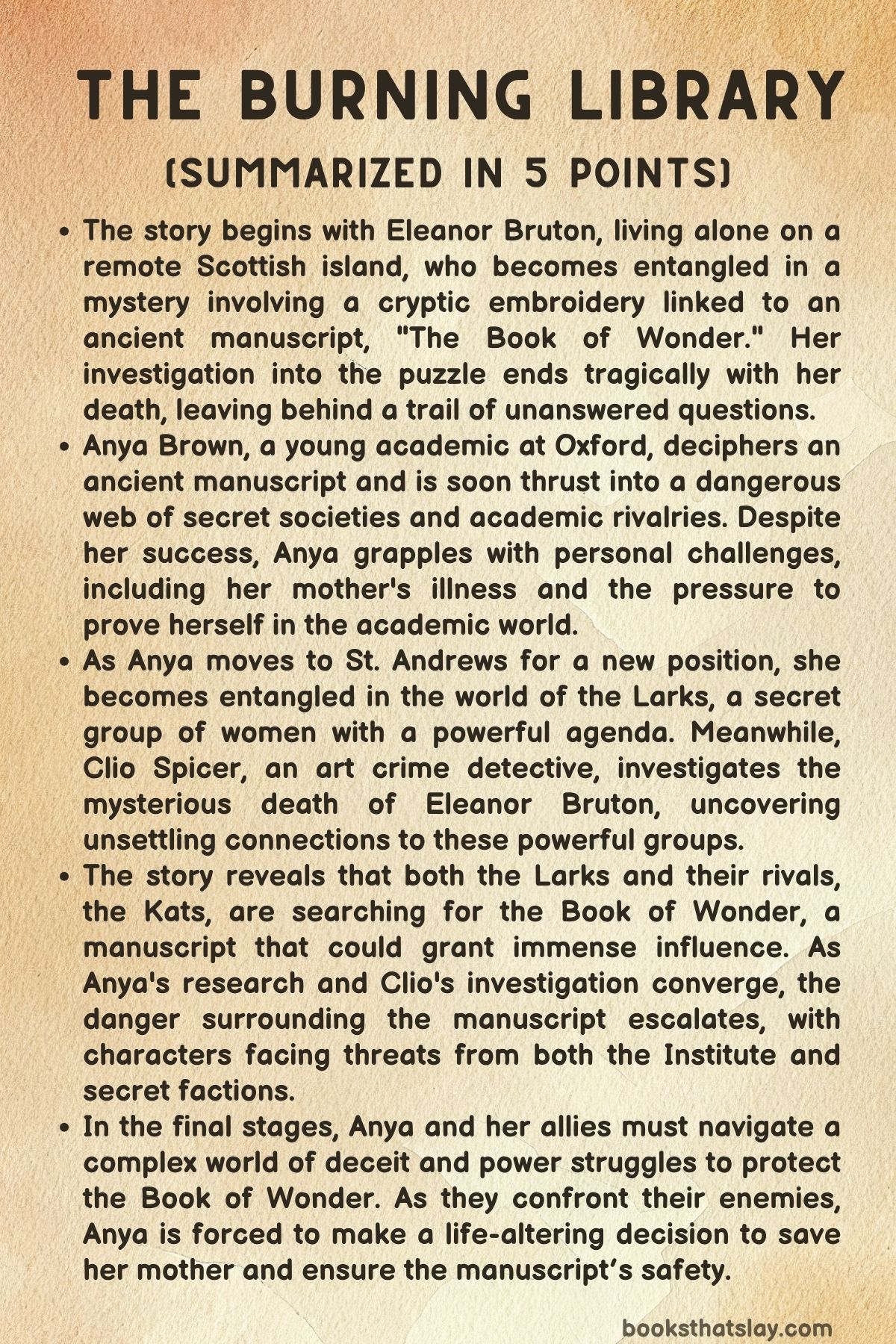
The story of The Burning Library begins with Eleanor Bruton, a woman living alone on a remote island in Scotland. She notices two women arriving by kayak and setting up camp on a nearby beach.
After a storm, Eleanor realizes that the women have vanished, which unsettles her. Eleanor, a scholar, spends her time working on a cryptic embroidery fragment that she believes is a key to an ancient historical mystery.
The embroidery is part of a larger enigma tied to “The Book of Wonder,” a legendary manuscript sought by secret groups of women, including Eleanor herself.
Tragically, Eleanor’s work and life are abruptly cut short when her home is invaded, and she is struck on the head and killed by the very women she had observed. Her death leaves behind nothing but ashes from the work she had so carefully protected, raising more questions than answers.
In a separate narrative thread, Anya Brown, an academic at Oxford, deciphers “Folio 9,” an ancient manuscript that had puzzled scholars for years. Anya’s breakthrough brings her to the attention of prestigious institutions, and she is offered positions at places like Yale and St. Andrews.
Her academic success is tempered by her struggles with impostor syndrome and the pressure from her mother, who is battling cancer, to pursue the best opportunity. Anya eventually accepts a position at St. Andrews, where she is offered the chance to work with a collection of rare manuscripts.
At the same time, Clio Spicer, a detective with Scotland Yard’s Art and Antiques Squad, begins investigating the mysterious death of Eleanor Bruton. Clio had worked with Eleanor’s mentor, Lillian Shapiro, before her own death, and she suspects that Eleanor’s death was no accident.
As Clio delves into Eleanor’s life, she uncovers a hidden network of powerful women connected to secret societies, including a group known as the Larks. These women are working to reshape the world by using their influence in academia and beyond.
Diana Cornish, a prominent professor at St. Andrews, is a key figure in the Larks, and she becomes intrigued by Anya’s expertise in decoding ancient manuscripts. Diana pressures Anya to accept a research position at St. Andrews, hoping to enlist her in the search for “The Book of Wonder.” However, Anya is also approached by MI5, who offer her a job as a spy due to her skills in code-breaking.
She declines, preferring a life of open scholarship over secrecy.
Meanwhile, Clio continues her investigation into Eleanor’s death, suspecting that the secretive women’s groups may be involved. As she uncovers more details about these groups, Clio learns that Eleanor was studying an embroidery fragment that holds the key to a much larger mystery.
The fragment is tied to both the Larks and their rivals, the Kats, who are also hunting for the Book of Wonder. Clio’s search for answers leads her to the same cottage where Eleanor lived, and she becomes more determined to unravel the truth behind Eleanor’s death.
Anya’s life becomes increasingly complicated as she gets drawn deeper into the web of intrigue surrounding the manuscripts. She starts working with Professor Diana Cornish at St. Andrews, and as she does, she uncovers secrets about the mysterious benefactors funding their work.
One such benefactor is Anya’s estranged father, Magnus Beaufort, a wealthy surgeon and collector. Magnus had abandoned Anya’s mother years ago, but he now wants to make amends by involving Anya in his rare manuscript collection.
Anya is initially angered by his sudden reappearance in her life, but Magnus promises to fund her mother’s medical treatments if she works with him on the manuscripts.
As tensions rise, Clio continues her investigation into the secret societies and their connection to Eleanor’s death. She uncovers more details about Diana’s role in the Larks and the rival Order of St. Katherine, which is also seeking the Book of Wonder.
In a shocking turn, Diana Cornish is found murdered in East London, leading Clio to further investigate the connection between the secret societies and the manuscript.
Anya and her boyfriend Sid are soon caught in the middle of a dangerous conflict as they learn that their lives are being watched. They are pursued by both the Larks and the Order, who are determined to find the Book of Wonder.
Anya’s mother, Rose, becomes a pawn in this dangerous game, and Anya is forced to make a difficult decision to protect her.
As the story reaches its climax, Anya deciphers a final clue that leads her to Verona, Italy, where the Book of Wonder may be hidden. Anya, Sid, and Clio travel to Verona, where they uncover further secrets about the manuscript and the factions fighting to control it.
In a dramatic sequence, Anya finds the hidden Book of Wonder in an underground Roman-Christian shrine and must make a fateful choice between handing it over to the rival factions or using it to secure her mother’s safety.
In the end, Anya makes a deal with the rival factions, exchanging the manuscript for her mother’s freedom. Though she is left with a sense of betrayal and loss, Anya realizes that her actions have been part of a larger struggle for power and influence.
The story concludes with Anya reflecting on the sacrifices made and the dangerous forces at play in a world where knowledge and secrets can hold the key to shaping the future
Characters
Eleanor Bruton
Eleanor Bruton is an isolated and mysterious figure who lives alone on a remote Scottish island. A dedicated scholar, Eleanor spends her time working on a cryptic embroidery fragment she believes holds significant historical clues.
Her connection to the manuscript known as The Book of Wonder is central to her character. Despite her seclusion, Eleanor’s anxiety about the women she observes on the island reveals her growing sense of danger, a feeling that is eventually proven true when she is killed by the very women she had been observing.
Her death and the loss of her work, burned to ashes, create a haunting legacy, leaving behind only fragmented mysteries for others to uncover. Eleanor’s tragic end is a catalyst for the unfolding events of the story, linking her fate to secret groups and the pursuit of an ancient manuscript.
Anya Brown
Anya Brown, a young and talented Oxford academic, is deeply engrossed in her research on ancient manuscripts, particularly Folio 9, which had previously been the subject of failed scholarly attempts. Her career, already flourishing, is tinged with insecurity, as Anya struggles with feelings of impostor syndrome, despite her academic achievements.
The complexity of her personal life adds further layers to her character, as she grapples with the declining health of her mother and the pressure of choosing the right academic path. Anya is eventually offered a position at St. Andrews, where she becomes entangled with a secret group of scholars, the Larks, who are interested in her skills in deciphering ancient texts.
As Anya navigates these professional opportunities, she becomes a key figure in a larger battle involving secret societies, ancient manuscripts, and hidden power struggles. Her relationship with her estranged father, Magnus Beaufort, and her involvement in the mysterious Book of Wonder showcases her inner conflict and the high stakes of the academic and personal challenges she faces.
Clio Spicer
Clio Spicer, a determined and introspective detective from Scotland Yard’s Art and Antiques Squad, plays a pivotal role in unraveling the mysteries surrounding Eleanor Bruton’s death. Her investigation delves deep into the circumstances surrounding the murder, leading her to uncover connections between Eleanor’s cryptic embroidery and secret societies of powerful women.
Clio’s personal loss of her mentor, Lillian Shapiro, adds an emotional layer to her character, driving her determination to solve the case. Clio’s meticulous nature and resilience are reflected in her commitment to understanding the larger web of deceit, academic rivalries, and covert organizations linked to the Book of Wonder.
As her investigation leads her closer to the truth, Clio finds herself entangled in a dangerous pursuit that crosses academic, personal, and criminal lines. Her unwavering dedication to justice and her emotional vulnerabilities make her a compelling and complex character.
Diana Cornish
Diana Cornish is a high-ranking member of the Larks, a secret society of women who aim to reshape the world using their power and influence. As a professor at the Institute of Manuscript Studies at St. Andrews, Diana is deeply involved in the pursuit of the Book of Wonder, which is central to the Larks’ agenda.
She is persuasive and manipulative, particularly when it comes to recruiting Anya for their cause. Diana’s calculated nature is evident in her interactions with Anya, as she pressures her to join the Larks and work on decoding ancient texts, all while hiding her true motivations.
Diana’s personal relationships, including her affair with Judge Henry Macdonald and her hidden loyalty to the Larks, reflect the complexity of her character. Her character is marked by a duality between intellectual prowess and moral ambiguity, making her both an ally and a potential antagonist in the story.
Sid
Sid, Anya’s partner, is an intelligent and grounded figure who stands by her throughout her academic and personal challenges. Though initially less involved in the academic intrigue, Sid becomes a key player in the unfolding mystery as he helps Anya navigate the dangerous world of secret societies and ancient manuscripts.
His relationship with Anya is characterized by support and loyalty, but as the story progresses, Sid’s own sense of unease grows, especially when he becomes involved in uncovering inconsistencies and dangerous connections within the Institute of Manuscript Studies. Sid’s unease and suspicion about the secretive forces surrounding Anya push him to investigate further, and his actions ultimately lead to crucial revelations about the true nature of the threats they face.
Magnus Beaufort
Magnus Beaufort, Anya’s estranged father, is a wealthy surgeon and collector who plays a pivotal role in the story’s unfolding mysteries. His relationship with Anya is strained due to his abandonment of her mother years ago, and his reappearance in Anya’s life is marked by manipulation and secrecy.
Magnus’s deep involvement in the world of rare manuscripts and occult texts, particularly the Book of Wonder, makes him a central figure in the battle for control over these powerful artifacts. His complex character is defined by a blend of charm and self-interest, as he attempts to recruit Anya into his world while making veiled threats regarding her mother’s safety.
Magnus’s death in a helicopter crash, engineered by rival factions, underscores the dangerous world he inhabited and the deadly stakes surrounding the manuscript.
Zofia Danek
Zofia Danek is a former academic at St. Andrews who becomes an important figure in the investigation into the mysterious death of Eleanor Bruton. Once a scholar with a specialization in textiles, Zofia’s life is upended when she becomes involved in the Institute’s covert operations, including the search for the missing embroidery fragments that hold the key to the Book of Wonder.
Zofia’s relationship with Paul, a colleague’s husband, complicates her situation, and her eventual disappearance and reappearance under a new identity point to the lengths to which the Institute will go to conceal its secrets. Zofia’s role as a whistleblower, revealing the truth about the Institute’s dangerous activities, makes her a crucial player in the unfolding mystery.
Viv
Viv, a caregiver to Anya’s ailing mother, is secretly working for the Order of St. Katherine, a rival group to the Larks. Her role in the story is marked by her manipulation and betrayal, as she is tasked with spying on Anya and Sid while maintaining a facade of caregiving.
Viv’s inner conflict and warped devotion to the Order reveal a disturbing sense of loyalty to a group that she believes will empower women through control and manipulation. Her actions, including poisoning Anya’s mother and betraying her trust, show her willingness to sacrifice others for the sake of her own desires.
Viv’s character is a reflection of the morally gray nature of the secret societies that play such a central role in the story.
Lady Arden
Lady Arden is an aristocratic figure who holds knowledge about the embroidery that plays a key role in the search for the Book of Wonder. Her connection to the embroidery fragments and her interactions with Clio Spicer add to the intrigue surrounding the Institute and its secrets.
While her role in the story is relatively minor, her information about the embroidery serves as a crucial lead for Clio’s investigation. Lady Arden’s character represents the hidden layers of power and influence that the secret societies exert over seemingly innocuous individuals and families.
Sarabeth Schilders
Sarabeth Schilders is a high-ranking academic at the Institute of Manuscript Studies and a member of the Larks. Her character is defined by her ruthless ambition and her role in the Institute’s covert activities.
Sarabeth’s interactions with Anya and other characters reveal her deep commitment to the Larks’ goals, even if it means using others as pawns in their quest for power. Her actions, including the decision to eliminate Sid to protect Anya and the Fellowship’s interests, highlight her willingness to sacrifice anyone who stands in the way of the Institute’s objectives.
Sarabeth’s character is marked by a cold pragmatism and an unwavering loyalty to the Institute’s cause, making her a formidable antagonist in the story.
Paul
Paul is a character whose growing paranoia and fear contribute to the tension in the story. His past relationship with Zofia, a former academic at St. Andrews, is marred by her disappearance and the haunting memory of her alleged involvement in secret activities.
Paul’s fear of surveillance and his obsession with the mysterious Institute of Manuscript Studies add to the suspense of the narrative. His troubled relationship with his wife, Giulia, and his involvement in the disappearance of Zofia make him a complex and unsettling figure whose actions drive the plot forward.
Paul’s character embodies the theme of fear and secrecy, as he becomes entangled in the dark web of the Institute’s machinations.
Themes
Power and Influence of Secret Societies
The novel revolves around the influence of secret societies and the lengths individuals will go to obtain power. The mysterious groups, such as the Fellowship of the Larks and the Order of St. Katherine, are pivotal to the story, as they manipulate those around them to achieve their hidden goals.
These societies operate in the shadows, wielding influence in academia, politics, and even through the ancient manuscripts they seek to control. The Larks, in particular, are portrayed as a group with a clear agenda to reshape the world to suit their vision of female empowerment, though their methods are often dangerous and ruthless.
They focus on manipulating knowledge, particularly hidden or lost manuscripts, as a means to control historical narratives and gain societal power. The characters within these groups, especially Diana Cornish and her colleagues, often struggle with personal desires and the broader implications of their actions.
This pursuit of power through knowledge and secrecy highlights the theme of control, showing how those in power often use hidden agendas and secretive operations to maintain their dominance, leaving a trail of betrayal, manipulation, and violence in their wake.
The Quest for Knowledge
Central to the narrative is the quest for knowledge, not just for academic achievement but for power and survival. Anya’s discovery of the Voynich manuscript and her work on deciphering ancient texts reflects the human desire to uncover hidden truths, but it also reveals how knowledge can be weaponized.
The book presents knowledge as both a gift and a burden. For Anya, her expertise becomes a tool to navigate a dangerous world where scholars and academics are manipulated by those seeking to control historical narratives and gain influence.
The secret societies’ obsession with manuscripts like the Book of Wonder underscores the idea that knowledge is power, but it also comes with significant risks. Characters like Anya and Eleanor Bruton are caught in a struggle where their pursuit of intellectual curiosity is intertwined with danger, secrets, and manipulation.
The novel explores how knowledge, particularly ancient or forbidden knowledge, can be both a path to enlightenment and a trap that ensnares those who seek it.
Identity and Self-Perception
Throughout The Burning Library, the theme of identity, especially in terms of self-perception and how one is perceived by others, is explored in depth. Anya Brown’s struggle with her academic achievements and her sense of impostor syndrome is a direct reflection of how the pursuit of knowledge and success can be complicated by internal insecurities.
Despite her academic prowess, Anya continually doubts her worth, particularly in relation to her colleagues and her past. This theme is also explored through the character of Clio Spicer, who is deeply affected by the loss of her mentor, Lillian Shapiro.
Clio’s journey through the investigation into Eleanor Bruton’s death is not just a professional one; it is also a personal exploration of her identity and her place in a male-dominated world of law enforcement and academia. The novel illustrates how characters’ internal struggles with identity shape their actions, motivations, and relationships.
Anya, in particular, is forced to reconcile her academic identity with the dangerous and manipulative world she is thrust into, ultimately realizing that her academic success has made her a pawn in a larger game of power and control.
Betrayal and Trust
Betrayal is a recurring theme in The Burning Library, particularly in the way characters are manipulated or deceived by those they trust. The relationship between Anya and her estranged father, Magnus Beaufort, is a prime example of this betrayal.
Magnus, a wealthy and influential figure, manipulates Anya emotionally and professionally, drawing her into the dangerous world of manuscript collection and secret societies. This betrayal runs deep, as Anya is forced to confront the reality that her father’s affection for her is driven by his desire to control her and use her expertise for his own gain.
Similarly, the secret societies in the book operate under a veil of trust, but the members are often betrayed by their own colleagues. Diana Cornish, for example, is involved in a complex web of deception, where even her closest allies are not fully trustworthy.
The novel shows how betrayal, whether personal or professional, is a tool of power, with individuals frequently being forced to choose between loyalty and survival. Trust becomes a commodity that is traded and broken as characters attempt to navigate a world where manipulation is rampant and no one is entirely who they appear to be.
Gender and Empowerment
The theme of gender and the empowerment of women is central to the narrative, particularly through the portrayal of the secret societies and the women within them. The Fellowship of the Larks, in their pursuit of the Book of Wonder, represents a vision of female empowerment, where women seek to wield power through knowledge, influence, and manipulation.
However, this empowerment is not portrayed in a straightforwardly positive light. While the women in the Larks are depicted as strong and determined, their methods of achieving power often involve secrecy, betrayal, and violence, challenging the idealized notion of female empowerment.
The novel critically examines the lengths to which women in these societies are willing to go to reshape the world in their image, highlighting the complexity of empowerment in a patriarchal society. This theme is also reflected in the personal struggles of characters like Anya, who must navigate the tension between her academic success and the sexist expectations of those around her.
The novel suggests that true empowerment for women is not simply about gaining power but about understanding the cost of that power and the ethical choices one must make in its pursuit.