The Chemistry Test Summary, Characters and Themes
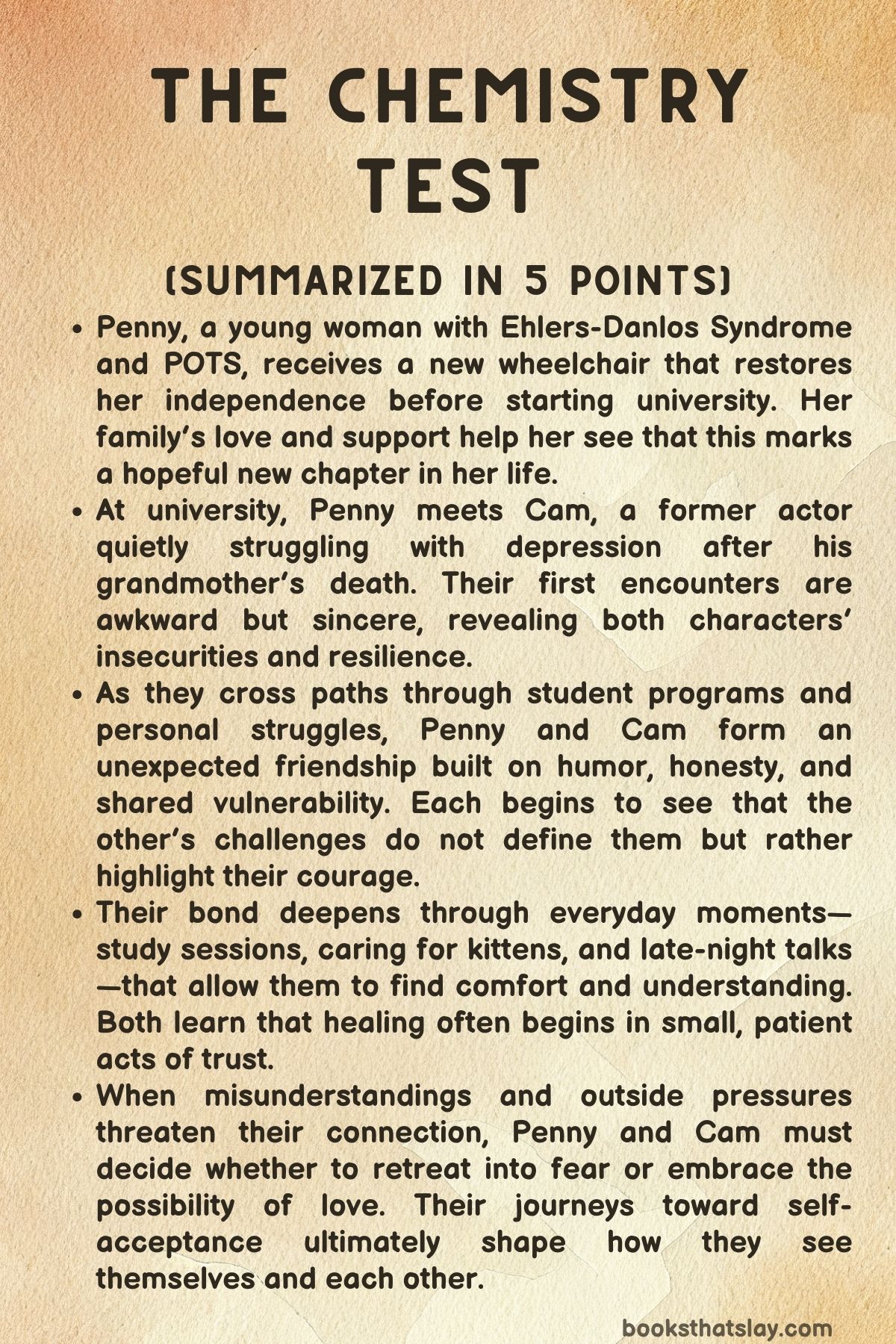
The Chemistry Test by Georgina Frankie is a tender and intelligent exploration of love, identity, and resilience. At its heart are Penny, a young woman living with Ehlers-Danlos Syndrome and POTS, and Cam, a former actor struggling with depression and grief.
Their lives intersect by chance and grow into a relationship defined by mutual vulnerability and courage. The novel follows their journey through illness, fame, self-doubt, and discovery, offering a portrayal of how two people with broken parts can still build something whole. Frankie crafts an honest, warm narrative about acceptance—of oneself, of others, and of the imperfect chemistry that binds them.
Summary
Penny, an eighteen-year-old about to start university, receives a new motorized wheelchair as a surprise from her mother, who reveals that her brother helped raise funds for it. The gift restores Penny’s independence and marks a turning point in her life with Ehlers-Danlos Syndrome and POTS.
On a visit to her doctor, she meets Cam, a nervous young man waiting for his appointment. Their first encounter is brief and clumsy—she accidentally bumps him with her chair—but it sparks a small curiosity between them.
When they meet again in the waiting room, they invent playful stories about each other, briefly forgetting their troubles. Yet, when Cam hides from some classmates to avoid being seen with her, Penny senses his embarrassment and leaves hurt.
Cam later regrets the moment but is consumed by his own battles. A former actor on a popular HBO series, The Age of Artemisia, he has withdrawn from acting after his grandmother’s death and now lives with friends while managing depression and medication.
Meanwhile, Penny begins university life with optimism but also anxiety about managing her illness alone. Her roommates, Amy and Ro, quickly become her support system.
During an accessibility meeting, she is assigned a student mentor—CJ—who turns out to be Cam under his initials. Their surprise reunion turns awkwardly warm, and as they tour the campus, their connection begins to rebuild.
Penny runs a secret online advice site, Closer Than Yesterday, where she supports strangers struggling with mental health. One of her anonymous correspondents, “A Not-So-Happy Camper,” shares feelings of grief and hopelessness—unbeknownst to her, it’s Cam.
Through these exchanges, they unknowingly grow closer, each offering the other comfort in different forms. Cam, meanwhile, starts attending grief counseling sessions, finally opening up about losing his grandmother.
His compassion extends to fostering kittens, one of which, Callie, becomes his source of healing.
At university, Penny begins facing the practical challenges of her condition—fainting spells, exhaustion, and awkward accessibility setups—but handles them with quiet determination. When she and Cam start seeing more of each other, their friendship strengthens.
They share meals, inside jokes, and an ease that feels new to both. Penny appreciates his sensitivity, while Cam admires her strength.
Yet Penny’s friends warn her to be cautious, worried that Cam’s feelings may waver when others are watching.
Cam begins making small steps toward recovery, guided by his therapy group and his bond with Penny. Wanting to help her feel more independent, he teaches himself wheelchair skills so he can help her navigate curbs safely.
The thoughtful gesture deepens their trust, and they spend an evening laughing and learning together. Later, Cam writes to his anonymous counselor—Penny—about his memories of his grandmother and finds peace through her unseen kindness.
Their friendship blossoms into affection. Penny helps Cam catch up on his studies, and together they comfort another struggling student, revealing their shared empathy.
When she meets Cam’s kittens and learns how devoted he is to them, Penny sees how much pain he carries beneath his calm demeanor. The more they learn about each other, the clearer it becomes that both are healing from different wounds.
Their bond takes a leap when they travel together on a short trip for a university project. On the flight, Penny suffers a panic attack, and Cam helps calm her with patience and humor, even taking her to the cockpit to meet the pilot.
Their shared vulnerabilities draw them closer, and conversations about fear, purpose, and identity bring unspoken feelings to the surface. Later, they share simple joys—pizza, laughter, mountain views—culminating in Penny’s birthday, which Cam celebrates with a scavenger hunt of cupcakes and notes signed “Love, CJ.
” The moment hints at love becoming real between them.
Their happiness is soon challenged when photos of them appear online, drawing public attention to Cam’s private life. As an actor, he’s unprepared for the exposure, and Penny, unfamiliar with fame, feels overwhelmed.
A misunderstanding follows when Penny realizes that “Cam,” the online friend she counseled, is the same person as CJ. Though accidental, the breach of anonymity shakes their trust.
Cam withdraws, and Penny blames herself, fearing she’s broken something precious.
Both try to move on, but their lives continue to overlap. Penny throws herself into a TEDx talk on invisible illnesses, advocating for self-belief and better symptom-based care.
When she spots Cam in the audience, the connection between them resurfaces. Afterward, he confesses he still wants to be with her, but Penny refuses, convinced their worlds don’t fit.
Cam leaves heartbroken, trying to focus on rebuilding his life and returning to acting.
Months later, Penny surprises him by showing up at his film premiere, dressed elegantly and determined to support him. The red-carpet event becomes chaotic—her wheelchair snags cables and disrupts equipment—but Cam stays by her side, reassuring her that she’s not ruining anything.
Inside the theater, Penny faints, and Cam catches her in his arms. As she regains consciousness, he tells her he loves her—not out of pity or obligation, but because he admires her strength and honesty.
She finally accepts that love doesn’t have to mean sameness, and they reconcile, sealing their bond with a kiss.
Two years later, Penny narrates the epilogue. She and Cam have graduated and built careers in science, still surrounded by their friends and family.
Amy is preparing for her master’s degree, Ro’s adaptive clothing line has become a success, and the kittens have grown into beloved family pets. As everyone gathers to watch the finale of The Age of Artemisia, Penny reflects on how far they’ve come—from loneliness and loss to a shared life of understanding.
Both she and Cam have learned that chemistry isn’t about perfection but about connection—the courage to stay when life’s tests get hard, and to find home in each other.
Characters
Penny
Penny is the emotional heart of The Chemistry Test, embodying courage, warmth, and the quiet defiance of someone determined to live fully despite physical limitations. Living with Ehlers-Danlos Syndrome and POTS, she endures chronic pain, fatigue, and social misunderstanding.
Yet rather than letting these conditions define her, Penny actively shapes her own identity around empathy and perseverance. Her new wheelchair at the start of the story is more than a mobility aid—it symbolizes regained independence and a fresh chapter in life as she begins university.
She navigates accessibility challenges and societal assumptions with grace, refusing to be pitied or underestimated.
Her personality is marked by kindness and emotional intelligence, most visible through her anonymous advice site, Closer Than Yesterday, where she comforts others even when she herself feels vulnerable. This duality—offering support while privately struggling—reveals a deeply human contradiction.
Penny’s growth throughout the novel lies in embracing imperfection: learning that strength isn’t measured by how invincible one appears, but by one’s willingness to be open and seen. Her relationships, particularly with Cam, test her capacity for trust.
She oscillates between pride and self-consciousness, independence and the need for connection. In the end, Penny becomes a symbol of holistic strength—physical, emotional, and moral—demonstrating that love and acceptance can coexist with vulnerability.
Cam (Cameron / CJ Taylor)
Cam, also known as CJ, is the novel’s other central force—a young actor whose external glamour hides deep emotional turmoil. Once a rising star on an HBO series, his life derailed after his grandmother’s death, leading to depression and the abandonment of his career.
Through Cam, The Chemistry Test explores the quiet, often invisible weight of grief and mental illness. His struggle isn’t dramatized through spectacle but through subtle moments—missed messages, avoidance of public spaces, self-recrimination, and the tentative rebuilding of self-worth.
Cam’s compassion reveals itself gradually. He fosters kittens, attends bereavement groups, and, though hesitant at first, learns to open up to Penny.
Their connection evolves from awkward strangers to confidants, with their mutual empathy forming the story’s emotional core. He admires Penny’s resilience but initially battles shame and insecurity—believing that, as a man and a public figure, he must hide weakness.
His journey culminates in understanding that strength lies in authenticity, not perfection. By the story’s conclusion, Cam reclaims both his art and his sense of self, not as an actor defined by fame but as a person capable of love, grief, and growth.
Amy
Amy, Penny’s flatmate, is the embodiment of practicality wrapped in warmth. A germ-conscious, methodical student, she initially appears slightly neurotic but quickly reveals herself as a steadfast friend.
Amy’s instinct to sanitize everything mirrors her emotional cautiousness, yet she becomes one of Penny’s strongest advocates. Her presence injects humor and balance into the narrative—she grounds the emotional intensity of Penny and Cam’s arcs with pragmatic care and loyalty.
Amy represents the everyday heroism of friendship: the quiet acts of understanding, the willingness to adapt to someone else’s pace, and the fierce protectiveness born from love.
Ro
Ro, another of Penny’s university flatmates, brings creativity and color into the story. He is open, expressive, and deeply empathetic, serving as both comic relief and emotional support.
His evolution—from a fashion enthusiast uncertain of his family’s acceptance to a confident designer whose reflective necklace line becomes a success—mirrors the theme of self-acceptance that runs through The Chemistry Test. Ro’s friendship with Penny is platonic but intimate; he listens, challenges her assumptions, and, like Amy, becomes a mirror through which she can see her worth more clearly.
His later collaboration with Amy and his connection to CJ’s life highlight how interconnected acts of courage can ripple outward to touch many lives.
Penny’s Mother
Penny’s mother is a figure of deep tenderness and quiet resilience. Her decision to organize the fundraiser for Penny’s wheelchair reveals both her resourcefulness and her protective nature.
Throughout the novel, she oscillates between overprotectiveness and pride in her daughter’s independence. Her calls and constant checking-in, while sometimes stifling, stem from profound love and fear—a mother witnessing her child navigate a world not built for her.
Through her, The Chemistry Test portrays caregiving as both an act of love and of letting go. Her arc subtly shifts from control to trust, paralleling Penny’s own growth toward autonomy.
Parker
Parker, Penny’s brother, is a minor but significant figure. His role in setting up the fundraiser introduces him as quietly compassionate, a sibling whose actions speak louder than words.
He represents the understated network of family support that allows Penny to step into her new life with confidence. Though he remains mostly in the background, Parker’s influence is one of grounding stability and familial love, reminding readers that even small acts of kindness can profoundly impact someone’s freedom.
CJ’s Mother
CJ’s mother embodies wisdom shaped by loss. Having endured the deaths of family members, she offers a model of resilience that contrasts with her son’s suppressed grief.
Their scenes together—preparing spaces for foster kittens, reminiscing about the past—are imbued with bittersweet warmth. Her line, “pain is love enduring,” distills the novel’s emotional thesis: grief is not the opposite of love but its continuation.
She gently guides CJ toward healing, not by forcing recovery but by modeling acceptance and compassion.
Callie and Tabby
The kittens, Callie and Tabby, serve as symbolic extensions of Cam’s and Penny’s emotional worlds. Callie, with her disability and fragile health, mirrors Penny’s condition, reminding Cam of his capacity for care and patience.
Tabby’s adoption and later return signify renewal and second chances, aligning with the novel’s recurring motif of love rediscovered after loss. Through these small creatures, The Chemistry Test portrays healing as something nurtured—quietly, persistently, and with tenderness.
Elias Thompson-Knight
Elias, Penny’s TEDx collaborator, represents ambition and the professional world Penny must learn to navigate. His intellectual enthusiasm and self-assurance contrast with Penny’s more self-effacing nature, highlighting her journey toward owning her voice.
Though he is not a romantic rival in any overt sense, his partnership with Penny forces CJ to confront jealousy and miscommunication. Elias’s role underscores one of the novel’s subtler lessons: that misunderstanding and insecurity often stem not from malice but from fear of inadequacy.
Josie
Josie, CJ’s co-star and longtime friend, brings clarity and humor to his life. As a counterbalance to his introspection, she offers practical advice and unwavering honesty.
Her presence reminds CJ—and the reader—that friendship can be just as sustaining as romance. By encouraging him to face his fears, attend premieres, and reclaim joy, she becomes a quiet architect of his recovery.
Themes
Disability and Independence
In The Chemistry Test, disability is presented not as a symbol of limitation but as a complex, lived reality that reshapes identity, relationships, and the pursuit of independence. Penny’s Ehlers-Danlos Syndrome and POTS form a constant backdrop to her growth—conditions that affect her physically, emotionally, and socially, yet never fully define her.
Her new wheelchair represents more than mobility; it symbolizes self-determination and the right to autonomy. Throughout the novel, Penny battles not just the constraints of her body but also the subtle paternalism of those around her—well-meaning peers, institutional barriers, and even her mother’s protective instincts.
Her struggle is to claim a voice within a world that often assumes fragility where there is resilience. The narrative’s detailed focus on accessibility meetings, awkward stares, and small victories in movement highlights how independence is a layered process.
It is not about rejecting help but redefining control on her own terms. When she learns to lift her wheelchair over kerbs or navigates university life with exhaustion and courage, Penny’s journey becomes a declaration of capability.
Her relationship with Cam amplifies this theme—he learns to support her without diminishing her agency. Through Penny’s determination and humor, the story reframes disability as a form of adaptation and strength, portraying independence not as isolation but as the power to live fully, with both vulnerability and confidence coexisting.
Grief and Healing
Grief permeates the emotional fabric of The Chemistry Test, shaping Cam’s arc as profoundly as illness shapes Penny’s. The death of his grandmother fractures his sense of self, robbing him of joy, purpose, and identity.
His depression and withdrawal from acting mirror the paralysis of loss—a numbness that seeps into every decision he makes. Yet, healing in the novel is not portrayed as an erasure of pain but as an act of integration.
Cam’s gradual return to living—caring for kittens, opening up in therapy, re-engaging with university, and allowing Penny into his life—reflects the slow, uneven nature of recovery. His grandmother’s memory continues to guide him, not as a haunting presence but as a source of moral and emotional grounding.
The recurring imagery of pets, especially Callie and Tabby, embodies continuity and compassion—love that endures through new forms. Penny, through her empathy and understanding, becomes both a mirror and catalyst for Cam’s healing.
Their conversations about fear, imperfection, and belonging allow him to process grief without shame. The novel suggests that grief’s weight can become lighter when shared, that love after loss is not betrayal but renewal.
By the end, Cam’s decision to return to acting and embrace vulnerability on his own terms signifies not closure but transformation—a life that carries grief forward, redefined through hope.
Love and Emotional Vulnerability
Love in The Chemistry Test emerges not as romantic fantasy but as a process of mutual unmasking. Both Penny and Cam carry insecurities—hers born of chronic illness and his from depression and public scrutiny.
Their connection thrives on shared honesty rather than perfection. Each moment of openness—whether Penny explaining her medical conditions, or Cam revealing his fears of inadequacy—challenges the usual scripts of romance.
The novel emphasizes emotional safety as the foundation of affection: Cam helping Penny with her wheelchair, her supporting him during breakdowns, and their quiet humor that turns pain into laughter. Their love grows through acts of gentleness, not grand gestures.
Vulnerability becomes a form of courage, redefining what strength looks like. Even their misunderstandings—like Penny discovering Cam’s hidden identity or her shame after an accident—serve to deepen trust.
Frankie constructs love as an acceptance of imperfection, where both learn to be seen fully, without performance or defense. The final reconciliation, grounded in empathy and mutual respect, solidifies love not as rescue but as partnership—a space where both can exist authentically, with flaws intact.
Identity and Self-Acceptance
The search for identity runs parallel in both protagonists, entwined with illness, fame, and self-perception. Penny’s identity evolves from seeing herself as defined by medical labels to recognizing her intellectual and emotional worth.
University becomes a crucible where she confronts external stigma and internalized doubt. Her online persona, “Closer Than Yesterday,” reflects her instinct to help others while avoiding her own need for affirmation.
By the end, she reconciles these sides, realizing that compassion for others must include herself. Cam’s identity crisis, rooted in celebrity and grief, explores the gap between public image and private truth.
His struggle to balance acting with emotional authenticity reveals the tension of living under constant observation. The story’s depiction of social media scrutiny and the fear of judgment highlights how easily self-worth can be shaped by external validation.
Both characters ultimately reclaim their narratives—Penny through advocacy and science, Cam through art reimagined as personal expression. Their journeys affirm that identity is not fixed but chosen, shaped by acceptance rather than avoidance.
In finding each other, they also find permission to exist freely—without apology for who they are, what they’ve lost, or how they love.
Resilience and Hope
Resilience in The Chemistry Test is quiet, persistent, and deeply human. The novel resists grand declarations of triumph, instead portraying endurance through everyday acts—attending lectures despite exhaustion, fostering animals, facing therapy sessions, or rebuilding after failure.
Penny’s optimism is not naïve; it’s hard-won through years of adapting to pain. Her mantra, “Don’t mock the process,” encapsulates the novel’s philosophy of perseverance through imperfection.
Similarly, Cam’s slow return to passion demonstrates resilience as recovery rather than invincibility. Their relationship reinforces that hope does not erase hardship; it coexists with it.
The book’s closing scenes—Penny delivering a TEDx talk, CJ returning to the red carpet—serve as symbolic affirmations that healing is circular, not linear. They have not transcended suffering; they have learned to live alongside it with grace.
Frankie’s portrayal of resilience rests on empathy and community, suggesting that strength grows in connection. Ultimately, The Chemistry Test celebrates hope as a conscious act—the decision to keep trying, to find meaning in small moments, and to believe that love and purpose can survive even the most testing chemistry of human life.