The Court of Venus Summary, Characters and Themes
The Court of Venus by Bel Banta is a historical fantasy novel that combines royal intrigue, forbidden romance, political ambition, and an inventive system of planetary magic.
Set in the fictional kingdom of Alvion, the story follows Bianca Mortlake, a gifted Moonborn magician who returns to the royal court seeking answers about the deaths of people she once loved. Her investigation reunites her with Roland, a powerful Venusborn magician whose political influence conceals personal suffering and dangerous secrets. As competing noble families struggle for control of the throne, Bianca discovers that love, loyalty, and magical power are closely connected, and that uncovering the past may transform the kingdom’s future.
Summary
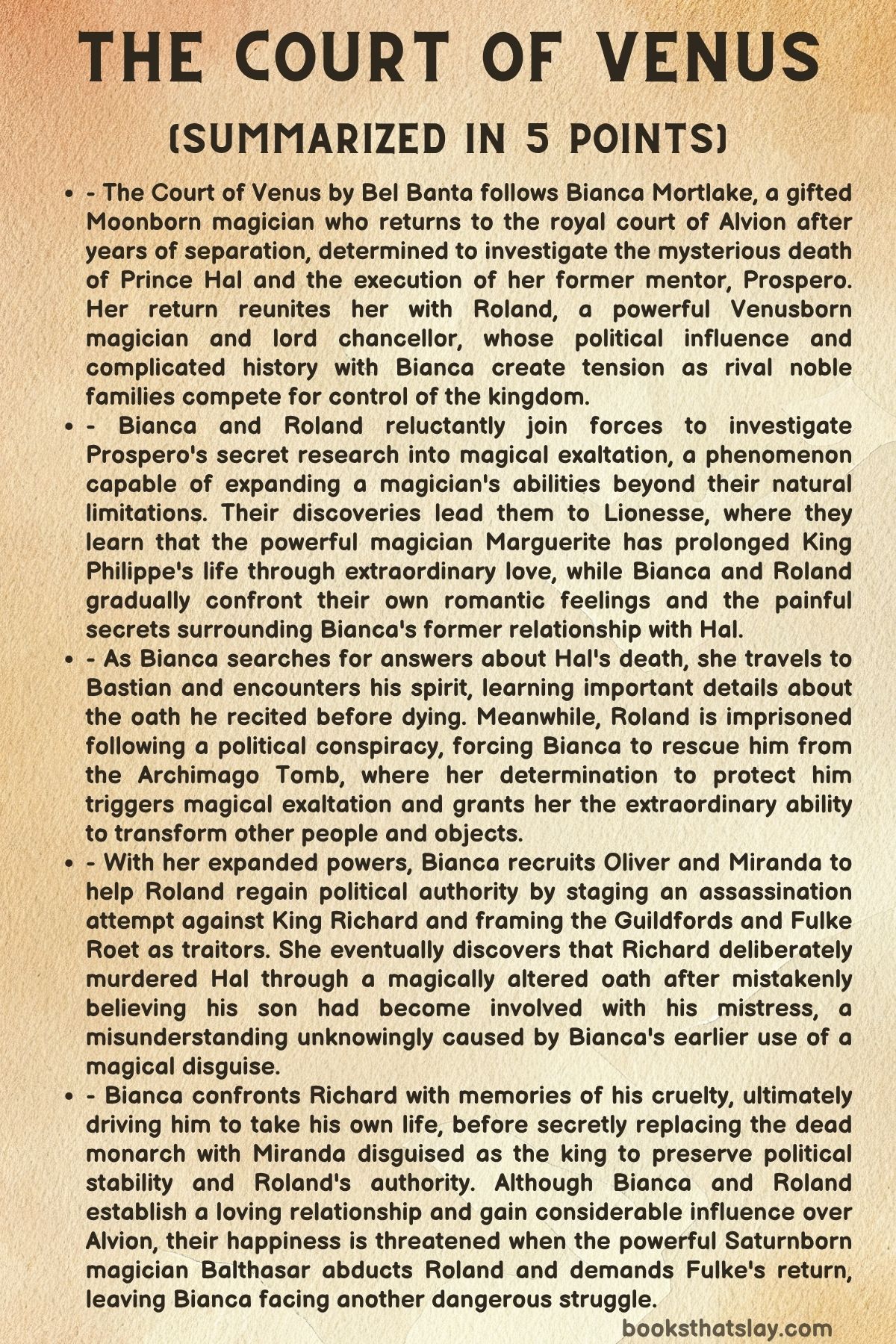
Bianca Mortlake, an extraordinarily talented Moonborn magician, returns to the royal court of Alvion after receiving an invitation supposedly sent by Roland, her childhood companion and the kingdom’s powerful lord chancellor. The invitation concerns a magical tournament celebrating the coronation of Queen Cecily, but Bianca’s true reason for returning is her desire to investigate the mysterious death of Prince Hal, whom she once loved.
Her journey to Redhall Palace revives painful memories of growing up alongside Hal and Roland under the supervision of Prospero, the kingdom’s celebrated magician. During her absence, Hal died under suspicious circumstances, Prospero and Queen Eleanor were executed, and Roland rose to unprecedented political authority under the increasingly unstable King Richard.
At court, Bianca discovers that Roland has become one of the most influential figures in Alvion. He occupies Hal’s former chambers, commands the attention of powerful nobles, and uses his Venusborn abilities to manipulate desires and maintain the appearance of the king’s failing health.
Their reunion is marked by resentment and mutual suspicion. Bianca initially accuses Roland of engineering Prospero’s execution, but he maintains that Richard ordered the magician’s death after Prospero failed to provide another male heir.
Roland also denies sending Bianca the invitation, suggesting that her return involves a deception. Although their relationship remains strained, both recognize that the kingdom faces a political crisis because Richard is gravely ill and his nephew, Fulke Roet, stands to inherit the throne unless Queen Cecily produces a son.
The Guildford family, closely connected to the queen, hopes to exploit this uncertainty and weaken Roland’s authority. Bianca infiltrates their private gatherings through her ability to assume other people’s appearances, discovering that Charles Guildford and his relatives are preparing to challenge Roland’s influence.
Their plans involve Miranda, a Marsborn magician capable of inflicting extraordinary physical suffering. Bianca also becomes suspicious when Ambrose, a Sunborn contestant, dies unexpectedly during the tournament festivities.
The tournament itself exposes the brutality of Richard’s court. Bianca survives a dangerous confrontation with Miranda during a challenge involving a captive bear, using emotional perception and animal transformations to overcome attacks that nearly kill her.
Roland tends her injuries afterward, revealing a protective side that complicates Bianca’s judgment of him. Their reluctant cooperation develops into a genuine partnership when they discover that Prospero had been conducting secret research into exaltation, a phenomenon supposedly capable of expanding a magician’s ordinary abilities.
Bianca and Roland investigate Prospero’s writings and discover that his research may have been connected to Richard’s obsession with securing his dynasty. They also suspect that Queen Eleanor participated in the work before her execution.
To gain information directly from the king, Bianca impersonates Prospero’s ghost. The encounter exposes Richard’s deteriorating mental condition, his cruelty, and his increasingly desperate desire to escape mortality.
Further investigation leads Bianca and Roland to Eleanor’s Book of Hours, which contains concealed correspondence and an unusual astrological chart. When they attempt to examine the writings, a deadly blood cipher nearly kills them both.
They survive only because Oliver, a Mercuryborn magician specializing in language and magical communication, manages to counteract the spell. The experience forces Bianca to confront how deeply she fears losing Roland, even though she has spent years blaming him for her suffering.
Oliver subsequently translates Eleanor’s hidden correspondence, revealing that King Philippe of Lionesse has survived far beyond an ordinary human lifespan. His longevity appears connected to Marguerite, a powerful Venusborn magician who has remained beside him for decades.
Prospero believed that exaltation might allow a magician to acquire powers capable of preserving human life. Richard’s ambitions had therefore shifted from producing another heir to achieving immortality himself.
Roland considers the political advantages of preserving Richard’s life, particularly because it could prevent Fulke from inheriting the throne. Bianca, however, questions whether extending the reign of a cruel monarch would benefit anyone.
Meanwhile, Bianca continues investigating Hal’s death. By impersonating Roland, she questions Kitty Seton, who participated in the original inquiry and possesses information about the prince’s final days.
Kitty reveals that Hal entered the forest alone because he was performing an oath associated with his royal responsibilities. She also describes a disagreement between Hal and Prospero shortly before his death.
During the interrogation, the new Moon arrives, temporarily stripping Bianca of her magical abilities and exposing her disguise. Kitty uses Bianca’s vulnerability to discuss her secret relationship with Hal and her possible romantic feelings for Roland.
The confrontation forces Bianca to acknowledge emotions she has long suppressed. Memories reveal that she and Hal became lovers after Roland departed for Lionesse, but their happiness was overshadowed by Hal’s arranged marriage and the knowledge that Bianca could never provide the royal heirs expected of a future queen.
Believing their relationship would damage Hal’s future, Bianca eventually accepted Prospero’s arrangement to leave the palace and enter the Stafford family’s service. Hal died afterward, leaving her burdened by regret and unresolved love.
Bianca and Roland eventually travel to Lionesse to question Marguerite about Philippe’s longevity. At the foreign court, they discover historical records proving that Philippe has occupied the throne for approximately ninety years.
Their investigation also brings their emotional relationship into sharper focus. Roland reveals the hardship of his childhood, the exploitation endured by his mother, and his private longing to become a father despite the infertility associated with magicians.
During an elaborate courtly game involving attraction, Roland confesses that he has loved Bianca for years. Although she responds to his affection, memories of Hal interrupt their intimacy, exposing the emotional conflict she has never resolved.
Marguerite subsequently reveals that she preserved Philippe’s life through the extraordinary power of her love rather than a predictable planetary alignment. Her magic can prolong his existence, but maintaining it has become increasingly difficult.
Marguerite also exposes Bianca’s former romance with Hal, devastating Roland, who never knew that his two closest companions had loved one another. Feeling betrayed, he withdraws from Bianca.
After apologizing and explaining her past, Bianca persuades Roland to support another investigation. She travels to Bastian, where Balthasar, a powerful Saturnborn magician, can communicate with the dead.
Balthasar identifies Prospero’s mysterious astrological chart as a Final Breath, a prediction marking the planetary alignment at someone’s death. Although he refuses to identify the person, Bianca realizes that the predicted death is approaching rapidly.
Inside Balthasar’s supernatural realm, Bianca fails to find Prospero but encounters several deceased figures, including Prince Hal. Through his memories, she witnesses his final journey into the forest and learns that Prospero intercepted a letter Bianca had written to him.
Hal encourages Bianca to embrace a future with Roland. His appearance also confirms that the oath he recited shortly before dying contains an important clue.
Returning to Alvion, Bianca discovers that Charles Guildford has arranged Roland’s imprisonment in the Archimago Tomb. She immediately attempts to rescue him, using transformations and emotional manipulation to bypass the prison’s defenses.
Miranda confronts them during their escape, and Bianca eventually assumes the form of an enormous white dragon. When their situation becomes desperate, Roland’s affection and her determination to save him trigger an extraordinary transformation in her magic.
Bianca achieves exaltation, gaining the ability to transform other people and ordinary objects rather than merely changing herself. She uses this new power to disguise Roland and escape the prison’s magical restrictions.
The fugitives seek refuge with Roland’s mother, Elizabeth Daymour, before developing a plan to overthrow the nobles responsible for his imprisonment. Bianca recruits Oliver and Miranda, appealing to their shared resentment toward the powerful families who have exploited them.
Miranda reveals that the Guildfords have controlled her since childhood through a binding oath. Oliver learns that Fulke and Jasper were responsible for Ambrose’s murder, giving him a personal reason to join Bianca’s conspiracy.
Together, the magicians stage an apparent assassination attempt against Richard. Miranda wounds the king, Bianca manipulates the resulting panic, and Roland uses his powers to make Fulke appear threatening.
The operation results in several deaths, including Tom Guildford’s, but succeeds in convincing Richard that the Guildfords and Fulke have betrayed him. Roland publicly intervenes as the king’s rescuer and regains his former authority.
With Oliver’s assistance, Roland secures magical legal documents restoring his influence and establishing provisions that could allow him to act as regent. Bianca recognizes that their victory depends upon deception and calculated violence, revealing how far she has moved from her earlier moral certainty.
Her investigation into Hal’s death nevertheless continues. After questioning the imprisoned nobles, she concludes that neither Charles Guildford nor Fulke directly arranged the prince’s murder.
Bianca eventually realizes that the answer lies in the oath Hal recited before dying. The wording had been deliberately altered so that an apparently ceremonial promise became a deadly magical command.
She confronts Richard in his chambers and shares her memories of Hal, forcing the king to witness their love and the consequences of his cruelty. Bianca discovers that Richard himself altered the oath because he believed his son had betrayed him by becoming involved with his mistress, Alice Seton.
Unable to murder Richard directly because of her magical obligations, Bianca overwhelms him with the memories and suffering of his victims. The king ultimately kills himself, fulfilling the prediction contained in the Final Breath.
Richard’s death creates another crisis when Balthasar attempts to intervene in Alvion’s succession. He believes he has rescued Fulke from imprisonment, but Bianca reveals that the apparent prince is actually another man whose appearance she transformed.
Bianca then investigates the accusation that caused Richard to condemn Hal. Through Kitty Seton’s memories, she discovers that the woman mistaken for Alice was Bianca herself, who had adopted Alice’s appearance during her secret relationship with the prince.
This revelation transforms Bianca’s understanding of the tragedy. Her own disguise unintentionally helped create the misunderstanding that convinced Richard to murder his son, making her an unwitting participant in the events she has spent years investigating.
To prevent foreign intervention and preserve Roland’s authority, Bianca devises an extraordinary deception. Instead of revealing Richard’s death, she transforms Miranda into his likeness and allows the court to believe the king remains alive.
The plan succeeds, leaving Roland in effective control of Alvion while Bianca becomes an influential political figure beside him. Their romantic relationship offers a measure of happiness after years of grief, misunderstanding, and separation.
Several months later, however, that happiness is threatened when Roland disappears. Bianca discovers a message from Balthasar announcing that he has imprisoned Roland within his supernatural realm and demanding Fulke’s return.
The warning also suggests that Bianca’s growing powers have made her a dangerous adversary whose death may already be foretold. The novel ends with Bianca facing another struggle against forces determined to control both magic and monarchy, leaving her future with Roland uncertain.
Characters
Bianca Mortlake
Bianca Mortlake is the central protagonist of The Court of Venus, a gifted Moonborn magician whose intelligence, emotional sensitivity, and determination drive the story. Her abilities allow her to read emotions, experience memories, and transform her appearance, giving her unusual advantages in a court governed by deception and political rivalry.
Despite her remarkable powers, Bianca remains deeply affected by childhood poverty, the loss of her adopted family, and the death of Prince Hal. Her return to Alvion is motivated by grief and a desire for justice, but her investigation gradually becomes a confrontation with her own memories and unresolved guilt.
Bianca’s relationship with Roland reveals her complicated understanding of love and trust. She initially treats him as a possible enemy, yet their shared experiences and growing attraction force her to reconsider the assumptions that have shaped her life.
Her defining transformation occurs when she achieves exaltation while trying to rescue Roland from execution. The expansion of her powers symbolizes her increasing independence, allowing her to move beyond the restrictions imposed by kings, noble families, and conventional magical limitations.
However, Bianca’s growing authority introduces moral complications. She participates in a staged assassination, manipulates political enemies, causes Richard’s death, and conceals the disappearance of the king behind a magical deception.
These decisions reveal that her compassion exists alongside a willingness to use coercion when she believes the consequences justify it. By the end of the novel, Bianca has become a powerful political strategist whose actions determine Alvion’s future, even as she remains vulnerable to personal loss.
Roland
Roland is the powerful Venusborn lord chancellor whose commanding presence, political intelligence, and extraordinary magical abilities make him one of the most influential characters in The Court of Venus. His magic allows him to perceive and manipulate desire, restore physical vitality, and influence the behavior of people around him.
Initially, Roland appears arrogant, ambitious, and willing to exploit King Richard’s instability for personal advancement. His occupation of Prince Hal’s former chambers and his extraordinary influence over the monarchy strengthen Bianca’s suspicion that he contributed to the tragedies surrounding their childhood.
As the novel progresses, however, his apparent confidence is revealed to conceal emotional insecurity and a desperate need for stability. Roland grew up in poverty, and his experiences protecting his mother from exploitation shaped his belief that power offers protection against humiliation and helplessness.
His romantic attachment to Bianca complicates his carefully controlled public identity. Although he has loved her for years, he frequently expresses affection through rivalry, sarcasm, and attempts to protect her rather than direct emotional honesty.
The revelation that Bianca and Hal were secretly lovers wounds Roland because he feels excluded from the intimate history of the two people closest to him. His eventual reconciliation with Bianca demonstrates his ability to recognize that love cannot be maintained through possessiveness or complete control.
Roland’s political ambition remains morally complicated. He willingly participates in manipulating Richard, deceiving the court, and framing his enemies, but his actions also reflect genuine concern about the kingdom’s future and his own survival.
His desire to become a father, despite the infertility associated with magicians, reveals a longing for ordinary domestic happiness. By the conclusion, Roland has gained both political authority and Bianca’s love, although his abduction by Balthasar demonstrates that neither achievement can guarantee lasting security.
Prince Hal
Prince Hal is a central figure in the novel despite having died before its present-day events begin. His kindness, rebellious nature, and relationship with Bianca influence nearly every major decision she makes.
Unlike his father, Hal resists the belief that royal duty must determine every aspect of his existence. He enjoys riding, archery, reading, and exploring the world beyond the palace, and his companionship provides Bianca with an escape from the restrictions of court life.
His romance with Bianca develops through mutual affection and a shared desire for personal freedom. When he proposes marriage, his willingness to disregard dynastic expectations demonstrates both the sincerity of his love and his limited understanding of the consequences Bianca would face.
Hal’s death becomes the central mystery that brings Bianca back to Alvion. The discovery that Richard deliberately killed him through a magically altered oath exposes the terrible vulnerability of a prince living under an absolute monarch.
His appearance in Balthasar’s realm also provides emotional resolution for Bianca. Rather than demanding that she remain devoted to his memory, Hal encourages her to accept Roland’s love and pursue happiness beyond their unfinished relationship.
Hal ultimately represents the human cost of a political system that treats children as possessions of the monarchy. His tragedy demonstrates how a loving, independent individual can be destroyed by authority disguised as paternal responsibility.
Prospero
Prospero is the celebrated magician who discovers Bianca’s extraordinary abilities and brings her into royal service. Acting as a teacher and adoptive father, he provides Bianca, Roland, and Hal with an education that shapes their understanding of magic, duty, and personal responsibility.
His influence continues long after his execution because the three young people measure their choices against the lessons he taught them. Bianca particularly associates him with intellectual curiosity, belonging, and the childhood security she eventually loses.
Yet Prospero is not entirely the benevolent guardian Bianca remembers. His involvement in separating Bianca from Hal, intercepting her correspondence, and conducting dangerous research for Richard reveals the compromises he made while serving the Crown.
His investigations into exaltation demonstrate exceptional intelligence and an ambition to extend the accepted boundaries of magic. However, his willingness to pursue extraordinary powers for an increasingly cruel king raises questions about his judgment.
Prospero’s execution illustrates the precarious position of even the kingdom’s most respected magician. His knowledge made him indispensable while it served Richard’s ambitions, but his failure to satisfy the king ultimately left him defenseless.
His lasting importance lies in the contrast between the ideals he taught and the political realities he helped preserve. Bianca’s eventual independence represents both a continuation of his intellectual legacy and a rejection of unquestioning service to royal authority.
King Richard
King Richard is the principal source of political corruption and familial tragedy in The Court of Venus. His deteriorating health, paranoia, cruelty, and obsession with preserving his dynasty create the instability that drives the struggle for Alvion’s throne.
Richard views the people around him primarily according to their usefulness. Magicians must extend his life, queens must produce heirs, and his son must obey commands that subordinate personal happiness to royal expectations.
His fear of death gradually overwhelms his concern for succession. Once he begins considering immortality, even his own children become potential threats rather than people deserving affection and protection.
Richard’s murder of Hal reveals the full extent of his moral collapse. Believing that his son has betrayed him with Alice Seton, he alters a ceremonial oath into a lethal blood cipher, using the prince’s obedience as the instrument of his destruction.
His behavior is complicated by his physical and mental deterioration, but the novel does not present illness as sufficient justification for his actions. His cruelty also emerges from a longstanding belief that his royal position entitles him to control other people’s lives.
Richard’s death at Bianca’s hands, indirectly induced through emotional magic, reverses the power relationship that has governed her childhood. The monarch who once controlled the lives of magicians is destroyed when one of those magicians confronts him with the suffering he caused.
Oliver
Oliver is a Mercuryborn magician whose command of languages, magical communications, and binding ciphers makes him indispensable in The Court of Venus. Initially introduced as a fellow traveler and tournament participant, he gradually becomes one of Bianca’s most valuable allies.
His abilities are particularly important because Mercuryborn magic can transform language into an instrument of extraordinary power. He can decipher concealed messages, create binding oaths, and counteract dangerous instructions that operate through words.
Oliver’s discovery that Jasper murdered Ambrose through a cipher associated with Fulke deeply affects him. His previous romantic connections with both men make the murder more personal, especially because he unknowingly helped develop the communication method used in the crime.
Although Oliver possesses considerable magical knowledge, he initially hesitates to challenge the established political order. His caution reflects an understanding that magicians are vulnerable to punishment regardless of how valuable their abilities may be.
His decision to join Bianca’s conspiracy demonstrates a shift from self-preservation toward collective resistance. He becomes essential to the legal and magical arrangements through which Roland regains authority and Fulke’s political position is weakened.
Oliver represents the importance of knowledge and cooperation in confronting entrenched power. His contributions demonstrate that intellectual abilities can be as influential as physical strength or extraordinary transformations.
Miranda
Miranda is a Marsborn magician whose destructive abilities initially establish her as one of Bianca’s most dangerous opponents in The Court of Venus. Associated with the Guildford family, she is introduced as an intimidating figure capable of inflicting intense physical pain and threatening even exceptionally talented magicians.
Her violence during the magical tournament and her later confrontation with Bianca at the Archimago Tomb suggest that she is a willing instrument of the nobility. However, the discovery of her personal history changes the reader’s understanding of her character.
Miranda has been bound to the Guildfords since childhood through a magical oath that prevents her from acting against them. Her apparent loyalty therefore conceals coercion, resentment, and years of forced participation in cruelty.
Her situation illustrates how magical obligations can transform extraordinary abilities into instruments of exploitation. Although she possesses formidable destructive powers, those abilities cannot protect her from the family that controls her.
Bianca’s decision to recruit Miranda instead of simply defeating her demonstrates the importance of understanding an adversary’s circumstances. Once offered a possibility of freedom, Miranda becomes an important participant in the conspiracy against the Guildfords.
Her transformation into Richard’s likeness after his death is particularly significant. Having spent much of her life controlled by aristocrats, she becomes the central figure in a deception that allows magicians to exercise effective authority over the monarchy.
Queen Cecily
Queen Cecily is Richard’s young wife, whose position depends almost entirely upon her ability to produce a male heir. Although her marriage places her near the center of royal authority, she possesses remarkably little control over her own circumstances.
Her family views her as a means of securing influence over the throne, while Richard treats her reproductive capacity as a political necessity. Cecily consequently becomes trapped between competing demands that offer her little personal freedom.
Her attraction to Roland suggests a longing for protection, affection, and recognition beyond her role as queen. However, his political obligations prevent him from offering the emotional security she desires.
Bianca recognizes Cecily’s vulnerability despite her connections to the Guildfords. Her decision to offer the queen emotional comfort demonstrates that compassion can survive even within an atmosphere of political hostility.
When the Guildfords are accused of treason, Cecily’s position becomes even more dangerous. Her claim that she is pregnant reflects the desperation of a woman whose safety depends upon satisfying the expectations of powerful men.
Cecily represents the limited agency available to women whose value is measured through marriage, fertility, and dynastic advantage. Her royal title provides status without necessarily granting meaningful independence.
Marguerite
Marguerite is the powerful Venusborn magician serving King Philippe of Lionesse. Her beauty, confidence, and extraordinary command of desire establish her as a formidable counterpart to Roland.
Her most remarkable achievement is her ability to preserve Philippe’s life far beyond its natural duration. This accomplishment challenges the established understanding of magical limitations and reveals that extraordinary powers may emerge through intense emotional attachment.
Unlike Prospero’s theories, Marguerite’s transformation does not depend upon a predictable planetary alignment. Her abilities have developed through her profound love for Philippe, suggesting that personal relationships can create magical consequences that formal scholarship cannot fully explain.
However, her achievement also carries a terrible burden. Sustaining Philippe has become increasingly difficult, and she cannot reverse the process without confronting the consequences of allowing him to die.
Marguerite’s treatment of Bianca and Roland exposes her willingness to use emotional vulnerabilities as weapons. By revealing Bianca’s past relationship with Hal, she deliberately damages the developing romance between the two magicians.
Her character illustrates the ambiguous relationship between love and control. Although devotion has expanded her powers, it has also created an obligation from which she appears unable to escape.
King Philippe
King Philippe is the ruler of Lionesse whose extraordinary longevity becomes a central mystery in Prospero’s research. Historical records reveal that his reign has lasted approximately ninety years, contradicting the age he appears to possess.
His continued existence depends upon Marguerite’s extraordinary Venusborn magic. This dependence complicates the conventional relationship between sovereign and servant because the supposedly subordinate magician possesses the power that maintains his life.
Philippe’s situation demonstrates that immortality may create vulnerability rather than freedom. Although his extended lifespan appears desirable to Richard and Roland, its maintenance places an enormous burden on Marguerite.
His character also functions as a warning about the hidden consequences of magical intervention. The preservation of a monarch’s life can become an arrangement that binds another person to indefinite service.
Balthasar
Balthasar is a powerful Saturnborn magician whose abilities allow him to communicate with the dead and control access to supernatural realms. His position at the court of Bastian gives him influence over both grieving individuals and powerful political figures.
He understands magical principles that other characters have only begun to investigate, including the meaning of the mysterious Final Breath. His knowledge allows him to anticipate events and exploit uncertainty surrounding death.
Balthasar initially appears as a potential source of answers for Bianca’s investigation into Hal and Prospero. However, Roland warns that the Saturnborn magician manipulates grief, suggesting that his apparent assistance may conceal ulterior motives.
Following Richard’s death, Balthasar attempts to influence Alvion’s succession by supporting Fulke Roet. His intervention demonstrates that political ambition extends beyond national boundaries and that foreign magicians can threaten the kingdom’s stability.
His eventual abduction of Roland establishes him as a continuing antagonist. By imprisoning Roland within his supernatural realm, he exploits Bianca’s deepest emotional vulnerability and attempts to force her into surrendering Fulke.
Balthasar represents the frightening possibility of power exercised through control over mortality itself. Unlike ordinary political opponents, he can threaten forms of punishment that extend beyond physical imprisonment or death.
Fulke Roet
Fulke Roet is King Richard’s nephew and a potential successor to the throne. His political importance increases as Richard’s health deteriorates and Queen Cecily struggles to produce an heir.
Fulke’s ambition makes him a natural opponent of Roland, whose continued influence depends upon controlling the royal succession. Although Fulke denies arranging Hal’s murder, he openly acknowledges that the prince’s removal would have benefited his political interests.
His involvement in Ambrose’s assassination demonstrates that his ambition is supported by a willingness to employ lethal methods. He uses magical intermediaries to carry out violence while attempting to preserve his own political position.
During Bianca and Roland’s conspiracy, Fulke’s desire for the throne becomes a weakness that Roland can manipulate. His actions are made to appear threatening to Richard, allowing the conspirators to portray him as a traitor.
Fulke ultimately becomes more important as a political symbol than as an independent actor. Balthasar’s determination to restore him to power reveals how competing factions can use hereditary claims to justify intervention.
Kitty Seton
Kitty Seton is a courtier whose knowledge of Prince Hal’s final days makes her important to Bianca’s investigation. Her involvement in the original inquiry connects her to testimony concerning the prince’s solitary journey into the forest.
Kitty is observant, socially ambitious, and skilled at identifying emotional vulnerabilities. When Bianca’s disguise collapses during the new Moon, Kitty takes advantage of the situation to question her about Hal and Roland.
Her greatest significance emerges when Bianca discovers that Kitty reported an apparent relationship between Hal and Alice Seton. Kitty had witnessed Hal with a woman who appeared to be Alice but failed to recognize that the woman was actually Bianca in disguise.
This mistaken identification set in motion the misunderstanding that encouraged Richard to murder his son. Kitty’s actions therefore demonstrate how incomplete observations can become devastating when interpreted through prejudice and suspicion.
Although Kitty is not responsible for Richard’s decision to kill Hal, her accusation illustrates the dangerous power of information at court. Her character shows how gossip, surveillance, and personal ambition can produce consequences far beyond the intentions of those involved.
Charles Guildford
Charles Guildford is a leading member of the powerful Guildford family and a central participant in the struggle against Roland’s authority. He represents the interests of a noble faction determined to preserve its influence over Queen Cecily and the royal succession.
His hostility toward Roland arises from the lord chancellor’s exceptional access to Richard and his ability to influence the monarchy without belonging to the established aristocratic hierarchy. Charles regards Roland’s authority as an obstacle to the Guildfords’ ambitions.
His involvement in arranging Roland’s arrest reveals his willingness to exploit political institutions to eliminate opponents. He also benefits from the coercive service of Miranda, illustrating his family’s dependence upon controlled magical power.
However, Charles’s political calculations ultimately fail when Bianca and Roland organize a conspiracy that makes the Guildfords appear responsible for an assassination attempt. His downfall demonstrates the danger of relying upon influence that can disappear as quickly as royal favor changes.
Tom Guildford
Tom Guildford is a member of the Guildford faction whose position places him among Roland’s political opponents. His participation in courtly activities, including hunting and jousting, connects the aristocratic culture of entertainment with the larger competition for influence.
Tom’s rivalry with Roland reflects the hostility between established noble families and a magician who has acquired extraordinary political authority. Their competition is personal, but it also represents conflicting claims to prestige and royal attention.
He dies during the violence unleashed by Bianca and Roland’s staged assassination attempt. His death demonstrates that even carefully planned political deception can produce consequences beyond the conspirators’ immediate objectives.
Tom’s fate also complicates the apparent success of Bianca’s strategy. His death reminds the reader that the restoration of Roland’s authority is achieved at a real human cost.
Jasper
Jasper is a Jupiterborn magician whose abilities and political associations connect him to the dangerous competition for power within Richard’s court. Although initially presented as another tournament participant, he becomes implicated in the assassination of Ambrose.
Oliver discovers that Jasper used a magical instruction concealed within music to carry out the murder. This revelation demonstrates how specialized magical abilities can be used for assassination while concealing the identity of the perpetrator.
Jasper’s relationship with Oliver gives the crime an additional emotional dimension. His involvement represents a betrayal of intimacy as well as an act of political violence.
During the staged assassination attempt against Richard, Jasper loses control of his powers and transforms into an enormous giant, contributing to the destruction in the great hall. His character illustrates the danger of extraordinary strength when it operates without ethical restraint.
Ambrose
Ambrose is a Sunborn magician whose gift allows him to discern truth. His presence in the tournament introduces a form of magic that could potentially expose deception within the royal court.
His sudden death during the festivities initially appears mysterious, but Oliver later discovers that Jasper murdered him through an elaborate Mercuryborn cipher. Fulke’s involvement connects the killing to the kingdom’s wider political conflicts.
Ambrose’s death is particularly significant because it demonstrates the vulnerability of magicians whose abilities threaten powerful interests. His gift for recognizing truth becomes dangerous in an environment where political survival depends upon concealment.
Although Ambrose does not receive extensive development, his murder becomes an important motivation for Oliver’s eventual alliance with Bianca. His fate also establishes the tournament as an instrument of political violence rather than an innocent celebration of magical talent.
Elizabeth Daymour
Elizabeth Daymour is Roland’s mother, whose difficult past helps explain his complicated relationship with love, wealth, and personal security. Her experience working in a brothel exposed Roland to exploitation and hardship during his childhood.
As a young magician, Roland attempted to protect her by manipulating the desires of her customers. These experiences shaped his understanding of Venusborn power as both a means of protection and a response to helplessness.
When Roland returns to her establishment after escaping imprisonment, their reunion reveals the emotional distance that has developed between them. Elizabeth appears particularly concerned about his financial circumstances and public position, leaving Roland without the unconditional reassurance he desires.
Her character emphasizes the lasting psychological effects of poverty and social humiliation. She also helps explain why Roland’s extraordinary ambition exists alongside a longing for family, affection, and acceptance.
Queen Eleanor Guildford
Queen Eleanor Guildford is a deceased royal figure whose secret intellectual activities become essential to Bianca’s investigation. Her collaboration with Prospero reveals that she possessed knowledge extending beyond the political responsibilities associated with her position.
The concealed correspondence in her Book of Hours contains vital information about magical exaltation and King Philippe’s unnatural longevity. Her participation suggests that she recognized the significance of magical research for preserving or transforming royal authority.
Eleanor’s execution connects her fate to the broader atmosphere of fear surrounding Richard’s court. Like Prospero, she becomes another example of how proximity to royal power can provide influence while creating mortal danger.
Her appearance among the dead encountered by Bianca reinforces the importance of recovering suppressed histories. Eleanor’s surviving writings allow her to influence the living long after the monarchy has eliminated her.
Alice Seton
Alice Seton is a former mistress of King Richard whose identity becomes central to the mystery surrounding Prince Hal’s death. Richard believes that Hal betrayed him by becoming romantically involved with Alice, an accusation that helps provoke the king’s murderous response.
The truth is that Bianca had assumed Alice’s appearance during her secret relationship with Hal. Kitty Seton’s failure to recognize the disguise caused Bianca’s private actions to be interpreted as evidence of the prince’s betrayal.
Alice’s importance therefore arises largely from how others perceive and use her identity. Her apparent involvement in the scandal exposes the ease with which women at court can become objects of suspicion and accusation.
Her appearance in Balthasar’s realm also connects her to the deceased figures who help Bianca investigate the past. Alice’s role demonstrates that identity and appearance can become dangerous when a ruler allows jealousy to determine justice.
Wyatt Francis
Wyatt Francis is an influential courtier associated with Roland and the political atmosphere surrounding the magical tournament. He participates in courtly activities where personal rivalry, aristocratic status, and royal favor determine social standing.
His most significant contribution is the design of a tournament challenge requiring magicians to identify alleged traitors among imprisoned subjects. The challenge exposes the cruelty of Richard’s administration because the contestants are expected to participate in executions presented as entertainment.
When Bianca discovers that neither of her assigned prisoners is guilty, Richard disregards her judgment and orders an execution anyway. Wyatt’s contest therefore becomes a crucial moment in Bianca’s growing rejection of the court’s accepted moral standards.
His character represents the officials who normalize cruelty by incorporating it into royal ceremony. Rather than openly opposing justice, such figures help create institutions in which injustice appears routine.
Joan Rockford
Joan Rockford is a lady-in-waiting whose position gives her access to private conversations involving Queen Cecily and the powerful members of the court. Her additional role as an informant for Roland makes her identity particularly useful for gathering information.
Bianca impersonates Joan during the masque to investigate the Guildford family’s activities without attracting attention. Through this disguise, she discovers the extent of the family’s hostility toward Roland and the political danger surrounding the tournament.
Joan’s role emphasizes the importance of servants and attendants as sources of intelligence in aristocratic households. Individuals who appear socially subordinate may possess access to information unavailable to more powerful figures.
Edward Guildford
Edward Guildford is a member of the noble family opposing Roland, and his identity becomes useful to Bianca during her investigation. She places him into an enchanted sleep before assuming his appearance to gain access to private Guildford affairs.
Her impersonation allows her to observe discussions and behavior that would otherwise remain concealed. Edward’s role demonstrates the particular advantage of Moonborn transformation in a political environment where family membership determines access and trust.
Although Edward’s independent motivations receive limited attention, his position illustrates how noble identity can function as a form of political privilege. Bianca’s ability to appropriate that identity temporarily undermines the boundaries protecting the aristocracy.
Queen Gertrude
Queen Gertrude is one of the deceased figures Bianca encounters while visiting the supernatural realm controlled by Balthasar. Her appearance contributes to Bianca’s understanding of the troubled history surrounding Richard’s monarchy.
As a figure from the royal past, Gertrude demonstrates that the consequences of political cruelty extend beyond the lives of those presently occupying the palace. Her presence reinforces the importance of testimony from individuals whose experiences have been excluded from official accounts.
Her role also broadens the significance of Bianca’s journey among the dead. The supernatural encounter becomes an investigation into the monarchy’s accumulated suffering rather than simply an opportunity to speak with Prospero or Hal.
Faustus
Faustus is an influential magician whose writings and teachings help shape the intellectual background of the novel’s magical system. His research attracts Prospero’s attention and provides another source of knowledge concerning the possibilities and limitations of magic.
His connection to Balthasar’s magical education suggests that the study of extraordinary powers extends across national borders and different planetary traditions. The survival of his writings also allows later magicians to reconsider theories that may have been neglected or misunderstood.
Faustus functions primarily as an intellectual influence rather than an active participant in the central conflict. His importance lies in demonstrating how magical discoveries depend upon knowledge passed between generations, even when rulers attempt to control or suppress that knowledge.
Themes
Love as a Source of Power and Transformation
Love possesses a transformative force that extends beyond emotional attachment and becomes an essential element of the magical system in The Court of Venus. The experiences of Bianca, Roland, and Marguerite demonstrate that extraordinary abilities may develop through profound emotional connections rather than through knowledge or technical mastery alone.
Bianca initially associates love with loss because her relationship with Prince Hal ended in separation and tragedy. His death leaves her convinced that loving someone creates an unbearable vulnerability, making her reluctant to acknowledge her growing affection for Roland.
Roland approaches love from a different emotional position. His childhood experiences taught him to associate affection with protection, obligation, and the fear of abandonment, which explains why he frequently expresses care through political influence and personal sacrifice.
Their relationship gradually challenges these assumptions. Bianca discovers that accepting Roland’s affection does not require abandoning Hal’s memory, while Roland learns that genuine intimacy depends upon trust rather than the ability to control another person’s desires.
The connection between love and magic becomes explicit when Bianca achieves exaltation while attempting to save Roland from imprisonment. Her extraordinary transformation occurs because her emotional commitment enables her to exceed limitations that previously appeared permanent.
Marguerite’s preservation of Philippe reinforces this connection, but her circumstances reveal its darker implications. Her love grants her the power to prolong his life, yet the responsibility becomes increasingly difficult to sustain.
The novel therefore presents love as both a liberating and potentially burdensome force. Its capacity to create extraordinary change does not eliminate grief, jealousy, fear, or the possibility that devotion may become another form of confinement.
Identity, Deception, and the Search for Truth
Appearances cannot be trusted in a society where magicians can alter bodies, influence emotions, and manipulate language. Bianca’s Moonborn abilities make identity unstable, allowing her to inhabit other people’s appearances while exposing the fragility of assumptions upon which social and political authority depends.
Her disguises initially function as practical instruments of investigation. By impersonating Joan Rockford, Edward Guildford, Roland, and Prospero, she gains access to conversations and information that would otherwise remain unavailable.
However, the same abilities that help Bianca uncover secrets also contribute to the greatest tragedy of her life. Her decision to assume Alice Seton’s appearance during her relationship with Hal creates the misunderstanding that leads Richard to believe his son has betrayed him.
This revelation demonstrates that deception can produce consequences far beyond the intentions of the person employing it. Bianca never intends to endanger Hal, yet the false identity she adopts becomes inseparable from the circumstances of his death.
Other characters also manipulate appearances to preserve authority. Roland makes Richard appear healthier than he truly is, while Bianca eventually transforms Miranda into the dead king’s likeness to maintain political stability.
These actions raise an important question about whether deception becomes acceptable when employed for seemingly beneficial purposes. The characters repeatedly justify falsehoods through necessity, but the novel shows that even carefully planned illusions can generate violence and suffering.
Truth itself becomes difficult to distinguish from interpretation. Kitty witnesses an encounter accurately enough to identify the apparent participants, yet misunderstands its meaning because she cannot recognize the transformation.
The search for truth consequently requires more than supernatural perception. Bianca must confront personal memories, question inherited assumptions, and recognize how her own actions have contributed to the false narratives she seeks to expose.
Grief, Memory, and Personal Responsibility
Grief shapes the motivations of nearly every central character, determining how they understand the past and approach the possibility of future happiness. Bianca’s return to Alvion begins with her inability to accept the official explanation for Hal’s death and her belief that discovering the truth might resolve years of suffering.
Her memories of Hal preserve the happiness of their relationship while also reinforcing her guilt about leaving him. She repeatedly imagines that different decisions might have prevented his death, even though she does not yet understand the circumstances surrounding it.
Prospero’s execution creates another emotional wound because Bianca loses the teacher who offered her security and belonging. Her suspicion of Roland partly reflects her attempt to identify someone responsible for the destruction of their childhood family.
Roland experiences a similar grief but responds by pursuing political authority. His determination to preserve his position suggests that controlling the present offers him a way to avoid confronting the helplessness he experienced when Hal and Prospero died.
The supernatural realm governed by Balthasar gives grief a more literal dimension. Bianca can encounter the dead and recover information from their memories, yet these meetings do not restore the relationships she has lost.
Hal’s encouragement to embrace Roland’s love becomes especially meaningful because it challenges Bianca’s belief that moving forward would betray his memory. Remembering someone does not require sacrificing the possibility of future affection.
The discovery that Bianca’s disguise indirectly contributed to Hal’s murder complicates her emotional recovery. She must acknowledge an unintended role in the tragedy without confusing that involvement with Richard’s deliberate decision to kill his son.
The novel presents responsibility as something more difficult than assigning blame. Bianca’s development depends upon recognizing the limits of her control, accepting painful truths, and choosing how to live after learning that the past cannot be changed.
Political Power, Freedom, and Moral Compromise
Political authority in The Court of Venus depends less upon justice than upon the ability to control information, enforce obedience, and manipulate the fears of others. King Richard’s monarchy provides the clearest example of a system in which personal desire becomes law and opposition can result in imprisonment or death.
Magicians occupy a particularly contradictory position within this hierarchy. Their abilities make them indispensable to rulers, but magical oaths and political dependence often prevent them from exercising genuine freedom.
Prospero’s execution demonstrates that exceptional knowledge cannot guarantee protection from arbitrary royal judgment. Miranda’s bondage to the Guildfords provides an even more direct example of extraordinary personal power existing alongside complete political subordination.
Roland initially appears to have escaped these restrictions through his position as lord chancellor. However, his arrest reveals that his authority ultimately depends upon Richard’s favor and can be withdrawn whenever powerful nobles succeed in challenging him.
Bianca’s exaltation changes the balance between magicians and monarchy. Her expanded abilities allow her to manipulate the very structures that previously controlled her, eventually enabling her to determine how political authority will be exercised.
Yet her liberation introduces serious ethical problems. She helps organize a violent deception, frames political opponents, indirectly causes Richard’s death, and participates in concealing the king’s disappearance.
These decisions challenge the assumption that resistance to tyranny necessarily produces morally superior leadership. Although Bianca and Roland seek to protect themselves and stabilize Alvion, they increasingly rely upon methods resembling those used by their enemies.
The false continuation of Richard’s reign provides the clearest illustration of this contradiction. The magicians gain practical control of the kingdom, but their authority depends upon maintaining a public illusion rather than allowing the population to confront the truth.
The novel ultimately questions whether freedom can be secured through manipulation without reproducing the abuses it seeks to overcome. Bianca’s growing power creates the possibility of changing Alvion, but the unresolved political conflict and Balthasar’s continuing threat demonstrate that acquiring authority is not the same as establishing justice.