The Cove by Claire Rose Summary, Characters and Themes
The Cove by Claire Rose is a young adult horror novel about seventeen-year-old Lindsay Weinberg, a rebellious student whose repeated expulsions conceal a deeper sense of abandonment.
Sent to an isolated coastal farm in Maine, Lindsay discovers that the supposed rehabilitation program is controlled by a frightening woman posing as her aunt. Strange deaths, ritual objects, missing teenagers, and a secret island community soon force her to question every explanation she receives. Combining supernatural horror with themes of identity, coercion, family neglect, and chosen community, the book follows Lindsay as she learns that survival depends not only on resisting her captors but also on trusting people who refuse to abandon her.
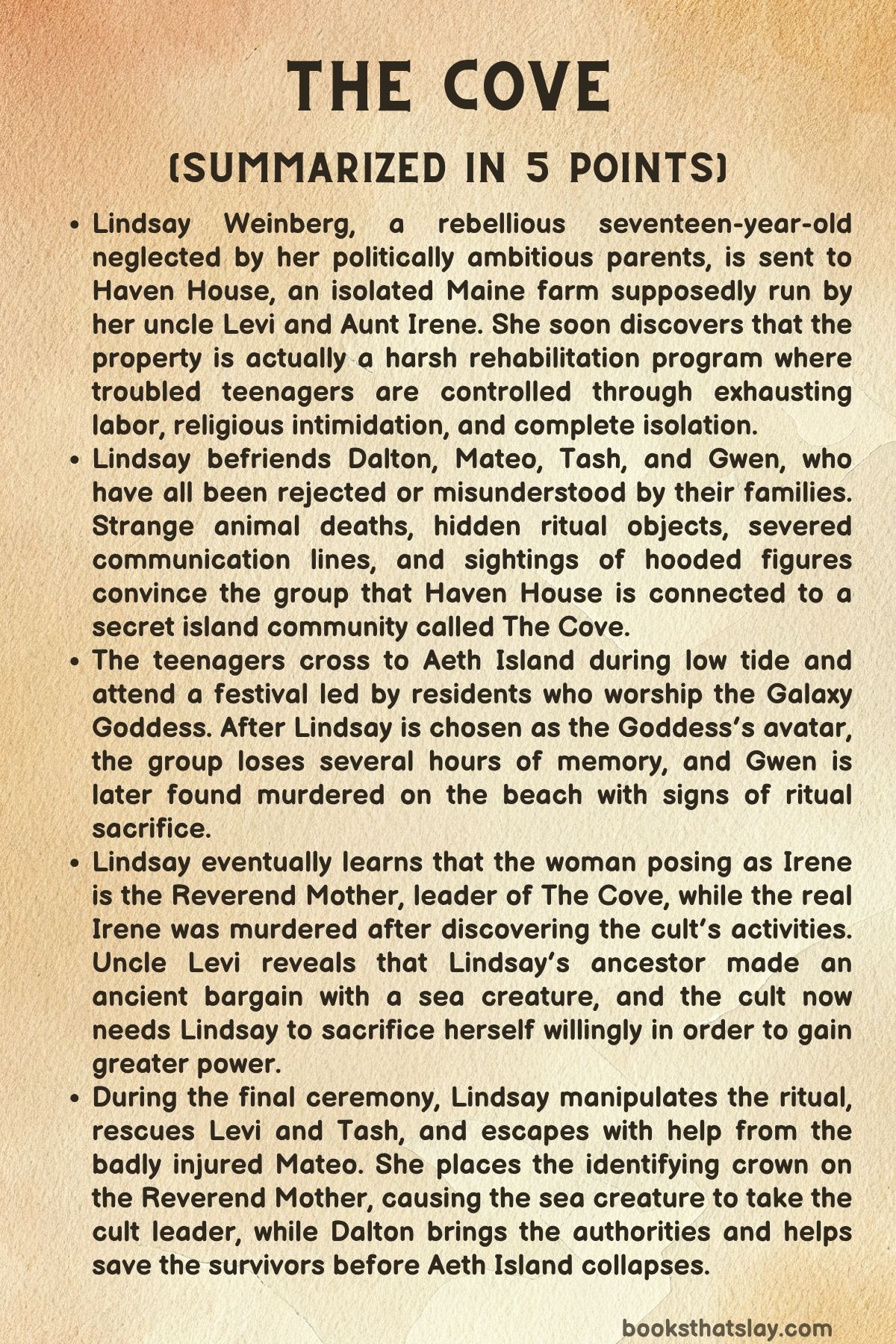
Summary
Seventeen-year-old Lindsay Weinberg is called to the office of Headmistress Delaney after skipping another class at Eastwood Academy. Lindsay has accumulated an extraordinary record of misconduct, including plagiarism, setting off fire alarms, releasing insects, violating school rules, and even advertising the school for sale online.
She expects to be expelled from her third boarding school and secretly hopes that another failure will finally force her emotionally distant parents to bring her home to Brooklyn. Instead of treating Lindsay as a hopeless troublemaker, Delaney recognizes that her destructive behavior may come from pain and neglect.
Delaney asks Lindsay to leave for the remainder of the semester but offers her the opportunity to return in the fall under academic probation. Lindsay rejects the offer with sarcasm, yet the headmistress’s concern affects her because it is one of the few times an adult has appeared angry on her behalf.
Rather than taking Lindsay home, her parents arrange for an unfamiliar driver to transport her north. Lindsay eventually learns that she is being sent to Marbury, Maine, to stay with her estranged uncle Levi and his wife, Irene.
Her mother, Rebecca, presents the arrangement as an opportunity for reflection, but Lindsay understands that her parents are once again removing her from their lives. Rebecca is focused on her Senate campaign, while Lindsay’s father, Bill, remains equally unwilling to confront the family’s problems.
Marbury is a nearly deserted village surrounded by forest, farmland, cliffs, and the Atlantic Ocean. Lindsay is left at Haven House, an old coastal farmhouse where she is greeted by a severe woman claiming to be Aunt Irene.
Irene offers little warmth and announces that Levi is away on a business trip. Her strange biblical quotations, rigid manner, and refusal to explain Levi’s absence immediately make Lindsay suspicious.
In Lindsay’s attic bedroom, a typed letter supposedly written by Levi repeatedly misspells her name. She also notices a hooded figure moving through the fields and discovers that the room has no electrical outlets or reliable means of communication.
The next morning, Lindsay meets four other teenagers living at Haven House. Dalton is confident and charming, Mateo is sarcastic and openly gay, Tash is quiet and observant, and Gwen is struggling with addiction and emotional withdrawal.
They explain that Haven House is presented to parents as a religious rehabilitation program for troublesome teenagers. Tash has been rejected because he is transgender, while Mateo was sent away partly because of his sexuality.
The teenagers follow an exhausting daily routine of farm labor, household chores, compulsory meals, and monitored recreation. Irene controls their food, sleep, communication, and movements, using collective punishment to make them afraid of breaking rules.
Lindsay attempts to use the house’s landline but discovers that its cable has been deliberately cut. Irene confiscates her mobile phone and warns her about a wooden paddle hanging on the wall, confirming that the teenagers are prisoners rather than willing participants.
Strange events begin occurring around the property. Lindsay and Dalton discover a dead seagull that releases seawater from its beak, even though it appears to have drowned far inland.
Later, Lindsay uncovers a gutted fish buried beneath the vegetable garden. She also discovers that barbed-wire fencing surrounds the farm, while the remaining boundary consists of dangerous cliffs above the sea.
From the cliffs, Lindsay notices smoke rising from a beach beyond the rocks. During a supply trip into town, she meets pale, silver-haired twins named Cass and Phin, who claim to live in a settlement called The Cove on nearby Aeth Island.
Cass and Phin invite Lindsay to an island celebration. Although their old-fashioned clothing and unusual interest in her Star of David necklace concern her, Lindsay believes the island may offer a boat, telephone, or route of escape.
When Lindsay returns to Haven House, she learns that Gwen’s favorite goat has been killed. Its body has been cut open and filled with seashells instead of organs, making the death appear ritualistic.
Irene reacts violently when Lindsay mentions Aeth Island and orders the teenagers never to approach the cliffs. Her fear convinces Lindsay that the island contains information about Levi, Haven House, or the strange deaths.
Dalton reveals that he has found a hidden staircase leading down the cliff. Lindsay, Dalton, Mateo, Tash, and Gwen secretly descend to the beach and cross a rocky causeway that appears only during low tide.
Cass and Phin welcome them as though their arrival had been expected. They introduce the teenagers to their isolated community, whose residents worship a cosmic being called Andromeda, the Galaxy Goddess.
The island celebration initially resembles a welcoming party filled with food, music, dancing, and alcohol. Lindsay kisses Cass, while the other Haven House residents briefly relax and enjoy the acceptance they have been denied elsewhere.
The mood changes when a masked leader begins a ceremony involving blood, chanting, and a crown called the Circlet of Sea and Sky. Lindsay feels an unnatural attraction to the crown before Cass declares her the chosen avatar of the Goddess.
Lindsay later awakens at Haven House with no memory of leaving the island. Her bed is covered with sand, seaweed, shells, and seawater, and the Circlet rests beside her.
Dalton, Mateo, and Tash have also awakened with mysterious ritual objects. Gwen, who had attempted to remain sober and might remember what happened, has disappeared.
Lindsay and Dalton follow circling seagulls to the beach, where they discover Gwen’s body. Her throat has been cut, and a new seashell necklace hangs around her neck.
They bring Tash into their confidence and hide Gwen’s body in a potting shed until they can contact the authorities. Meanwhile, Lindsay searches Irene’s locked bedroom and discovers damp sheets surrounded by a precise circle of seashells and sand.
When Lindsay and Dalton attempt to walk into town, they find Irene unconscious inside her damaged truck. Irene claims the sheriff and townspeople attacked her, stole her satellite phone, and caused Mateo to run into the forest.
While searching for him, the group discovers a clearing filled with blood, pieces of Mateo’s clothing, his shoes, and his severed hand. Irene immediately declares that Mateo is dead, though the absence of his body leaves Lindsay and the others uncertain.
Back at Haven House, the Circlet begins producing a mournful song that calls Lindsay toward the sea. Dalton and Tash hear it as well, proving that the phenomenon is not simply a hallucination.
An unnatural fog soon surrounds the property. Cass and Phin appear inside it and warn Lindsay that Irene is not who she claims to be, suggesting that even her name may be false.
Irene later tells the teenagers that Levi disappeared while fishing near Aeth Island. She claims The Cove murdered him and argues that the entire town supports the island’s sacrificial religion.
Lindsay pretends to believe her but remains suspicious. Her doubts become certainty when she finds a photograph of a completely different woman identified as Irene Weinberg.
A store employee confirms that the real Irene died in a car accident several months earlier. Lindsay realizes that the woman controlling Haven House has stolen a dead woman’s identity.
Dalton then leads Lindsay and Tash to a hidden shed containing animal skulls, shell decorations, axes, machetes, and bloodstained blades. Before they can investigate further, hooded figures appear and chase them toward the cliffs.
Unable to return to the farmhouse, the teenagers cross to Aeth Island and seek protection from Cass and Phin. The twins claim that the people of Marbury belong to an older murderous cult, while The Cove represents the innocent descendants who escaped from it.
Their story contains obvious gaps, and every request for communication or transportation is delayed. During the night, Lindsay and Dalton share painful personal truths, including Lindsay’s memory that her parents have never personally sung “Happy Birthday” to her.
By morning, Dalton has disappeared. Cass and Phin claim he stole a motorboat, abandoned his friends, and may have been working as a spy for Marbury.
When Tash and Lindsay challenge the twins, Cass accidentally reveals that the real Irene had discovered the island’s activities. She and Phin admit that Irene died while trying to seek help.
Islanders surround Lindsay and Tash, and the masked ceremonial leader reveals herself as the woman who posed as Irene. She is the Reverend Mother, leader of The Cove and mother of Cass and Phin.
The Reverend Mother demonstrates the cult’s methods by forcing Tash to hold a knife while she kills a teenage girl named Eve. The act restores Tash and Lindsay’s suppressed memories of the festival.
They remember that Tash had been drugged or supernaturally controlled while the cult used his arm to cut Gwen’s throat. The ritual objects left beside the teenagers were intended to make them believe they had voluntarily participated in Gwen’s death.
Lindsay and Tash are imprisoned in an underground shelter, where they discover that Uncle Levi is still alive. Levi explains that the real Irene uncovered the truth about the island and was murdered while attempting to escape.
He reveals that Lindsay’s connection to The Cove began with her ancestor Jakub. During an Atlantic crossing, Jakub begged an unknown power in the sea to save his dying family.
After settling at Haven House, Jakub learned that the islanders sacrificed young girls to a sea creature associated with their Goddess. His bargain ensured that the cult would remain confined to Aeth Island as long as one of his descendants lived on the mainland property.
However, a willing sacrifice from Jakub’s bloodline on Aeth Island would give the cult greater freedom and power. Lindsay was brought to Haven House so that the Reverend Mother could manipulate her into crossing willingly and accepting the role of tribute.
The cult prepares Lindsay for sacrifice by dressing her in white, placing a seashell necklace around her throat, and returning the Circlet to her. Lindsay pretends to cooperate while secretly stealing the ceremonial knife.
At the beach, the Reverend Mother explains that Lindsay must enter the water willingly and bind herself to a bloodstained rock. Since the ritual requires consent, she threatens to kill Levi and Tash unless Lindsay obeys.
Lindsay agrees only after securing a promise that they will be released when she reaches the rock. Once tied there, she discovers that the attendant has left the knots loose because he assumes she intends to surrender.
Her knife slips beyond her reach, but Mateo unexpectedly emerges from the water. He is alive despite losing his hand and suffering severe injuries, and he helps Lindsay cut through the ropes.
Lindsay and Mateo return to shore, where Levi and Tash have waited for them. The cult surrounds the group, while the high tide has submerged the causeway to the mainland.
A huge creature begins moving beneath the water, creating a whirlpool around the island. Lindsay realizes that the Circlet marks the intended sacrifice and forces it onto the Reverend Mother’s head.
The Reverend Mother attempts to drag Lindsay into the sea, but Mateo, Tash, and Levi pull Lindsay to safety and push the cult leader into the water. The creature takes the Reverend Mother instead, and Aeth Island begins collapsing.
Police and marine patrol boats arrive before the survivors are destroyed with the island. Dalton had stolen a boat not to abandon them but to reach the mainland and summon help.
Dalton reveals that he entered Haven House deliberately while searching for his younger brother Jack, who disappeared after being sent there for kissing another boy. The story about dealing drugs was a cover that allowed him to investigate the program.
Lindsay’s parents arrive and apologize, but she refuses to let them treat the disaster as something they could not have prevented. She forces them to admit that their neglect and refusal to investigate Haven House placed her in danger.
Three months later, Lindsay returns to Eastwood Academy and accepts the second chance offered by Headmistress Delaney. She is allowed to study music and begins rebuilding her relationship with her parents without pretending that their past failures have disappeared.
Tash lives with Levi at the restored Haven House, which had originally been a genuine nonprofit created by Levi and the real Irene. Mateo recovers with Dalton’s support, while Dalton continues searching for information about Jack.
Lindsay remains connected to the other survivors and begins a long-distance relationship with Dalton. Her new confidence comes from knowing that she has friends who stay beside her instead of sending her away when she becomes difficult.
Her apparent peace is disturbed when she enters her dormitory room and discovers the Circlet of Sea and Sky resting on her bed. Its return suggests that although Aeth Island has vanished, the supernatural force behind The Cove is still alive.
Characters
Lindsay Weinberg
Lindsay is the central character and emotional foundation of The Cove. Her sarcasm, rule-breaking, and elaborate acts of rebellion initially make her appear careless, but her behavior is largely a response to years of emotional abandonment.
She repeatedly creates crises because ordinary requests for attention have failed. Being expelled offers the possibility that her parents will finally have to stop delegating her care to schools, employees, and distant relatives.
Lindsay’s distrust is therefore both a weakness and a survival mechanism. She quickly notices inconsistencies in Levi’s letter, Irene’s explanations, the farm’s security, and the stories told by the islanders.
Her Jewish identity, bisexuality, musical ambitions, and resistance to authority give her a strong sense of individuality. The cult attempts to erase these qualities by reducing her to a bloodline, an avatar, and a ceremonial object.
Her development occurs through her growing willingness to trust people without surrendering her judgment. Dalton, Tash, Mateo, Gwen, Levi, and Delaney show her that care can involve honesty, disagreement, sacrifice, and continued presence.
By the conclusion, Lindsay no longer believes she must destroy opportunities before others can take them away. She remains defiant, but her defiance becomes purposeful rather than self-destructive.
Dalton
Dalton presents himself as a confident former class president who was sent to Haven House for selling medication. His charm initially makes Lindsay suspicious because he appears too polished and socially skilled for their brutal surroundings.
He often uses humor to manage fear, grief, and uncertainty. His jokes after disturbing discoveries do not indicate indifference but reveal his need to prevent panic from overwhelming him.
Dalton gradually becomes one of Lindsay’s most reliable allies. He accompanies her when she tries to reach town, comforts her during panic attacks, challenges her reckless decisions, and refuses to let her face danger alone.
His secret investigation adds another layer to his personality. Dalton deliberately entered Haven House to search for Jack, his missing younger brother, making his confidence part of a carefully constructed cover.
The disappearance of Jack explains Dalton’s guarded behavior and his occasional reluctance to reveal what he knows. He is motivated by guilt, loyalty, and the hope that he can succeed where the adults responsible for Jack failed.
His decision to steal the motorboat appears to be a betrayal but becomes the group’s salvation. Dalton’s actions demonstrate that genuine loyalty may require temporary separation, personal risk, and decisions that others cannot immediately understand.
Tash
Tash is quiet, intelligent, and emotionally perceptive. Having been sent away because he is transgender, he understands how families and institutions can disguise rejection as correction or moral concern.
He initially keeps much of his personality hidden, partly because Haven House punishes vulnerability. As the danger grows, however, Tash becomes an organizer who uses routines and practical tasks to keep the group functioning.
His attachment to Gwen reveals his capacity for tenderness. After her death, his determination to preserve her dignity and return her to people who might mourn her reflects his refusal to let the cult treat her as disposable.
The Reverend Mother’s use of Tash during Gwen’s murder causes severe psychological trauma. Although he did not choose the act, the cult deliberately forces him to experience guilt by making his body part of the ritual.
Tash’s story examines the difference between participation and consent. His horror comes not only from witnessing violence but from understanding that someone else controlled his movements and then left him to carry the emotional consequences.
Despite this, he continues protecting Lindsay, Mateo, and Levi. His physical speed, practical intelligence, and emotional loyalty make him essential to the group’s survival.
Mateo
Mateo combines sarcasm, courage, anger, and resilience. He openly discusses being gay and recognizes that Haven House is designed to punish teenagers whose identities embarrass or challenge their families.
Although he admits to committing arson, the novel makes clear that his sexuality is a major reason he was sent away. His presence exposes how programs claiming to reform difficult children can become tools for suppressing difference.
Mateo forms strong connections with the other teenagers beneath his mocking exterior. His humor prevents Irene from defining the emotional atmosphere of the house and allows the group to maintain some sense of shared resistance.
His apparent death is one of the story’s most disturbing moments. The discovery of his severed hand and blood-soaked clothing demonstrates the cult’s ability to construct convincing false narratives.
Mateo’s survival displays extraordinary determination. Injured and missing a hand, he treats himself, returns to Haven House, reaches the island, and arrives at the sacrificial rock when Lindsay most needs help.
His rescue of Lindsay reverses his earlier position as a presumed victim. Rather than being reduced to the remains found in the forest, Mateo returns as an active participant in defeating the cult.
Gwen Myers
Gwen is withdrawn, vulnerable, and struggling with addiction when Lindsay first meets her. Her limited speech and guarded behavior indicate that she has learned to protect herself by avoiding emotional exposure.
She forms a close bond with the farm animals, particularly her goat Lady. This attachment suggests that Gwen finds safety in creatures that do not judge, manipulate, or demand explanations from her.
The destruction of Lady is therefore both a warning and an act intended to destabilize Gwen. The Reverend Mother understands that harming the goat will increase Gwen’s fear and weaken the group’s emotional balance.
After Gwen’s death, Lindsay discovers her fantasy books, stuffed dragon, folded clothes, and carefully labelled water bottle. These ordinary possessions reveal a complete person whom the others had not been given enough time to know.
Gwen’s murder transforms the group’s understanding of the danger surrounding them. She is no longer merely another teenager sent away by her family but becomes evidence of the deadly consequences of treating vulnerable young people as problems to be removed.
Her memory continues to motivate Tash and Lindsay. Their grief gives Gwen a dignity that the cult’s ceremony attempted to deny her.
The Reverend Mother
The Reverend Mother is the primary human antagonist of The Cove. By posing as Irene, she combines physical control, religious intimidation, emotional manipulation, and supernatural influence.
Her impersonation allows her to corrupt Haven House from within. Parents believe they are sending their children to a structured rehabilitation program, while she uses the property to imprison, observe, and prepare possible victims.
She constantly changes the identity of the supposed enemy. At different moments, she blames the town, the sheriff, The Cove, the teenagers, or the supposed sins of the victims, ensuring that no one can identify a stable truth.
Her cruelty is calculated rather than impulsive. She stages Mateo’s apparent death, manipulates the group’s memories, hides Levi, impersonates a dead woman, and uses Gwen and Eve in ceremonies meant to destroy the survivors psychologically.
The Reverend Mother’s belief in destiny protects her from moral responsibility. She presents Lindsay’s sacrifice as an ancient obligation rather than a murder she has deliberately arranged.
Her defeat occurs when Lindsay turns the logic of the ritual against her. By placing the Circlet on the Reverend Mother’s head, Lindsay forces her to confront the same power she has used to control and destroy others.
Uncle Levi
Levi is initially defined by absence. Lindsay remembers him fondly from childhood, but his unexplained estrangement from Bill and the suspicious letter supposedly written by him make his role uncertain.
The truth reveals him as a prisoner rather than an accomplice. He has been kept alive because his relationship with Lindsay makes him useful as bait and because the island’s supernatural power restricts his escape.
Levi’s knowledge of the Weinberg family history provides Lindsay with the context she needs to understand the cult’s interest in her. He explains Jakub’s bargain, the function of Haven House, and the conditions governing the sacrifice.
His decision to move Gwen’s body to the beach is disturbing but understandable. Unable to escape fully or communicate directly, he uses the only warning available to expose the violence occurring on the island.
Levi also represents an alternative model of adult responsibility. Although he cannot prevent every tragedy, he tries to protect vulnerable teenagers and later restores Haven House to its original purpose.
His reconciliation with Bill suggests that family relationships can be repaired only after concealed histories and failures are acknowledged. Levi does not erase the past, but he helps create a safer future from its remains.
Cass
Cass is charismatic, curious, and skilled at making danger feel welcoming. Her flirtation with Lindsay encourages emotional trust while distracting her from the cult’s intentions.
She appears fascinated by Lindsay’s confidence, sexuality, clothing, and connection to the outside world. These interests suggest that Cass has spent her life within a highly controlled community and sees Lindsay as a glimpse of an existence she has never experienced.
However, Cass repeatedly places loyalty to her mother and community above Lindsay’s safety. She raises Lindsay’s hand during the festival, assists in identifying her as the avatar, and helps keep her trapped on the island.
Her admission that she enjoyed kissing Lindsay introduces conflict without excusing her actions. Cass may possess genuine feelings, but she still participates in deception, imprisonment, and sacrifice.
Her character shows how personal affection can exist alongside serious betrayal. Feeling drawn to someone does not become meaningful care when their freedom and survival remain secondary.
Cass is therefore both a product of indoctrination and an accountable participant. Her upbringing explains her choices but does not remove their consequences.
Phin
Phin is more reserved than Cass and often appears cautious about the visitors. His silence creates an impression of uncertainty, but he remains deeply involved in the cult’s plans.
He helps lure Lindsay toward Aeth Island, repeats the community’s history, restricts access to boats and communication, and assists in separating the survivors. His calm behavior makes his manipulation less obvious than the Reverend Mother’s open cruelty.
Phin often presents restrictions as practical necessities. Broken networks, dangerous currents, missing transportation, and community rules become excuses that prevent the teenagers from leaving.
His relationship with Cass demonstrates how the twins perform complementary roles. Cass attracts and reassures, while Phin normalizes the limits placed around their guests.
Although he appears less enthusiastic about violence, he does not openly resist it. His passivity therefore becomes another form of participation.
Phin represents individuals who preserve abusive systems by following orders, maintaining appearances, and refusing to challenge obvious harm. He rarely needs to threaten the victims because the structure he supports has already removed their choices.
Bill Weinberg
Bill is Lindsay’s father and Levi’s estranged brother. His emotional absence contributes directly to Lindsay’s belief that she must misbehave dramatically before anyone will pay attention to her.
He allows schools, drivers, employees, and rehabilitation programs to manage his daughter. Even when Lindsay is expelled, he avoids appearing in person and accepts Rebecca’s decision to send her to Maine.
Bill’s separation from Levi also leaves him unwilling to investigate warnings about Haven House. Family conflict becomes an excuse for disengagement at precisely the moment adult involvement is needed.
His remorse after the rescue is sincere but incomplete until Lindsay demands accountability. She refuses to let him describe the danger as unpredictable because he chose not to ask basic questions about where she was being sent.
Bill’s later attempts to reconnect with Levi and become more present in Lindsay’s life suggest possible change. The novel does not treat a few apologies as sufficient, but it allows consistent effort to become the beginning of repair.
Rebecca Weinberg
Rebecca is Lindsay’s mother and an ambitious political candidate. She is highly skilled at presenting warmth, responsibility, and concern to the public, yet she struggles to offer these qualities privately to her daughter.
Her conversations with Lindsay often sound like campaign statements. Carefully chosen phrases replace emotional honesty, allowing Rebecca to avoid admitting that Lindsay’s behavior may be a response to parental neglect.
Sending Lindsay to Maine protects Rebecca’s campaign from scandal while removing a difficult family problem from view. Her ultimatum reveals that reputation and obedience matter more to her than understanding why Lindsay is suffering.
Rebecca is not portrayed as completely without love. Her fear after Lindsay’s rescue and her later efforts to communicate show that she does care, but caring without attention has repeatedly failed to protect her daughter.
Her development depends on abandoning public-relations language and accepting blame. Lindsay requires Rebecca to recognize that neglect can be dangerous even when it is hidden beneath wealth, education, and respectable intentions.
Headmistress Delaney
Headmistress Delaney is one of the first adults to interpret Lindsay’s behavior as evidence of unmet emotional needs rather than simple moral failure. She remains firm about the consequences of Lindsay’s actions while refusing to treat her as disposable.
Her offer of academic probation balances accountability with compassion. Lindsay must face the results of her misconduct, but she is also given a realistic path back to school.
Delaney’s anger on Lindsay’s behalf is especially meaningful. Unlike Lindsay’s parents, she notices that the teenager has repeatedly been passed between institutions instead of receiving stable care.
Her promise to allow Lindsay to return becomes an important source of hope. When Lindsay eventually accepts the opportunity, the decision signals that she has stopped assuming every second chance is merely a prelude to rejection.
The Real Irene Weinberg
The real Irene is dead before Lindsay arrives, yet her choices shape much of the story. She and Levi originally established Haven House as a legitimate nonprofit intended to support vulnerable young people.
Her discovery of the cult’s activities transforms her from a caregiver into a threat against the Reverend Mother’s plans. Rather than ignore the danger, she attempts to reach help and expose what is happening.
The cult murders her and steals her identity, turning her compassionate work into a mechanism of abuse. This violation shows how easily respectable institutions can be corrupted when oversight disappears.
The photograph of the real Irene becomes crucial evidence because it restores her identity. Until Lindsay finds it, the Reverend Mother benefits from controlling both Irene’s name and the story of her disappearance.
Eve
Eve is a young member of the island community who willingly kneels during the Reverend Mother’s demonstration. Her obedience suggests lifelong indoctrination rather than informed consent.
She wears the same seashell necklace placed on Gwen and Lindsay, visually connecting the cult’s previous, present, and intended victims. Her death shows that even loyal members of the community are considered expendable.
By using Tash’s arm to kill Eve, the Reverend Mother turns her death into both a sacrifice and an instrument of psychological torture. Eve’s individuality is ignored because the cult values her only as a ritual body.
Her brief appearance reveals the cruelty hidden beneath the language of devotion. A community that celebrates sacrifice has taught its young people to accept their own destruction as sacred duty.
Jack
Jack is Dalton’s missing younger brother and the reason Dalton enters Haven House. He was sent away after kissing another boy, showing how adult prejudice can place children in dangerous institutions.
Although Jack does not appear directly, his absence influences nearly every decision Dalton makes. The possibility that he might still be alive gives Dalton hope, while the evidence surrounding the cult forces him to confront a more painful conclusion.
Jack’s story connects the supernatural plot to a broader social failure. The cult gains access to victims because families are willing to surrender children whose identities they refuse to accept.
Themes
Abandonment and the Creation of Chosen Family
Lindsay’s rebellious behavior grows from the belief that she can disappear from her parents’ lives without causing them meaningful concern. Every school, driver, and disciplinary process becomes another layer separating her from the direct attention she wants.
The teenagers at Haven House share different versions of this abandonment. Tash and Mateo have been rejected because of their identities, Gwen has been sent away while struggling with addiction, and Dalton enters the institution because ordinary adults have failed to investigate Jack’s disappearance.
The Cove shows that abandonment does not always look like open cruelty. It can appear as expensive schools, professional transportation, rehabilitation programs, religious correction, or carefully worded parental concern.
What matters is the repeated decision to transfer responsibility elsewhere. The cult succeeds because families place vulnerable teenagers into an unknown program and then accept silence as evidence that the arrangement is working.
Against this failure, the survivors create a family based on presence. Dalton walks beside Lindsay, Tash refuses to abandon Mateo, Mateo returns despite catastrophic injuries, and Levi risks himself to explain the truth.
Their relationships are not perfect or immediately trusting. They argue, hide information, misjudge one another, and sometimes act alone, but they continue returning when danger separates them.
Lindsay’s recovery begins when she experiences loyalty that does not depend on obedience. The final friendships give her the confidence to return to school because she no longer sees every separation as proof that she has been discarded.
Control Disguised as Care
Haven House operates through rules that claim to promote discipline, morality, and rehabilitation. Irene controls food, sleep, clothing, labor, communication, and movement while describing these restrictions as necessary for personal reform.
Collective punishment strengthens her authority by encouraging the teenagers to monitor one another. When one person breaks a rule, everyone may lose food or privileges, making solidarity appear dangerous.
The island community uses a more attractive version of the same method. Music, alcohol, dancing, flirtation, acceptance, and celebration create an atmosphere in which control initially feels like belonging.
Cass and Phin rarely issue direct threats when Lindsay first arrives. Instead, they delay communication, provide incomplete explanations, exploit curiosity, and make remaining on the island appear reasonable.
The Reverend Mother shifts between these methods depending on what will produce obedience. At Haven House she is severe and punishing, while on Aeth Island she presents sacrifice as destiny, honor, and spiritual necessity.
Both approaches depend on confusing domination with protection. The adults claim to know what is best for the teenagers while removing every opportunity for them to make informed decisions.
The story challenges institutions that demand trust without transparency. Rules can offer safety, but when authority removes communication, hides information, punishes identity, and prevents departure, discipline becomes captivity.
Consent, Identity, and Bodily Autonomy
The cult insists that Lindsay must enter the sea willingly because her consent gives the sacrifice its supernatural power. Yet the Reverend Mother threatens to kill Tash and Levi, revealing that the ritual depends on coercion while pretending to honor choice.
Lindsay rejects the idea that agreement under threat can be meaningful consent. Her resistance exposes the moral emptiness of a system that cares about ceremonial wording while ignoring fear, confinement, deception, and violence.
Tash’s forced participation in Gwen and Eve’s deaths presents an even more severe violation. The cult controls his arm, suppresses his memory, and leaves him to experience guilt for actions he never chose.
His body becomes a weapon used by someone else. The resulting trauma demonstrates that physical involvement does not prove responsibility when a person has been drugged, manipulated, restrained, or controlled.
Identity is also threatened throughout the novel. Tash is sent away for being transgender, Mateo and Jack are punished for being gay, and Lindsay’s Jewish and bisexual identities conflict with the cult’s image of a pure sacrificial descendant.
The Reverend Mother ignores who Lindsay actually is and values only her ancestry. The ritual gown, necklace, crown, and ceremonial bathing attempt to transform her from a complicated individual into a symbolic object.
Lindsay survives by reclaiming control over the ritual objects and her own body. She steals the knife, negotiates the release of her friends, frees herself, and places the crown on the person who tried to define her fate.
Inherited Burdens and Breaking Destructive Cycles
Lindsay becomes a target because of a bargain made by Jakub more than a century before her birth. She inherits obligations and dangers that were created without her knowledge or agreement.
The cult treats ancestry as destiny. To the Reverend Mother, Lindsay’s bloodline matters more than her personality, desires, beliefs, relationships, or right to determine her own future.
The Weinberg family also carries emotional patterns across generations. Bill’s estrangement from Levi prevents communication, while Lindsay’s parents repeat a habit of avoiding conflict by creating distance.
These family divisions allow the cult to operate without challenge. Had Bill listened to Levi, investigated Haven House, or remained actively involved in Lindsay’s life, the Reverend Mother’s plan would have been far more difficult.
Breaking the cycle therefore requires more than defeating the sea creature. Lindsay must also refuse secrecy, coerced loyalty, inherited guilt, and the assumption that family mistakes should be protected from scrutiny.
Her confrontation with Bill and Rebecca is part of this process. She accepts their apology only after demanding that they acknowledge how their own choices contributed to the danger.
The restored Haven House represents another form of repair. A place corrupted into a prison can again become a refuge when its history is exposed and responsible people reclaim its original purpose.
The Circlet’s return warns that destructive legacies do not disappear after one victory. Lindsay’s growth lies in facing that possibility with stronger relationships, clearer boundaries, and a determination not to let inherited forces decide who she must become.