The Crimson Throne Summary, Characters and Themes
The Crimson Throne by Sara Raasch and Beth Revis is a gripping fantasy novel set against the backdrop of 16th century Scotland. The story follows Alyth Graham, a half-human, half-fae woman with magical abilities, who serves as a protector of Queen Mary Stuart amidst political intrigue and magical threats.
As Scotland teeters on the edge of political collapse, Alyth must navigate a dangerous web of enemies, both human and fae, while trying to protect the queen and her homeland. The novel explores themes of power, loyalty, and the battle between good and evil, blending historical events with a rich magical world.
Summary
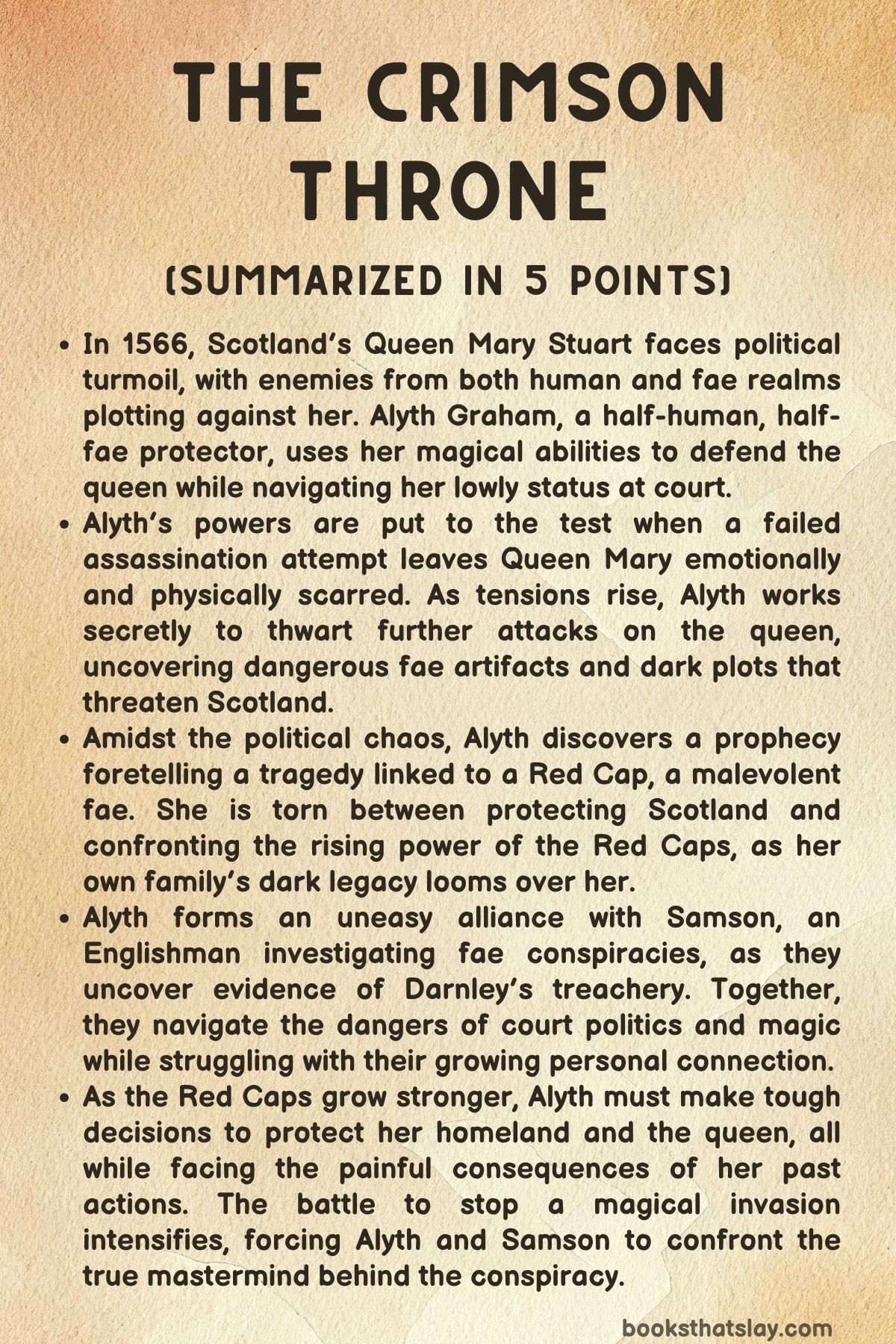
In the year 1566, Scotland’s Queen Mary Stuart is caught in the midst of a dangerous political situation, where enemies lurk both within her court and beyond her borders. At her side is Alyth Graham, a half-human, half-fae woman with the ability to weave magic.
Alyth’s magical powers allow her to protect the queen from external threats, though her position at court remains low due to her status as a bastard and an outsider. Despite this, Alyth plays an essential role in guarding the queen, using her skills to create glamours and protective barriers.
Her magic makes her a valuable asset, but also a potential threat to those who seek to use her power for their own agendas.
The story begins with Queen Mary requesting Alyth to demonstrate her abilities. In a private chamber, Alyth brings a tapestry to life, animating the plants and animals woven into it.
While the queen’s companions are amazed by the display, Queen Mary’s response is far colder. Jealousy begins to fester in the queen’s heart as she realizes the power Alyth possesses could undermine her own position.
The situation takes a darker turn when a group of men, including Mary’s husband, Lord Darnley, storms the chamber and attempts to assassinate the queen. The attack is fueled by Darnley’s ambition to take the throne for himself.
He uses a Red Cap artifact—a fae weapon that induces a bloodlust—to incite the men against the queen. Despite Alyth’s best efforts to protect Mary, David Rizzio, the queen’s close advisor, is brutally murdered, leaving the queen both physically and emotionally scarred.
Months later, Darnley continues to undermine the queen, and his treachery is far from over. Alyth, concerned about the growing influence of Red Caps and the dangerous fae weapons that could be used to harm Mary, works secretly to thwart these threats.
She uncovers several magical artifacts intended to harm the queen, including poisoned vials and cursed daggers, but she cannot yet uncover who is orchestrating these attacks.
Mary’s recovery is slow, both physically and emotionally, and she remains isolated from her husband. The political tension in Scotland only increases, as enemies from both within and outside the country, including the English monarchy, continue to conspire against her.
Meanwhile, Alyth continues to monitor the magical dangers to the queen, while learning of a more ominous prophecy. A fae seer, a bean-nighe, predicts that Alyth will be responsible for the death of a man whose life will be claimed by a Red Cap.
Alyth’s fear of a Red Cap invasion grows, and she begins to wonder whether the magical barrier she has sworn to protect will be breached.
As the story unfolds, Alyth’s abilities continue to provide protection to the queen, though her powers are tested as the political and magical threats intensify. Alyth discovers a mysterious fae artifact that holds the potential to break her curse, but its presence also signals darker forces at play.
Her loyalty to the queen is tested as she finds herself caught between her duties and her growing awareness of the magnitude of the threat she faces.
Alyth’s journey leads her to the border of Scotland, where the ancient fae barrier that protects the kingdom from the encroaching fae world is weakening. Alyth reflects on her heritage, the strained relationship with her fae father, and the duty she feels toward both Scotland and the fae realms.
Her mission to protect her homeland from the Red Caps brings her into conflict with Samson, an Englishman working for the mysterious Cecil, who is tasked with retrieving fae artifacts. Although Samson initially appears to be an ally, Alyth remains suspicious of him, especially after discovering that Darnley has been using fae magic to control Samson’s actions.
Throughout their journey, Alyth and Samson form an uneasy alliance. Samson, unaware of the full extent of Alyth’s fae heritage, is drawn into the conflict between humans and fae, unaware of the powerful forces manipulating events.
As they travel through remote villages, Alyth uses her magic to protect the inhabitants from the malevolent fae forces, such as the Sluagh, creatures corrupted by Red Cap magic. Their shared experiences lead to a complex relationship, and Alyth finds herself grappling with her feelings for Samson while remaining focused on her mission.
The situation takes a dramatic turn when Alyth discovers that Darnley has used Red Cap magic to control Samson, turning him into a weapon. In a tense confrontation, Alyth uses her fae powers to subdue Samson, but her actions have unintended consequences.
Samson’s growing awareness of his curse and his role in the conflict creates a rift between him and Alyth, even as they begin to trust each other more.
Alyth learns that Darnley has planned a larger conspiracy involving the Red Caps and the fae barrier, and the political tensions between Scotland and England escalate. As the situation grows more dire, Alyth and Samson continue to work together, trying to unravel the mystery behind the Red Caps and their connection to the fae magic that threatens both the human and fae realms.
In a climactic moment, Samson inadvertently activates one of the fae weapons, putting both of their lives at risk. Alyth is forced to confront her father, who criticizes her use of fae magic to kill, forcing her to question whether she is becoming as destructive as the very forces she is fighting.
Despite the moral conflicts, Alyth continues her mission, determined to stop the Red Caps before they can break through the magical barrier and invade Scotland.
As the story reaches its conclusion, Alyth faces an ultimate test of loyalty and power. The Red Caps are poised to invade, and Alyth’s role in preventing the war becomes ever more critical.
Her relationship with Samson is strained, but together they must confront the forces that seek to destroy their world. In the end, Alyth’s loyalty to her people and her love for Samson will determine the fate of Scotland and the fae realm, as both worlds stand on the brink of destruction.
Characters
Alyth Graham
Alyth Graham is the central protagonist in The Crimson Throne, embodying a complex blend of power, vulnerability, and inner conflict. As a half-human, half-fae woman with magical abilities, Alyth stands as both an outsider and a protector.
She has a deep connection to her fae heritage, particularly through her father, a distant fae prince from the Seelie Court, whose indifference towards her upbringing adds layers to her sense of abandonment and identity. Throughout the story, Alyth’s magical talents, including her ability to create glamours and protective barriers, are crucial to safeguarding Queen Mary and Scotland from both human and fae threats.
Despite her essential role, Alyth remains in a precarious position at court, marked as a bastard and viewed with suspicion by many, including the queen herself. Her loyalty to Queen Mary is steadfast, yet it is constantly tested, especially as Alyth is drawn deeper into the intrigue and treachery surrounding the throne.
The prophetic visions she receives and the moral dilemmas she faces force her to confront her own use of magic, particularly when she must make difficult choices that blur the lines between good and evil. Her relationship with Samson adds emotional depth to her character, as she grapples with her growing feelings for him while navigating the treacherous political landscape.
Alyth’s journey is one of self-discovery, where she must come to terms with her magical abilities, her family legacy, and the sacrifices she must make to protect her world.
Queen Mary Stuart
Queen Mary Stuart, the monarch of Scotland, is a figure defined by strength, political savvy, and a deep sense of vulnerability. Throughout The Crimson Throne, she faces constant threats both from within her court and from external forces, particularly the English monarchy.
Her marriage to Lord Darnley, initially a political alliance, quickly becomes a source of personal anguish as his betrayal becomes evident. Mary’s initial reaction to Alyth’s magic—viewing it with jealousy and suspicion—reflects her own insecurity in the dangerous political environment she must navigate.
As her world unravels with assassination attempts and plots against her life, Mary’s resilience shines through, though she is deeply scarred both emotionally and physically by the violent events surrounding her. Despite her royal status, Mary’s sense of isolation is palpable, as she constantly contemplates escape from the weight of her responsibilities.
Her desire to rid herself of Darnley and her determination to confront her enemies, even as her own safety is at risk, speaks to her inner strength and drive to maintain her power. Mary’s character arc is marked by her efforts to balance personal survival with the larger political and magical struggles she faces.
Samson Calthorpe
Samson is a key figure in The Crimson Throne, and his journey is one of personal discovery and tragic transformation. As an Englishman working for Cecil, Samson is initially tasked with retrieving fae artifacts and uncovering the magical forces at play in Scotland.
However, his involvement with Alyth, and the discovery of his own connection to the fae world, complicates his mission. Throughout the story, Samson grapples with the curse that seems to bind him to fae magic, causing him to black out and potentially harm those around him.
His struggle with his identity and his growing feelings for Alyth add layers to his character, as he becomes more entangled in the magical and political conflicts. Although initially unaware of the full extent of the fae world, Samson’s exposure to the Red Caps and his interactions with Alyth gradually reveal his importance in the unfolding drama.
His connection to the fae realm becomes both a curse and a potential source of power, and his relationship with Alyth evolves from mistrust to a tentative alliance. When Samson is manipulated by Red Cap magic into becoming a weapon against Alyth, it highlights the personal stakes of the conflict.
His internal battle to retain control over his actions and his desire to protect Alyth reflect the complexity of his character and the difficult choices he must make.
Lord Darnley
Lord Darnley, Queen Mary’s husband, is a central antagonist in The Crimson Throne. His character is defined by ambition, arrogance, and a deep desire for power.
Initially seen as a political ally to Queen Mary, Darnley quickly reveals himself to be a manipulative and treacherous figure. His relationship with Mary deteriorates as his thirst for the throne grows, culminating in his involvement with the Red Caps, a malevolent fae faction.
Darnley’s use of a Red Cap artifact to manipulate others and orchestrate assassination attempts against the queen shows the depth of his betrayal. Despite his outward confidence, Darnley is ultimately a man driven by insecurity and desperation, willing to do anything to secure his place as king.
His complex relationship with Mary, marked by both affection and rivalry, showcases his dual nature as both a lover and a threat. Darnley’s actions set in motion much of the political and magical upheaval that drives the plot, and his eventual downfall at the hands of Cecil reveals the extent of his manipulation and the consequences of his ambition.
Cecil
Cecil, the true mastermind behind much of the intrigue in The Crimson Throne, is a calculating and cold figure whose ambitions drive the plot forward. As a political operator, he seeks to control the fate of both Scotland and the fae realm, and he is willing to manipulate others to achieve his goals.
Cecil’s machinations involve using Alyth’s power to break the barrier between the human and fae worlds, paving the way for a Red Cap invasion. His role as the architect of much of the chaos surrounding Queen Mary’s court, and his influence over figures like Darnley, marks him as a formidable force in the story.
Cecil’s lack of empathy and his ruthless pursuit of power make him one of the most dangerous characters, as he uses others as pawns in his larger scheme. His ultimate confrontation with Alyth and Samson, in which he seeks to control the fate of both realms, serves as a climactic moment in the story, testing the loyalty and resolve of the characters who stand in his way.
Cecil represents the darker side of political power, where morality is sacrificed in the pursuit of control.
The Glaistigs
The glaistigs, fae creatures who assist Alyth in her mission, are complex characters in The Crimson Throne. As allies to Alyth, they play a crucial role in aiding her efforts to protect Queen Mary and Scotland from the looming threat of the Red Caps.
The glaistigs are depicted as fierce and no-nonsense, bound by a strong sense of loyalty to their fae kin and the magical world they inhabit. Their willingness to deal ruthlessly with traitors and their commitment to their cause make them formidable allies, though they are not without their own code of conduct.
Their involvement in the story highlights the tense relationships between the fae factions, as well as the delicate balance between helping and manipulating. The glaistigs’ interactions with Alyth reveal the tensions within the fae world, where loyalty is prized, but the line between ally and enemy can be easily blurred.
David Rizzio
David Rizzio, while a secondary character, plays a pivotal role in The Crimson Throne. His tragic death at the hands of Darnley’s men underscores the brutal reality of the political landscape in which Queen Mary operates.
Rizzio’s loyalty to Mary and his support of her reign make his murder all the more shocking and emblematic of the betrayals she faces. His death serves as a catalyst for Alyth’s deepening involvement in the protection of the queen, and it highlights the stakes of the political intrigue that unfolds.
Though his role is brief, David’s character represents the human cost of the power struggles at court, and his death leaves an emotional and narrative scar on the story.
Themes
Magic and Power
In The Crimson Throne, magic is not just a mystical force but a tool that defines the balance of power. Alyth’s fae abilities are both a blessing and a curse.
Her magical talents, such as creating glamours and protective barriers, make her invaluable to Queen Mary, but they also place her in a perilous position. Magic in this world is deeply intertwined with politics and personal ambition.
Queen Mary’s jealousy toward Alyth’s powers illustrates how magic can be seen as a threat, especially when it challenges authority. The Red Caps, malevolent fae beings, use their dark magic as a weapon of control, wielding power that is both destructive and hard to combat.
In contrast, Alyth struggles to find balance in her use of magic, as it can be both protective and lethal. Her reluctance to use violent magical tools to defend her land highlights the internal conflict between protecting those she loves and the moral cost of using her powers.
The novel suggests that the pursuit of power, whether through magical means or political maneuvering, often leads to dangerous consequences, as those who wield power may find themselves compromised by it.
Loyalty and Betrayal
A central theme in The Crimson Throne is the complexity of loyalty and betrayal. Alyth’s unwavering loyalty to Queen Mary drives much of her actions, even as she faces growing political and magical threats.
Her relationship with Mary is one of duty and trust, yet this loyalty is constantly tested by betrayal, both from within the court and from the fae world. Lord Darnley’s treachery and his collusion with the Red Caps represent the deep divides within the kingdom, where personal gain and power often override loyalty to the crown.
Alyth’s own personal conflicts—her loyalty to her family, her sense of duty to Scotland, and her burgeoning feelings for Samson—further complicate her decisions. Her willingness to protect Mary, despite the personal risks and the doubts she faces, shows her commitment to a cause larger than herself.
On the other hand, Samson’s role as an outsider, caught between the human and fae worlds, reflects the theme of betrayal on a more intimate level. His manipulation by Darnley and the Red Caps underscores how loyalty can be easily fractured by external forces, leaving characters questioning who they can trust.
Identity and Heritage
The Crimson Throne explores the theme of identity and heritage, particularly through Alyth’s internal struggle with her fae bloodline. Raised as an outsider due to her half-human, half-fae lineage, Alyth constantly grapples with her place in both the human and fae worlds.
Her father, a fae prince from the Seelie Court, remains distant and largely uninterested in her upbringing, which fuels Alyth’s sense of abandonment and conflict with her heritage. This duality of identity shapes much of her journey as she tries to protect Scotland from the magical threats of the Red Caps while simultaneously reconciling her feelings of alienation from both the human and fae communities.
The weakening barrier between the fae realm and the human world adds another layer of complexity to Alyth’s identity crisis. Her personal journey becomes one of self-discovery, where she must confront her legacy, accept the powers she possesses, and decide how to use them to prevent destruction.
The novel suggests that identity is not just about one’s bloodline but also about the choices one makes in the face of adversity.
Love and Sacrifice
As Alyth’s journey unfolds, the theme of love and sacrifice emerges as a driving force behind many of her decisions. Her growing feelings for Samson complicate her mission, as she struggles with the conflict between her duty to protect Scotland and her personal attachment to him.
Throughout the story, Alyth faces difficult decisions where her love for Samson is tested, especially as he becomes more entangled with the Red Caps and the dangerous magic they control. Her willingness to risk everything to save him, even when he becomes a weapon under Darnley’s control, highlights the theme of sacrifice.
Alyth must continually choose between her personal desires and the greater good. Her love for Samson, though complicated by the curse that plagues him, ultimately becomes a source of strength.
In this way, love is portrayed as both a motivating force and a burden, as it demands sacrifices that can sometimes lead to difficult, painful choices. The novel suggests that true love often requires personal sacrifice, as characters must make choices that transcend their own desires for the sake of others and the greater cause.
The Nature of Evil
The Crimson Throne presents a nuanced view of evil, particularly through the portrayal of the Red Caps and their destructive influence. These fae beings are not just villains in the traditional sense, but embodiments of chaos and destruction, whose actions are driven by an unrelenting hunger for power and control.
The Red Caps use magic as a weapon, manipulating individuals and turning them into instruments of destruction, such as Samson, who is coerced into serving their dark purposes. The novel raises questions about the nature of evil, particularly when it is tied to magic and power.
Alyth’s struggle against the Red Caps is not just a battle against external forces but also an internal one, as she grapples with her own use of magic and the darker sides of her fae heritage. The presence of evil in the novel is not confined to a single character or group; it is a pervasive force that manifests in both human and fae actions, making it difficult to define or combat in a straightforward manner.
Evil in this world is not a simple, black-and-white concept but a complex force that blurs the lines between good and bad, right and wrong.