The Crown of Gilded Bones Summary, Characters and Themes
The Crown of Gilded Bones by Jennifer L. Armentrout is the third installment in the Blood and Ash series, a fantasy saga that blends political intrigue, forbidden love, ancient prophecy, and divine power. The novel follows Penellaphe “Poppy” Balfour as she grapples with the revelation that she is far more than mortal—perhaps even more than Atlantian.
After surviving betrayal, attempted execution, and near death, Poppy must confront questions about her lineage, her destiny, and the cost of power. As kingdoms teeter on the brink of war, she is forced to decide not only who she is, but what kind of ruler—and weapon—she is willing to become.
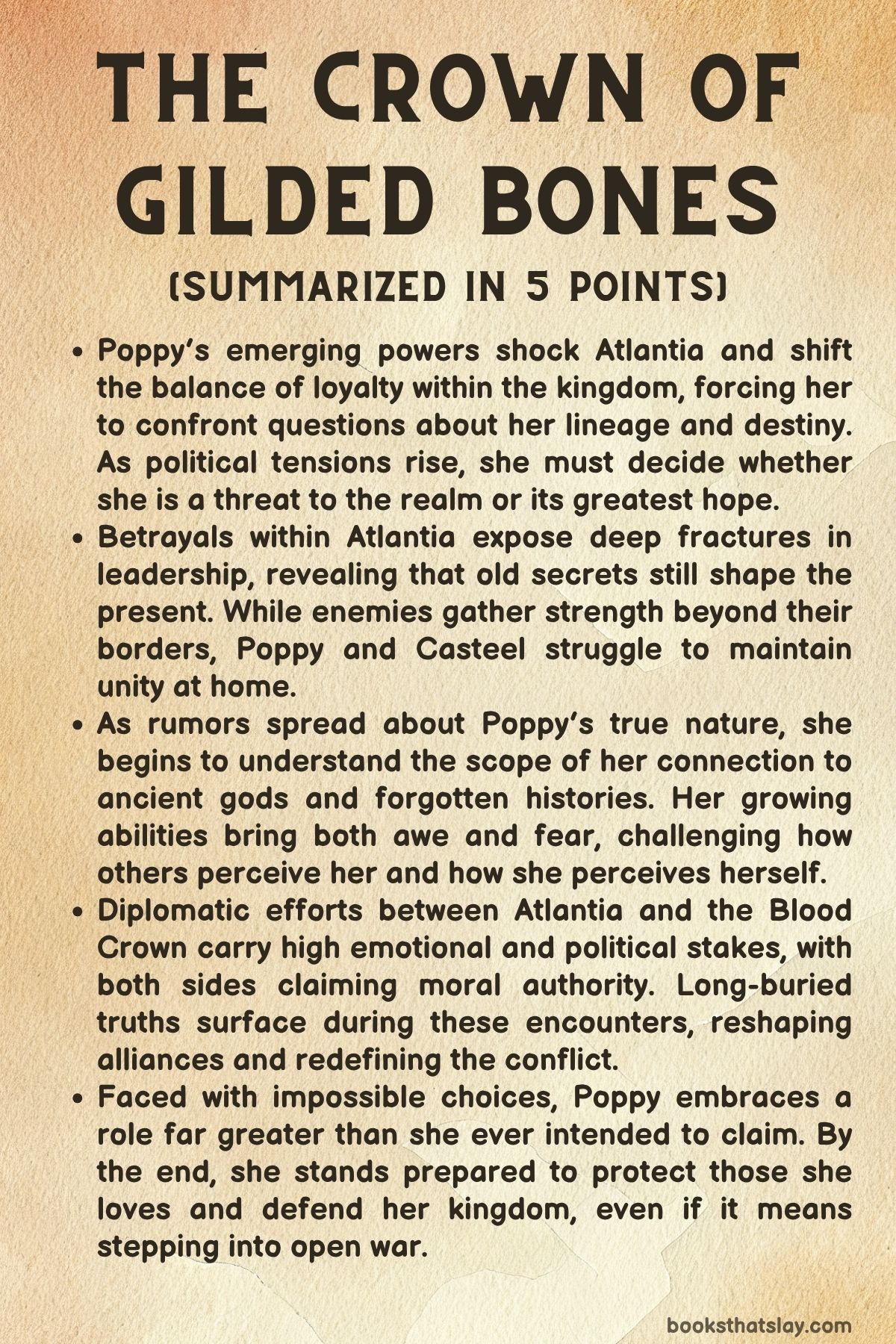
Summary
The story opens in the aftermath of violence within the Chamber of Nyktos. Poppy has just manifested devastating power, killing Atlantians who believed her to be a Soul Eater and attempted to stone her to death.
Before the gathered court, Queen Eloana removes her crown and offers it to Poppy, naming her the last descendant of the most ancient gods. The wolven—who traditionally bond to Atlantians—declare their loyalty to Poppy instead, responding to the silver glow of eather radiating from her skin.
The shift unsettles the kingdom. While Casteel stands proudly at her side, others see only danger.
Suspicion quickly turns toward Alastir, a powerful advisor with a complicated history tied to Casteel’s family. When confronted, he initiates a coup.
Guards attack, and Poppy unleashes her power with brutal efficiency, slaughtering traitors and restraining others with cords of gilded eather. She experiences a fleeting vision of a silver-haired woman warning that events were not meant to unfold this way.
Before she can execute Alastir, she is struck from behind and awakens imprisoned in a crypt surrounded by the skeletons of long-dead deities.
Her captor is revealed to be Commander Jansen, a changeling who has infiltrated multiple factions. He argues that Poppy’s growing power makes her a threat to Atlantia and claims the gods were once destroyed for similar reasons.
Alastir later confirms he believes Poppy is descended from Nyktos, the Primal God of Life and Death, and possibly from Malec, the former Atlantian king who created the first Ascended. Convinced she fulfills a prophecy that promises ruin, Alastir intends to return her to the Ascended rather than martyr her.
Before this plan succeeds, Casteel and his allies storm the stronghold. Poppy insists on killing Jansen herself, but during the battle she is struck by an arrow through the chest.
As she bleeds out, Casteel makes a forbidden choice. To save her, he attempts to Ascend her by draining her blood and compelling her to drink his.
The act would transform her into a vampry, but death looms closer than the consequences. Lightning splits the sky as he bites her.
When Poppy awakens, she is not what anyone expected. She does not become a vampry.
Her eyes remain green, not black. She retains her emotions.
Instead, her power deepens. She can sense the wolven through telepathic cords and feels the ancient pulse of something far older than Atlantian blood.
She heals with remarkable speed, hears thoughts, and struggles with bloodlust, but she is undeniably alive.
Returning to Atlantia, Poppy confronts Alastir and executes him publicly after extracting information. The wolven consume his body, cementing their allegiance to her.
Yet unrest spreads across the kingdom. A shadow organization known as the Unseen resurfaces, deploying creatures called Gyrm—undead constructs animated by forbidden magic.
Poppy defeats them with escalating force, and rumors grow about what she truly is.
As she and Casteel travel through Atlantia, she witnesses the love the people hold for their prince. She also sees overcrowded cities and a kingdom bracing for war against Solis.
When she heals a dying child with what appears to be resurrection, it confirms her connection to Nyktos. Her power is not merely destructive—it restores life.
At court, tensions sharpen. Some elders distrust her due to her former role as the Maiden of Solis.
Eloana and Valyn reveal their belief that Malec, long thought dead, may still live, and that Poppy could be his daughter. The possibility shakes the foundation of Atlantian history.
Poppy is caught between identities: mortal, Atlantian, deity, daughter of a tyrant.
Meanwhile, the Blood Crown sends word. Ian, Poppy’s brother—now Ascended—arrives with a warning and an invitation from Queen Ileana.
Before leaving, Ian whispers to Poppy to wake Nyktos. Realizing peace may be impossible without understanding her origins, Poppy accepts the crown of Atlantia, choosing to rule rather than flee.
She and Casteel are crowned king and queen in a ceremony marked by both celebration and dissent.
Seeking answers, Poppy travels beneath the Mountains of Nyktos into Iliseeum. There she encounters draken and finally meets Nyktos himself.
He confirms that she carries Primal blood and that only those born in the mortal realm with such blood can wield full divine power beyond Iliseeum. He warns that ancient forces are stirring and that Revenants—reborn third-born mortals forged into immortal weapons—have been created.
Armed with knowledge but not certainty, Poppy proceeds to meet Queen Ileana at Oak Ambler. The confrontation shatters everything.
Ileana reveals her true identity: she is Isbeth, Malec’s heartmate and Poppy’s biological mother. She claims Malec is a god and that she ascended alongside him.
She accuses Atlantia of destroying her family and admits orchestrating centuries of revenge. To prove her power, she commands a Revenant to resurrect after being stabbed.
Negotiations collapse. Ileana orders Ian executed before Poppy’s eyes.
In her fury, Poppy attacks, but Ileana easily overpowers her, revealing strength beyond expectation. To save Poppy’s life, Casteel surrenders himself.
He is taken prisoner, and Poppy awakens outside the city, her grief igniting storms across the sky.
Determined to rescue him, Poppy confronts Eloana, demanding truth and accountability. She learns that Eloana once ordered the death of Ileana’s son and concealed critical truths about Malec.
Accepting that war is inevitable, Poppy embraces her identity as a goddess. She summons the draken, forging an alliance with Nektas.
He demands in return that she rescue Ires, Malec’s twin and her true father, who has been imprisoned in feline form by Ileana.
With draken at her command and wolven bound to her will, Poppy issues a final warning to the Blood Crown. When Jalara arrives with insults instead of diplomacy, she beheads him and sends his head back as a message.
She declares herself by her full title and promises devastation if Casteel is harmed.
The novel closes with Poppy standing at the threshold of war, no longer uncertain of what she is. She is queen, daughter of gods, wielder of life and death.
And she is prepared to burn kingdoms to reclaim the man she loves.
Characters
Penellaphe “Poppy” Balfour
Poppy is the emotional and moral center of The Crown of Gilded Bones, and her character arc is built around power colliding with choice. She begins the story already shaken by what she can do—violent, godlike abilities that terrify others and unsettle even her.
What makes Poppy compelling is that her strength is never only physical or magical; it is also the ability to question herself honestly. She repeatedly interrogates whether she is becoming the kind of being Alastir fears, and she does not treat leadership as a prize.
Her empathy remains a defining trait even as her abilities evolve, but the book is clear that empathy does not make her soft—it makes her dangerous in a different way, because she can understand what people feel and still choose to act decisively. Across the story, she moves from reacting to revelations about her lineage to actively shaping her identity, culminating in her acceptance of the crown and her declaration of war terms.
By the end, Poppy is no longer negotiating with her fate; she is setting the conditions for everyone else.
Casteel “Cas” Da’Neer
Cas is driven by devotion that is both tender and ferocious, and his role as partner, protector, and political figure constantly overlaps. He is often labeled through reputation—violent, ruthless, the “Dark One”—but the book repeatedly shows that his brutality is selective and tied to loyalty.
His defining choice is the forbidden act of saving Poppy’s life by ascending her when she is dying, an act that exposes his priorities with no ambiguity: he would rather face civil war, disgrace, and his parents’ wrath than live without her. Cas’s love is not passive reassurance; it becomes a force that steadies Poppy when she fears herself, but it also challenges her to take ownership of what she wants.
Politically, he is caught between responsibility and reluctance—he never forgets Malik is the rightful heir—yet he steps into power because stability demands it and because Poppy’s safety requires authority. Cas is also written with a private vulnerability that surfaces in brief moments: his need to be called “Cas,” his trauma from captivity, and the way he clings to the idea that love is something you do, not just something you feel.
Kieran Contou
Kieran functions as both anchor and mirror for the central relationship, embodying loyalty without submission and strength without ego. He is defined by a long history with Cas, but The Crown of Gilded Bones expands him beyond “best friend” into a leader in his own right—someone who carries the weight of wolven identity and politics.
His bond shifting toward Poppy is not treated as a simple magical adjustment; it forces him to renegotiate duty, intimacy, and selfhood. Kieran’s most important quality is emotional steadiness.
He can challenge Cas, protect Poppy, and still accept that both of them are changing the world he knows. His insistence that wolven see themselves as equals rather than subjects adds ideological depth to his character: he is not simply loyal to a crown, but to a people and an older set of truths.
Even when he is frustrated, protective, or skeptical, his actions reveal a rare kind of integrity—he adapts to what is right, not just what is familiar.
Queen Eloana
Eloana is one of the most layered figures in the novel because she is simultaneously ruler, mother, and a person haunted by old losses that shaped her decisions. At first, she appears harsh and controlling, questioning Poppy’s intentions and treating her as a potential catastrophe.
Over time, the book reveals that Eloana’s severity is part fear, part political calculation, and part shame. Her greatest weakness is pride—she admits, directly and indirectly, that personal humiliation and grief influenced what she concealed and how she justified certain choices.
Yet she is not portrayed as a cartoon villain. She is capable of apology, empathy for Poppy’s suffering, and a genuine desire to protect Atlantia without pretending her hands are clean.
Eloana’s relationship with Poppy becomes a test of whether power can coexist with accountability. She begins as a gatekeeper to the crown and ends as someone forced to acknowledge that Poppy’s authority is not symbolic; it is real, and it changes the balance of who must answer to whom.
King Valyn
Valyn represents the hard edge of Atlantian leadership: pragmatic, strategic, and shaped by centuries of conflict. He carries the blunt worldview of someone who believes that survival requires choices that will never feel morally pure.
His dynamic with Cas is strained because Valyn expects sacrifice as a baseline, while Cas refuses to accept cruelty as necessity when it involves innocents. Valyn’s complexity shows in how he can fight beside Cas and still attempt to stop him from saving Poppy, not because he hates her, but because he fears what civil collapse would do to their people.
He respects strength and expects obedience, and that expectation makes him clash with Poppy’s insistence on agency. Yet he is not merely antagonistic; he can acknowledge Poppy’s place in the family, and by the end he places trust in her to do what he cannot—bring Cas home and end a threat that standard politics cannot contain.
Alastir
Alastir is a portrait of fanaticism disguised as patriotism. He frames his actions as protection of Atlantia, but his logic repeatedly exposes itself as selective, self-serving, and soaked in old grudges.
His greatest weapon is not the sword; it is narrative—prophecy, fear, history, and the idea that some lives are acceptable losses for a “greater good.” The book uses him to show how a person can weaponize trauma and tradition to justify betrayal. His personal history with Cas and Shea gives his hatred emotional fuel, but he makes choices that go beyond grief into calculated power-grabbing.
Alastir’s obsession with controlling the future—by eliminating descendants, shaping alliances, and sacrificing children—reveals a character who cannot tolerate uncertainty. He fears what Poppy might become, but the irony is that his actions help create the very threat he claims to prevent by forcing Poppy into more violent, decisive forms of self-definition.
Commander Griffith Jansen
Jansen operates as a symbol of deception elevated into ideology. As a changeling, his literal ability to become someone else matches his moral shapeshifting: he can justify any cruelty if it serves the identity he has chosen for himself.
His confession that changelings can lose themselves in borrowed forms adds a psychological edge to his villainy—there is a suggestion that he has spent so long pretending to be “guardian” that he no longer knows what he is without the role. Jansen’s conversations with Poppy are built around moral math: innocents weighed against outcomes, murders reframed as necessities, and fear used as persuasion.
He is also crucial because he bridges factions, proving that threats to Atlantia come not only from external enemies but from internal zealots who believe they alone can steer history. His death at Poppy’s hand is not simply revenge; it is Poppy refusing to accept his worldview as inevitable.
Malik Da’Neer
Malik is both presence and absence for much of the story, and that duality is part of his function. He is the rightful heir who haunts every political conversation about the crown, and he is also a personal wound for Cas and Eloana.
When Malik appears beside the Blood Queen, the shock is not only that he is alive, but that he is presented as compliant—whether by coercion, manipulation, survival strategy, or something more complicated. The book positions him as a measure of what captivity can do to identity: the brother Cas would burn the world to save may no longer be the person he remembers.
Malik’s role sharpens the moral stakes for Poppy as well, because rescuing him is not simply freeing a prisoner—it is confronting what has been done to him and what he may have done while trapped in the Blood Crown’s power.
Ian Balfour
Ian is written as tragedy shaped by indoctrination and survival, and his transformation into an Ascended makes him a living argument about what the Blood Crown steals from people. His early interactions with Poppy are loaded with propaganda and suspicion, yet he is not depicted as purely malicious.
His whispered warning to wake Nyktos suggests a buried thread of conscience that has survived whatever was done to him. That contradiction—public loyalty to the Blood Queen, private desperation to stop her—makes him one of the more heartbreaking figures in the book.
Ian’s death is brutal and politically calculated, designed to break Poppy and force compliance, and it becomes a turning point: it removes one of Poppy’s last hopes for peaceful negotiation and proves the Blood Queen will sacrifice anyone, even her own son, to win.
Queen Ileana / Isbeth
Isbeth is the story’s central force of domination, and her power is not limited to magic—she controls through spectacle, narrative, and cruelty staged as righteousness. Her reveal as Poppy’s mother reframes much of the series’ foundation, turning what seemed like political conflict into generational catastrophe.
She does not simply want land or surrender; she wants recognition, worship, and the rewriting of history so that her revenge looks like justice. Isbeth’s worldview is built on entitlement and grievance: she presents herself as someone wronged by Eloana and Atlantia, then uses that pain to excuse centuries of predation.
The most chilling aspect of her character is how easily she can shift between intimate emotional claims—love, betrayal, motherhood—and cold calculation, such as ordering Ian’s execution to manipulate Poppy. She is a ruler who treats people as pieces, and she is terrifying because she believes she deserves to do so.
Tawny Lyon
Tawny represents Poppy’s connection to her former life and to ordinary human resilience. Unlike many characters whose roles are tied to power structures, Tawny’s significance lies in what she preserves: truth, friendship, and the reminder that not everyone in Solis was complicit in the Blood Crown’s cruelty.
Her presence during the confrontation at Oak Ambler keeps the conflict personal, not just political. Her later injury—marked by the strange substance Poppy cannot heal—adds an ominous layer, suggesting that the enemy’s weapons are evolving beyond the reach of even divine power.
Tawny’s continued survival matters because it gives Poppy someone to protect who cannot fight like a wolven or rule like a monarch, reinforcing that Poppy’s war is not only about crowns and lovers, but about safeguarding people who never asked to be part of any prophecy.
Vonetta Contou
Vonetta is a steady counterweight to the intensity of the main trio, bringing both competence and emotional clarity. As Kieran’s sister, she expands the wolven world beyond Jasper’s household, and her interactions with Poppy help normalize Poppy’s place among them.
Vonetta’s ability to sense Ian as Ascended is a key moment because it removes denial and forces Poppy to face reality. She also carries a distinct presence: firm, grounded, and unwilling to treat Poppy as fragile, yet clearly loyal.
The brief spark of strange energy when she touches Poppy hints that Vonetta may be more connected to the broader magic of the world than she fully understands, positioning her as a character who could become even more important as Poppy’s powers reshape bonds and identities across Atlantia.
Delano
Delano embodies wolven loyalty expressed through action rather than ceremony. He is protective, blunt, and often functions as the immediate shield between danger and the people he serves.
His relationship to the group also shows the wolven culture of intimacy and fierce devotion, especially as he navigates the risks of war and the fear of losing those he loves. Delano’s significance increases when the story moves into active conflict: he is present in key moments of defense and strategy, and his reactions often reflect what the broader wolven community might feel—pride in Poppy’s strength, anger at disrespect toward her, and readiness to meet violence with violence.
Jasper
Jasper is a political presence within wolven society, not just Kieran’s father. He represents tradition, authority, and the sense that wolven have their own hierarchy that does not exist merely to support Atlantian royalty.
His initial reluctance to share knowledge about Iliseeum shows a character who understands leverage; he does not give information freely, even to someone like Casteel, because wolven autonomy matters. Jasper’s eventual cooperation is earned through necessity and negotiation, and his frustration with Valyn’s secrecy highlights the growing fractures between wolven and Atlantian leadership.
Through Jasper, the book emphasizes that unity cannot be demanded—it must be maintained with respect.
Kirha
Kirha brings warmth and stability, offering Poppy a rare form of reassurance that is not tied to strategy or fear. As Kieran’s mother, she reflects the domestic, communal side of wolven life—color, craft, family, and the quiet strength of a society that values bonds.
Her kindness toward Poppy is significant because it gives Poppy a model of acceptance that is not performative or political. Kirha’s presence also subtly reinforces what is at stake in war: not only thrones and borders, but homes, children, and ordinary moments that violence can erase.
Nektas
Nektas is both protector and judge, carrying the authority of Iliseeum into the mortal realm. He is not easily impressed by crowns or titles, and his loyalty is conditional on responsibility.
His negotiations with Poppy—offering draken support only if she commits to rescuing Ires and restoring what has been broken—frame him as a character driven by duty to a larger order rather than personal allegiance. Nektas also functions as a moral boundary: he warns Poppy about the cost of war and the loss of innocent lives, forcing her to confront what her threats could mean in practice.
Unlike many characters who react to Poppy’s power with fear or awe, Nektas treats it as fact and focuses on what she will choose to do with it.
Reaver
Reaver represents draken strength with a personality that clashes against wolven intensity, creating friction that feels both cultural and personal. His conflict with Kieran is not merely bickering; it reflects two ancient warrior identities assessing each other’s worth and authority.
Reaver’s presence underscores that Poppy’s growing power is drawing forces into her orbit that are not easily controlled by Atlantian politics. He is a reminder that alliances forged through necessity can still be volatile, especially when pride and power sit close to the surface.
Aurelia
Aurelia’s importance lies in what she represents rather than how much time she spends on page: rarity, legacy, and the vulnerability within draken society. As a female draken, she is treated as precious, and her brief guidance to Poppy helps establish the draken as individuals with names, roles, and history rather than faceless weapons.
Her presence also reinforces the urgency of rescuing Jadis, making the conflict more personal for Nektas’s side and reminding Poppy that the war is tangled with imprisonments, stolen lives, and broken families on every front.
Wilhelmina “Willa” Colyns
Willa is a disruptive truth-teller whose humor masks sharp intelligence and deep instinct. Her reveal as a seer recontextualizes her earlier influence: she did not merely stumble into events—she nudged them, trusting feelings over logic.
Willa’s value to Poppy is twofold. Politically, she is a knowledgeable elder who can counterbalance the council’s distrust and provide crucial information about Iliseeum and Nyktos.
Personally, she gives Poppy something she rarely receives from authority figures: straightforward acceptance without reverence, treating her like a person even while acknowledging what she is becoming. Willa’s sarcasm and impatience also work as a pressure release in a story heavy with threat, but her warnings show she understands the scale of what is coming and that her levity does not equal ignorance.
Gianna
Gianna functions as a small but meaningful test of insecurity, power, and social perception. As a woman Valyn once hoped Casteel would marry, she could have been positioned as a rival, but the story uses her to undo that expectation.
Gianna’s lack of interest in Casteel allows Poppy to confront her own possessiveness in a safer space, showing both her intensity and her capacity to self-correct. The interaction also reinforces a recurring theme: women in this world are often used as political tools, but they still have desires independent of the plans made for them.
King Jalara
Jalara represents the petty arrogance of inherited authority and the failure of leadership built on entitlement. He approaches Poppy with insults and threats, refusing to adapt to the reality that she is no longer a pawn of Solis.
His death is swift and symbolic: Poppy does not negotiate respect with him—she enforces consequences. Jalara’s role, while brief, is a clear marker of the story’s shift.
The time when Poppy had to endure being called “The Maiden” as a leash is over, and characters like Jalara are shown as relics of a world that no longer understands the power standing in front of it.
Themes
Power and the Burden of Choice
Power in The Crown of Gilded Bones is never presented as a simple gift. It arrives tangled with expectation, fear, and consequence.
Poppy’s growing abilities—her control over life and death, her command of the wolven, her capacity to summon storms—are not triumphant milestones. Each new revelation forces her to confront a deeper question: just because she can act, does that mean she should?
The novel repeatedly places her in situations where overwhelming force would be easier than restraint. She can crush enemies instantly, silence dissent through fear, or claim dominance without negotiation.
Yet the tension lies in her refusal to equate strength with cruelty.
This burden becomes even heavier when leadership enters the equation. Accepting the crown is not about prestige; it is about accountability.
The people’s cheers come with the expectation that she will decide when to wage war and when to hold back. Unlike characters such as Alastir or Isbeth, who treat power as justification in itself, Poppy constantly interrogates her motives.
The narrative draws a stark contrast between domination and responsibility. Isbeth uses her strength to demand submission and rewrite history in her favor.
Poppy, by contrast, hesitates, questions, and worries about collateral damage. That hesitation is not weakness but a defining moral line.
The theme reaches its sharpest edge when Poppy threatens destruction to secure Casteel’s release. Her declaration that she will level cities is not casual bravado; it signals a turning point.
She understands what she is capable of, and she is willing to bear the moral cost if pushed. The novel frames power not as corruption in itself, but as a magnifier.
It reveals what a person values. Through Poppy, strength becomes a test of identity rather than an automatic descent into tyranny.
Identity and Inheritance
Questions of lineage dominate the emotional core of the novel. Poppy’s sense of self fractures as revelations stack upon one another: descendant of Nyktos, possible daughter of Malec, child of Isbeth, once the Maiden, now queen.
Each identity carries a history she did not choose and a reputation she cannot easily escape. The tension lies in whether blood determines destiny.
Characters around her often respond to her ancestry with fear or reverence, projecting onto her the sins of gods and kings long dead.
The narrative consistently challenges the idea that heritage dictates morality. Malec’s brutality does not predetermine Poppy’s character, just as Isbeth’s vengeance does not bind her to the same path.
Poppy fears becoming what others expect—a monster born from violent bloodlines—but she repeatedly asserts that her decisions define her more than her origins. This is reinforced through her interactions with Eloana and Valyn, who are forced to confront how their own pasts shaped political choices that ripple into the present.
History is not static; it actively influences the present, but it does not remove agency.
The presence of divine ancestry complicates this struggle. Being connected to a Primal means Poppy’s power is not symbolic—it is elemental.
Yet the novel resists presenting divinity as purity. The ancient gods were capable of immense destruction.
By placing Poppy at the intersection of mortal compassion and divine strength, the story argues that inheritance provides capacity, not character. Identity is built through action.
When Poppy claims the crown, she does so not because prophecy demands it, but because she believes she can change the trajectory of both kingdoms. Her identity becomes something claimed rather than assigned, and that shift undercuts the fatalism that prophecies and bloodlines often impose in fantasy narratives.
Love as Strength and Vulnerability
Romantic love in this story is not ornamental; it is catalytic. Casteel’s decision to ascend Poppy in order to save her life destabilizes the kingdom and violates law.
It is reckless, desperate, and deeply human. His love becomes a force strong enough to override political caution, parental authority, and tradition.
Yet the novel refuses to romanticize that choice as purely noble. It acknowledges the fallout—civil unrest, suspicion, and the possibility that he could have transformed her into something she did not want to be.
Love is portrayed as powerful, but not automatically wise.
Poppy’s love for Cas functions similarly. It grounds her, giving her emotional clarity amid chaos.
She finds courage in his presence, and their mutual devotion provides stability as her identity shifts. However, that love also becomes her greatest vulnerability.
Isbeth understands this and exploits it, forcing Cas to surrender by threatening Poppy’s life. Ian’s execution compounds this, demonstrating how attachment can be weaponized.
The novel emphasizes that love creates leverage. Those who care deeply can be manipulated through what they value most.
At the same time, love extends beyond romance. Kieran’s loyalty, the wolven’s bond, Tawny’s friendship, and even Eloana’s complicated maternal concern contribute to a broader understanding of connection as a source of resilience.
When Poppy chooses to fight, she does so not only for a crown but for people. Love becomes both shield and target.
The story suggests that vulnerability is inseparable from attachment; to care is to risk devastation. Yet the narrative ultimately frames love as worth that risk.
It does not weaken Poppy. Instead, it sharpens her resolve and clarifies what she is willing to sacrifice.
War, Revenge, and Moral Justification
Centuries of retaliation define the political landscape of the novel. Atlantia and Solis are locked in a cycle fueled by betrayal, half-truths, and personal grievances passed down as national policy.
Isbeth’s revenge for the loss of Malec and her son becomes the foundation of an empire built on fear and ritualized cruelty. Eloana’s pride and secrecy contribute to the escalation.
Both queens claim righteousness. Both believe their suffering legitimizes their actions.
The narrative exposes how easily revenge masquerades as justice. Isbeth frames her brutality as correction for past wrongs.
She casts herself as the injured party reclaiming what was stolen. Yet her methods—creating Revenants, feeding on mortals, executing her own son to prove a point—reveal a moral decay that cannot be excused by grief.
The story challenges the audience to consider how long a wound can justify violence. At what point does retaliation become indistinguishable from tyranny?
Poppy stands at the edge of repeating that cycle. Ian’s death and Cas’s capture give her every reason to burn the world.
Her threats are not empty; she has the capacity to enact them. The crucial distinction is that she remains conscious of the cost.
She does not deny that innocent lives would be lost. Her anger is volcanic, but it is accompanied by awareness.
This awareness sets her apart from Isbeth, whose pursuit of vengeance eclipses empathy entirely.
War becomes inevitable not because peace is impossible, but because trust has eroded beyond repair. Failed negotiations, hidden truths, and ideological extremism leave little room for compromise.
The novel portrays war as tragic rather than glorious. It is the culmination of unresolved pain and unchecked pride.
By positioning Poppy as someone who once sought coexistence but now prepares for battle, the story underscores a grim reality: when leaders refuse transparency and accountability, even the most reluctant warriors can be driven to take up arms.