The Cuffing Game Summary, Characters and Themes
The Cuffing Game by Lyla Lee is a campus rom-com that turns a messy first impression into a high-stakes student production: a winter-break dating show filmed in a snowy cabin. Marlon University is supposed to be Mia Yoon’s fresh start: new city, film school dreams, and maybe, finally, a crush that doesn’t end in embarrassment.
Then she meets Noah Jang—campus-famous dancer, senior, and social-media star—and her life gets complicated fast. Between cameras, contestants, and online fandom, Mia discovers that controlling a story is much harder when her own feelings are part of the plot.
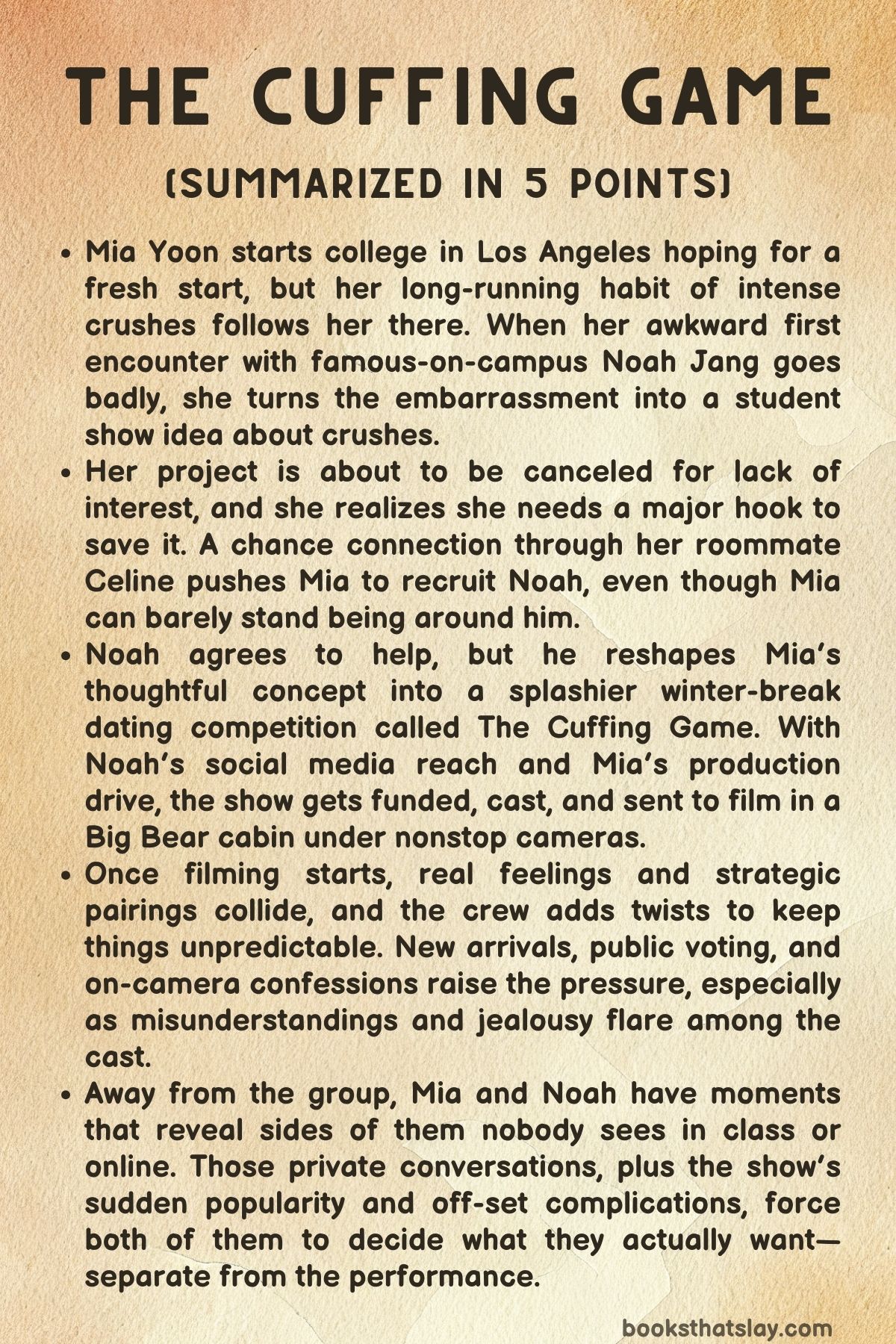
Summary
Mia Yoon arrives in Los Angeles from Texas to start her freshman year in Marlon University’s film program. She’s used to crushes that go nowhere, so she tells herself she’ll focus on school.
That plan collapses during her first week when she sees Noah Jang perform at a frat party. He’s confident, magnetic, and clearly used to attention.
When he casually dismisses the girls around him as “not really my type,” Mia feels singled out and embarrassed. She snaps at him to put on a shirt and bolts back to her dorm.
Humiliation turns into motivation: Mia drafts a concept for a student show about unreturned crushes, hoping she can turn her own frustration into art.
Weeks later, Mia and Noah clash in a film class debate about short-form video and traditional cinema. Their argument entertains the class and makes it obvious she can’t stand him.
Noah, who has built a career on content creation, is irritated by her seriousness—but also curious about her. Soon he spots an email from the Student Production Center advertising a new student project called Campus Crush.
He’s amused to learn Mia created it, especially since it seems designed around the exact problem she’s trying not to talk about: liking someone who doesn’t like you back.
Mia’s idea immediately hits trouble. The SPC warns her the show may be canceled because not enough students signed up.
Her small crew—Kallie, Damien, and Alex—scramble for solutions, but nothing seems big enough to rescue it. Then Mia overhears her roommate, influencer Celine Huang, complaining that her crush won’t reply to her messages.
The crush is Noah Jang. Mia is horrified, but she also recognizes a lifeline: if Noah and Celine appear on the show, interest will spike.
Mia swallows her pride and approaches Noah, bluntly telling him she needs him to participate.
Noah refuses at first. He worries about losing control of his image and being edited into a stereotype.
Mia argues that it could help both of them: it saves her project and gives him a chance at something real instead of curated online attention. He agrees to meet at a hidden campus café called Ground Smoothie.
The conversation is awkward but revealing. Noah reviews Mia’s concept and tells her it’s too slow for the audience they’re trying to reach.
He suggests reworking it into a louder reality dating format set in a winter cabin, with challenges and eliminations—and he even names it: The Cuffing Game. Mia doesn’t love the shift, but she can’t ignore that his instincts match what students will actually watch.
She keeps one piece of her original idea: confessionals where participants speak honestly to the camera.
With Noah’s help, the project explodes. He posts promotional videos to his huge audience, and applications flood in.
Funding targets are met, the SPC greenlights the show, and filming is scheduled for winter break in Big Bear. Mia lies to her parents about the details, worried they’ll judge the dating-show angle, and focuses on making the production work.
The cast includes “crushers” who confess their feelings and “crushes” who may or may not return them. Celine enters as a crusher set on Noah, convinced she’ll win him.
At the lodge, Mia confiscates phones and lays out the rules: to stay, crushers must successfully pair with their crush, and each day’s event can reshuffle the game. The first challenge is speed dating.
Celine immediately targets Noah and quickly confesses on camera. Noah, uncomfortable but unwilling to humiliate her publicly, agrees to cuff with her.
At the first elimination, many contestants pair up strategically to avoid going home, and Carlos is eliminated when he’s left uncuffed. Behind the scenes, Mia’s crew realizes most pairings are survival tactics rather than romance—but the show has what it needs: drama, storylines, and a breakout couple that viewers can latch onto.
The first episode goes live and gains traction quickly. An online popularity vote gives Noah and Celine a special date, tightening the narrative around them.
Noah feels trapped by the audience’s expectations; rejecting Celine now would make him look cruel. He tries to play the role, talks movies with her, and kisses her for the cameras—an act that makes Mia uneasy even as she knows it will boost views.
More chaos follows when Bethany confesses to Jack and gets rejected, leading to another tense elimination that sends Bethany and Caleb home. Meanwhile, Matías and Jack’s bond becomes real, and Matías admits to Noah that he likes guys.
Noah supports him, and their friendship becomes a fan favorite.
By Day Three, the show starts to feel too stable—everyone left seems safely paired. Mia’s crew decides to shake things up by bringing in “Gamechangers” who can steal partners.
They invite back Carlos and add newcomers Violet Russo and Kyle Yoshida. Kyle immediately unsettles Noah: he’s a former fraternity member with a bad reputation.
The Gamechangers choose partners for the day, and Kyle steals Celine while Violet takes Noah, leaving Shirin vulnerable when Tiana is taken.
Tensions spike during the snowy outdoor date. Noah finds Celine and Kyle making out off-trail.
Celine turns on Noah, accusing him of leading her on through social media and then ignoring her in real life. The argument and the sudden grabbing of his hand trigger Noah’s panic response.
Overwhelmed, he runs into the woods, loses his bearings, and ends up sheltering in a nearby cabin. Production shuts down in alarm.
When Noah calls, he asks Mia to pick him up herself. She drives through worsening conditions, brings him food, and gets trapped with him overnight when the storm makes the roads unsafe.
In the quiet, Noah opens up about how he reacts to touch and shouting, and Mia pushes him toward getting help. Their bond deepens in a way neither of them can easily explain away.
After the show returns to a safer setup, Noah later admits he’s developed feelings for someone who isn’t a contestant: Mia. The confession shocks her, and when he speaks harshly about Celine, Mia fires back, calling him privileged and arrogant.
They separate angry and hurt. Soon after, Kyle and Celine disappear, claiming Mia approved a trip to Vegas.
Mia panics, fearing something is wrong. Noah hears Mia has been crying and goes to Vegas to track them down.
Celine eventually calls: she and Kyle are safe, just reckless. She and Mia clear the air, and Celine admits she noticed Mia’s feelings for Noah while watching the episodes.
Mia decides to stop hiding. In her own on-camera confessional, she reveals she was the original “crusher” and that the show started because she couldn’t handle her crush on Noah.
Her family watches and supports her, and the finale becomes a live event on the beach. As the last couples compete, Noah arrives mid-stream, chooses Mia, and publicly asks to cuff with her.
Mia takes his hand, asks if she can kiss him, and they kiss on camera while the crew cheers. After the livestream ends, they talk privately about dating after graduation and agree to try—accepting that the real relationship will be off-script, without edits, and worth the risk.
Characters
Mia Yoon
Mia is the story’s emotional and creative engine in The Cuffing Game, entering Marlon University as a film freshman who is both romantically tender and professionally ambitious. Her long habit of “hopeless crushes” shows how deeply she feels and how quickly she attaches meaning to someone’s attention, yet she isn’t passive about it; when she feels humiliated, she reacts loudly, then turns the same intensity into art by inventing a show concept.
That pattern defines her: embarrassment becomes fuel, and anxiety becomes planning. As showrunner, Mia’s core conflict is control versus authenticity—she wants to craft something sincere (confessionals, honesty, emotional truth) while the realities of attention, algorithms, and a hungry audience pressure her toward spectacle.
Her hidden fear of disappointing her parents, and her decision to keep parts of the production secret, reveal how much she measures herself against approval even while trying to build her own identity. Over the course of the show, she matures from seeing Noah as a distant idol and personal problem into seeing him as a complicated person, while also recognizing her own responsibility when production choices create real emotional consequences.
By the end, her biggest act of courage is not the livestream or the finale, but publicly admitting she built the show as a way to cope with her feelings—choosing vulnerability over image, and choosing an honest life over a perfectly edited narrative.
Noah Jang
Noah is introduced as charisma in motion—shirtless dancing, social-media magnetism, the kind of senior who seems untouchable—yet The Cuffing Game steadily reveals that the confident exterior is a practiced performance. He is strategic about perception and wary of losing narrative control, which makes sense for someone who has built a public persona, but it also exposes a deeper insecurity: he knows attention can be a trap.
Noah’s sharpness in class and his occasional arrogance are a shield as much as a flaw; they keep him above the messiness of sincerity until Mia’s bluntness forces him into real conversation. His discomfort with unexpected touch and loud conflict, and his panic response when overwhelmed, recast him not as a cold heartthrob but as someone whose nervous system is always scanning for threat.
He can be generous—he mentors Matías, supports him without judgment, and later drops everything to check on Celine’s safety because Mia is hurting—but he also has a mean streak when he feels cornered, lashing out at Celine and escalating arguments with Mia. His arc is the slow collapse of the “content creator who always knows what to do” into a young man who realizes he needs help, needs therapy, and needs relationships that are not performative.
His final public “cuff” with Mia is meaningful precisely because it reverses his old pattern: instead of controlling the narrative, he risks being seen.
Celine Huang
Celine functions as both catalyst and cautionary mirror in The Cuffing Game—a roommate whose influencer life turns longing into content, and whose crush on Noah transforms Mia’s struggling project into something viable. She begins as a fan with a fantasy, convinced she knows Noah because she has watched him, messaged him, and built a relationship in her head.
That dynamic makes her sympathetic—her hope is real—but also volatile, because the real Noah cannot match the idealized one. On the show, her confidence reads as boldness, yet underneath is a deep fear of rejection that pushes her to lock Noah down quickly, then cling to the “it couple” storyline once viewers validate them.
When she shifts toward Kyle and accuses Noah of leading her on, her anger is not purely irrational; it’s the crash that comes when parasocial intimacy collides with reality and pride. At the same time, her actions show a willingness to bend truth for excitement—dropping out and going to Vegas without proper approval—and her emotional swings contribute to the show’s most dangerous moment.
Her late-night call with Mia is important growth: she apologizes, clears misunderstandings, and shows she can care about someone else’s feelings even while chasing her own. By the end, Celine is less a villain than a portrait of what happens when attention becomes the language of love.
Kallie
Kallie is Mia’s stabilizer and practical problem-solver inside The Cuffing Game, often reading the room and the risks before Mia does. She supports the project’s logistics and morale, but she also represents the production mindset that sees structure and pacing as necessary, not cynical.
When the show becomes too “stable,” she pushes for disruption—understanding that in this format, unpredictability is part of survival. Her presence during the crisis sequence is quietly crucial: she is the one who can be both crew and caretaker, helping Mia move through panic without collapsing into it.
Kallie’s character highlights a truth the story keeps returning to: behind every on-camera romance is off-camera labor, and the people doing that labor carry ethical weight even when they are not the ones in the spotlight.
Damien
Damien embodies the producer’s appetite for momentum in The Cuffing Game, constantly hunting for ways to increase stakes—crowd energy, plot twists, new entrants, bigger drama. He is not portrayed as cruel, but he is willing to treat conflict as a tool, and his “bombshell” idea is a turning point that proves entertainment choices can become safety issues.
Damien also plays the role of internal conscience in a blunt, imperfect way: he confronts Mia about boundaries with Noah, not out of moral superiority, but out of a recognition that the show can implode if the showrunner becomes emotionally entangled. His arc is less about personal transformation than about revealing the pressures of producing: he moves quickly, sometimes recklessly, then has to absorb the fallout when real people get hurt.
Alex
Alex is the craftsperson and observer in The Cuffing Game, often positioned where storytelling becomes tangible—editing setups, running smaller camera operations, and conducting behind-the-scenes interviews that capture what contestants cannot say publicly. This makes Alex a quiet authority on truth versus narrative, because editors decide what “really happened” looks like to the audience.
Alex’s interviews, especially with Shirin, show how the show can become a confessional space that is both empowering and frightening. As a character, Alex represents the invisible hand of reality television: not the one who causes the emotion, but the one who shapes how emotion will be remembered.
Jeannette
Jeannette, Mia’s older sister, is an off-screen anchor in The Cuffing Game, appearing mainly in moments when Mia is scared and needs grounding. Her advice doesn’t magically fix anything, which is part of her realism—she cannot protect Mia from consequences or uncertainty—but her role matters because she is the first “adult” voice Mia turns to.
Jeannette also reflects Mia’s complicated relationship with family approval: Mia reaches out, then withholds truth from her parents, showing how sibling support can coexist with secrecy and pressure. Even with limited page time, Jeannette symbolizes the life Mia came from and the expectations Mia is trying to outgrow.
Matías
Matías is one of the clearest portraits of courage in The Cuffing Game, entering the game with a crush that feels risky and uncertain, then slowly choosing honesty over strategy. His early decision to cuff platonically with Shirin shows survival instincts, but his later connection with Jack reveals a desire for something real rather than simply staying on camera.
Matías’s friendship with Noah is a critical subplot because it brings out Noah’s tenderness and reliability, contrasting with Noah’s more performative romantic scenes. When Matías and Jack leave the show to date privately, it becomes a statement against the format itself: intimacy does not always thrive under constant filming.
Matías represents the version of love that refuses to be optimized for engagement.
Jack
Jack begins as a “crush” figure who attracts multiple storylines in The Cuffing Game, and his early rejection of Bethany highlights how harsh the show’s structure can be when feelings are unreturned in public. What makes Jack more than a generic heartthrob is how he becomes part of Matías’s safest space; he is affectionate, willing to be seen, and ultimately willing to step away from the game for the sake of a relationship that can breathe.
Jack’s role underscores a key theme: the most sincere choice may be to leave the competition.
Shirin
Shirin is defined by restraint and fear of exposure in The Cuffing Game, openly admitting she is scared to confess and refusing to name her crush in private interviews. That secrecy is not manipulation; it reads as self-protection, the kind that comes from knowing rejection can be amplified by cameras and comments.
Her pairing with Matías begins as strategy, but her real emotional thread is with Tiana, expressed through small tells—glances, nervousness, hesitation—until she finally chooses vulnerability. Shirin’s journey is about the cost of being seen: she must decide whether love is worth the risk of public failure, and her eventual win is satisfying because it is earned through emotional honesty rather than clever gameplay.
Tiana
Tiana acts as both grounding presence and emotional spark in The Cuffing Game, often comfortable in social spaces while also sensitive enough to notice what Shirin cannot say aloud. She becomes the center of a triangle when Carlos’s gamechanger choice leaves Shirin uncuffed, but she doesn’t weaponize that power; instead, her storyline turns into a test of clarity—will she treat affection as a game mechanic or as a real commitment.
When she and Shirin finally confess and kiss, it feels like a choice made in full daylight rather than a move made for survival. Tiana’s role also broadens the show’s emotional palette, offering a romance that builds through trust rather than spectacle.
Carlos
Carlos starts as the unlucky outsider in The Cuffing Game, eliminated early for being uncuffed, then returns as a production-injected variable rather than a pure romantic lead. His presence often serves structure—he is the person without a defined crush, the one who can be used to shuffle dynamics—yet he retains a human warmth, including humor and a willingness to participate without turning cruel.
His later pairing with Violet puts him into a more traditional arc of connection, suggesting that even a “utility” contestant can find sincerity inside an engineered format. Carlos represents adaptability: he survives not by clinging to one fantasy, but by staying open to what unfolds.
Caleb
Caleb’s brief storyline in The Cuffing Game highlights the vulnerability of entering a public dating game with a specific crush and not getting the outcome you imagined. His elimination after failing to secure a partner shows how the show’s rules punish quiet hope: if you can’t translate feeling into a visible pairing, you disappear.
Caleb’s role isn’t to transform, but to demonstrate stakes—people’s emotions become content, and not everyone gets a satisfying edit.
Bethany
Bethany is the story’s clearest example of public rejection as spectacle in The Cuffing Game. Her confession to Jack is direct and brave, but the format turns the moment into a cliff edge: when he rejects her, she must absorb both heartbreak and humiliation under cameras.
Her storming off is not just drama; it’s self-preservation when privacy is unavailable. Bethany’s elimination shows how the show rewards those who can pivot quickly into strategy and punishes those who treat confession as sacred.
Violet Russo
Violet enters The Cuffing Game as a “gamechanger,” positioned to destabilize existing cuffles, and her choice of Noah immediately puts her in the center of the story’s hottest conflict. What’s notable is that Violet does not need to be villainous to be disruptive; her function is structural, and the tension she causes is a byproduct of being introduced as temptation and threat.
In the later stages, her pairing with Carlos suggests she can move from instrument to participant, shifting from “plot device” into someone capable of genuine connection once the chaos settles.
Kyle Yoshida
Kyle is the most overt antagonist force in The Cuffing Game, not because he is purely evil, but because his behavior is predatory toward attention and control. Noah’s recognition of him as someone expelled for lying and stealing immediately frames Kyle as untrustworthy, and Kyle’s aggressive pursuit of Celine reads less like romance and more like conquest—especially when he implies Noah should “give her up.” His off-trail makeout with Celine and his later decision to vanish to Vegas without proper communication show a consistent disregard for boundaries and consequences.
Kyle also functions thematically as Noah’s distorted reflection: another young man chasing status, trying to take what Noah has, but without Noah’s capacity for guilt or self-questioning. The dance-off anecdote in Vegas turns him briefly comic, yet it doesn’t erase the danger he introduces; he is the character who proves that “reality” stakes can become real-world risk.
Thad
Thad serves as Noah’s outside-world tether in The Cuffing Game, the friend who delivers information, social context, and a reality check when Noah is spiraling. His call while Noah is stranded helps shift Noah from self-pity into reflection, and his later help in tracking Kyle’s information enables Noah to act instead of obsess.
Thad’s role emphasizes that relationships off-camera matter, and that support systems can keep a person from making their worst moment permanent.
Ms. Merritt
Ms. Merritt is a minor but pivotal presence in The Cuffing Game because her cabin becomes the unexpected refuge that transforms a production crisis into an intimate turning point. The smart-doorbell detail makes her feel real and contemporary, but her deeper function is symbolic: a private space outside the show’s constant surveillance where Noah can finally speak honestly and where Mia can stop performing competence and simply care for someone.
Ms. Merritt herself remains mostly offstage, yet the safe shelter associated with her name becomes part of the story’s emotional architecture.
Themes
Self-Discovery and Emotional Growth
Mia’s journey in The Cuffing Game centers around her struggle to understand herself beyond her romantic infatuations. At the beginning of the story, she is characterized by her pattern of hopeless crushes—idealizing boys from afar and defining her emotional world around unattainable figures.
Her initial humiliation at Noah’s dismissive comment acts as the catalyst for her growth, pushing her to redirect her energy toward creativity and self-expression. Through the process of developing her student show, she begins to explore the dynamics of love and attraction with a newfound sense of agency.
The project becomes more than an academic or creative endeavor; it becomes a mirror through which she confronts her insecurities, assumptions about love, and her need for validation. As the narrative progresses, Mia learns to distinguish between admiration and genuine emotional connection.
Her evolving relationship with Noah challenges her to reevaluate her own emotional depth and to accept that vulnerability is not weakness. By the end, she gains the maturity to confess her feelings openly, no longer hiding behind irony or creative distance.
Her journey from naïve crushes to emotional honesty reflects a broader message about self-acceptance and the courage to express authentic feelings even in public spaces. Noah’s own development parallels hers; his acknowledgment of trauma, discomfort with touch, and decision to seek help mark his path toward self-understanding.
Together, their arcs underline that self-discovery often arises not from romantic success but from confronting one’s emotional fears and learning to trust genuine connection.
Media, Performance, and Authenticity
A defining thread of The Cuffing Game is its exploration of how social media and performance shape identity and relationships. Noah’s life as a social-media star reveals the tension between the persona people project online and the person they truly are.
His curated confidence and charm conceal emotional isolation and anxiety, while Mia’s project exposes her own conflicting relationship with authenticity. Initially, she constructs a show that aims to document genuine crushes, yet its transformation into a sensationalized dating program exposes how easily truth can be compromised for engagement and approval.
The boundary between sincerity and spectacle continually blurs as the cameras roll and the participants, knowingly or not, act for an audience. Through the meta-layer of the reality show, Lyla Lee examines how digital culture rewards exaggeration, dramatization, and curated vulnerability.
Noah’s viral promotions, the public voting, and the fans’ obsession with “ships” demonstrate how authenticity is commodified. For Mia, the process becomes an ethical dilemma: how much truth can survive once emotions are mediated through a lens?
Her eventual on-camera confession—acknowledging her personal motivations—becomes a radical act of honesty in a world obsessed with filters and narratives. The novel ultimately suggests that while media can distort reality, it can also reveal it when individuals choose honesty over performance.
The finale, where Mia and Noah’s real emotions surface live, symbolizes the reclaiming of authenticity within a culture built on appearances.
The Complexity of Modern Love
The Cuffing Game examines the multifaceted nature of modern romance—its impulsiveness, contradictions, and the influence of public scrutiny. Through multiple pairings—Noah and Celine, Matías and Jack, Shirin and Tiana—the book depicts love as unpredictable, fluid, and shaped by diverse experiences.
Mia’s project, initially meant to explore unrequited crushes, evolves into a microcosm of contemporary dating culture, where emotions mix with strategy, insecurity, and social media visibility. The concept of “cuffing,” with its undertone of temporary attachment during winter, reflects a culture of transient connections, yet the story subverts this by allowing genuine affection to emerge amid performative relationships.
Noah and Mia’s evolving dynamic encapsulates the emotional messiness of love. Their initial hostility, creative partnership, and eventual confession illustrate how attraction can coexist with frustration, misunderstanding, and fear.
Unlike idealized romances, their connection grows from imperfection and emotional honesty. The narrative’s inclusion of queer relationships—particularly Matías and Jack’s and Shirin and Tiana’s—broadens its representation of love, emphasizing acceptance and the courage to embrace identity.
The book ultimately portrays love not as a destination but as an ongoing process of learning, unlearning, and connecting. The final image of Mia and Noah choosing to navigate logistical realities rather than fairy-tale promises underscores a mature understanding of love as something built through effort, respect, and emotional transparency.
Creativity, Ambition, and Female Agency
Mia’s creative drive anchors the narrative, positioning her as a young woman learning to assert her voice within a male-dominated, image-driven industry. Her decision to turn her embarrassment into a creative project illustrates how ambition can transform vulnerability into strength.
Throughout The Cuffing Game, Mia navigates professional and emotional obstacles, from being underestimated by peers to compromising her artistic vision for visibility. Her struggle mirrors the broader challenge faced by young creators—particularly women—trying to balance integrity with ambition in an environment that often values popularity over substance.
The novel portrays creativity as both liberating and constraining. Mia’s show gives her power to direct narratives, yet it also subjects her to institutional pressures and public judgment.
As her project gains traction, she grapples with questions of authorship, ethics, and control—especially as Noah’s influence threatens to overshadow her. However, instead of relinquishing authority, Mia learns to collaborate and assert her boundaries, turning the show into an authentic reflection of her emotional truth.
Her journey culminates in reclaiming her creative ownership by publicly acknowledging her personal stake in the project. Lyla Lee’s portrayal of Mia celebrates young women who pursue ambition without apology, affirming that agency lies not in perfection but in the courage to make mistakes, revise, and continue creating on one’s own terms.
Friendship and Emotional Support
Beyond romance and ambition, the friendships in The Cuffing Game provide emotional grounding and moral perspective. Characters like Kallie, Damien, Alex, and even Mia’s sister Jeannette represent the web of support that enables personal growth.
Their presence counterbalances the volatility of the romantic plot, reminding the reader that connection extends beyond romantic love. Through these relationships, the novel underscores the importance of communication, loyalty, and empathy.
The interactions among contestants—especially Matías’s vulnerability about his sexuality and Noah’s support—highlight the value of acceptance and emotional openness within friendship. Mia’s relationship with Celine evolves from rivalry and jealousy to understanding, illustrating how empathy can bridge insecurity.
Their reconciliation marks a significant emotional victory for both, showing that maturity often comes through recognizing shared humanity rather than competition. These friendships also emphasize that personal fulfillment requires community.
By the story’s end, Mia’s sense of belonging expands beyond her crush or career; it includes her peers, collaborators, and friends who reflect back her growth. The theme reinforces that self-realization and love both thrive in environments of trust and compassion, making friendship the quiet yet essential heartbeat of the novel.