The Dark One Summary, Characters and Themes
The Dark One by Nikki St. Crowe is a dark fantasy romance that reimagines the familiar story of Peter Pan into something far more dangerous, seductive, and brutal. In this world, Neverland is not a place of eternal childhood but a treacherous realm of shadows, blood, and forbidden desire.
The story follows Winnie Darling, who is pulled into the volatile lives of Peter Pan, the exiled fae princes Kas and Bash, and the brooding Vane. Bound by lust, power, and survival, she discovers that the battle for control over shadows is as much about desire and loyalty as it is about magic and war. It’s the 2nd book in the Vicious Lost Boys series.
Summary
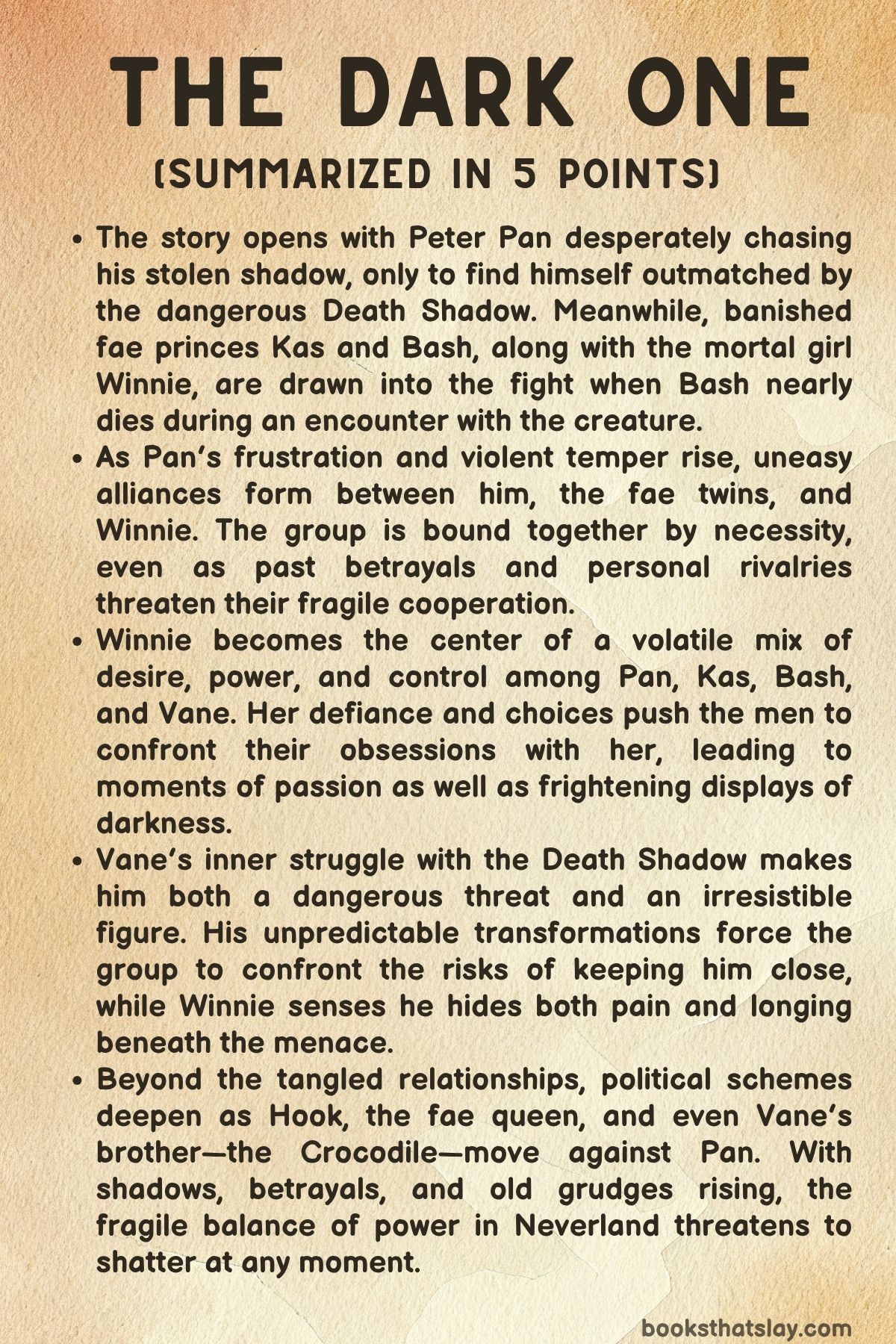
The tale begins with chaos: Peter Pan’s own shadow and a second, darker force known as the Death Shadow escape from captivity. Desperate to reclaim his shadow, Pan and his ally Vane chase after it, but it slips away into Captain Hook’s territory.
Meanwhile, Kas and Bash, banished fae princes, attempt to hunt the Death Shadow themselves. During their pursuit, Bash suffers a brutal attack that nearly kills him.
Winnie Darling, a mortal caught in their dangerous games, saves Bash by reviving him with her belief in fairies. Her action cements her role within this dangerous circle of men bound by dark magic.
Pan returns furious over losing his shadow, his rage terrifying everyone. In this tense environment, Winnie becomes more deeply entangled with Kas and Bash, who reveal their tragic past with their mother, Tinker Bell, and Pan’s bloody history with her.
Despite mistrust, all sides remain reluctantly allied against the greater danger posed by the Death Shadow.
As tensions rise, Pan’s claim over Winnie becomes volatile. His anger explodes when Winnie challenges him, leading to a clash that turns sexual and forces him to admit she is the only one he wants.
In the aftermath, Winnie engages intimately with all four men—Kas, Bash, Pan, and the ever-dangerous Vane. Yet Vane’s encounter turns violent when the Death Shadow inside him surfaces.
His hair turns white, his eyes black, and he nearly kills Winnie in his possessed state before blood grounds him and he regains control. Shaken, he flees, leaving the others unnerved by the shadow’s growing power.
Later, Pan tends to Winnie’s injuries from her encounter with Vane, showing a rare protectiveness. He then confronts Vane, who confesses his fear of the shadow’s cruel desires but refuses to part with it.
Pan persuades him to approach Hook for safe passage into his territory under the guise of searching for a missing Lost Boy. Vane complies, bringing along Cherry, a girl who secretly hopes to win his attention.
But their meeting with Hook sows more intrigue: Hook suspects Pan has already regained his shadow and becomes determined to capture it for himself.
Back at the house, Winnie grows closer to Kas and Bash. In a heated encounter, they bind and pleasure her at the Never Tree, revealing their desire to claim her fully.
Though rough and consuming, they establish trust through her chosen safe word, “Crackle.” Their intimacy strengthens their bond, making it clear that Winnie chooses all of them willingly. Yet jealousy brews when Pan learns of this, sparking tension among the men.
Meanwhile, Cherry schemes to prove her worth and encounters Pan’s rogue shadow, which she manages to trap, planning to use it for leverage. At the same time, Hook receives word from Smee that Tilly, Kas and Bash’s sister, has summoned the Crocodile—a ruthless figure tied to both Pan’s past and Winnie’s ancestry.
The Crocodile once loved Wendy Darling, Winnie’s great-great-grandmother, and now looms as another threat on the horizon.
Pan admits to Winnie that he abandoned Wendy in Everland long ago, deepening her mistrust. She demands he promise to rescue Wendy, but he refuses until after reclaiming his shadow.
Winnie, though furious, remains bound to him and the others, unable to escape the dangerous bonds tying them together.
Amid mounting schemes, Vane and Winnie share a raw and vulnerable moment at the lagoon, where he reveals fragments of his tragic past. Though he nearly gives in to his desire for her, the shadow within him threatens to consume them both, forcing him to push her away.
Their connection remains unresolved, a dangerous temptation.
The conflict comes to a head when Pan and Vane infiltrate Hook’s territory to reclaim the stolen shadow. Betrayal erupts when Tilly appears with Winnie held captive, and Hook demands to know how to claim the shadow.
Amid the chaos, Pan manages to trap his shadow within a seashell and reabsorb it, restoring his full power. Tilly flees, the twins rally to his side, and Hook is left fearful of the Crocodile’s inevitable return.
Pan leads his allies back, victorious yet wary of the battles still to come.
While this unfolds, Winnie faces her own battle when pirates invade the treehouse. With Vane fighting them off, she kills one in self-defense, marking her transformation from mortal outsider to active participant in their violent world.
But danger strikes again when Cherry lures her into a room under false pretenses. When Winnie emerges, her eyes have turned pitch black, a chilling sign that the shadow’s corruption has taken hold of her.
By the end, Neverland stands on the brink of chaos. Pan has reclaimed his shadow but faces growing threats from Hook, Tilly, and the Crocodile.
Vane teeters on the edge of losing himself completely. Kas and Bash are torn between loyalty, desire, and the schemes of their sister.
Winnie, once an innocent girl, is now deeply enmeshed in the dangerous web of desire, betrayal, and shadow magic, her fate forever tied to the dark men of Neverland.
Characters
Winnie Darling
Winnie Darling emerges as the central figure of The Dark One, her journey shaped by desire, defiance, and the peril of Neverland’s dark magic. She begins as an outsider, a mortal entangled by chance, but her quick thinking—such as reviving Bash with her belief in fairies—reveals her courage and adaptability.
Throughout the story, Winnie struggles against Pan’s dominance, refusing to be reduced to property, yet she cannot resist the magnetic pull he and the others exert over her. Her relationships with the twins, Pan, and Vane pull her into a web of passion and danger, and she willingly binds herself to all of them, asserting her choice rather than submission.
However, her attraction to Vane is different—rooted in vulnerability, danger, and an almost destructive pull. Winnie’s arc is one of self-discovery, as she learns not only the depth of her own desires but also her resilience in facing the shadows—both literal and figurative—that haunt Neverland.
Peter Pan
In this darker retelling, Peter Pan is no longer the carefree boy who never grew up but a volatile, ruthless ruler of Neverland. His obsession with reclaiming his shadow reflects his hunger for control and power, and his violent outbursts show how fragile his composure truly is.
Pan’s dynamic with Winnie oscillates between dominance and protectiveness; though he tries to enforce control, he also stitches her wounds and grows uncharacteristically shaken when she is harmed. His intimacy with her reveals a possessiveness that borders on vulnerability—he desires her not just as a conquest but as someone who unsettles his carefully constructed authority.
Yet Pan remains a strategist, balancing alliances with the twins and Vane while manipulating Hook. He is both a tyrant and a broken figure, scarred by his past with the Darling family and haunted by the shadow that constantly slips through his fingers.
Vane
Vane is perhaps the most enigmatic figure in the novel, defined by his dangerous bond with the Death Shadow. His outward coldness and cruelty mask a man tormented by his past—his sister’s death and his reckless vengeance that led to claiming the shadow.
His transformations into a white-haired, black-eyed monster embody the struggle between his humanity and the consuming darkness within him. Winnie’s presence destabilizes him further, as her persistence pierces his defenses, stirring desires he both craves and fears.
Unlike Pan’s fiery dominance, Vane’s intimacy with Winnie is tinged with danger, vulnerability, and an almost predatory restraint. His promise not to leave her, though reluctant, marks one of his rare moments of tenderness.
Ultimately, Vane represents the peril of unchecked grief and rage, a man who teeters constantly between self-destruction and reluctant connection.
Kas
Kas, one of the banished fae princes, is steady, cunning, and emotionally complex. Unlike his more impulsive twin, he displays a balance of control and intensity, especially in his dealings with Winnie.
His use of illusion magic reveals not only his fae heritage but also his desire to ease her pain, suggesting a softer core beneath his sharp exterior. However, his loyalty is tested by conflicting allegiances—to Pan, to Winnie, and to his sister Tilly, whose schemes threaten their fragile alliance.
Kas ultimately chooses Winnie, emotionally binding himself to her, even if it means forsaking his fae bloodline. This choice underscores his transformation from a political player into a man ruled by desire and devotion, a shift that deepens his humanity despite his fae origins.
Bash
Bash, the other half of the twin bond, is more impulsive, brash, and fiercely protective. His near-death at the hands of the Death Shadow cements Winnie’s importance in his life, as her belief literally saves him.
He delights in physicality, in games of dominance and punishment, yet his moments with Winnie are not merely cruel but revealing of his need for connection. His frustration with Pan’s hypocrisy highlights his own sense of fairness, however skewed by his dark desires.
Together with Kas, Bash pushes Winnie into moments of overwhelming vulnerability, but unlike Pan, he respects the idea of choice, allowing her safe words and consent even within their twisted games. His loyalty to Winnie strengthens over time, marking him as not just a partner in desire but a true ally in her survival.
Captain Hook
Captain Hook serves as the foil to Pan, a man driven by bitterness, fear, and ambition. Haunted by the Crocodile and consumed by his hatred of Pan, Hook is manipulative and calculating, willing to strike alliances with the fae queen to destroy his rival.
His interactions with Cherry and Smee reveal a man torn between vengeance and paranoia, unable to trust even those closest to him. His obsession with Pan’s shadow underscores his hunger for power, but also his insecurity, as he suspects every move to be a trick.
Hook is less a swashbuckling villain here and more a desperate, haunted man, clutching at schemes that threaten to consume him as much as his enemies.
Cherry
Cherry embodies the danger of envy and misplaced ambition. Though initially portrayed as a frivolous girl eager to gain attention, her jealousy of Winnie festers into betrayal.
Her willingness to act as a bargaining chip, her desire to attract Vane, and ultimately her manipulation of Winnie into a deadly trap illustrate her descent from companion to rival. Cherry’s encounter with Pan’s rogue shadow marks her turning point, as she seeks validation and power by attempting to leverage what she discovers.
Yet her jealousy of Winnie blinds her to the true dangers around her, making her both a tragic and dangerous figure. In many ways, Cherry represents the collateral damage of Neverland’s cruel games—those who crave recognition but are consumed instead.
Tilly
Tilly, the twins’ sister and the fae queen, is a figure of ambition and ruthless manipulation. Her schemes against Pan are steeped in both personal vendetta and political strategy, as she seeks to control the forces of Neverland by summoning the Crocodile.
Her illusions and magic reveal her cunning, but her confrontation with Pan also shows her overconfidence, as she underestimates his resilience once he reclaims his shadow. Tilly’s role underscores the theme of betrayal within families and alliances, as even blood ties cannot prevent the lure of power from driving wedges between siblings.
She is not only a political antagonist but also a mirror of the darker impulses that define the fae heritage Kas and Bash struggle against.
The Crocodile
Though he does not yet fully emerge in the story, the Crocodile looms as a figure of fear and inevitability. More man than beast, he is tied deeply to the Darling lineage, once in love with Wendy Darling herself.
His reputation as ruthless and unstoppable strikes fear in both Hook and Pan, making him a shadowy specter of vengeance and time—much like the ticking clock that once symbolized his presence. His eventual arrival promises devastation, serving as both a literal and metaphorical reminder that in Neverland, no one can truly escape the consequences of their past.
Themes
Power and Control
In The Dark One, power is constantly in flux, and control becomes a defining measure of relationships, choices, and survival. Peter Pan’s desperation to regain his shadow is not only about reclaiming lost strength but also about asserting his dominance over Neverland and those bound to him.
His erratic behavior, destructive rage, and need to possess Winnie reflect how power can corrupt intimacy and turn desire into a struggle for ownership. Similarly, the fae twins, Kas and Bash, struggle with their heritage and the influence of their mother, Tinker Bell, whose hunger for power led to ruin.
Their entanglement with Winnie becomes a test of whether they can channel power into connection rather than manipulation. Vane represents perhaps the darkest side of power: possession by the Death Shadow.
His abilities give him frightening dominance, but they also hollow him, leaving him enslaved to darkness. Even Hook is consumed by his obsession with seizing Pan’s shadow, seeing it as a weapon that can tip the scales in his favor.
Across all characters, power is shown as both intoxicating and destabilizing, shaping bonds, identities, and choices. The constant question becomes whether power can ever exist without domination, or whether it inevitably destroys those who chase it.
Desire and Boundaries
Desire is raw, consuming, and often tested by the fragile boundaries between freedom and coercion. Winnie’s relationships with Pan, Vane, Kas, and Bash push her to confront the thin line between passion and possession.
She rejects Pan’s initial attempts to claim her as property, demanding her own agency in choosing her lovers, even as she is drawn deeper into dynamics of submission and dominance. The twins’ binding and overwhelming of her test her resilience and autonomy, yet her insistence on choosing them all reframes intimacy as a matter of consent amid intensity.
Vane, by contrast, embodies desire that veers toward destruction, with his shadow pushing him beyond control and nearly costing Winnie her life. What emerges is an exploration of how desire can liberate and bond, but also how easily it can blur into violence and loss of self.
Boundaries, safe words, and choices anchor Winnie’s survival and empowerment, forcing each man around her to reckon with their own impulses. Through this, the book portrays intimacy as a negotiation of vulnerability, trust, and limits in a world where danger bleeds into every moment of passion.
Identity and Transformation
Identity is unstable, constantly reshaped by shadows, histories, and choices. Peter Pan is no longer the eternal boy but a volatile leader haunted by loss, his identity fractured by the absence of his shadow.
The twins navigate dual identities as both fae royalty and exiles, torn between loyalty to their bloodline and the freedom of forging new bonds with Winnie. Vane’s identity is the most precarious: his possession by the Death Shadow transforms him physically and mentally, threatening to erase who he truly is.
Even Winnie undergoes transformation, moving from outsider to a central figure in Neverland’s power struggles. Her mortal fragility does not diminish her role; instead, her adaptability, bravery, and insistence on choice reshape her from passive participant to active agent of fate.
Shadows themselves symbolize the instability of identity, representing both what is lost and what one fears to become. By the end, transformation is not only inevitable but also a source of tension—whether it means growth or complete annihilation depends on how much one resists or surrenders to the forces around them.
Betrayal and Trust
Trust is constantly tested, eroded, and rebuilt, making betrayal an ever-present threat. The twins are haunted by their mother’s betrayals and must question whether their allegiance to Pan or to Winnie can withstand manipulation and schemes.
Pan himself is the embodiment of distrust, capable of loyalty only when it serves his interests, as revealed in his abandonment of Wendy Darling generations before. His promises to Winnie are laced with uncertainty, leaving her unsure whether she can truly depend on him.
Vane’s inability to control his shadow makes him dangerous even to those he cares for, forcing Winnie to gamble her trust in him at the cost of her own safety. Hook and Cherry embody betrayal at a political and personal level: Hook plotting to exploit Pan’s shadow, and Cherry’s jealousy pushing her toward reckless choices that endanger others.
Amid such betrayals, Winnie’s survival depends on her ability to discern when to give trust and when to guard it, highlighting the fragility of bonds in a world where alliances shift like shadows. Trust becomes both the most precious and most perilous resource, capable of either cementing unity or opening the door to ruin.
Survival and Mortality
Death is never far in The Dark One, and survival often requires desperate choices. Bash’s near-death at the hands of the Death Shadow underscores how fragile even fae immortality can be, while Winnie’s repeated brushes with death—from Vane’s strangling grip to pirate attacks—demonstrate her vulnerability as a mortal in a supernatural world.
Survival here is not only physical but also emotional: characters wrestle with grief, vengeance, and fear of abandonment, all of which threaten to consume them as much as blades or shadows. Vane’s torment over his sister’s death propels him into a destructive alliance with darkness, while Hook’s fear of the Crocodile shows how mortality haunts even those who cloak themselves in violence.
Winnie’s insistence on choice, even in the face of overwhelming danger, reframes survival as more than just endurance—it is also about maintaining agency and meaning in a world determined to strip both away. The looming presence of shadows, betrayals, and the Crocodile remind all characters that death is not an abstract possibility but an inevitable companion, making every decision a gamble between life and oblivion.