The Dawn of the Cursed Queen Summary, Characters and Themes
The Dawn of the Cursed Queen by Amber V. Nicole is a dark fantasy romance that picks up after disaster has already torn the world apart. The story opens in the aftermath of betrayal, war, and loss, with kingdoms broken, old loyalties shattered, and powerful figures scattered across enemy territory.
At its center are Dianna and Samkiel, whose love survives death, separation, and the growing threat of forces far older and darker than either of them fully understands. The book balances brutal conflict, court intrigue, magical horror, and intimate emotional stakes, while setting up a wider struggle over fate, memory, identity, and the survival of entire realms. It’s the 3rd book in the Gods & Monsters series. The 1st book in the series is The Book of Azrael and the 2nd book is The Throne of Broken Gods.
Summary
At the start of The Dawn of the Cursed Queen, Camilla gives a bitter, mocking recap of how badly everything has gone. Rashearim has fallen, Samkiel once abandoned his people for centuries, and when he returned with Dianna, buried truths began surfacing.
Dianna, devastated by grief and rage, nearly destroyed everyone around her before Samkiel stopped her and hid her from the council. More betrayals followed as Vincent was exposed as working with Kaden, and Kaden’s schemes became tied to ancient secrets involving hidden children of Unir.
In the final collapse, Samkiel was defeated, Rashearim burned again, Nismera seized control of the realms, and resistance seemed crushed. Even so, Camilla ends the recap with one certainty: Dianna is alive, and when she returns, she will come back furious.
Camilla is then dragged by Vincent through a portal into Nismera’s realm. Instead of the dungeon she expects, she finds a disturbingly beautiful city full of bright stone buildings, flowers, and calm citizens who seem untouched by the horrors of Nismera’s rule.
The false peace makes the place more unsettling, and Camilla studies the streets closely, already thinking about escape. As Vincent forces her toward the palace, she notices that even he seems uneasy, revealing that he too fears what waits there.
A week later, Vincent is seen in Nismera’s chambers after sleeping with her. His thoughts reveal disgust, self-loathing, and hatred for the role he still plays in her world.
Nismera restores his old military title of High Guard, crushes any possible objections, and orders him to escort Camilla everywhere because she needs Camilla’s power to repair an ancient artifact. Vincent understands that although his position has changed, he is still trapped.
In a later gathering of generals, he hears commanders celebrating Samkiel’s fall and praising Vincent for helping destroy the World Ender. He is revolted by them and consumed by guilt, especially when rumors spread that Dianna is still alive and attacking Nismera’s forces in the eastern territories.
Remembering that Samkiel once genuinely tried to help him, Vincent feels the full weight of his betrayal.
Kaden’s section in The Dawn of the Cursed Queen shows how ruthless Nismera’s rule has become. He watches as she feeds captured rebels one by one into a monstrous vortex creature.
Even the last rebel, Sir Molten, dies defying her. At a war meeting afterward, Nismera discusses relics stolen from Rashearim, rebellions rising across the realms, and reports that Dianna has been slaughtering soldiers and leaving provocative messages behind.
Dianna’s survival unsettles everyone because she can become a rallying point for resistance.
Kaden argues that Dianna should not simply be killed. In private, he proposes using a special rune-carved blade to erase her memories and remake her into a loyal servant.
His reasoning is not only political but deeply personal, because he still claims to love her. Nismera is enraged that his obsession has already created problems, but she accepts the idea because of its value as both punishment and propaganda.
She then punishes Kaden for his failures by sending him to the dungeons for a week and ordering the destruction of his created beasts. Though he hides it, the punishment terrifies him because darkness recalls old imprisonment and trauma.
Later, he confesses to Isaiah that Samkiel and Dianna were never meant to find each other, and that their bond ruined his plans.
Another thread follows Cameron in a brutal pit fight where crowds mock Samkiel’s death and the fall of The Hand. When his monstrous opponent threatens Xavier, Cameron loses control, kills him, and heals himself by drinking his blood.
Kaden and Isaiah then appear and try to force Cameron into helping them. Cameron resists, furious over being turned and over Xavier’s fate, but Kaden manipulates him with the promise of information about where Xavier was taken.
Cameron finally agrees to help track Dianna, while warning them that Dianna, shattered by Samkiel’s death, is likely roaming the realms in a state of lethal vengeance.
The story then shifts back to an earlier period, when Dianna and Samkiel are together in Jade City after his severe injury. Once the healers finally clear him, the two of them reconnect physically after weeks of restraint.
Their reunion is intense and joyful, but it also shows how much fear and grief they are trying to forget through closeness. During it, Dianna briefly feels her monstrous hunger return: her eyes change, her fangs emerge, and she senses the old bloodlust stirring.
She hides it from Samkiel, refusing to let him see how much she is slipping.
Later, after bathing together, their peaceful moment is broken when Roccurem interrupts to summon Samkiel to Queen Frilla. Once Samkiel leaves, Reggie confronts Dianna.
He accuses her of escalating the war by massacring Nismera’s soldiers in Tarr and making herself look so dangerous that attention would be drawn east instead of toward Samkiel’s hiding place in the west. Reggie also presses her about the truths she is keeping from Samkiel: the fall of The Hand, his death, the strange mark that formed and vanished after his resurrection, and the possibility that bringing him back may have broken something in the universe.
Dianna admits she is terrified, especially because she does not know whether his return is permanent. Reggie also forces her to admit that food no longer satisfies her, that only blood does, and that she has been starving herself for more than a month.
On top of that, she confesses recurring dreams of a throne room made of bones and a figure with glowing orange eyes waiting for her.
Meanwhile Samkiel, under the false name Cedaar, meets Queen Frilla and maintains the lie that he is merely a soldier of The Eye. Frilla openly flirts with him while probing for information about Dianna.
Samkiel keeps his cover intact, though privately he sees Dianna as his entire world. Frilla also confirms that the realms believe Samkiel is dead and that hope is fading under Nismera’s domination.
Samkiel refuses to accept defeat. Later, he and Dianna train together, with Dianna frustrated by how slowly his wound is healing.
Though they quarrel, the tension soon softens. Samkiel, however, increasingly senses that she and others are hiding major truths from him.
Another major turn comes when Dianna wakes after being unconscious for four days in a tavern room, with Samkiel at her side. He gives her animal blood to restore her strength, and their teasing conversation slowly leads into darker matters.
Dianna admits she killed Vincent during the prison conflict and feels no regret, only relief. Samkiel confesses that Vincent had once been a friend he wanted to save, but that betrayal changed everything.
Dianna also tells him that the wound she suffered came from a godly weapon, perhaps one forged by his sister. Samkiel believes such a weapon could have been made on a dead moon built by his father, but he refuses to chase that lead while so weak.
He says his first priority is reclaiming the power still burning in the sky.
Below them, Roccurem, Orym, and Savees discuss the dangerous bond between Dianna and Samkiel and warn each other how catastrophic Dianna’s power could become if left unchecked. This concern gains more weight when later events reveal how unstable everything truly is.
Elsewhere, Camilla overhears disturbing war-room conversations in Nismera’s palace and then finds Vincent nearly destroyed, burned and sedated in his chamber. Furious, she forces Kaden to help her save him by magically binding him and drawing part of his life force into Vincent.
During the spell she touches something vast and unnatural beyond normal reality, hears a strange voice, and channels immense power into Vincent, healing him. The act leaves her collapsed, but Vincent survives.
Dianna later joins a covert mission tied to suspicious trade in Veeq, where she infiltrates an auction dealing in rare weapons and creatures. There she meets Faye, who seems helpful at first.
Chaos erupts when a monstrous murrak escapes, and in the confusion Faye steals an ancient enchanted sword and flees. While pursuing her, Dianna and Orym discover hidden cells and an imprisoned oracle.
The oracle taunts Dianna mercilessly, calling her hollow and destructive, exposing truths about her father Azrael, and revealing that she brought Samkiel back through forbidden means. When the oracle pushes too far, Dianna loses control and kills her brutally.
Afterward, Orym confronts Dianna, and she finally admits the truth: after losing her sister and then losing Samkiel, she could not bear another death. In desperation, she threatened the realms and somehow resurrected him, but the price may have been the bond mark she treasured.
Orym reassures her that Samkiel’s love does not depend on that mark. Samkiel later comforts her too, but Dianna remains deeply afraid of what she has done.
The climax comes when Samkiel captures Ennas and tortures him for information about where Dianna has been taken. Ennas finally reveals that Kaden intends to use a blade forged by Dianna’s father to erase her memories and reshape her into whatever he wants.
Realizing he is too weak to reach her in time, Samkiel nearly breaks. Roccurem urges him to call back the power he cast into the sky.
In that moment, Samkiel understands the truth: Oblivion was never only his weapon. He himself is Oblivion.
He summons his full power home.
At the same time, Dianna is being overpowered by Kaden and Isaiah as they force the dagger toward her chest. As she weakens, she thinks desperately of everything she stands to lose if her memories vanish.
Just before the blade can take her, Samkiel arrives in overwhelming force, reducing the place to ruin and ash. He later pulls Kaden and Isaiah away to a dead world, kills Kaden outright, defeats Isaiah, and returns with Isaiah as a prisoner.
Samkiel reunites with Dianna, heals her, and brings her home. Elsewhere, Camilla escapes with Vincent, rescues Elianna, and realizes that Samkiel has returned.
Nismera also learns the truth and begins preparing for war. Back in Samkiel’s stronghold, Isaiah wakes in chains, while Samkiel and Dianna finally cling to each other in exhausted relief.
But their peace is brief. Dianna senses danger in the castle, follows it into Samkiel’s study, and encounters a shadowy figure her flames cannot touch.
When he turns, she recognizes him in shock: Unir, Samkiel’s dead father. He tells her the dead have much to discuss with her, then drags her into darkness.
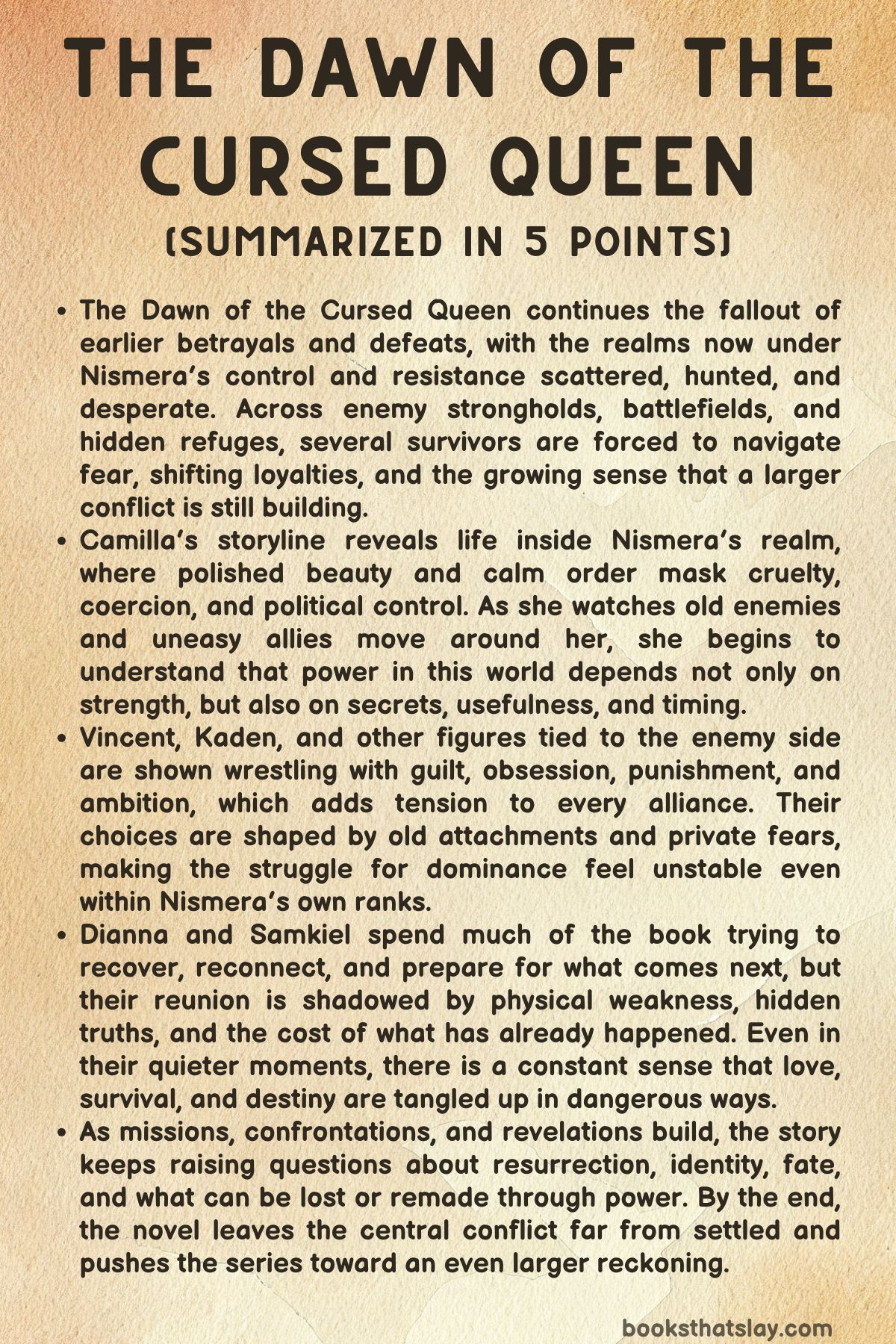
Characters
Dianna
Dianna stands at the emotional and destructive center of the story. She is written as a woman divided between fierce devotion and terrifying instability, and that conflict shapes nearly every major event.
Her love for Samkiel is absolute, to the point that she brings him back from death through forbidden means and accepts any consequence that might follow. At the same time, she is carrying immense grief, especially over her sister, and that grief has sharpened her into someone capable of extraordinary violence.
Her massacre of Nismera’s soldiers in the East is not only revenge but also strategy, since she wants to draw attention away from Samkiel’s location. That makes her both emotionally driven and tactically intelligent.
What makes her compelling is that she is never only a lover or only a weapon. She is protective, frightened, secretive, hungry, and increasingly unsure of what she is becoming.
Her craving for blood, her recurring visions, and her fear that Samkiel’s resurrection may have broken the natural order all give her a tragic dimension. She wants tenderness and a future, yet she keeps being pulled toward monstrosity.
Even when she is trying to protect Samkiel, she does it through concealment and force, which shows that love has not softened her so much as made her more dangerous. She remains sympathetic because her worst choices come from desperation, but the story never lets the reader forget how catastrophic she could become.
Samkiel
Samkiel is presented as both a fallen king and a mythic force struggling to return to himself. Much of his character is built around contrast: he is feared as the World Ender, yet in private he is patient, loyal, affectionate, and deeply vulnerable where Dianna is concerned.
His greatest strength is not simply power but emotional depth. Even while weakened, wounded, and cut off from much of what made him formidable, he refuses to surrender to hopelessness.
He still thinks in terms of responsibility, family, and the wider fate of the realms, which makes him far more than a warrior figure.
His love for Dianna is central to his identity, but it does not reduce him. Instead, it reveals his humanity.
He listens to her, argues with her, worries about her, and also realizes that others are keeping truths from him. That gives him a quiet intelligence beneath the more obvious physical dominance.
His defining transformation comes when he understands that Oblivion is not merely a weapon he once wielded but something inseparable from himself. This revelation completes his arc from injured survivor to restored cosmic force.
Even so, the character remains emotionally grounded because his power is always tied to fear of loss. His brutality toward Ennas and his annihilation of Kaden and Isaiah show how terrifying he can be, but those acts are framed through desperation and love rather than empty cruelty.
He is most interesting because he is both savior and apocalypse.
Camilla
In The Dawn of the Cursed Queen, Camilla brings sharpness, wit, and emotional intensity to the narrative. Her opening voice is irreverent and darkly funny, which immediately sets her apart from the more solemn or grand figures around her.
That humor is not superficial; it reads as a survival mechanism developed in response to repeated devastation. Even when she is dragged into Nismera’s realm, she stays observant and strategic, noting routes, watching Vincent, and thinking constantly about escape.
She is a character who refuses passivity even when trapped in enemy territory.
Her deeper emotional significance emerges through Vincent. She is furious at his betrayal, yet her response to his ruined condition reveals that her feelings toward him remain powerful and complicated.
Instead of abandoning him, she forces Kaden to help save his life, even at enormous personal risk. That decision shows loyalty, courage, and a willingness to act decisively when everyone else hesitates.
Camilla also becomes important because of her unexplained magical capacity. When she channels strange power during Vincent’s healing, the story hints that she is connected to forces much larger than she understands.
This makes her more than a sarcastic survivor; she is becoming a figure of possible future importance. Her emotional directness, resilience, and refusal to stop caring make her one of the most vivid characters in the book.
Vincent
Vincent is one of the most morally damaged and psychologically conflicted figures in the story. He is not written as a simple traitor, even though he has undeniably betrayed Samkiel and helped Nismera.
His inner life is defined by shame, disgust, and entrapment. He understands exactly what Nismera is and what he has become under her control, and that awareness makes his situation more tragic.
He sees himself as compromised beyond repair, yet he is not numb enough to stop suffering from that knowledge.
His memories of Samkiel are crucial because they reveal that he once had access to something good and failed to hold onto it. He remembers Samkiel as someone who tried to help him, which deepens his guilt and prevents his betrayal from feeling casual.
Even when others celebrate him as a hero for helping defeat the World Ender, he recoils from the praise. That reaction shows that his conscience, though damaged, is still alive.
Vincent’s fear of the palace and of Nismera also humanizes him. He may appear cold from the outside, but inwardly he is terrified and exhausted.
His later rescue of Camilla and restoration of her hands suggests that redemption may still be possible, though not easy. He is compelling because he embodies corruption without becoming hollow; there is still enough of the original man left to suffer, regret, and possibly choose differently.
Nismera
Nismera is constructed as a ruler whose greatest power lies in control, violation, and emotional predation. She dominates not only through military force but through her ability to reduce people into tools, trophies, and extensions of her will.
Her realm looks beautiful and calm, which makes her cruelty feel even more sinister. She understands the value of appearances, ceremony, rank, and spectacle, using them to maintain an image of order while feeding prisoners to monsters and crushing rebellion.
That duality makes her especially threatening.
She is also defined by her possessiveness. Whether dealing with Vincent, Camilla, Kaden, or the larger political machinery of the realms, she cannot tolerate autonomy in others.
Everyone must be useful, obedient, and replaceable. Her interest in relics, creatures, and hidden prisons suggests that her ambition extends beyond ordinary conquest into something older and more dangerous.
What makes her effective as an antagonist is that she combines personal cruelty with political intelligence. She immediately recognizes the symbolic danger of Dianna’s survival and the usefulness of breaking her publicly.
She is not impulsive in the way Kaden is; her rage is disciplined by calculation. Even when others fear open war, she thinks in terms of leverage and domination.
She feels less like a villain of passion and more like one of appetite and design.
Kaden
Kaden is driven by obsession, resentment, and failed control. His connection to Dianna defines him, but not in a noble way.
He claims to love her, yet every action he takes proves that what he truly wants is possession. His plan to use a blade to strip away her memories and remake her into someone loyal exposes the violence at the heart of his attachment.
He cannot accept that Dianna has chosen Samkiel, so he reframes domination as love and manipulation as necessity. That makes him one of the more disturbing characters in the book.
He is also a deeply insecure figure. Nismera’s punishments terrify him, the darkness of the dungeon unsettles him because of past imprisonment, and he repeatedly loses control when confronted with the reality of Dianna and Samkiel’s bond.
He still has strategic value, and he clearly possesses intelligence, but his judgment is poisoned by personal fixation. His conversations with Isaiah reveal how badly his original plans have failed, and that failure eats at him.
Kaden works best as a character because he is not powerful in a stable, self-possessed way. He is unraveling.
By the time Samkiel confronts him, he has already become a man ruled by wounded ego and fantasy. His death feels fitting because he is destroyed not only by Samkiel’s strength but by his own refusal to accept reality.
Cameron
Cameron is presented as a character forged by suffering, humiliation, and survival instinct. His pit fight sequence establishes him as someone trapped in a brutal system where he is expected to perform, endure, and be claimed by stronger powers.
What makes him memorable is the fury beneath that captivity. When Xavier is threatened, Cameron’s restraint breaks, and the violence that follows shows both how dangerous he is and how thin the barrier is between endurance and eruption.
He is also a useful contrast to more romantic or regal figures. His motives are immediate and personal.
He is angry about being turned, angry about Xavier being taken, and angry at the people who keep using him. That directness gives him a rough honesty.
Even when Kaden coerces him into cooperation, Cameron never becomes submissive. He agrees because he is manipulated with the possibility of finding Xavier, not because he trusts anyone.
His warning that they cannot control what they will find in Dianna reveals sharp instinct and a realistic understanding of grief and vengeance. Cameron feels like someone the story can push into either allyship or further brutality, which gives him tension and potential.
Isaiah
Isaiah functions as both accomplice and contrast. He is closely aligned with Kaden and Nismera, but unlike Kaden, he does not appear driven by obsessive love.
Instead, he comes across as colder, more pragmatic, and more willing to participate in cruelty as part of a larger agenda. His powers make him especially frightening because they allow him to attack from within, turning violence into something invasive and intimate.
His role in Dianna’s near-erasure emphasizes that he is not merely present for support; he is an active architect of suffering.
Yet the summary also makes clear that he is not as unshakable as he may seem. When Samkiel returns at full strength, Isaiah becomes frightened and hesitant.
That shift matters because it exposes the limits of his confidence. He is dangerous when he has institutional power or numerical advantage, but far less composed when confronted directly by a fully restored Samkiel.
His later imprisonment completes that reversal. Once able to help corner Dianna, he ends the book chained, tortured, and fearful.
That trajectory makes him effective as a secondary antagonist whose menace depends on the systems he serves.
Roccurem
Roccurem is one of the steadier presences in the narrative, acting as a guide, protector, and keeper of difficult truths. He repeatedly appears in moments where emotional chaos threatens to overwhelm practical action.
He reminds Samkiel of appointments, observes the state of the bond between him and Dianna, and eventually gives the crucial advice that allows Samkiel to reclaim his power from the sky. That positions him as someone with both loyalty and insight.
He is also notable for the way he understands danger without being ruled by panic. He recognizes how catastrophic Dianna’s power could be, yet he does not reduce her to a monster.
He treats her as a serious risk and a person at the same time. That balance makes him feel wise rather than merely cautious.
His role in the story suggests an older, experienced figure who sees patterns others miss and understands when to push, when to observe, and when to speak plainly. He is not flashy, but he provides structure in a world where so many other characters are being driven by fear, lust, grief, or vengeance.
Reggie
Reggie serves as a truth-teller and prophetic warning voice. His importance lies less in action than in confrontation.
He is willing to say what Dianna does not want to hear, especially about the consequences of her choices, the instability caused by Samkiel’s resurrection, and the danger of keeping secrets. That makes him essential because he pushes against the emotional logic that governs Dianna’s decisions.
He does not deny her love or pain, but he refuses to let those things excuse everything.
His broken visions add another layer to his character. He is not a distant seer who speaks with certainty; he is someone who can feel the damage in reality itself.
That makes his warnings more unsettling because they come with vulnerability rather than authority. He becomes a voice for cosmic consequence inside a story otherwise dominated by personal urgency.
Even when Dianna dismisses the cost to herself, Reggie makes clear that the issue is larger than individual sacrifice. He embodies the perspective that forbidden acts do not stop mattering simply because they were done for love.
Orym
Orym is a quieter but emotionally valuable supporting character. His role becomes especially important during the gallery and oracle sequence, where he acts as a witness to truths Dianna has been trying to contain.
His shock at learning what she has done and what she has hidden shows that he is morally responsive and not simply there to follow orders. At the same time, he does not abandon her when faced with disturbing revelations.
That response defines him. Orym is capable of judgment, but also of compassion.
After the oracle’s accusations and Dianna’s violent reaction, he confronts her privately and gives her room to speak honestly about her sister, Samkiel’s death, and the desperate act of bringing him back. His reassurance does not erase the seriousness of what she has done, but it helps anchor her emotionally.
He comes across as someone who offers human steadiness in a story crowded with extremes. His importance lies in emotional intelligence rather than dramatic dominance.
Queen Frilla
Queen Frilla is written as politically alert, flirtatious, and difficult to read. Her scenes with Samkiel show that she uses charm as a form of intelligence gathering, testing his cover story while revealing selected truths about the state of the realms.
She is not openly hostile, but neither is she harmless. Every conversation with her seems to carry multiple purposes, which makes her feel like a ruler who survives through perception and controlled performance.
She also contributes to the political atmosphere of the story. Through her, the narrative shows how widely belief in Samkiel’s death has spread and how thoroughly Nismera’s rise has damaged morale.
Frilla seems interested in Dianna and Samkiel not merely as individuals but as possible pieces in a changing power structure. Her likely desire for a secret meeting by the river suggests further motives beyond flirtation.
She is a secondary figure, but one who adds complexity to the wider world.
Ennas
Ennas is characterized through resistance, cruelty, and provocation. Even when captured and tortured, he refuses immediate submission and uses the opportunity to wound Samkiel psychologically.
His taunt that the feared World Ender now has a weakness is meant to reduce Samkiel’s love into vulnerability and shame. That makes Ennas more than a disposable enemy; he understands exactly where to strike.
He also serves an important narrative purpose by delivering the horrifying truth about Kaden’s plan for Dianna. In doing so, he becomes the catalyst for Samkiel’s final transformation.
His ability to inflict damage even while losing physically speaks to a vicious, defiant nature. He is memorable because he remains dangerous through knowledge and malice long after he has lost the upper hand in combat.
Faye
Faye enters briefly but leaves a strong impression because of how uncertain her loyalties remain. She initially appears helpful and flirtatious, creating the sense that she might become an ally or at least a useful contact.
Instead, chaos reveals that she has her own agenda, especially when she steals the enchanted sword and escapes. This makes her feel elusive and self-directed rather than easily classifiable.
Her importance comes from disruption. She complicates the mission, exposes hidden layers within the gallery, and moves the plot toward the chained cells and oracle.
She represents a type of character who operates outside the major power blocs, motivated by purposes the book only hints at. That ambiguity gives her intrigue.
Elianna
Elianna appears late, but her actions immediately establish her as resourceful and opportunistic. She is found stealing documents at a moment of political chaos, which suggests both courage and a keen instinct for when power structures are vulnerable.
Her belief that Kaden is dead and Samkiel has returned shows that she is responsive to shifting realities and ready to act on them.
What stands out is how quickly Camilla identifies her potential value. Elianna is not framed as purely trustworthy, but as someone whose information and mobility could matter in the coming conflict.
That makes her feel like a survivor character, someone who navigates danger through wit and initiative rather than overwhelming strength.
Savees
Savees functions as a warning voice about the larger scope of Nismera’s plans. Even with limited page space in the story, the character contributes an important interpretive angle by suggesting that Nismera’s collection of captives and creatures points to something more sinister than simple empire-building.
This makes Savees significant as someone who can see patterns others may overlook.
The character’s value lies in broadening the threat. Through Savees, the narrative hints that the war is only one layer of a deeper design.
Though not heavily developed here, Savees helps deepen the sense of looming horror.
Tedar
Tedar is a minor but useful figure because he reveals the culture forming under Nismera’s rule. His enthusiastic praise of Vincent for helping destroy Samkiel exposes how victory has been mythologized among the enemy ranks.
He reflects a world in which betrayal is rewarded publicly and cruelty is celebrated as political success.
Because of him, Vincent’s disgust becomes even sharper. Tedar does not need much complexity; his role is to embody the poisonous values of the regime now in power.
Sir Molten
Sir Molten appears briefly, but his death scene marks him as a symbol of resistance. Even in defeat, he refuses submission and suggests that something important remains beyond Nismera’s reach.
That refusal gives him dignity and makes his execution feel significant rather than incidental.
Characters like Sir Molten help show that rebellion is still alive, even if scattered and punished brutally. He stands for defiance carried to the end.
Xavier
Xavier is mostly present through Cameron’s fear and loyalty, but even from that limited perspective he matters. The threat against him is enough to trigger Cameron’s transformation from beaten captive to lethal force.
That indicates Xavier is one of the few ties strong enough to cut through Cameron’s exhaustion and rage.
He therefore functions as an emotional anchor. Even without much direct characterization here, his importance is measured by what others are willing to suffer and do for him.
Azrael
Azrael exists in the book mainly as a shadow over Dianna’s identity. References to him, especially through the oracle, connect her to a darker lineage and deepen the mystery around what she is becoming.
He seems to represent inheritance in its most troubling form: not just ancestry, but the fear that something destructive has been passed down and cannot be easily escaped.
His importance is thematic as much as personal. Through Azrael, the story suggests that Dianna’s struggle is not only about recent grief or forbidden resurrection, but about older forces already embedded in her life.
Unir
Unir’s late appearance gives him enormous dramatic weight. Though physically absent for most of the book, he shapes the story through legacy: he is Samkiel’s dead father, the creator of powerful structures and histories that continue to affect the present, and the source of secrets tied to prisoned children and godly weapons.
By the time he appears directly, he already feels like a looming ancestral force.
His arrival at the end transforms him from background influence into immediate threat. He crosses the boundary between death and presence with chilling ease, and his claim that the dead have much to discuss with Dianna suggests knowledge that could change everything.
He is written to feel larger than ordinary villainy, almost like an unresolved past returning in literal form.
Killium
Killium appears briefly, but the information delivered through him matters. He helps reveal that the weapon Nismera wanted was not truly about fate, but about repairing something she had broken.
That moment sharpens the sense that hidden plans are still unfolding beyond what most characters understand.
Though small in direct presence, Killium serves as one more link in the chain of revelations that keep widening the scope of the conflict.
Themes
Love as Salvation and Vulnerability
Love is presented as the force that keeps these characters alive, but it also becomes the exact point where they can be broken. Samkiel and Dianna repeatedly return to each other for comfort, healing, and a sense of home in a world that has almost collapsed around them.
Their private moments are never just romantic interludes; they are acts of survival against grief, war, fear, and physical ruin. At the same time, that devotion creates danger.
Ennas’s taunt that the feared World Ender now has a weakness captures the cost of caring deeply in a violent world. Enemies do not merely want to kill; they want to sever memory, connection, and identity by targeting the person each lover cannot bear to lose.
Even resurrection is shaped by this theme, because Dianna’s refusal to let Samkiel remain dead changes the balance of the universe itself. Love here is not gentle or abstract.
It restores strength, inspires impossible acts, and gives both of them purpose, yet it also leaves them exposed to manipulation, desperation, and choices that carry enormous consequences.
Power, Corruption, and the Hunger to Possess
Power in the novel is rarely shown as noble authority. More often, it appears as domination, ownership, and the desire to control bodies, memories, and futures.
Nismera rules through spectacle and terror, feeding prisoners to monsters, crushing rebellion, and treating even loyal servants as objects to be used and discarded. Kaden reflects a more intimate form of corruption.
His wish to erase Dianna’s memories is framed as strategy, but it is really possession disguised as devotion. He does not want her freedom or happiness; he wants a version of her that can be remade to suit his needs.
Vincent’s situation also reinforces this theme, because even his restored rank changes nothing about his captivity. He remains trapped inside a system where obedience is rewarded only as long as it is useful.
Across these storylines, power is shown as something that invites moral decay when it becomes tied to ego and entitlement. The central horror is not only physical violence, but the belief that another person’s mind, will, and soul can be reshaped by force.
Identity Under Ruin and Reinvention
Many characters in The Dawn of the Cursed Queen are living through shattered versions of themselves, and the story keeps asking what remains when the old self has been damaged, corrupted, or stripped away. Dianna fears both the monstrous hunger inside her and the consequences of what she did to bring Samkiel back.
She is torn between the person she wants to be and the terrifying possibility that she has already crossed into something irreversible. Samkiel faces a different crisis, learning that his true nature is far greater and more dangerous than the identity he had tried to contain.
His realization that he himself is Oblivion changes the way he must understand his own existence. Vincent, too, is caught between past and present, between the wounded man Samkiel once tried to save and the betrayer he became under Nismera’s rule.
Even Camilla, in the heart of enemy territory, begins to discover strange reserves of strength and a link to powers she does not yet understand. Identity in this world is never fixed.
It is tested by trauma, guilt, hidden truths, and transformation, forcing each character to confront who they are when everything familiar has fallen away.
Death, Resurrection, and the Cost of Defying Fate
Death is not treated as a clean ending but as a violent disruption that leaves scars even when reversed. Samkiel’s return from death should be a miracle, yet it immediately carries dread.
The vanished bond mark, Reggie’s broken visions, and the instability spreading through existence all suggest that restoring a life has disturbed something fundamental. Dianna accepts any personal price as long as Samkiel survives, which gives this theme a tragic edge: resurrection is born not from balance or wisdom, but from unbearable grief and refusal to let go.
The consequences ripple outward through prophecy, fear, and uncertainty, making survival itself feel fragile. Unir’s final appearance pushes the theme even further by suggesting that the dead are not silent and that unfinished reckonings remain.
Throughout the book, death does not erase love, guilt, duty, or conflict. Instead, it deepens them.
The narrative treats fate as something characters can resist, but never without consequence. Every attempt to overturn loss creates a new burden, and every return from death seems to demand a reckoning still to come.