The Dinner Party Summary, Characters and Themes
The Dinner Party by Viola van de Sandt is a psychological novel about memory, shame, and the long afterlife of coercion. Franca, living alone in Berlin, is trying to build a workable life after leaving her wealthy fiancé, Andrew.
In weekly therapy sessions with Stella, she circles the same missing piece: a night in England, a kitchen knife, and a gap in her recollection that refuses to close. As Franca writes letters and revisits the past, the story shows how isolation grows quietly inside comfort, and how a single evening can expose what a relationship has been hiding in plain sight.
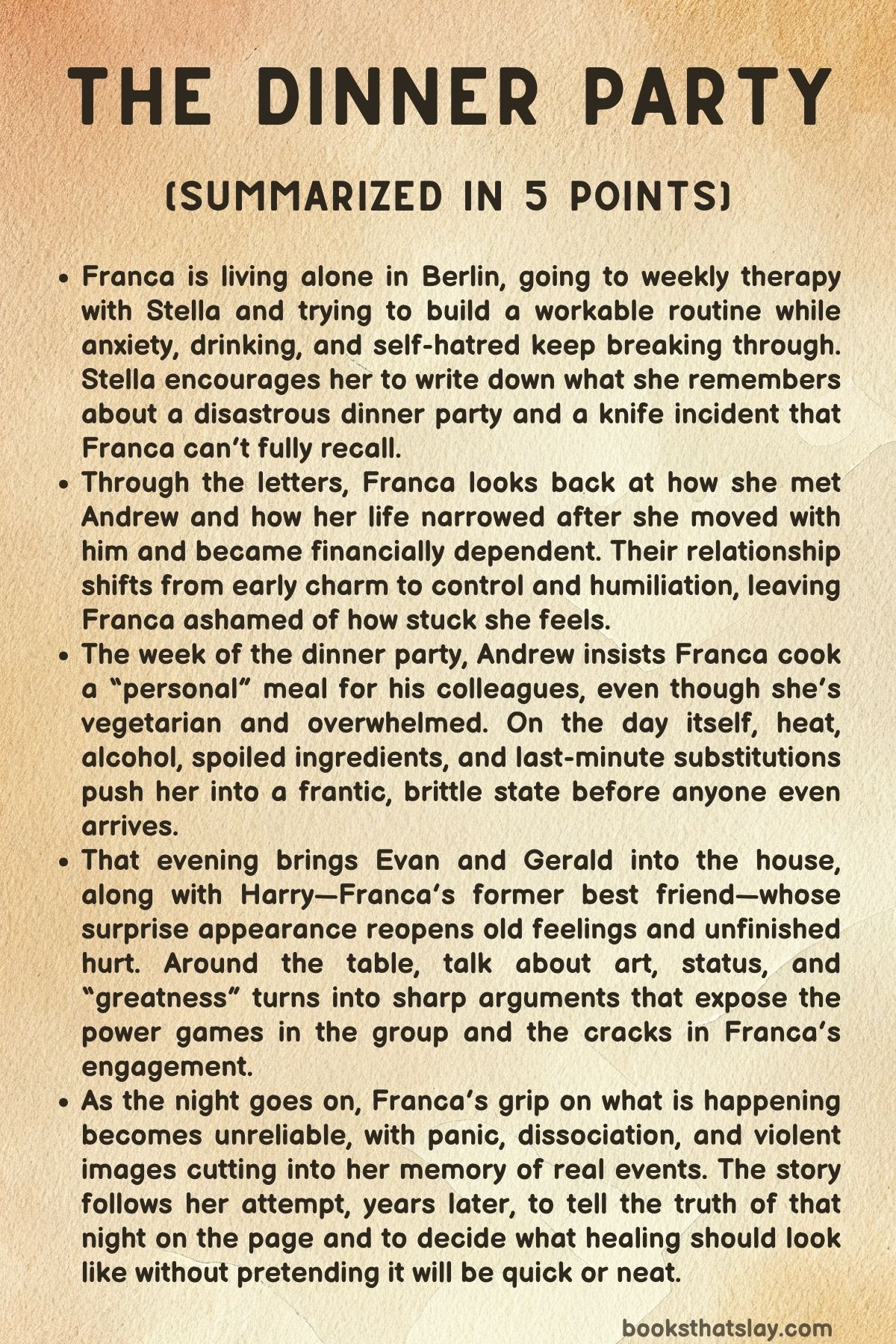
Summary
Franca lives in Berlin in a small flat she is slowly making her own, painting walls in warm colors and trying to tolerate the silence of being alone. She works at a department store, speaks little to her coworkers, and carries herself as if she is always slightly outside the room.
Once a week she meets Stella, her therapist, who listens closely to Franca’s self-contempt, her drinking, and the way her memories break apart when she gets near one particular night. Stella keeps returning to the “facts” Franca cannot avoid: an incident involving a knife, injuries, and Franca’s inability to recall crucial minutes of what happened.
When Stella asks Franca to write a letter—about the night, about the person she trusts, or even only to herself—Franca insists she has nothing to recover from. Still, she begins.
Franca chooses to write to Harry, a former friend whose name keeps rising through her recollections. At first she tries to pin down a small detail: what she did with the kitchen knife at the end of that evening.
The memory won’t settle. She can picture several versions—knife on the counter, knife on the floor, hands washing it, hands not washing it—and each version brings a different fragment with it: a sticky spill, broken glass, a cut that won’t stop bleeding, a smear she cannot explain.
The uncertainty makes her furious, but it also pulls her back to the days leading up to the dinner party.
Years earlier, Franca lived in England with Andrew, the man she had followed there after meeting him in Utrecht. Andrew is a successful tech entrepreneur who has money, plans, and a habit of turning his preferences into rules.
A week before his project launch, he announces he wants a celebratory dinner at their house and decides Franca will cook. He assigns a starter, braised rabbit for the main course, and chocolate cake for his colleague Evan.
Franca reminds him she is vegetarian and suggests they can hire a caterer, but Andrew insists a “personal” meal will impress the guests. Franca agrees while feeling both trapped and guilty, as if she is failing a test that has no fair marking scheme.
Her dependence on Andrew has been building for years. Franca remembers meeting him in a library in Utrecht, where he was researching an app designed to block distractions.
She teased him for needing software to stop using software, and the joke opened into a long afternoon of conversation. She spoke about her father’s death from cancer and the distance that grew between her and her mother afterward.
Andrew spoke about abandoning a dream of astrophysics for computer science. Their connection intensified quickly, and Franca soon moved countries for him.
She dropped out of her degree, applied for jobs, and collected rejections until shame hardened into stillness. When Andrew’s wealth made work “unnecessary,” he told her she could write.
She didn’t. She stayed home, watched the same shows, and felt herself shrinking.
On the day of the dinner party, the heat is oppressive and Franca is already drinking. She buys groceries, including two rabbits from a poulterer who refuses to remove their heads.
The sight unsettles her. Back home, the house feels too quiet, too large, and too full of Andrew’s absence.
Then she discovers she has left the fridge door open. The rabbits have spoiled, leaking into a foul puddle.
With guests coming soon, she rushes to a supermarket in panic. An elderly woman there—oddly confident, oddly helpful—talks her through an emergency plan: a stuffed chicken with chorizo and beans, guided by a recipe online.
Franca follows the instructions as if obedience might keep her safe.
Andrew arrives late and tense. He is irritated that the fridge is empty and the beer is in the cellar, irritated that the rabbits are gone, irritated that Franca has changed the plan.
While Franca cooks, she cuts her finger badly with a sharp kitchen knife. She tells Andrew she is bleeding and needs a plaster, but he comes up behind her, blocks her movement, and initiates sex against the stove.
Franca tries to protest and to turn away, but he restrains her, pressing her into the counter while food cooks and their kitten watches. When he finishes, he apologizes abruptly and tells her to change before the guests arrive.
Franca cleans herself, bandages her finger, and forces her face into something usable as the doorbell rings.
Evan and Gerald arrive first and settle in the garden with drinks. Gerald is older, a respected figure in literature, and he has helped choose a list of books for a “Golden Record” project connected to a space mission that Andrew and Evan are funding.
Evan is proud and rehearses the language of legacy—humanity, canon, greatness—while Franca feels herself recede. Then Evan mentions another guest: a friend named Harry.
When the bell rings again, Franca opens the door to Harry—her former best friend from Utrecht—both of them stunned by the coincidence. Harry didn’t know she lived there.
He has reconnected with Evan by chance and accepted the invitation without realizing whose house it was. Franca lets him in, shaken.
She returns to the kitchen, bleeding again in her mind if not in her hand, trying to keep the evening from tipping over.
In the kitchen, her body starts to rebel. Her hands shake as she chops garlic.
The kitten claws up her leg, panicking her further. In a moment of overwhelmed rage and terror, Franca yanks the kitten free and snaps its neck.
The body goes limp in her hands. She drops it into the bin and returns to the party as if she can still pass as a person with an ordinary night.
At the table and in the garden, conversations sharpen into tests. Gerald speaks with authority about literary “excellence.” Harry challenges him, asking who gets to decide what greatness means and why certain voices are always missing.
Franca, drunk and humiliated, interrupts Evan’s grand speech and punctures the performance. Andrew grows hostile toward Harry and exposes Franca as “his fiancée,” telling the group about her drinking and announcing their marriage plans as if she is a shared asset.
Franca retreats to the cellar, drinking from the bottle, remembering her childhood after her father died: her mother’s year-long silence, Franca’s secret drinking as a thrill and a comfort, and the relief she felt when a counselor named Paul finally brought noise and attention back into the house.
As the dinner party unravels, Franca’s memory becomes unreliable on purpose, like a mind protecting itself with fog. There are arguments in the kitchen about money, work, and Andrew’s control.
There is the cutlery drawer, the knife, and a rush of images—blood, shouting, a sense that something terrible is about to happen or has already happened. At one point Franca flees into the night.
Harry follows, careful not to touch her without permission, and they sit at a bus stop where the past finally breaks through: Harry admits he once loved her and left when she rejected him; Franca admits she loved him too and regrets what fear made her do. They decide to walk back together, with Harry asking her to tell him what happened.
The next clear frame is later: Franca in Berlin, months after the incident, with Stella pressing gently and steadily for the truth Franca can approach only in fragments. Gerald’s actions that night—calling for help—likely saved her.
Andrew was injured but did not die. Franca’s engagement and the life she thought she was supposed to have collapsed, and she feels an unsettling mix of ruin and relief.
Her mother visits after the incident and, awkwardly, speaks more honestly than she used to. Franca refuses reconciliation with Andrew despite his attempts to contact her.
She keeps writing, keeps showing up to therapy, and keeps learning to live with what she remembers and what she cannot. By the end, Franca is not “fixed,” but she is present: reading again in small doses, furnishing her flat, making cautious connections, and planning to see Harry—someone who knows her history and still insists she deserves a life that belongs to her.
Characters
Franca
Franca (Fran) is the narrative center of The Dinner Party, and almost everything we learn is filtered through her fractured recall, shifting self-perception, and therapy-driven reconstruction. She is intelligent, observant, and once oriented toward literature and writing, but grief, isolation, and a slow erosion of agency have pushed her into dependence and numb routine.
What makes Franca especially complex is that she is not simply “unreliable” as a storyteller; her mind actively protects her through dissociation, producing competing versions of the same moment (the knife, the kitchen floor, the cat, the blood). Those contradictions are not tricks—they are symptoms of a person trying to live with what she cannot yet hold in a single, coherent memory.
Her relationships expose how she has learned to survive by shrinking herself. With Andrew, she slides from partnership into a controlled domestic role where her usefulness is measured by performance—hosting, cooking, smoothing social situations, absorbing embarrassment.
With Stella, she confronts the reality that her coping strategies (alcohol, detachment, avoidance) have become a second prison. With Harry, she reveals the version of herself that could once connect, think freely, and be seen.
Franca’s arc is not a clean triumph; it is a slow, uneven movement from collapse toward self-authorship, where even small acts—painting a wall, buying furniture, writing a letter—become proofs that her life can belong to her again.
Stella
Stella functions as both therapist and structural anchor in The dinner party, providing a steady, non-sensational counterweight to Franca’s spiraling memory. She is persistent without being coercive, repeatedly returning Franca to “the facts” while respecting the defenses that have kept her alive.
Stella’s approach is patient and methodical: she invites naming, noticing, and writing as ways to create a bridge between sensation and language. Her insistence on the letter is not about confession; it is about giving Franca a safe container for chaos so that the story can be held without shattering her.
Stella’s significance is also ethical. She does not become a savior figure or the loudest voice in the room; instead, she models a kind of attentive care Franca rarely received—care that does not demand performance or gratitude.
Even when she asks difficult questions (about scars, about the knife, about Andrew), she does so to restore Franca’s ownership of her experience. In that sense, Stella represents a new relationship template: one where Franca’s pain is neither minimized nor used against her.
Andrew
Andrew is the primary force of control and distortion in Franca’s life, not because he is constantly theatrical, but because he normalizes coercion through routine entitlement. He frames his demands as reasonable—“a personal touch,” a dinner party, cooking specific dishes—while ignoring Franca’s preferences, values, and even bodily autonomy.
His wealth and success intensify this imbalance: once he decides she “doesn’t need” to work, her dependence becomes both practical and psychological, turning her stalled ambitions into a shame he can later weaponize. He is skilled at making his version of reality feel inevitable, which is why Franca’s world narrows around him long before the overt violence peaks.
Andrew’s cruelty is often social as much as sexual. He publicly labels Franca—fiancée, problem drinker, embarrassment—using the group as an audience to fix her identity in place.
The assault in the kitchen is not presented as an isolated act; it is the clearest expression of a dynamic already established: Franca’s “no” does not count, her injury is an inconvenience, and apology arrives only after he has taken what he wants. In the aftermath, his occasional calls and the possibility of reconciliation represent a lingering threat: the old gravity that could pull her back into the same orbit if she stops choosing herself.
Harry
Harry is Franca’s mirror and missed exit—someone who once offered connection without ownership. In The Dinner Party, he carries the emotional and intellectual life Franca lost: literature, moral argument, empathy, conversation that treats her as a mind rather than an accessory.
Their friendship in Utrecht is described with a softness that contrasts sharply with Franca’s later domestic life, which makes Harry’s reappearance at the dinner party feel like a collision between two versions of Franca: the person she was allowed to be, and the person she has become.
Harry is not idealized as flawless; his history includes burnout, a breakdown, and a pattern of leaving when pain becomes unbearable. His romantic feelings—and his decision to disappear after rejection—create genuine abandonment that Franca still carries.
Yet his return shows growth: he tries to respond to Franca’s distress with practical care, even calling in help, and he is willing to name what others avoid naming. When he calls Andrew a rapist, it is both an act of advocacy and a catalyst that forces the room—and Franca—to confront what has been structured into silence.
Harry’s continuing presence later, through weekly conversations and plans to meet, becomes one of Franca’s few stable threads: not a rescue, but a reminder that she can be known without being consumed.
Evan
Evan is the dinner party’s performative engine: ambitious, image-conscious, and deeply invested in narratives of significance—whether that’s the launch, the speech, or the grand “canon” tied to a space-bound cultural project. He often uses big ideas to stabilize himself, which is why his breakdown over Rosalie lands so hard; when his personal story collapses, he becomes chaotic, mocking, needy, and volatile.
Evan’s drinking amplifies this instability, turning the evening into a pressure cooker where intellectual posturing flips into emotional exposure.
He also functions as an enabler of the night’s social cruelty, not necessarily through direct malice, but through a willingness to let the gathering become entertainment. He invites Harry without understanding the history, laughs at tension when it suits him, and keeps pushing the room toward “performance” (the rehearsed speech, the debate) even as it is clearly unraveling.
By the time blood appears—his own cut hand, the talk of the knife—Evan embodies the story’s collision between lofty rhetoric and raw harm: the human mess underneath the polished projects.
Gerald
Gerald represents institutional authority and the self-protective confidence of a gatekeeper. As an older critic and adviser, he speaks as though taste can be objective, as though “greatness” is definable, and as though his background does not shape his judgments.
That confidence makes him an ideal target for Harry and Franca’s challenges, because the argument is not merely about books; it is about who gets to declare value, and whose lives are rendered invisible by the declaration.
Yet Gerald is not only a symbol of power. His illness during the party—whether caused by an accidental mix-up or Franca’s quiet sabotage aimed at Andrew—strips him of control and dignity, forcing vulnerability into a man used to commanding rooms.
Later, his loneliness and the disclosure of a long-ago love affair reveal a private self that complicates his public posture. He becomes one of the story’s unexpected pivots: despite his arrogance, he is also the person who calls the ambulance and “likely saves” Franca’s life.
That action does not erase his flaws, but it prevents him from being reduced to a simple antagonist; he, too, is capable of decency when the performance ends.
Rosalie
Rosalie appears indirectly, but her absence shapes Evan’s emotional trajectory and the party’s volatility. In The Dinner Party, she functions less as a fully drawn character and more as a destabilizing event: a boundary set elsewhere that Evan cannot negotiate.
Her departure punctures the masculine bubble of the dinner party by exposing how thin the group’s composure is when personal rejection enters the room. Even unseen, she influences the tone—Evan’s ranting, his meanness, his need to be witnessed—making her a quiet catalyst for the night’s escalation.
Sandra
Sandra’s role is brief but sharp: she is a fellow patient who speaks plainly about sexual abuse and treatment in a way that contrasts with Franca’s careful detours and fragmented disclosure. She functions as a social mirror inside therapy, showing Franca that trauma can be named directly—and that naming does not automatically destroy a person.
Sandra’s bluntness does not “fix” Franca, but it widens the emotional vocabulary available to her. In that sense, Sandra represents a kind of permission: to stop dressing pain in acceptable language.
Paul
Paul is a small but important figure in Franca’s childhood story, because he represents the first adult attention that feels steady after her father’s death and her mother’s year of silence. He notices Franca, listens to her, and offers presence rather than panic.
Even when he likely detects her hidden drinking, he does not turn the moment into punishment or spectacle, which allows Franca to experience moral care as something gentle rather than threatening.
Paul also highlights a theme that repeats in Franca’s adult life: the life-altering power of being seen. Franca remembers him as “moral and good,” and the memory suggests that her later tolerance for Andrew’s control is partly rooted in starvation for any stabilizing figure.
Paul is not a solution, but he is an early example of a relationship that interrupts chaos without demanding ownership.
Themes
Memory and Fragmentation
Franca’s recollections in The Dinner Party unfold through fractured timelines, letters, and therapy sessions, revealing memory not as a record but as a terrain of distortion and survival. Her struggle to recall the events surrounding the dinner party—particularly the knife, the blood, and the missing moments—illustrates how trauma splinters one’s sense of time and truth.
The gaps in her recollection are not just narrative techniques but manifestations of her psychological disarray; memory becomes an unreliable witness, both concealing and protecting her from unbearable pain. The story suggests that memory is shaped as much by fear and guilt as by fact, and that forgetting, in Franca’s case, is both involuntary and defensive.
The repetition of uncertain details—the color of stains, the position of the knife, the sounds in the kitchen—mirrors her attempts to reconstruct coherence where none exists. Through therapy and writing, Franca begins to confront these voids, not by recovering every fact, but by accepting the impossibility of a single, stable truth.
The act of remembering becomes an act of reclaiming agency, even when the results remain ambiguous. Viola van de Sandt portrays memory as a living process: mutable, unstable, and ultimately necessary for healing.
Franca’s fractured recollections underscore that trauma’s aftermath is not marked by forgetting alone but by a constant negotiation between what the mind can bear and what it cannot. Her recovery depends less on retrieving the past than on learning to live with its unresolved echoes.
Gender, Power, and Control
Power dynamics within gendered relationships form one of the most unsettling undercurrents in The Dinner Party. Franca’s relationship with Andrew exposes how psychological manipulation can erode identity long before physical violence emerges.
Andrew’s insistence that Franca cook despite her vegetarianism, his dominance in their home, and his sexual aggression in the kitchen reveal how control disguises itself as affection or domestic routine. The novel exposes the mechanisms through which women internalize subjugation—how dependence, emotional manipulation, and social pressure confine them in invisible cages.
Franca’s earlier life, marked by her mother’s emotional withdrawal and her father’s absence, leaves her seeking validation from men who replicate these dynamics of dominance and silence. Van de Sandt does not reduce Andrew to a caricature of cruelty; instead, she examines how social and emotional conditioning sustain such imbalance.
The dinner party becomes a stage where private hierarchies erupt into public spectacle, each guest reflecting different facets of patriarchal behavior—mockery, entitlement, intellectual condescension. Even Franca’s eventual act of defiance with the knife is not framed as empowerment but as the culmination of long-term psychological collapse.
The novel’s exploration of gendered control is deeply embedded in the texture of everyday life—conversations, gestures, silences. By tracing Franca’s gradual recognition of her own erasure, Van de Sandt portrays the devastating intimacy of coercion and the slow, painful process of reclaiming autonomy from those who disguise domination as love.
Isolation and Emotional Disconnection
Isolation is both Franca’s symptom and her condition of being. From her childhood in a silent house after her father’s death to her adult years spent in the confines of an airless relationship, loneliness follows her like a second self.
In The Dinner Party, solitude is not peaceful withdrawal but a suffocating detachment from others and from one’s own desires. Her inability to sustain friendships, her estrangement from work, and her dependence on alcohol reveal how disconnection feeds self-destruction.
Even when surrounded by people—Andrew, Harry, or the dinner guests—Franca remains emotionally unreachable, her mind receding into an interior fog of anxiety and shame. Berlin, where she later lives alone, becomes a metaphorical space of exile and recovery; its small apartment mirrors her attempt to reconstruct boundaries after years of being invaded, silenced, and controlled.
Yet isolation also grants her a fragile freedom. Through Stella’s therapy sessions and her hesitant writing, she begins to use solitude as a means of self-rediscovery rather than punishment.
The narrative refuses a redemptive arc—loneliness is never fully conquered—but it transforms from a destructive force into a space where healing can take root. Van de Sandt’s portrayal of isolation underscores how trauma alienates individuals not only from others but from the continuity of their own lives, and how connection—whether through therapy, friendship, or memory—becomes the only path toward meaning.
Trauma and the Body
Throughout The Dinner Party, the body becomes the most eloquent witness to what the mind cannot articulate. Franca’s body absorbs the unspoken violence of her past—her scars, her drinking, her dissociation during sex—all testify to experiences she struggles to verbalize.
The incident in the kitchen, where Andrew forces himself on her while she bleeds from a cut, symbolizes the intersection of physical pain and emotional subjugation. Her later hallucinations, where she imagines killing the cat or seeing blood where there is none, express trauma’s cyclical nature: the body remembers what the mind denies.
Therapy introduces her to the idea that healing is not just psychological but corporeal, requiring acknowledgment of the body as a site of memory. Even mundane details—painting her Berlin apartment, touching her scars, cleaning the floor—acquire ritualistic significance, acts of reclaiming ownership over her physical space and self.
Van de Sandt portrays trauma as inscribed not only in memory but in muscle and movement. The novel’s recurring imagery of blood, wounds, and decay exposes how suppressed pain manifests through sensory experience, forcing confrontation with what has been buried.
Franca’s eventual calmness at the novel’s end is not an erasure of suffering but a reconciliation with the body’s persistence, its refusal to forget. Through her, Van de Sandt captures the uneasy truth that recovery is less about forgetting pain than learning to inhabit one’s own skin again.
Healing, Writing, and Self-Reconstruction
The structure of The Dinner Party—letters, memories, and therapy sessions—positions writing as both a mirror and a medicine for Franca’s fractured identity. Stella’s insistence that Franca write “what happened” is not about producing confession but about re-establishing narrative control.
Franca’s early resistance reflects her belief that her story is meaningless, that she has nothing to recover from. Yet through the act of writing to Harry, she begins to see that memory, however unreliable, carries emotional truth.
Writing becomes a private form of witnessing, allowing her to reframe her experiences without the distortions imposed by Andrew or by shame. The process is slow and often painful, exposing the contradictions in her recollections, the gaps she cannot fill.
Therapy amplifies this by providing language for experiences once silenced—abuse, guilt, dependence, and loss. Together, writing and therapy represent parallel journeys from chaos to articulation, from muteness to voice.
By the end, Franca has not achieved closure but continuity; she is still haunted, yet able to exist without collapsing under memory’s weight. Van de Sandt portrays recovery as a quiet rebellion against erasure, emphasizing that healing does not demand the annihilation of pain but the willingness to live alongside it.
The act of writing—messy, uncertain, incomplete—becomes a metaphor for self-reconstruction: an ongoing attempt to make sense of a life shattered by others’ control and her own silence.