The Dragon Wakes with Thunder Summary, Characters and Themes
The Dragon Wakes with Thunder by K X Song is a sweeping fantasy epic set in a fractured empire where power, betrayal, and destiny intertwine with the elemental forces of ancient dragons. The story follows Meilin, a once-revered commander whose bond with the Azure Dragon grants her dominion over the elemental force of lixia.
Imprisoned and broken after her fall from grace, Meilin’s journey becomes one of painful self-discovery, rebellion, and redemption. Across dungeons, palaces, and spirit realms, she grapples with the cost of power and the haunting question of what it means to be free—both from her captors and from the dragon within her soul. It’s the 2nd book in The Dragon Spirit series by the author.
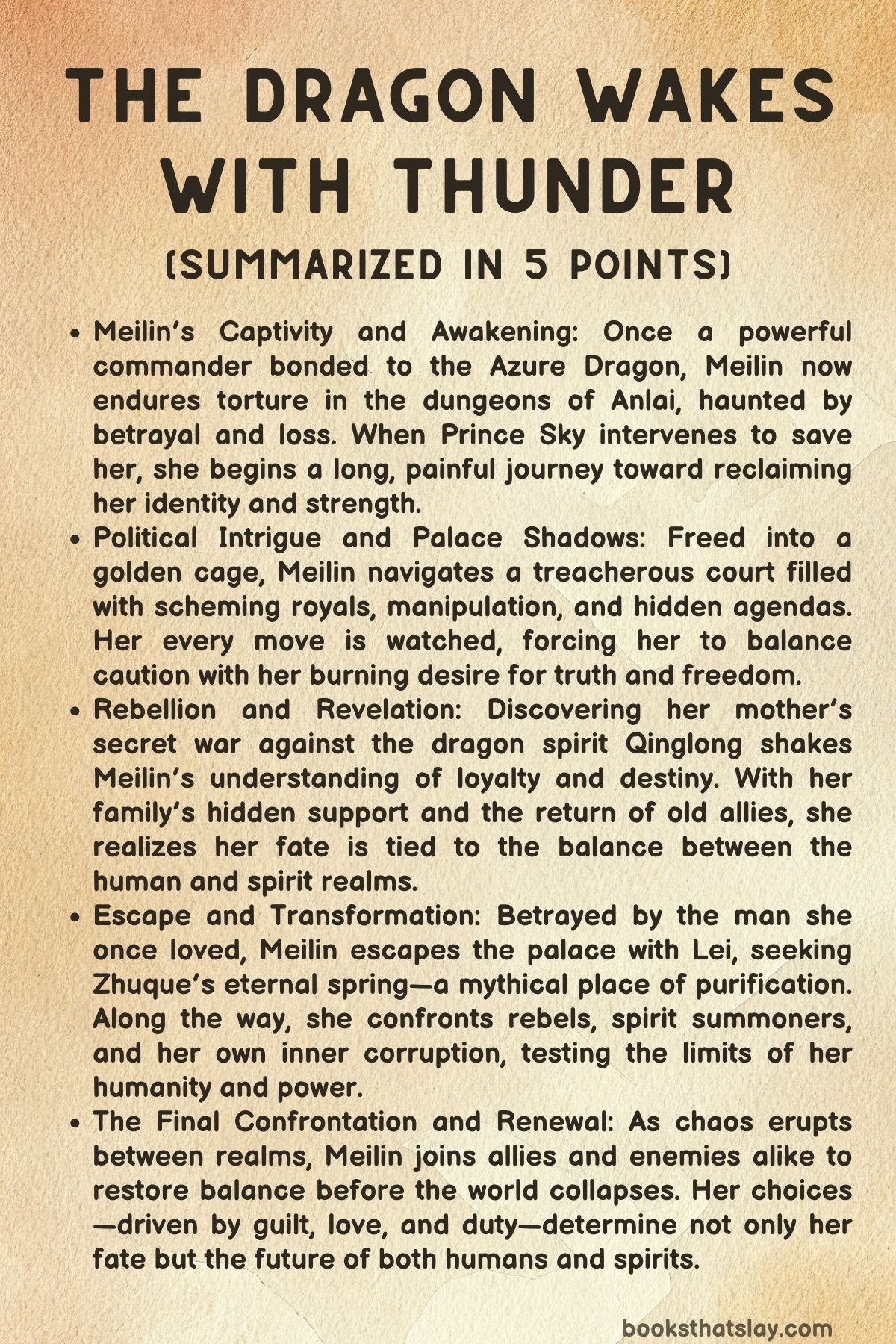
Summary
Meilin begins her story in the palace dungeons of Anlai, imprisoned after a catastrophic fall from grace. Once a powerful commander bonded with the Azure Dragon, she is now reduced to a frail captive, tortured by Warden Hu, who seeks information about forbidden black magic.
Her physical and spiritual strength fade, sustained only by memories of her former glory and the burning ache for lixia—the elemental energy once coursing through her veins.
During one of her brutal interrogations, Prince Sky, the emperor’s son and her former ally, intervenes to stop the torture. Horrified at her state, he vows to free her, but Meilin, broken by fear and trauma, barely responds.
Later, Prince Lei of Ximing visits her cell. Once her enemy, now an uneasy confidant, Lei mocks her despair but his harshness rekindles her will to survive.
His words stir a faint ember of defiance, and Meilin begins to eat again, clinging to a thread of endurance.
Hu’s questions soon turn toward the growing appearance of “spirit realm gates,” strange portals between worlds. Meilin speculates that the gates are caused by the overuse of lixia.
When Sky visits again, he brings word of her release, but Meilin suspects deceit. She realizes that living in comfort under the emperor’s eye would be another kind of prison.
Her fear of freedom and distrust of Sky deepen her inner conflict.
When her family visits, her younger siblings cry at her condition, while her sister Xiuying offers a veiled message hinting that rebellion brews beyond the palace walls. Their uncle secretly gives Meilin a diary belonging to her late mother.
Within its ruined pages, Meilin discovers that her mother had fought and died resisting Qinglong, the dragon spirit who once deceived her for his immortal designs. This revelation shatters Meilin’s remaining illusions and reignites her determination to resist her fate.
Lei returns, revealing that her release is a political maneuver to placate public unrest. Though wary, Meilin accepts, vowing to uncover the truth behind the empire’s corruption.
When she finally emerges from the dungeon, sunlight blinds her weakened senses. Deprived of her jade seal—the artifact binding her to lixia—she collapses.
To save her, Sky secretly restores a forged jade crafted by Lei and Prince Winter. Revived but fragile, Meilin reenters palace life under close surveillance.
Within the opulent confines of court, she faces new torment. Her servants Lotus and Lily prepare her for appearances, and she meets Princess Yifeng, whose cruelty manifests in veiled insults.
Meilin suffers public humiliation during a banquet when Prince Yuchen mocks and shames her before the court. Isolated but observant, she begins piecing together the hidden politics and rivalries among the royal family.
The discovery that black magic persists throughout the empire confirms her fear: Qinglong’s design still unfolds.
Haunted by past power and present degradation, Meilin vows to reclaim her agency. Sky professes love for her and proposes marriage, offering comfort and protection.
Though moved by his sincerity, Meilin senses the imbalance between them—his authority smothers her independence. When he departs on a campaign, she begins rebuilding her influence in his absence.
With Lotus and Lily’s help, she gathers information about the princes and their alliances. Lily, spirited and brave, yearns to learn swordsmanship.
Meilin trains her in secret, building a small circle of loyal women within the palace. She also resumes forbidden research on lixia, studying Sky’s hidden library of banned texts.
When Lily confesses that Lei had stolen Meilin’s mother’s diary, Meilin resolves to recover it, suspecting Lei’s motives remain tangled with rebellion.
Reports of spirit gates multiplying across the land heighten Meilin’s anxiety. During her studies, she receives a cryptic message from a palace maid claiming allegiance to a hidden uprising.
Winter, ever the cautious observer, warns her not to endanger Sky’s fragile position, but Meilin insists that only decisive action can protect them both. She begins to view the throne as a means to restore balance and prevent the spirit world from consuming their own.
Communing once more with Qinglong, Meilin confronts the dragon directly. She offers an alliance—her ambition in exchange for his restraint.
Though the dragon mocks her, he grants a temporary reprieve, intrigued by her defiance. Empowered, Meilin exposes Yuchen’s financial corruption and neutralizes his attempts to brand her a traitor.
Her political cunning grows, earning grudging respect even from Winter.
Her triumph is short-lived. Lei sends her a message proposing an alliance against the empire and promising the return of her mother’s diary.
Torn between loyalty, ambition, and guilt, Meilin agrees to meet him but is betrayed. Princess Yifeng’s guards capture her, and she is accused of treason.
Facing execution, Meilin braces for death until Winter and Crown Prince Keyan intervene. To save her, Winter fabricates a scandalous rumor of an affair between them, sparing her life but ruining her reputation.
Once again confined, Meilin contemplates the futility of survival and the consuming hunger for power that has led her here.
Later, Sky returns from his campaign. When Meilin confronts him, she realizes their relationship has corroded—his love has become domination.
Furious, she breaks free of her chains with Lei’s help. Accompanied by Lily, they flee the Forbidden City under moonlight, vowing never to return.
Their journey east leads to the village of Canyuan, where Lei collapses from poison. Sheltered by Madame Wu, a villager aligned with the rebellion, Meilin learns she is celebrated as a hero among the common people.
Sky’s soldiers soon arrive to hunt her, but Madame Wu hides them. To save Lei, Meilin shares her qi, an act that binds their fates further.
They join the Black Scarves rebel army led by Tan Kuro, a charismatic warrior with hidden motives. During a battle ambush, Kuro forces Meilin to unleash her elemental powers, revealing his manipulation.
When she discovers that Kuro is possessed by Baihu, the Ivory Tiger, she realizes that he seeks to destroy monarchies and merge the realms for his own cause. Meilin refuses to follow his violent vision and chooses instead to seek Zhuque’s eternal spring—a mythical place where she might finally relinquish her power.
Journeying toward the Red Mountains, Meilin and Lei witness the spreading corruption between worlds. Her guilt deepens as she confronts the devastation caused by her past choices.
Along the way, their bond strengthens in quiet endurance.
As the story reaches its climax, Meilin, Kuro, and Sky face the unraveling of reality itself. Spirit gates tear the realms apart, and Qinglong’s influence threatens all creation.
To restore balance, Meilin and Kuro merge their qi within the in-between realm to seal the rift. Outside, Sky battles his own father to protect their bodies.
In the chaos, Lily is slain, and grief surges through Meilin as she channels every memory—hers and Kuro’s—into the veil. Winter joins them, offering his pure qi to complete the seal.
Qinglong attacks, dragging Meilin into a psychic duel that reveals the intertwined fates of those she loves. In a moment of sacrifice, Baihu intervenes, forcing both spirits back to their realms.
Meilin is caught in the collapse, torn between worlds. Sky leaps after her, and they fall into the spirit realm together.
There, Meilin wanders lost until her mother’s spirit finds her and helps her remember who she is. Sky, changed by his spirit bargain, returns her to the human world.
Together they rebuild in the aftermath: Sky becomes Imperial Commander and reforms the empire with equality and justice at its core. Meilin, still haunted by her power, journeys once more to Zhuque’s eternal spring with Lei.
At the spring, she hesitates between redemption and temptation. Realizing her power has already consumed too much, she plunges into the waters, severing her bond to the dragon.
Cleansed but forgotten by history, she emerges nameless and free. The empire heals, spirit gates fade to legend, and a new age of peace begins.
Only whispered tales remain—of a warrior who defied gods and kings to bring balance to the world.
Characters
Meilin
Meilin stands as the beating heart of The Dragon Wakes with Thunder, a heroine forged in trauma, betrayal, and the ceaseless tension between power and humanity. Once a revered commander bonded to the Azure Dragon, she embodies the tragedy of greatness: a woman both weapon and savior, revered and feared.
Her journey begins in darkness—imprisoned, tortured, and stripped of identity—only to evolve into a meditation on autonomy and corruption. Meilin’s inner landscape is marked by guilt and longing: guilt for the destruction wrought by her connection to lixia, and longing for freedom from both political control and spiritual domination.
Yet, her resilience becomes the axis upon which the story turns. The hunger for power that once enslaved her transforms into a desire for renewal, culminating in her self-sacrifice at Zhuque’s spring.
Meilin’s evolution—from a puppet of divine will to an architect of her own destiny—represents both the decay and rebirth of human strength. Even when her name fades from history, her spirit endures, suggesting that true legacy lies not in remembrance but in the peace one leaves behind.
Prince Sky
Prince Sky is the embodiment of conflicted ambition—a man torn between love and authority, compassion and control. His relationship with Meilin is the novel’s most tragic contradiction: he saves her life yet becomes her jailer, adoring her while shackling her freedom.
Sky’s devotion is genuine, but it is filtered through the lens of empire and patriarchal power. His growing political hunger mirrors the empire’s rot; as he ascends, his morality dims.
Yet, he remains the most human of rulers—capable of regret, tenderness, and eventual transformation. By the novel’s end, his reforms mark the first dawn of genuine change, proving that he, too, has been remade by Meilin’s courage.
In loving her, Sky learns the cost of domination; in losing her, he learns the meaning of justice.
Cao Ming Lei
Lei represents the shadow of Meilin’s conscience—part betrayer, part redeemer, and the most complex of her allies. Once manipulative and driven by political expedience, he becomes the mirror through which Meilin confronts her own corruption.
His illness, frailty, and fierce devotion act as a counterbalance to her overwhelming strength. Where she wields dragons and floods, Lei wields compassion and restraint.
His willingness to share his qi, to travel beside her even in ruin, transforms him from a figure of deceit into one of absolution. The final act—forcing Meilin to confront the cost of her unchecked power—cements him as both her moral anchor and her final test.
Through Lei, the story articulates the painful truth that love is not always mercy, and salvation sometimes comes through confrontation rather than comfort.
Liu
Liu, the pragmatic and observant prince, is the silent strategist behind much of Meilin’s survival. His intellect and quiet empathy stand in contrast to Sky’s passionate idealism.
Winter’s understanding of politics and spirit lore bridges the worlds of reason and mysticism, grounding Meilin’s chaotic journey in a sense of logic and purpose. His self-sacrifice in the in-between realm reveals the nobility that his quiet demeanor always concealed.
Winter’s death, though understated, underscores the novel’s larger theme of equilibrium—the necessary surrender of one life to preserve many. In him, K X Song paints a portrait of understated heroism, proving that power without ego can still shape destiny.
Kuro
Tan Kuro, leader of the Black Scarves and vessel of the Ivory Tiger, is both revolutionary and warning. Charismatic, cunning, and consumed by his vision of equality, he mirrors Meilin’s early zeal but lacks her self-awareness.
His desire to empower the masses by opening spirit gates stems from righteous outrage at tyranny, yet it devolves into chaos—a reflection of how idealism, untempered by humility, can become monstrous. Kuro’s dynamic with Meilin crackles with tension; he tempts her not with love but with ideology.
Their clash is less personal than philosophical—a war between freedom and control, passion and balance. His end within the spirit realm, choosing dissolution over domination, transforms him from antagonist to tragic martyr, his dream corrupted by forces larger than himself.
Qinglong, the Azure Dragon
Qinglong is both divine manipulator and cosmic metaphor, the embodiment of the intoxicating allure of power. His relationship with Meilin is parasitic yet intimate, entwined in a dance of dominance and dependence.
He seeks to dissolve the barrier between realms, claiming liberation for spirits but enacting subjugation upon mortals. Through him, the novel explores the seduction of eternal purpose—the idea that destruction can masquerade as creation.
Qinglong’s mental duels with Meilin are not just battles of will but existential debates about identity and sovereignty. Even in defeat, his influence lingers, symbolizing that power, once tasted, can never be entirely relinquished.
Xiuying
Xiuying, Meilin’s elder sister, serves as the moral and emotional compass amid chaos. Her quiet rebellion and faith in Meilin offer the grounding that keeps the story tethered to family and human connection.
Though not a warrior, her courage manifests through sacrifice and conviction. She bridges generations—carrying their mother’s wisdom and passing it to Meilin when all hope seems lost.
Xiuying’s choices, particularly her veiled defiance of imperial authority, reveal a subtler form of resistance: one born of patience, faith, and love rather than force. In her, the novel pays homage to the strength of women whose endurance sustains revolutions long after swords fall silent.
Lily
Lily’s transformation from frightened servant to fierce ally encapsulates the novel’s undercurrent of feminine solidarity. Initially timid and eager to please, she evolves through Meilin’s mentorship into a symbol of defiance and agency.
Her tragic end—slain after avenging injustice—underscores the cost of awakening in a world that punishes courage. Lily’s faith in Meilin, even unto death, reflects the story’s recurring motif of cyclical sacrifice: one generation empowering the next through loss.
Her death is not in vain—it crystallizes the stakes of the struggle and propels Meilin toward her final act of renunciation.
Tan Kuro’s Rebellion and the Spirits
Beyond individual characters, the rebellion itself—embodied by Kuro, the Ivory Tiger, and the restless spirits—serves as an ensemble force representing the human thirst for liberation. Each faction, whether mortal or spectral, mirrors a fragment of Meilin’s psyche: rage, hope, chaos, and renewal.
Through their conflicts, the story paints revolution not as glory but as a series of moral reckonings. The Cardinal Spirits act as both gods and allegories, their wars reflecting the inner wars of those bound to them.
In this cosmic interplay, humanity’s fragility becomes its greatest strength—the ability to endure imperfection while striving for harmony.
Themes
Power and Corruption
In The Dragon Wakes with Thunder, power operates as both a lifeline and a curse, shaping Meilin’s journey from warrior to prisoner to reluctant savior. The elemental force of lixia grants immense strength, yet it corrupts the body and mind, reflecting how ambition and the thirst for control erode humanity.
Meilin’s bond with the Azure Dragon embodies the dual nature of dominance—while it elevates her above mortals, it also enslaves her to a will beyond her own. The empire itself mirrors this dynamic: rulers and princes mask tyranny beneath ideals of order, their obsession with eradicating “black magic” serving as a pretext for consolidating authority.
Sky’s transformation from ally to oppressor illustrates how even love bends under the weight of hierarchy and ego. Every act of power, whether through sword or spirit, demands sacrifice—of morality, freedom, or identity.
The novel ultimately questions whether power can ever exist without corruption, suggesting that purity arises not from control but from surrender. When Meilin renounces her gift at Zhuque’s spring, the narrative reaches a paradoxical resolution: true strength lies in relinquishment.
Yet even in this act, the cost is immense—her name erased from history, her legend surviving only as myth. Power, then, is portrayed not as triumph but as contagion, a force that consumes even those who seek to wield it for good.
Identity and Memory
The loss and reconstruction of identity form the emotional core of Meilin’s story. Her captivity in the dungeons of Anlai initiates a gradual stripping away of self—titles, honor, and power—all replaced by doubt and trauma.
As she uncovers her mother’s diary and the truth about Qinglong’s manipulation, her sense of self fractures further. Identity becomes an unstable intersection between memory, legacy, and deception.
The manipulation of recollections—by spirits, politics, and even affection—questions how much of who we are depends on the stories we believe. Meilin’s struggle with her corrupted qi is both physical and psychological: her veins darken as her spirit weakens, blurring the line between human and monster.
Even her romantic bonds complicate selfhood; Sky’s devotion becomes possessive control, and Lei’s companionship oscillates between salvation and temptation. In the end, her journey toward Zhuque’s spring is not merely to purify her power but to reclaim ownership over her narrative.
When the spring erases her name from history, it symbolizes the ultimate paradox of identity—freedom through oblivion. Meilin’s anonymity ensures her survival, but it also reveals that individuality in a world of power and myth is both fleeting and fragile.
Her forgotten name becomes a testament to the impermanence of human memory and the resilience of the human spirit.
Betrayal and Trust
Trust in The Dragon Wakes with Thunder is perpetually under siege. Meilin’s life unfolds amid deceit—from the empire that imprisons her to the allies who claim to love her while binding her in chains.
Betrayal becomes the defining language of survival; even compassion carries hidden motives. Sky’s betrayal is the most personal and devastating, not only because of his emotional closeness but because it embodies the empire’s broader hypocrisy—love as a mask for dominance, mercy as a disguise for control.
Lei’s shifting loyalties, meanwhile, test the boundaries between forgiveness and self-destruction. His duplicity in stealing her mother’s diary contrasts sharply with his later sacrifices, illustrating how betrayal and devotion coexist within human frailty.
The dragons and spirits betray their hosts through manipulation, reflecting a cosmic mirror of mortal deceit. Each act of treachery leaves Meilin more isolated yet also more self-reliant.
The novel’s emotional resonance lies in how it portrays betrayal not as a single act but as an evolving condition of power and intimacy. By the time Meilin chooses to trust Lei again on their journey to the Red Mountains, her trust is no longer naive—it is an assertion of autonomy, born from pain and clarity.
The conclusion transforms betrayal into redemption, suggesting that trust, reclaimed through suffering, carries a deeper truth than faith untested.
Freedom and Confinement
Freedom in the novel is never absolute; it is constantly redefined by circumstance, body, and will. Meilin’s literal imprisonments—first in the dungeon, then in the gilded palace, and later within her own corrupted body—reveal the many forms captivity can take.
Even when unchained, she remains bound by politics, expectations, and the burden of power. The palace represents the illusion of liberty under surveillance, a microcosm of an empire that prizes obedience over choice.
Her escape with Lei marks a turning point, yet her dependence on lixia shows that liberation requires more than physical escape—it demands spiritual release. The Eternal Spring of Zhuque becomes the ultimate metaphor for emancipation, where freedom equates to renunciation.
The irony is profound: Meilin must lose everything—power, fame, even her identity—to achieve true autonomy. The novel portrays freedom as an act of self-erasure, a decision to exist beyond the reach of both mortal and divine control.
In doing so, it redefines heroism, rejecting conquest for self-mastery. The closing image of Meilin’s nameless legacy reinforces this idea; though forgotten, she lives free of the histories that once confined her.
Freedom, the narrative suggests, is not the opposite of confinement but its transformation—the acceptance of transience as the only enduring liberation.
Legacy and Renewal
Legacy operates as both burden and promise throughout the novel, binding generations through cycles of duty, memory, and sacrifice. Meilin inherits her mother’s unfinished struggle against Qinglong, a legacy tainted by deception yet illuminated by courage.
Her journey to complete this mission mirrors the broader human desire to reconcile with the past—to honor it without being consumed by it. As the story unfolds, legacy evolves from personal inheritance to collective renewal.
The empire’s transformation under Sky’s reforms, inspired by Meilin’s influence, marks the transition from mythic heroism to social progress. Yet Meilin’s anonymity underscores the irony of historical remembrance: the world changes because of those it forgets.
Her mother’s words—“imagine a new world”—become the novel’s moral axis, transforming legacy from remembrance to creation. In rejecting the immortality offered by the dragon, Meilin ensures a future not defined by her power but by her absence.
Renewal thus arises not from domination but from relinquishment, from the quiet persistence of hope after destruction. The Dragon Wakes with Thunder concludes on a note of profound humility, suggesting that the truest legacy lies not in being remembered but in enabling others to live freely, unburdened by the myths of those who came before.