The Eight Heartbreaks of Hanukkah Summary, Characters and Themes
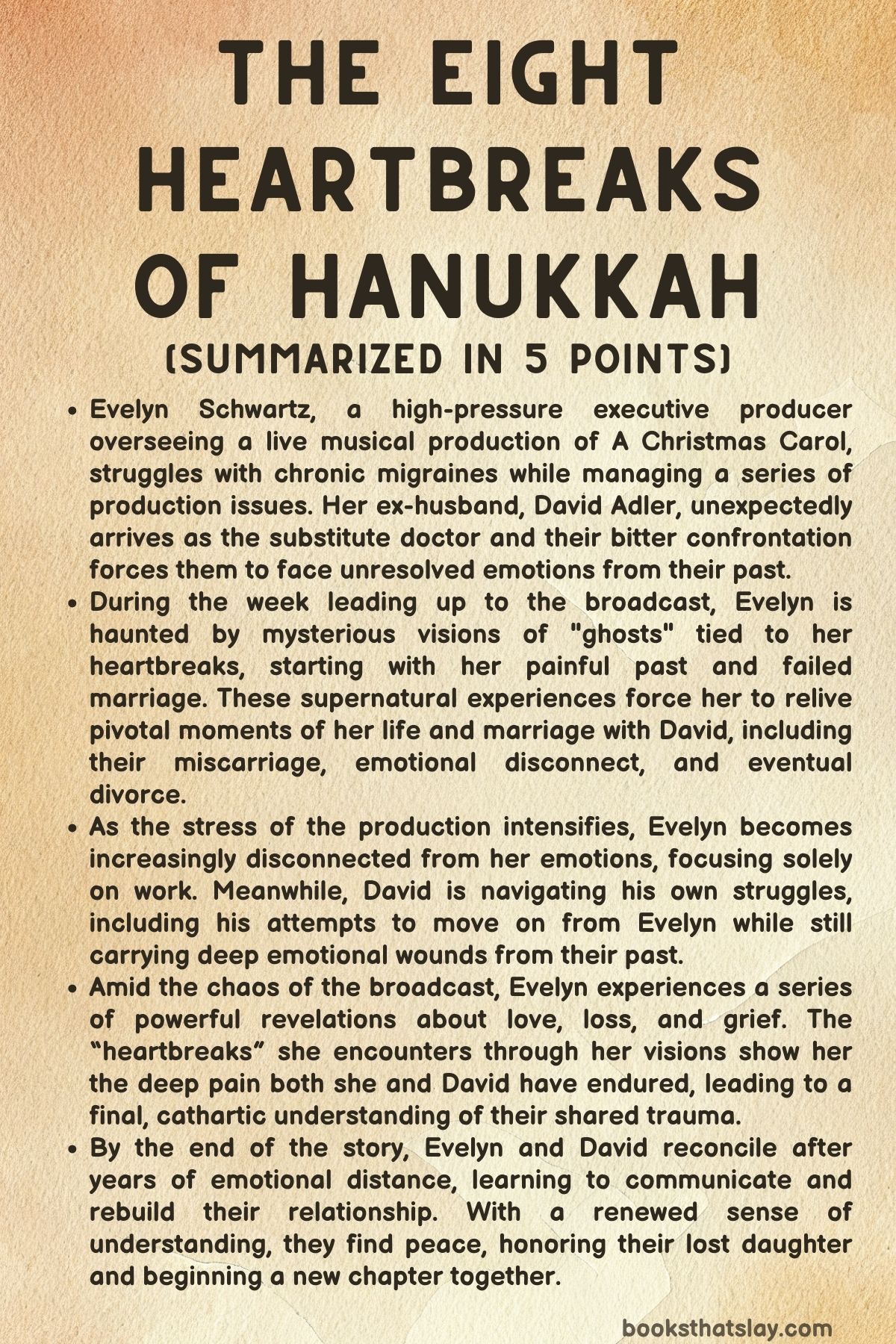
The Eight Heartbreaks of Hanukkah by Jean Meltzer is a heartfelt, transformative story about a woman named Evelyn Schwartz who, while preparing for a high-pressure live TV production of A Christmas Carol, is confronted by ghosts from her past. These supernatural apparitions challenge Evelyn to face deep emotional wounds, most notably her painful divorce and the loss of her unborn child.
As the Hanukkah season unfolds, Evelyn’s journey through personal heartbreaks forces her to reckon with her past, rediscover lost love, and find healing, all set against the backdrop of family, career, and holiday traditions. This novel explores themes of grief, redemption, and the enduring power of love.
Summary
Evelyn Schwartz is the executive producer of a high-budget live television musical of A Christmas Carol at CBS7-T studios, overseeing a demanding and complex production. As the dress rehearsal is underway, Evelyn notices that one of the carolers is missing, which causes a series of complications.
Amidst the chaos, she collapses and wakes up in the medical bay with a severe headache. Evelyn initially thinks it’s just another of her chronic migraines but is surprised to find that the studio physician, Dr. Vikram Brar, has been replaced by her ex-husband, David Adler.
Their reunion is jarring, filled with unresolved tension and old wounds from their painful divorce.
David explains that he is covering for Dr. Brar while he is away. Though Evelyn is irritated by his presence, she begrudgingly accepts his medical advice.
The situation quickly escalates as they confront their past: Evelyn accuses David of abandoning her without notice, and he counters by blaming her obsession with work for the breakdown of their marriage. Despite their conflict, they agree to remain professional for the sake of the production.
As Evelyn tries to navigate the challenges of the show, her migraine worsens, and she starts to withdraw from the Hanukkah celebrations that are unfolding around her.
As the first night of Hanukkah passes, Evelyn reflects on her estranged relationship with her family and the bitterness she feels toward the holiday. Meanwhile, David spends his time with his sister and niece, participating in a traditional Hanukkah celebration.
Despite the tension between them, David and Evelyn’s paths continue to cross. One night, Evelyn encounters a strange, ghostly figure—a vision of her former boss, Marla Feinberg, who died years ago.
Marla warns her that she will be visited by “the eight heartbreaks of Hanukkah,” each of which will bring painful lessons that Evelyn must learn if she is to move forward in life.
The first ghostly visit takes Evelyn back to her childhood home, where she witnesses the tumultuous last Hanukkah her parents spent together before their divorce. In this vision, she also remembers David, a kind neighbor boy who once gave her a handmade menorah.
The memory stirs old emotions and unresolved feelings about David, and Evelyn realizes that their relationship, which she had long buried, was once full of tenderness and care.
The second visit brings Evelyn back to her teenage years, where she relives the night she lost her virginity, a painful reminder of how she often used relationships as a way to escape emotional turmoil. Meanwhile, David has started dating again, meeting a woman named Claire at a Hanukkah-on-Ice event.
Evelyn’s jealousy flares, especially when she sees that David is moving on from their past.
Evelyn’s encounters with the ghosts continue. The third and fourth ghosts take her on journeys that force her to confront her emotional detachment from her marriage, particularly the way she had prioritized her career over her relationship with David.
These visions force Evelyn to realize the emotional rift that had deepened between her and David, especially after the loss of their unborn child, April. Their inability to grieve together pushed them further apart.
During a chaotic rehearsal at the studio, Evelyn’s migraine worsens. She’s physically and emotionally drained, trying to keep the production together while also dealing with her ghosts.
The fifth ghost, a puppet from the musical, transports her to a dinner from six years ago when David shared his dream of leaving his lucrative TV job to pursue a simpler, more meaningful life in Westchester. Evelyn, focused on her career, dismissed his idea, leading to a deepening of their emotional divide.
As the days of Hanukkah progress, Evelyn experiences more visions. The sixth ghost, a talking chicken named Delilah, takes her to a surreal memory where Evelyn is forced to confront the grief surrounding the stillbirth of her daughter, April.
This heart-wrenching vision is one of the most painful for Evelyn, as she relives the emotional trauma of losing her child and the subsequent fallout in her marriage. The guilt, shame, and sadness she has carried for years come to the forefront.
David, increasingly concerned for Evelyn, takes her to the hospital for tests, though doctors find nothing physically wrong with her. Evelyn becomes furious at the suggestion that her symptoms might be psychological.
She and David have a heated argument, revealing the depth of their mutual pain. Both accuse each other of abandoning the other after April’s death, with Evelyn retreating into work and David feeling isolated in his grief.
The argument is a breaking point for both of them, as they confront the unresolved emotions that have shaped their fractured relationship.
Despite their emotional upheaval, Evelyn carries on with the production. The live musical goes off without a hitch, earning praise from her boss.
Yet, Evelyn feels hollow inside, unable to enjoy her professional success. In a moment of introspection, she revisits her memories of David and realizes that the ghosts she has been seeing are not just about her heartbreak—they are also about his.
The lesson she learns is that love means sharing pain, not running away from it.
The final vision comes in the form of the eighth ghost, who reveals to Evelyn that the true source of her heartbreak was the loss of her daughter, and that the ghosts were meant to guide her back to the love she once had with David. Evelyn, now fully aware of the importance of healing and forgiveness, rushes to David’s farm, where they reconcile.
In the quiet of their home, they place April’s ashes on the mantel and find peace together.
A year later, Evelyn and David are in couples therapy, rebuilding their relationship. Evelyn has learned to balance her career with her personal life, and they are rediscovering affection and love.
David proposes remarriage, and Evelyn agrees. On Hanukkah, they reflect on their journey, realizing that the true miracle of the holiday was the love they had found once again.
As they kiss, the sound of a child’s laughter fills the room, a reminder of their daughter’s spirit watching over them.
Characters
Evelyn Schwartz
Evelyn Schwartz is a complex character driven by her ambition and a deep sense of responsibility. As an executive producer of a high-profile television musical, she is perfectionistic and determined to keep everything running smoothly, even at the expense of her health and emotional well-being.
Throughout the story, Evelyn’s focus on her career serves as both her strength and her flaw. She often buries her pain in work, choosing to prioritize her professional success over her personal life.
This coping mechanism stems from a deep well of unresolved grief, particularly the loss of her unborn child, April, which severely strained her marriage to David. Her initial resistance to addressing her past and her emotional pain manifests in her avoidance of Hanukkah, a holiday tied to her family and her father’s death.
Evelyn’s journey is one of self-discovery, learning to face her past, her grief, and the emotional void she has been carrying for years. Her emotional transformation, from a hard-driving, emotionally distant woman to someone willing to confront her vulnerabilities and reconcile with her past, is at the heart of the novel.
David Adler
David Adler, Evelyn’s ex-husband, serves as a foil to Evelyn’s intense career focus. He is compassionate, deeply emotional, and still carries the weight of his shared trauma with Evelyn.
David’s reappearance in Evelyn’s life is a catalyst for much of the story’s emotional depth, as their reunion sparks unresolved issues from their marriage. He is portrayed as someone who, though initially distant and resigned, still cares deeply for Evelyn.
His motivations are driven by a desire for peace and healing, both for himself and, in the end, for their relationship. His own grief over the loss of their child, which Evelyn buried in her work, is a key element in their separation.
Throughout the story, David’s actions demonstrate his yearning for meaning and connection, in contrast to Evelyn’s avoidance. He is ultimately able to offer her the space to confront her pain and, through their shared understanding, they find a path to healing together.
David’s journey mirrors Evelyn’s in some ways, as he too is learning to move past their shared heartbreak and embrace the possibility of a future together.
Marla Feinberg
Marla Feinberg, Evelyn’s former boss and mentor, plays a unique role in the narrative as a ghostly presence who haunts Evelyn during Hanukkah. While she is technically dead, Marla’s influence is far from over, and she serves as a spectral reminder of Evelyn’s past mistakes and the workaholic lifestyle that ultimately led to her emotional isolation.
Marla represents the cost of excessive ambition and the sacrifice of personal relationships for career success. Through her appearances, she pushes Evelyn to examine the choices she has made and the emotional void she has created in her life.
Marla’s character is a ghost of regret and an embodiment of the consequences of neglecting one’s emotional health in favor of external achievements. She becomes a guide for Evelyn, albeit in a harsh and mocking manner, urging her to change before it’s too late.
Marla’s presence is both a warning and a catalyst for Evelyn’s eventual self-reflection and emotional growth.
Jared Sparks
Jared Sparks is the eccentric star actor playing Scrooge in the live television production of A Christmas Carol. He is a representation of the challenges and absurdities that Evelyn faces in her career, adding to her stress and further complicating her already strained emotional state.
Jared’s flamboyant behavior and outlandish demands highlight Evelyn’s frustrations with the superficiality and unpredictability of her job. His constant attention and flirtation with her, although annoying, also serve to distract Evelyn from the deeper issues she is avoiding.
Jared’s character contrasts sharply with David’s, as he lacks the depth and emotional resonance that David brings into Evelyn’s life. However, his interactions with her—particularly when he refers to her and David as the “mommy and daddy” of the production—force Evelyn to confront the unresolved tension between her personal and professional lives.
While Jared is largely a comedic figure in the story, his antics also serve as a foil to the emotional weight that Evelyn and David carry, highlighting the complexity of their relationship and the emotional baggage they must unpack.
One
One is the first of the supernatural figures to appear to Evelyn, ushering her into a journey through her heartbreaks. A confident and mysterious little girl, she claims to be a “ghost” sent to guide Evelyn through her past emotional wounds.
One’s role is significant as she acts as a guide to Evelyn, introducing her to the ghosts and helping her relive key moments from her past. While she initially appears to be a whimsical character, her role is much deeper, symbolizing the innocence and vulnerability that Evelyn has long ignored.
One’s presence forces Evelyn to confront the idea that she cannot run from her pain, no matter how much she tries to distract herself with work. One’s character represents the childhood innocence and purity that Evelyn lost along the way, making her the perfect guide to lead Evelyn back to herself.
Two
Two, the second ghost, takes Evelyn on a journey through her high school years, revealing pivotal moments that shaped her emotional landscape. Two represents the youthful experiences and decisions that led to Evelyn’s emotional disconnection.
The vision of losing her virginity serves as a key moment in Evelyn’s emotional development, exposing the deep-rooted pain that Evelyn has been suppressing for years. Two’s role is to push Evelyn to acknowledge the consequences of her choices and the emotional void they created, particularly in her relationship with David.
This ghost helps Evelyn to realize that her disconnection from her emotions and her decision to prioritize work over personal connection has had long-lasting effects, and it is time for her to face the impact of those choices.
Four
Four is a key figure in Evelyn’s journey, appearing in a surreal vision that takes her back to the moment when she almost ran away from her wedding to David. In this haunting scene, Evelyn is forced to confront her emotional resistance to commitment and the pain of her father’s death.
Four represents the unresolved grief and fear of loss that Evelyn carried into her marriage with David. The vision helps Evelyn understand that her hesitations and emotional walls were not just about David but were deeply tied to her unresolved pain.
Four serves as a pivotal figure in Evelyn’s realization that her emotional detachment from David was not just about their marriage but also about her larger fears of love and loss.
Five
The fifth ghost transports Evelyn to a memory from six years ago when David shared his dream of leaving his lucrative career to pursue a more meaningful life. Evelyn’s dismissal of his plan represents a turning point in their relationship, where their emotional disconnect deepened.
The fifth ghost serves as a reminder of the critical moment when Evelyn prioritized her career over her relationship with David, marking the beginning of their emotional drift. This ghost forces Evelyn to confront her career-driven mindset and the emotional toll it has taken on her marriage.
Through this vision, Evelyn understands that her inability to support David’s dream was a crucial moment in their separation and the failure to truly see and appreciate David’s needs.
Seven
Seven, in the form of a talking chicken named Delilah, brings Evelyn face-to-face with one of the most painful moments in her life—the loss of her child, April. This ghost leads Evelyn into a vision where she relives the trauma of her pregnancy and the devastating decision to terminate it.
Seven represents the heartbreak Evelyn has been unable to process and the deep emotional scars left by the loss. Through this vision, Evelyn confronts her grief head-on, facing the loss of April and the guilt and sorrow that have haunted her since.
Seven is a manifestation of Evelyn’s grief, forcing her to finally grieve openly and release the emotional weight she has been carrying for years.
Eight
The eighth heartbreak is the most poignant and transformative. It is revealed that the eighth ghost is not a new figure but the spirit of April herself.
The presence of their lost daughter symbolizes the culmination of Evelyn and David’s journey, where they both understand the depth of their shared loss. Through the spirit of April, Evelyn and David are able to reconcile, understanding that love is about sharing the heartbreaks and the pain that life brings.
April’s spirit guides them back to each other, offering the possibility of healing and renewal. The eighth heartbreak represents the final lesson in Evelyn and David’s relationship—the realization that love and healing are possible through mutual understanding and shared grief.
Themes
Grief and Loss
Grief is a pervasive and central theme in The Eight Heartbreaks of Hanukkah, profoundly shaping the lives of the characters, particularly Evelyn and David. The emotional burden of loss begins with the tragic stillbirth of their daughter, April, and continues to haunt both of them in different ways.
For Evelyn, grief manifests as an emotional withdrawal and an intense focus on her career, burying her pain under layers of work. She avoids confronting the trauma of April’s death, fearing the vulnerability that would come with expressing her sorrow.
This avoidance drives a wedge between her and David, as he yearns for shared mourning and healing. The unraveling of their marriage is a direct result of their inability to process grief together.
Evelyn’s professional success and unyielding work ethic act as a defense mechanism, a way to distract herself from the painful reality of her loss.
David, on the other hand, handles grief with more openness but struggles with the isolation that comes with it. He needs the space to grieve but feels abandoned by Evelyn, who is emotionally unavailable.
His attempt to move forward with a new relationship with Claire reflects his ongoing battle with loneliness and the hope for peace, but his heart remains tethered to Evelyn and their shared past. Their grief is not only a source of personal pain but also a significant barrier to their reconciliation.
The eight heartbreaks represent the different facets of their sorrow, pushing them to confront their past and learn to process their pain together.
Ultimately, the theme of grief in the novel emphasizes the importance of acknowledging and sharing pain in order to heal. As Evelyn confronts her grief head-on, she begins to understand the depth of her loss, not only for April but also for the relationship with David that she allowed to wither.
The process of reconciliation is rooted in both characters learning to be vulnerable and accepting their shared heartbreak, symbolized by the reconnection of their love after years of emotional distance. Through grief, the novel explores the transformative power of love and healing, as Evelyn and David find peace by honoring their daughter’s memory and rekindling their relationship.
Redemption and Self-Awareness
The Eight Heartbreaks of Hanukkah delves deeply into the idea of redemption, both personal and relational. The theme of redemption is intricately tied to Evelyn’s journey of self-awareness, where she is forced to confront the mistakes she made in her marriage to David and the emotional walls she built around herself.
Her focus on work, which initially seemed like a coping mechanism, becomes a reflection of her inability to process and face her emotions, especially the loss of her child. The supernatural “heartbreaks” are not just about revisiting painful memories but also about understanding the role her choices played in her emotional and relational turmoil.
Throughout the story, Evelyn is confronted with moments of reckoning where she must acknowledge her emotional failings. Her ex-husband, David, plays a crucial role in this process.
He symbolizes both her past mistakes and the possibility of redemption. As Evelyn experiences the heartbreaks, she is forced to face the consequences of her actions, both in her marriage and in her handling of grief.
The arrival of the “ghosts,” each representing a significant heartbreak, pushes Evelyn to reevaluate her past choices, particularly her tendency to bury herself in work at the expense of her relationship with David. The ghosts act as catalysts for her personal growth, leading her to realize that her emotional isolation and her relentless focus on career were forms of self-punishment for her perceived failures.
In the end, redemption comes when Evelyn finally accepts responsibility for her actions, admits her emotional neglect of David, and understands the necessity of vulnerability in her relationships. Her willingness to apologize to David, to confront her grief openly, and to embrace love again signals her emotional rebirth.
The redemption arc is not just about reconciling with David but also about Evelyn’s growth as a person who learns that healing requires confronting both her past mistakes and her pain. This journey of self-awareness and redemption highlights the novel’s message: redemption is achieved not through perfection but through the willingness to change, forgive, and rebuild what was lost.
The Impact of Family and Tradition
Family and tradition are central themes that shape the characters’ emotional landscapes in The Eight Heartbreaks of Hanukkah. For Evelyn, Hanukkah becomes a complicated symbol of her past—filled with both warmth and pain.
Growing up, the holiday was associated with family togetherness, but as an adult, Evelyn distanced herself from these traditions due to the unresolved pain of losing her daughter and her fractured marriage. She avoids celebrating Hanukkah, associating it with the emotional weight of loss and abandonment.
This rejection of family traditions serves as a coping mechanism, but it also alienates her from the sense of connection that these traditions can offer.
David, on the other hand, embraces family and tradition more readily. Despite his own emotional scars, he participates in Hanukkah celebrations with his sister and niece, symbolizing his willingness to keep family traditions alive.
His connection to his heritage remains a source of comfort and stability, providing him with a foundation as he navigates his grief. His support of Evelyn and his invitation to join him in these celebrations highlight the contrast between their approaches to dealing with loss.
David’s commitment to his family and traditions helps him maintain a sense of hope and connection even as he faces his own heartbreak.
The theme of family and tradition is not only important for the characters’ personal healing but also for the resolution of their relationship. As Evelyn comes to terms with her grief and opens herself to the possibility of reconciliation with David, she begins to embrace the traditions she once rejected.
The act of lighting the menorah again, and later rekindling her love with David, becomes symbolic of her return to the family and traditions that once brought her comfort. This return to her roots allows her to heal and rediscover the value of connection—both with her heritage and with those she loves.
In the end, the theme of family and tradition underscores the novel’s message that healing and growth are possible when individuals reconnect with the foundational bonds that have always sustained them.
The Complexity of Relationships
The complexity of relationships is a prominent theme in The Eight Heartbreaks of Hanukkah, particularly through the portrayal of Evelyn and David’s marriage. Their relationship is marked by love, loss, and unspoken grievances, making it a testament to the challenges of maintaining a connection through difficult circumstances.
The breakdown of their marriage is rooted in a deep emotional disconnect, where Evelyn’s career-driven attitude creates a rift between her and David. He needs emotional intimacy and shared grief, while she withdraws into work to avoid facing her sorrow.
The unresolved tension between them is palpable, and their interactions throughout the novel reveal the fragility of their bond.
The ghosts of Hanukkah serve as a reflection of the layers within their relationship. Each heartbreak reveals different aspects of their love story—both the moments of joy and the times of pain.
Evelyn’s denial of her emotional needs and David’s quiet suffering contribute to the dissolution of their connection. Yet, the novel also demonstrates the potential for healing within complex relationships.
As they confront their past and acknowledge their individual pain, they come to understand that the love they shared was never truly gone. Through their reconciliation, the novel emphasizes that while relationships are often messy and fraught with misunderstandings, they also offer the potential for growth and renewal when both parties are willing to confront their flaws and work toward mutual understanding.
The complexity of their relationship is ultimately a reflection of the deeper truth that love, in all its forms, requires effort, vulnerability, and a willingness to heal.