The Ever Queen by L.J. Andrews Summary, Characters and Themes
The Ever Queen by LJ Andrews is a romantasy set in a world split between earth fae (Night Folk) and sea fae (the Ever Kingdom). It follows Livia Ferus, daughter of the earth king, and Erik Bloodsinger, heir to the sea throne, whose lives were tangled by war, captivity, and a secret bond formed in youth.
When old grudges resurface and a spreading blight threatens both realms, Livia and Erik are forced into uneasy alliance that turns into love. Their relationship becomes the key to healing a dying land and ending a cycle of vengeance that has lasted decades.
Summary
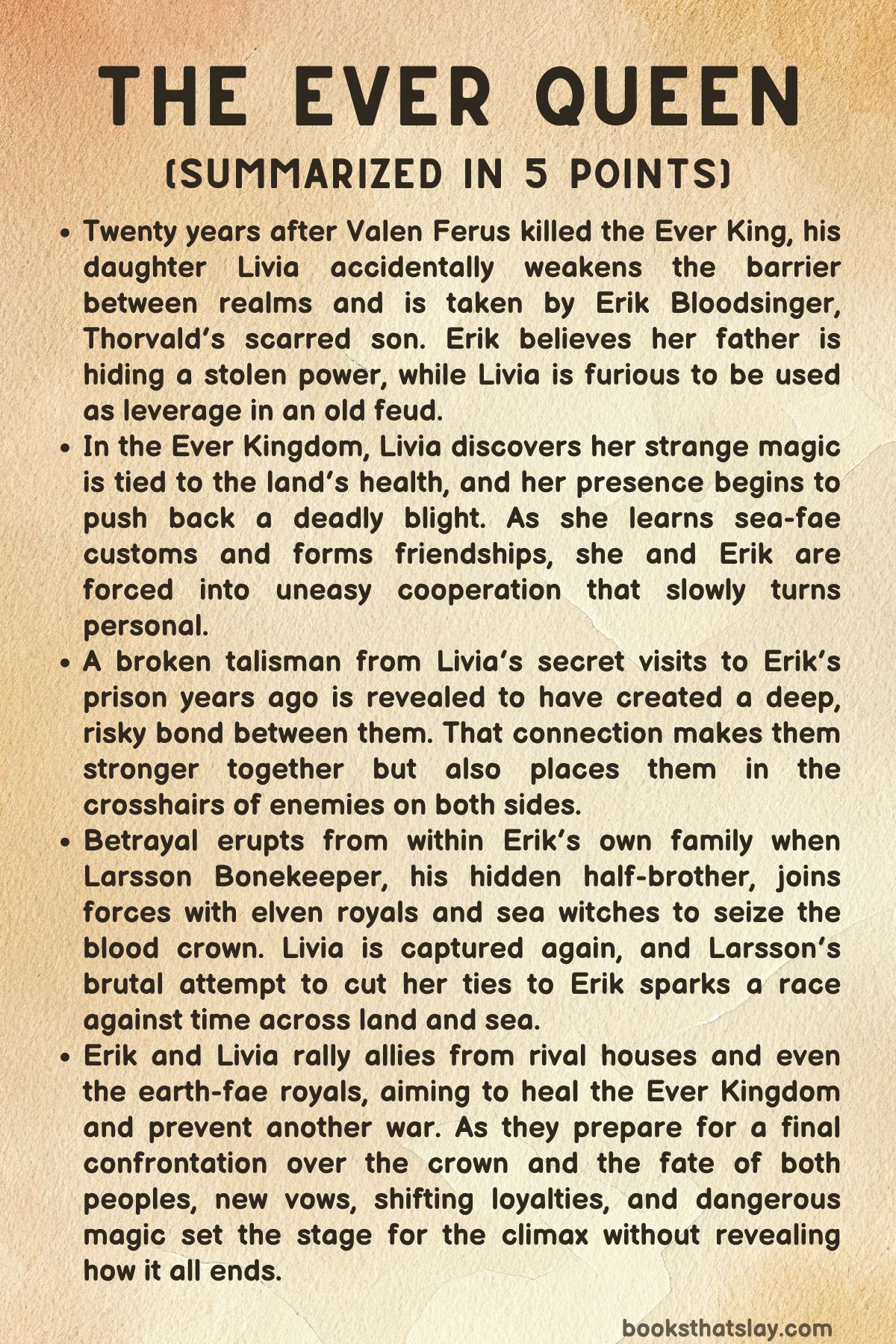
Twenty years after the Night Folk king Valen Ferus kills Thorvald, the Ever King, the two realms remain scarred by violence. The earth fae once captured Thorvald’s son Erik and treated him brutally, prompting Thorvald’s fatal attack in rage.
Ten years after that, the earth fae defeat the sea fae in a war that leaves Erik imprisoned. During his confinement, Valen’s daughter Livia slips into his cell in secret.
She reads him gentle stories about friendship between a songbird and a serpent, and the visits soften something in both of them. One night a talisman breaks, unknowingly binding their hearts together.
When the war ends, Valen banishes Erik back to the Ever Kingdom, and powerful wards are raised at the Chasm to keep the realms apart.
Another decade passes. Livia, now grown and restless, accidentally touches the wards at the Chasm and weakens them.
Erik, still burning with grief and a desire to reclaim what he believes is his father’s stolen power, seizes the chance, raids the earth fort, and kidnaps her. He expects Valen to be hiding Thorvald’s legacy.
Livia is furious and terrified, but once in the Ever Kingdom she discovers her own magic is tied to the sea realm. Her fury power begins to heal dying soil and push back the darkening, a blight spreading across the Ever lands.
The sea folk who once feared or hated her start to hope. Erik’s grandmother Narza, ruler of sea witches, reveals the truth: Thorvald’s power didn’t remain with Valen at all—it runs through Livia’s blood.
The heartbond between Livia and Erik, born the night she visited his cell years ago, only deepens as they spend time together. Livia forms friendships with sea fae like Celine Tidecaller and Sewell the cook, finding warmth in a place she expected to be a prison.
Erik and Gavyn Bonerotter, lord of the House of Bones, plan to renew the Chasm wards to stop earth fae from dying as they try to retrieve Livia by force. While politics tighten around them, Livia and Erik fall in love, and their bond saves them during an assassination attempt.
When Livia’s cousin Aleksi is dragged through the Chasm during a rescue effort, Erik uses his healing song to save him, proving to Aleksi that he isn’t the monster earth stories describe. Livia shows Aleksi the Ever Kingdom’s suffering and its people’s decency, hoping to win his support for peace.
Erik publicly seats Livia on his throne and names her Ever Queen, planning to unite the realms.
Before they can return to earth together, Larsson Bonekeeper betrays them. He reveals himself as Erik’s half-brother and abducts Livia with help from someone she recognizes, setting a challenge for the sea crown.
Erik sends Gavyn to search the seas, then crosses the Chasm with Tait and Aleksi, only to be ambushed by Jonas, an earth prince. Jonas captures Erik and declares he will be delivered to Valen to die.
Valen, half-mad with fear for his daughter, nearly kills Erik on the spot before the earth queen and Aleksi insist Erik is their best hope of finding Livia. Aleksi testifies that Erik saved him and came to earth seeking unity, not war.
Still, Erik is chained and held while the earth court gathers allies.
On the isle of Natthaven, Livia wakes in a tower room, not a cell. She meets Skadinia, a shadow elf princess of the Dokkalfar clan, who says Livia is hidden for now and offers to show her the island.
Skadi demonstrates Natthaven’s strange defenses and tells Livia that blood spells bind her to the isle. She warns that Larsson’s sea-witch ally Fione shields him from death, and only a white-iron elven blade can kill Fione.
Skadi’s betrothed, Prince Arion of the fire elves, arrives with cold authority, and Livia is brought before Larsson.
Larsson explains he is half-elven, the secret son of Thorvald and an elven noblewoman, and he carries a brutal gift: he can steal voices and magic through blood. He has waited years for the Chasm wards to weaken so he can claim the sea crown.
He needs Livia not as hostage but as a weapon. In a ritual led by Fione and forced through Skadi’s shadow magic, Larsson rips the heartbond from Livia in agony, burning it into ash so it cannot be remade.
At that same moment, Erik feels the bond sever and collapses with a gold-lit wound. Realizing what happened, he erupts in rage, nearly slaughtering guards with his blood and water magic before Valen traps him again.
Skadi, shaken by being made to harm Livia, attacks Arion and Larsson with a storm of darkness, but the forced use of her affinity numbs her into blank indifference. Larsson later tries to assault Livia; she bites off part of his ear to stop him, and he beats her until Fione interrupts with news of Erik’s escape.
Soon after, Gavyn appears in Livia’s chamber, water-shifting through mist, and helps her flee. Back on earth, Livia’s younger brother Rorik and a group of young royals break Erik and Tait out of prison.
Erik summons the Ever Ship and races toward the sea realm, learning on the way that Gavyn was swallowed by a sudden darkness and is missing.
Erik eventually reunites with Livia and brings her, Valen, and the earth princes to the Ever palace. A second throne waits beside his, carved for her.
Their reunion is raw and fierce; even without the magical bond, they choose each other. In council, Livia tells of Natthaven, Larsson’s lineage, Arion’s alliance, and Fione’s protection.
Erik reveals the white-iron blade Skadi dropped during their escape, believing it can end Fione and make Larsson killable. Plans form to uncover Larsson’s next move.
Through a shell spell, Livia speaks with her mother Elise and brother Rorik, reassured they’re alive. Livia’s presence and power convince more of the sea houses to stand with her, though some lords still waver.
To track Larsson, Tavish suggests Mindtaker magic linking Erik’s mind to his half-brother’s, requiring Avaline of the House of Tides. When they sail to Joron’s territory to demand her help, they find his people sick and his fields dead.
Joron admits he let the blight spread, hoping Larsson would take the crown and cure it. Livia answers by unleashing her Ever power, pulling the darkening back and restoring the land in a sweep of living green.
The display silences doubt: she is truly Ever Queen.
Skadi’s grandfather Eldirard later arrives to explain Arion’s deceit and the danger of Skadi’s affinity falling under Arion’s rule. Skadi is given refuge in the Ever Kingdom under restraint, while treaties are signed.
Livia’s coronation follows, with Erik crowning her using a circlet forged from his own blood and traitors’ bones. The Ever houses swear loyalty.
Erik reshapes leadership: Joron is stripped of rule, Avaline is raised as Lady of Tides, Celine becomes Lady of Blades, and old blood bonds on the Ever Ship crew are offered release but kept by choice.
Finally, the fleet returns through the Chasm to the earth realm to seal peace. Skadi offers a last gift: she can take away the violent force that makes crossing deadly.
With Tavish unthreading old spells, she pours mist into the sea and collapses, but Gavyn confirms the Chasm’s violence is gone, leaving a calm boundary both peoples can cross. Celebration spreads across shore and sea.
In the Ever gardens, Narza performs a renewed heartbond ritual, tying Erik to House Ferus and restoring the bond between Erik and Livia, now by consent and ceremony. The story ends with fragile unity in place, Larsson and Arion still at large, and Jonas quietly preparing a bold move of his own to counter the elven threat by binding himself into their kin through a royal vow.
Characters
Livia Ferus
Livia begins The Ever Queen as the sheltered but steel-spined daughter of Valen Ferus, carrying a secret history with Erik that quietly shapes the fate of two realms. Her defining trait is a fierce moral clarity: even when she’s frightened or outmatched, she refuses to accept cruelty as inevitable.
That streak first shows in childhood when she defies her father’s people by visiting Erik’s cell, and it matures into leadership when she chooses to heal a land that technically belongs to those who kidnapped her. The “fury magic” inside her is more than a power set; it’s an externalization of her emotional truth.
When she is angry at injustice, the Ever Kingdom responds—blight retreats, soil revives, and what was dying remembers how to live. Livia’s arc is also about autonomy.
She is used as a pawn by Valen’s enemies, by Larsson’s ritual, and even by ancient magic like the heartbond talisman, yet she continually reasserts that her love and her crown are chosen, not coerced. After the heartbond is torn away, she doesn’t collapse into helplessness; she becomes someone who can survive hollow grief and still return to the table as a queen who plans war, diplomacy, and reunion.
By the time she accepts coronation, she has transformed from a bridge between people into a pillar each side must lean on, embodying the possibility that unity can be fierce, not soft.
Erik Bloodsinger
Erik is a king forged out of captivity, loss, and a decade of grief that curdled into vengeance before it slowly became something else. He carries Thorvald’s legacy like a scar he both honors and resents, and the early Erik is defined by the belief that justice must look like retribution.
That rage is real—he can command blood and water in terrifying ways—but what makes him compelling is how the story keeps placing tenderness beside that violence. The boy who rejected Valen’s offer to stay in the earth realms chose hatred because it was the only language he had for survival; the man he becomes learns that love is another way to keep living.
His bond with Livia is the emotional core of the narrative, but Erik never reduces her to salvation. Even when the heartbond is revealed to be magical, he insists their devotion is deliberate, highlighting a key tension in his character: he fears being controlled, so he builds a kingship on consent—freeing crew bonds, elevating allies without demanding blind loyalty, and kneeling to crown Livia as equal.
Erik’s leadership is not gentle, but it grows principled. He can beat Joron in fury, yet he also hands power to Avaline and restores Sewell’s honor, signaling a ruler learning to separate personal rage from public justice.
The destruction and later restoration of the heartbond mirrors Erik’s deeper arc: he moves from being a man who clings to the past to one who chooses the future even when it terrifies him.
Valen Ferus
Valen is the story’s most complicated symbol of old war. As king of the Night Folk earth fae, he is responsible for brutal acts that created Erik’s hatred, including the death of Thorvald and the torture of Erik during capture.
Yet he is not written as a simple villain; he is a ruler shaped by loyalty to his people and by a paternal love for Livia that cracks his armor. His first instinct is always domination—storming halls with axes, nearly strangling Erik, and letting rage decide his language.
But Valen also demonstrates the capacity to change when confronted by a daughter who embodies a future he didn’t imagine. His grudging acceptance of Erik’s sincerity is not soft redemption, but political maturity born of recognizing that the cost of pride is too high.
Valen’s relationship with Elise is another layer: he admits deception in his early courtship, implying he understands that power and love can tangle dangerously. What makes him truly interesting is that he is both the wound and part of the remedy.
He must live with the fact that his past cruelty is the very fire that fuelled the war—and then choose to stand beside the man who embodies that consequence. In doing so, Valen becomes a living test of whether perpetrators of old violence can ever help build peace without erasing what they did.
Larsson Bonekeeper
Larsson is betrayal personified, but his motives are rooted in the same soil as Erik’s: the legacy of Thorvald’s blood and the hunger for a crown that was denied. As Erik’s half-brother and son of the fallen Ever King with elven lineage, Larsson occupies a liminal space—never fully belonging to sea fae, never accepted by elves, and therefore obsessed with proving superiority through conquest.
His power to steal voices and magic by consuming blood makes him a thematic mirror to the Ever Kingdom’s blight: he is a parasite who believes survival requires consumption. Larsson’s cruelty is intimate rather than distant; he doesn’t only want a throne, he wants to break what Erik loves.
Tearing out the heartbond isn’t tactical alone—it’s sadism designed to rewrite the emotional map of his brother’s world. His trophies of bone and the theatrics of his hall emphasize vanity and insecurity masquerading as destiny.
Even his attempted sexual assault of Livia follows this pattern: domination as proof of existence. Larsson represents what Erik could have become if grief never met grace.
He is not tragic because he is misunderstood; he is tragic because he chooses power over kinship at every turn and can no longer imagine another way to be alive.
Skadinia (Skadi)
Skadi is introduced as a calm, eerie guide through Natthaven, but beneath that composure is a woman trapped by obligations she never chose. As a shadow elven princess of the Dokkalfar, she is bound by custom to Arion’s betrothal and by politics to Larsson’s campaign, yet her instincts are protective, not predatory.
Her affinity—taking matter into darkness—makes her both a weapon and a sanctuary. She uses it gently at first, showing Livia the snares and sea-binding spell, suggesting she values truth even when it complicates allegiance.
The central tragedy of Skadi’s arc is coercion: when forced to wield her power for cruelty, she risks becoming emotionally deadened, and the text underscores that cost when her furious eruption against Arion collapses into chilling numbness. Skadi’s “indifference” afterward is not lack of feeling; it’s the scar tissue of being pushed beyond moral limits.
Her later refuge in the Ever Kingdom turns her into a living warning: power used against one’s nature corrodes the self. Yet she never becomes only a victim.
Her final act of removing the Chasm’s violence repositions her power as restoration, showing that even after being weaponized, she can reclaim purpose. Skadi embodies the theme that neutrality under oppression is impossible—and that choosing mercy might be the bravest revolt.
Prince Arion
Arion is a strategist of domination disguised as nobility. He enters Natthaven under a mask of diplomacy, but everything he does is about control: poisoning Eldirard’s quill ink, twisting agreements, and exploiting kinship rules to avoid the soul-stain of direct murder while still effectively imprisoning his relative.
Arion is politically ambitious, seeking to rule all elven clans, and Larsson’s rise is his ladder. His fire magic is a visual counterpoint to Skadi’s shadow, highlighting a worldview that prefers conquest by burning rather than by absorbing.
What makes Arion chilling is that he understands systems—law, tradition, contract—better than most rulers, and he weaponizes them. He treats Skadi not as a person but as a resource, because her affinity would become loyal to him through marriage.
Unlike Larsson, whose brutality is emotional, Arion’s cruelty is administrative. He is the embodiment of empire: patient, legalistic, and utterly ruthless.
Fione
Fione, ruling among sea witches and allied with Larsson, operates as the ritual heart of the antagonists’ plot. She is coldly pragmatic, more interested in outcomes than suffering, and her immortality shield makes her arrogance structural rather than emotional—she can afford to be unhurried because death doesn’t press on her.
Fione’s role in severing the heartbond shows her as a master of old magics and as someone willing to mutilate love to reshape politics. She is not a leader who dreams of a better world; she is a caretaker of power balances that benefit her faction.
Her protection spell over Larsson makes her the literal linchpin of his invincibility, turning her into a target not because she is the loudest threat, but because she is the quiet foundation beneath it.
Gavyn Bonerotter (Lord of the House of Bones / Seeker)
Gavyn is the story’s anchor of loyalty outside romance. His title—Seeker—captures his narrative function: he moves through danger and uncertainty to retrieve what matters, whether that’s a missing queen or the truth about Larsson’s plans.
Gavyn’s alliance with Erik is built on respect rather than fear, and he often thinks in terms of strategy and survival for the realm, not only the king. His rescue of Livia from the isle, water-shifting into her room, shows quiet heroism that doesn’t ask for praise.
Even when abducted by darkness later, he remains important because his absence widens the stakes—he is a stabilizing force whose loss signals how deep Larsson’s shadow reaches. Gavyn represents the kind of leadership that doesn’t need a throne to be essential.
Aleksi
Aleksi is Livia’s cousin and one of the most visible embodiments of the new generation trying to end old wars. He is brave but still young enough to be impulsive, which shows when he nearly dies clinging to Gavyn through the Chasm and later joins the jailbreak of Erik.
Aleksi’s defining trait is principled empathy: he stands before Valen’s hall and insists Erik came not to fight but to save, even though that claim risks political backlash. He seeks understanding rather than inherited hatred, and Livia’s decision to show him the Ever Kingdom underscores his role as a bridge within the earth fae court.
Aleksi’s arc doesn’t climax in a single hero moment; it’s in repeated choices to trust the enemy because he sees the cost of not doing so.
Jonas
Jonas is the earth fae prince who most sharply exposes the fractures still alive under peace. He captures Erik early, driven by suspicion and pride, and his actions threaten to reignite war.
Yet Jonas is not simply obstinate—he is a protector who has lived in a world where sea fae meant danger. Over time, his proximity to Livia and Erik forces evolution.
He helps in the jailbreak, participates in councils, and ultimately in the epilogue chooses a radical political path: becoming elven kin through a royal vow to neutralize the elven threat. That decision reveals a man willing to sacrifice personal comfort to protect both realms, showing that his earlier aggression was always rooted in duty, not malice.
Jonas’s arc is about learning that vigilance must sometimes look like alliance, not attack.
Tait
Tait begins as one of Erik’s hardened crew, a skeptic of Livia’s place among them, and grows into a loyal protector who defines his devotion through action rather than words. He takes a blade meant for Livia and later stands beside Erik through captivity and escape, proving a quiet constancy that contrasts with Erik’s volatility.
Tait’s past banishment by Mira’s father suggests a history of exile similar to Erik’s, making his loyalty feel chosen rather than inherited. His bond with the crew and his willingness to accept earth fae allies without surrendering caution make him a realistic soldier in a story of shifting treaties.
Queen Elise Ferus
Elise is Livia’s mother and a political counterweight to Valen. She hates Erik for the pain his people caused, yet respects his love for Livia and the courage it took to cross the Chasm for her.
That duality makes her compelling: she doesn’t confuse personal grief with political necessity. Elise’s choice to speak for Erik at council, and her private gratitude after Livia’s rescue, show a queen who can hold anger and diplomacy in the same hand.
She models adulthood to Livia—how to protect family without burying truth.
Lady Narza
Narza, ruler of the sea witches and Erik’s grandmother, sits at the crossroads of heritage and prophecy. She’s a keeper of old truths, revealing that Thorvald’s power runs through Livia’s blood, not Erik’s, and she understands the architecture of bonds, wards, and tides better than anyone.
Narza is not sentimental; she is strategic in the long view, treating magic as both tool and responsibility. Yet her final heartbond ritual restoring Erik and Livia’s connection shows that she respects love as a stabilizing force for realms, not merely as a personal indulgence.
Celine Tidecaller
Celine is a portrait of steadfastness among the sea fae. She befriends Livia when suspicion would be easier, showing her as someone who judges people by choices rather than lineage.
Her elevation to Lady of Blades after Hesh’s betrayal is a reward for competence and honor; she becomes a symbol of the Ever Kingdom reshaping itself through merit. Celine’s warm teasing friendship with Livia also reflects the story’s softer hope: that the friendships of peace can become as binding as treaties.
Tavish Spellbreaker
Tavish is a morally grounded advisor whose loyalty to Erik is complicated by history. He reveals that his family didn’t take Erik in as a child not from neglect but because Thorvald’s wards and threats made it impossible, a confession that reframes his role as one of long, silent guardianship.
Tavish’s proposal to use Mindtaker magic to connect Erik to Larsson shows his willingness to consider dangerous measures for the realm, but his caution underscores that he values Erik’s humanity as much as victory. He represents the kind of counselor kings need: honest, haunted, and still committed.
Eldirard
Eldirard, Skadi’s adoptive grandfather, is the narrative’s voice of regret and warning. His account of Arion’s deception illustrates a ruler who tried to do right by his people yet underestimated how law can be turned into chains.
Eldirard’s love for Skadi is genuine and paternal, and his explanation of her affinity’s moral cost gives the story one of its clearest ethical frameworks. He is less a warrior and more a witness to the way good intentions are not armor against cunning, making him a quietly tragic figure.
Joron
Joron, lord of the House of Tides, embodies the rot that fear can cause within a community. He hides the spreading infection, not because he wants destruction, but because he believes surrendering the crown to Larsson might heal his people.
That desperation curdles into betrayal, and his resentment toward Livia’s rise exposes deep sexism and classism in the Ever Kingdom’s old order. When Erik beats him and Livia heals the land anyway, Joron becomes a lesson: survival bought through traitors is always a lie.
His stripping of rule and Avaline’s appointment signal the realm’s rejection of cowardice masked as pragmatism.
Avaline
Avaline is a quiet heir stepping into a loud crisis. Her rare sea voice can link minds, making her crucial to plans against Larsson, but her power also symbolizes something deeper: the future taking responsibility for the failures of elders.
Watching her father’s disgrace and then being raised as Lady of the House positions her as a reluctant but necessary reformer. Avaline’s presence suggests that healing realms is not only about magic, but about handing leadership to those not poisoned by old bargains.
Stieg
Stieg is an earth fae warrior tied to Erik’s past suffering and survival. Once a protector to an imprisoned Erik, he personifies the possibility of decency within brutal systems.
His willingness to listen to Erik’s warning about Aleksi’s trap and his role in the shifting alliance place him among the “in-between” characters who make peace possible through everyday honor rather than grand gestures.
Mira
Mira, one of the earth-realm royals, brings a mix of youthful daring and dangerous power. Her illusion magic is pivotal in the jailbreak, showing her courage and willingness to defy authority when authority stalls justice.
Her moment of being briefly enchanted into unwanted desire also highlights her vulnerability and the story’s awareness of how magic can violate autonomy. Mira stands as a reminder that the new generation’s heroism is not clean or safe, but it is committed.
Rorik Ferus
Rorik, Livia’s younger brother, represents loyal rebellion. He risks everything to free Erik because he believes love matters more than court caution, and his voice through Narza’s tide-spell keeps Livia anchored to family when she might otherwise be swallowed by war.
Rorik’s faith in Erik shows that peace isn’t built only by rulers, but by the young who refuse to inherit hatred.
Alistair
Alistair, the Ever palace steward, is the ceremonial spine of the new regime. He recognizes Livia publicly as queen, prepares a second throne, and orchestrates unity through tradition reshaped into something new.
In a story full of blades and spells, Alistair’s power is legitimacy—he makes change look like rightful continuity.
Sewell Fleshripper and Finn Stormbringer
Sewell and Finn offer a view of Erik’s kingship from the deck rather than the dais. Sewell’s restoration of lordship shows Erik’s commitment to justice for the loyal, while Finn’s desire to be freed from blood bond and serve under Celine signals a culture shifting from compelled allegiance to chosen service.
Together they highlight the Ever Kingdom’s transformation into a realm where loyalty is earned, not enforced.
Torsten, King Ari, Sander, Maelstrom, and other secondary figures
Torsten, Aleksi’s father, and King Ari, Mira’s father, serve as elder rulers testing the new peace. Their cautious respect for Erik shows diplomacy’s slow thaw.
Sander stands near Jonas as another earth prince learning alliance, while Maelstrom of the House of Mists helps keep the Ever’s internal power structure functional during chaos. These characters don’t drive the central plot alone, but they create the political ecosystem in which Erik and Livia’s union either survives or fractures, emphasizing that a crown is never held in isolation.
Themes
Cycles of vengeance and the possibility of choosing differently
Revenge sits at the root of nearly every catalyst in The Ever Queen. Two decades before the present conflict, Valen’s killing of Thorvald is framed as retaliation for violence done to Erik, and that single act reverberates through each generation.
The story doesn’t treat vengeance as a simple villainous impulse; it shows how it becomes language, inheritance, and even a form of identity. Erik’s early decision to reject Valen’s offer of guidance, clinging instead to hatred after years of torture, reveals how revenge can feel like the only stable ground left to someone who has been stripped of safety and dignity.
Yet that choice is also shown as costly, not just to the enemies he targets but to his own future. The narrative repeatedly presents moments where characters could repeat old patterns or interrupt them.
Livia’s childhood visits to Erik’s cell are a quiet rebellion against inherited hostility, and the songbird-serpent story she shares becomes a blueprint for a different emotional education than the one both realms have practiced. When Livia later becomes a source of healing for the Ever’s blighted land, her magic works like a thematic counterweight to revenge: it restores instead of punishes.
Importantly, the book doesn’t pretend that choosing differently erases harm. Erik still carries rage, Valen still bears guilt, and the political structures of both peoples still reward suspicion.
But the text insists that cycles are not destiny. Erik’s eventual willingness to seek unity across the Chasm, even after betrayal within his own bloodline, marks a turning point from vengeance as purpose to responsibility as purpose.
Larsson functions as a mirror to Erik’s earlier self, someone who lets grievance justify atrocity and treats suffering as currency. By contrasting these paths, the book explores how revenge can be understood, even mourned, without being obeyed.
The most striking idea is that breaking a cycle is not a single heroic act; it is a sequence of hard, unglamorous choices that must be renewed each time old wounds are touched.
Love as agency rather than fate or coercion
The romance between Erik and Livia is built on a binding spell, but the story’s deeper interest is in separating love from magical compulsion. The heartbond begins accidentally, without consent or awareness, and later becomes a political and physical vulnerability.
Larsson’s ritual to rip the bond away is a brutal literalization of a theme running through the book: love can be used as a weapon by those who see people as tools. What follows is not a claim that love survives because it is destined, but because it is chosen.
When the bond is destroyed, the connection between Erik and Livia doesn’t vanish as a feeling; instead, the absence forces them to confront how much of what they shared was theirs versus what was written into their blood. Erik’s reassurance that he belongs to her by choice, not spell, is not just romantic comfort; it is a declaration of agency in a world where power often arrives through lineage, ritual, or conquest.
Livia’s fear after waking without the bond shows that love can be destabilizing when it has been externalized into magic. She must learn to trust her own perception of their relationship rather than relying on supernatural certainty.
Their intimacy after trauma is also not presented as a neat cure; it is messy, sometimes desperate, and sometimes restorative, underlining that agency includes choosing closeness even when the body and mind are bruised. The political dimension of their love matters too.
Erik seating Livia on the throne without traditional vows invents a new social custom, turning personal devotion into a structural shift. It challenges the idea that legitimacy comes only from old rules or patriarchal succession.
In parallel, Skadi’s situation shows love’s opposite: a betrothal imposed for strategy, where the absence of free choice threatens to hollow a person into obedience. Eldirard’s warning that Skadi’s affinity can be claimed through marriage reinforces how intimacy can be annexed by power.
Against this, Erik and Livia’s renewed heartbond near the end is meaningful not because magic returns, but because it is re-forged in a context of mutual consent and public alliance. The book’s stance is clear: love is not most powerful when it is inevitable, but when it is defended as a voluntary act in the face of coercion, fear, and political manipulation.
Power, legitimacy, and the ethics of rule
Authority in The Ever Queen is never treated as a static crown passed cleanly from one worthy head to another. Instead, rule is a contested moral space where legitimacy must be earned repeatedly.
Erik inherits a throne marked by his father’s violence and his own years of bitterness, and he is constantly judged against that legacy. Livia’s rise to queenship is even more radical because it is not secured through tradition, marriage ceremony, or conquest but through recognition: Erik publicly bows to her and declares her his equal, making legitimacy a social act rather than a blood right.
The reaction to this choice illustrates how power structures protect themselves. Some whisper about Valen’s history, others question a queen without vows, and Joron clings to grievances that allow him to excuse collaboration with Larsson.
These tensions show how authority relies on shared belief, and how destabilizing it can be when belief is redirected. The story also probes the ethics of what rulers owe their people.
Erik’s decisions after Livia’s coronation are framed around repair: releasing ship crews from blood bonds, restoring Sewell’s honor, reassigning titles to those who have proven loyalty, and removing those who weaponize resentment. His kingship tries to move from domination to stewardship, even while he remains capable of terrifying violence when threatened.
Livia’s governing presence is defined by restoration rather than spectacle. When she heals the blighted House of Tides fields, she demonstrates that power can be protective without being punitive, and she does so publicly, forcing even skeptics to witness the tangible effects of her rule.
The book doesn’t ignore the dangers of power either. Larsson’s gift to steal voices through blood makes literal the predatory model of rulership—taking life, magic, and identity to inflate oneself.
Arion’s manipulation of treaties and use of kinship prohibitions to trap Eldirard represent a different corruption: law and diplomacy as cages. By positioning these models alongside Erik and Livia’s approach, the narrative asks what kind of authority can hold a violent world together without reproducing that violence.
Notably, legitimacy isn’t framed as moral purity. Erik admits doubts, considers flight, and struggles with the shadow of his brother.
Livia feels rage, sometimes wants vengeance herself, and must learn how to wield fury without letting it become cruelty. The theme lands on a demanding idea: ethical rule is less about being flawless and more about being accountable, transparent, and willing to change the rules that no longer serve survival.
Identity, lineage, and self-definition beyond blood
Bloodline matters in the world of The Ever Queen, but the story keeps asking whether it should matter in the way characters assume. The revelation that Thorvald’s power runs through Livia rather than Erik disrupts the expectation that inheritance is predictable, patriarchal, and owned by those who thirst for it.
Livia’s struggle to integrate that truth reflects a deeper theme of identity as something discovered through action rather than assigned by ancestry. She is a daughter of the Night Folk, a bearer of Ever magic, and later a queen of sea fae—all before she fully understands what any of those labels mean.
Her identity grows through relationships and choices: her commitment to the Ever land, her defense of Erik, and her refusal to let old enmities define her role. Erik’s identity is similarly unstable.
He is Thorvald’s son, Narza’s grandson, Bloodsinger, former captive, king, and lover. Each title carries expectations, and the story is concerned with what happens when someone chooses to define himself against those expectations.
His choice to pursue peace with the earth fae, despite growing up as their victim, is a refusal to let blood history dictate his present self. Larsson complicates identity further.
As Erik’s half-brother with elven heritage, he embodies the truth that lineage can produce contradictions, not clarity. His obsession with the blood crown shows the danger of using ancestry as entitlement.
Instead of letting mixed heritage broaden empathy, he turns it into a justification for supremacy, suggesting that blood can be interpreted either as connection or as excuse. Skadi’s adoption story is another crucial angle.
She is not Eldirard’s blood granddaughter, yet the emotional and ethical bond is real, while Arion’s legal claim on her through betrothal treats her as property. Her affinity’s vulnerability to being redirected through marriage dramatizes how identity can be colonized by social structures.
The theme extends to the realms themselves: sea and earth fae are defined by long wars, but the narrative pushes toward a shared identity rooted in common survival rather than separate myths. The calming of the Chasm becomes a symbol of this shift, not because it erases difference, but because it allows relationship to replace isolation.
The book ultimately argues that while blood shapes context, it does not have to determine character. Self-definition is hard-won and often painful, but it is possible, and it is the only path that doesn’t simply recycle ancestral conflict.
Trauma, healing, and the cost of survival
Pain in The Ever Queen is not decorative; it is formative. The story treats trauma as something that reshapes bodies, instincts, and politics.
Erik’s imprisonment and torture leave him with a hair-trigger rage and a deep suspicion of mercy, and the book shows how survival strategies learned in captivity—threat, control, emotional armor—can become habits that endanger the survivor’s future. Livia’s captivity on Natthaven echoes this.
The attack on her body during the heartbond ritual, the theft of her agency, and Larsson’s attempted sexual violence are presented as experiences that fracture trust in self and world. Her numbness afterward is not glossed over; it is the realistic aftermath of terror, where feeling itself becomes hazardous.
Healing, however, is treated as active and communal rather than automatic. Livia’s Ever magic heals land first, which mirrors her gradual healing of self: restoration begins externally, then slowly becomes internal as she allows herself to rely on Erik, on her friends, and on the public affirmation of her queenship.
Erik’s healing song is another facet of this theme. It is a power tied to care, used to save Aleksi and once to save Valen, suggesting that even a weaponized voice can be reoriented toward preservation.
The story also recognizes that healing doesn’t remove anger. Livia’s fury remains part of her, and the question is how to let that fury protect rather than consume.
Skadi is a cautionary figure here. Her forced use of shadow magic for cruelty shifts her into indifference, showing trauma’s potential to hollow a person into emotional absence.
Her blankness after the ritual is not a moral failure; it is a psychic injury. The book insists that recovery may require safety, time, and choice, not shame.
Politically, the realms themselves are traumatized. The darkening blight, the suspicion between peoples, and the betrayal within the Ever houses are collective wounds.
Livia’s public healing of the fields is therefore not just agriculture; it is a gesture toward communal repair, making hope visible. Still, survival has a cost that can’t be ignored.
People die, bonds are broken, trust is difficult to rebuild, and the threat of future war lingers. By ending with new vows, new customs, and cautious alliances, the narrative suggests that healing is not a return to what was, but the construction of something that can hold what was suffered without being ruled by it.