The Eyes Are the Best Part Summary, Characters and Themes
The Eyes Are the Best Part by Monika Kim is a dark psychological horror novel about a Korean American college student whose family begins to break apart after her father leaves home. At the center is Ji-won, a young woman trying to manage grief, anger, racism, academic pressure, and the growing threat posed by her mother’s new boyfriend.
What begins as a story about abandonment and family instability slowly turns into something far more disturbing, as Ji-won’s thoughts and impulses become increasingly dangerous. The novel studies desire, shame, misogyny, and power with sharp intensity, using horror to show what happens when pain is ignored for too long.
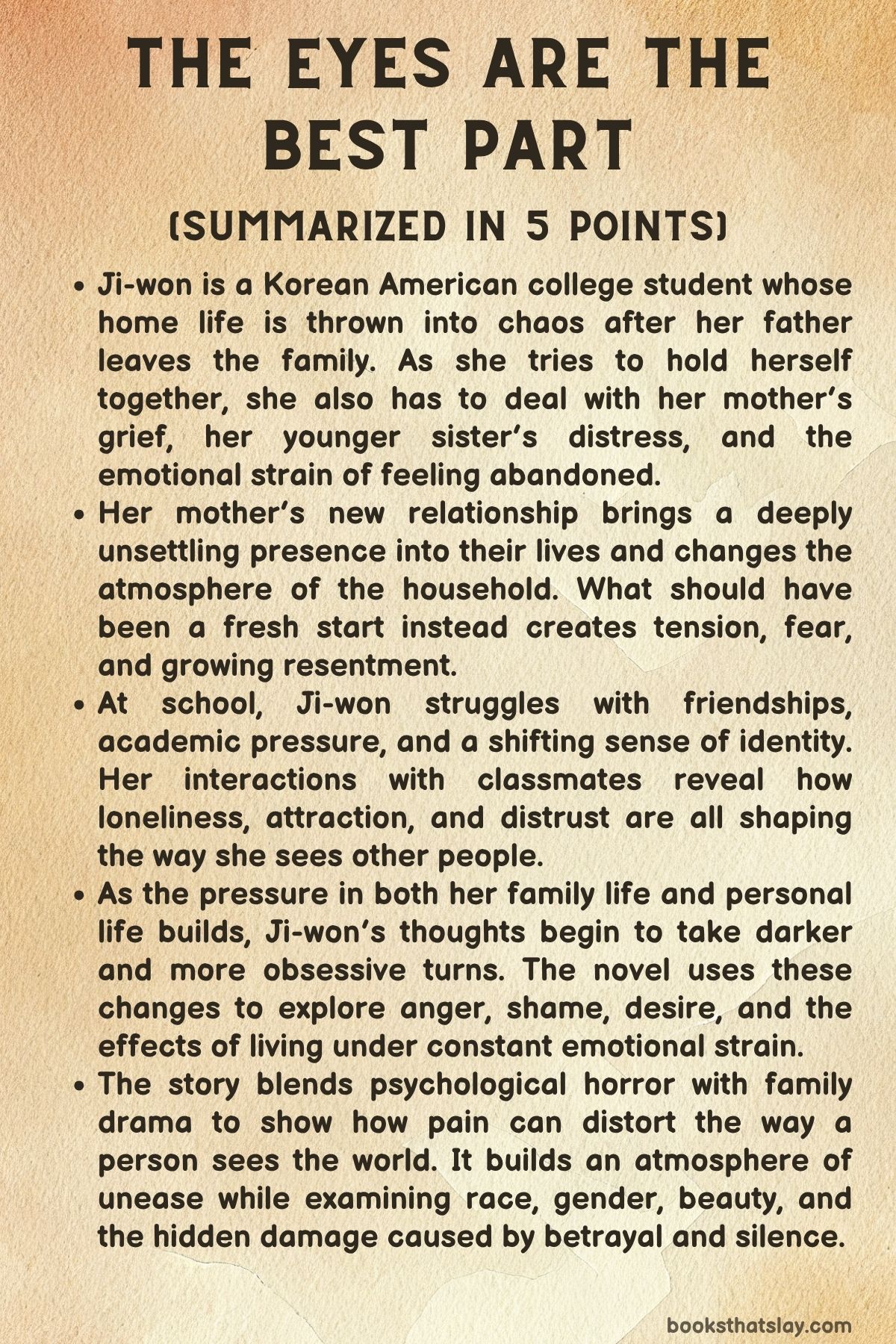
Summary
Ji-won lives in Los Angeles with her mother, Umma, and her younger sister, Ji-hyun. Their home has been unsettled ever since Appa left them for another woman.
In the weeks after he disappears, Umma falls into grief and humiliation. She cries through the night, waits by the door for his return, and becomes fixated on the idea that eating fish eyes will bring him back.
What first seems like strange behavior soon becomes a symbol of the family’s collapse. Ji-won is repulsed, but she is also deeply aware that her mother is coming apart in front of her.
The household is shaped by old wounds as much as present ones. Ji-won knows her mother’s history of hunger and abandonment in Korea, where she once survived alone as a child by waiting for her parents to come back.
That story helps explain why Umma clings so desperately to men who leave her. Ji-won feels both anger and pity toward her mother.
She cannot respect her weakness, yet she cannot ignore the suffering behind it. At the same time, she has complicated feelings about her father, seeing him as a smart, frustrated man whose failures turned him bitter and resentful.
When Umma begins dating George, she presents him as proof that life can improve. She is especially drawn to the fact that he is white, convinced that white men are more respectful and dependable than Korean men.
Ji-won and Ji-hyun quickly see what their mother refuses to admit. George is rude, controlling, vain, and openly fetishistic toward Asian women.
He mispronounces the girls’ names, orders for them, mocks correction, and stares at Ji-won and Ji-hyun in ways that make them feel unsafe. Still, Umma is determined to hold on to him.
At college, Ji-won’s life is also unstable. She meets Geoffrey, a classmate who first appears thoughtful and politically aware, and Alexis, another student who becomes a more comfortable and grounded presence in her life.
Geoffrey initially seems kind, especially when he reacts angrily to racist comments made by other men, but he soon reveals himself to be possessive and self-important. Alexis, by contrast, offers Ji-won moments of ease and connection, and their friendship gradually carries romantic tension.
Ji-won’s emotional life is already troubled before George arrives. She carries guilt over how she destroyed her high school friend group.
Out of jealousy and resentment, she manipulated her closest friends, framed one for theft, and turned them against each other. When they later confront her, she refuses accountability and walks away.
This history matters because it shows that Ji-won has long responded to pain with control, deceit, and retaliation.
As George becomes more established in the apartment, Ji-won’s inner state worsens. He moves in, leaves messes everywhere, speaks disrespectfully to Umma, and continues to look at Ji-won and Ji-hyun with predatory interest.
Ji-won begins to have vivid dreams and waking visions centered on eyes, especially George’s blue eyes. Her disgust turns into obsession.
After eating fish eyes to please her mother, she starts to think constantly about the texture and taste of eyeballs. The fixation becomes stronger as her stress grows.
She struggles in school, is placed on academic probation, and begins losing her grip on reality.
Her hatred of George deepens when she overhears him on the phone crudely describing Umma and speaking sexually about Ji-hyun. By then Ji-won is already having violent fantasies about him.
She imagines pulling out his eyes, stabbing him, and making him suffer. She starts acting on smaller impulses first, stealing from him, hiding his keys, destroying his belongings, and setting traps meant to humiliate him.
She also discovers that Geoffrey has become another threat. He watches her, follows her, pressures her for affection, and refuses to accept rejection.
Ji-won’s obsession crosses into murder when she encounters the body of a dead unhoused man near Alexis’s apartment. Seeing his blue eyes, she cuts one out and eats it.
The act horrifies and satisfies her at once. From there, her violence escalates.
She begins hallucinating more often, seeing blue eyes everywhere and struggling to separate dreams from reality. She kills again, this time attacking a man in an alley, tearing out and eating his eyes.
Later she picks up a drunk man with blue eyes, drives him to an abandoned lot, and murders him as well. These killings are linked not only to her growing compulsion but also to the way blue eyes have come to represent whiteness, power, threat, and desire in her fractured mind.
Meanwhile, George continues to betray Umma. Ji-won follows him and learns that he is involved with another Asian woman, Jen, while still planning a wedding with Umma.
Rather than expose him directly, Ji-won chooses manipulation. She sabotages his job by deleting a presentation and replacing his work materials with sexual images of young Asian women.
He is fired, humiliated, and emotionally shaken, but Umma still stands by him. Ji-won then creates a fake profile on a dating app and lures him into agreeing to meet.
By this point, Geoffrey has also become openly menacing. He admits to following Ji-won and taking her backpack, which contains the knife connected to her crimes.
He believes she owes him affection and sees himself as the person meant to protect and possess her. Ji-won realizes that he is dangerous, but she also recognizes that he may be useful.
After Umma discovers that George has deceived her and maintained another relationship, she falls into despair. Ji-won decides the situation must end.
She arranges to meet George in his truck under false pretenses, drugs him with crushed sleeping pills, and drives him to an isolated construction site. Her plan is to kill him and finally take his eyes.
But George wakes and fights back, choking and overpowering her. At that moment Geoffrey appears and attacks George with a rock.
Police arrive, and Ji-won loses consciousness.
When she wakes in the hospital, she learns that doctors found and removed a brain tumor. This revelation offers a medical explanation for some of her hallucinations and behavioral changes, but it does not erase what she has done.
George survives and is recovering in the same hospital. Geoffrey is briefly treated as a rescuer.
Ji-won senses an opportunity. She secretly enters George’s room, poisons him with crushed oxycodone, removes his eyes, and eats them mixed into her hospital food.
She then calls Geoffrey to her room. Still obsessed with the idea that saving Ji-won entitles him to her love, he comes at once.
Ji-won tells him George is nearby and lets him walk into the scene of the mutilated corpse. She screams, draws attention, and tells the police that Geoffrey threatened her and killed George.
Because Geoffrey had stalked her, stolen her backpack, and placed himself at the crime scene, he becomes the perfect suspect. Ji-won knows evidence will point toward him, including the earlier murder weapon at his apartment.
In the aftermath, Umma mourns George despite everything, showing how deeply her need for attachment rules her life. Ji-won feels both protective and coldly resolved.
With George gone and Geoffrey set up to take the blame, she turns her thoughts toward the person she sees as the first cause of the family’s destruction: her father. The novel closes with Ji-won directing her rage toward him, suggesting that the cycle of violence is not over.
Characters
Ji-won
Ji-won stands at the center of The Eyes Are the Best Part as both victim and perpetrator, and that dual position is what makes her such a disturbing and effective protagonist. She begins as a daughter trying to survive the collapse of her family after her father abandons them.
She is intelligent, observant, bitterly funny at times, and sharply aware of humiliation, especially the humiliations tied to race, gender, and class. She sees the weakness in the adults around her long before they admit it themselves.
Her mother’s desperation embarrasses her, her father’s selfishness disgusts her, and George’s predatory behavior fills her with rage. Yet her responses to pain are never simple or clean.
She does not process hurt in a healthy way. Instead, she stores it, feeds it, and turns it into fantasies of control.
What makes Ji-won especially complex is that the novel does not present her moral collapse as coming from nowhere. She already has a history of manipulation before the murders begin.
Her actions toward her high school friends show that jealousy and resentment have long shaped how she behaves when she feels rejected. She does not merely suffer betrayal; she also causes it.
That earlier cruelty prepares the reader to understand how easily she begins to rationalize later violence. Her mind works by rewriting injury into justification.
Once she decides someone has wronged her or her family, she starts seeing punishment as a form of balance.
Her obsession with blue eyes is one of the clearest signs of her psychological fracture. The fixation links hunger, disgust, desire, whiteness, violence, and power into one consuming image.
George’s eyes become the object through which she tries to master everything that terrifies her. In that sense, her cannibalistic urge is not random shock material.
It expresses her desire to possess what threatens her, to destroy what looks at her with contempt, and to reverse the power dynamic that has left her feeling watched, judged, and violated. Even after the tumor is revealed, the novel does not fully excuse her.
The medical explanation matters, but it does not erase the choices she makes. Ji-won remains one of the most unsettling parts of The Eyes Are the Best Part because she is never reduced to a diagnosis alone.
She is wounded, furious, perceptive, selfish, protective, and capable of terrifying calculation all at once.
Umma
Umma is one of the most tragic figures in the novel because her weakness is rooted in long histories of deprivation, abandonment, and emotional conditioning. She is not merely foolish or naïve, though Ji-won often sees her that way.
She is a woman shaped by scarcity from childhood and by a lifetime of being taught that endurance is the same thing as love. Her memories of surviving alone as a child in Korea help explain the passivity and waiting that define her adult life.
She learns early that survival may depend on staying still, enduring pain, and hoping someone returns. That lesson never leaves her.
It becomes the structure of her emotional life.
After Appa leaves, Umma’s grief becomes ritualized. She waits by the door, cooks his favorite meals, and convinces herself that fish eyes will bring him back.
This behavior is irrational, but it is also an attempt to create order in a situation where she has none. The fish eyes become a private superstition, a desperate action that promises luck, control, and reunion.
Her later fixation on white men as better partners grows from the same damaged hope. She cannot bear to sit with the fact that the problem may not simply be Korean men or bad luck, but the patterns of dependency that keep drawing her into relationships where she is diminished.
Her relationship with George is painful to watch because the warning signs are immediate and obvious. He disrespects her daughters, controls conversations, sexualizes Asian women, and shows open cruelty.
Yet Umma sees in him what she wants to see: stability, affection, male presence, and the fantasy of rescue. She confuses attention with care because neglect has set the standard for what she expects from men.
Even when evidence of George’s betrayal and vulgarity piles up, she still moves toward him rather than away. This is not because she lacks intelligence.
It is because loneliness has become stronger than judgment.
At the same time, Umma is not only passive. She can be manipulative, emotionally volatile, and unfair to her daughters.
She guilt-trips them, burdens them with her pain, and expects them to support choices that endanger the whole household. Her suffering does not make her blameless.
She repeatedly places romantic need over maternal responsibility. That tension makes her portrait richer.
She is both deeply sympathetic and deeply frustrating. By the end, her mourning for George shows how completely she has been shaped by longing for love from men who do not deserve it.
Ji-hyun
Ji-hyun serves as a crucial contrast to Ji-won. She is younger, but she is often emotionally clearer and more direct than her older sister.
Where Ji-won internalizes, schemes, and hides, Ji-hyun speaks out. She notices changes in the apartment quickly, questions her mother more openly, and is often the first person to name what others are avoiding.
Her instincts are sharp. She understands early that George is dangerous, and she senses that Ji-won is coming apart long before anyone else fully recognizes it.
Because of that, Ji-hyun often functions as the moral alarm within the family.
Her youth does not make her simple. She is angry, lonely, and vulnerable in ways that the adults around her fail to honor.
She misses her father, even while knowing he failed them. She wants her mother to be happy, but she also wants her to stop choosing men over her daughters.
She loves Ji-won and tries repeatedly to reach her, but she is pushed away each time. That repeated rejection gives her role a quiet sadness.
Ji-hyun is the person most actively trying to preserve the family’s emotional truth, yet she has the least power to change anything.
There is also something painfully ordinary about her desires. She wants to be taken seriously, protected, and included.
Instead, she is left to witness adult chaos without being given safety or honesty. George sexualizes her.
Umma ignores how frightened she is. Ji-won withholds information from her even when danger is growing.
Her tears and outbursts come not from immaturity alone but from the experience of being trapped in a household where everyone is acting around her while claiming it is for her own good.
Ji-hyun’s importance lies partly in what she reveals about Ji-won. The more Ji-won slips into obsession and violence, the more Ji-hyun becomes a reminder of the person she once might have protected cleanly.
Ji-won still feels tenderness toward her sister, but that tenderness is contaminated by secrecy and control. Ji-hyun is the family member Ji-won most wants to shield, yet she is also someone Ji-won manipulates through lies and omissions.
That contradiction makes their relationship especially painful. Ji-hyun represents what remains innocent enough to be harmed by everyone else’s failures.
George
George is the clearest embodiment of predatory entitlement in the novel. From his first appearance, he carries himself like a man accustomed to being centered and obeyed.
He mispronounces names, resents correction, orders food for others, sexualizes women casually, and treats Asian culture as something he can consume without respect. He does not simply behave badly; he moves through the world with the confidence that his behavior will be tolerated.
That is what makes him so unnerving. He is not a dramatic monster at first glance.
He is recognizable, banal, and socially functional, which makes his cruelty more believable.
His racism is inseparable from his sexual desire. He fetishizes Asian women, seeks out Asian spaces, and speaks as if women like Umma are interchangeable objects who exist to comfort him.
He flatters her when convenient, but the private language he uses about her is contemptuous. The gap between his public charm and private degradation exposes the ugliness beneath his performance.
He is the kind of man who mistakes access for affection and who treats female dependence as permission. His gaze itself becomes important.
Ji-won experiences it as invasive, hungry, and violating, which is why his eyes come to hold such symbolic force for her.
George also exposes the failures of masculinity from another angle than Appa. Appa abandons the family through absence, while George invades it through presence.
Both men destabilize the home, but George does so with a particularly vulgar mixture of self-pity, possessiveness, and appetite. Once he loses his job and authority, his fragility becomes obvious.
He reacts to humiliation with anger and blame rather than self-examination. His sense of manhood depends on control, sexual access, and financial dominance, so any threat to those things makes him dangerous.
As an antagonist, George works because he is more than an object of Ji-won’s hatred. He represents a larger system of racialized and gendered power that the novel keeps bringing into view.
He is a white man who consumes Asian women while imagining himself generous, worldly, and desirable. He is also a deeply pathetic figure, and the novel never lets him escape that.
His pretensions, his affairs, his performative sophistication, and his eventual collapse all reveal a person hollowed out by entitlement. By the time he dies, he is both terrifying and pitiful, which makes his role more disturbing.
Appa
Appa shapes the story through absence as much as through memory. He leaves the family before the main events fully unfold, but his abandonment creates the emotional vacuum that everything else fills.
Ji-won sees him with a mixture of resentment and reluctant admiration. She knows he is selfish and sexist, especially in the ways he expressed disappointment that she was a girl.
Yet she also understands the hardships that formed him. His childhood poverty, ambition, immigration, and repeated failures give him the outline of a tragic self-made man who never achieved the life he thought he deserved.
That sense of thwarted promise matters because it helps explain his bitterness. He is not presented as a cartoon villain but as a man who turned disappointment outward.
He blames fortune, circumstances, and other people rather than confronting his own limitations. His intelligence becomes part of the problem because it feeds his belief that life owes him more.
When he does not receive that more, he becomes resentful toward the family that seems to symbolize what trapped him. His leaving is not sudden in emotional terms.
The marriage has already been weakened by years of dissatisfaction and contempt.
Appa’s role also helps show how patriarchy operates through emotional neglect as well as overt cruelty. He does not need to be constantly present to dominate the family’s inner life.
Even gone, he remains a measure against which Umma compares men and against which Ji-won measures loss. His betrayal helps push Umma toward George and helps push Ji-won toward rage.
The fact that he starts a new life and prepares for another child without properly facing what he has done makes his selfishness even sharper. He moves on while the people he left behind disintegrate.
By the end, Ji-won identifies him as the one ultimately responsible for everything, and while that judgment may be emotionally driven, it is not meaningless. Appa is the first betrayal, the first abandonment, and the father whose choices teach his daughters what kind of men they may be forced to survive.
His importance lies not only in what he does but in the ruin he leaves behind.
Geoffrey
Geoffrey is one of the most unsettling characters because he enters the story wearing the language of sensitivity, progress, and moral awareness. At first he seems refreshing to Ji-won.
He notices racist remarks, presents himself as emotionally available, and positions himself as someone who understands complicated family situations. For a while, he appears to be an alternative to the more obvious misogyny around her.
That first impression is important because it shows how easily coercion can hide inside the performance of allyship.
As Ji-won gets to know him better, Geoffrey’s entitlement becomes more visible. He is intrusive, self-satisfied, and unable to accept boundaries.
He takes her phone without permission, pushes for more contact than she wants, and reacts badly when she starts pulling away. His interest in her is rooted less in actual care than in the fantasy that he understands and deserves her.
The moment she stops reflecting that fantasy back to him, he becomes hostile. He cannot tolerate being ordinary in her eyes.
He needs to be exceptional, chosen, validated.
What makes Geoffrey especially dangerous is that he reframes stalking and control as protection. When Ji-won confronts him about following her, he does not show shame.
He speaks as though he has the right to watch over her, guide her, and decide what is good for her. This is the logic of possessiveness disguised as concern.
He is not as openly vulgar as George, but his behavior is driven by the same belief that a woman’s refusal is negotiable. His anger after rejection reveals how much resentment sits beneath his polished surface.
His final role in the novel is grimly fitting. Ji-won uses his obsession against him and frames him for murder.
That ending works because Geoffrey has already built the case against himself through his own actions. He has stalked her, taken her belongings, cornered her, and demanded emotional payment.
Even though Ji-won manipulates the situation, the trap only succeeds because Geoffrey is exactly the kind of man the authorities can plausibly imagine doing such a thing. He is both scapegoat and genuine threat, which makes his character morally complicated and sharply drawn.
Alexis
Alexis provides one of the few spaces in the novel where Ji-won experiences something close to ease, curiosity, and tenderness. Their friendship begins through shared classes and grows gradually into emotional closeness.
Alexis is observant without being overbearing, warm without being suffocating, and direct in ways that often help reveal what Ji-won is avoiding. She notices Geoffrey’s strangeness earlier than Ji-won wants to admit, and she also sees Ji-won’s exhaustion and emotional instability even when Ji-won tries to hide them.
Her role is especially important because she represents a possible alternative path for Ji-won. In scenes with Alexis, the atmosphere changes.
There is room for attraction, humor, friendship, and the possibility of mutual care. These scenes suggest that Ji-won’s life might have opened toward something gentler if she had been able to trust connection rather than sabotage it.
Alexis does not save her, but she shows what healthy attention could have looked like. That matters in a novel so full of distorted desire.
At the same time, Alexis is not simply a fantasy of safety. She has limits, and the novel respects those limits.
She cannot fully understand what Ji-won is carrying, and Ji-won never allows true honesty between them. Their near-romantic moments are interrupted not only by outside forces but by Ji-won’s own inability to stay emotionally present.
Alexis becomes someone Ji-won wants closeness with and also someone she begins to resent whenever shame rises. This pattern fits the broader way Ji-won handles intimacy: she longs for it but cannot sustain it once vulnerability becomes real.
Alexis also sharpens the novel’s sense of loss. Through her, the reader can see what Ji-won is forfeiting every time she chooses secrecy, manipulation, or violence.
Alexis remains one of the few characters not defined by cruelty or neediness. That does not make her naïve; it makes her a reminder that another kind of relationship is possible, even if Ji-won cannot accept it.
Jenny, Sarah, and Han-byeol
Jenny, Sarah, and Han-byeol are essential to understanding Ji-won even though they do not dominate the later action. Together, they form the emotional history that reveals Ji-won’s long-standing patterns of envy, competition, and revenge.
Their friendship with her once offered belonging, familiarity, and affection. They were not casual acquaintances but part of the social world through which she understood herself.
That is exactly why their success and closeness became unbearable to her once she felt excluded.
Ji-won’s sabotage of the group is one of the clearest signs that her later violence grows from traits already present in her personality. She frames Sarah, manipulates Han-byeol, and turns the girls against each other because she cannot endure the wound of being left behind.
What matters here is not only that she acts cruelly but that she acts methodically. She does not lash out once and regret it.
She keeps going, extending the damage over time. The later confrontation at the coffee shop shows that her former friends want truth and accountability, while Ji-won wants erasure.
She refuses to sit with what she did because acknowledging it would threaten the story she tells herself about being the injured one.
These three characters therefore function as more than background figures from an earlier life. They expose the gap between Ji-won’s self-image and her conduct.
They show that she has long been capable of harming people who care about her when her pride is wounded. Their presence gives the later horror a deeper psychological foundation.
Ji-won does not become dangerous only because of George, family trauma, or illness. She already knows how to turn hurt into destruction.
Jenny, Sarah, and Han-byeol are the proof.
Themes
Hunger, Consumption, and the Desire to Possess
Hunger in The Eyes Are the Best Part is never only about food. It becomes a language for grief, power, shame, longing, and violence.
The novel begins with fish eyes at the dinner table, and that image quickly expands into something far larger than disgust. For Umma, eating fish eyes is a ritual of hope and desperation, a way to believe she can bring her husband back through bodily action.
For Ji-won, the same object becomes a site of revulsion, then performance, then obsession. What one person treats as a superstition, another turns into appetite.
That movement is central to the novel’s emotional architecture.
The repeated focus on eating and swallowing suggests that the characters are always trying to absorb what they cannot bear to lose or control. Ji-won’s later desire to eat blue eyes is not simply gore for shock value.
It expresses a wish to possess the very thing that has threatened, judged, and objectified her. George’s gaze makes her feel watched and contaminated, so she develops a fantasy in which she can reverse that relationship by taking his eyes into herself.
Violence becomes a distorted answer to helplessness. To consume the object is to erase distance between self and enemy.
It is also to destroy what cannot otherwise be mastered.
This theme is connected to race and beauty as well. Blue eyes carry cultural meaning beyond their physical presence.
Ji-won associates them with whiteness, social power, and male threat. Her fixation therefore joins racial resentment, erotic confusion, and bodily craving into one horrifying impulse.
Consumption becomes both refusal and imitation. She hates what blue eyes represent, yet she also wants them with a compulsive intensity.
That contradiction gives the theme its force. Hunger is not clean.
It contains envy as much as rejection.
The novel also links appetite to emotional deprivation. These characters are starving for love, safety, dignity, and recognition.
Umma starves for male devotion. Ji-hyun starves for stability and honesty.
Ji-won starves for control and for a form of tenderness she can trust. Because those needs are unmet, desire mutates into something ugly.
What should have been emotional nourishment turns into destructive craving. The result is a world where eating no longer signifies comfort but need sharpened into compulsion.
Abandonment, Waiting, and the Damage of Emotional Dependency
Waiting defines the emotional life of the family long before the murders begin. Umma’s childhood story of surviving alone while waiting for her parents to return creates the foundation for one of the novel’s deepest concerns: what happens when waiting becomes a person’s central way of loving.
She learns in childhood that survival may require endurance without certainty, and as an adult she repeats that pattern in her marriage and later in her relationship with George. She waits by the door, waits through humiliation, waits through betrayal, and waits even when evidence tells her that no one worthy is coming back.
Her waiting is not patience in any noble sense. It is a form of emotional imprisonment.
The damage of abandonment is shown not only in the fact that people leave, but in what their leaving teaches those who remain. Appa’s departure tears through the household, but the deeper wound lies in how each family member reorganizes herself around it.
Umma becomes more dependent, not less. Ji-hyun becomes frightened of being forgotten inside her own family.
Ji-won reacts differently: she grows contemptuous of dependency and tries to replace waiting with action, even when that action becomes monstrous. In this way, the sisters represent two responses to abandonment.
One continues to ask for love. The other decides that needing love is the first mistake.
The novel is also interested in how dependency distorts judgment. Umma can see facts, but she cannot act on them because attachment matters more to her than truth.
She accepts disrespect, excuses betrayal, and keeps preparing for a wedding that has already emotionally collapsed. This is not just about romantic desperation.
It is about the way abandonment can make a person willing to accept almost any version of connection, no matter how degrading, if it offers temporary relief from loneliness.
Ji-won’s hatred of her mother often comes from recognizing this pattern while fearing she may be caught inside related ones herself. She thinks she despises waiting, yet she also spends much of the novel waiting for the right moment to punish George, waiting for proof, waiting for release, waiting for something inside herself to settle.
Even her violence is tied to accumulated suspension. She is a character stretched tight by delay.
The theme gains power because abandonment is never treated as a single event. It becomes a structure of feeling that shapes the body, the family, and the imagination.
Racism, Fetishization, and the Violence of Looking
The novel pays close attention to what it means to be looked at through racialized desire. George is the clearest example of this.
He does not merely date Asian women; he collects them within a fantasy that flatters his sense of power. He treats culture as decoration, language as performance, and women’s bodies as proof of his own desirability.
His attraction is inseparable from condescension. He wants proximity to Asian women without respecting their personhood.
That is why his every interaction feels invasive. Even when he is smiling, he is consuming.
Ji-won understands this almost immediately, and that understanding intensifies her hatred. She has already heard racist and misogynistic talk from men on campus.
She already knows the scripts through which Asian women are made legible to others: submissive, exotic, grateful, available. George condenses these scripts into a single figure inside her own home.
His gaze does not simply make her uncomfortable; it reminds her that racial power can enter the family space and redefine it. Home becomes a place where women are watched, misnamed, and assessed.
The importance of eyes in the novel grows directly from this theme. To look is never neutral here.
Looking can be possessive, dismissive, hungry, or violent. George’s blue eyes become the visual form of the force Ji-won wants to destroy because they symbolize a gaze backed by whiteness and male entitlement.
Her desire to remove and consume eyes is therefore not only personal madness. It is also a grotesque response to objectification.
If she has been turned into something to be seen and categorized, then destroying the organ of that gaze becomes, in her broken logic, a way to take back agency.
At the same time, the novel does not reduce racism to the obvious villain alone. Geoffrey’s behavior shows how racial entitlement can survive inside progressive self-presentation.
He believes his apparent sensitivity should make him desirable to Ji-won and reads her refusal almost as ingratitude. His complaint that she may dislike him because he is white exposes the narcissism beneath his supposed awareness.
In both George and Geoffrey, the novel shows men who center their own feelings while misunderstanding Asian women as projections of fantasy, validation, or need. The violence of looking lies in that reduction.
To be looked at this way is to be denied complexity before a word is even spoken.
Female Inheritance, Anger, and the Fear of Becoming What Hurts You
A painful current runs through the relationships between women in the novel: the fear that suffering is inherited not only through circumstance but through behavior. Ji-won watches her mother with a mixture of pity, rage, and terror because she sees in Umma a version of womanhood built around waiting, apologizing, and shrinking for men.
She does not want to become that woman. Yet as the story progresses, she develops her own destructive patterns of fixation, secrecy, and emotional cruelty.
The form changes, but the damage continues. This is what gives the novel such a bleak view of inheritance.
One generation may submit, another may retaliate, but both are shaped by the same violence.
The bond between Ji-won and Ji-hyun is especially important here. Ji-won wants to protect her younger sister from men like George and from the humiliation their mother accepts.
But protection becomes compromised when it is filtered through concealment and control. Ji-won keeps secrets, withholds danger, and decides for others what they should know.
In this way, she begins acting with the same kind of paternal certainty she claims to reject in men. Her anger may be understandable, but it does not remain pure.
It starts reproducing the very logic of domination that wounded her.
Umma’s role deepens this theme because she is both a victim of patriarchy and a participant in its continuation. She pushes harmful ideas about which men are worth marrying.
She drags her daughters into her emotional crises. She prioritizes romance over safety.
Her weakness harms the people around her, even though it comes from wounds she did not choose. The novel refuses the easy idea that women are naturally each other’s refuge.
Sometimes they fail each other because pain has narrowed what they can imagine.
What emerges is not a simple celebration of female rage, though rage is everywhere. Instead, the novel asks what anger becomes when it has no healthy outlet and no trustworthy world to answer it.
Ji-won’s fury starts as moral clarity. George deserves her hatred.
Appa deserves blame. Geoffrey is genuinely frightening.
But rage that cannot build anything begins to feed on itself. It turns into appetite, punishment, and self-corruption.
The fear running underneath all of this is that escape may not be possible, only transformation from one damaged form into another. That is what makes the ending so unsettling.
Ji-won believes she is protecting the family, but the reader is left to ask what kind of inheritance she is now preparing to pass forward.