The Fallen and the Kiss of Dusk Summary, Characters and Themes
The Fallen and the Kiss of Dusk by Carissa Broadbent is a dark fantasy that explores power, immortality, and the fragile line between love and damnation. Set across realms of gods, mortals, and the undead, the novel follows two intertwined destinies: that of Vincent, a forsaken vampire prince who rises to godhood only to lose everything he holds dear, and Mische Iliae, a fallen priestess who awakens in the underworld after killing her god
Their stories converge in a fractured cosmos where faith, death, and devotion collide, testing the limits of redemption and the endurance of love across centuries of ruin and rebirth. It’s the 4th book in the Crowns of Nyaxia series by the author.
Summary
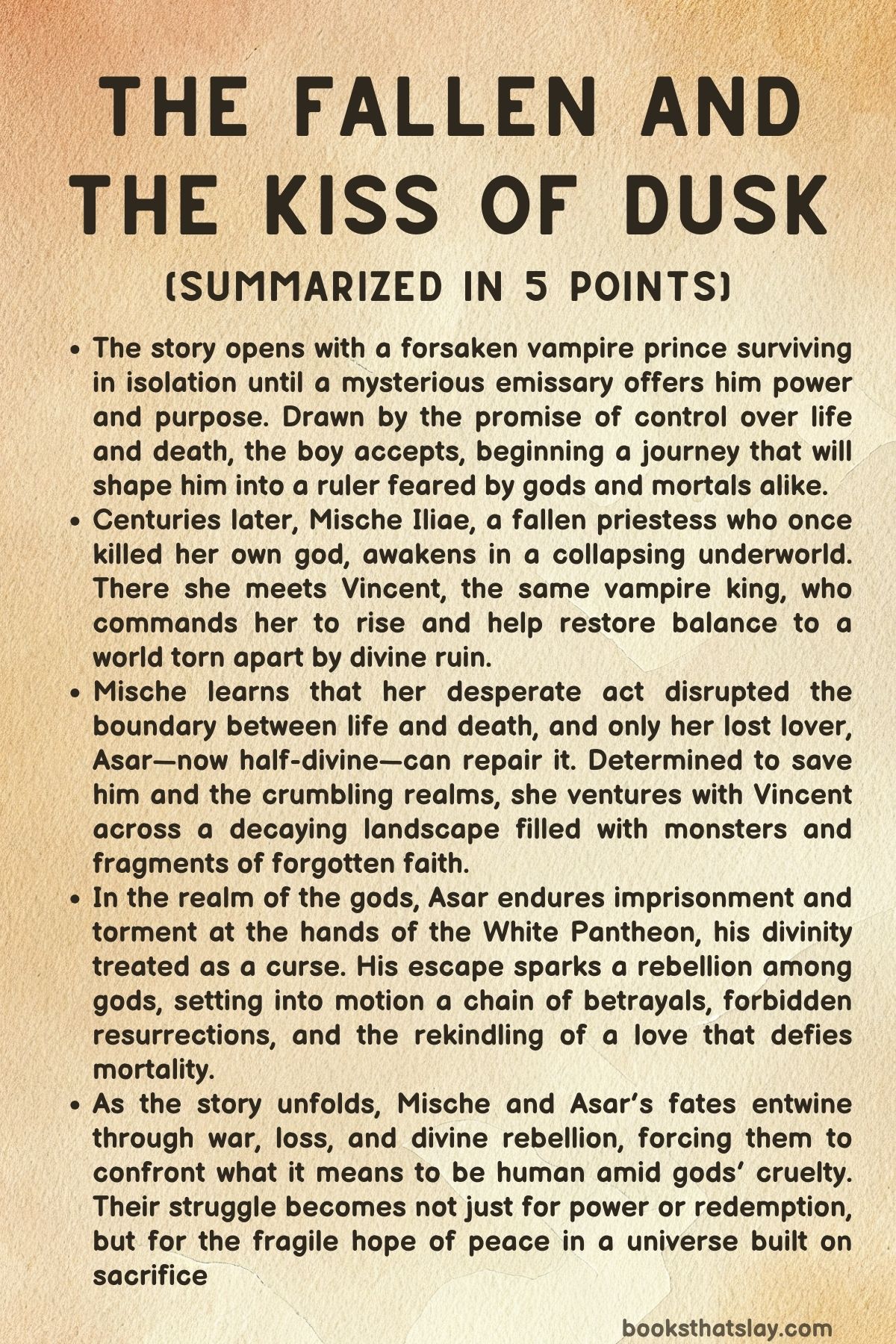
The tale opens on a remote island, home to a feral child with cursed royal blood. The boy, the abandoned son of the vampire king, survives by feeding on whatever he can catch—animals, travelers, or the rare lost soul who washes ashore.
His life changes forever when a stranger cloaked in black arrives. Commanding shadows as effortlessly as breathing, the man reveals himself as an emissary of the king.
He tells the boy that his father wants to see whether he’s fit to inherit his legacy. The boy’s mother had warned him of royal cruelty—how bastard princes are hunted and slain—but the stranger tempts him with the promise of true power and mastery over life and death.
Longing for more than survival, the boy accepts. This choice seals his fate, beginning his transformation from abandoned child to immortal ruler.
Centuries later, this boy becomes Vincent, the vampire king of the House of Night, whose rise will ultimately cost him the love of his life.
The narrative shifts to Mische Iliae, once a faithful servant of the god Atroxus. Her devotion ends in betrayal when she kills her own deity to save the man she loves, Asar.
Her death is brutal, her soul scorched by divine fire. When she awakens in the underworld, she finds it collapsing into chaos.
The sky is torn apart by color and shadow, and monstrous creatures called souleaters roam freely. There she meets Vincent, now long dead but bound to the underworld by his power.
He tells her that her actions have shattered the balance of creation—by killing Atroxus and interrupting a resurrection ritual, she has destabilized the boundary between life, death, and divinity. The world itself is coming undone.
Vincent insists that only Asar—Mische’s lover, who now carries stolen godhood—can mend the underworld. But he is imprisoned by the White Pantheon, the gods of light.
Despite her confusion and grief, Mische agrees to help, driven by guilt and love. She and Vincent begin their journey through the fractured underworld toward the veil, where she might reach Asar.
Meanwhile, Asar is held captive in the realm of the gods. He suffers endlessly, tormented by visions of Mische’s death.
Once a vampire king, now infused with divine essence, he is feared as an abomination—part god, part creature of night. The gods force him to participate in a ritual to restore the fallen sun, but their arrogance causes it to fail.
Enraged by their mockery, he strikes a goddess and narrowly escapes death. In his rebellion, he steals a burning fragment of the shattered sun and uses it to slay his captors.
As he flees, he hears Mische’s voice calling to him. Following it through collapsing halls, he finds her vision bathed in golden light.
Together they fall into the abyss between worlds.
Asar wakes in a strange place, rescued by beings who serve the goddess Acaeja, mistress of fate. She tells him she orchestrated his escape and that destiny has only begun to unfold.
She warns that the balance of all realms is crumbling—the death of Atroxus, the fall of the sun, and the fracture between gods threaten existence itself. Asar’s path is clear: find Mische, restore what was broken, and face the divine war to come.
Their reunion happens amid violence and resurrection. Mische, aided by Asar and their allies, brings back the ancient Keeper—a once-loyal warrior of the gods.
When revived, he rails against their mission, declaring all hope futile before killing himself again to open the gateway to the deadlands. The group is pulled into a ruined divine world—an echo of paradise destroyed by the gods’ own wars.
As they traverse the desolation, Mische and her companions encounter remnants of lives obliterated by divine cruelty. Each ruin tells a story of failure and grief, forcing Mische and Sylina to question their faith and the righteousness of the gods they once served.
In this haunted land, Asar briefly regains his compassion when he helps a child’s spirit find peace. But Mische grows weaker, her mortal form eroding under divine strain.
Their bond deepens through pain and remembrance; they cling to each other as symbols of what still lives. Eventually, they reach the colossal forge where the god of death, Alarus, was executed.
The forge pulses with unnatural energy, revealing that Srana, goddess of creation, has been building an army of divine machines. A brutal battle ensues.
Mische is cast into the forge’s depths, where she discovers Alarus’s weapon—an axe forged from his own eye—and channels its power, merging life and death within herself. She rises reborn, part mortal, part god.
Asar and Mische fight Srana together. He wields Alarus’s weapon and defeats her, but rage threatens to consume him until Mische’s plea anchors him to his humanity.
Gravely wounded, she fades as Asar calls upon forbidden magic to save her. With divine energy roaring through him, he tears open the fabric between worlds, carrying her and their loyal companion into the void as the deadlands crumble.
In the next act, Asar—now the god of death—storms through the underworld seeking a traitor. He confronts a masked warrior who challenges his rule.
Their fierce battle ends when he recognizes her eyes: it is Mische. Memories flood him, and instead of killing her, he hesitates.
She takes the chance to strike him, splitting his divine heart in two. Half of it transfers to her, making her a goddess, while the other half restores his mortality.
In their last moments before the world collapses, Mische kisses him, returning his humanity and their shared love.
They awaken together, alive but changed. Asar is mortal once more; Mische now carries divine and mortal essence in fragile balance.
Their joy is brief. Nyaxia, goddess of shadows, arrives in fury, condemning Asar for defying her and gifting power to Mische.
When she attacks, Asar shields Mische, and the dead rise to defend their new mistress. The White Pantheon descends, ready for war, but Acaeja intervenes, halting the destruction.
She divides the realms and warns Mische that her dual nature could destroy her, though it may also save creation.
Peace returns for a time. Mische meets Vincent one last time in a dream, carrying his final message to his daughter Oraya.
Waking beside Asar, she finds herself truly alive, scarred yet whole. Together, they rebuild Morthryn, their kingdom of the dead, welcoming old allies and preparing for the inevitable divine conflict.
Amid restoration and renewal, they rediscover love as mortals.
Their union culminates in a sacred wedding ritual that binds their souls as one—an oath of eternity spoken not as gods, but as equals. Around them, the underworld blooms once more with light and poppies, a living testament to redemption.
Yet beyond their peace, Nyaxia plots vengeance. She commands her surviving followers to bring eternal night upon the mortal world.
A decade later, war looms once again as her armies march through ruined lands. Though Asar and Mische have reclaimed love and mortality, the gods’ war continues, threatening everything they fought to save.
Their story ends not in finality, but in the quiet promise that even amid endless darkness, love endures.
Characters
Vincent (The Fallen King)
Vincent’s journey in The Fallen and the Kiss of Dusk is that of a cursed monarch, both architect and victim of his own damnation. Born as a forsaken prince of the vampire king, his childhood is steeped in isolation, hunger, and fear.
The moment he accepts the hand of the shadowed emissary marks his first step toward power—and the beginning of his descent. His life becomes a meditation on ambition and loss, as every act of conquest robs him further of his humanity.
Over centuries, Vincent evolves from a frightened boy into a being of immense shadow magic, commanding both reverence and terror. Yet beneath his immortal grandeur lies a profound emptiness.
His reign is defined by the paradox of mastery and enslavement—the more power he gains, the further he strays from redemption. His reappearance in the underworld as a spectral guide to Mische reveals a soul trapped in eternal servitude to his own choices.
In death, he becomes both mentor and mirror: a being who urges others to defy the gods while knowing that rebellion cost him his own salvation. Vincent’s arc is thus one of tragic lucidity—he is a king who sees too late that the crown he sought was forged from loss.
Mische Iliae
Mische stands as the emotional and moral axis of The Fallen and the Kiss of Dusk. Once a devout acolyte of the god Atroxus, her transformation from believer to traitor defines the novel’s spiritual conflict.
Her decision to slay her god is both an act of liberation and of blasphemy—an assertion of free will that unravels the balance between worlds. In death, she becomes a wanderer between realms, burdened by guilt and driven by love.
Her devotion to Asar anchors her even as the underworld collapses around her, and her journey from penitent to goddess mirrors humanity’s struggle to find meaning amid divine indifference. Mische’s compassion, intelligence, and defiance make her more than a pawn in the gods’ war; she is a creator of her own fate.
When she ascends through divine fire, merging mortal fragility with godly essence, she embodies the story’s central tension: the coexistence of ruin and redemption. Her love for Asar—tender, destructive, and transcendent—ultimately restores life to death itself, proving that even within divine tragedy, humanity endures.
Asar
Asar’s character is that of a fallen hero caught between two identities: the vampire king and the half-divine heir of the gods. His imprisonment in the celestial realm showcases his torment—he is neither mortal nor divine, condemned to relive Mische’s death in endless cycles of pain.
His defiance of the gods, particularly Shiket, reflects not arrogance but love weaponized into fury. Asar’s power is both his salvation and his curse, granting him the ability to slay gods but robbing him of peace.
His evolution from wrathful captive to a being capable of mercy culminates when he spares Mische during their fateful battle in Morthryn. In that moment, his rage transforms into redemption.
When he relinquishes divinity to reclaim mortality beside Mische, Asar transcends heroism; he becomes a symbol of love’s defiance against cosmic inevitability. His final acts—choosing compassion over power, life over godhood—restore the moral symmetry the novel builds toward.
Asar’s story closes not with conquest, but with reconciliation, making him the embodiment of balance restored.
Acaeja, Goddess of Fate
Acaeja operates as the unseen architect of destiny throughout The Fallen and the Kiss of Dusk. Her presence is serene yet menacing, representing the inevitability of consequence.
Though she aids Asar’s escape and offers Mische the chance to live, her motives remain obscured—part divine manipulation, part preservation of cosmic order. Unlike the other gods, Acaeja is not driven by vanity or vengeance; she acts as the quiet equilibrium holding creation together.
Her dialogues reveal a consciousness that exists beyond morality, perceiving existence as a pattern of cycles that must continue. Through her, the story examines fate as both a curse and a mercy.
In granting Mische and Asar their reunion, Acaeja allows love to exist within the bounds of mortality, but her warning of future war underscores her ultimate impartiality. She is not a savior but a custodian, one who reminds all beings—divine or otherwise—that even love must bow to time’s design.
Shiket, Goddess of Justice
Shiket stands as the embodiment of divine hypocrisy in the novel. As the goddess of justice, she should preserve balance, yet her actions—torture, cruelty, and vengeance—reveal a justice corrupted by pride.
Her interactions with Asar expose the arrogance of the gods and the moral decay within divinity itself. She despises Mische and mocks her humanity, highlighting the contempt the divine hold for mortals who dare to challenge them.
Yet Shiket’s downfall lies in her blindness; she cannot see that in punishing rebellion, she perpetuates the cycle of ruin that threatens all creation. Her conflict with Asar symbolizes the war between heartless law and compassionate truth.
Though she survives to the end, her authority wanes, suggesting that divine power without empathy is destined to crumble.
Srana, Goddess of Creation and Machinery
Srana introduces a chilling vision of divinity stripped of soul. As the forger of divine weapons and creator of mechanical armies, she represents the fusion of godhood with cold invention.
Her philosophy is one of domination through progress—she seeks to rebuild the cosmos as a machine governed by control, not emotion. Srana’s confrontation with Asar and Mische is a clash between creation as tyranny and creation as love.
Her arrogance mirrors the gods’ broader fall, illustrating that mastery of life without understanding its meaning leads only to ruin. When she faces defeat, her fury is less about loss of power than the failure to comprehend why mortals would sacrifice everything for love.
Through Srana, the novel critiques the hollow perfection of divine order and elevates flawed humanity as the truer act of creation.
Nyaxia, Goddess of Shadows
Nyaxia embodies the eternal hunger of the void. She is both creator and destroyer, a force of chaos that revels in dominion over night and death.
Her fury at Asar’s rebellion and Mische’s ascension reflects her inability to tolerate autonomy within her dominion. Yet beneath her menace lies tragedy—the awareness that even gods are prisoners of their own roles.
Nyaxia’s wrath in the epilogue, as she commands her houses to conquer the mortal world, signals the endless recurrence of conflict. She stands as the antithesis of Mische: where Mische seeks union, Nyaxia demands subjugation.
Her enduring rage ensures that peace remains fragile, hinting that the divine war, and the moral questions it raises, are far from over.
Atrius, Sylina, and the Keeper
The trio of Atrius, Sylina, and the resurrected Keeper serve as reflections of humanity’s diverse responses to divine ruin. Atrius embodies courage rooted in conviction—a mortal unafraid to challenge gods.
His bravery contrasts with Sylina’s disillusioned faith; she represents the believer who sees divinity’s cruelty yet cannot wholly abandon hope. The Keeper, once a guardian of the underworld, epitomizes despair—the exhaustion of an immortal who has witnessed eternity’s futility.
His second death, self-inflicted, opens the path for others, marking sacrifice as the only pure act left in a world poisoned by power. Together, they form the human counterpoint to the novel’s celestial drama, proving that mortals, though fragile, possess a strength even gods envy: the ability to choose meaning in the face of oblivion.
Themes
Power and Corruption
From the very beginning of The Fallen and the Kiss of Dusk, the narrative ties power to hunger—both literal and spiritual. The young vampire prince’s life begins in deprivation, and power becomes the only language he understands.
When the emissary of the king offers him not safety or comfort but knowledge and mastery, the offer is irresistible because it promises control over a world that has only ever controlled him. This initial seduction marks the seed of corruption.
As the boy matures into a ruler and then a godlike figure, every act of strength costs him a fragment of his soul, until he realizes that true corruption is not the loss of morality but the erosion of meaning. His immortality becomes a curse, each victory hollow because it distances him further from his own humanity.
Power in this novel is shown as cyclical and contagious. The gods themselves are not immune to its decay; their divine wars mirror the mortal hunger that birthed them.
Asar’s ascension echoes the same fatal flaw—the belief that one can command life and death without consequence. Mische’s magic, once driven by devotion, evolves into an act of desperation to fix what the gods have broken, yet it too consumes her.
Through these characters, the story exposes how power isolates rather than liberates. Even the gods, luminous and omnipotent, crumble under their own arrogance, unable to comprehend that control without compassion leads to ruin.
The book thus paints power not as a prize but as an infection—one that begins with survival and ends with self-destruction.
Love and Sacrifice
Love in The Fallen and the Kiss of Dusk exists as both salvation and torment. Mische and Asar’s bond transcends mortality, divinity, and even the afterlife, yet it is never free of suffering.
Each act of love demands sacrifice—Mische kills her god and herself for Asar, while Asar abandons eternity for a fleeting return to humanity. Their story challenges the notion of love as a redemptive force.
Instead, it becomes a crucible through which both characters are stripped of illusion. What they endure is not romantic idealism but the raw, painful truth that love demands surrender of the self.
Their reunion in the underworld is emblematic of this paradox. Mische’s willingness to walk through the collapsing realms of death to reach Asar reveals that love, in its purest form, resists divine order.
It is both rebellion and creation, an act that defies the boundaries of existence. Yet, the same passion that redeems them also destroys everything around them—worlds fracture, gods fall, and the balance of creation unravels.
In the end, their peace comes not through victory but through acceptance. They rebuild their shattered world not as gods or rulers but as lovers who have learned that endurance, not eternity, defines devotion.
The novel’s treatment of love is profoundly human—it thrives in imperfection, survives apocalypse, and finds meaning not in grandeur but in quiet defiance.
Divinity and Mortality
The boundary between the divine and mortal is constantly tested throughout The Fallen and the Kiss of Dusk, revealing that godhood is neither an elevation nor a liberation but an illusion. The gods are shown as flawed beings, driven by the same desires and fears as mortals.
When Mische kills Atroxus, she exposes the vulnerability of divinity—the idea that gods exist only because mortals believe in them. This act of rebellion dismantles the hierarchy of existence and sets off a cosmic unraveling, suggesting that the line between creation and destruction is perilously thin.
Asar’s transformation into a half-divine creature further complicates this theme. His dual nature embodies the conflict between infinite power and finite emotion.
His suffering in captivity, his yearning for Mische, and his struggle against divine manipulation underscore the emptiness of godhood devoid of humanity. The book repeatedly shows that to be divine without empathy is to be hollow, while to be mortal with compassion is to hold true strength.
When Asar relinquishes his godhood to reclaim his heart, it is not a fall but a return—a recognition that mortality is not weakness but the foundation of meaning. Through this, the novel questions the purpose of immortality and the cost of transcendence, asserting that to feel pain, to love, and to die are not flaws of existence but its essence.
Redemption and Guilt
Guilt pervades the emotional fabric of The Fallen and the Kiss of Dusk, driving both Mische and Asar toward redemption that always seems just out of reach. Mische’s guilt stems from her betrayal of Atroxus and the devastation her actions cause, while Asar’s arises from centuries of violence and his failure to save her.
Their journey is not about absolution but about endurance—learning to live with the weight of their choices. Redemption here is not divine forgiveness but the act of rebuilding amidst ruin.
The underworld itself becomes a manifestation of guilt, a landscape of fractured souls and collapsing faith. Every creature, from the souleaters to the broken gods, represents the remnants of failed redemption.
Mische’s passage through this realm mirrors an internal reckoning; she faces her sins not through confession but through confrontation. By the time she becomes half-divine, she has ceased to seek forgiveness from the gods and instead strives to make meaning out of her suffering.
Asar, too, finds peace not by erasing his past but by embracing it—by choosing love over vengeance and mortality over power. Their eventual reunion is less a triumph and more an acknowledgment that redemption is never granted; it is earned through persistence, compassion, and acceptance of imperfection.
Fate and Free Will
Throughout The Fallen and the Kiss of Dusk, fate looms as an invisible hand shaping every event, embodied in the goddess Acaeja, who manipulates both mortals and gods alike. Yet, the novel’s power lies in its resistance to the inevitability of destiny.
Mische’s defiance of divine order, her killing of Atroxus, and her refusal to surrender even in death are acts of rebellion against predetermined paths. Asar, born into a prophecy of ruin, constantly struggles to define his own purpose beyond what the gods dictate.
Their love becomes an assertion of free will—a choice repeated across life, death, and divinity.
Acaeja’s presence complicates this struggle. She represents the paradox of fate: that even rebellion may be part of destiny’s design.
The characters’ awareness of manipulation does not grant them freedom but forces them to redefine it. True autonomy, the novel suggests, is not the absence of fate but the courage to act despite it.
By the story’s end, Mische and Asar accept their entwined destinies yet choose how to live within them. Their marriage ritual, performed outside divine authority, symbolizes humanity’s ultimate defiance—the power to find meaning even when every thread of existence is bound by fate.
In this, the novel transforms the age-old conflict between destiny and choice into a meditation on agency, endurance, and the fragile hope that even in a universe ruled by gods, love and will can still rewrite the stars.