The Fix by Mia Sheridan Summary, Characters and Themes
The Fix by Mia Sheridan is a gripping thriller that explores the complexities of trauma, revenge, and redemption. The novel follows Cami Cortlandt, a young woman who has survived unimaginable loss, only to find herself pulled back into a web of danger and deceit.
After her family’s tragic death at the hands of kidnappers, Cami’s life is filled with emotional scars that she’s still trying to heal. As she grapples with her past and her own personal demons, she finds herself entangled in a new mystery that brings her face-to-face with old enemies and forces her to confront the haunting events that have shaped her life. The Fix is a story of survival, strength, and the lengths one will go to seek justice and peace.
Summary
Cami Cortlandt is a high school senior whose life is thrown into chaos when she suspects she might be pregnant. At a pool party hosted by her boyfriend, Hollis, she realizes her period is late, and her fears begin to mount.
As she quietly deals with the situation, she remains calm and hides her concerns from her friends. After the party, Cami heads home, feeling unwell and emotionally distant from everything around her.
When she arrives, her life is completely shattered as two men break into her house, kidnapping her and her family. These men, Trig and AJ, tie up Cami, her mother, and her sister, leaving them vulnerable as they begin their terrorizing assault.
The men have come for more than just money—they are on a mission to cause harm. As the night wears on, Cami witnesses her family being abused, while the men, high on drugs, show no mercy.
Cami is desperate to protect herself and her loved ones, clinging to the hope that someone, perhaps the neighbor Mrs. Willoughby, will notice the signs and come to their aid. She desperately uses a compact mirror to signal for help, hoping that someone will see the light and intervene before it’s too late.
The kidnappers continue their violent actions as Cami fights to stay composed and find an escape route. Despite the overwhelming fear and pain, she refuses to give up, finding small ways to create an opportunity to free herself.
Her determination grows, but the danger escalates, and she realizes just how grave the situation has become. The men, after looting the house and recording their violent actions, plan to leave, but Cami is not ready to surrender.
She holds on to a small shred of hope that she can escape and save her family.
The tension intensifies as Cami attempts a final, desperate move to free herself and alert the authorities. In her mind, rescue is still a possibility, but her body and spirit are exhausted by the constant terror she faces.
The trauma she endures is immense, but Cami’s will to survive drives her to keep fighting.
During the ordeal, Cami’s physical pain is immense as she struggles to break free from her captors. She manages to free one of her wrists using a shard of glass, but the pain is unbearable.
While she feigns sleep to avoid detection, she overhears the kidnappers plotting further violence, including the possibility of harming her mother. Panicking, Cami manages to free herself entirely, though her body is weak and battered.
She rushes to her mother’s room, only to find her mother gravely injured. Desperate, Cami searches for her father’s gun, but just as she finds it, Trig appears, and a tense confrontation unfolds.
In the chaos, Cami is forced to shoot Trig in self-defense, her emotions a whirlwind as she faces the reality of her actions.
Despite her relief at temporarily subduing Trig, Cami knows that the danger isn’t over. AJ, the other kidnapper, is still active, and Cami barely manages to avoid him.
She succeeds in injuring him, giving her enough time to get to her sister, Elle, only to find her severely wounded and unable to be saved. Devastated, Cami’s heart breaks as she realizes that her sister has died.
However, the sound of police sirens brings hope. As the authorities storm the house, Cami, still emotionally shattered, does everything she can to get help for her mother, who is on the brink of death.
After the chaos subsides, Cami is left with overwhelming grief. Her father, though unconscious, is alive, and the police begin questioning everyone in the neighborhood.
Rex, a boy from her school, becomes part of the investigation, though he has no idea that his connection to Cami will be more than just casual. In the aftermath of the tragedy, Cami starts to piece her life together.
She opens a butterfly farm in honor of her mother and sister, but the scars of the past still haunt her. Although she is trying to heal, the memories of that night continue to torment her.
Years later, Cami encounters Rex again, who has joined the military. Both have changed, and their shared trauma continues to linger in their interactions.
They struggle with unresolved emotions, but Cami offers him an olive branch. Meanwhile, Cami has a child and, after much emotional turmoil, decides to give him up for adoption, believing it to be the best option for his future.
Cami’s life takes another turn when she and Rex begin investigating the disappearance of a young boy, Cyrus, who has been kidnapped. Despite limited leads, Cami and Rex push forward, eventually discovering a crucial clue that brings them closer to the boy’s whereabouts.
Cyrus, however, manages to escape from his captor and is eventually rescued by Rex. Cami and Rex reunite with the boy and learn about his tragic past, including the death of his adoptive parents in a car accident.
Cami, deeply affected by Cyrus’s loss, begins to feel a bond with him, as he recognizes her as his biological mother.
The authorities confirm that Cyrus’s captor is dead, but the mystery surrounding his kidnapping remains unsolved. As Cami navigates the complex emotional landscape of motherhood and guilt, she must confront unresolved questions about her past, including the possible involvement of her ex, Hollis, in the events that led to Cyrus’s abduction.
As Cami and Rex begin to uncover a larger conspiracy that links her tragic past to Cyrus’s kidnapping, they are forced to confront the dark forces at play.
Cami’s life continues to unravel as she learns more about the secrets that have been hidden from her. In a surprising twist, Cami finds herself bound and drugged in a limo by Seraphina, who reveals that her mother was responsible for the death of Cami’s family.
Seraphina’s bitterness toward Cami and her family leads to more revelations about the conspiracy that has shaped both their lives. Seraphina confesses that Hollis’s mother, Felicia, orchestrated the kidnapping of Cyrus to protect Hollis’s political career.
As Rex works tirelessly to find Cami, he uncovers the truth about Seraphina’s involvement and the dark forces manipulating their lives. In the end, Rex rescues Cami, and Seraphina is arrested for her role in the plot to destroy Felicia.
Cami and Rex share a tender moment, but Cami’s trauma continues to haunt her.
Months later, Cami begins to rebuild her life. She opens a butterfly farm, reconnects with Rex, and starts a new chapter in her life.
Although Seraphina is in custody, Cami’s search for answers about the shadowy figure behind the events that shattered her world continues. Cami, Rex, and Cyrus, now a family, look toward the future with hope, knowing that while the past may never be fully understood, they can still move forward together.
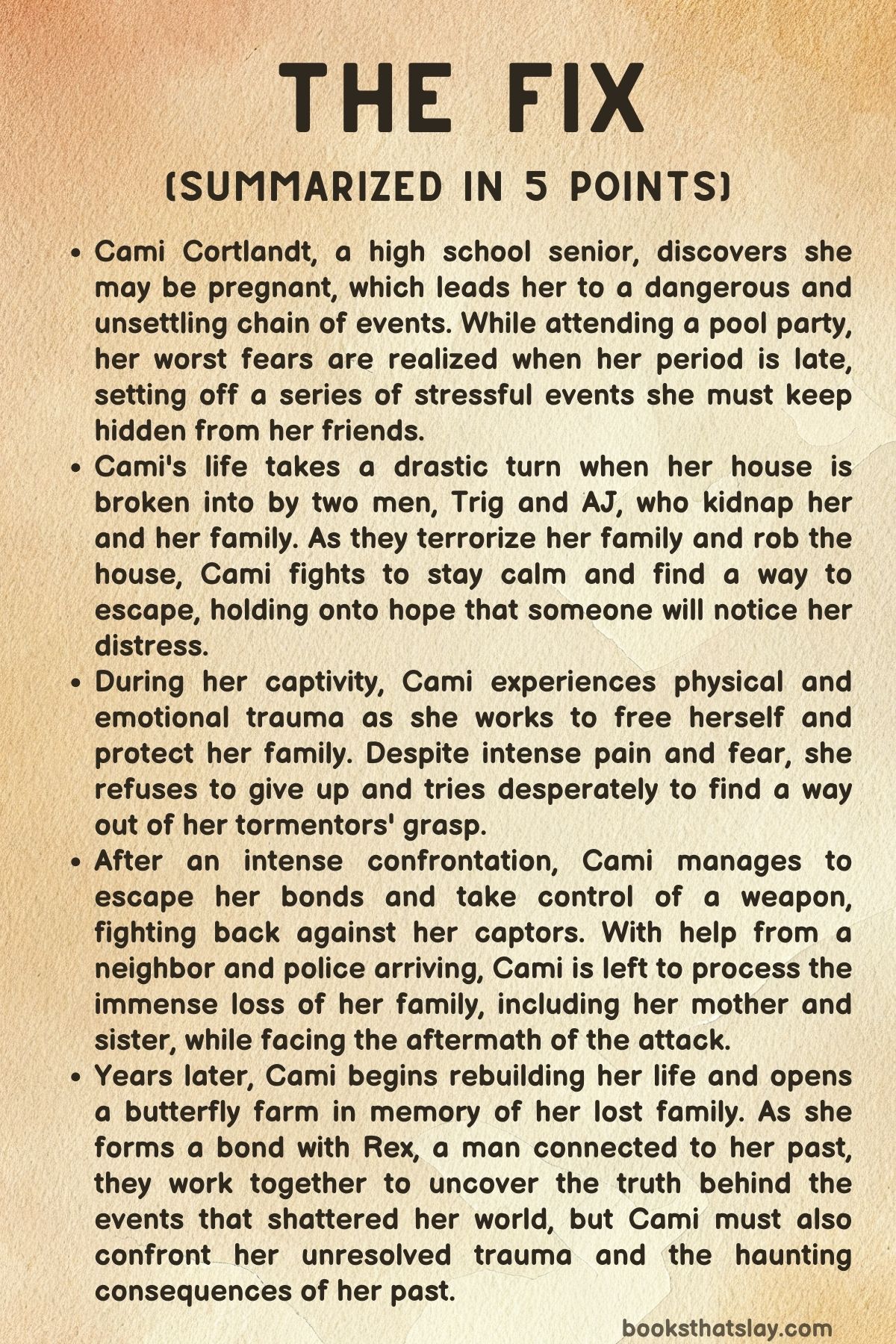
Characters
Cami Cortlandt
Cami is the central character of The Fix, whose life is turned upside down by a series of tragic and traumatic events. Initially introduced as a high school senior grappling with signs of pregnancy, Cami’s life becomes far more complicated as she faces a violent home invasion and kidnapping.
Despite her initial fear and uncertainty, she demonstrates remarkable resilience and strength, fighting to survive both physically and emotionally. Throughout the ordeal, Cami remains calm under pressure, and her determination to protect her family, especially in the face of unimaginable horrors, is a defining characteristic.
Even as she suffers both physical and emotional trauma, her inner strength and will to survive drive her to free herself and fight back against her captors. Cami’s journey of healing is long and filled with intense grief, especially after the brutal loss of her mother and sister.
However, through these struggles, she learns to find meaning in her pain by opening a butterfly farm in their memory, symbolizing hope and renewal. The emotional scars of her past continue to haunt her, but her eventual reunion with Rex and the adoption of Cyrus signify her gradual recovery and the building of a new life.
Rex
Rex is a key figure in The Fix, initially presented as an observer in Cami’s life but gradually becoming a crucial support system in her healing process. His involvement in the investigation into Cyrus’s kidnapping brings him closer to Cami, and his protective nature emerges as he aids in saving the boy and, later, Cami.
Rex’s transition from a military figure to someone deeply involved in Cami’s life reflects his personal growth. As Cami’s emotional anchor, he helps her navigate the complex legal and emotional hurdles after the tragedy, supporting her through the challenges of raising Cyrus.
Though Rex has his own unresolved issues, especially surrounding his connection to Cami’s trauma, his dedication to her and their shared future is unwavering. His role in rescuing Cami from her captors shows his loyalty and deep care for her, and he remains by her side as they confront their past together.
By the end of the story, Rex’s readiness to build a life with Cami and Cyrus reflects his commitment to healing and creating a fresh start, despite the ghosts of their shared past.
Seraphina
Seraphina is a complicated and multifaceted character whose actions are driven by a mix of personal trauma and bitterness. Initially, she is portrayed as an antagonist, having played a role in the plot to destroy Cami’s family.
Her backstory reveals a deep sense of resentment toward Cami’s family, particularly her mother, due to the devastating impact of a past tragedy involving Seraphina’s own family. She harbors a desire for revenge, believing that the destruction of Cami’s family would somehow provide justice for the wrongs her own family suffered.
However, Seraphina’s motivations become more understandable as her personal history is unveiled. She is ultimately a victim of her circumstances, manipulated by her mother’s obsessive need for vengeance.
While she acknowledges her role in the kidnapping and the tragic events that follow, Seraphina is portrayed as someone who has been shaped by her past in ways that prevent her from fully reconciling with her actions. By the end of the story, Seraphina seems to come to terms with her own guilt and confusion, offering an honest letter to Cami that reflects her internal struggle and desire for peace, even if it is too late for redemption.
Cyrus
Cyrus’s introduction into The Fix marks a pivotal turn in the story, as he represents hope and the possibility of healing for Cami. As a young boy who is kidnapped and held captive, Cyrus’s resilience and bravery mirror Cami’s own inner strength.
After managing to escape from his captor, he finds unexpected help in Rex, who ensures his safety. Cyrus’s bond with Cami grows as he learns about his biological connection to her, despite never having met her before.
Cami’s initial guilt over not being there for him sooner gives way to a deep desire to provide Cyrus with the love and stability he needs. The emotional and logistical challenges of raising Cyrus are compounded by the trauma Cami has experienced, but she is committed to being the mother he needs.
Cyrus’s journey reflects the power of family, both biological and chosen, and his presence in Cami’s life acts as a catalyst for her own healing. Despite the past horrors, Cyrus represents the possibility of a new beginning for Cami, Rex, and their emerging family.
Hollis
Hollis plays a significant yet morally ambiguous role in The Fix. He is introduced as Cami’s boyfriend, whose connection to her is complicated by the revelation of his involvement in the larger conspiracy surrounding her family’s destruction.
As the story unfolds, Hollis’s actions, particularly his involvement with his powerful mother, Felicia, become more troubling. He is initially unaware of the full extent of the plot against Cami’s family but later becomes entangled in the ramifications of his mother’s actions.
Hollis’s character is marked by his internal conflict, torn between loyalty to his family and his growing feelings for Cami. However, his inability to fully protect her or support her during the most critical moments of her life leaves a lasting impact on their relationship.
Despite his personal struggles, Hollis ultimately becomes a figure representing the consequences of unchecked privilege and the lengths to which people will go to protect their image and status.
Felicia Barclay
Felicia Barclay, Hollis’s mother, emerges as one of the central antagonists in The Fix. Her actions are driven by a ruthless desire to protect her son’s political career at any cost.
This leads her to orchestrate the kidnapping of Cyrus, seeking to prevent the public revelation that Hollis has a child he has denied. Felicia is portrayed as manipulative and willing to go to extreme lengths, including murder, to preserve her family’s reputation.
Her role in the story underscores the theme of power and corruption, highlighting how the pursuit of status can lead to moral degradation. Felicia’s character is an embodiment of the lengths to which people in positions of power will go to maintain their control and influence, and her actions have far-reaching consequences for Cami and others.
Posey
Posey’s character is one of quiet strength and resilience. Throughout the story, she operates in the shadows, working behind the scenes to help Rex and Cami.
Her backstory reveals a life of manipulation and betrayal at the hands of her brother Anton, but despite these challenges, Posey manages to carve out her own path toward freedom. She represents the idea of redemption and personal growth, choosing to help Rex in his quest to bring justice and closure to Cami’s traumatic past.
Posey’s role in the story is subtle but significant, as her actions ultimately contribute to the unravelling of the complex web of deceit surrounding Cami’s family’s destruction. Her character is a reminder that even those who seem to be on the periphery can play crucial roles in bringing about resolution and healing.
Themes
Survival and Resilience
The central theme of The Fix revolves around survival in the face of extreme trauma. Cami’s journey is one of both physical and emotional endurance.
From the brutal home invasion and kidnapping to the emotional aftermath of losing her family, Cami is pushed to her absolute limits. The brutality of her situation leaves lasting scars, yet her will to survive never wavers.
She fights not only for her own life but for the lives of her family, especially in the moments when she acts to save her mother and sister. Her ability to remain calm under duress, even while enduring severe physical pain, showcases a fierce determination to overcome what seems insurmountable.
This fight for survival continues after the kidnapping when Cami faces the challenge of rebuilding her life. Even when faced with guilt, grief, and the sense of losing everything, she finds a way to move forward, symbolized by her creation of a butterfly farm.
The symbolism of the butterfly—transforming from one state to another—mirrors her own journey of personal rebirth and resilience.
The theme of survival is also intertwined with Cami’s internal battle. Her efforts to cope with the aftermath of trauma are complicated by her guilt over not being able to protect her family.
Yet, the constant throughout her ordeal is her refusal to be defeated. Even as she navigates the psychological toll of her past, she takes responsibility for her actions, faces her fears, and moves toward healing.
The Fix portrays the immense strength of the human spirit to survive, even in the darkest of circumstances, while also highlighting the complexity of healing from such deep wounds.
Justice and Revenge
The Fix delves into the theme of justice and revenge, exploring how the desire for retribution can shape and distort lives. Seraphina’s motivations are driven by the injustice her mother experienced and her quest for revenge against Cami’s family.
Her mother’s traumatic experience—having her hand shattered during a violent home invasion—set in motion a cycle of vengeance. The bitter belief that her mother’s suffering could only be avenged by destroying the Cortlandt family leads Seraphina to manipulate events and ultimately become complicit in the death of Cami’s family.
In this way, The Fix raises important questions about the cost of vengeance. Seraphina’s actions, motivated by a desire for justice, ultimately lead to her own personal destruction, as she is consumed by guilt and regret.
At the same time, Cami’s journey challenges the idea of revenge. Although she faces extreme loss and trauma, she never fully embraces the desire to destroy those who wronged her.
Instead, her focus remains on survival and eventually healing. The contrast between Cami’s quest for peace and Seraphina’s spiral into obsession speaks to the destructive nature of revenge.
Even though Cami does seek justice for what was done to her family, the novel suggests that true justice is not found in vengeance but in the ability to reclaim one’s life, heal, and find peace. The theme ultimately suggests that the pursuit of revenge may not only fail to bring closure but can perpetuate a cycle of pain that is hard to break.
Trauma and Healing
The Fix portrays the devastating impact of trauma, not only in terms of physical violence but also emotional and psychological scars. The kidnapping and the subsequent loss of Cami’s family are central to her character’s journey, and much of the novel is spent exploring the deep emotional pain that accompanies these events.
Cami’s trauma is not just about the physical violence she endures, but also about the aftermath—living with the constant weight of grief, guilt, and the overwhelming sense of powerlessness. The psychological toll of what happened haunts her for years, manifesting in her difficulty trusting others, her fear, and her struggle with the idea of being a mother to her own child.
Despite the profound pain, The Fix also offers a narrative of healing. Cami’s process of healing is slow, often messy, and filled with setbacks.
Her trauma lingers in her interactions with those around her, especially with Rex, who symbolizes both a reminder of the past and a chance for a new future. Through her determination to build a new life, symbolized by the butterfly farm, she begins to heal.
The butterfly, representing transformation and rebirth, becomes a metaphor for Cami’s own gradual healing process. While her trauma may never fully disappear, Cami’s ability to rebuild her life and create new connections speaks to the possibility of finding peace after immense suffering.
Trust and Betrayal
Trust and betrayal are key themes in The Fix, explored through Cami’s relationships with those around her, especially with Rex and Hollis. Cami’s trust is severely tested after the events of the kidnapping, as the people closest to her either fail to protect her or, in some cases, actively contribute to her suffering.
Her relationship with Hollis, which was once a source of comfort, is marred by betrayal. His indirect involvement in the events surrounding her family’s death, as well as the revelation of his past actions, forces Cami to confront the painful truth about her relationships.
Similarly, Seraphina’s betrayal of Cami’s family, driven by her own twisted sense of justice, adds a layer of complexity to the theme.
Despite these betrayals, Cami finds a form of trust with Rex, though it is not without difficulty. Their connection is built on shared trauma and mutual understanding.
However, Rex’s struggle with his own guilt and Cami’s trauma creates an ongoing tension. The novel portrays the fragility of trust in the aftermath of betrayal, but also its potential for renewal.
Through time, vulnerability, and mutual support, Cami and Rex navigate the painful path of rebuilding trust, even if they cannot entirely let go of their past.
Family and Loss
The theme of family and loss is pervasive throughout The Fix, with Cami’s devastating loss at the center of the narrative. The violent destruction of her family forces Cami into a confrontation with the fragility of life and the devastating impact of losing loved ones.
The novel captures the overwhelming grief Cami experiences, not only from the loss of her mother and sister but from the loss of the life she once knew. This theme is explored in depth through Cami’s journey to reclaim a sense of family, despite the tragedy she faces.
The connection she eventually forms with Cyrus highlights her ability to love and nurture, despite the deep scars from her past.
Family is also explored through the fractured relationships that Cami must navigate. Her father, who survives the attack, is a reminder of what is lost, and yet he too is struggling with his own pain.
Cami’s journey of loss, grief, and healing is marked by her desire to create a new family, symbolized by her care for Cyrus and her renewed connection with Rex. Through this, The Fix suggests that family is not solely defined by blood but by the bonds we form and the love we share.
While Cami cannot replace the family she lost, she begins to form a new family of choice, one that offers hope for the future.