The Forgotten Book Club Summary, Characters and Themes
The Forgotten Book Club by Kate Storey is a contemporary, character-led novel about grief, community, and the quiet ways people learn to live again. After her husband Frank dies, Grace Clarke becomes expert at getting through the day while avoiding the parts of her life that hurt most—his study, old routines, even her family’s concerned visits.
Everything shifts when she’s nudged toward Frank’s unusual “Silent Book Club” at a local bookshop. What begins as an awkward attempt to show up turns into a lifeline: new friendships, unexpected truths about Frank, and a shared mission that gives Grace a reason to step forward again.
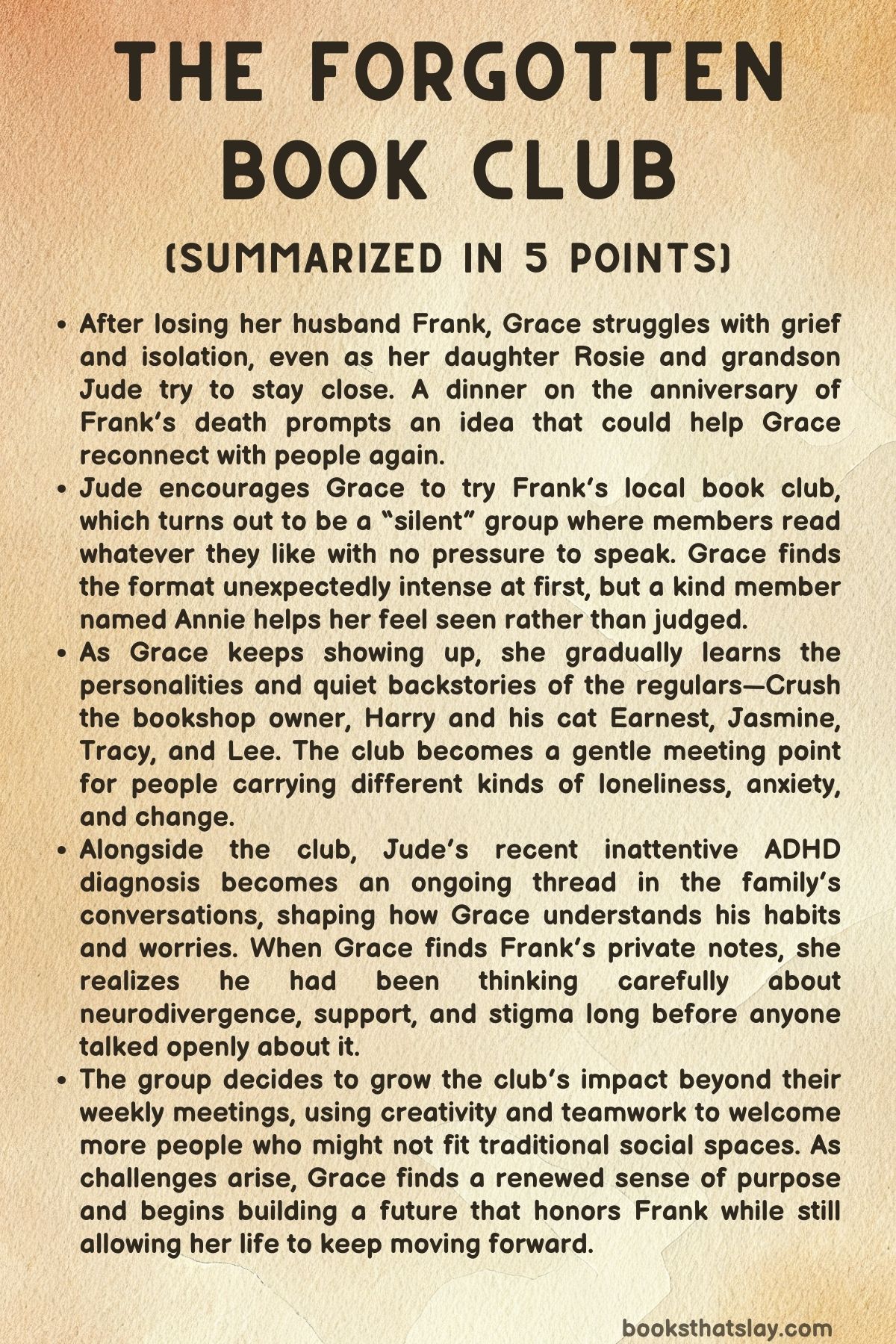
Summary
A year after her husband Frank’s death, Grace Clarke reaches the anniversary with a mix of dread and determination. She has kept Frank’s study sealed, as if closing the door could keep the worst of grief contained.
On the anniversary, she forces herself inside. The curtains have been drawn for months, so she yanks them open and light pours across the room Frank once used every day.
A framed family photo on his desk stops her cold—Frank beside Grace, their daughter Rosie, Rosie’s husband Paz, and their grandson Jude at graduation. Grace searches Frank’s face for some sign she missed, then feels the familiar sting of guilt: Rosie has carried too much of Grace’s sadness this past year.
Grace has been dodging Rosie and Jude’s visits, choosing long walks alone instead. She tells herself she is sparing them worry, but the truth is she is shrinking her world until it feels both safer and emptier.
Rosie and Jude come for dinner on the anniversary anyway. Grace tries to play host, making jokes, opening champagne, and offering a toast to Frank—and then, with a slightly forced brightness, to “moving on.” Rosie and Jude echo the words, though neither sounds convinced it is that simple.
During dinner, Jude shares something personal: he has been diagnosed with inattentive ADHD after a long period of struggling with focus, memory, and day-to-day functioning. Rosie responds with support and regret that they didn’t notice sooner.
Grace tries to be reassuring, but inside she is uneasy about medication and what the diagnosis might mean. Afterward, Rosie confronts Grace about her constant absence when Rosie visits.
Grace insists she is fine, just out walking. Rosie worries that Grace is isolating herself into harm.
Grace snaps defensively, then realizes her remarks could sound like she is dismissing Jude’s anxiety and challenges. The moment leaves everyone raw.
Jude proposes a practical solution: Grace should go to Frank’s old book club at the local bookshop, Books En Parade. Grace resists—she claims she isn’t much of a reader and hasn’t read the current selection.
Jude explains it doesn’t work like that. Rosie pushes gently but firmly.
They remind her that the people there cared about Frank, and that she might not feel so alone among them. Grace agrees, not because she’s confident, but because she can’t think of a better answer.
When Grace arrives at Books En Parade, she’s already unsettled. The building used to be Simpson’s Antiques, the shop where she once worked and which she still misses.
The bright, modern interior feels like an erasure of the past. The owner, a tattooed woman named Crush, welcomes her and asks what she is reading.
Grace admits she has brought nothing. Crush explains Frank’s group is different: people bring whatever they want, read quietly, and talk only if they feel like it.
It’s a “Silent Book Club.”
Grace doesn’t know what to do with that. The silence, instead of soothing her, makes her feel exposed.
She buys a couple of books anyway, encouraged by a tall, friendly woman named Annie. Grace sits with the group, but the quiet quickly becomes unbearable; it amplifies every thought she has tried to outrun for a year.
Overwhelmed and embarrassed, she bolts.
Outside, Annie follows, checks on her, and gently gives her room to fall apart. On a bench, Grace explains that the building carries history for her, and that the silence made the loneliness feel louder.
Annie tells her the group looks after each other in small ways, like giving Crush space when she is struggling. When Grace mentions Frank’s belief that there is no such thing as a guilty pleasure in reading, Annie suddenly realizes who she is: Frank’s wife, “Frank’s Gracie.” Annie invites her back in to meet everyone properly, but Grace isn’t ready.
She goes home shaken, yet oddly curious.
Jude visits the next evening, eager to hear how it went. Grace complains that he didn’t warn her it would be silent; Jude shrugs, saying that’s how it always was when he attended with Frank.
Jude talks about how his ADHD can create intense focus on certain interests, and how he’s been drawn to stories about mental health. Grace finds herself thinking about Annie, Crush, and the others more than she expected.
Against her instincts, she decides to try again.
Two weeks later, she plans to go, having read most of one of the novels she bought, but heavy rain and a sudden venue change leave her arriving at the wrong shop. Cold and soaked, she calls Jude and learns the meeting is in Beckenham that night.
She nearly turns back, but chooses to drive on alone, deciding she has to be brave without being rescued.
At Beckenham Books, the group welcomes her with warmth and gentle teasing. A bald man named Harry jokes about her lateness.
A black-and-white cat approaches; Harry reveals the cat’s grand official name, but says Frank nicknamed him “Earnest,” and the name stuck. Grace learns Frank had nicknames for many of them—Jasmine, a shy young woman with hennaed hands, was “Billie”; Tracy, a sporty Scottish woman, was “T”; and Lee, whose real name is also Lee, didn’t escape the joke.
Grace is surprised when the group asks sincerely what she’s reading and what she thinks. She shares thoughtful reactions to her current book, and the group responds with interest rather than politeness.
Yet when the silent reading begins, Grace struggles again. The quiet makes her hyperaware of every sound, every breath, every page turn, and it opens the door to grief.
She feels like an outsider among Frank’s friends instead of her own.
Afterward, Annie asks for Grace’s number so she can keep her updated about location changes. Grace offers Annie a lift home, and in the car they talk more personally.
Annie hints that her partner Jack has not been himself. Grace confesses she might not return because the silence hurts too much.
Annie understands and says that for her, books and the group make loneliness feel less absolute. Grace realizes that when she is absorbed in a story, she doesn’t feel alone either.
They agree on a compromise: Grace can come for the social part and leave before the silent hour if needed.
At home, Grace finishes her book and notices herself copying Frank’s habit of closing the cover and letting out a satisfied sigh. She wanders into Frank’s study again, staring at his shelves and feeling regret that she didn’t read alongside him when he was alive.
She chooses one of his favorites and reads it, but the heaviness of it leaves her hollow. Still, Annie’s friendship has started to brighten her days, and Grace decides to keep showing up.
At the next meeting back at Books En Parade, Grace arrives early and notices a new mural. Crush tells her about the artist and offers contact details, hinting at a wider community around the shop.
Harry arrives with Earnest in a carrier. The group chats with an ease that surprises Grace.
Crush admits her father has died and she is struggling with complicated feelings. Annie gives Grace and Crush a copy of a grief memoir.
The conversation moves through jokes, frustrations, and the kinds of truths people only share when they trust they won’t be judged.
Grace manages the silent hour better this time by focusing on Earnest’s steady purr. Later, Annie rushes off after a message and seems distracted.
At home, Grace accidentally drops one of Frank’s old reading journals. When she opens it, she finds Frank’s private notes connecting impulsivity, emotional regulation, and addiction.
He writes about his older brother Tony’s alcoholism and death, and the entry unsettles Grace because it suggests worries Frank never shared with her.
Then the family is jolted by an emergency. Grace receives a call and hears Jude screaming in the background.
She and Rosie rush to the hospital, where Jude sits in a wheelchair with his shoulder dislocated after a fall. The doctor treats him and casually connects dots Rosie mentions: ADHD, working memory, and hypermobility.
He notes that neurodivergent people are more likely to be hypermobile, and he shares that he has ADHD himself. The conversation lands heavily—Rosie realizes she is hypermobile too, and Frank was as well.
That night, Grace can’t sleep. She replays Jude’s scream and feels ashamed for doubting the diagnosis earlier.
She returns to Frank’s study and searches through his journals more deliberately. In one entry, Frank reflects that he believed he probably had ADHD, and that Rosie and Jude may have inherited traits from him.
He writes about Tony, addiction risk, and his fear that Jude’s perfectionism and self-criticism will turn inward. Frank outlines three ambitions: make sure Jude gets the support he needs, help raise awareness of inattentive ADHD, and grow the silent book club into something larger that can hold people who don’t fit easily into typical social spaces.
Grace is stunned by how carefully he planned for a future he didn’t live to see. She decides she will try to carry those ambitions forward.
Grace speaks openly with Rosie, learning Rosie suspected Frank’s ADHD traits for years. Paz returns from travel and slips into the family’s affectionate chaos.
Grace shares Frank’s goals, and Rosie supports the idea of talking about Frank’s probable ADHD with the book club as part of reducing stigma. Grace feels purpose for the first time since Frank died.
Together, the family joins the book club. Grace explains that the silent format helped Frank handle overwhelm while still being connected, and that he wanted a space for people dealing with anxiety, loneliness, grief, or neurodivergence.
Jude shares how reading used to be hard for him, and that Frank was the one who first suggested ADHD. The group begins planning expansion—more sessions, more locations, and online options for people who can’t easily attend in person.
They head to a pub afterward to plan an outreach campaign, with Rosie offering photos, Paz offering help with sponsorship, and Jude and Jasmine creating videos.
Momentum builds. A photo shoot brings out everyone’s personalities, including Harry arriving dressed up with Earnest in a new collar.
But trouble arrives in the form of a reporter, Zed Fellows, who has a hostile history with Crush. He pushes boundaries, implying he deserves access and attention.
Crush refuses and storms off; Rosie steps in and redirects the interview toward Grace and Annie.
Soon after, Zed publishes a nasty opinion piece questioning ADHD awareness and mocking the book club’s mission. Grace feels sick with shame, worried she has harmed Frank’s legacy and invited public doubt.
Annie’s anger is immediate, and during a walk they talk through the difference between paperwork and lived reality: Jude had ADHD before any diagnosis label, and awareness can help even if some people misuse language. During that conversation, Annie finally reveals her own crisis: Jack lost his job, hid unpaid bills, and has slid into deeper depression.
Annie has drained her inheritance trying to keep them afloat. She asks Grace to keep it private, and says the one thing that would help her cope is seeing the book club succeed.
The group keeps going anyway, with bigger plans, wider reach, and increasing online support. Grace also helps Harry come out of hiding with his love of romance novels, proposing a shared read so he can talk about the genre without embarrassment.
Their friendship becomes a gentle thread of possibility in Grace’s life, even as she panics at the idea of betraying Frank.
Grace later finds another journal entry where Frank worried about her future loneliness, admitted health fears he kept quiet, and hoped she would find community and even companionship after he was gone. The discovery doesn’t erase her grief, but it loosens the guilt that has trapped her in place.
A major event night arrives—Reading Rocks—filled with music, an author appearance, and fundraising. When Zed shows up again looking for drama, the group backs each other and pushes him out.
The night succeeds beyond their hopes, and the fundraising total is high enough to offer real help. Grace and the group propose using the money to support Jack’s inpatient care and his training to teach carpentry.
Annie, overwhelmed and frightened of accepting help, finally agrees.
In the wake of the event, small joys land with big weight: Jude and Jasmine finally admit what everyone else has seen and kiss outside the shop. Grace finds herself able to talk to Harry again without running, redefining connection on terms that don’t erase Frank.
Six months later, the silent book club has expanded into many affiliated groups. Jack is improving and training for a new path.
Plans are underway for a larger celebration of neurodiversity, with Grace helping to shape reading lists and resources. Grace films a Desert Island Reads episode in Frank’s honor, using his journals to speak directly to others who are grieving.
She doesn’t pretend grief disappears. Instead, she shows what she has learned the hard way: life can still be built, friendships can still arrive, and the people we love can leave behind not only memories, but instructions for how to keep going.
Characters
Grace Clarke
Grace is the emotional center of The Forgotten Book Club—a woman learning how to live inside the hollow space that grief leaves behind. A year after Frank’s death, her avoidance of his study mirrors her larger strategy: if she can keep the door closed on pain, she can keep functioning.
But once she finally opens that room and lets light back in, she begins a longer, messier opening—toward memories, toward other people, and toward a future she didn’t choose. Grace’s early instinct is to protect her family by hiding how fragile she feels, which paradoxically isolates her more and makes Rosie worry.
Her discomfort with Jude’s ADHD medication also reveals a generational tension in her—she wants to be supportive, but she’s still adjusting to newer language around mental health and neurodivergence, and she fears what she doesn’t fully understand. What makes Grace compelling is that she doesn’t transform through sudden bravery; she changes through repeated, reluctant attempts—returning to book club, enduring the silence, asking for help, offering support to others, and slowly realizing that companionship doesn’t replace Frank, but it can sit alongside his memory without betraying it.
By the end, her grief becomes purposeful: she takes up Frank’s unfinished ambitions not as a shrine to the past, but as a bridge into community and meaning.
Frank Clarke
Frank’s presence dominates the story even after his death because his love was practical, observant, and quietly far-reaching. He didn’t just leave behind a study full of books; he left behind structures—literal and emotional—that still shape the living.
The glass extension he designed symbolizes him as someone who built light into shared space, and the Silent Book Club becomes the most important example of his philosophy in action: connection without pressure, belonging without performance. Frank is revealed as emotionally perceptive in hindsight, especially through his reading journals, which function like messages he didn’t know he was writing to Grace.
His reflections on ADHD, addiction, impulsivity, and emotional regulation show a man trying to make sense of his family’s patterns, worried for Jude, and protective of Grace in a way that is both loving and flawed. He shields her from the “extra worry,” but that secrecy also leaves her stunned later, forced to rebuild her understanding of their marriage and of Frank himself.
Frank’s character is most moving in his contradictions: he is gentle but withholding, deeply social but easily overwhelmed, humorous about “no guilty pleasures” yet privately anxious about what he can’t fix in time. Even his fear—his hidden chest pains, his suspicion that he had ADHD—becomes an act of care when Grace discovers he wanted her to find community and even future companionship.
Frank ultimately represents a kind of love that continues not as sentimentality, but as a set of values that others can carry forward.
Rosie Clarke
Rosie is the sturdy, sharp-edged warmth that keeps Grace tethered to life when grief threatens to pull her away. She loves her mother fiercely, but she refuses to treat her as fragile porcelain; instead, she pushes, probes, and challenges, even when it irritates Grace.
Rosie’s worry shows up as insistence—questioning Grace’s walking, pressing about isolation, urging her to go to book club—because she has been doing emotional labor for a year and can’t bear the idea of losing Grace to loneliness after already losing Frank. Her relationship with Jude shows Rosie as both supportive and regretful: she responds compassionately to his inattentive ADHD diagnosis while also mourning how long it took to recognize the signs, which suggests she holds herself responsible for things that were never entirely within her control.
Rosie also carries complicated knowledge about Frank—she suspected he had ADHD and had conversations with him about Jude’s needs—so she becomes a bridge between Frank’s private interior world and Grace’s belated discoveries. When conflict arrives in the form of public skepticism and Zed’s article, Rosie’s protective instincts sharpen into leadership; she steps in, redirects the reporter, and later helps strategize the campaign.
Rosie’s role is not only “the daughter” but a co-builder of the new community—pragmatic, decisive, and emotionally honest enough to keep the people she loves from disappearing into silence.
Jude
Jude embodies the book’s theme that identity often becomes clearer when it finally has language. His inattentive ADHD diagnosis doesn’t “change” him so much as rearrange the way everyone interprets his life: his struggles with concentration, working memory, and learning to read; his capacity for intense hyperfocus; his perfectionism and self-criticism.
Jude’s openness—describing what it feels like to lose people’s words as they’re spoken, hoping medication might help—contrasts with Grace’s earlier instinct to keep pain private, and it gently forces her to confront modern mental-health realities rather than retreat into generational stoicism. Jude is also the story’s spark plug: he’s the one who suggests Grace attend the book club, and later he becomes central to the expansion campaign through videos and social media, turning reading into something communal and accessible.
His relationship with Frank continues as a guiding force; Frank was the first to suggest ADHD, and that memory gives Jude both gratitude and grief. Beneath Jude’s humor—joking even after a painful shoulder dislocation—there’s vulnerability, especially when he fears being a “liability” in relationships.
That fear makes his eventual connection with Jasmine feel earned: it’s not a neat romantic flourish, but a step toward trusting that he can be loved without being “fixed.” Jude’s character ultimately represents the future of the club’s mission—proof that compassion, accommodation, and community can change a person’s trajectory.
Paz
Paz operates as a calm, affectionate counterweight in the family’s dynamic—a presence who can slide into chaos with humor and steadiness. He is often seen through Grace’s eyes as part of the “madhouse” warmth that makes the Clarke family feel alive, and his ease suggests a long practice of loving people with strong personalities and shifting moods.
Paz’s voluntary legal work abroad adds a layer of quiet idealism: he is someone motivated by service, and that trait carries into the book club campaign when he offers to seek sponsorship for printing and support expansion. He isn’t portrayed as the loudest voice, but his value is in reliability and follow-through; he’s the kind of person who makes community plans actually happen.
In a story where many characters are overwhelmed, grieving, or anxious, Paz’s groundedness helps stabilize the family system without dominating it.
Annie
Annie is the first real “light” that reaches Grace from outside her family, and her friendliness is not shallow cheerfulness but a deliberate kind of care. She is socially confident enough to follow Grace when she bolts from the first silent meeting, yet emotionally intelligent enough not to pressure her back inside.
Annie understands loneliness as something that can coexist with a crowded room, and she models a way of being with grief that isn’t performative—she admits her own struggles, shares the strain of Jack “not being himself,” and uses reading as a lifeline rather than a hobby. Annie also functions as a gentle catalyst: she offers Grace compromise instead of ultimatums, makes the club feel flexible and human, and becomes the person Grace chooses to text, meet, and eventually support.
Her arc reveals how caretaking can become a trap; Annie’s love for Jack is steadfast, but it also pulls her into isolation, financial stress, and exhaustion when he refuses help. What makes Annie particularly poignant is that she is both helper and helped—she gives Grace belonging, then later needs the group’s intervention to survive her own crisis.
The story treats her not as a side character but as proof of the book’s argument: community isn’t a nice extra; sometimes it is the difference between coping and collapsing.
Crush
Crush is the book club’s hard-edged tenderness—a person whose appearance and reputation signal toughness, while her grief and loyalty reveal sensitivity underneath. As the owner of Books En Parade, she becomes the guardian of Frank’s legacy, but she doesn’t treat it as a museum; she adapts it, explains it, and protects it.
Her first interactions with Grace are firm and rule-setting, which makes sense: Crush has likely managed many vulnerable people in that space, and boundaries are part of how she keeps it safe. Over time, she shows a wry humor and a willingness to be vulnerable—admitting complicated feelings around her father’s death, attending funerals that reopen old versions of herself, and revealing how exposed she feels when publicity forces her story into the open.
The conflict with Zed hints at a past public life in music and the way the media can freeze someone into a caricature; his hostility suggests he still believes he’s entitled to access to her narrative. Crush’s refusal to be coerced, and her decision to keep showing up anyway, make her a model of self-protection without shutting down.
She’s essential to the club’s growth because she understands that “safe space” isn’t created by softness alone—it’s created by clarity, consent, and a refusal to let louder, crueler voices define the community.
Harry
Harry’s character is built around the tension between image and truth. On the surface, he reads as intimidating—bald, blunt, joking sharply, casually referencing pistols from past work—yet he’s also the tender caretaker of Earnest and the secret devotee of romance novels.
His humor can be abrasive, but it’s often a social tool that keeps awkwardness from curdling into discomfort, especially when Grace arrives late and drenched and embarrassed. Harry’s bond with Earnest shows his capacity for gentleness, and his willingness to bring the cat to meetings turns the club into a warmer, more sensory place—important for Grace, who uses the cat’s purring to endure silence.
The revelation of his romance collection is Harry at his most vulnerable: he has internalized a hierarchy of “serious” taste that makes him feel shame about joy, and that shame mirrors Grace’s fear that moving forward equals betrayal. Grace’s “buddy read” with him is therefore bigger than books—it’s a pact to stop apologizing for what comforts them.
Harry’s romantic invitation to Grace, and her panic, becomes a key moment in her grief journey, forcing her to confront the idea that companionship is not the same as replacement. Harry also becomes a living proof of Frank’s motto—“no guilty pleasures”—because when he finally admits his love of romance publicly, it signals that the club is doing what Frank intended: making room for people as they actually are.
Earnest
Earnest, the cat, functions less like a pet and more like an emotional regulator for the room. His presence softens the group’s edges and provides a physical focus in the silent hour—purring, padding around, becoming a shared point of attention that makes the silence feel less like emptiness.
The fact that Frank named him Earnest, and that the nickname stuck, turns the cat into a kind of living relic of Frank’s affection and playfulness; he is a small, warm reminder that Frank’s relationships weren’t abstract or distant, but intimate enough to include silly, loving names. Earnest also quietly supports Grace’s transformation: when she can’t tolerate the silence, she learns to anchor herself in something immediate and nonverbal, which is one of the first ways she discovers how to stay present without being swallowed by grief.
Jasmine
Jasmine’s role begins in quietness—shy, observant, introduced through small details like her hennaed hands—yet she gradually becomes one of the book club’s most pivotal builders. Her willingness to share what Frank called her, and her soft participation in discussions, show someone who belongs even without dominating conversation, which fits the club’s inclusive ethos.
Jasmine also embodies cultural expansion and intentional welcome: turning up in a gold sari for the photo shoot is both personal expression and community outreach, a signal to people like her that the club is not for one narrow demographic. Her initiative is substantial—securing BBC Radio Kent studio time and arranging an interview segment gives the campaign legitimacy and reach, proving she has confidence and competence beneath her shyness.
Emotionally, Jasmine’s growing affection for Jude adds tenderness to the story, but it’s not treated as mere subplot; it connects to Jude’s fear of being a “liability” and highlights how visibility, accommodation, and kindness can make intimacy possible. Her disappointment when Jude leaves early, and her attempt to hide it, show her vulnerability, making the eventual kiss feel like a hard-won opening rather than a sudden romance.
Lee
Lee is the club’s comic precision instrument—someone who expresses belonging through correctness, pedantry, and small intellectual performances. His “Matryoshka dolls” correction could easily read as annoyance, but within the club it signals something else: this is a space where even mildly difficult personalities are allowed to exist without being exiled.
Lee’s point that nicknames show affection suggests he craves evidence that he is included, and the fact that Frank called him “Lee” even though that is his real name becomes its own gentle joke about how belonging doesn’t need to be elaborate to be real. Later, when Lee reveals his wife has left him, the story reframes him: beneath the fussy exterior is someone wounded and lonely, using knowledge and sharpness as armor.
His blush of pride when Grace compliments his video segment is telling—Lee may act superior, but he deeply wants recognition. He represents another kind of quiet need the club serves: people who might not thrive in conventional social warmth, but who still deserve community.
Tracy
Tracy brings kinetic, no-nonsense energy—Scottish, sporty, blunt, covered in earrings, switching between gym gear and professional attire with ease. She’s practical in a way that balances the group’s emotional intensity; while others process grief and mental health, Tracy turns care into action by gathering auction pledges and helping make events happen.
Her presence also signals that the club isn’t built only from soft-spoken readers—it includes doers, organizers, and people who may not speak in therapeutic language but still show up for others. Tracy’s humor and straightforwardness help normalize the club as a social organism rather than a grief circle; that normality is important because it prevents the community from collapsing into only crisis management.
She embodies the kind of solidarity that looks like logistics, sweat, and follow-through.
Jack
Jack is mostly seen through Annie’s pain, which is fitting because depression often makes a person appear as absence rather than presence. What emerges is the outline of a good man—kind, skilled as a carpenter, once steady—who is slowly erased by job loss, shame, and worsening mental health.
His secrecy about unpaid bills isn’t framed as villainy but as collapse: he hides the truth until systems fail, and by then Annie is forced into rescue mode, burning through inheritance and emotional reserves. Jack’s refusal to seek help, even when Annie begs, shows how depression can distort self-worth into stubbornness and fear.
He becomes a crucial test of the club’s values: if this community is real, it should respond to suffering with action, not just sympathy. The group’s decision to use funds for inpatient care and training transforms Jack from a private catastrophe into a shared responsibility—without stripping him of dignity.
His later improvement and return toward himself validates the book’s core claim that support networks can change outcomes, not by magically curing illness, but by making treatment and hope possible.
Zed Fellows
Zed is the narrative’s antagonist not because he wields physical threat, but because he weaponizes skepticism and public framing. His hostile history with Crush and his pushy entitlement during the photo shoot reveal someone who believes access is owed to him—attention, an interview, a storyline—and who punishes refusal by writing a piece designed to humiliate.
His opinion article is damaging precisely because it exploits a cultural fault line: the backlash against rising ADHD awareness. By misrepresenting the club as “hunting” neurodivergent people and casting doubt on Frank due to lack of clinical diagnosis, Zed turns nuance into a smear, and he triggers Grace’s deepest vulnerability—shame that she has dishonored Frank rather than honored him.
Zed matters because he externalizes the stigma the book is trying to dismantle; he is the voice of dismissal that makes people second-guess their experiences and stay silent. The group’s response—anger, clarity, continued advocacy—shows that the club’s mission isn’t just comforting individuals, it’s also resisting narratives that make care and self-understanding look like trendiness.
Dr Hussain
Dr Hussain appears briefly, but his impact is outsized because he offers Jude something many medical encounters fail to provide: validation without condescension. By connecting ADHD and benign joint hypermobility syndrome and casually mentioning his own ADHD, he normalizes neurodivergence as variation rather than defect.
His demeanor shifts the tone of the scene from emergency panic to informative reassurance, and that reassurance ripples outward—Rosie begins reinterpreting her own hypermobility, and Grace confronts her guilt about doubting Jude’s diagnosis. Dr Hussain represents a model of care that aligns with the book club’s ethos: expert knowledge delivered with warmth, clarity, and respect, turning fear into understanding.
Toby
Toby, the BBC Radio Kent host, functions as a gate-opener: an enthusiastic outsider who validates the group publicly without trying to reshape it. His excitement, especially about meeting Crush, helps transform the campaign from a local effort into something with wider reach, but his role also highlights a contrast with Zed.
Where Zed uses media to belittle and distort, Toby uses media to amplify and celebrate. He represents what it looks like when attention is offered with respect instead of extraction.
Dani and Lorna
Dani and Lorna appear as part of the Reading Rocks event, but their presence emphasizes the club’s evolution from private sanctuary to public movement. Dani’s confrontation with Zed, and the group backing her, shows that the community has learned to protect its members and its narrative.
Their performance of “Puncture Wounds” becomes symbolic—a piece of art repurposed as a signature tune for collective healing and advocacy—suggesting the club isn’t only about books as objects, but about stories and voices as tools for connection.
Parker
Parker is mostly referenced through music rather than direct characterization, but the band’s song “Puncture Wounds” takes on thematic meaning: it mirrors how grief feels—like an injury that stays tender—and how community doesn’t erase wounds but helps people live with them. The fact that consent is secured to use the song also fits the book’s wider concern with boundaries and dignity: even in promotion, the group tries to do things the right way, with respect rather than entitlement.
Verity Ibe
Verity’s contribution—the mural at Books En Parade—matters as a visual marker of renewal. Her presence signals that the shop and the club are living, changing things, not frozen memorials to Frank.
Offering her number creates another thread of possible connection, reinforcing the story’s pattern: community expands through small openings, introductions, and creative collaborations that make a space feel inhabited rather than haunted.
Themes
Grief as a Physical Presence in Ordinary Life
Grace’s bereavement is not treated as a single emotional wave that fades with time; it behaves more like a constant atmosphere that changes pressure depending on where she stands and what she touches. Frank’s study becomes the clearest example of how grief can live inside rooms and objects.
A closed door turns into a boundary between “before” and “after,” and opening it is less a practical act than a confrontation with everything she has been avoiding: memory, regret, and the fear that she is failing at survival. Even light carries meaning here.
When Grace pulls open the curtains, brightness doesn’t automatically heal; it exposes what has been sealed away and forces her to see how time has moved on without her consent. The framed family photo is equally punishing because it demands interpretation—she searches Frank’s face for warning signs, as if identifying them might rewrite the past or relieve her guilt.
That guilt is central: she feels she has asked too much of Rosie, she worries she has become a burden, and she resents that her own coping strategies create more worry. The long solitary walks show the double bind of mourning: distance from loved ones can feel protective, yet it also deepens isolation and makes the smallest interactions feel like tests she might fail.
The book club’s silence intensifies this truth. Quiet does not soothe Grace at first; it gives her grief room to speak loudly, turning her attention to breathing and rustling fabric, as if her mind is trying to anchor itself anywhere except in pain.
Over time, the same silence becomes something she can tolerate, then something she can shape, especially once she learns she is allowed to set limits. Grief here is not “overcome” by a breakthrough moment; it is negotiated daily, and Grace’s progress comes from learning that continuing to love Frank does not require her to stop living.
Loneliness, Community, and the Courage of Being Seen
Grace’s loneliness is not simply the absence of company; it is the feeling of being unrecognizable to others and even to herself after Frank’s death. She avoids Rosie and Jude not because she doesn’t love them, but because she can’t bear being observed in a fragile state.
That avoidance creates the very outcome Rosie fears: Grace becomes harder to reach, and her world shrinks into routines that look functional from the outside but feel hollow from within. The Silent Book Club complicates conventional ideas of community by suggesting that belonging does not always require performance.
Grace arrives expecting a typical social group with conversation and clear roles; instead she finds a space where presence counts even when speech does not. For someone grieving, that can feel threatening because silence removes distractions and makes emotions harder to hide.
Yet that same design also becomes the club’s generosity. It invites people who struggle with anxiety, overwhelm, and social pressure to exist among others without having to justify themselves.
Annie’s role is crucial because she offers Grace a form of companionship that isn’t intrusive. She follows Grace outside, sits with her, and listens without trying to fix her.
That simple responsiveness makes connection feel safe again. The community grows through small acts—offering tea, asking for a phone number to prevent future mishaps, giving someone a lift, sharing what they are reading—until those small acts form a reliable net.
Later, the group’s bond proves itself when personal crises surface: Annie’s financial and emotional burden with Jack, Lee’s marriage ending, Crush’s complicated grief, Grace’s shame after the article. Nobody is treated as a problem to be managed; they are treated as part of the group’s reality.
The club becomes a model of mutual care where help is offered without humiliation, and privacy is respected without becoming secrecy that harms. Grace’s transformation is not that she becomes extroverted; it is that she accepts she deserves a social life that is not a substitute for Frank but a continuation of her humanity.
By choosing to return, contribute, and eventually lead, she moves from being a visitor in Frank’s world to being a full member in a community that is also her own.
Neurodiversity, Misunderstanding, and the Politics of Legitimacy
Jude’s ADHD diagnosis introduces a theme that goes beyond individual psychology and into how society decides which struggles “count.” Jude describes inattentive ADHD in terms of concentration, memory, and the exhaustion of trying to function while constantly missing pieces of what others find easy. Rosie’s response holds a quiet grief of its own: regret that the signs were missed and relief that a name might finally allow support.
Grace’s initial discomfort about medication reflects generational habits and the fear of medical labels, but the story refuses to treat her unease as villainy. Instead, it shows how beliefs form under different cultural expectations, then get challenged by new information and lived experience.
The emergency department scene deepens this theme by linking neurodivergence with hypermobility and by offering an affirming medical voice through Dr Hussain, who discloses his own ADHD and frames difference as a legitimate way of seeing the world. That moment matters because it counters the shame that often follows diagnosis, especially for people who have spent years being told they are lazy, careless, or not trying hard enough.
Frank’s journals reveal another layer: he suspected his own ADHD and worried about inherited traits, addiction risk, and how perfectionism can be a mask for internal chaos. His reflections connect impulsivity, emotional dysregulation, and addiction not as moral failures but as patterns that deserve understanding.
This becomes ethically charged when the reporter publishes a hostile opinion piece. The article’s attack is not merely rude; it represents a common cultural backlash where increased awareness is reframed as trend-chasing and self-diagnosis is mocked.
Grace’s nausea and shame after reading it show how stigma operates: it doesn’t just insult; it pressures people into silence, making them doubt their right to speak about their own lives. The group’s response is careful and grounded.
They acknowledge that labels can be misused while defending the reality that Jude’s difficulties existed long before paperwork. The theme insists that legitimacy should not depend on whether someone had the luck, money, or timing to get a diagnosis earlier.
It also highlights how advocacy can be tender rather than confrontational: building a welcoming book club, making videos, planning events, and creating resources are all forms of public education that do not require anyone to prove their pain in court. By the end, neurodiversity becomes part of the community’s language of care—something named honestly, discussed without spectacle, and held with respect.
Books, Reading, and the Private Space Where Healing Begins
Reading functions as more than leisure in The Forgotten Book Club; it becomes a way to regulate emotion, process memory, and practice attention in a world that keeps changing. Grace begins by claiming she is “not much of a reader,” which sounds like a personality fact but is also a grief defense.
To read is to be quiet long enough to feel, and she is terrified of what will arrive when distractions fade. Her first experience of the club’s silence confirms that fear: the quiet makes her feel stranded, surrounded by Frank’s friends rather than her own, and the act meant to comfort becomes an emotional ambush.
Yet the story steadily shows that books offer a kind of companionship that does not make demands. When Grace becomes absorbed in her book, she notices a temporary suspension of loneliness—not because she forgets Frank, but because her mind is allowed to rest in another narrative without guilt.
That relief is subtle but powerful; it teaches her that comfort is not betrayal. Frank’s beliefs about reading—especially his refusal to treat any genre as shameful—matter because they build a culture where people can admit what they love without fear.
Harry’s hidden romance habit becomes a perfect example: he has created a private shelf of joy but has also internalized embarrassment, as if pleasure must be defended with seriousness. Grace’s “buddy read” proposal is not just friendly; it is an attempt to rewrite social rules so that taste is not a hierarchy.
Meanwhile, Frank’s journals turn reading into a bridge across death. They contain not only book opinions but pieces of his mind: his concern for Jude, his memories of Tony, his plans for the club.
Grace reads those pages and encounters Frank not as an idealized figure but as a complex person who carried secrets, worries, and tenderness. This reshapes her grief because it gives her something to do with her love: she can carry forward his values and his goals rather than only mourning his absence.
Even the range of texts mentioned—from children’s books to classics to contemporary novels—supports the idea that reading meets people where they are. Grace’s reaction to a harrowing classic shows that books can wound as well as soothe, and the point is not to romanticize literature as automatic therapy.
The point is choice: the freedom to pick what helps today, to stop when it hurts, to return when ready, and to share stories with others as a form of gentle human contact.
Secrets, Protection, and the Cost of Not Talking
The story repeatedly shows how silence can be either care or harm depending on why it exists. Frank created a silent book club as an inclusive structure, a quiet that welcomes people who are overwhelmed.
But Frank also carried personal silences that shaped his family in ways Grace only understands after his death. His decision not to tell Grace about the family history of alcoholism is framed as protection—he wanted to spare her worry—yet it also leaves her unprepared to interpret his anxieties and his attention to Jude’s risks.
When Grace discovers Frank’s journal reflections about ADHD and addiction, she experiences a specific kind of grief: not only missing Frank, but realizing she did not fully know him. That realization carries anger, sadness, and guilt at once.
Rosie’s response complicates the issue further. She suspected Frank’s neurodivergence and discussed Jude’s needs with him, yet they did not seek diagnoses for themselves because they weren’t planning to “do anything” with that information.
This exposes a practical truth about health narratives: people often delay naming an issue until it becomes useful, urgent, or undeniable, and that delay can look like denial from the outside. Annie and Jack’s situation mirrors this pattern in a different register.
Jack hides unpaid bills until services begin failing, not because he is cruel but because shame and depression make him avoidant. Annie then carries the burden privately, trying to keep things functional while losing herself in the process.
Both cases show that secrecy often begins as a coping strategy and ends as a crisis multiplier. The theme also examines how communication fails across generations.
Grace’s defensive remark about her generation “getting on with things” reveals how cultural scripts can invalidate younger people’s mental health struggles without anyone intending harm. Her quick backtracking shows she is learning, but the slip matters because it illustrates how easily people can wound each other when they lack shared vocabulary.
Public misrepresentation becomes another form of forced silence when the reporter’s opinion piece pressures the group to doubt their own narrative. Grace’s shame makes her want to retreat, which is exactly what stigma attempts to achieve: it isolates people by making them question whether they are allowed to speak.
The resolution does not come from perfect honesty or one big confession; it comes from building environments where truth becomes less risky. Grace asking Rosie directly about Tony, Annie finally agreeing to involve the group, and the club’s willingness to hold complex stories without judgment all point toward a model of communication that is brave, imperfect, and necessary.
Love After Loss, Loyalty, and Permission to Begin Again
Grace’s emotional conflict about future companionship is handled with unusual tenderness because it acknowledges that love can feel like a closed system: if she opens her heart to someone new, does that mean Frank’s place shrinks? Harry’s invitation for coffee triggers panic not because Grace dislikes him, but because the very idea of being wanted again feels like disloyalty.
Her reaction is bodily—she flees—showing that this is not a debate she can reason through easily. What changes the equation is Frank’s own voice from beyond the grave.
In his journal, he anticipates her loneliness and expresses a hope that she will find community and even companionship. That note does not “solve” grief, but it offers Grace something she has been missing: permission.
Permission matters because the barriers are not only emotional; they are moral. Grace needs to believe that living fully is consistent with loving Frank, not a betrayal of it.
The book club becomes a practical training ground for this lesson. It shows her that relationships can take many forms—friendship, shared projects, gentle flirtation, communal care—and that affection can coexist with remembrance.
Her evolving relationship with Harry is telling because it begins not with romance but with honesty. Harry admits he loves romance novels and feels embarrassed; Grace responds with warmth rather than ridicule.
Their connection grows out of mutual respect and shared vulnerability, not out of replacing anyone. At the same time, Grace’s family relationships shift in ways that support her renewal.
Rosie stops treating her as fragile and starts treating her as a partner in carrying Frank’s legacy. Jude’s openness about ADHD and insecurity invites Grace into his inner life, giving her a role beyond being “the grieving grandmother.” Even Crush’s guardedness and Annie’s exhaustion become invitations for Grace to practice showing up for others, which in turn helps her feel alive.
The theme insists that starting again is not a sudden transformation where the past disappears. Frank remains present in routines, in journals, in the club’s origins, and in Grace’s habits when she finishes a book and sighs like he used to.
Renewal here is additive: new affection does not erase old love; it sits beside it. The closing movement—Grace filming an episode honoring Frank while speaking to grieving viewers—shows a mature form of loyalty.
She does not freeze Frank into a shrine; she keeps his influence active by using it to help people. That is what permission becomes: not forgetting, not replacing, but allowing the heart to expand.