The Fort Bragg Cartel Summary and Analysis
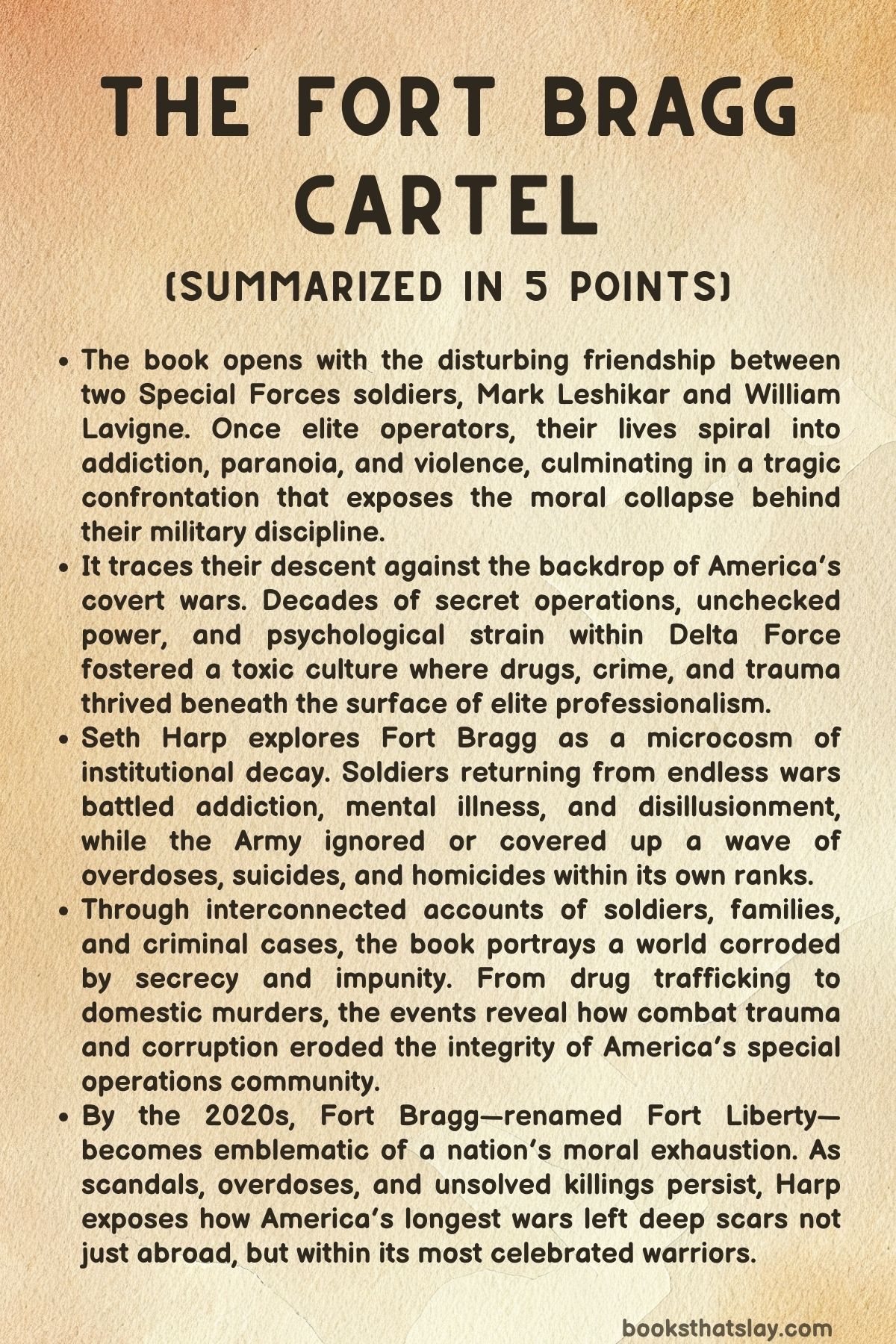
The Fort Bragg Cartel: Drug Trafficking and Murder in the Special Forces by Seth Harp is an investigative chronicle of corruption, addiction, and institutional decay within America’s most elite military community.
Set primarily at Fort Bragg (later renamed Fort Liberty), the book traces how decades of secret wars, drug abuse, and systemic neglect transformed the home of Special Forces into a microcosm of moral and social collapse. Through detailed reporting, Harp exposes the hidden consequences of America’s endless conflicts—how elite soldiers trained for covert warfare became consumed by the very violence and corruption they were meant to fight. It’s both a human tragedy and a revelation of a nation’s militarized underworld.
Summary
The Fort Bragg Cartel opens with a personal tragedy that encapsulates the book’s broader themes of addiction, secrecy, and institutional failure. Two Special Forces soldiers—Sergeant First Class Mark Leshikar and Master Sergeant William Lavigne II—drive home from a chaotic family trip to Disney World in 2018. Both are intoxicated after days of drug and alcohol abuse, with their young daughters in tow.
Leshikar, hallucinating and paranoid, believes they’re being followed. When his delusions spiral into violence, Lavigne shoots and kills him inside his own home. The killing is quickly ruled self-defense despite contradictory evidence, setting the tone for a story about how elite soldiers evade accountability through the protection of powerful systems.
Leshikar’s descent began after his 2017 return from Tajikistan, where he claimed to have been injured in an ambush that the Army later denied. Suffering from mental instability and substance abuse, he turned violent and unpredictable. Lavigne, a Delta Force operator and longtime friend, was also deeply immersed in a life of drugs and secrecy. Their friendship was built on shared trauma and mutual addiction.
Lavigne, who had served across the Middle East and Africa in assassination missions against ISIS, had grown corrupted by years of covert warfare. His home became a hub for soldiers who used cocaine, meth, and MDMA while maintaining their image as elite warriors.
When Lavigne killed Leshikar, the ensuing investigation was shallow and riddled with inconsistencies.
Witnesses and forensic evidence contradicted his version of events, yet military and civilian authorities swiftly ruled it justified. Friends and family members believed the Army covered up the killing to protect one of its own. Lavigne remained in Delta Force, his behavior growing more unstable until his own mysterious death years later.
Harp broadens the lens to trace how this culture of corruption took root. He recounts the creation of Delta Force in 1977 by Colonel Charles Beckwith, modeled after Britain’s SAS. Over time, Delta evolved from an elite counterterrorism unit into an unaccountable global strike force under the Joint Special Operations Command (JSOC).
The wars following September 11 accelerated this transformation. The Bush administration’s open-ended Global War on Terror authorized global assassinations and secret operations, often outside legal oversight.
In Afghanistan and Iraq, Delta Force and SEAL Team Six became central to JSOC’s mission. Under General Stanley McChrystal and later Admiral William McRaven, the U.S. military perfected the “F3EAD” model—Find, Fix, Finish, Exploit, Analyze, Disseminate—creating an endless cycle of raids and killings. Harp reveals how this system, fueled by performance drugs and constant pressure, normalized violence and moral collapse among its operatives. Soldiers returned home desensitized and addicted, carrying the war’s chaos into their personal lives.
Within this world, William Lavigne’s career is emblematic. Joining the Army in 2001, he climbed into Delta Force by 2009, becoming part of JSOC’s most secretive missions. In Iraq and Afghanistan, he participated in targeted killings and black operations.
By 2011, stationed in Afghanistan, he was taking dextroamphetamine to stay awake during prolonged combat. He operated near Tajikistan, guarding U.S. supply routes that also served as heroin corridors—links between military logistics and the global drug trade. Reports suggested American intelligence ignored or even cooperated with traffickers allied to U.S.-backed Afghan officials.
Fort Bragg itself became a symbol of this moral erosion. Harp recounts how soldiers returned from combat with PTSD, addictions, and a sense of impunity.
Murders, overdoses, and suicides rose sharply. In 2002, a rash of domestic killings by returning soldiers shocked the nation, prompting the Army to blame an antimalarial drug rather than acknowledge deeper institutional rot.
The pattern persisted for decades, culminating in a 2020–2025 wave of violence and overdoses.
The narrative interlaces individual stories that expose the broader collapse. Freddie Wayne Huff, a drug dealer suffering from addiction and mental illness, staged violent robberies while posing as a U.S. Marshal, entangling himself with soldiers linked to narcotics trafficking. Specialist Enrique Roman-Martinez, a young soldier exploring psychedelics, vanished during a camping trip in 2020; his decapitated head later washed ashore, yet authorities ruled the case inconclusive. These incidents highlight a culture where drugs, secrecy, and impunity merged.
Domestic violence cases further revealed institutional neglect. Keith Lewis, a steroid-abusing veteran, murdered his pregnant wife and then killed himself after repeated pleas for protection were ignored. Fort Bragg’s leadership seized evidence from the scene, allegedly to hide widespread steroid trafficking among special operations troops.
Harp uses such cases to illustrate how systemic corruption and indifference perpetuated the cycle of abuse and death.
Between 2018 and 2025, more than a hundred soldiers at Fort Bragg died—mostly from overdoses and suicides, not combat. Fentanyl became the deadliest threat, while cocaine and methamphetamine circulated through the ranks.
The base’s rate of death far exceeded national averages. Commanders attempted reforms through drug tests and arrests, but these efforts failed to curb the crisis. Soldiers described the environment as hopeless, their trust in the institution eroded.
The Army’s indifference contrasted sharply with the magnitude of the problem. Families accused officials of cover-ups and neglect. Meanwhile, high-ranking soldiers involved in trafficking often avoided serious punishment, while lower ranks faced harsh consequences.
The base also saw murders tied to addiction and mental illness, such as Delta veteran David Jensen killing his wife and dog before turning the gun on himself.
Harp connects these tragedies to the broader disillusionment following America’s withdrawal from Afghanistan. Soldiers from Fort Bragg were among the first to invade and the last to leave, only to watch the Taliban reclaim control.
The failed mission symbolized two decades of wasted lives and moral corrosion. When the Taliban banned opium cultivation after the U.S. withdrawal, it ended the heroin trade that had thrived under occupation—a grim irony highlighting America’s role in enabling global narcotics networks.
By 2023, congressional investigations began examining suicides and drug trafficking at Fort Bragg, while the Army renamed the base Fort Liberty to distance it from scandal. Yet the chaos persisted: murders, overdoses, and corruption continued unabated.
In 2024, several soldiers were caught smuggling narcotics and weapons internationally. The same year, the FBI charged a man named Kenneth Quick Jr. with murdering Lavigne and another ex–Green Beret, Timothy Dumas, allegedly over cocaine disputes. Many suspected Quick was a scapegoat, while evidence—including Dumas’s supposed blackmail letter exposing a military drug ring—disappeared from police custody.
By 2025, Fort Liberty remained mired in violence, addiction, and institutional denial. Over 15,000 service members across the U.S. military had overdosed since 2017, with Fort Bragg leading in deaths.
Two former soldiers carried out domestic terror attacks that year, underscoring the spread of militarized violence into civilian life. As the political climate shifted, former Green Berets and media figures sympathetic to the military’s darkest legacy gained power. One of their first acts was to restore the name Fort Bragg—symbolically reviving a place long defined by war, secrecy, and corruption.
Through exhaustive reporting, The Fort Bragg Cartel exposes the unseen costs of America’s forever wars.
It reveals how an elite culture of secrecy and violence, once justified by patriotism, corroded from within—leaving a trail of broken soldiers, grieving families, and institutions unwilling to confront their own decay.
Key People
Sergeant First Class Mark Leshikar
A once disciplined Green Beret, Mark Leshikar is portrayed as a man hollowed out by war, addiction, and institutional abandonment. His identity fractures after the denied Tajikistan ambush claim and worsening neurological and psychological symptoms; the refusal of recognition becomes the fuse for self-medication that mutates into dependency.
Friends remember bravado and cruelty—a man who boasted of atrocity footage—yet the portrait is ultimately tragic: a soldier unable to reconcile battlefield conditioning with domestic life, spiraling into paranoia that culminates in the chaotic night of his death.
As a father, he is present enough to celebrate a shared Disney trip yet too consumed by delusions to keep his daughter safe; as a comrade, he is both magnetized to and endangered by William Lavigne’s orbit. Leshikar embodies how elite training without care pathways can yield volatility, not valor, when the war comes home.
Master Sergeant William “Billy” Lavigne II
William Lavigne is the charismatic apex operator whose competence masks corrosion. Rising to Delta Force by 2009 and steeped in clandestine raids, he emerges as both consummate professional and corrupted ringleader, a man who turns his Fayetteville home into a nexus for elite soldiers’ drug binges. The narrative presents him as cool under pressure yet ethically unmoored: his shifting accounts after shooting Leshikar, the removal of evidence by an ally, and the seamless deference he receives from local authorities all signal power without accountability.
Lavigne’s drug use—ranging from cocaine to heroin and MDMA—intertwines with performance enhancement and operational tempo, revealing a soldier who cannot step off the throttle even stateside. He personifies the moral slippage of covert warcraft, where the skill to “finish” targets metastasizes into impulsive domestic violence cloaked as self-defense.
Master Gunnery Sergeant Jens Merritt
Jens Merritt functions as the quiet fixer inside the special operations fraternity. Summoned by Lavigne during the crisis, he becomes an accessory to the narrative’s murk by removing Leshikar’s phone before investigators can secure it, a small act with large symbolic weight.
His role illustrates the informal networks that protect reputations and shape official stories, where loyalty to the unit supersedes duty to the law. Merritt is less a fully sketched personality than a mechanism of impunity, emblematic of operators who manage fallout rather than confront wrongdoing.
Laura Leshikar
Laura is the bereaved spouse who must translate institutional opacity into human terms for a child and a family.
Her arc is defined by persistence against a wall of euphemisms—self-defense rulings, credibility assessments, and bureaucratic non-answers—while she insists on the plain truth of what her daughter saw. She is not depicted as naïve; rather, she becomes the moral counterweight to the operators’ code of silence, sustaining the claim that justice was foreclosed by status and connections.
Laura’s presence reframes the story from a tale of wayward soldiers into a domestic tragedy sustained by institutional choices.
Tammy (Mark’s mother)
Tammy widens the lens from a spousal grievance to a family’s reckoning with systems that absorbed her son’s best years and then discarded his worst. Her confrontational stance toward authorities underscores a theme of dignity denied: that grief, without transparent accounting, hardens into an accusation of cover-up.
She represents the downstream costs of opaque military justice and the social labor families perform to keep dead sons from being reduced to “cases.”
Nicole (Mark’s sister)
Nicole’s brief appearance—nearly assaulted during one of Mark’s binges—captures the proximity of loved ones to the blast radius of addiction and untreated trauma.
She stands at the boundary between familial loyalty and personal safety, a reminder that the line separating “war story” and domestic violence is often crossed long before headlines are made. Her experience adds texture to Mark’s unraveling by grounding it in domestic space, not just deployments.
Delta Force and JSOC (the institution as a character)
Across The Fort Bragg Cartel, the institution is rendered as a sovereign ecosystem: selective, hyper-competent, and increasingly unaccountable. Born from counterterror ambitions and refined through the F3EAD kill-chain, it professionalizes speed, secrecy, and lethality while externalizing moral cost. Performance enhancers, sleep aids, and stimulants become operational tools; impunity—legal, cultural, and reputational—becomes a force multiplier.
The institution’s shadow looms over every individual arc, shaping behaviors by incentivizing results and tolerating off-book economies, from stolen funds to drugs. The net effect is to make the organization feel like the most dominant “character,” one that scripts the others’ choices even when it is offstage.
General Stanley McChrystal
McChrystal appears as the architect of scale, transforming targeted raids into an industrialized night-war.
His leadership amplifies the intelligence-raid feedback loop and normalizes a tempo that blurs risk assessment, due process, and civilian protection. Publicly strict yet operationally permissive, his tenure exemplifies how narrative control—about “al-Qaeda in Iraq,” about rules of engagement—can sanctify practices whose ethical costs surface years later in the soldiers who carried them out.
Admiral William McRaven
McRaven inherits and globalizes the apparatus, channeling it into signature missions while maintaining institutional mystique. The book situates him in a paradox: public acclaim for high-visibility successes alongside allegations of routine brutality in units under JSOC’s umbrella.
He functions as the brand manager of covert war, demonstrating how prestige can deflect scrutiny and preserve the system’s continuity regardless of administration.
Freddie Wayne Huff
Huff is a civilian mirror of the military’s drug-violence nexus: debilitated by illness and addiction, he adopts tactical cosplay—fake marshal gear, staged abductions—to enforce debts and wage personal vendettas.
His schemes are both ruthless and hapless, culminating in crimes that expose a broader cocaine economy touching soldiers and local actors alike. When the state clamps down, he claims theft by police and hints at military drug rings, positioning himself as both perpetrator and unreliable whistleblower.
Huff’s volatility underscores how the tactics and aesthetics of special operations bleed into regional criminality.
Rosado and Deriggs
As Huff’s confederates, Rosado and Deriggs are opportunists who operationalize intimidation by appropriating law-enforcement theater. They help convert private grudges into paramilitary kidnappings, demonstrating how authority can be mimicked and monetized. Their presence keeps the focus on networks rather than lone wolves, where loyalty is transactional and risks are socialized across a crew.
Hundred K and Tomont “Rise” Williams
The rapper Hundred K and his lieutenant Rise are nodal points in a parallel economy where reputation, cash, and narcotics circulate at speed.
Their interactions with Huff—extortion paid, silence purchased—show how violence can be managed as a cost of doing business until someone miscalculates.
Rise’s abduction dramatizes the permeability between performance culture and real coercion, while Hundred K’s compliance shows the leverage created by credible threats, even when staged by amateurs.
Michael Sosa and Steven (supplier)
Sosa and Steven anchor the supply chain that ensnares Huff’s crew, bringing the story back to product, provenance, and payback. Sosa’s flashy lifestyle makes him both target and signal—advertising liquidity invites predation—while Steven’s creditor role keeps pressure constant.
Together they illustrate how cocaine disputes cascade into home invasions and betrayals, tying neighborhood addresses to transnational routes suggested elsewhere in the book.
Specialist Enrique Roman-Martinez
Roman-Martinez is the story’s most haunting victim: a curious, gentle seller of psychedelics who becomes a cipher for institutional failure. His decapitation, forensic contradictions, and the campers’ synchronized silence create a void that investigative agencies fill with delay and implausible hypotheses.
He is neither operator nor criminal kingpin; his death exposes how a base inured to catastrophe can normalize the unthinkable through administrative drift. Roman-Martinez’s legacy in the narrative is a demand for humility: when facts are uncertain, process must be unimpeachable—here it is not.
Keith Lewis and Sarah Lewis
Keith Lewis embodies a different trajectory of war’s return: steroid-fueled rage, untreated trauma, and domestic homicide followed by suicide.
Sarah’s repeated attempts to secure protection and the system’s nonresponse indict a command climate that treats warning signs as paperwork rather than emergencies.
After the murders, the alleged rush to seize devices to protect reputations suggests that truth management eclipses victim care. Together they represent the family-level endpoint of institutional neglect.
Chief Warrant Officer Timothy Dumas
Dumas threads the operator economy with whispers of graft and narcotics logistics. Questioned about theft and contracting fraud, he reportedly drafts a blackmail-like exposé of a Special Forces drug ring that later disappears into evidentiary limbo. His later death alongside Lavigne, and the contested narrative of culpability, places him at the crossroads of rumor, risk, and potential whistleblowing.
Dumas symbolizes the peril of knowing too much in an ecosystem that rewards silence.
Master Sergeant Martin Acevedo
Acevedo personifies the normalization of deviance: caught trafficking cocaine, he pleads guilty yet returns to active duty within months. His case underscores the book’s central contention that elite status can alchemize felonies into career speed bumps.
The signal to the ranks is corrosive—rules are flexible for those deemed operationally valuable—further entrenching a culture of corners cut and debts ignored.
David Jensen
Jensen’s murder-suicide is one of several grim markers in the timeline that the text alleges were quietly minimized.
As a Delta veteran, his case reinforces the theme that the violence honed overseas can reappear domestically with catastrophic intimacy. The quiet handling of the incident becomes part of the book’s broader claim: that reputational risk management often takes precedence over transparent accountability.
Staff Sergeant Ryan Knauss
Knauss is presented as the exception that proves the rule: the year’s only combat death amid a sea of domestic losses.
His death during the Kabul airport bombing compresses twenty years of deployments into a final, chaotic coda, contrasting battlefield sacrifice with the home-front decay consuming his peers. He becomes a somber hinge between the wars’ public heroism and their private wreckage.
General Chris Donahue
Donahue appears at two symbolic moments: the last soldier to depart Afghanistan and the officer presiding over Fort Bragg’s renaming to Fort Liberty.
In both, he serves as custodian of narratives—closure abroad, renewal at home—yet the text portrays these gestures as cosmetic against unresolved overdoses, suicides, and homicides. His presence highlights the gap between ceremonial change and material reform.
Charles Crooks
Crooks’s mid-air death—ruled accidental—introduces an eerie resonance with the base’s history of clandestine flights and smuggling corridors. Whether or not connected to wrongdoing, the incident accrues meaning in context; it is another improbable tragedy in a place saturated with them. Crooks functions less as a culprit or victim than as a symbol of how even training spaces feel haunted by risk and rumor.
Kenneth Quick Jr.
Quick is the convenient antagonist in the late-stage resolution of the Lavigne-Dumas homicides, charged as the killer in a cocaine dispute.
The text records skepticism from families and observers who see scapegoating rather than closure, especially amid vanished evidence and unpursued leads. Quick’s role underscores how prosecutions, absent trust, can read as narrative management rather than justice rendered.
Analysis of Themes
War-Bred Corruption and Institutional Rot
On the surface, the narrative tracks a few sensational crimes, but the deeper current is the corrosion that long wars inflict on the institutions meant to fight them.
In The Fort Bragg Cartel, the special operations enterprise is shown accruing extraordinary latitude over two decades, from early counterterror raids to globe-spanning kill-capture missions.
That latitude fosters habits—secrecy, self-justification, contempt for oversight—that migrate from the battlefield to garrison life. Command climates become calibrated to output metrics and public image rather than law and ethics; leaders praise operational tempo while quietly absorbing misconduct as the cost of doing business. The result is an organization that protects itself first.
Homicides, overdoses, and trafficking allegations are framed as anomalies, then downplayed, then administratively mummified. Investigations stall or narrow; unflattering evidence goes missing; implausible narratives are allowed to stand because they shield reputations and programs. The book’s throughline is not a few bad actors but a reliable process by which systems defend their prerogatives, even when lives are shattered.
That process hardens during the Global War on Terror, when speed and deniability are prized, and it lingers afterward as a default reflex. Soldiers carry home battlefield methods—rapid targeting cycles, euphemisms for lethal force, flexible definitions of threat—and leadership carries home the habit of classifying problems out of view.
The base becomes a microcosm of imperial overreach: sprawling, unaccountable, and numb to the human damage it generates. Rot, here, is not sudden collapse but a slow normalization of the unacceptable, until overdoses and unsolved killings are treated as unfortunate background noise rather than alarms demanding structural change.
Addiction as Operational Byproduct and Black-Market Engine
The book treats drug abuse not as a side plot but as the bloodstream of the world it depicts.
Amphetamines, opioids, benzodiazepines, cocaine, MDMA, and steroids move through teams as performance aids, anesthetics, and off-duty escapes. Combat rotations encourage pharmacological solutions to exhaustion and fear; prescriptions sanction focus and wakefulness; downtime expands those edges into dependency.
When the official pipeline meets the illicit market, boundaries blur. Soldiers learn supply chains and smuggling routes in theater, then encounter parallel routes at home; the skills that make them exceptional—planning, deception, logistics—map neatly onto criminal enterprise. Addiction is thus both symptom and accelerant: it begins as self-medication for trauma or tempo, becomes a social glue among operators, and ultimately powers trafficking rings that exploit access, impunity, and cash.
The narrative insists on this continuity by showing drugs at every junction: in elite quarters where raids are planned, in family trips where paranoia erupts, in barracks where counterfeit pills kill, and in investigations where evidence disappears. Overdoses are not random misfortunes but the foreseeable outcome of a culture that monetizes endurance and treats bodies as expendable platforms.
Even reformist gestures—dogs at gates, surprise urinalysis, stern memos—function as theater when the core economic and psychological incentives remain intact. In The Fort Bragg Cartel, drugs are a language the institution speaks fluently, whether to stay awake for another raid, to quiet a mind that will not sleep, or to turn war-forged logistics into stateside profit. The market thrives because the need is real and because oversight prefers the appearance of discipline to its disruptive practice.
Trauma, Paranoia, and the Domestic Afterlife of War
Combat does not conclude when a deployment ends; it relocates.
The narrative tracks how blast injuries, moral injury, sleep deprivation, and stimulant cycles rewire perception and impulse control. Hallucinations on a highway, violent outbursts at home, and hair-trigger responses to imagined threats are presented not as isolated breakdowns but as predictable outcomes of years spent in environments where vigilance is rational and aggression is rewarded. The family minivan becomes a mobile checkpoint; a front door becomes a breach point.
Children, spouses, siblings, and neighbors inherit the war’s half-life, living with men who are simultaneously highly trained and increasingly unmoored. The book is unsparing in showing how trauma’s symptoms—paranoia, dissociation, depression, and dependence—interlock with institutional patterns. When leaders minimize or medicalize the problem without resourcing sustained care, service members drift toward self-treatment and peer circles that normalize intoxication and risk.
Domestic violence, suicides, and confused shootings grow in the shadow of unprocessed experiences. Investigations that focus on immediate circumstances—Was there a weapon?
Was there a break-in?—often ignore the long build-up, the prior seizures, the sleepless months, the cocktail of prescriptions and powders.
In The Fort Bragg Cartel, trauma is not only the backdrop but the medium of the story: it explains why men who can clear compounds fall apart in kitchens, why friends become enemies in seconds, and why entire units quietly accept that the war’s casualties will continue at home. The tragedy is that help exists in fragments—therapy slots, chaplains, peer support—but the operational culture discourages vulnerability, and the bureaucracy prefers clean narratives to messy healing.
Impunity, Cover Stories, and the Politics of Narrative
A recurring pattern structures the book: an event erupts, an official story congeals, and contradictions are smoothed until they lose bureaucratic traction. Self-defense claims stand despite forensic anomalies; missing phones and thumb drives are treated as footnotes; shifting testimonies receive respectful deference instead of aggressive cross-checks.
The mechanics are mundane—jurisdictional handoffs, career incentives, PR sensitivities—but the effect is profound. Once an agency frames a case, the frame hardens into doctrine; to challenge it is to question allies, embarrass commanders, and risk exposing a broader scandal.
The narrative also shows how public mythmaking overlays operational ambiguity. During the war years, slogans about precision and professionalism mask body counts driven by thin intelligence and permissive definitions of targets. Afterward, memorial ceremonies and base renamings gesture toward virtue while families contend with unanswered calls and sealed records.
The book’s title evokes a criminal syndicate, but its sharper critique targets a culture of story management: leaks that shape press cycles, euphemisms that sanitize killing, and legal outcomes that align conveniently with institutional interests. In The Fort Bragg Cartel, truth is not decided by evidence alone but by which facts an institution is willing to acknowledge and escalate.
That politics of narrative rewards silence, isolates whistleblowers, and convinces many grieving relatives that they are fighting not for justice but for the right to be heard against a machinery built to outlast them.
Friendship, Loyalty, and the Slide from Bond to Betrayal
Elite units cultivate powerful bonds. Shared danger, competence, and secrecy build a sense of chosen family that can sustain people through unbearable stress.
The book honors that reality while tracing how those same bonds can enable decline. Friends cover for binges, rationalize lapses, and offer access to substances that promise relief. Loyalty becomes a shield against accountability; an operator’s status at the pinnacle of his craft grants him second, third, and fourth chances that a junior soldier would never receive.
The friendship at the heart of the story—men who trained, partied, and parented alongside one another—exposes the thin line between caretaking and complicity.
Attempts to calm a spiraling comrade morph into justifications for reckless decisions; confidences about pain become operational knowledge about vulnerabilities; the trust that once kept teammates alive on target enables fatal choices at home. Families stand just outside this circle, simultaneously grateful for the brotherhood and terrified by its power to override common sense. When catastrophe arrives, those same loyalties harden into synchronized accounts, selective omissions, and an instinct to protect the group from outsiders.
In The Fort Bragg Cartel, betrayal does not erupt in a single treacherous act; it accumulates as friends fail, repeatedly, to set boundaries, to insist on treatment, to tell the unvarnished truth when it matters most. The moral ache of the narrative lies in watching a camaraderie forged for mission success become the conduit through which addiction, paranoia, and violence pass unchecked until a child’s scream or a mother’s eulogy marks the awful endpoint.
Shadow Warfare, Democratic Oversight, and the Elasticity of Law
The architecture of modern special operations rests on authorities that expand in crises and rarely contract afterward.
The book traces how global manhunting frameworks—fueled by executive findings, classified annexes, and partner-force arrangements—create a parallel foreign policy with its own tempo and logic. Raids surge, target lists swell, and battlefield geographies stretch from valleys to continents, while public debate lags behind acronyms and briefings few civilians ever see. Inside that architecture, legal categories become flexible. “Combatant” and “supporter” are stretched to fit operational needs; “self-defense” is invoked in contexts far from front lines; and secrecy forecloses adversarial testing of claims.
Such elasticity does not stay abroad. At home, gate guards, prosecutors, and commanders inherit the habit of resolving risk through authority rather than persuasion. The same confidence that enables door-kicks at night encourages officials to treat messy deaths as administrative problems to be closed, not puzzles to be solved. In The Fort Bragg Cartel, this is not an abstract civics lesson but a practical chain of cause and effect: when a society sustains shadow wars for years, it normalizes exceptional powers and grows used to their shortcuts.
Congressional oversight appears episodically, usually after sensational headlines, and reforms address symptoms rather than the enabling structure.
The book argues—by accumulation of cases—that restoring genuine accountability requires narrowing authorities, protecting investigators from command pressure, and insulating evidence from units with reputational stakes. Without that, law remains pliable for the powerful and brittle for the bereaved.
Civic Collateral: Families, Communities, and the Cost of Silence
Beyond units and operators, the text keeps returning to those who must live with the aftermath: daughters who witness shootings, spouses who plead for help against escalating violence, parents who organize funerals while learning a lexicon of autopsy terms they never wanted to know.
Fayetteville and surrounding towns absorb the unpredictability of men cycling on and off deployments and substances, of investigations that go nowhere, of press conferences that promise change without delivering it. Civilians become unwilling extras in a war that never ends—drivers on highways with covert checkpoints in the mind, neighbors adjacent to houses that double as party barracks, hospital staff working overdose after overdose from a single installation. The civic fabric frays as rumor outruns fact and cynicism settles in.
When bases are renamed or commanders rotate, the ordinary mechanisms of closure—truthful timelines, transparent findings, sincere apologies—are notably absent.
Community trust, once lost, becomes hard to rebuild, and the institutions that depend on it resort to more security instead of more honesty. In The Fort Bragg Cartel, the quiet victims are those who are asked to move on without answers. The book amplifies their testimonies to show how the price of institutional self-protection is paid in living rooms and courtrooms far from classified briefing rooms.
It suggests that genuine repair begins not with new slogans or tightened gates but with a moral recalibration: to count every overdose, to investigate every death with stubborn rigor, and to treat grief not as a public relations challenge but as a mandate to tell the truth and break harmful patterns.