The Gallagher Place Summary, Characters and Themes
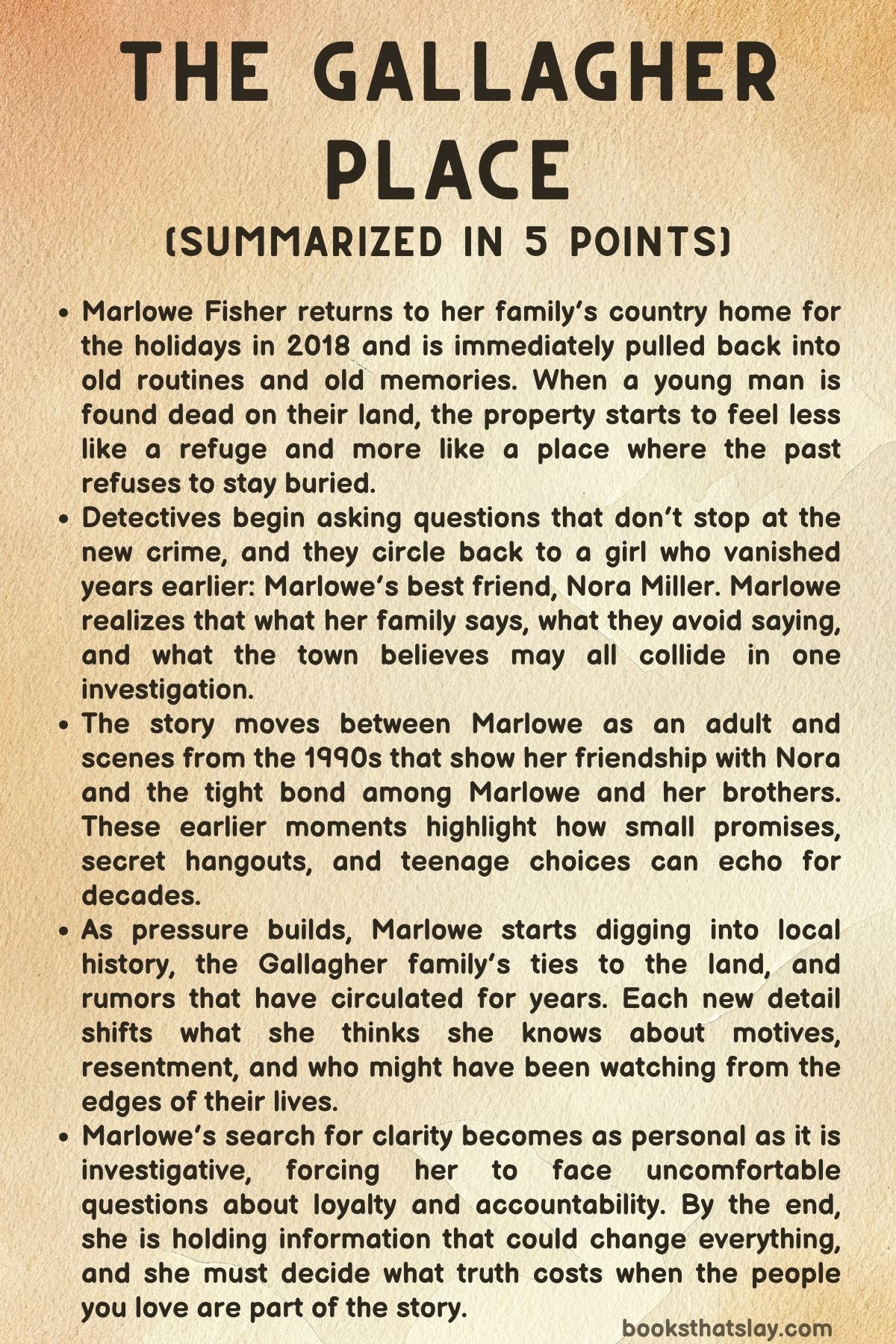
The Gallagher Place by Julie Doar is a dual-timeline mystery about what families bury—literally and emotionally. Marlowe Fisher returns to her parents’ country home for Thanksgiving in 2018, only for a dead man to be found on their land.
The discovery reopens an older wound: the disappearance of Marlowe’s best friend, Nora Miller, decades earlier. As police questions tighten and old memories sharpen, Marlowe begins digging through local records, rumors, and her own past. The book follows her growing certainty that the place she loves is also the place where the truth has been waiting.
Summary
Marlowe Fisher’s relationship with her family’s country property begins with beauty and fear. As a teenager, she lies awake in her room staring into the darkness outside the Gray House, studying the red barn across the road and imagining someone hidden inside it.
The land feels familiar, yet never fully safe, and even her drawings can’t settle the unease that settles in her body when the woods go quiet.
Years later, on the morning after Thanksgiving 2018, Marlowe is back at the Gray House for the annual family gathering. She’s thirty-six now, an illustrator with a life elsewhere, but the holiday routine pulls her into the old patterns: her parents’ strict schedules, the crowding of family in every room, and the way the house seems to hold its own rules.
Before the day begins, she joins her brothers, Nate and Henry, for a long walk they’ve taken since they were kids. They move through the cold fields and familiar landmarks—the Rise, the Flats, the gully of trees—toward the river bend where they used to swim in summer.
In the open field near the river, they notice a sagging tent. At first it seems like a hunter’s shelter, but the closer they get, the more wrong it feels.
Henry unzips the flap, and a dead man’s head drops into view. The body is clearly injured, the skull cracked from a heavy blow.
Shock splinters the moment: Nate turns away, Henry stumbles back, and Marlowe can’t stop looking. With no phone service where they are, they run to the house and call police.
Their family reacts in fragments—children distracted, adults trying to control the chaos, and Marlowe caught between the present horror and older memories that the land never lets her forget. When officers arrive, the area is taped off, photographs taken, and detectives summoned.
Soon the victim is identified: Harmon Gallagher, a young man connected to the Gallagher family that once owned the neighboring farm and the red barn. Marlowe learns Harmon had been pushing to buy the old Gallagher land back and had pressured Frank Fisher, her father, for years.
Detectives Ben Vance and Ariel Mintz begin building a timeline and taking statements. Frank admits Harmon contacted him repeatedly, and that he once met him to tell him to stop.
He also admits seeing someone in the woods at one point and assuming it might have been Harmon, though he never reported it. The detectives question each family member, mapping the property and tracking movements from the night before.
When Marlowe gives her statement, Ben suddenly asks about a missing girl from years ago. The name lands like a bruise: Nora Miller, Marlowe’s best friend, who vanished when they were teenagers.
As the investigation continues, the book shifts between the present case and Marlowe’s past with Nora. In the mid-1990s, the Gray House and the Gallagher barn are the center of the kids’ world.
Marlowe and Nora hide in the barn’s hayloft, sharing stolen makeup and secrets, claiming the loft as a private space where they can talk without being watched. The barn is also where the children build their games and myths, including a story about a shadowy figure in the woods they call Mr. Babel—a name that begins as invention and later becomes something far more unsettling.
In 2018, the homicide pulls the Fisher family into pressure they’ve tried to avoid. Marlowe’s brothers reveal the family has received anonymous threats over time—letters and messages accusing them of wrongdoing and promising punishment, including a threat that their house will burn with them inside.
The family assumed Harmon was behind the threats, using fear to force Frank to sell. Police later confirm the threats trace back to Harmon.
Even so, the language of the threats and the resurfacing of Nora’s name make Marlowe feel as if the past is climbing out of the ground.
Marlowe begins investigating on her own. She searches Harmon online and learns about his mother, Layla Gallagher, then starts looking into the Gallagher family history and how it connects to the land Frank bought.
She walks the old paths, touches the barn door, and remembers the Gallagher brothers—Tom, Dave, and Leroy—and how their family once filled the fields around her childhood. The woods stir up the old fear of being watched and the old guilt of Nora’s absence.
When Ariel and Ben return, they share basic findings: Harmon was killed between midnight and 3 a.m. on November 23 by blunt force trauma.
Ariel takes Marlowe outside and presses her about the old Gallagher property and the disappearance of Nora Miller. Marlowe recounts what she has always said happened: during an early-summer gathering with older boys and drinking, Nora stepped outside around midnight to take out the trash and never came back.
They noticed quickly and woke the adults, and the search began. Ariel also mentions rumors that have long circulated, rumors that tie the Fishers and the Gallaghers to Nora’s disappearance.
Marlowe insists her family lied about nothing, but she can feel how the detectives are weighing the family’s closeness and the old case’s gaps.
After that visit, Marlowe receives a packet of notes from the original investigator, John Brierley. Reading them in the basement bedroom, she’s jolted by how suspicious he was of the teenagers, especially Nate and Henry.
He believed they were hiding something and saw Henry’s friend Liam as a possible weak link. The notes question the “trash” story and even raise the possibility that Nora had a secret relationship or a pregnancy.
Worst of all, Brierley’s notes mention Mr. Babel—proof that her brothers told police the figure was real, not a childhood story, and that they used it to distract attention.
Marlowe’s private search widens. She speaks to people from the past, including Sean Hastings, who still blames the Fisher family and reveals Nora had a sexual relationship he never told Marlowe about.
Marlowe attends Harmon’s wake and meets Caroline Rodine, an older woman with ties to the Gallagher property. Caroline talks about curses and a troubled Gallagher past, but she also confirms something practical: a man named Pete Gallagher was obsessed with the farm and never forgave the sale.
When Marlowe raises Pete with the detectives, Ariel insists Pete died years earlier and dismisses him as an unreliable drunk, but Marlowe remains convinced the official story has missed what mattered.
Then the murder case shifts: police arrest Rick Frasier after finding bloody clothes and a motive tied to money and a failed deal. Harmon’s death begins to separate from Nora’s disappearance, at least on paper.
But for Marlowe, the land doesn’t separate anything. The place remembers.
Driven by a need she can’t quiet, Marlowe walks out into the snowy fields alone, crossing familiar routes away from the river and toward an old stone wall the children once built together. The wall has always been a symbol of their shared work, their friendship, and their secret vows to protect one another.
In a sudden act of certainty, she begins pulling stones from its center. Buried inside, she finds black canvas, rotting denim, a small boot, and bone.
Nora has been there the whole time, hidden in the wall for decades. The discovery changes everything.
Nora wasn’t taken by a stranger in a sudden attack; she must have known the person she met near the house that night.
Nate arrives and sees what Marlowe has uncovered. Under pressure, he confesses pieces of what he believes happened.
He says Nora told them she was pregnant, and he panicked, going to their father for help. He insists he didn’t kill her and then says the pregnancy claim was tied to Henry, not him.
He describes fear, secrecy, and Enzo’s role as the fixer who made the problem disappear. His version suggests an accident after a confrontation, followed by a cover-up meant to protect the family.
Marlowe, stunned and sick with it, goes back to the house and confronts Enzo, the longtime handyman who has been part of their lives as long as she can remember. Enzo, near the end of his life, becomes lucid and tells her what actually happened.
He confirms that Nora and Henry were involved and that the “pregnant” claim threw the household into crisis. Enzo tried to speak with Nora first, but the real confrontation came from Glory, Marlowe’s mother.
Glory went outside while the others were distracted and confronted Nora near the trash cans, offering money for a procedure and money to make the problem go away. The argument turned violent.
Nora attacked Glory, and Glory pushed her. Nora fell backward, hit her head, and died.
Enzo describes the immediate aftermath in stark detail: Glory came to the basement and told him what had happened. Nora’s body was placed in a large bear-proof trash bin.
Enzo checked for a pulse, confirmed she was dead, and moved the bin to the Gallagher barn, hiding it behind a trough. While the house erupted into frantic searching, Enzo used the chaos to move Nora again—fetching a tarp, tearing open the stone wall, placing her inside, and rebuilding the stones before dawn.
The sealed bin prevented dogs from tracking scent at the barn during the initial search. The lie held, and life continued above the hidden body.
When Marlowe leaves Enzo’s room, she finds Glory listening, confirming it in her own words as a bad fall, something that ruined lives in a moment and then forced years of pretending. Marlowe is left facing a choice: tell the detectives and expose what her family did, or keep silent and protect the house, her parents, and the fragile structure her family still lives inside.
In December 2018, Marlowe drives to Poughkeepsie with Brierley’s notes and the weight of the truth. She returns the notes to Ariel but denies knowing anything else.
She chooses silence—for now—carrying both Nora’s memory and the knowledge of what happened at the Gray House, in a place that never stopped holding the evidence.
Characters
Marlowe Fisher
In The Gallagher Place, Marlowe is the emotional center of the story and the character through whom the past and present constantly collide. As a teenager, she is observant, imaginative, and deeply sensitive to place; her drawings and invented myths are not just hobbies but a way of translating fear into something she can hold at arm’s length.
That creative instinct follows her into adulthood as an illustrator, but it also becomes a kind of trap: she notices too much, remembers too sharply, and cannot stop revisiting the same images until they yield meaning. The discovery of Harmon Gallagher’s body forces her into a familiar posture—watching, absorbing, trying to decode danger—yet now the danger is not a shadow in the woods but the possibility that her own family’s story has been built on deliberate concealment.
What defines Marlowe most is her layered guilt: survivor guilt for living while Nora vanished, moral guilt for the relief she once felt when the searching ended and life resumed, and then a colder, adult guilt when she realizes silence might be a choice rather than an accident. Her final decision to withhold the truth from the detectives is not presented as simple loyalty or cowardice; it reads as Marlowe accepting that the Gray House, her family identity, and her idea of childhood safety were purchased with a hidden body, and that revealing the truth would not only expose a crime but also dismantle the emotional architecture of everyone she loves.
Nora Miller
Nora, in The Gallagher Place, is both vividly present in memory and structurally absent in reality, which makes her function like a gravitational force rather than a conventional character who gets to evolve on the page. In Marlowe’s recollections, Nora is bold, catalytic, and hungry for experience, the friend who turns boredom into adventure and secrecy into intimacy, whether that means claiming spaces like the hayloft, painting symbols on cows, or pushing Marlowe toward acts that feel thrilling precisely because they flirt with consequences.
At the same time, the later revelations complicate any temptation to canonize Nora as an innocent symbol of lost girlhood. She is shown as someone navigating adolescent power in a world that offers her few clean options, and her relationships—especially the hidden involvement with Henry and the pregnancy claim—place her at the intersection of desire, desperation, and leverage.
What makes Nora so haunting is that she seems to have known the person she met at the trash cans; her death is not the result of a faceless monster but of a private conflict that turned bodily, fast, and final. Nora becomes the story’s moral mirror: everyone remembers her in the way that protects them most, and the truth of what happened is less about who Nora “really was” than about how her presence threatened the Fisher family’s need for order and control.
Nate Fisher
Nate is cast in two timeframes that reveal a consistent instinct: he becomes the family’s practical protector, but his protection often depends on containment rather than honesty. As a teenager, he is the older brother who helps set the tone of daring—sneaking back to the Bend, turning fear into bravado, policing what gets told to adults—yet he is also the one who later pulls Marlowe out of collapse by giving her a different kind of escape, a night in the city where she can feel untouchable for a moment.
That duality matures into adulthood as controlled competence: he makes calls, takes charge when the body is found, and tries to steer the family through crisis without letting emotion rupture the surface. His confession at the stone wall shows that his defining trait is not cruelty but panic paired with loyalty to a closed system.
He is capable of telling Marlowe the devastating facts, yet he frames them in a way that preserves a hierarchy of priorities—family stability first, truth second, justice last. Nate’s moral tragedy is that he has lived for years with a version of events that still exonerates him emotionally, even as it implicates him ethically; he did not kill Nora, but he helped build the silence that made her disappearance a permanent wound for everyone else.
Henry Fisher
Henry embodies the story’s idea that secrecy is not just something people keep but something that shapes them. In childhood scenes, he is part of the quartet’s shared rituals and conspiracies, a boy who belongs to the same bright, reckless orbit as Nate, Marlowe, and Nora.
As an adult, he appears more anxious and tightly managed, the brother who draws maps for detectives, worries about Enzo, and seems to feel pressure without always naming its source. The later disclosure that Nora was sleeping with Henry reorients his entire character: he becomes the hidden hinge of the original tragedy, not because he intended harm, but because adolescent intimacy collided with adult fear and family control.
What sharpens Henry’s portrait is how insulated he remains from the full truth; Nate insists Henry never knew what really happened, which means Henry’s life may be built on a lie told partly to protect him and partly to preserve the family’s public innocence. In that way, Henry is both victim and catalyst—someone whose choices mattered, whose knowledge was manipulated, and whose adulthood is haunted by an absence he may not realize was engineered around him.
Frank Fisher
Frank represents patriarchal steadiness that can turn into moral evasion when threatened. He runs the Gray House as a domain of routines and boundaries, and he appears to value control, reputation, and the management of risk, whether that risk is a dead body on the land or the reopening of a disappearance that never truly closed.
His interactions with the detectives suggest a man skilled at presenting reasonableness while withholding vulnerability, someone who treats investigation as a nuisance to be handled through authority, connections, and narrative discipline. Frank’s involvement in the original Nora crisis is portrayed through what others bring to him: Nate comes to him for a “rational solution,” and Frank’s devastation after Nora’s death is real, but it does not translate into confession or accountability.
Even his later expression of love to Marlowe lands ambiguously, as if affection and absolution are being offered in the same breath. Frank is not written as an obvious villain; instead, he is the kind of figure whose commitment to family can be used to justify silence, and whose belief in order becomes the mechanism by which disorder is buried—literally and emotionally.
Glory Fisher
Glory is the story’s most unsettling portrait of love fused with control. In the present timeline, she maintains strict household routines and rules that make the Gray House feel simultaneously cherished and suffocating, and her parenting style reads as vigilance shaped by fear—fear of danger, fear of disorder, fear of what the outside world can do to her children and what her children can do to themselves.
The flashbacks show how quickly her worry becomes punishment and how easily she frames adolescent secrecy as betrayal, which foreshadows the catastrophic moment when she confronts Nora. Her confession that Nora’s death was “a bad fall” reveals the central mechanism of Glory’s self-justification: she translates violence into accident, intention into necessity, and moral responsibility into domestic cleanup.
The detail that she still transferred the trash before acting underscores something chillingly consistent about her—she responds to crisis by restoring order first, even when the crisis is a dying girl. Glory’s character forces the novel’s hardest question: how much harm can be committed in the name of protecting a family, and how long can a person live inside the story that harm was unavoidable?
Enzo
Enzo, in The Gallagher Place, functions as both caretaker and confessor, a man whose devotion to the Fisher household gives him power that is mostly invisible until it becomes devastatingly clear. On the surface, he is the longtime handyman with old-world warmth, food, stories, and practical wisdom, someone the children trust and the adults rely on, and his warnings about “searching for danger” initially read like folklore wisdom.
But Enzo’s deeper role is that of the family’s moral janitor: when Glory causes Nora’s death, he becomes the person who turns catastrophe into concealment through action—verifying death, moving the body, exploiting chaos, and rebuilding the stone wall before dawn. His religiosity and his care are not presented as contradictions to his crime but as the psychological fuel that allows it; he frames what he did as protection, penance, and duty, which lets him live for decades beside the secret without speaking it aloud.
By the time he confesses to Marlowe, he is physically declining, and the story positions his failing body as the last weakening barrier around the truth. Enzo is tragic because his loyalty is genuine, yet it is precisely that loyalty—toward the Fishers, toward the house, toward the idea of keeping the children safe—that makes him capable of choosing concealment over justice.
Detective Ariel Mintz
Ariel Mintz, in The Gallagher Place, brings a measured, psychologically oriented approach to the case, and she often functions as the narrative’s voice of professional skepticism toward family stories. She questions gently but persistently, and her focus is not only what happened but why people might lie, which is why she returns to themes like sibling protection and the private logic of families under threat.
Ariel is also the character who most directly challenges Marlowe’s self-concept; instead of validating Marlowe’s suspicions as heroic intuition, she suggests Marlowe’s drive may be entangled with guilt, unfinished grief, and the desire to repair the past by finding a clean culprit. Her dismissal of Pete as merely a drunk can be read as either practical prioritization or an investigative blind spot, but either way it positions Ariel as someone who is not easily seduced by gothic explanations like curses or legendary figures in the woods.
Ariel’s presence keeps the story grounded in human behavior: she does not need a monster in the forest because she understands how ordinary fear, shame, and loyalty can produce outcomes as brutal as any myth.
Detective Ben Vance
Ben Vance operates as the more procedural counterpart to Ariel, the detective who anchors the investigation in timelines, evidence, and formal questioning. He establishes the homicide window, connects Harmon to the threats, and applies a steady pressure that makes the Fisher family’s carefully maintained normalcy start to wobble.
Ben’s approach highlights how the past resurfaces through method rather than memory: maps, statements, and small inconsistencies become the tools that threaten the family narrative. Even when the murder case appears to “advance” through the arrest of Rick Frasier, Ben’s continued attention to the broader context suggests that solving one crime does not erase the gravity of another.
He is less psychologically intimate than Ariel, but his value in the story is that he embodies the persistence of fact; against a family built on managing appearances, Ben represents the reality that a body on land becomes a public event, and public events do not stay private simply because a household wants them to.
Harmon Gallagher
Harmon, in The Gallagher Place, is a dead man who nevertheless shapes the living plot, functioning as both trigger and false lead. His obsession with buying back Gallagher land, his campaign of threats and intimidation, and his decision to camp on or near the Fisher property make him feel like the kind of character who should be the story’s central antagonist, especially because his actions reopen local gossip about Nora and the old feud.
Yet his youth and his limited history also make him a figure of inherited grievance rather than original malice; he seems like someone carrying a family hunger for land and identity, turning it into harassment because that is the only agency he knows. In death, Harmon becomes a convenient container for the family’s fears—someone the Fishers can blame for escalating tension without having to look inward—until the narrative reveals that his threats were real but ultimately peripheral to the deeper secret.
Harmon’s significance is that he demonstrates how easily communities build causal stories, and how a loud external enemy can distract from quieter, more intimate violence that happened within the home.
Pete Gallagher
Pete Gallagher is the story’s ghost suspect, a name that gathers power because it sits at the edge of what can be proven. Through records, obituaries, and family lore, Pete becomes a plausible embodiment of long-term resentment, the idea that someone could have been watching the land for years and that Nora’s disappearance might have been an act of revenge tied to property and pride.
His alleged instability and drinking are used to dismiss him, which paradoxically makes him feel even more like a gothic figure—someone simultaneously too broken to be capable and too angry to be harmless. What matters most about Pete is not whether he could have committed Nora’s kidnapping, because the truth points elsewhere, but what he represents for Marlowe: the hope that the horror came from outside the family system.
Pete is the narrative’s temptation, the theory that would allow Marlowe to preserve the Fisher family as fundamentally good people haunted by an external curse, rather than as people capable of burying a girl to keep their world intact.
Caroline Rodine
Caroline Rodine, in The Gallagher Place, is a keeper of legacy who speaks in the language of curses, but her real function is to reveal how families mythologize wrongdoing. Her claim that the land is cursed and her story about Victoria Gallagher turn generational suffering into folklore, providing a supernatural vocabulary for what is actually a history of resentment, obsession, and damage passed down through kinship.
Caroline’s quick sale of the property and her portrayal of Pete as passionate and sad suggest a person who has made choices to escape the weight of family inheritance, while still needing to justify those choices through the idea that the place itself is poisoned. She complicates the Fisher-Gallagher dynamic by showing that even within the Gallagher lineage there are fractures, betrayals, and competing narratives about what the land means.
Caroline is important because she demonstrates how “curse” stories often function as social camouflage, a way to speak about guilt and fear without naming the human actions at the center of them.
Tom Gallagher
Tom Gallagher is remembered more through the children’s experiences than through direct present-day action, yet his presence defines the texture of the Fishers’ youth. He is the older local figure who introduces the Bend and the rope swing, shaping the children’s sense of freedom and belonging to the landscape, and his casual encouragement of unsupervised swimming becomes a flashpoint for Glory’s protective control.
Tom’s gift of the firepit rim and his ability to smooth conflict with a gesture suggest a man fluent in rural neighbor diplomacy, someone who maintains relationships through practical offerings rather than emotional disclosure. In the broader story, Tom also represents the porous boundary between the Fisher family and the Gallagher history; he is part of the reason the land never feels purely owned, because it carries earlier hands, earlier habits, and earlier claims.
Even when he is not central to the final truth, Tom functions as a reminder that childhood innocence in this world was always shared with adult complexities the kids could not fully understand.
Jeanine
Jeanine, in The Gallagher Place, serves as a quiet but crucial gatekeeper to institutional memory. Her assistance in the archives gives Marlowe access to the official story of land, inheritance, and division, and the fact that Marlowe secretly photographs records while Jeanine wanders away underscores how truth in this novel is often acquired through small acts of stealth rather than public permission.
Jeanine is not deeply characterized emotionally, but that absence is part of her role: she embodies the neutrality of bureaucracy, the way paperwork can hold answers without caring who is hurt by them. Through Jeanine’s space, the novel shows how property disputes are never just economic; they become emotional histories written into maps, names, and dates, waiting for someone like Marlowe to read them as motive and meaning.
John Brierley
John Brierley, in The Gallagher Place, appears through his notes as a kind of belated conscience for the original investigation. His observations cut against the sentimental narrative that a random stranger took Nora, emphasizing instead how difficult it would be for an outsider to act with such precision and silence.
By focusing suspicion on the teenagers and identifying fractures like the “weak link,” his notes expose the story’s core theme: the most dangerous secrets are usually local, relational, and protected by the people who have the most to lose. Brierley’s attention to “Mr. Babel” is especially revealing because it shows how even children’s invented myths can bleed into adult testimony, becoming tools for misdirection or coded truth.
He matters not because he solves the case, but because his work becomes the instrument that finally cracks Marlowe’s denial open; he leaves behind a trail of doubt that forces the present-day narrative to confront what the community preferred to keep buried.
Sean Hastings
Sean Hastings, in The Gallagher Place, illustrates how grief curdles when it is left without resolution. His bitterness toward the Fishers shows the social afterlife of Nora’s disappearance, the way a single unsolved event can polarize a community into blame and rumor for decades.
His revelation that he and Nora had sex twice complicates Nora’s private world and undermines Marlowe’s belief that she knew everything about her best friend, intensifying Marlowe’s sense that the truth was never only outside her but also inside the gaps of what she failed to ask. Sean’s role highlights a painful reality: even those who were close to Nora can use pieces of her story as weapons, not necessarily out of malice but out of the need to assign meaning to loss.
He stands for the secondary casualties of secrecy, the people who did not commit the hidden act but were shaped into harder, angrier versions of themselves by its long shadow.
Liam
Liam, in The Gallagher Place, is significant less for his direct actions and more for what he represents within the investigative logic of the past. Labeled the “weak link” in Brierley’s notes, he becomes the kind of peripheral figure who might crack under pressure, not because he is guiltier than others but because he is less armored by family loyalty and shared narrative discipline.
The idea of a weak link underscores the novel’s view of secrecy as a group project: conspiracies endure not only because people lie, but because they coordinate their lies, test them, and distribute emotional burdens unevenly. Liam’s characterization, even at a distance, reinforces that the truth of Nora’s disappearance was always embedded in the teenage social web, not floating somewhere in the woods.
Layla Gallagher
Layla Gallagher appears primarily through public information and through her position as Harmon’s mother, which makes her a portrait of grief seen from the outside. Her presence underscores the novel’s recurring pattern: mothers absorb the consequences of male obsession and family legacy, whether that legacy is land hunger, threats, or the need to “take back” what was lost.
Layla’s loss also provides a counterpoint to the Fisher family’s secret, because her suffering is cleanly visible and socially acknowledged, while the suffering around Nora is tangled, concealed, and privately managed. Even without extensive scenes, Layla’s role matters because it reminds the reader that Harmon’s death is not just a plot device; it is a real rupture in someone else’s life, mirroring how Nora’s disappearance ruptured the Millers and the broader community.
Rick Frasier
Rick Frasier, in The Gallagher Place, functions as the narrative’s apparent resolution to the homicide thread, offering the community a suspect with a straightforward motive tied to money and a failed deal. His arrest shows how the legal system prefers cases that can be packaged neatly—evidence, motive, individual perpetrator—while messier truths, like Nora’s death, resist clean prosecution because they implicate a web of relationships and the slow complicity of time.
Rick’s presence also heightens the novel’s irony: while the police can move quickly on Harmon’s murder, the deeper harm that has shaped Marlowe’s entire life sits literally within a stone wall, preserved by silence rather than solved by procedure. He is less a fully drawn person than a structural contrast, demonstrating how one crime can be processed while another remains morally unresolved, living on as a private burden instead of a public verdict.
Mike Cameron
Mike Cameron, in The Gallagher Place, represents the life paths that continued after Nora’s disappearance, even for people connected to that summer. As a now-successful surgeon, he embodies a version of adulthood that appears polished and distant from the rural landscape where the trauma occurred, which makes Marlowe’s decision to contact him feel like an attempt to stitch together a fractured past using the people who escaped it.
His inclusion emphasizes how Nora’s absence became a fork in the road for the entire cohort: some were marked in place, like Marlowe, and others moved on into identities that seem unrelated to the Gray House and the Gallagher land, even if the memory still exists underneath. Mike matters as a reminder that time does not heal through fairness; it heals unevenly, granting some people ordinary futures while others remain trapped in the moment that went wrong.
Themes
Memory as a living force in The Gallagher place
The story begins with Marlowe’s mind behaving like an extra character, one that never accepts that the past is finished. As a teenager, she sits at night trying to draw what she feels in the dark—an unease that refuses to become a simple childhood fear.
That early inability to capture the woods on paper becomes a pattern: memory is present, vivid, and physical, but hard to translate into something orderly and safe. When Marlowe returns as an adult to the Gray House, familiar paths and landmarks immediately activate old sensations, not as gentle nostalgia but as a pressure on the chest.
The river bend, the rise, the flats, the barn—these places do not just remind her of childhood; they control her attention and behavior, shaping what she notices and what she avoids.
Memory also works as a competing narrative system. The family’s routines and their insistence on normalcy are an attempt to manage remembrance by strict structure—food, television, schedules, holiday rituals.
Yet the homicide on the property punctures that structure and lets older memories push forward. As detectives ask about Nora, Marlowe’s recollections arrive as complete scenes, not as background information, suggesting that the past is not stored away but continuously running.
The emotional impact is not limited to grief; it includes shame, fear, yearning, and even the guilty relief Marlowe once felt when time allowed her to stop looking. The theme becomes sharper when Marlowe reads the old investigative notes and sees her childhood invention, “Mr. Babel,” treated as something that might have existed.
That moment shows how memory can be unstable and contagious, turning play into evidence and imagination into suspicion. By the end, memory acts like a moral demand: once Marlowe learns where Nora has been all these years, she cannot return to the earlier kind of not-knowing.
Knowing becomes its own form of captivity, because it forces choices that memory has been preparing her to face for decades.
Family loyalty and the cost of protection in The Gallagher place
The Fisher family’s closeness is presented through repetition and shared rituals, especially the annual gathering and the morning walk across the property. That closeness looks warm on the surface, but the same familiarity also functions as an enforcement mechanism.
People know which role they are expected to play: Frank and Glory maintain order, the adult children step into old sibling dynamics, and Enzo acts as both caretaker and gatekeeper. When the body is discovered, the household response shows how loyalty operates under stress.
Rather than openly processing fear and shock, the family tries to contain the moment. Even the way information is shared becomes controlled—private conversations in the study, partial truths, and quick decisions about what outsiders should or should not learn.
As the story reveals the long-hidden truth about Nora, loyalty stops being a comforting idea and becomes a moral trap. The protection offered to Henry is protection built from silence, and that silence requires more silence.
Nate’s confession to Marlowe is not framed as a full confession to the world; it is framed as a negotiation between siblings, where the priority is limiting fallout. Enzo’s role intensifies the theme because his loyalty is both personal and transactional: he loves the family, owes them, depends on them, and feels responsible for the household’s survival.
That combination makes it possible for him to take on the job of concealment, treating it as a necessary act to keep the family intact.
Glory embodies the most difficult edge of this theme. She is not simply strict; she is committed to controlling risk, reputation, and stability.
That commitment is what leads her to confront Nora and then to focus on ordinary tasks immediately afterward, as if routine can neutralize catastrophe. The theme does not ask whether family loyalty exists; it asks what loyalty becomes when it is used to justify harm or to erase a victim’s place in the story.
By the time Marlowe decides to deny knowing anything more, the theme reaches its cruel conclusion: loyalty is no longer a bond that supports her. It is a weight that requires her to carry the secret forward, protecting a home and a family identity at the expense of truth and justice.
Guilt, complicity, and the burden of choice in The Gallagher place
Marlowe’s guilt is not presented as a single feeling tied neatly to a single event. It changes shape over time.
In adolescence, the guilt is bound to fear and helplessness: she searches, she worries, she imagines threats, and she cannot control what happens. As an adult, the guilt becomes more complex because it attaches to what she allowed herself to believe.
She remembers the early days after Nora vanished, the frantic searching and communal panic, but she also recognizes that life eventually moved forward, and part of her accepted that moving forward because it made daily living possible. That recognition creates a self-accusation: she did not cause Nora’s death, but she benefited emotionally from the world’s ability to stop looking.
The most painful layer of this theme emerges when Marlowe learns the truth was not outside the family system. It was inside the home’s hierarchy, protected by adults and preserved by a trusted caretaker.
The story then shifts guilt into the realm of complicity. Marlowe did not participate in the concealment, yet she becomes responsible for what happens next because she is now holding the truth.
The wall containing Nora’s remains becomes a symbol of how secrecy is constructed: stone by stone, decision by decision, with each step making reversal harder. When Marlowe helps Nate rebuild the stones, the theme becomes immediate and physical.
She is actively doing something that aligns her with the original concealment, even if her motive is panic, shock, and love.
The final decision—returning the notes while denying further knowledge—turns guilt into a long-term condition rather than a crisis moment. The narrative makes clear that Marlowe is not choosing between a good option and a bad option; she is choosing between harms.
Telling the truth could destroy her family, strip away the Gray House, and expose Henry and Glory to consequences that would redefine their lives. Staying silent preserves the family’s stability while leaving Nora’s life reduced to a hidden fact.
The theme’s power comes from refusing easy moral relief. Marlowe’s silence is not portrayed as calm; it is portrayed as a choice that will keep demanding payment from her.
Place, ownership, and the violence hidden inside ordinary landscapes in The Gallagher place
The land in the story is not background scenery; it is a system that shapes relationships and conflict. The Gray House and the former Gallagher land carry a history of transfers, resentments, and claims of belonging that do not disappear when paperwork changes hands.
Harmon’s attempts to buy land back, his harassment, and his threats show how ownership can become emotional rather than practical, tied to identity and inheritance. The Fisher family’s attachment is also emotional: the property is their refuge, their tradition, and the stage where their family identity repeats itself each year.
The competing attachments create a quiet hostility that can persist for decades, even when the families rarely interact directly.
The landscape also functions as a hiding structure. Fields, barns, stone walls, and wooded gullies provide the conditions for secrets to survive.
The story repeatedly shows how easy it is for something to exist nearby without being found: a tent in a field, a man living rough, a body concealed within a wall that children once built with pride. This is not a theme about wilderness being unknowable; it is about ordinary rural space containing blind spots that people choose not to inspect too closely.
The barn, especially, carries double meaning. For the children, it is a refuge and a playground.
For the adults, it becomes a staging point for concealment and misdirection. Even the search after Nora’s disappearance is shaped by the built environment: dogs stop at the barn, chaos spreads across familiar routes, and the truth remains untouched because it is hidden inside something that looks like simple craftsmanship.
The archival research strengthens the theme by showing that land remembers through documents as well as through stories. Family trees, sketches, and property records expose how the past sits under the present like a foundation.
The talk of curses and “madness” adds a folklore layer, but the story ultimately grounds the threat in human choices: what people do to keep what they own, to protect their version of home, and to avoid losing status in a small community. The land becomes a witness that cannot speak, holding both communal myths and the literal evidence of violence.
The comfort the property gives the Fishers is real, but the narrative insists that comfort is built alongside denial, and sometimes directly on top of a hidden body.
Power, control, and the policing of risk in The Gallagher place
Control appears early through Glory’s rules and Frank’s routines, but the theme grows sharper when it becomes clear that control is not just about parenting style; it is about managing threats to the family’s image and stability. Glory’s reaction to the children swimming at the Bend reveals her worldview: danger is not only physical, it is social, and preventing danger requires authority.
The children respond by learning secrecy. They develop a private code of loyalty, deciding what adults can know and what must stay within the group.
That early training matters later, because the same instincts—protect, hide, deny—become the family’s default response when real catastrophe occurs.
Power also appears in the way adults shape reality for children. After Nora disappears, the household can erupt into frantic searching while the adults still quietly manage the true crisis behind closed doors.
The children’s fear is real, but their understanding is curated. Enzo, positioned as a helper, holds extraordinary power because he moves through spaces others ignore: basement rooms, barns, dark paths, early morning silence.
His ability to act unseen is what makes the concealment possible. Frank’s power is tied to social standing and confidence that he can handle problems through influence, while Glory’s power is tied to decisiveness and control of household order.
Together, these forms of power create an environment where truth is treated as a negotiable substance.
The theme becomes most disturbing when the story reveals the confrontation with Nora. Glory offers money and an “arrangement,” framing the situation as something to be handled like a transaction.
That framing is a form of power: it attempts to reduce Nora’s agency and treat her as a problem to be removed. When the confrontation turns physical and ends in death, the subsequent actions—hiding the body, sustaining the lie—extend that power beyond the moment, shaping the narrative for years.
Nora’s voice is erased, then replaced by a story that keeps the family safe.
Even the official investigation is affected by power dynamics. Detectives press Marlowe, probe sibling loyalty, and interpret the family through suspicion, while the family judges the detectives and considers using connections to evaluate them.
The resulting push-and-pull shows how truth-seeking institutions are still influenced by class, reputation, and strategic withholding. In the end, Marlowe’s silence becomes a final act shaped by this theme: she recognizes that speaking would shift power away from her family and toward the law and public judgment.
She chooses to keep control inside the family, even while knowing that control is the reason the truth stayed buried for so long.