The Genius Bat Summary and Analysis
The Genius Bat: The Secret Life of the Only Flying Mammal by Yossi Yovel is an insightful exploration into the fascinating world of bats, focusing on their behavior, ecology, and the groundbreaking research conducted to understand their roles in the environment. The book takes readers on an intellectual journey, uncovering the critical work of scientists who study bats in their natural habitats, from the Hula Valley in Israel to Belize and beyond.
It highlights how bats, often misunderstood and feared creatures, are vital contributors to ecosystems through their roles in insect control and pollination. Through vivid accounts of fieldwork and scientific discovery, Yovel sheds light on the social behaviors, migration patterns, and unique abilities of bats, particularly their use of echolocation for navigation and hunting.
Summary
In the Hula Valley in northern Israel, researchers have been closely studying the behavior of greater mouse-tailed bats, which migrate from Africa to the valley during summer. The primary goal of their research is to understand the migration patterns and hunting habits of these bats.
Using small GPS devices, the researchers successfully track the bats’ movements for the first time, which leads to a breakthrough in their understanding of bat behavior. The GPS data reveals the bats’ flight paths as they search for food, marking a significant advancement in tracking the movements of these creatures in the wild.
This discovery paves the way for further research into the migration patterns of bats and the technologies that can be used to monitor their movements in various ecosystems.
Bats, as the only mammals capable of true flight, are an incredibly diverse group, with nearly 1,500 species. Despite their crucial role in the environment—such as controlling insect populations and pollinating plants—bats are often misunderstood and feared.
The book focuses on how research is slowly changing the public perception of bats, highlighting their importance in maintaining ecological balance. The studies conducted by scientists, including the use of GPS tracking devices, have provided a clearer understanding of bat migration, their social structures, and their behavior, especially in relation to echolocation.
One major research focus centers on vampire bats in Belize. Researchers, led by Brock Fenton, investigate the role of echolocation in the social interactions of these bats, specifically to see if they use echolocation to recognize each other in the dark.
Although their research does not provide definitive answers, it sparks further curiosity about how bats use their remarkable ability to navigate and communicate in darkness. Meanwhile, Gerald S. Wilkinson, working on his PhD, becomes fascinated by the concept of altruism in animals.
He studies food-sharing behavior in vampire bats and uncovers the concept of reciprocal altruism, where bats share food with others who have helped them in the past. Wilkinson’s research demonstrates that vampire bats will go to great lengths to help those in their social circles, even if they are not directly related.
This research reshapes our understanding of altruism in the animal kingdom, challenging the belief that it is solely a form of manipulation.
Gerry Carter, inspired by Wilkinson’s work, continues studying food-sharing behavior in vampire bats and conducts experiments to test the theory of reciprocal altruism. His findings further solidify the idea that vampire bats rely on mutual cooperation and strong social bonds for survival.
This research sheds new light on animal behavior, showing that cooperation and trust-building are just as essential to animals as they are to humans. The study reveals the complexity of bat social networks, suggesting that survival depends on long-term cooperation rather than short-term selfishness.
Simultaneously, another team of researchers explores the behavior of Mexican fish-eating bats in the Sea of Cortés. These bats hunt in groups, flying in search of food, relying on each other to locate fish.
The research shows how social behaviors in animals help overcome environmental challenges, such as hunting in the vast, open sea. The collaboration within bat groups increases their chances of finding food, highlighting the importance of social structures in the animal kingdom.
Further research into bat social behavior also explores lekking behavior in hammer-headed bats in Gabon. These bats gather in large groups to attract females, with males competing for female attention.
Lekking is a strategy that increases the chances of mating, and researchers study this phenomenon to understand its evolutionary significance. The findings suggest that lekking and similar behaviors are driven by the availability of resources and the competition among males for reproductive success.
The study of bats continues with an emphasis on their vocal communication, particularly in species like the greater sac-winged bat and the Egyptian fruit bat. Researchers observe that these bats use complex vocalizations during mating rituals or in large colonies to maintain order.
The vocalization patterns are essential for communication and social organization within the group. The greater sac-winged bat, for instance, uses a combination of visual displays and ultrasonic singing to attract mates, while Egyptian fruit bats rely on vocalizations to coordinate within their colonies.
Researchers also study the fascinating phenomenon of vocal learning in bats. In particular, the greater sac-winged bat exhibits a behavior similar to human infant babbling, where young bats practice vocalizations before developing their adult calls.
This research, led by Mirjam Knörnschild, suggests that vocal learning in bats is influenced by both genetic factors and the environment in which the bats are raised. Interestingly, female bats do not use vocalizations in adulthood, possibly due to hormonal changes, which remains an area of ongoing study.
The book also explores the history of bat research, particularly the pioneering work of Donald Griffin and Hans-Ulrich Schnitzler in echolocation. Griffin’s discovery in the 1930s that bats navigate through echolocation was revolutionary.
Schnitzler’s research built on this discovery by investigating Doppler-shift compensation in horseshoe bats, showing that bats adjust their echolocation frequencies to account for their speed during flight. This work has had a lasting impact on the field of echolocation and even influenced the development of sonar technology.
In addition to these studies, the book discusses the growing challenges faced by bats due to human activities. One significant threat to bat populations is wind turbines, which have been found to kill large numbers of migratory bats.
Researchers like V oigt investigate how bats are attracted to turbines, raising awareness of the environmental impact of wind energy. Another threat comes from white-nose syndrome, a fungal disease that has decimated bat populations in North America.
Despite efforts to mitigate the disease, researchers have been unable to stop its spread, leading them to focus on ways to help bats survive in affected areas.
In conclusion, The Genius Bat presents a thorough exploration of the ongoing research into bat behavior, communication, and ecology. It highlights the vital roles that bats play in ecosystems around the world, while also addressing the significant threats they face due to human development and environmental changes.
Through the pioneering work of researchers, the book provides a deeper understanding of these remarkable creatures and emphasizes the importance of their conservation for the health of the planet.
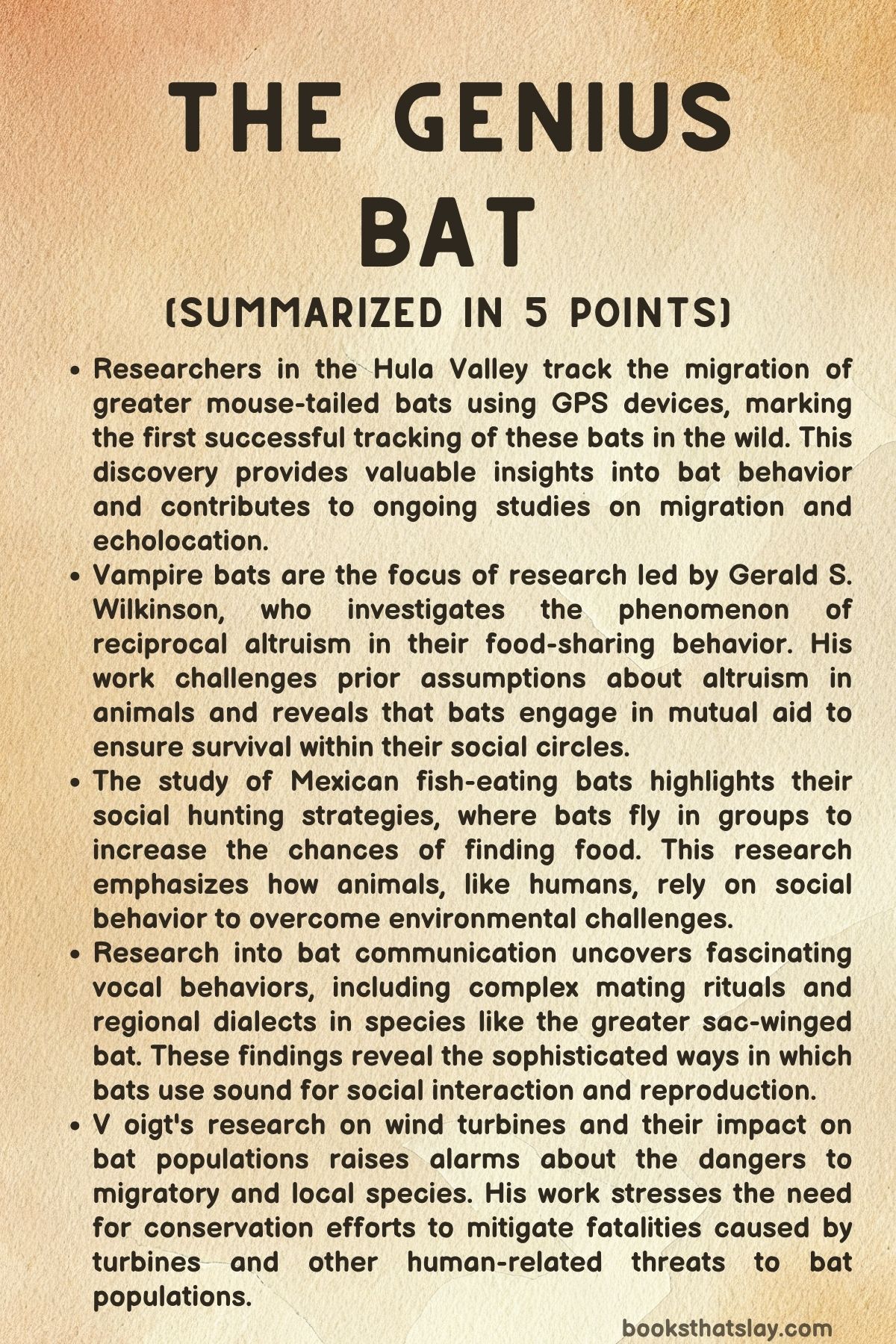
Key People
Brock Fenton
Brock Fenton is a renowned bat expert whose work has had a profound impact on the field of bat studies. His initial interest in bats came by chance while studying biology at Queen’s University, where a lecture by moth researcher Ken Roeder sparked his curiosity.
Fenton’s research journey has been deeply rooted in fieldwork, especially focusing on bat migration and echolocation. He was one of the pioneers in tracking bat movements through banding, discovering their incredible migratory patterns.
His passion for understanding bat navigation, particularly how they use echolocation to navigate in the dark, has led to significant findings about bat behavior and ecology. Fenton also played a crucial role in developing a unique and successful bat course that encourages students to design their own research projects, fostering creativity and independence in future bat researchers.
His work on bat evolution, particularly the debate about the origins of echolocation, has brought forth new perspectives on how these remarkable creatures evolved. Fenton’s legacy in bat research has been pivotal in shaping the study of bat behavior and ecology, influencing numerous students and researchers worldwide.
Gerald S. Wilkinson
Gerald S. Wilkinson, an influential researcher in the field of bat behavior, made groundbreaking contributions to the study of vampire bats and the concept of altruism in animal behavior. His fascination with altruism was sparked during his PhD research, where he delved into the food-sharing behaviors of vampire bats.
His discovery that vampire bats share food in a reciprocal manner, where bats help others who have previously helped them, became a cornerstone of his work. This concept of reciprocal altruism challenged the prevailing belief that altruism in nature is merely a form of manipulation.
Wilkinson’s findings provided evidence that cooperation in animal behavior can be mutually beneficial, offering long-term survival advantages. His research extended beyond vampire bats, showing that social networks in animals are based on both genetic and social proximity, highlighting the complexities of animal relationships.
Wilkinson’s work on vampire bats not only expanded our understanding of cooperation in nature but also influenced further research on social behaviors in other species.
Gerry Carter
Gerry Carter, a researcher inspired by Wilkinson’s work on vampire bats, further expanded the understanding of food-sharing and social behavior in bats. Initially skeptical about the concept of reciprocal altruism, Carter’s experiments provided strong evidence that vampire bats indeed engage in this behavior.
Through his research, Carter demonstrated that the social bonds formed through reciprocal food-sharing are essential for the survival of bat groups. His work emphasized the gradual development of trust and cooperation, akin to human relationships, highlighting the importance of social connections in animal behavior.
Carter’s research on vampire bats not only solidified the idea of cooperation in bats but also contributed to the broader field of animal behavior, offering new insights into how sociality and cooperation work in the animal kingdom.
V Oigt
V Oigt, an expert on bat behavior and energy consumption, made significant contributions to the understanding of bat flight and the effects of human activity on bat populations. Initially focused on the energy dynamics of nectar-feeding bats, Oigt’s career took a turn when he became concerned about the environmental impact of wind turbines on bat populations.
His research uncovered the deadly effects of wind turbines on migratory bat species, highlighting the need for greater awareness of their environmental impact. Oigt’s studies not only focused on how turbines kill bats but also examined the factors that attract bats to these turbines, such as the presence of insects.
His work expanded to the study of light pollution and its negative effects on bat populations, further underscoring the role of human development in threatening bat habitats. Despite the challenges in mitigating bat fatalities, Oigt has remained dedicated to raising awareness about bat conservation and finding solutions to protect these crucial creatures.
Winifred Frick
Winifred Frick is a researcher whose work focuses on the devastating impact of white-nose syndrome, a fungal disease that has decimated bat populations in North America. Frick’s research has been instrumental in understanding the disease’s impact, particularly its effects on the little brown bat, which has seen a dramatic decline in numbers due to the disease.
She has explored why certain bat species are more resistant to white-nose syndrome than others, although no definitive solution to halt its spread has been found. Despite the challenges posed by the disease, Frick’s research continues to focus on helping bat populations survive in affected areas.
Her work underscores the fragility of bat populations and the importance of ongoing research to understand and mitigate the effects of white-nose syndrome.
Nancy Simmons
Nancy Simmons is a prominent researcher in the field of bat evolution, with a particular focus on the evolutionary relationships between bat species. Her work has provided valuable insights into the origins of fruit bats, which do not use echolocation, and how they evolved from insectivorous ancestors.
Simmons’s research into bat fossils, especially her discovery of the Onychonycteris fossil, has been instrumental in advancing the understanding of bat evolution. Her findings challenge previous assumptions about the evolution of echolocation and highlight the genetic differences between echolocating and non-echolocating bats.
Simmons’s contributions to bat evolution have shaped the current understanding of how bats evolved and adapted to their environments.
Mirjam Knörnschild
Mirjam Knörnschild is a researcher who has made significant contributions to the study of vocal communication and learning in bats. Her work focused on the vocal development of greater sac-winged bats, particularly the way in which male and female pups learn to mimic the songs of their fathers.
Her research revealed that vocalization in bats is similar to human infant babbling, with pups practicing syllables before developing their adult calls. Knörnschild’s studies also uncovered the presence of regional dialects in bat populations, with different harems developing distinct vocal patterns.
This finding suggests that vocal learning plays a critical role in bat sociality and reproduction, with females potentially preferring males from their local harem due to regional familiarity. Knörnschild’s work has provided valuable insights into the complexities of bat communication and social structures.
Hans-Ulrich Schnitzler
Hans-Ulrich Schnitzler is a pioneering figure in bat echolocation research, known for his groundbreaking work on Doppler-shift compensation in horseshoe bats. Schnitzler’s discovery that bats adjust their echolocation frequencies to compensate for the Doppler effect revolutionized the understanding of bat navigation.
This finding demonstrated that bats could navigate in dynamic environments filled with moving objects, which was a pivotal moment in both bat biology and sonar technology. Schnitzler’s research on echolocation not only advanced bat biology but also influenced the development of sonar systems, making his work a critical contribution to both the study of bats and the field of acoustics.
His work in shaping the understanding of echolocation continues to be highly regarded in the scientific community.
Donald Griffin
Donald Griffin is considered the father of bat echolocation research, having made the revolutionary discovery that bats navigate using sound. His work in the late 1930s showed that bats emit ultrasonic sounds and use the returning echoes to form a mental map of their surroundings.
This groundbreaking discovery changed the way scientists understood bat behavior, revealing that bats could perceive their environment in complete darkness. Griffin’s research laid the foundation for decades of studies on bat echolocation, influencing the direction of future research on animal communication and navigation.
His legacy in bat biology is significant, as his work opened the door to understanding how animals use sound for navigation and prey detection.
Themes
The Ecological Importance of Bats
Bats, though often misunderstood and feared, play a critical role in maintaining ecological balance. Throughout the research documented in The Genius Bat, it becomes evident that bats contribute in ways that are often overlooked.
They are vital for controlling insect populations, pollinating plants, and even dispersing seeds, which are essential for maintaining biodiversity. In particular, insect-eating bats help reduce the need for pesticides, benefiting agriculture and the environment.
For example, the study of greater mouse-tailed bats in Israel reveals their migratory behavior and how their presence aids in controlling local insect populations, which would otherwise be damaging to crops. Additionally, the Mexican fish-eating bats rely on their social behavior and cooperative hunting techniques to capture prey, showing how their survival and ecosystem services are intricately tied to their social structure.
The research on vampire bats adds another layer to this understanding, highlighting their role in promoting mutual aid within their communities, which in turn strengthens the overall ecological fabric. The text stresses the importance of these often feared creatures, urging the need for a paradigm shift in how humans view and interact with bats.
Cooperation and Social Behavior in Bats
One of the central themes explored in The Genius Bat is the concept of cooperation among bats, particularly through the lens of reciprocal altruism. The research led by Gerald S. Wilkinson and later expanded by others like Gerry Carter, uncovers the ways in which vampire bats share food with others in their social circles.
This cooperation is not random; instead, bats share food with those who have previously helped them, ensuring mutual survival in times of scarcity. This behavior challenges the conventional view of animal behavior as purely self-interested and competitive.
It provides compelling evidence that animals, particularly vampire bats, form strong social bonds that are critical for their survival. These bonds go beyond kinship and involve a network of interactions based on trust and reciprocity.
This theme of social behavior, also explored through the study of Mexican fish-eating bats and hammer-headed bats, demonstrates that cooperation is not an isolated phenomenon but a common strategy used across different bat species to enhance survival and improve hunting success. The research shows that these bats are not solitary creatures but highly social animals whose interactions are based on cooperation and mutual benefit.
The Evolution of Communication in Bats
Communication in bats is another important theme that emerges in The Genius Bat, particularly through the study of vocalization and echolocation. Bats communicate using a wide range of vocalizations, from the ultrasonic songs of the greater sac-winged bat to the shrill calls of the Egyptian fruit bat.
These vocalizations serve not only to coordinate social interactions but also to establish mating preferences and territory. The greater sac-winged bat, for example, uses singing as a mating display, with males who sing more often tending to attract larger harems.
In contrast, the Egyptian fruit bat’s communication is more about maintaining order within the colony and facilitating social interactions in crowded conditions. Researchers, such as Mirjam Knörnschild, have also discovered that young bats learn their vocalizations by mimicking their fathers, much like how human infants learn to speak.
This vocal learning process is essential for their social and reproductive success, as it allows them to adapt their communication to their specific social environments. The study of regional dialects in greater sac-winged bats further deepens our understanding of bat communication, showing that these animals, like humans, develop distinct vocal patterns that identify them to others in their community.
This intricate use of sound and its evolution over time highlights the complexity of bat communication systems, which are vital for their survival.
The Threats to Bat Populations
The threats to bat populations, particularly from human activity, are explored in detail in The Genius Bat, focusing on the impact of wind turbines and diseases like white-nose syndrome. The research conducted by V oigt on the impact of wind turbines reveals a significant ecological concern: wind turbines kill large numbers of bats, including migratory species.
The bats are drawn to turbines either due to their similarity to tall trees or because they are attracted to the insects around them. This threat is particularly dangerous for migratory bat populations, which rely on seasonal migrations to maintain their populations.
V oigt’s findings emphasize the need for careful planning when constructing wind turbines, especially in areas with high bat activity. Additionally, white-nose syndrome, a fungal disease that has ravaged bat populations in North America, is another pressing issue.
The disease disrupts hibernation and causes bats to prematurely deplete their fat reserves, leading to mass mortality. Despite efforts to mitigate its effects, including fungicide treatments, the disease continues to spread, decimating bat populations in affected areas.
Both of these threats highlight the vulnerability of bat species in the face of human development and the urgent need for conservation efforts to protect them.
Bat Conservation and Human Impact
The final theme that emerges in The Genius Bat is the ongoing tension between bat conservation and human development. This theme is highlighted in various research studies that focus on the challenges of balancing bat protection with human interests.
For example, the legal dispute over the neem tree in Israel illustrates the conflicts that arise when bats are involved in urban settings. Residents, concerned about the bat droppings and the health risks associated with them, clashed with conservationists who wanted to preserve the tree for the bats.
This conflict underscores the broader issue of how bat conservation often intersects with human land use and development. Moreover, V oigt’s work on light pollution and its detrimental effects on bat populations further complicates this issue.
Bats, as nocturnal creatures, rely heavily on darkness for hunting and navigation, and artificial lighting disrupts their natural behaviors. This theme calls for greater awareness and more effective policies that address the environmental impacts of human activities on bat populations.
It also emphasizes the importance of educating the public about bats’ vital roles in ecosystems and the necessity of protecting them despite the challenges posed by urbanization and industrialization.