The Girls’ Trip Summary, Characters and Themes
The Girls’ Trip by Ally Condie is a mystery thriller about three women whose online friendship becomes a real-world escape that turns dangerous. Ash, Caro, and Hope meet through a virtual Agatha Christie book club during the pandemic and form a bond strong enough to carry them through loneliness, family stress, professional pain, and private fear.
When they finally decide to meet in person at a desert resort in Utah, the trip begins as a playful disappearance inspired by Christie herself. But the adventure soon becomes a fight for survival, tied to a flash flood, a missing woman, an old murder, and a stalker who has been watching them far longer than they realize.
Summary
Ash, Carolina “Caro” Stewart, and Hope Hanover first become friends in an unusual way. During the pandemic, they are the only three people who attend a virtual Agatha Christie book club.
What begins as a small online meeting soon becomes a major part of their lives. Over two years, the monthly book discussions grow into regular texts, private conversations, late-night emotional support, and a friendship that feels real even though they have never met in person.
Each woman is carrying her own burdens. Hope is a famous actress whose career and public image are under pressure.
Ash lives in Oregon, runs a flower business, and is exhausted by the demands of raising three daughters while dealing with a failing marriage. Caro is an anesthesiologist in Utah, struggling with trauma from her work, the death of a patient, and the growing demands of caring for her father, Henry, who has Alzheimer’s.
Hope suggests that the three women finally meet face-to-face and do something dramatic: disappear for a few days. Her idea is inspired by Agatha Christie’s famous real-life disappearance, and she presents it as a way for them to escape work, family, fame, expectations, and the constant reach of technology.
They choose Sonnet, a desert resort near Eden National Park in southern Utah, and plan to hike a remote slot canyon known as the Underground. Hope insists on secrecy.
She uses the fake name Chastity Bentley, encourages them to lock away their phones, brings a burner phone for emergencies, and gives them disposable cameras instead. Before the hike, the women burn slips of paper naming what they want to leave behind.
Hope admits she has lost a film role. Caro and Ash name work, while Ash also writes down family, feeling ashamed but unable to deny her exhaustion.
At Sonnet, a young resort employee named Page notices the women almost immediately, especially Hope. Page is poor, sharp, and resentful of the wealthy guests who pass through the resort, but her interest in Hope is not just curiosity.
She is hiding her own connection to the desert and to an old disappearance. The women, unaware of the full danger around them, enjoy the strange freedom of being away from their usual lives.
They eat from the food truck, collect postcards, and prepare for the canyon with nervous excitement.
The next day, Ash, Caro, and Hope enter the Underground. Caro leads because she knows the canyon from childhood hikes with her father, Henry.
The canyon is beautiful but demanding, with cold water, slick rock, descents, and the constant risk of flash floods. Caro’s skill becomes important when they meet a group of unprepared young hikers whose rope is too short for a rappel.
She helps them get down safely, showing her calm competence in a dangerous place. Later, the women camp near three men: Spencer, an old friend of Caro’s; Kevin; and Kevin’s brother Tony.
Spencer’s presence brings up Caro’s past, while Tony quickly makes the women uneasy with his aggressive manner. Hope hides her identity by using a local accent and sticking to her fake name.
That evening, the two groups play poker, then a version called “secret poker,” where winners are allowed to ask questions. The game starts as entertainment but soon exposes tension.
Spencer admits he was once in love with Caro, opening a window into old feelings and missed possibilities. Tony says the thing he wants most is money, and his blunt, unpleasant behavior makes Ash especially suspicious of him.
The canyon, already physically dangerous, begins to feel emotionally unsafe too.
On the second night, the real disaster comes. Caro wakes and realizes a flash flood is rising through the canyon.
She urgently wakes Ash and Hope, pushing them to move toward higher ground as muddy water rushes around them. The flood grows violent, carrying branches, debris, and force strong enough to kill.
The women climb, but the rock face is unstable. Caro slips, and Ash tries to save her with a rope.
Realizing Ash may be pulled down with her, Caro lets go. She survives, and she and Ash spend the night stranded on a ledge, injured and terrified.
Hope, however, is gone.
When daylight comes, search and rescue reaches them. Spencer has survived, but Tony is dead, and Hope remains missing.
While waiting for help, Ash sees what looks like a body caught in flood debris. Caro examines it and realizes it is not Hope.
The remains are much older. This discovery turns the disaster into something larger than a missing-person case.
Back at Sonnet, Ash and Caro are traumatized, frightened, and desperate for answers. They search Hope’s Airstream and find the locked phone box.
When the box vibrates with messages, they take it to a locksmith. After gaining access to their phones, they receive strange messages that seem to be from Hope.
At the same time, a social media account called @findhopehanover begins spreading private images of the three women, making the case public and ugly. The account suggests that someone has been watching them closely.
A letter reveals that Hope had already known something was wrong before the trip. She had discovered that someone had been secretly observing their online book club meetings for a long time.
She hired a hacker using the code name Jane Marple and learned there was a hidden “lurker.” Hope also sent Ash and Caro secret phones so they could help investigate without alerting the stalker.
The mystery deepens when Page is questioned by police and sees photos recovered from a dry bag found with the old body. She recognizes the remains as those of her missing older sister, Eve Herriman, who vanished twelve years earlier.
Eve had once worked events with Page and their grandmother, gone to college, and dreamed of becoming a doctor. One photo shows Eve with Dr. Henry Stewart, Caro’s father.
This makes Page suspect that Henry may have been involved in Eve’s death. Caro also begins to fear this possibility when Henry wanders away while her husband Dan is supposed to be watching him.
She later discovers that Henry has screenshots of Hope on his phone and an old clipping about Eve, making her wonder whether her father’s damaged memory is hiding something terrible.
Ash and Caro follow the messages that seem to come from Hope, but the trail only creates more confusion. At Seraph’s Perch, Ash unexpectedly finds her husband Wade.
His appearance makes her question why he is there and whether he has been honest with her. The pressure fractures Ash and Caro’s friendship.
Caro wonders whether Hope staged everything as part of some elaborate plan, while Ash wonders whether Caro or someone in Caro’s family is hiding the truth. Hope’s agent, Raye, arrives and reveals that Hope left Ash and Caro money in her will, which adds another layer of suspicion.
Ash refuses to leave Sonnet with Wade, recognizing that their marriage has reached a breaking point. Caro, meanwhile, is pulled between fear for Henry, guilt over her medical trauma, and the possibility that her father may be connected to Eve.
The final texts lead Ash and Caro to Afton, an abandoned ghost town. Page is already there.
She has not simply been watching from the outside; she has been helping Hope. Hope had planned to fake her disappearance by escaping from the Underground through a difficult route and hiding in the ghost town.
Her goal was to draw out the lurker who had been stalking her and the others. Page helped her partly for money and partly because Hope had contacted her about Eve’s disappearance.
But when Page looks again at the old photos, she realizes she has blamed the wrong person. The killer is not Henry.
It is Ty, the Sonnet food truck cook. Ty had once dated Eve and murdered her when she tried to leave him.
Ty attacks Page and is holding Hope captive in the old church, where the floor has been soaked with gasoline. Ash, Caro, Henry, and Dan arrive, and Page manages to whisper that “he” killed her sister.
Ty enters with Hope at knifepoint and reveals the truth. He is the stalker.
He watched the women’s online meetings, tracked their phones, studied their homes, and learned about their families. Hope explains that Ty becomes obsessed with women he cannot possess, and Eve had been one of them.
His stalking of Hope is part of the same violent pattern.
When Ty cuts Hope’s throat, Ash and Caro attack. In the chaos, Ash fires a flare gun into Ty, stopping him without setting the gasoline-soaked church on fire.
Hope survives, though injured, and Ty is taken away. The truth finally comes into the open: Hope had learned before the hike that the stalker was focused on her and tried to handle the danger alone.
She believed she could protect Ash and Caro by drawing Ty away from them, but Ty overpowered her, took her phone, and sent the later messages himself.
Afterward, the women begin to face the damage left behind. Page receives Eve’s ashes but cannot choose a formal resting place, so she scatters them beside an unknown desert road.
Caro admits the truth about her failed fertility treatments and the lie she told Dan. Ash reveals that Wade has moved out, marking the end of the life she had been pretending she could maintain.
Hope, grateful and changed by what happened, offers Caro her frozen eggs if Caro and Dan decide they want to try to have a child. Page joins the women’s call, no longer completely alone in her grief.
The story closes with Eve’s presence, suggesting that although she was lost for years, the women finally saw her, and Page was always finding her way back to the sister she had never stopped missing.
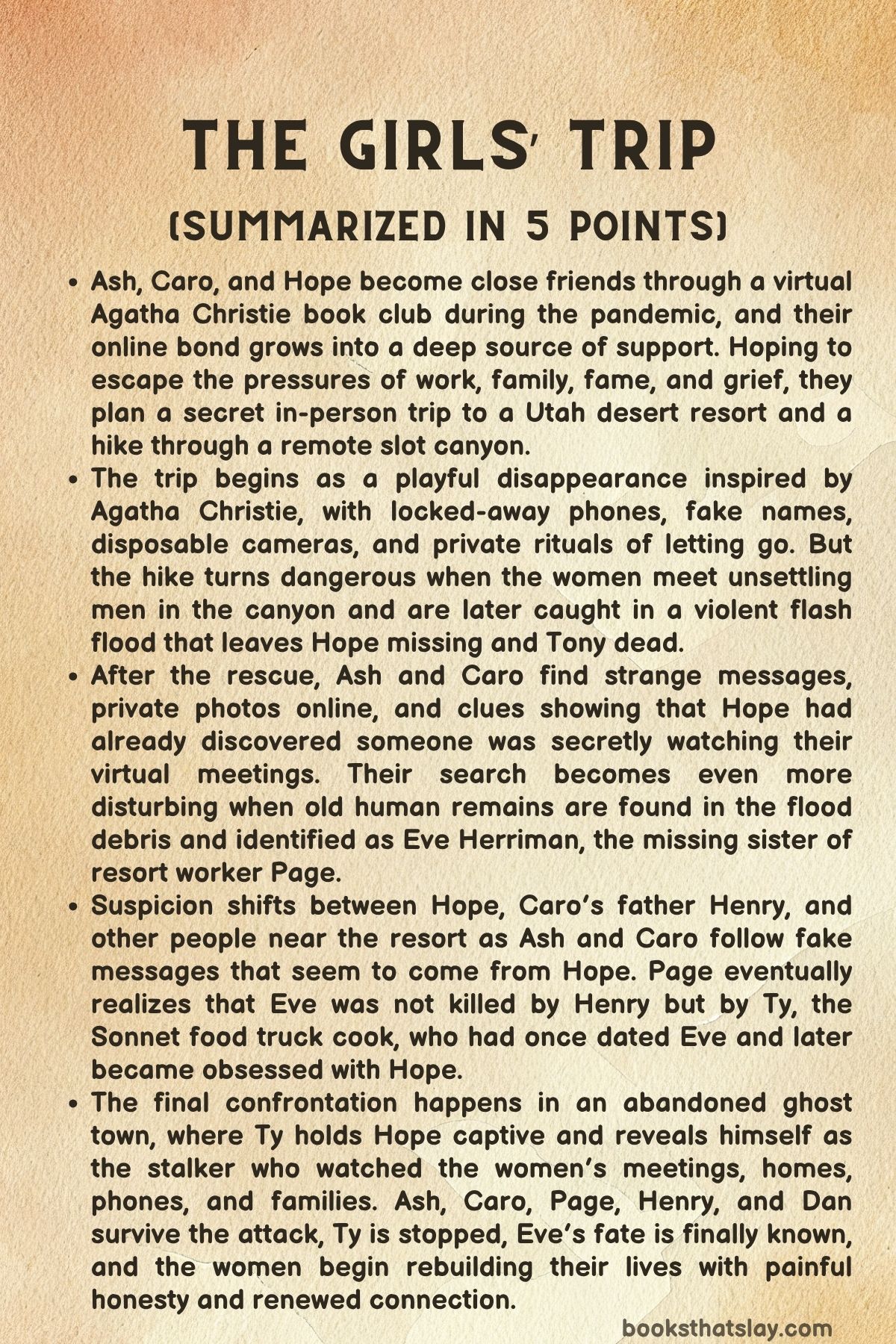
Characters
Ash
Ash is one of the emotional centers of the book, a woman whose warm and practical surface hides deep exhaustion. She runs a flower business in Oregon and raises three daughters, but her life has become so full of responsibility that she feels almost erased by it.
Her guilt over writing “family” on the slip of paper she wants to burn shows how conflicted she is: she loves her children, but she is also overwhelmed by the endless demands placed on her. This makes her escape to Sonnet more than a vacation.
It is a brief chance to exist outside the roles of wife, mother, and business owner.
Ash’s marriage to Wade is already weak before the trip, and the crisis forces her to see it clearly. When Wade appears unexpectedly near the investigation, it does not comfort her; instead, it exposes how little trust remains between them.
Ash’s suspicion, fear, and eventual refusal to leave with him show that she is beginning to choose honesty over habit. She is not portrayed as someone who suddenly becomes fearless, but as someone who acts even while afraid.
Her attempt to save Caro during the flood, her refusal to abandon the search for Hope, and her final use of the flare gun against Ty all reveal a courage rooted in loyalty rather than confidence.
In The Girls’ Trip, Ash’s arc is about admitting that love and exhaustion can exist together. She begins the story ashamed of wanting space from her family, but by the end, she understands that denying her own needs has damaged her.
Her friendship with Hope and Caro helps her see herself more clearly. She survives the desert not only physically, but emotionally, leaving behind a marriage that no longer works and accepting that a new life may have to begin with painful truth.
Carolina “Caro” Stewart
Caro is intelligent, capable, and controlled, but much of her control comes from fear. As an anesthesiologist, she is used to making precise decisions under pressure, yet she is haunted by a woman who died during childbirth under her care.
That professional trauma follows her into the trip, shaping her sense of failure and making work one of the things she wants to escape. She is also carrying the strain of caring for her father, Henry, whose Alzheimer’s is slowly changing the man she once knew.
Caro is responsible, but responsibility has become a weight she cannot easily set down.
Her knowledge of the Underground makes her essential during the hike. She knows the canyon from childhood trips with Henry, and she takes the lead with confidence.
When she helps the unprepared hikers rappel safely, the book shows her at her best: calm, skilled, and focused on protecting others. During the flash flood, however, nature strips away her ability to control the outcome.
Her decision to let go of the rope so Ash will not be dragged down is one of her defining moments. It shows both desperation and self-sacrifice, and it leaves Ash and Caro bound by a traumatic experience neither can easily explain to others.
Caro’s fear that Henry may have killed Eve adds emotional complexity to her part of the story. She loves her father, but his illness makes it impossible to fully trust his memory or actions.
The screenshots of Hope and the clipping about Eve force Caro into a painful space between daughterly loyalty and moral dread. By the end, the revelation that Henry is not the killer frees her from one fear but not from every truth she has avoided.
Her confession about failed fertility treatments and her lie to Dan shows that her real journey is not only solving the mystery, but learning to stop hiding her pain from the people closest to her.
Hope Hanover
Hope Hanover is famous, charming, and theatrical, but the book gradually reveals how vulnerable she is beneath the confidence. As an actress, she is used to being watched, judged, and recognized, which makes her decision to disappear both playful and deeply serious.
Using the fake name Chastity Bentley allows her to step outside the identity that has trapped her. She wants the trip to feel like an Agatha Christie mystery, but she also knows there is a real threat behind the performance.
Her fame has made her visible, and that visibility has attracted danger.
Hope is the one who discovers that someone has been secretly watching the women’s online meetings. Instead of fully revealing the danger, she tries to manage it through secrecy.
She hires a hacker, sends Ash and Caro secret phones, and designs a fake disappearance meant to draw out the stalker. This plan shows her intelligence and courage, but also her flaw: she believes she can control the danger alone.
Her desire to protect her friends leads her to withhold important information from them, leaving them confused and exposed when the situation turns violent.
Hope’s disappearance drives the central mystery, but she is not simply a victim. She is active, strategic, and emotionally loyal, even when her choices are risky.
Her later explanation that Ty had taken her phone and sent messages himself reveals how quickly her plan was overtaken by the man she hoped to expose. After surviving Ty’s attack, Hope remains generous, especially in offering Caro her frozen eggs.
That gesture shows the depth of her bond with the other women. In a story full of false appearances, Hope’s most important truth is that her friendship with Ash and Caro is real.
Page
Page begins as an observant outsider at Sonnet, watching guests who seem to have money, freedom, and choices she does not have. Her resentment of wealthy visitors gives her early scenes a sharp edge, but the book slowly shows that her interest in Hope and the other women comes from grief as much as envy.
Page’s older sister Eve disappeared twelve years earlier, and that loss has shaped her life. She has lived with uncertainty, anger, and the pain of not knowing where Eve went or why she never came home.
Her connection to Hope complicates her role in the mystery. Page has been helping Hope because Hope contacted her about Eve’s case, and because Hope’s plan offered money and the possibility of answers.
Page is not naïve. She understands how people use others, and she has learned to survive by noticing details.
When she sees the photos recovered with the old body, she recognizes Eve and begins to connect the past to the present. At first, she suspects Henry because of the photo of him with Eve, but her willingness to keep looking allows her to realize the truth: Ty was the danger all along.
Page’s grief reaches its most painful point when Eve’s remains are identified and Ty is revealed as her killer. Yet Page’s role in the final confrontation also gives her agency.
She is injured and afraid, but she still helps communicate the truth. Afterward, her scattering of Eve’s ashes beside an unknown desert road reflects the difficulty of mourning someone who was missing for so long.
Page does not receive a neat healing, but she gains answers, connection, and a place within the women’s circle. Her joining the call at the end suggests that grief may remain, but isolation does not have to.
Eve Herriman
Eve Herriman is dead before the main events of the book, but her presence shapes the entire story. She was Page’s older sister, a young woman who worked events with Page and their grandmother, attended college, and dreamed of becoming a doctor.
These details make her more than a mystery victim. She had ambition, family ties, and a future that was stolen from her.
Her disappearance twelve years earlier left Page trapped in uncertainty, unable to properly grieve or move on.
Eve’s connection to Henry through an old photograph creates one of the story’s major misdirections. Because Henry has Alzheimer’s and because Caro finds troubling material on his phone, Eve’s past seems to point toward him.
But this suspicion also shows how easily fragments of evidence can be misunderstood when grief and fear are involved. Eve’s true connection is to Ty, who once dated her and murdered her when she tried to leave.
Her death reveals the long history behind Ty’s violence and proves that Hope is not his first target.
Eve’s final voice gives the ending a quiet emotional weight. Her bones are found because of the flood, because of the women’s trip, and because Page never truly stopped searching.
In The Girls’ Trip, Eve represents the women who disappear from public attention when no one powerful keeps looking. The discovery of her remains restores part of her story.
It also gives Page the answer she has needed for years, even though that answer is devastating.
Ty
Ty is the hidden predator at the center of the book. On the surface, he is the Sonnet food truck cook, someone easy to overlook among resort staff and desert travelers.
That ordinary position is part of what makes him dangerous. He can watch people without drawing attention, move through the background, and gather information while others underestimate him.
His connection to Eve and Hope reveals a pattern of obsession, control, and violence toward women he believes he has the right to possess.
Ty’s stalking of Hope is not random. He has watched the women’s online book meetings, tracked their phones, studied their homes, and learned about their families.
This invasion turns the women’s friendship into something vulnerable, because even their private comfort has been observed by someone dangerous. His use of Hope’s phone to send messages after overpowering her shows how he manipulates both technology and emotion.
He understands that Ash and Caro will follow if they believe Hope needs them.
His final confrontation in the old church reveals the full scale of his cruelty. Holding Hope at knifepoint in a gasoline-soaked room, he tries to control the scene through fear.
But his power depends on secrecy, and once Page, Ash, Caro, Henry, and Dan understand the truth, that secrecy breaks. Ty is not presented as a complicated romantic figure or a misunderstood man.
He is possessive, violent, and calculating. His defeat by Ash’s flare gun is fitting because the women he watched and underestimated are the ones who stop him.
Henry Stewart
Henry Stewart is Caro’s father, a doctor whose Alzheimer’s makes him both vulnerable and difficult to understand. For Caro, he represents childhood safety, professional admiration, and family history.
He taught her the canyon, and her knowledge of the Underground comes from time spent with him. Yet his illness has changed the way she relates to him.
She cannot always know what he remembers, what he has done, or what his confusion might hide.
The discovery of Hope’s screenshots and the old Eve clipping on Henry’s phone turns him into a painful suspect. Because he appears in a photo with Eve, and because his memory cannot defend him clearly, Caro must face the possibility that someone she loves could have committed a terrible crime.
This suspicion is devastating not only because it threatens Henry’s image, but because it forces Caro to question her own memories of him. The book uses Henry’s illness to create uncertainty, but it also shows the sadness of watching a parent become someone both familiar and unreachable.
When the truth comes out, Henry is not Eve’s killer. His presence in the mystery reflects proximity, memory, and misinterpretation rather than guilt.
Still, his role remains important because he exposes Caro’s emotional strain. Her fear for him, her fear of him, and her guilt about not being able to protect or understand him all shape her choices.
Henry is a reminder that family love can be full of tenderness and fear at the same time.
Dan
Dan, Caro’s husband, is part of her private life outside the canyon, but his role becomes more important as the crisis grows. He is connected to Caro’s deepest unresolved pain, especially her failed fertility treatments and the lie she has been carrying.
Their marriage is strained not because love has vanished, but because truth has been withheld. Caro’s silence creates distance between them, and the emergency surrounding Hope, Henry, and Eve forces hidden tensions into the open.
Dan’s failure to keep track of Henry when Henry wanders away adds to Caro’s panic and anger. At the same time, his presence in the final confrontation shows that he remains part of Caro’s support system, even if their relationship needs honesty to survive.
He is not as central as Ash, Caro, Hope, or Page, but he matters because he reflects the life Caro must return to after the mystery ends. Survival alone does not solve her marriage; only confession and trust can begin to do that.
By the end, Dan becomes part of Caro’s possible future rather than just her strained present. When Caro admits the truth about fertility treatments, she gives their relationship a chance to become more honest.
Hope’s offer of frozen eggs complicates that future in a hopeful way, but the emotional foundation has to come from Caro and Dan themselves. Dan’s character helps show that the aftermath of danger is not only about catching the villain.
It is also about deciding what kind of life remains possible afterward.
Wade
Wade is Ash’s husband, and his role in the book centers on the collapse of a marriage that has already been weakening. Before the trip, Ash is overwhelmed by home, children, and business, and Wade represents part of the domestic pressure she is trying to escape.
His unexpected appearance at Seraph’s Perch does not feel like rescue. Instead, it increases Ash’s suspicion and clarifies how far apart they have become.
Wade’s presence forces Ash to confront the truth she has been avoiding. She may have wanted distance from her family, but what she needs most is distance from the version of marriage that has left her unsupported and unseen.
Her refusal to leave Sonnet with him is one of her strongest acts of self-recognition. She chooses to stay with the search, with her friends, and with the truth rather than retreat into a familiar life that no longer works.
By the end, Wade has moved out, confirming the break in their relationship. He is not the main villain of the story, but his function is still important.
Through him, the book examines a quieter kind of damage: the slow erosion of trust and partnership. Ash’s separation from Wade is painful, but it also marks the beginning of her reclaiming her own needs without apologizing for them.
Spencer
Spencer is an old friend from Caro’s past who appears in the canyon with Kevin and Tony. His presence brings personal history into an already dangerous trip.
During the poker game, he admits that he was once in love with Caro, which briefly shifts the story from survival adventure to emotional reckoning. His confession suggests roads not taken and feelings that were never fully addressed.
Although Spencer survives the flood, his main purpose is to complicate the canyon experience and Caro’s emotional state. He belongs to her past, and his appearance in the Underground reminds her of who she was before her current life became defined by medical trauma, family illness, and marital strain.
Unlike Tony, Spencer does not emerge as a direct threat, but the setting makes everyone feel potentially suspicious for a time.
Spencer also helps create uncertainty after Hope disappears. Because he is one of the few people connected to the women during the hike, his survival matters to the investigation.
His role is smaller than the central characters, but he adds tension by bringing unresolved personal history into a situation where every secret begins to feel dangerous.
Tony
Tony is Kevin’s brother and one of the most openly unsettling figures the women encounter before the larger truth is revealed. From the beginning, he makes Ash uneasy.
His aggressive manner, interest in money, and uncomfortable behavior during the poker game make him seem like an obvious danger. When he says that what he wants most is money, he gives the women a clear reason to distrust him.
His death in the flash flood initially adds to the confusion surrounding Hope’s disappearance. Because Tony behaves badly, readers and characters alike can easily wonder whether he might have been involved in something sinister before the flood killed him.
In that sense, he functions as a red herring. His unpleasantness is real, but it is not the central evil of the story.
Tony’s role also helps show how danger can appear in different forms. He is threatening in a direct, crude way, while Ty is hidden, patient, and far more dangerous.
Tony makes the canyon feel unsafe before the flood, but his death proves that the most obvious source of discomfort is not always the true source of harm.
Raye
Raye, Hope’s agent, enters the story after Hope’s disappearance and adds another layer of suspicion. As someone connected to Hope’s career, public image, and legal affairs, Raye represents the world of fame that Hope had tried to escape.
Her arrival reminds Ash and Caro that Hope is not only their friend; she is also a celebrity surrounded by professional interests and public narratives.
When Raye reveals that Hope left Ash and Caro money in her will, the detail unsettles the friendship and the investigation. It raises uncomfortable questions about motive, secrecy, and what Hope may have known before the trip.
For Ash and Caro, the money does not feel like a gift at first. It feels like another sign that Hope had hidden important truths from them.
Raye’s role is not as emotionally intimate as the three friends’ bond, but she helps expose the gap between Hope’s public life and private life. Through Raye, the book shows how fame complicates danger.
When Hope disappears, she becomes not only a missing friend but also a public story, a legal matter, and a viral spectacle.
Themes
Friendship as Chosen Shelter
The friendship among Ash, Caro, and Hope begins in an online book club, but it becomes a shelter from the pressures of their separate lives. Their bond forms during a time of isolation, when virtual spaces become the only way many people can connect honestly.
What makes their friendship powerful is not shared background or convenience, but the emotional safety they create for one another. Hope is famous, Ash is consumed by family and work, and Caro is burdened by medical trauma and caregiving, yet their conversations allow them to be seen outside those roles.
The trip to Sonnet is meant to turn that emotional closeness into real-world companionship, and the danger that follows tests whether the bond can survive fear, suspicion, and betrayal. For a time, the mystery threatens to divide Ash and Caro, especially when Hope’s secrets come to light.
Still, the friendship holds because it is based on more than comfort. It becomes active loyalty.
They search, risk themselves, confront Ty, and continue supporting one another afterward. The Girls’ Trip presents friendship not as perfect trust at every moment, but as a chosen relationship strong enough to survive confusion and return to care.
The Cost of Being Watched
Surveillance in the story is not only technological; it is emotional, social, and physical. Hope already lives under public attention because of her acting career, but Ty’s stalking turns visibility into violation.
He watches the women’s online meetings, tracks their phones, studies their families, and uses private knowledge to control them. The horror comes from the fact that their safe space was never fully safe.
What they believed was an intimate friendship had an unseen intruder. This theme connects strongly to modern fears about digital life, where private conversations, images, locations, and identities can be exposed or manipulated.
The viral @findhopehanover account makes the violation public, turning trauma into spectacle. Hope’s attempt to disappear is partly a rebellion against being constantly seen, but it also shows how difficult it is to escape someone who has already entered the hidden parts of life.
Ty’s power depends on watching without being noticed. Once he is identified, his control begins to collapse.
The book treats being watched as a form of possession, especially when directed at women who are trying to claim freedom, privacy, or independence.
Grief, Memory, and Unfinished Loss
Page’s search for Eve gives the mystery its deepest emotional foundation. Eve’s disappearance has left Page suspended between hope and mourning for twelve years.
Without a body, a clear answer, or justice, grief becomes unfinished business. Page cannot fully move forward because she does not know what happened to her sister, and that uncertainty hardens into suspicion, resentment, and loneliness.
Henry’s Alzheimer’s adds another layer to the theme of memory. His fading mind makes the past feel unstable, especially when evidence seems to connect him to Eve.
Caro’s fear that he might be guilty is intensified by the fact that he cannot clearly explain himself. The story uses these two kinds of uncertainty, a missing sister and a fading father, to show how painful it is when memory cannot be trusted or completed.
Eve’s remains finally provide answers, but they do not erase the years of loss. Page scattering her ashes beside a desert road reflects the difficulty of finding closure after such a long absence.
The ending offers recognition rather than simple healing. Eve is seen, Page is no longer alone, and the past is finally named.
Women Escaping Roles That Confine Them
Each central woman is trying to escape a role that has become too narrow. Ash wants relief from being endlessly needed as a mother, wife, and business owner.
Caro wants to escape the crushing responsibility of medicine, caregiving, and hidden grief over fertility. Hope wants to step outside fame, public judgment, and the fear caused by a stalker who has turned her image into a target.
Even Page is trapped by poverty, grief, and the long shadow of Eve’s disappearance. The planned disappearance at Sonnet is therefore more than a game.
It is a symbolic refusal of the identities that have trapped them. Yet the book does not suggest that escape is simple.
The desert brings danger instead of peace, and the women are forced to confront what they hoped to leave behind. Ash must face her broken marriage.
Caro must tell the truth to Dan. Hope must admit that secrecy put her friends at risk.
Page must face the reality of Eve’s death. Their freedom comes not from vanishing, but from returning with clearer knowledge of themselves.
The story argues that escape only matters when it leads to truth.