The Glowing Life of Leeann Wu Summary, Characters and Themes
The Glowing Life of Leeann Wu by Mindy Hung is a contemporary novel that blends family drama, cultural legacy, and a subtle touch of magical realism. Set in the fictional town of Reineville during an oppressively hot summer, the story follows Leeann Wu—a compassionate midwife, single mother, and daughter—who discovers a mysterious glow in her hands that seems to heal and connect those around her.
As Leeann grapples with the pressures of work, motherhood, and a rekindled romance, she uncovers the inherited power of the women in her family and the haunting history of her great-aunt Yi-beh. The novel explores exhaustion, memory, and the unseen energies that pass through generations of women.
Summary
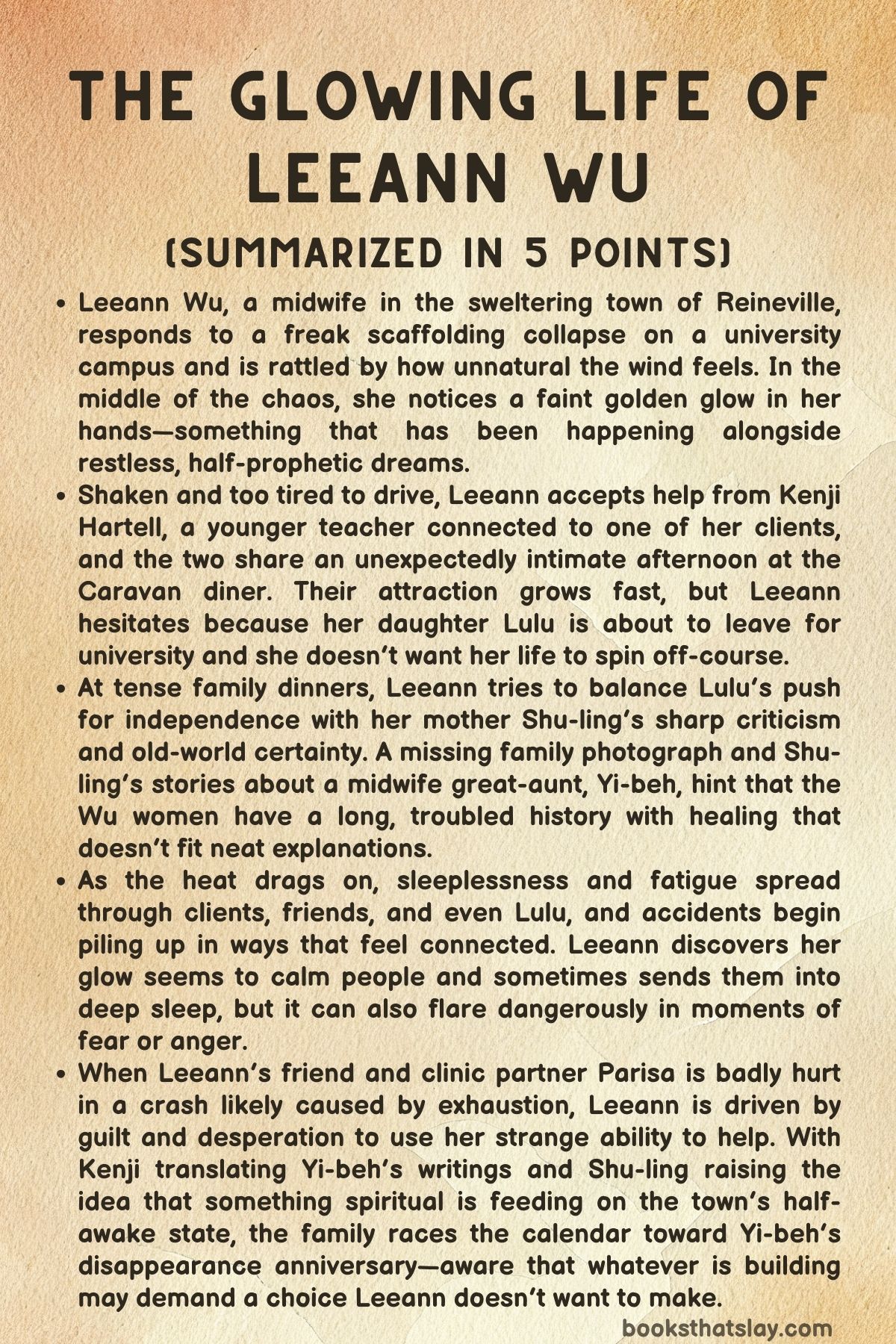
The story begins with Leeann Wu witnessing a scaffolding collapse on her university campus during an early June heatwave. As a midwife and natural caregiver, she rushes to help the injured.
Amid the chaos, she notices her hands emit a faint glow—an unexplained phenomenon that has been occurring for weeks. Though no one is seriously harmed, the event leaves her shaken.
Too distressed to return home, she accepts help from Kenji Hartell, a younger man she knows through a former client. They spend the afternoon at a diner, where an unexpected connection grows between them.
Though drawn to him, Leeann keeps her distance, preoccupied with her daughter Lulu’s upcoming departure for university.
That evening, during dinner with her mother Shu-ling (“Ma”) and Lulu, Leeann tries to shake off the strange day. Ma, as always, is sharp-tongued and critical, quick to sense her daughter’s new distraction and disapprove.
When Lulu brings out family photos from Taiwan, Ma reluctantly tells the story of Leeann’s great-aunt Yi-beh—a midwife rumored to have possessed mysterious healing powers. She vanished decades ago during a typhoon after saving many lives.
The tale unsettles Leeann, whose glowing hands now seem less like coincidence and more like inheritance.
In the following days, Leeann’s glow grows stronger, surfacing during her midwife visits. When she touches a pregnant client’s belly, her hands shine visibly, radiating warmth that calms both parents.
The incident leaves her shaken but also strangely fulfilled. Her daily life becomes increasingly intertwined with the unexplainable: sleepless nights, prophetic dreams, and visions of her great-aunt.
As exhaustion spreads across Reineville, Leeann notices her patients and even her daughter complaining of insomnia and fatigue.
Meanwhile, Leeann’s relationship with Kenji deepens. Despite their age gap, he offers her kindness and stability.
Their encounters—coffee dates, conversations, brief touches—are charged with affection and mystery. Kenji notices her glow and assures her it’s something beautiful, not frightening.
Leeann finds in him a rare comfort, yet she is wary of what her growing power might mean for those she loves.
A car accident involving Lulu brings the family’s underlying tensions to the surface. Though Lulu escapes with minor injuries, Leeann’s guilt and Ma’s criticisms flare.
That night, the three generations sit together in the kitchen. When they clasp hands, a soft golden light spreads between them, illuminating the room.
Startled, they break apart, unsure whether they imagined it. The moment becomes a turning point: Ma admits there have always been whispers of a “gift” among Wu women, passed through bloodlines.
Leeann begins to suspect her glow is not illness or stress, but inheritance.
Her work continues under growing strain. More people in town fall victim to accidents caused by sleeplessness and heat.
During one home visit, Leeann helps a new mother overcome crippling exhaustion by channeling her glowing energy through touch. The woman immediately relaxes into peaceful sleep, leaving Leeann convinced her power has healing potential.
But she also fears its cost. Her friend and colleague Parisa notices her fatigue and growing detachment, warning her not to overextend herself.
As the heat intensifies, Leeann experiences a surge of energy that culminates in a lightning strike near her diner—a flash she realizes may have come from her own body. Frightened yet exhilarated, she begins exploring her gift in secret, trying to control it.
These attempts exhaust her, but Kenji’s presence offers solace. Their intimacy deepens, and during a night together, Leeann’s glow fully ignites, surrounding them in radiant light.
For the first time, she feels whole.
But her peace is brief. Tension between Leeann and Ma grows as old resentments resurface.
Lulu accuses Leeann of hiding behind work and superstition. The glow becomes both symbol and burden—something that connects the three women but also threatens to divide them.
When Leeann dreams vividly of Yi-beh, her great-aunt’s spirit warns that the world of the living and the dead is thinning, and that the sleeplessness plaguing Reineville may be connected to restless ghosts.
Leeann turns to Ma for answers. Together, they uncover Yi-beh’s old journals written in Japanese, which Kenji helps translate.
The entries describe strange illnesses, haunting dreams, and an impending “sacrifice.” As they read, Ma reveals long-suppressed memories—her resentment toward Yi-beh for leaving her behind, her guilt for surviving, and her fear that Leeann has inherited both Yi-beh’s gift and her curse. The discovery brings painful honesty between mother and daughter, softening years of bitterness.
When Leeann’s colleague Parisa is injured in a car crash, likely from falling asleep at the wheel, Leeann is overcome with guilt. Convinced she can help, she sneaks into the hospital to use her glow on Parisa.
For a fleeting moment, Parisa awakens and speaks lovingly to her, but later doctors insist she was never conscious. Leeann is left doubting her senses, unsure whether she healed her friend or dreamed the encounter.
As the anniversary of Yi-beh’s disappearance nears, Reineville’s exhaustion worsens. Accidents multiply, and the air feels charged with restless energy.
Leeann, Ma, and Lulu begin to suspect the sleeplessness is spiritual—a bridge between the living and the dead opened by Yi-beh’s lingering regret. They decide to use their shared energy to calm the town.
At the summer fair, Leeann walks among the crowds, touching shoulders and hands, quietly channeling peace. Her glow grows until it is visible to all, drawing awe and fear.
A lightning storm breaks out, echoing the typhoon that once took Yi-beh.
On the festival stage, Leeann feels herself pulled upward by the storm’s power, as if invited to cross over. Lulu reaches her, grounding her back to life.
Leeann releases a great burst of light and sound that ends the storm, brings long-awaited rain, and restores calm. She collapses and awakens later in her bed, surrounded by her family.
The crisis has passed; people in town sleep again.
In the aftermath, Parisa recovers, though slowly. Life resumes its rhythms—Lulu leaves for university, Kenji moves in, and Ma reconciles her past.
Leeann and Ma travel to Taiwan, where they visit Yi-beh’s resting place and leave offerings, at last honoring her memory. The glow no longer appears in Leeann’s hands, but she feels its quiet warmth in moments of love, healing, and connection.
Through this calm acceptance, she understands that her gift was never about power—it was about presence, continuity, and the unseen threads binding generations of women across time.
Characters
Leeann Wu
Leeann Wu, the protagonist of The Glowing Life of Leeann Wu, is a midwife and single mother navigating the demands of caregiving, generational tension, and an emerging supernatural inheritance. She begins the story as a deeply empathetic yet overburdened woman, defined by her role as a healer—professionally and personally.
Her identity is tied to nurturing others, from her daughter Lulu to her clients, even as she struggles to care for herself. The onset of her mysterious glowing ability marks a symbolic and literal awakening of self-awareness.
The glow—both blessing and burden—reflects her latent capacity for transformation, bridging the ancestral wisdom of her great-aunt Yi-beh with her own modern sense of purpose. Through her encounters with exhaustion, spiritual inheritance, and love, Leeann evolves from someone defined by fear and obligation into a woman who embraces her complexity and power.
By the novel’s end, her glow fades, signifying peace rather than loss: she learns that her strength lies not in the supernatural but in human connection, compassion, and resilience.
Lulu Wu
Lulu represents the voice of youth, rationality, and rebellion against inherited silence. At eighteen, she stands on the cusp of independence, preparing to leave home for university, yet she remains tethered to her mother and grandmother by the invisible weight of lineage.
Her skepticism toward Leeann’s glow and her insistence on practicality reflect her struggle to reconcile scientific modernity with spiritual legacy. Lulu’s relationship with her mother is tender but charged—she admires Leeann yet fears her instability.
Her attempts to mediate between Leeann and Shu-ling expose her deep emotional intelligence and her yearning for harmony. Over time, Lulu’s role shifts from skeptic to emotional anchor; when she physically grounds her mother during the storm at the fair, she symbolically restores balance to generations of Wu women.
Lulu’s journey is one of reluctant inheritance—she may not glow, but she inherits understanding, carrying forward the possibility of blending faith and reason in the family’s evolving story.
Shu-ling Wu (Ma)
Shu-ling Wu, Leeann’s mother, embodies the stern pragmatism of an immigrant matriarch whose life has been marked by sacrifice, displacement, and restraint. Initially portrayed as critical and emotionally distant, Ma’s sharpness hides deep-seated grief over her sister Yi-beh’s disappearance and the weight of unspoken history.
Her skepticism toward Leeann’s choices—both as a mother and as a woman—reflects her fear of vulnerability and chaos. Yet beneath her rigidity lies faith in ancestral power: her eventual admission that she once saw the glow reveals that her disbelief was protection, not ignorance.
Through the course of the novel, Shu-ling softens, rediscovering tenderness toward both her daughter and her past. Her journey culminates in reconciliation—between science and spirituality, between mother and daughter, and between the living and the dead.
When she joins Leeann and Lulu to channel healing energy, she becomes part of a collective restoration, her strength grounded in acceptance rather than denial.
Kenji Hartell
Kenji Hartell serves as both romantic partner and emotional catalyst for Leeann’s transformation. A younger man, a teacher by profession, and brother to one of Leeann’s clients, Kenji enters her life at a time of vulnerability and awakening.
His presence challenges Leeann’s guardedness and her sense of propriety; he represents renewal, vitality, and the possibility of love untethered from duty. Throughout their relationship, Kenji demonstrates gentleness and patience, offering both grounding and curiosity toward Leeann’s glowing ability.
His willingness to translate Yi-beh’s writings signifies his role as bridge—between cultures, languages, and emotional worlds. Yet he is not without his own insecurities, often unsure of how to exist beside someone whose life pulses with literal and figurative light.
Ultimately, Kenji’s devotion is steady and human, anchoring Leeann in the ordinary joys of companionship after the extraordinary trials of her awakening.
Parisa
Parisa, Leeann’s friend and colleague, mirrors the toll of caregiving in a fatigued world. Warm, competent, and quietly spiritual, she stands as both confidante and cautionary figure.
Her friendship with Leeann underscores the solidarity of women in healing professions, who often absorb the suffering of others. Parisa’s accident and coma mark the novel’s emotional low point, forcing Leeann to confront guilt and the limits of her powers.
When Leeann’s attempted healing leads to Parisa’s ambiguous awakening, it blurs the line between miracle and self-deception. Parisa’s eventual recovery, though incomplete, represents survival and endurance rather than salvation.
Her character reflects the theme that healing is not about perfection or cure—it is about persistence, connection, and the courage to keep moving through exhaustion.
Yi-beh (Great-Aunt)
Yi-beh is the spectral heart of The Glowing Life of Leeann Wu, a midwife from colonial Taiwan whose mysterious disappearance during a typhoon haunts generations of Wu women. Though long dead, she exerts a living influence, appearing in Leeann’s dreams as both guide and warning.
Yi-beh’s writings and fragmented memories embody the fusion of myth and memory; she is at once healer, ghost, and symbol of the costs of unfulfilled desire. Her story of sacrifice and hunger—both literal and spiritual—echoes in Leeann’s struggles with sleeplessness and light.
Yi-beh’s final revelation, that her yearning blurred the boundary between worlds, reframes the family’s “gift” as a double-edged inheritance: the same energy that heals can also consume. By the novel’s end, her spirit is laid to rest through remembrance and ritual, closing the circle of grief that began decades earlier.
Sarah McCaffrey
Sarah McCaffrey, though a secondary character, plays a pivotal role in the climactic convergence of the supernatural and social. A local woman whose exhaustion and instability epitomize the community’s shared malaise, Sarah’s public confrontation of Leeann during the fair exposes the fragility between wonder and hysteria.
Her impulsive act of drawing attention to Leeann’s glow inadvertently triggers the chaotic energy that threatens the town, yet it also forces the invisible into visibility. Later, her fame as the singer of that night contrasts with Leeann’s anonymity, underscoring society’s preference for spectacle over substance.
Sarah embodies the collective unrest of the town—a mirror of the restless ghosts haunting Reineville.
Paul
Paul, Leeann’s ex-husband and Lulu’s father, remains a background presence throughout the novel. His physical absence but persistent digital concern—mostly through texts and calls—symbolizes emotional distance and the fragmentation of modern family life.
While he is neither villainous nor negligent, his inability to offer real support underscores Leeann’s solitude and resilience. His role functions primarily as contrast: where Paul represents detachment and logic, Kenji embodies presence and empathy.
Paul’s character highlights the gendered asymmetry of care—the expectation that women must continue to nurture even when men retreat.
Themes
Exhaustion, Sleep, and the Body as a Warning System
Heat, fatigue, and insomnia become a shared condition that turns daily life in Reineville unstable, not just uncomfortable. People nod off at the wheel, workers lose focus, accidents multiply, and even those who normally cope well begin to fray at the edges.
This isn’t framed as a private wellness issue; it behaves like a community-wide breakdown in basic functioning, where the ordinary safeguards of attention and rest are no longer available. In The Glowing Life of Leeann Wu, sleeplessness also changes what people perceive: postpartum clients report unsettling visions, Leeann’s dreams start carrying information she can’t dismiss, and the boundary between stress symptoms and supernatural contact becomes hard to separate.
The story treats sleep as both a biological need and a kind of protective barrier—when it fails, people become more suggestible, more accident-prone, and more open to forces they do not understand.
Leeann’s work as a midwife places her at the center of this crisis because she sees how sleep loss reshapes emotion, judgment, and bodily recovery. New parents already live on fragmented rest, and the town’s larger insomnia wave amplifies that vulnerability until fear starts to feel normal.
The narrative also shows how exhaustion can spread socially: Lulu’s dark circles, the waitress’s admission that she cannot sleep, Parisa’s eventual crash, and the sense that everyone is running on fumes. Even Leeann’s attempts to control her glow backfire when she tries too hard and drains herself further, suggesting that self-mastery is not the same as self-care.
By treating sleep as infrastructure—something a whole community relies on—the book makes accidents feel less random and more like symptoms of a system pushed beyond safe limits. Rest becomes a moral and practical issue: without it, people cannot parent safely, drive safely, work safely, or make wise choices, and the cost shows up in bruises, broken scaffolding, ICU rooms, and strained relationships.
Inherited Gifts, Family Legacy, and the Weight of Unspoken History
Leeann’s glowing hands are not presented as an isolated quirk; they arrive with a lineage, a story that has been buried, denied, or edited by the family over time. The Wu line carries a repeating pattern—women who attend births, heal, and sometimes attract rumors of “knowing magic”—and that pattern unsettles the modern assumptions that everything must have a medical explanation.
Shu-ling’s insistence on practicality clashes with the evidence that something unusual has followed their family for generations, and that clash creates a tension between what can be documented and what can only be remembered. The missing photograph of the great-aunt functions like a literal gap in the record, echoing how families often lose or hide the pieces that would make the present understandable.
This theme is also about who gets to control the narrative of inheritance. Shu-ling frames her past through endurance and achievement, trying to protect her daughter and granddaughter from stories that might sound irrational or shameful.
Lulu pushes for transparency, treating heritage like an urgent puzzle because she senses that identity can’t be built on half-truths. Leeann sits in the middle, both craving answers and resenting the silence, especially around her father and around Yi-beh’s disappearance.
When the truth begins to surface, it does not arrive as a neat explanation; it comes as fragments—journals in Japanese that require translation, family memories shaped by trauma, and dreams that feel like messages. That structure mirrors how cultural loss works for diaspora families: language barriers, colonial history, migration, and catastrophe can turn personal history into scattered artifacts that the next generation must piece together.
Importantly, the inherited gift is not purely empowering. It brings risk, attention, and responsibility, and it pulls Leeann toward forces that may want something from her.
Legacy becomes double-edged: it offers connection to ancestors and meaning to her calling as a healer, but it also reopens old wounds and forces mother, daughter, and granddaughter to confront what they tried to outgrow. The book suggests that inheritance is not only genetic; it is also emotional and historical—what is concealed still shapes behavior, what is unresolved still demands care, and what is feared still gets passed down until someone chooses to face it.
Caregiving as Identity: Midwifery, Healing, and the Limits of Responsibility
Leeann’s profession is not just her job; it is the lens through which she measures herself and the way others rely on her. From the scaffolding collapse to home visits with exhausted new parents, she moves toward crises instinctively, triaging, reassuring, and absorbing fear so others can function.
That reflex is admirable, but the story also shows how caregiving can become a trap when it turns into the only acceptable identity. Leeann tries to protect Lulu from chaos, tries to hold Parisa’s world together after the accident, and tries to keep patients safe in a town where sleep deprivation keeps tightening its grip.
Her glow intensifies this dynamic by making her help feel limitless—if she can soothe someone into sleep or calm panic with warmth in her hands, then stepping back starts to look like neglect, even when stepping in may endanger her.
The narrative keeps pressing on the question of what Leeann owes to others, and what she owes to herself. When Parisa ends up in ICU, guilt becomes its own kind of exhaustion; Leeann replays the chain of events until she believes she caused it, even though the larger pattern of townwide fatigue suggests a broader force.
Her decision to sneak into the hospital reveals how caregiving can override ethics when desperation rises: she risks professional consequences, violates boundaries, and then must face the possibility that the moment of connection with Parisa happened only in her mind. That ambiguity matters because it forces Leeann to confront a hard truth: wanting to heal is not the same as being able to heal, and believing in a gift does not guarantee control over it.
At the same time, the book treats care as a form of power that is already present even without magic. Leeann’s skill, calmness, and presence change outcomes for clients, and Parisa points out her unusually high recovery rates, suggesting that competence and empathy can be transformative long before anything glows.
The story also shows the cost of sustained care without replenishment: Leeann’s insomnia, her emotional rawness, and the way fear seeps into her parenting. Caregiving becomes something she must renegotiate—still central, still meaningful, but no longer a reason to erase her own needs or deny her own life.
Mother–Daughter–Granddaughter Conflict and the Inheritance of Harm
The relationship among Leeann, Lulu, and Shu-ling is driven by love that often arrives as criticism, control, or avoidance. Shu-ling’s harshness is not a simple personality flaw; it reflects a worldview shaped by survival, where finishing the job matters more than naming the pain.
Lulu, raised in a different context, reads that harshness as cruelty and demands accountability. Leeann, caught between them, recognizes that she has learned to normalize her mother’s tone—and worse, that she has repeated parts of it with Lulu.
The story treats this as a realistic family pattern: harm does not need to be intentional to be passed down, and apology is difficult when everyone believes they are protecting someone else.
What sharpens this theme is the timing. Lulu is on the edge of leaving for university, and separation makes every argument feel urgent.
Leeann fears becoming alone with her mother in a house filled with old resentments, and Lulu fears leaving behind an unstable emotional environment she can’t fix from afar. The glow incident at the hospital—three generations lighting up while holding hands—functions like an unwanted revelation: even when they argue, they are connected, and that connection has consequences.
Lulu’s denial after seeing the light reads as self-protection; if it is real, then the family’s problems are not only psychological or interpersonal, and she may not be able to keep her mother safe by insisting on “normal.”
The narrative gives Shu-ling more depth by showing her adolescence with her midwife aunt: she learned calm in blood and birth, and she trained herself to respect practical outcomes over mystery. Her refusal to call anything “magical” becomes a defense against fear and against a past that included disappearance, typhoon destruction, and forced migration.
When she finally admits envy and long-held knowledge about the family’s gift, it cracks open space for tenderness. Reconciliation is not presented as a single heartfelt scene that solves everything; it emerges in smaller shifts—listening late at night, sharing tea, translating journals together, traveling to Taiwan, and tending a grave.
The book’s portrait of generational conflict argues that healing in families often requires two things at once: truth-telling about what happened, and patience with how long it takes for people to change.
Love, Desire, and Choosing a Life Beyond Duty
Leeann’s relationship with Kenji is charged not only by attraction but by the question of whether she is allowed to want something for herself. Her daughter’s impending departure frames romance as both a risk and a possibility: risk because Leeann fears destabilizing the family during transition, possibility because Lulu actively wants her mother to have joy that is not defined by work.
Kenji’s age and gentleness create a contrast with Leeann’s self-critical inner voice. She worries about how she looks, how she is perceived, and whether she is being irresponsible, which reveals how strongly she has tied worth to self-denial and to being needed rather than desired.
Kenji’s role becomes even more complex because he can see her glow and is drawn to it. That raises questions about consent and authenticity: is his interest shaped by fascination with her power, and is her desire for him influenced by the warmth that floods her body when she touches him?
The story refuses easy answers by showing Leeann’s persistent doubt even as their intimacy deepens. Kenji, for his part, tries to offer a clear ethical stance: he claims he chooses her, not a spell, and he backs that up by supporting her search for the truth rather than treating her as an object of curiosity.
His offer to translate Yi-beh’s journals makes the relationship practical as well as romantic, grounded in shared work and shared vulnerability rather than fantasy.
Love also becomes a way for Leeann to practice receiving care, something she is not good at. He drives her when she is shaken, brings her food, stays close after frightening events, and eventually becomes part of the household rather than a secret.
That integration matters because it shows love as community-building, not escapism. By the end, romance is not portrayed as replacing Leeann’s responsibilities but as widening her life so duty does not swallow everything.
The relationship suggests that midlife desire can be restorative without being a crisis, and that tenderness can coexist with uncertainty. It also shows Lulu’s growth: she moves from alarm about her mother dating to a more adult understanding that parents are whole people, and that independence includes allowing each other room to change.
Spirits, Grief, and the Need for Closure
The presence of Yi-beh and the idea of hungry ghosts frame the supernatural elements as an emotional and cultural logic rather than mere spectacle. The dead are not simply frightening; they are unfinished, and their unfinished state affects the living through dreams, heavy air, and a pull toward sacrifice.
Yi-beh’s messages—“the dead want to leave,” her admissions of wanting more than “half life,” her request to be remembered—tie haunting to grief and regret. The story suggests that when loss is not properly mourned or when history is disrupted by disaster and migration, the past does not stay quiet.
It returns through objects (vanishing photographs, untranslated journals), through the body (glow, tingling fingers, fatigue), and through atmosphere (strange lightning, metallic stillness).
This theme is also about the ethics of remembrance. Shu-ling carries anger at Yi-beh for leaving Leeann, and that anger is intertwined with guilt, because she also survived by leaving.
Leeann carries guilt for forgetting someone who raised her as a toddler, even though forgetting is what children often do when adults remove them from pain. Lulu’s hunger for family history becomes a form of care: she refuses to let the missing parts stay missing, even when the truth is frightening.
The eventual trip to Taiwan and the cleaning of Yi-beh’s tombstone offer a concrete counterpoint to the earlier confusion: remembrance becomes an action, not just a feeling. Offerings, a named grave, and shared stories create a boundary that the family did not have before.
The town fair sequence shows how grief can scale up from private to collective. A crowd, music, phone lights, and rising panic create conditions where emotion becomes contagious, and Leeann feels a seductive pull toward disappearing the way Yi-beh did.
That pull reads like inherited grief trying to repeat itself. Lulu’s touch anchoring Leeann back to her body highlights the role of the living in interrupting cycles of loss.
Closure in this book is not a magical sealing of the spirit world; it is the slow construction of farewell—admitting what was wanted, naming what was lost, and choosing presence over vanishing.