The Graceview Patient Summary, Characters and Themes
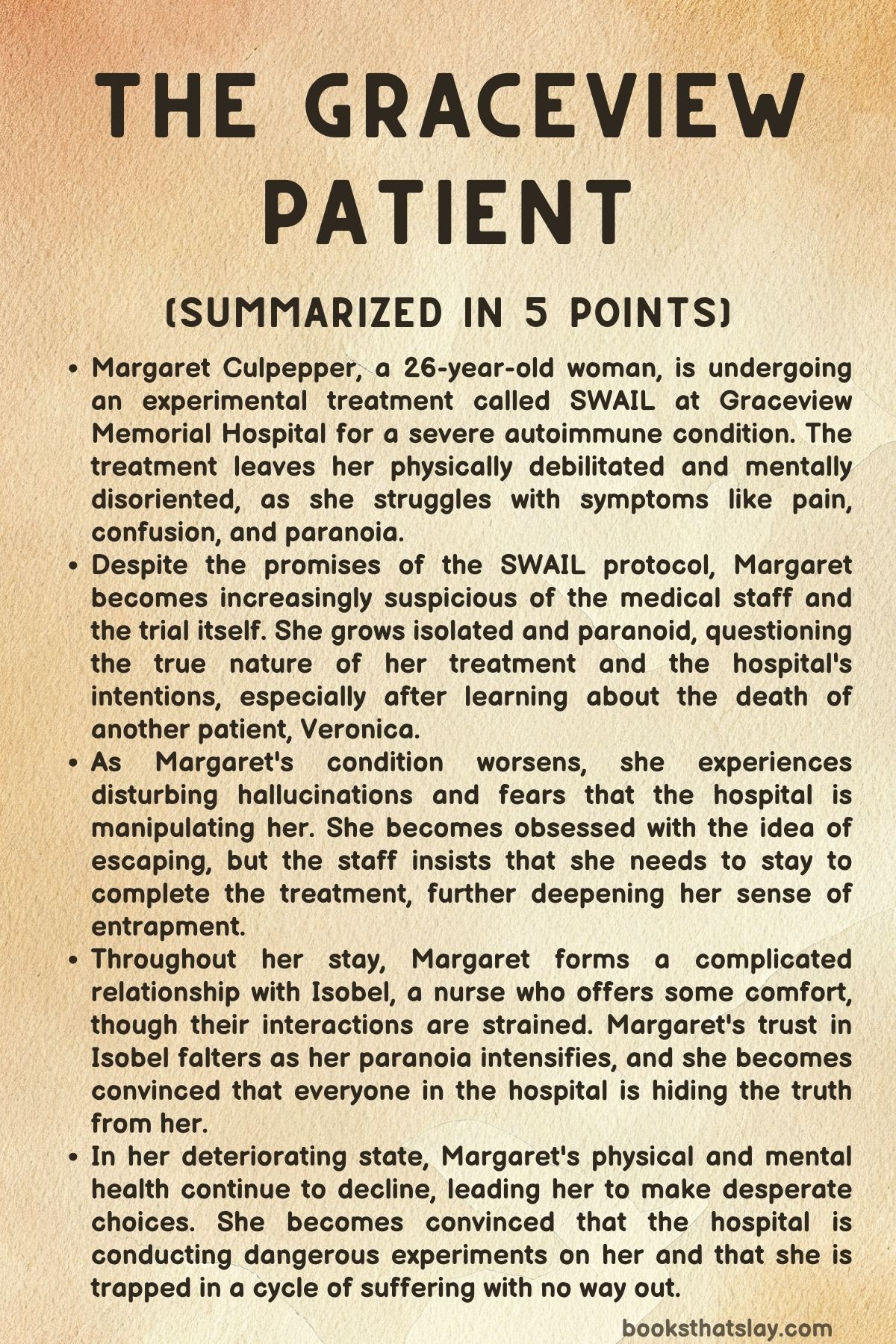
The Graceview Patient by Caitlin Starling is a psychological thriller set in the confines of a hospital, where the protagonist, Margaret Culpepper, is undergoing experimental treatment for a severe autoimmune disorder. Margaret’s physical and emotional turmoil is compounded by the mysterious side effects of the experimental drug, SWAIL.
As she struggles with the confusing and isolating nature of her treatment, she becomes increasingly paranoid, questioning the true motives of the medical staff and the intentions behind the trial. The story explores themes of trust, isolation, the blurring of reality, and the emotional and psychological impacts of being a patient in an experimental setting.
Summary
Margaret Culpepper, a 26-year-old patient at Graceview Memorial, is undergoing an experimental treatment called SWAIL for Fayette-Gehret syndrome, a rare autoimmune disease. She has been in the hospital for seven weeks and is experiencing a worsening of her condition due to the aggressive nature of the treatment.
The SWAIL protocol aims to rebuild her immune system, but the process involves destroying it first, leaving her physically and mentally debilitated. Margaret’s treatment is complex, and she endures a range of symptoms, including joint pain, nausea, confusion, paranoia, and seizures.
The hospital staff, though attentive, seem detached, reducing Margaret to a collection of medical numbers and measurements.
Four weeks into the treatment, Margaret starts showing symptoms of tuberculosis, which further weakens her already fragile body. The doctors administer antibiotics, but her health continues to decline, and she feels increasingly disconnected from reality.
Her sense of time becomes distorted, and the routine of the hospital, while offering some structure, only deepens her sense of alienation. Margaret resents being treated as a medical case rather than as a person and grows more frustrated with her situation.
The SWAIL treatment, which was introduced to Margaret by her rheumatologist, was initially presented as a possible solution to her deteriorating condition. Though she was skeptical, her declining health made her desperate for a cure, and she agreed to participate in the trial.
The treatment would require her to stay in the hospital for an extended period, and she was informed that the process would be arduous, with significant risks. Despite her doubts, Margaret decided to take part, hoping for a chance at recovery.
In the hospital, Margaret contemplates her worsening condition and reflects on her initial sense of hope regarding the treatment. Over time, however, that hope diminishes as she begins to feel more like an object under the control of the medical team.
The small comforts of the hospital, such as the softness of the pillows and the privacy of her room, offer little solace in the face of her physical pain and emotional distress. Margaret feels isolated, as her illness is rare, and few people truly understand her struggles.
Margaret’s mother frequently calls, offering support, but Margaret finds these interactions emotionally draining and prefers to distance herself. Her mother’s concern feels overwhelming, and Margaret becomes more withdrawn.
Despite the gravity of her situation, Margaret feels unable to connect with her family or the medical professionals around her. This sense of emotional disconnection is compounded by the physical toll of her illness and the side effects of the treatment.
Among the staff, Margaret encounters Adam Marsh, a pharmaceutical company representative overseeing the SWAIL protocol. Adam is kind and brings her flowers, engaging in light conversation to provide some emotional comfort.
Despite his professional role, Margaret feels drawn to him, though she remains aware of the boundaries between them. Another patient in the hospital, Veronica, is also undergoing the SWAIL treatment.
Veronica’s condition is more stable, which causes Margaret to feel both relief and envy, as she is uncertain of what the future holds for her.
As time passes, Margaret’s condition fluctuates. She feels increasingly confused, isolated, and disconnected from her surroundings.
Her physical pain intensifies, and she begins to fear that her fate may mirror Veronica’s. Veronica’s condition worsens, and Margaret witnesses firsthand the brutal toll the SWAIL treatment takes on patients.
Veronica’s physical decline is rapid, and Margaret becomes more apprehensive about her own fate. Despite the kindness shown by some hospital staff, Margaret remains unsure if the treatment is worth the suffering it inflicts.
One day, Veronica suffers a seizure, and Margaret, feeling compelled to help, sneaks out to the hospital garden to gather flowers for her. When she returns, Veronica is unresponsive, and the medical staff rushes to assist.
Margaret learns that Veronica’s seizure was a side effect of the SWAIL treatment, and though Adam reassures her that such reactions are normal, she is deeply disturbed by the experience.
Margaret’s condition continues to worsen. She experiences a blood clot, which adds to her growing list of medical issues.
Her mind begins to drift in and out of clarity, and she becomes increasingly paranoid about her treatment and the motives of the hospital staff. She begins to distrust everyone, especially after learning of Veronica’s death.
Margaret’s emotional turmoil intensifies as she grapples with feelings of isolation and fear. She becomes obsessed with the idea that the medical team is concealing the truth from her, and she starts to question the legitimacy of the SWAIL protocol and the hospital’s intentions.
As Margaret’s physical health deteriorates, her emotional and psychological state becomes even more fragile. She feels trapped in a cycle of medical interventions, unable to escape the constant treatments and tests.
The hospital, once a place of potential healing, now feels like a prison, and Margaret becomes convinced that she is being used as a test subject in a larger experiment. Her paranoia deepens, and she begins to suspect that the medical staff is withholding crucial information from her.
Despite the growing sense of dread, Margaret remains committed to the treatment, hoping that it will eventually offer a solution, even though it is difficult to believe in its success. She becomes increasingly disoriented, her mind clouded by the effects of the treatment, and she begins to question what is real and what is a product of her deteriorating mental state.
Margaret’s journey is one of physical suffering, emotional disintegration, and the terrifying uncertainty of being trapped in an experimental trial that may not offer the cure she so desperately needs.
Characters
Margaret Culpepper
Margaret Culpepper is a 26-year-old woman struggling with a debilitating illness that has forced her into a harsh and isolating medical environment. Participating in the experimental SWAIL protocol for a rare autoimmune disease, Margaret’s health rapidly deteriorates due to the aggressive nature of the treatment.
Her physical condition is marked by a series of painful and frightening symptoms, including nausea, joint pain, confusion, and seizures. Emotionally, Margaret faces an intense internal battle as she grapples with the gradual loss of her identity, feeling like she is being reduced to nothing more than a medical case number in the sterile environment of the hospital.
This treatment is supposed to offer hope but only seems to trap her in a cycle of worsening health, emotional turmoil, and a growing sense of paranoia.
Her internal conflict is exacerbated by the hospital’s detached and impersonal treatment approach. She is frequently surrounded by medical professionals, yet she feels increasingly alienated, unable to connect with those who are supposed to help her.
While her mother expresses concern and calls frequently, Margaret seeks distance, overwhelmed by the emotional burden these interactions bring. Margaret’s growing distrust in the medical staff further isolates her, and she becomes obsessed with the idea that the hospital and its treatments are contributing to her decline, rather than aiding her recovery.
As she witnesses the decline of another patient, Veronica, Margaret becomes consumed with fear about her own fate. Her paranoia peaks when she uncovers unsettling truths about the hospital’s protocols, and she begins to see the institution as an oppressive, living entity.
Despite these fears, Margaret holds onto a glimmer of hope, still believing that the treatment might ultimately provide a solution, though she remains trapped in an emotional and physical prison.
Adam Marsh
Adam Marsh, a pharmaceutical representative overseeing the SWAIL protocol, plays a key role in Margaret’s experience at the hospital. Though he appears professional and caring, bringing Margaret flowers and engaging in light conversation, his true role is that of an enforcer of the hospital’s clinical practices.
Adam reassures Margaret when she is troubled, especially regarding the side effects of the SWAIL treatment, including the disturbing developments in Veronica’s condition. However, Margaret’s increasing suspicion and paranoia lead her to question Adam’s true intentions.
Is he genuinely concerned about her well-being, or is he simply fulfilling his duties as a pharmaceutical representative, detached from the deeper emotional consequences of the trial?
Throughout Margaret’s emotional unraveling, Adam remains a calm, reassuring figure, yet this detachment becomes unsettling to her. Margaret begins to distrust not only the medical staff but also Adam, feeling that he, like the hospital, is part of a system that manipulates patients for its own purposes.
This relationship, though outwardly helpful, reveals a deeper tension in Margaret’s mind, where every gesture of kindness or reassurance is met with suspicion. Adam’s calm demeanor contrasts sharply with Margaret’s growing anxiety, and as her paranoia deepens, his role in the unfolding medical experiment becomes more ambiguous and unsettling.
Veronica
Veronica, another patient undergoing the SWAIL treatment, serves as a significant figure in Margaret’s journey. Initially, Veronica’s condition seems more stable compared to Margaret’s, which brings her a fleeting sense of relief and envy.
However, as time passes, Margaret witnesses Veronica’s rapid decline, which becomes a harrowing reminder of the harsh realities of the SWAIL treatment. Veronica’s deterioration, culminating in a seizure, marks a turning point for Margaret.
The sight of Veronica’s helplessness and the eventual revelation of her death amplifies Margaret’s fear and uncertainty about her own fate.
In the hospital’s rigid and clinical environment, Veronica’s death stands as a stark warning for Margaret, highlighting the precariousness of her situation. Veronica’s death forces Margaret to confront the frightening possibility that the treatment may not be a cure at all, but rather a harrowing path toward a fate she may not escape.
As Margaret’s mental state deteriorates, she becomes fixated on Veronica’s fate, seeing it as a precursor to her own potential demise. Veronica’s suffering becomes a mirror, reflecting Margaret’s deep fears and the growing realization that the treatment, which she once believed might offer hope, is instead exacerbating her suffering.
Isobel
Isobel, one of Margaret’s nurses, represents a source of comfort amidst the chaos and isolation of the hospital. Despite the impersonal nature of the medical environment, Isobel’s occasional acts of kindness, such as offering Margaret a moment of human connection, provide brief respite from the otherwise sterile atmosphere.
However, as Margaret’s paranoia grows, her perception of Isobel becomes more complex. Margaret begins to see Isobel not just as a nurse, but as a symbol of the dangers within the hospital system.
Her initial reliance on Isobel shifts into a more complicated, ambivalent relationship, where Margaret is both dependent on her care and resentful of the way the hospital system reduces her to a patient in need of constant supervision.
As Margaret’s mental state worsens, she experiences an emotional dependency on Isobel, compounded by the growing fear that Isobel is not as trustworthy as she once believed. In her delirium, Margaret begins to feel a strange mix of affection and resentment toward Isobel, whose role in the hospital is at once comforting and suffocating.
This internal struggle intensifies when Margaret becomes convinced that Isobel is part of a larger system of control, and that the nurse’s care is ultimately a tool of manipulation. In a moment of extreme delirium, Margaret makes a drastic decision, attempting to help Isobel by transferring her own blood to her, in a misguided effort to reverse Isobel’s deteriorating condition.
This act, born of confusion and desperation, ultimately symbolizes Margaret’s growing isolation, her increasing distrust in the system, and her complete loss of agency within the hospital’s control.
Themes
Isolation and Disconnection
Throughout The Graceview Patient, the theme of isolation is central to Margaret’s experience in the hospital. From the moment she enters the medical institution, she is immersed in a sterile, clinical environment where the staff seems to view her as a mere subject in a trial rather than as a person with emotions and individuality.
This creates an overwhelming sense of disconnection for Margaret, as her humanity is reduced to a series of medical procedures, numbers, and data points. The more time she spends in the hospital, the more she finds herself physically and emotionally alienated from the world around her.
Her relationships with those closest to her, especially her mother, become strained, as Margaret distances herself from emotional support that feels both suffocating and unhelpful.
Her physical suffering is compounded by the emotional isolation of the hospital environment. Though she interacts with medical staff, including Isobel and Adam, these exchanges are often impersonal and filled with professional boundaries that prevent deeper connections.
Margaret’s growing paranoia and confusion add to this sense of isolation, as she no longer trusts the people around her and becomes increasingly disconnected from reality. The hospital, which should be a place of healing, instead amplifies her feelings of loneliness and despair.
Margaret’s struggle to maintain any semblance of control over her situation only deepens this sense of isolation, making it clear that, despite the presence of others, she is truly alone in her battle.
Margaret’s emotional detachment is further exacerbated by the fact that her body is deteriorating in ways that are beyond her comprehension. As she watches fellow patients like Veronica deteriorate, she realizes that her fate might be similarly grim, making her feel even more estranged from others who cannot understand her internal struggle.
Her isolation, therefore, is not only physical but also existential, as she grapples with the existential questions of survival, illness, and identity while surrounded by people who are either indifferent or incapable of truly understanding her plight.
Trust and Betrayal
Another key theme explored in The Graceview Patient is the issue of trust and betrayal, particularly within the medical system. At the beginning of her treatment, Margaret places some level of trust in the medical professionals and the experimental SWAIL protocol, despite her doubts.
However, as her physical and emotional state deteriorates, her faith in the system begins to erode. The medical staff, while performing their roles with apparent competence, seem detached from the human aspect of her experience.
The emotional coldness with which they interact with her and their clinical treatment of her as a mere subject in a trial heightens Margaret’s sense of betrayal.
This feeling of betrayal is intensified when Margaret starts to perceive that the hospital is not merely treating her illness but is, in fact, manipulating her for unknown or unethical purposes. Her suspicions about the treatment grow stronger, especially as she witnesses Veronica’s decline and eventual death.
Margaret begins to distrust the doctors, nurses, and even Adam, the pharmaceutical representative, who had once seemed like a source of comfort. When she learns of Veronica’s death, her fears intensify.
The supposed safety and hope that the trial offered her begin to feel like lies, and she is left questioning whether her participation was a mistake. She grows paranoid, convinced that the entire system is designed to deceive and exploit her.
The betrayal here is not just from the medical staff, but from the very treatment that was supposed to heal her, leaving her in a state of confusion and emotional turmoil.
Moreover, as Margaret becomes more disoriented, she starts to see the hospital itself as an entity conspiring against her. Her belief that the walls are alive and that the hospital is a living organism reflects her perception of a deep betrayal, where even her surroundings are complicit in her suffering.
The theme of trust and betrayal, therefore, not only encompasses Margaret’s relationship with the medical staff but also her struggle to trust her own perceptions, as her physical and mental state deteriorates.
The Human Condition and Survival
The theme of survival is explored in The Graceview Patient through Margaret’s battle with both her physical illness and the psychological toll of the treatment. Margaret’s participation in the SWAIL protocol represents her desperation to survive, as she clings to the possibility that the treatment might offer her a cure for her debilitating condition.
However, as the treatment progresses, she is faced with the grueling reality of survival at any cost. The treatment, though meant to rebuild her immune system, leaves her debilitated, confused, and isolated, raising the question of whether survival is truly worth the price it demands.
Margaret’s fluctuating health—marked by periods of deterioration and brief moments of improvement—reflects the fragile nature of human survival. Her internal struggle is not just a battle with disease but also with the emotional and psychological effects of being trapped in a system that she cannot escape.
As she witnesses the slow decline of Veronica and fears for her own future, she becomes increasingly aware of the precariousness of life itself. Her journey is not just about physical survival, but about the cost of that survival.
As she becomes more disconnected from herself and others, Margaret begins to question what it means to live—whether simply continuing to exist in a state of suffering is worth the toll it takes on her identity, her mind, and her spirit.
This theme is further explored through Margaret’s relationship with the hospital staff and her perception of their motivations. Are they truly trying to help her, or are they simply using her as a test subject?
The uncertainty surrounding her treatment, and the sense that she is being treated as an object, forces Margaret to question the value of survival when it comes at such a heavy emotional and psychological price. Her struggle becomes a larger commentary on the human condition, where survival is often seen as the ultimate goal, but the cost of that survival can sometimes be more than one can bear.
Mental and Emotional Struggles
The Graceview Patient also heavily delves into the mental and emotional struggles that accompany illness, particularly when the body deteriorates beyond the individual’s control. Margaret’s physical symptoms—severe pain, confusion, and fatigue—are not the only challenges she faces.
The psychological toll of being in the hospital, receiving aggressive treatment, and feeling like a subject in a trial overwhelms her mental state. Her disconnection from reality, her increasing paranoia, and her sense of helplessness are integral parts of her emotional journey.
As the effects of the SWAIL protocol worsen, Margaret’s mental state becomes increasingly unstable. She begins experiencing hallucinations and distorted perceptions, struggling to distinguish between what is real and what is a product of her deteriorating mind.
Her emotional responses, ranging from fear to anger and confusion, reflect the deep psychological cost of her treatment. She feels trapped in an environment where her every move is monitored, and the people around her either don’t understand or seem indifferent to her internal turmoil.
The hospital, which is supposed to be a place of healing, instead becomes a prison for Margaret’s mind, amplifying her emotional suffering.
Her emotional struggles are also shaped by her relationships, or the lack thereof, with the hospital staff. Though some of the staff offer her comfort, their actions are often professional and detached, further deepening her emotional isolation.
She becomes fixated on her connections with people like Isobel and Adam, yet these relationships are fraught with complexity. Isobel, in particular, represents both a source of comfort and a symbol of Margaret’s growing dependence on the very system that is causing her distress.
These emotional struggles, combined with her physical suffering, create a profound sense of disillusionment as Margaret is forced to confront the toll that illness, treatment, and survival take on the human psyche.