The Grand Paloma Resort Summary, Characters and Themes
The Grand Paloma Resort by Cleyvis Natera is a powerful exploration of wealth, inequality, and survival set against the deceptive paradise of a luxury resort in the Dominican Republic. Behind the resort’s polished image and manicured beauty lies a world of exploitation, moral compromise, and buried trauma.
The story follows three women—Laura, her younger sister Elena, and Vida—whose lives intersect in the shadows of privilege and desperation. When a tourist child is injured under mysterious circumstances, their choices set off a chain of events exposing corruption, colonial legacies, and the hidden costs of aspiration. Natera delivers a layered, human story about accountability, family, and the pursuit of freedom in a world built on unequal power.
Summary
The story begins with a shocking image: Elena, a seventeen-year-old babysitter, staggering out of the forest carrying the unconscious body of a tourist child from the exclusive Grand Paloma Resort. Mud-covered and terrified, she sneaks into the staff quarters where she lives with her sister Laura, a senior manager at the resort.
When the child shows no signs of waking, Elena desperately calls for help. Laura, occupied with work, ignores her pleas until she hears the words “the girl from PH7”—a reference to a wealthy guest’s villa.
Realizing the seriousness of the situation, Laura rushes back, bringing Vida, a local healer, to secretly treat the child. Vida performs a draining ritual that revives the girl but weakens her and endangers her unborn baby.
Laura insists the incident stay hidden, terrified of a scandal that could ruin her career and the resort’s image of perfection.
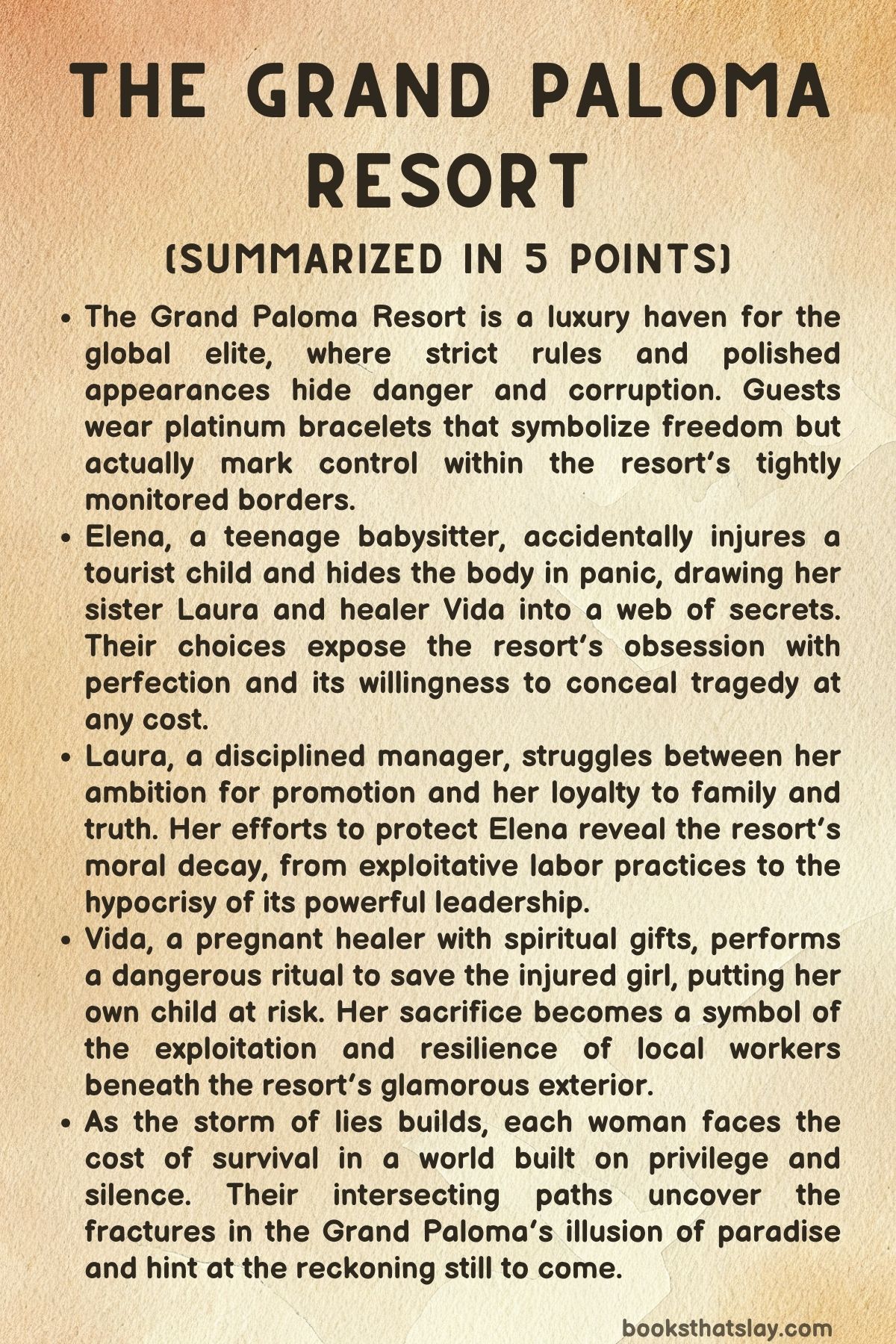
The Grand Paloma Resort itself is both magnificent and menacing. Its guests wear platinum bracelets symbolizing supposed freedom, but every moment of their stay is tightly monitored.
Employees like Laura and Elena live under constant pressure to meet impossible standards while concealing the darker realities beneath the resort’s glossy surface. The motto, “Welcome, you Parasites,” hacked into the resort’s digital welcome message, hints at an underlying rebellion against its hypocrisy.
As Laura tries to balance her professional duties with her family crisis, she is reminded of her precarious position. She manages the Platinum Member Companion Program, which rewards staff for pampering elite guests yet prevents their advancement.
Her boss, Miranda, orders her to promote one worker to create a façade of opportunity, and Laura chooses Pablo, a loyal employee with a complicated history with both sisters. Laura dreams of transferring to Lisbon and escaping the resort’s suffocating control, but class and racial barriers constantly remind her of her limits.
Meanwhile, Elena’s guilt consumes her. Believing the injured child may have died, she spirals into panic and despair.
When Laura finds her near a waterfall where their mother once drowned, the moment echoes their family’s painful past. Trying to jolt her sister into responsibility, Laura cruelly tells Elena the girl didn’t survive.
The lie pushes Elena to flee, terrified she’ll be blamed. Laura reluctantly helps her escape the resort, and they part on a cliffside road, haunted by memories of loss and longing.
Back at the resort, Vida recovers from the spiritual ritual and watches as the tourist girl wakes and runs off unharmed, unaware of the chaos she has caused. Laura rushes to confirm the girl’s safety, encountering her negligent, wealthy parents who embody the resort’s moral decay.
In their lavish suite, Laura discovers disturbing signs of excess and depravity. To avoid further scandal, she arranges for the family’s transfer to another Paloma property, the Yellow Paloma.
She leaves shaken but determined to protect her sister, sending Elena a warning to “move fast.
Elena, hiding at a seaside bar called Beyond Proof, seeks refuge with her friend Dulce, who runs the place as a front for sex work. Desperate for money, Elena contemplates selling herself.
When the tourist father from the accident arrives and makes vile suggestions about Dulce’s young daughters, Elena tricks him into paying her a large sum of cash. She takes his money and car, urging the girls to flee, but ultimately drives away alone, guilt-ridden and uncertain of their fate.
As a storm brews over the island, chaos spreads. Laura and Dulce search for the missing girls, discovering Elena’s involvement through surveillance footage.
Dulce’s grief turns to fury, and Laura drugs her to prevent a violent confrontation. When Laura later finds one of the girls’ shirts washed up on shore, the truth hits her—something terrible has happened.
At the same time, Pablo, now escorting the tourist family to the Yellow Paloma, becomes entangled in their debauchery and moral corruption. Vida suffers a miscarriage triggered by her earlier ritual, haunted by visions of her dead mother and warnings of danger.
In London, Elena—now calling herself “Lena”—tries to rebuild her life with her glamorous friend Socorro. She attempts to suppress her past, but memories of Dulce’s daughters haunt her.
When Pablo calls and tells her the tourist’s child survived while the two local girls are missing, her relief turns to horror. Overwhelmed by guilt, she vows to return and make amends.
Back in the Dominican Republic, Vida finds the missing girls alive, hiding in the mountains with villagers who sheltered them. She and Pablo reunite, and together they bring the girls back to safety.
Laura, managing the crisis at the resort, helps evacuate survivors after a hurricane devastates the area. Dulce and her partner Fabien are reunited with their daughters, though the trauma lingers.
Meanwhile, the resort’s ownership changes hands. The new buyers, Ida and Amber Vargas, plan to transform the property into a nature reserve that restores land to local communities, breaking from the exploitative Paloma model.
Miranda, Laura’s manipulative boss, informs her that the company has no place for her anymore, blaming her for the chaos. Laura and Elena are given a chance to start over in Mallorca by the Vargas sisters, while Dulce offers a conditional truce: if they leave the country forever, she won’t pursue charges.
Before they go, she gives Laura a bottle of deadly liquor called Beyond Proof, hinting at revenge or justice yet to come.
In Mallorca, the sisters begin a quieter life. Elena inherits the responsibility of preserving their family’s ancestral history through an archive once guarded by Doña Fella, symbolizing redemption and continuity.
Laura, however, cannot escape the past. On a business trip to New York, she recognizes the tourist father—now revealed as a serial predator—and decides to end the cycle of impunity.
She poisons his drink, warning him not to take another, but he ignores her, strikes her, and leaves. Laura departs, knowing justice has finally been served, even at great personal cost.
The novel closes with renewal and transformation. The Grand Paloma Resort becomes a sanctuary, rebuilt as a refuge for displaced and persecuted people.
The once-oppressive grounds now host farms, homes, and schools. Vida and Pablo marry and welcome a daughter, joined in celebration by Laura and Elena.
The women, once trapped by fear and exploitation, now stand together in a space reclaimed from greed and corruption, committed to building a freer, more humane world from the ruins of paradise.
Characters
Laura Moreno
Laura Moreno stands at the center of The Grand Paloma Resort, embodying the tension between ambition and moral compromise. As an Afro-Latina manager overseeing the Platinum Member Companion Program, Laura is a woman shaped by labor, discipline, and the weight of survival.
Her professionalism and composure mask a deep vulnerability—born of years spent navigating racism, classism, and sexism within a corporate system that thrives on exploitation. She has learned to wear deference as armor, projecting politeness to superiors like Miranda while exercising control and authority over the Dominican staff beneath her.
Beneath this mask, however, lies exhaustion and resentment, both toward her employers and the system that forces her to perform subservience to succeed.
Laura’s relationship with her younger sister, Elena, exposes her conflicting roles as protector and enforcer. She oscillates between maternal care and authoritarian cruelty, driven by the guilt of their mother’s death and the fear that Elena’s recklessness will ruin them both.
Her decision to hide the child’s accident and manipulate the aftermath reveals the moral erosion that power inflicts. Yet by the novel’s end, Laura undergoes a transformation—from the resort’s compliant servant to a woman willing to confront her complicity and reclaim her moral agency.
Her actions, including the ambiguous poisoning of the predatory tourist, mark a reckoning: Laura is both victim and perpetrator, shaped by systems of control yet ultimately capable of defiance.
Elena Moreno (Lena)
Elena Moreno, or “Lena” as she later calls herself, represents innocence corrupted by the same forces that ensnare her sister. At seventeen, she is impulsive, idealistic, and yearning for escape—from poverty, from control, and from the suffocating expectations of family.
Her descent into chaos begins with the accident that injures the tourist child, an event that becomes both literal and symbolic—her fall from naivety into guilt and moral compromise. Her relationship with Laura reveals her defiance and fragility; she resents Laura’s authority yet longs for her approval.
Elena’s later flight to London underlines her desire for reinvention. Adopting a new name, she clings to the illusion of freedom even as guilt and dislocation haunt her.
Elena’s choices throughout the novel—fleeing the country, abandoning Dulce’s daughters, and facing exile—reflect the consequences of systemic exploitation. Her guilt is not just personal but generational; she inherits the burdens of colonialism, class disparity, and gendered violence that define the world of the resort.
In her final arc, when she accepts her role as the secret-keeper of Pico Diablo, Elena’s transformation becomes one of reconciliation. She evolves from a frightened girl running from her past into a guardian of memory, symbolizing the possibility of redemption through truth and preservation.
Vida
Vida is the moral and spiritual conscience of The Grand Paloma Resort. A curandera—a healer rooted in Afro-Indigenous traditions—she bridges the natural and supernatural, the living and the ancestral.
Pregnant and overworked, Vida’s healing of the injured tourist child is both a physical and spiritual act that binds her to the other women. Her power, drawn from generations of women before her, exposes the contrast between authentic spirituality and the resort’s commodified “wellness.
” While the resort sells faux tranquility to the wealthy, Vida’s healing carries real cost: her body weakens, her pregnancy is endangered, and her spirit becomes burdened by the pain she absorbs from others.
Throughout the story, Vida remains a symbol of resilience and integrity. Her connection to the land and community stands in opposition to the resort’s corruption and exploitation.
Even in suffering, she chooses empathy and service over self-preservation. By the novel’s conclusion, her reunion with the rescued children and her marriage to Pablo signify healing—not only of her own wounds but of the fractured community.
Vida’s baby, celebrated by the survivors, becomes a living emblem of renewal, continuity, and hope for a future untainted by the greed of the Grand Paloma.
Pablo
Pablo is a man caught between worlds—between servitude and rebellion, morality and survival. A resort driver and former lover of Vida, he moves through the novel as a silent witness to its hypocrisies.
To the management, he is a dependable worker; to his peers, he is both admired and feared for his connections to illicit dealings. His relationship with Laura is professional yet transactional—he becomes the token figure for promotion, a hollow symbol of diversity within a system built on exploitation.
Beneath his stoicism lies a deep longing for respect and freedom.
Pablo’s encounters with the wealthy guests reveal his quiet defiance. His willingness to protect others—even when forced into degrading situations—speaks to his complex sense of duty.
The traumatic sexual encounter with Sophie and her husband at the Yellow Paloma marks the nadir of his moral entrapment, exposing the dehumanization that the resort’s hierarchy perpetuates. Yet, his later actions—risking his life to find Dulce’s daughters, reconciling with Vida, and assuming a leadership role in the reformed sanctuary—redeem him.
Pablo emerges as one of the few male characters capable of growth, embodying the struggle to reclaim dignity in a world designed to strip it away.
Dulce
Dulce, the pragmatic bar owner and mother of two daughters, embodies the harsh choices women in marginalized economies must make to survive. Her bar, Beyond Proof, serves both as a social hub and a front for sex work—an enterprise born not of vice but necessity.
She operates within moral gray zones, navigating exploitation with cunning and courage. When her daughters disappear, Dulce transforms from a hustler into a grieving, vengeful mother.
Her rage and sorrow expose the human cost of systemic neglect, as her private pain collides with the resort’s public image.
By the end, Dulce wields power of her own. Her ultimatum to Laura and Elena—leave the country and never return—demonstrates both vengeance and mercy.
She becomes the voice of accountability, demanding justice where institutions have failed. Dulce’s character arc mirrors the evolution of the community itself: from subjugation to self-determination, from silence to power.
Miranda
Miranda, the American executive overseeing the Grand Paloma, personifies corporate hypocrisy. She is polished, articulate, and ruthless, her empathy extending only as far as public image allows.
To Laura, she plays the role of mentor, dangling the promise of promotion abroad, yet privately belittles her. Miranda’s manipulation of local workers—rewarding obedience while denying advancement—reflects the colonial dynamics underlying the resort’s operations.
Her presence serves as a mirror for global capitalism: seductive on the surface, predatory underneath.
Even in her absence, Miranda’s influence looms large. She orchestrates a system that pits women against each other while profiting from their labor.
When the resort is sold, her callousness toward Laura’s displacement exposes the emptiness of corporate loyalty. Through Miranda, the novel critiques how global elites sustain luxury by exploiting the dispossessed, transforming paradise into a prison.
Sophie and Her Husband
The tourist couple, Sophie and her husband, are grotesque caricatures of privilege and moral decay. Their negligence toward their daughter, indulgence in substances, and participation in sexual exploitation illustrate the rot beneath wealth.
They treat the Dominican staff as disposable service providers, reinforcing colonial hierarchies through casual cruelty. The husband’s predatory behavior—particularly toward Dulce’s daughters—embodies the ultimate violation of innocence and power imbalance.
Sophie, though complicit, is portrayed with shades of guilt and insecurity, revealing her own entrapment within patriarchal structures of privilege.
Their presence in the novel serves as a haunting reminder that the true danger does not lie beyond the resort’s walls but within them. Their crimes—sexual, emotional, and moral—catalyze the collapse of the Grand Paloma’s illusion of paradise.
Doña Fella
Doña Fella, the elder guardian of Pico Diablo, represents ancestral wisdom and the preservation of cultural memory. Rooted in the land’s history, she holds knowledge of the community’s origins as a refuge for survivors of the Parsley Massacre.
Her guidance of Elena and her care for the rescued girls link the past to the present, ensuring that trauma becomes testimony rather than silence. Passing the tin archive to Elena symbolizes the transfer of responsibility across generations.
Doña Fella’s presence sanctifies the novel’s closing vision—a reclamation of identity and heritage from the ruins of exploitation.
The Vargas Sisters (Ida and Amber)
Ida and Amber Vargas, the wealthy investors who purchase the Grand Paloma, stand as paradoxical figures of salvation and suspicion. As long-time guests turned reformers, they envision transforming the resort into a sanctuary and nature reserve.
Their plan to return land to locals suggests restitution, yet their power still stems from inherited wealth. Through them, the novel interrogates whether ethical capitalism can exist at all.
Their offer to Laura and Elena to start anew in Mallorca represents both escape and erasure—a second chance built upon the ghosts of those left behind.
Themes
Power, Exploitation, and the Illusion of Freedom
The Grand Paloma Resort stands as a metaphor for the global systems of exploitation disguised as luxury and opportunity. The platinum bracelets that guests wear, marketed as symbols of freedom, ironically represent their confinement within a manicured, controlled paradise.
The same irony extends to the employees—especially Laura and Elena—whose apparent privileges and “rewards” mask deeper forms of servitude. Laura’s position as a middle manager exposes the double bind faced by marginalized individuals who rise within oppressive hierarchies; she polices others to maintain her place, internalizing the resort’s demand for silence and perfection.
The resort’s motto, “Welcome, you Parasites,” underscores the inversion of moral reality—it is not the laborers but the wealthy guests who drain life and dignity from the land and its people. The institution’s gleaming façade hides a rotting foundation of racism, classism, and gender inequality.
Every gesture of service, every rule of conduct, reinforces dependence and fear. Through this controlled world, Cleyvis Natera shows how exploitation evolves beyond chains and contracts—it thrives through luxury, aspiration, and the illusion of choice.
Sisterhood, Guilt, and the Cost of Ambition
The fractured bond between Laura and Elena becomes a powerful emotional current, reflecting the ways ambition and guilt corrode familial ties. Laura’s desire to ascend the corporate ladder mirrors her internalized belief that survival depends on assimilation and discipline.
Elena, in contrast, embodies resistance—reckless, idealistic, and unwilling to accept the moral compromises that sustain the resort’s machinery. Their mother’s drowning shadows both women, symbolizing the generational trauma of sacrifice and silence.
Laura’s choice to lie to her sister about the child’s death reflects not cruelty but the moral numbness born from ambition. Her lie becomes a catalyst for Elena’s flight, guilt, and eventual search for redemption.
By the end, their reconciliation in exile shows that survival demands not ambition but solidarity. Natera’s portrayal of sisterhood is unsentimental—it is love strained by class aspiration and shame, where forgiveness comes only after both women confront the price of their complicity.
Corruption of Innocence and the Violence of Privilege
The injured tourist child—first seen as a victim—becomes a haunting emblem of the moral sickness at the heart of The Grand Paloma Resort. Her survival exposes not healing but hypocrisy: the resort’s management suppresses truth to protect reputation, while the child’s family embodies the depravity behind wealth.
Innocence, whether embodied by children or by young workers like Elena, is continually corrupted by the predatory behavior of the privileged. When the tourist father propositions Elena with implications of child exploitation, Natera reveals how systemic impunity shields the powerful while criminalizing the powerless.
Even the spiritual purity of Vida’s healing ritual becomes tainted when her unborn child absorbs the suffering of another. Innocence cannot survive in an environment built on exploitation—it is traded, silenced, or transformed into guilt.
The novel’s unflinching portrayal of violence—physical, sexual, and emotional—forces the reader to confront the moral decay beneath the surface of wealth and leisure.
Colonial Legacy and the Question of Belonging
The Dominican setting of The Grand Paloma Resort is more than backdrop; it embodies the enduring legacy of colonialism, where tourism becomes the new empire. The resort’s foreign investors and managers represent the persistence of economic domination, while the local workers perform emotional and physical labor that keeps the illusion of paradise intact.
The novel reimagines colonial exploitation through modern corporate structures—contracts instead of chains, performance reviews instead of punishments. Even the landscape bears scars of conquest, from Pico Diablo’s hidden histories to the artificial perfection of Paloma’s beaches.
The revelation that the Moreno family descends from survivors of the Parsley Massacre binds personal suffering to historical trauma. Laura and Elena’s journey from subjugation to liberation mirrors a national struggle for self-definition.
Their eventual departure and the creation of a sanctuary rooted in justice mark an act of decolonization—a symbolic reclaiming of land, history, and identity from those who commodified it.
Redemption, Resistance, and the Reclamation of Humanity
In its final movement, The Grand Paloma Resort transforms from a story of decay into one of renewal. After enduring systemic oppression, guilt, and personal loss, the characters turn toward acts of moral restoration.
Vida’s healing, Pablo’s repentance, and Elena’s decision to face justice signal a collective awakening. The transformation of the resort into a sanctuary for displaced and persecuted people completes this arc of redemption, reclaiming the land’s purpose from exploitation to healing.
Laura’s confrontation with the tourist predator serves as her private reckoning; it is both vengeance and liberation from passivity. The rebirth of Pico Diablo as a refuge suggests that resistance is not only possible but necessary—that dignity can grow even from the ruins of corruption.
Natera’s vision of redemption resists simplicity; forgiveness does not erase wrongdoing, but acknowledgment of pain becomes the foundation of a new moral order. Through this ending, the novel insists that survival alone is not enough; true freedom lies in the reclamation of humanity from the systems designed to destroy it.