The Ha-Ha by Jennifer Dawson Summary, Characters and Themes
The Ha-Ha by Jennifer Dawson is a psychological novel told through the sharp, odd, often funny perceptions of Josephine Traughton, a young woman recovering in a mental hospital. Josephine’s mind keeps slipping sideways: ordinary rooms turn strange, conversation rules don’t stay fixed, and laughter arrives at the worst possible moments.
From the locked rhythms of Gardenwell Park to the half-freedom of a job in town, she tries to work out what “being well” is supposed to look like. The book watches her face love, memory, shame, and institutional control, and asks what gets lost when a person learns to fit in.
Summary
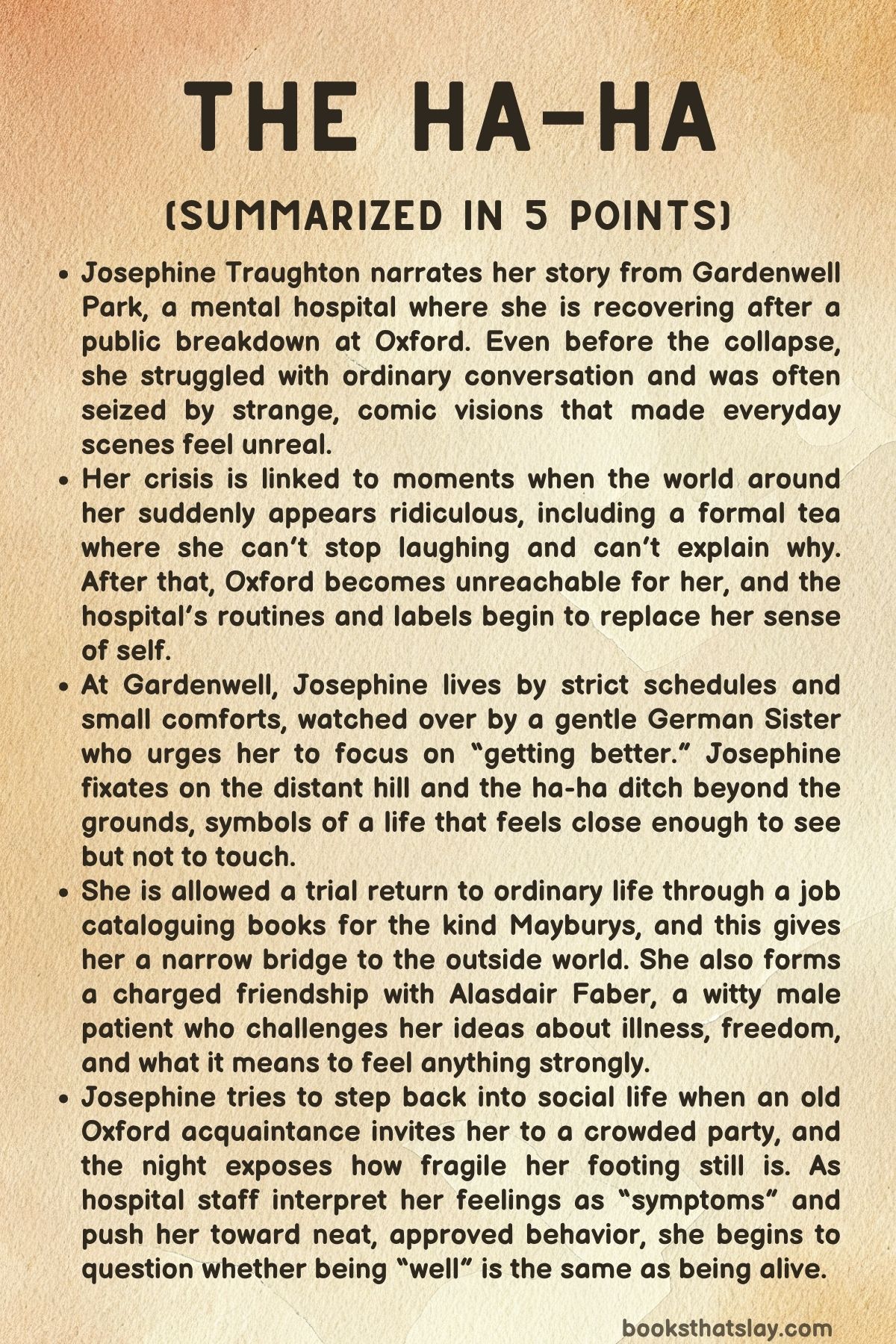
Josephine Traughton is a patient at Gardenwell Park, a mental hospital where days are arranged by bells, prayers, routines, and supervision. From a small side-room she looks back on how she got there.
Before the hospital, she was a student at Oxford, intelligent and capable in her studies, but never smooth in social life. Conversation felt like a set of moves other people had memorized.
She could not match tone and timing, and she often laughed when she should have nodded or agreed. Her laughter was not simple amusement; it came from the way the world appeared to her—slightly unreal, sometimes like an animal mask slipping over a human face, sometimes like a joke she could not explain.
The moment that ends her Oxford life happens at a formal tea with the Principal. As someone speaks earnestly about decline and morality, Josephine’s mind supplies its own picture: the women in the room become insects and armored creatures, and the gathering turns into a parade of beasts.
She laughs uncontrollably, and when she cannot justify it in ordinary terms, the laughter is treated as proof that she is unfit to remain. She is removed from the university and committed to Gardenwell Park.
In the hospital Josephine is watched over by a German ward sister, Sister Schwarz, who is practical and kind in her own way. The Sister urges her to look forward rather than back, and talks about adolescence and confused imaginings as if Josephine’s visions can be filed into a normal stage of growing up.
Josephine, however, experiences the institution as a sealed system: patients sing hymns, do assigned tasks, and repeat the same gestures of “improvement.” She learns the hospital’s language—recovery, grading, progress—without ever fully understanding what it is measuring. From her window she fixes on a distant green hill beyond the walls.
It becomes a symbol of a life that exists outside the hospital’s rules, a place she can picture herself walking toward, even if she cannot reach it.
Eventually the staff decide Josephine is ready for a trial of ordinary life. A social worker arranges work with Colonel and Mrs. Maybury, a retired couple back from India who want their library catalogued.
Josephine works in their attic among heaps of books, especially volumes about animals and the natural world. The subjects both comfort and unsettle her, because they echo the strange way her mind once recast people into creatures.
Mrs. Maybury is friendly and encouraging, inviting Josephine to tea and urging her to come downstairs and speak more, but Josephine prefers quiet. She likes being above the town, surrounded by pages rather than people.
On evenings after work, instead of returning straight to the hospital, Josephine walks through the park and climbs into the ha-ha, a deep grassy ditch that marks the boundary of the grounds. Lying hidden in the long grass, she feels a version of freedom: she is outside yet still close enough to the institution that it can claim her.
In this in-between place she meets Alasdair Faber, a man from the male side of Gardenwell Park. He is lively, sarcastic, and restless, and he treats the hospital with open contempt.
He says he is a medical student suffering from nervous tension, and he speaks with the confidence of someone who believes he understands the system that holds them.
Josephine and Alasdair begin meeting regularly. He teases her about her innocence and questions her about her laughter, her mother, and her past.
Josephine tries to explain that she laughed because existence itself looked ridiculous—fragile, arbitrary, liable to vanish—while he insists she should feel anger instead. He criticizes the hospital’s routines and the false cheer of its rehabilitation exercises, and urges Josephine to re-enter the world properly: go to parties, meet people, find a husband, start again.
Josephine listens, fascinated, but she does not share his combative energy. She watches everything with a careful wonder, as if each object might disappear if stared at too hard.
Sister Schwarz keeps checking in, hoping Josephine has found a “soul-friend,” preferably another young woman. When Josephine mentions Alasdair, the Sister disapproves quietly and tries to steer her toward safer attachments.
She leaves Josephine small gifts like chocolate and gingerbread, and offers her a kind of maternal attention that still carries the hospital’s expectation: behave correctly, speak correctly, want the correct future.
Josephine’s push toward the outside world intensifies when she runs into Helena Bruce, an old Oxford acquaintance, now stylish and married. Helena invites her to a party at Waterminster Place.
The invitation stirs Josephine’s memories of another party invitation years earlier—one she never attended because her mother died that night in a freak accident caused by a faulty electric blanket. Josephine remembers the day sharply: fixing a blocked drain with her mother, seeing a shell-less snail thrashing in the pipe, and laughing until she could not stop.
Her mother had scolded her gently and called her “the giggly one.” After the death, Josephine links her laughter to catastrophe with an uneasy superstition, as if joy and harm are tied together.
Despite her fear, Josephine decides to go to Helena’s party. Mrs. Maybury helps her pick a rose from the garden to pin to her jumper.
At the settlement, the nurse and Sister Schwarz treat the event as if it elevates Josephine’s status. The Sister gives her a heavy silver chain and says she may keep it if the night brings strong memories.
Josephine rides the bus into town feeling light and unreal.
The party is crowded, smoky, and loud, full of clever talk and shifting groups. Helena introduces Josephine as an “egg-head,” and Josephine drifts through conversations about philosophy, religion, relationships, and university life.
She tries to contribute a story about tracing the line of a vanished canal, and for a moment people listen, then the discussion moves on and she is left on the edge again. Later she is pulled into a darker room where couples dance.
A man forces an awkward dance on her, handles her too familiarly, comments on her skin, then loses interest and disappears. Josephine ends up sitting on the floor by a window, overwhelmed by noise and bodies, staring at the blue night and stars.
When a couple asks about her work, Josephine begins describing the vastness of what exists—stars, snow, love, death, and rooms like this full of pipes and voices—but she cannot find the word she needs. The couple withdraws in discomfort.
Josephine leaves, and on the stairs she overhears Tony dismissing her as someone Helena invited in a manic impulse. Outside, walking back under the stars, she feels as if nothing confirms she exists, as if houses and footsteps are thin props.
Back at the hospital she undresses, drops Sister Schwarz’s chain into a vase, and lies awake hearing imagined music and laughter, with Alasdair’s laughter loudest. Morning comes with rain and nurses singing, and when the Sister asks eagerly if Waterminster was happy, Josephine hides under the blanket, certain again that she does not know the rules of existing.
Time passes, and the institution tightens around her life once more. During cleaning, Josephine finds a letter from Alasdair.
He has been discharged and writes that he must go before he harms her, calling her kind and “good,” and asking her to write sometimes. The letter ignites hope so strongly that Josephine runs outside searching for him.
Instead of finding Alasdair, she meets a bright, overwhelming stillness in the natural world, as if light itself has taken over. Nurses drag her back, but she remains quiet, filled by the sensation that emptiness has been replaced by radiance.
By Christmas the brightness fades. Josephine becomes the kind of patient the hospital praises: calm, smiling, showing “insight,” letting the corners of her personality be rubbed down.
Dr. Clements, the superintendent, congratulates her progress and treats her attachment to Alasdair as a predictable symptom rather than love. Josephine begins to accept the hospital’s explanation, and with that acceptance comes a dulling: comfort, weight, routine, safety.
A breaking point arrives during a ward round when another patient, Kathie, protests violently. Staff restrain her and administer electroconvulsive treatment while Josephine watches.
Kathie returns bruised and humiliated, then submits meekly as the ward carries on. The scene shocks Josephine into anger—real anger, not the polite emotions she has been trained to display.
Outside, she hears forced music and sees patients made to dance, and the institution’s cheerful surfaces suddenly look like another form of harm. Josephine cries out inwardly against the life she has been shaped into, and her grief and rage wash through her until something hard and alive returns.
In February, with snow melting, Josephine walks back to the ha-ha where she once met Alasdair. The boundary wall is partly demolished.
She climbs up and looks out at fields, cattle, wind, and open distance. The world beyond is bleak and indifferent, but it is real.
Josephine decides that the hospital’s version of “getting well” is a kind of erasure. She climbs over the rubble and runs, choosing uncertainty over containment, determined to reclaim her own existence on her own terms.
Characters
Josephine Traughton
Josephine is the novel’s fragile center of consciousness in The Ha-Ha, and nearly everything we learn is filtered through her peculiar clarity: she is intelligent, observant, and often strikingly funny, yet chronically unable to perform the “ordinary” social choreography that makes other people seem effortless. What looks like madness from the outside is, for her, a heightened way of seeing—people blur into armadillos and flies, domestic details turn grotesque, and the world’s basic assumptions feel paper-thin.
Her laughter is not simple comedy or rudeness; it is a reflex against the absurdity she perceives everywhere, and it becomes both her symptom and her language, the one honest response she can’t suppress. Across the story she moves through several versions of “recovery”: first the institution’s version, where she learns to behave and speak correctly, and later her own emerging version, where she begins to recognize that enforced composure can be a kind of spiritual death.
Her deepest conflict is not merely sanity versus illness, but lived intensity versus socially approved numbness—whether she should accept a safe identity built from compliance, or risk the exposed, frightening openness that makes her feel real.
Sister Schwarz
Sister Schwarz, the German ward sister, is the most intimate embodiment of institutional care: genuinely kind, attentive, and capable of warmth, yet also unwaveringly loyal to the hospital’s logic. She speaks in the language of reassurance and forward movement, repeatedly steering Josephine away from retrospection as if memory itself were a relapse.
Her tenderness is practical—gifts of chocolate, gingerbread, apricots, a cherished chain—small offerings that create a private “home” inside confinement and make obedience feel like belonging. At the same time, her kindness has edges: she wants Josephine to have the right kind of friend, the right kind of future, the right kind of improvement, and she measures hope by committee decisions and “regrading.” The Sister is therefore both refuge and gatekeeper, a figure who illustrates how affection can coexist with control, and how a patient can be softened into submission through comfort rather than cruelty.
Alasdair Faber
Alasdair is Josephine’s sharp contrast and catalytic mirror: talkative where she is inward, cynical where she is wonder-struck, and intellectually aggressive where she is delicately receptive. He carries himself like someone who understands systems and resents them, mocking the hospital’s rituals and naming its infantilizing routines with a scorn Josephine initially cannot match.
His medical-student identity and talk of psychoanalysis give him a self-narrating confidence; he can explain, diagnose, joke, and provoke—skills Josephine lacks in social space. Yet the more he performs sophistication, the more he reveals fear: his letter later frames himself as dangerous, beyond help, and compelled to leave before he harms her, which recasts his earlier teasing as a defensive posture around intimacy.
For Josephine, he represents the possibility of a “soul-friend” and a bridge to the world beyond Gardenwell, but he also becomes a test of reality itself—whether what she felt with him was love or merely an episode that authorities can file away. His disappearance is a vacuum that exposes how thoroughly the institution can control narrative: even her most vivid connection can be re-labeled as symptom, and Alasdair becomes both a lost person and a lost proof that she once felt fully alive.
Dr. Clements
Dr. Clements, the superintendent, stands for the polished authority of psychiatric certainty, offering praise, progress-talk, and the promise of discharge while withholding anything as concrete as a real explanation or a shared vulnerability. He rewards Josephine for smoothing herself down—“rubbing off the corners”—which reveals his vision of health as social acceptability: emotion managed, oddness minimized, the patient made easier to place.
He is not depicted as a melodramatic villain; his power is subtler, expressed through professional calm and the ability to define what Josephine’s experiences “really” are. By treating her attachment to Alasdair as predictable and clinical, he drains it of meaning, and Josephine’s tragedy deepens when she begins to accept his framing.
He represents a system that can be humane in tone yet devastating in outcome, because it confuses the appearance of stability with the presence of life.
Kathie
Kathie is the novel’s raw counterpoint to Josephine’s trained composure, a figure who refuses—loudly, bodily, violently—to cooperate with confinement. Her protest forces the ward’s hidden machinery into view: restraint, humiliation, and electroconvulsive treatment arrive not as abstract policies but as immediate, witnessed suffering.
When she returns bruised and subdued, the horror is not only what is done to her, but how quickly the ward absorbs it into routine and how easily even the victim is pressured into meek acceptance. For Josephine, Kathie becomes a moral shock that breaks the spell of “insight”; the sight of resistance being crushed makes Josephine finally feel anger, and that anger becomes paradoxically life-giving, a sign that her spirit has not been fully replaced by institutional serenity.
Judas Iscariot
The patient Josephine nicknames Judas Iscariot is less a fleshed-out individual than a companion of longing, someone who shares the nightly ritual of watching the distant green hill. The nickname signals Josephine’s habit of turning the ward into a symbolic landscape, where people become archetypes and private myths help her endure.
Together, their attention fixes on the hill as an emblem of elsewhere—freedom not yet attained, a world beyond the wall that can still be imagined even if it cannot be entered. Judas Iscariot’s importance lies in the way he anchors Josephine’s sense of community inside isolation: even in a place designed to flatten individuality, there remains the quiet possibility of shared desire.
Colonel Maybury
Colonel Maybury is part of the “trial world” Josephine is allowed to re-enter, and his presence carries the weight of order, hierarchy, and old imperial certainty without needing overt harshness. He offers work rather than intimacy—cataloguing, sorting, arranging—as if Josephine’s safest reintroduction to life is through controlled tasks and quiet productivity.
The Colonel’s household becomes a staging ground where Josephine can exist near normality while still hovering above it, literally placed in the attic among books, watching the town below as if from a protected distance. He represents a socially respectable structure that can house Josephine temporarily, but cannot answer the deeper question of whether she can belong.
Mrs. Maybury
Mrs. Maybury is the gentlest face of ordinary society that Josephine encounters: talkative, hospitable, encouraging, and persistently trying to draw Josephine downstairs into tea, conversation, and sunlight. Her kindness is social rather than therapeutic, which makes it both refreshing and subtly pressuring—she assumes that being included will naturally heal isolation.
The rose she helps Josephine choose and pin to her clothes is a small act of beauty and belonging, an attempt to make Josephine feel “appropriate” for the world again. Mrs. Maybury cannot fully understand Josephine’s need for solitude, yet she offers a model of uncomplicated goodwill that contrasts with the hospital’s managed care; she is a reminder that warmth exists outside institutions, even if it does not automatically translate into true connection.
Helena Bruce
Helena is Josephine’s living link to the Oxford world Josephine lost, and she embodies the smooth surface of social competence: stylish, married, moving easily through parties and introductions. Her invitation is both generous and carelessly cruel because it assumes Josephine can simply step back into the swim of clever talk; she does not grasp the depth of Josephine’s rupture, and her coolness at the party suggests that the invitation may have been as much mood and whim as genuine commitment.
When she introduces Josephine as an “egg-head,” Helena reduces her to a label that is half compliment and half containment, positioning her as a type rather than a person. Yet Helena is not merely shallow; her own story hints at entrapment and compromise—an engagement as escape from tedious factory work—so she functions as a portrait of someone who survives by adapting, even if adaptation has costs Josephine can sense but not articulate.
Tony
Tony, bustling and cheerful, performs the social role of host and facilitator, offering drinks and pulling Josephine into groups, but his friendliness thins into dismissal the moment Josephine is no longer entertaining or useful. His offhand comment that Helena invited her in a “manic mood” exposes the casual cruelty of party society: people become anecdotes, invitations become jokes, and a vulnerable guest becomes a social misstep to be laughed off.
Tony’s function is to show how easily public warmth can coexist with private contempt, and how quickly Josephine’s attempt at re-entry can be invalidated by a single careless remark.
Peter
Peter appears briefly but sharply as a representative of the party’s evaluative gaze: he questions Josephine about what she reads, as if assessing her value through taste and intellect. The fact that Josephine cannot even clearly hear his remark amid noise and crowding is telling; the party world speaks in fragments, insinuations, and quick judgments, and for someone like Josephine, meaning slips away at the moment it is most demanded.
Peter’s presence highlights how social interaction can become an exam Josephine is not equipped to sit.
Kurshnan
Kurshnan, the Oxford student lecturing about philosophy, embodies the kind of confident intellectual display that passes for charisma in such gatherings. His talk is not presented as genuine inquiry but as performance—argument as dominance, cleverness as social currency.
By placing him near Josephine, the novel underlines a painful irony: Josephine is genuinely intelligent and deeply perceptive, yet the form her mind takes cannot be translated into the accepted rhythms of debate, so she is outshone by people whose thinking is more socially legible than personally profound.
Isabel
Isabel is one of the few party figures who briefly creates the possibility of humane attention, not by rescuing Josephine but by noticing her and asking about her work. She also represents the party’s casual spiritual tension: her refusal to be argued out of belief in God places her against the posturing rationalism around her.
When Josephine begins her rambling, luminous attempt to express the vastness of existence—stars, snow, love, death, ordinary rooms filled with music—Isabel’s embarrassed retreat reveals the limit of the group’s tolerance for sincerity. Isabel is not malicious; she simply cannot hold what Josephine offers.
In that failure, Isabel becomes a measure of Josephine’s loneliness: even kindness collapses when the conversation stops being socially manageable.
Alison
Alison arrives with a strong presence—rich voice, vivid opinions about childcare and sound—and she helps fill the party with the texture of adult life: marriage, babies, irritations, domestic arrangements. Her casual question about John Hope and the group’s joking response show a community knitted by shared stories and private myths, the kind of social fabric Josephine longs for but cannot weave.
Alison’s ease underscores Josephine’s sense of being an outsider to the everyday, even when she is physically in the room.
John Hope
John Hope never appears directly in the scenes described, but his name functions as a social token, a figure whose romantic adventures can be jokingly referenced to bind the group together. In a party culture, absent people like John Hope are often more useful than present ones: they provide safe, familiar material for conversation, allowing everyone to signal belonging without risk.
His role in the narrative is to emphasize how much of social life is maintained through shared shorthand that Josephine does not possess.
Themes
Alienation and the Search for Identity
Josephine Traughton’s experience in The Ha-Ha is dominated by her sense of estrangement—from others, from institutions, and ultimately from herself. Her laughter, which others interpret as madness, becomes both a symptom and a symbol of her disconnection.
She perceives the world through an absurd, almost surreal lens that isolates her from those who take social conventions for granted. This alienation extends beyond her Oxford days into her time at Gardenwell Park, where even the attempts to “normalize” her through routine and therapy serve to deepen her detachment.
The hospital’s rigid system replaces one form of alienation with another: instead of being ostracized for her difference, she is now confined and classified by it. Her identity is constantly negotiated between the demands of conformity and the remnants of individuality that survive within her imagination.
Josephine’s visions and laughter are, in essence, her attempts to articulate an identity that defies categorization. Her inability to “dovetail” into conversation or behavior that fits social expectation underscores a central tension in the novel: whether identity should arise from inner truth or social acceptance.
The ending, when she finally escapes over the ha-ha, represents not only a literal but also a psychological crossing—an act of reclaiming a fragmented self that had been suppressed under the guise of institutional recovery. Her journey exposes how the search for identity in a world that fears difference can lead to both isolation and revelation.
The Absurdity of Existence
Throughout The Ha-Ha, the perception of absurdity defines Josephine’s mental and emotional landscape. Her laughter at the Oxford tea, where women transform into beasts in her mind, epitomizes her confrontation with life’s irrationality.
This absurdity is not purely comic; it stems from an acute awareness of how fragile, arbitrary, and often meaningless human existence appears when stripped of social masks. Josephine sees through the pretenses of civility, sensing that beneath conversations about “moral decay” or “spiritual decline” lies a deeper emptiness.
The absurd becomes her only honest reaction to a world where tragedy and triviality coexist—such as the grotesque humor of her mother’s death following an ordinary domestic scene. Dawson’s narrative suggests that madness may, paradoxically, arise from perceiving truth too clearly.
The hospital’s routines and Dr. Clements’ insistence on “adjustment” attempt to deny absurdity through order and therapy, yet their mechanical optimism only amplifies its presence. Alasdair, with his cynicism, recognizes absurdity but responds with rebellion; Josephine, by contrast, seeks harmony within it.
Her final vision of dazzling light and unity with nature represents an acceptance of absurdity not as chaos but as a condition of being—where laughter, pain, and wonder all coexist without explanation. The absurd, for Josephine, becomes both the cause of her breakdown and the key to her transcendence.
Confinement and the Illusion of Recovery
The setting of Gardenwell Park embodies a world of polite control where recovery is equated with obedience. The institution’s orderliness—its timetables, hymns, and “occupational therapy”—masks a subtle violence that enforces conformity under the guise of care.
Josephine’s gradual “progress,” praised by Dr. Clements, signifies her domestication rather than healing. What begins as a sanctuary from chaos transforms into a system that drains her vitality and independence.
The Sister’s kindness and gifts of gingerbread or silver chains reveal the institution’s seductive side: affection used to secure compliance. When Josephine witnesses Kathie’s electroconvulsive treatment, the hidden brutality of the system is laid bare.
Her horror at this spectacle awakens her from passivity, making her recognize that acceptance of institutional order is tantamount to surrendering one’s humanity. Dawson critiques postwar psychiatric institutions as microcosms of a society obsessed with normality.
Recovery, as defined by Gardenwell Park, is not the restoration of wholeness but the erasure of disturbance. Josephine’s eventual decision to escape the hospital reflects an understanding that freedom cannot coexist with institutional validation.
Her act of climbing the broken ha-ha wall is not simply flight but a reclaiming of her right to live on her own terms, even if that means embracing uncertainty and risk.
Sanity, Madness, and Perception
The Ha-Ha continually questions the boundaries between sanity and madness. Josephine’s visions and laughter are not irrational within her own perceptual framework; they arise from a heightened sensitivity to the absurd and the beautiful.
The novel challenges the reader to ask whether madness is an illness or a mode of seeing that society cannot tolerate. The distinction between Josephine and those who judge her—doctors, friends, acquaintances—depends less on logic than on power.
The institution defines madness as deviation from collective norms, not as a loss of truth. Alasdair’s critique of the hospital’s “antediluvian” system underscores how medical authority replaces understanding with control.
Josephine’s madness, on the other hand, becomes a form of radical perception that reveals layers of meaning others overlook: the animal within the human, the fragility of existence, the comedy underlying tragedy. Yet this insight isolates her, as neither laughter nor vision can be translated into rational discourse.
Dawson thus exposes the paradox of perception—seeing too much can appear as blindness to those who see too little. When Josephine’s laughter fades and she conforms to expectations, her recovery is less a triumph than a diminishment of vision.
Her final act of rebellion restores not madness but awareness: the acceptance that sanity without freedom is merely another kind of confinement.
Freedom and the Desire for Connection
At the heart of Josephine’s story lies the tension between freedom and belonging. Her yearning for connection—first with Alasdair, then with the outside world—competes with her need for solitude and authenticity.
The ha-ha, the sunken wall separating the hospital from the open fields, becomes the central metaphor for this conflict. It represents both the barrier that confines her and the threshold she must cross to claim her freedom.
Her relationship with Alasdair briefly bridges this divide: two individuals reaching toward one another across the shared experience of marginalization. Yet even this connection is fragile, shadowed by Alasdair’s self-destruction and Josephine’s growing awareness that dependence can be another form of captivity.
The institutional insistence on “soul-friends” and supervised relationships reduces intimacy to therapy, denying its genuine emotional power. When Josephine finally escapes, her freedom is not simply external; it signifies a reclamation of inner life, a refusal to let human contact be defined by authority or fear.
Dawson portrays freedom not as isolation but as the courage to engage with the world without surrendering individuality. Josephine’s journey ends ambiguously, poised between liberation and uncertainty, but her final vision—standing before the open fields, wind against her face—suggests that true connection can only begin when one has first reclaimed the self from the walls that seek to contain it.