The Half Life Summary, Characters and Themes
The Half Life by Rachel Beanland is a historical novel about a young American woman whose rushed marriage to a naval officer takes her from grief-stricken South Carolina to La Maddalena, Sardinia, during the Cold War.
Against the beauty of the Mediterranean, Eileen Archer encounters military hierarchy, political unrest, nuclear-safety disputes, friendship, sexual awakening, and a growing need to determine what she believes for herself. Her life becomes connected to questions far larger than her marriage: who controls information, who bears the risks of military power, and how long the consequences of grief, radiation, love, and human error can remain.
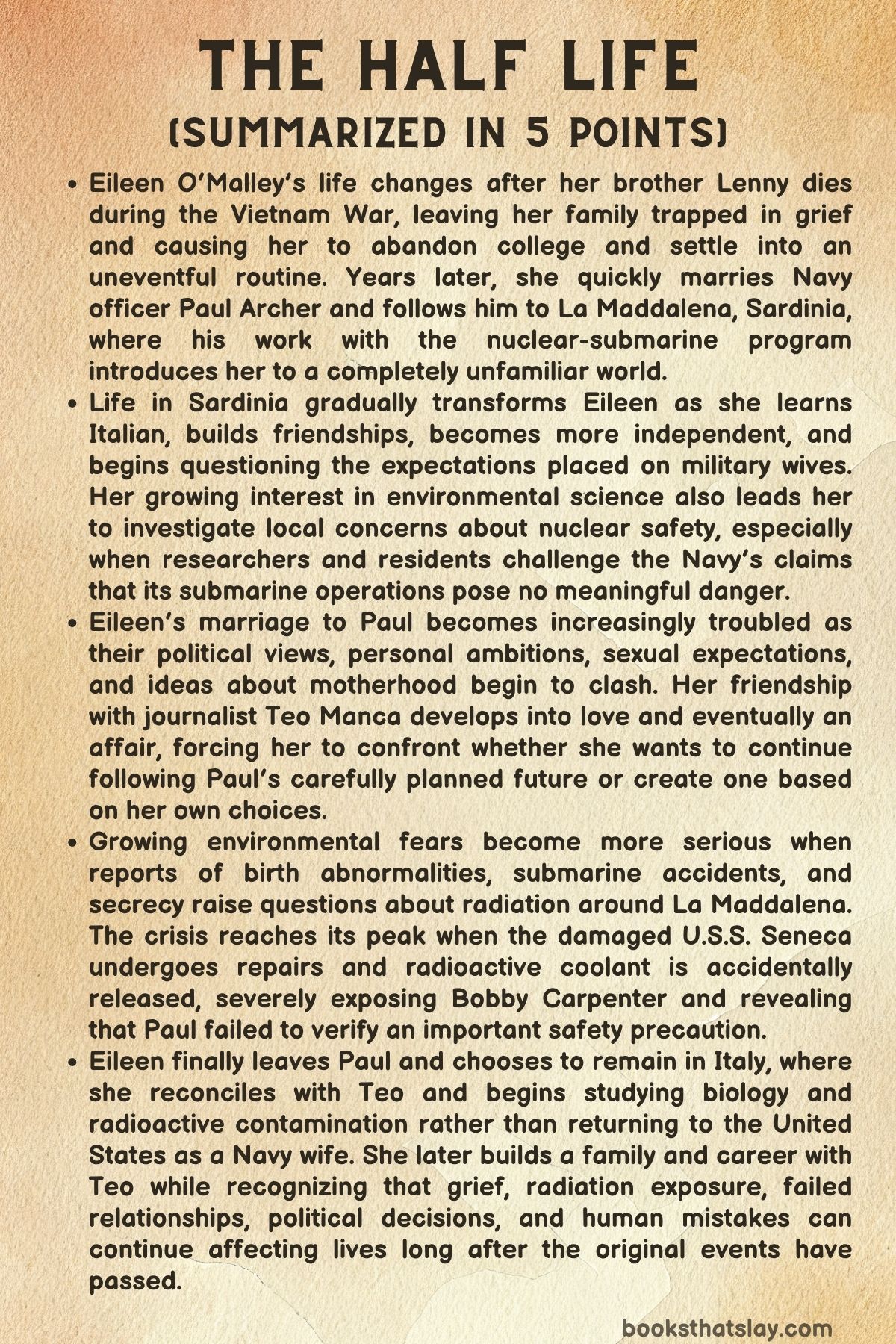
Summary
Eileen O’Malley grows up on James Island near Charleston in a close family that is permanently altered when her older brother, Lenny, is drafted into the Vietnam War and dies from his wounds. His death destroys the ordinary future Eileen had expected, weakens her religious faith, and leaves her parents trapped in grief while she abandons college and settles into an undemanding life working at Condon’s department store.
Several years later, Eileen meets Lieutenant Paul Archer, a confident young naval officer working in the nuclear-submarine program. Their attraction develops quickly, but Paul soon reveals that he has orders for Italy, and because the Navy will relocate a spouse but not a girlfriend, he proposes marriage after only a short courtship.
They marry at city hall and begin preparing for Sardinia. Eileen leaves her job, sells her car, gives up the familiar structure of her life, and accepts a social role she barely understands, symbolized by the Navy-wife etiquette guide Paul’s mother gives her.
The journey becomes Eileen’s first real encounter with the larger world. An unexpected night in Rome gives the newlyweds a brief honeymoon, yet even amid their happiness Eileen’s unresolved grief surfaces when the Pantheon makes her think about heaven and Lenny.
When they finally arrive in Sardinia, the beauty of La Maddalena astonishes her. Paul immediately understands the assignment as another step toward his goal of commanding a submarine, while Eileen realizes she has attached herself to a man with a clearly defined future even though she has no comparable plan of her own.
Their new home is politically complicated. The American submarine tender Gilmore operates near Santo Stefano, and local protesters fear that nuclear-powered submarines threaten the environment while American officials insist that strict procedures make serious contamination virtually impossible.
Eileen initially knows very little about Cold War politics or nuclear technology. Paul trusts the Navy deeply, while she becomes increasingly curious about why local residents oppose the American presence and why the United States refuses to release environmental data that supposedly proves its operations are safe.
At the same time, she struggles with ordinary independence. She has no job, little Italian, no familiar community, and initially depends heavily on Paul, but small experiences such as shopping alone, cooking in their temporary hotel room, choosing a rental house without him, and learning how to navigate the island gradually change her sense of what she can do.
The American military wives give her another form of belonging. Mary Lou Jenkins introduces her to a highly organized social network in which women provide practical help whenever deployments, illness, pregnancy, or grief create emergencies.
Eileen develops a particularly close friendship with Laura Carpenter, whose husband Bobby works in Nuclear Repair alongside Paul’s Radiological Controls division. Laura’s miscarriages and intense desire for motherhood force Eileen to confront her own uncertainty about having children, an uncertainty connected both to Lenny’s death and to doubts about whether she wants a permanent future with Paul.
Her life changes further when she studies Italian with Francesca Moriani. Francesca is politically independent, outspoken, and skeptical of American nuclear assurances, giving Eileen access to a local perspective that differs sharply from the Navy’s explanations.
Through Francesca, Eileen also meets Teo Manca, Francesca’s journalist nephew. Eileen is attracted to him, but more importantly, Teo treats her curiosity as valuable, talks seriously with her about politics and environmental issues, and eventually becomes one of the few people with whom she speaks openly about Lenny.
Meanwhile, Eileen experiences a sexual awakening of her own. She discovers that she has never actually had an orgasm with Paul and begins learning about her body independently, eventually recognizing that much of their sexual relationship has been structured around his wants rather than hers.
She tries to improve their marriage rather than immediately abandon it. Once she tells Paul what she needs, their physical relationship genuinely improves, but deeper disagreements continue because Eileen is becoming intellectually, politically, and emotionally independent while Paul expects his professional world and ambitions to remain central.
Her interest in environmental science grows after she joins Teo, Bruno, Luca, and other researchers collecting marine specimens around the archipelago. She learns that independent testing is slow and that radioactive substances with long half-lives may remain in an ecosystem long after an individual release appears insignificant.
The controversy becomes more urgent when several babies on La Maddalena are born with severe cranial abnormalities. No scientific proof immediately establishes radiation as the cause, but the cluster increases public fear and makes Eileen more suspicious of official claims that there is nothing worth investigating.
Her participation in an ecology conference creates an open break with Paul. When he challenges Luca’s research and dismisses evidence suggesting environmental uncertainty, Eileen publicly asks about radioactive half-lives, effectively supporting the scientists against her husband.
At home, their disagreements intensify. Paul also becomes increasingly jealous of Teo, particularly after discovering that Eileen has secretly joined research outings with him and after seeing a drawing Teo made of her.
Eileen begins passing information to Teo about incidents the Navy appears reluctant to publicize. Their emotional attraction eventually produces a kiss, but she initially refuses to begin a sexual affair and instead tries once more to repair her marriage.
A far more serious rupture occurs when Paul, drunk and angry, ignores Eileen’s insistence on using contraception and restrains her while initiating sex. Eileen lacks the language to classify what happened as marital rape, but she immediately goes to the Navy clinic for birth-control pills she can secretly control, demonstrating that her trust in Paul has fundamentally changed.
Despite this, Paul remains difficult for Eileen to reduce to a simple villain. He can be generous and loving, arranging for her mother to visit Sardinia and making genuine attempts to improve their relationship, yet those good actions cannot restore the security that has disappeared between them.
Eileen’s mother eventually recognizes that the marriage is troubled and notices Eileen’s connection with Teo. When Eileen admits they have kissed, her mother refuses to make the decision for her, instead forcing Eileen to ask the more difficult question of whether she actually wants to remain married.
By then, Teo and Eileen’s attraction has survived repeated attempts at distance. After another public confrontation between Teo and Paul during a Navy media event, Eileen goes deliberately to Teo’s apartment, and they begin a full affair.
Their relationship becomes increasingly domestic rather than merely sexual. Teo wants Eileen to leave Paul, remain in Sardinia, marry him eventually, and become part of his family, but Eileen fears losing the Navy-wife community, facing public judgment, and surrendering the security of the life she already knows.
Laura discovers the affair and feels personally betrayed because Eileen has repeatedly lied to her. Teo also becomes frustrated with receiving only the parts of Eileen’s life that fit around Paul’s schedule, leaving Eileen in danger of losing both her marriage and the man she loves.
Paul’s new orders finally force the issue. He expects Eileen to follow him back to the United States for the next stage of his career, while she realizes that Sardinia, her friendships, her scientific interests, and the independent identity she has created there now feel more like her real life.
Eileen eventually tells Paul that she will not go with him. When he asks whether someone else is involved, she admits that she loves Teo but insists correctly that Teo is not the sole reason the marriage is ending; the relationship was already failing because Eileen and Paul wanted fundamentally different lives.
Their separation coincides with a major nuclear emergency. A badly damaged submarine, the U.S.S. Seneca, reaches Santo Stefano after striking an underwater mountain, and during repairs radioactive coolant sprays into a work area after a line is not properly depressurized.
Bobby is badly exposed while trying to stop the leak. Eileen learns that Paul had been responsible for verifying protective shielding before the repair but signed the authorization without confirming that it had actually been installed.
The accident becomes a devastating demonstration of everything Eileen has questioned. Nuclear safety does not fail because of a spectacular reactor explosion but because procedures, equipment, stress, and ordinary human mistakes combine in dangerous ways.
Mary Lou also reveals that Naval Intelligence discovered Eileen’s affair months earlier and informed Paul because officials feared Teo could receive information through her. Paul knew about the relationship but never confronted Eileen, complicating her understanding of what he endured privately during the final months of their marriage.
After helping Laura through the crisis surrounding Bobby’s exposure, Eileen reconciles with Teo and tells him she has finally chosen to stay in Sardinia. She moves out of the house she shared with Paul, leaving behind many objects associated with her Navy-wife identity while taking with her a picture of Mary Magdalene that has come to symbolize judgment, failure, and the possibility of beginning again.
Paul later tells her that his failure to verify the shielding will probably end his dream of submarine command. He also admits that his own decision to join the Navy was partly shaped by fear of being drafted and sent to Vietnam, creating an unexpected connection between his history and Lenny’s death.
Eileen and Paul finally acknowledge that neither of them alone caused the marriage to fail. Paul admits responsibility for violating Eileen’s wishes sexually, while Eileen acknowledges her deception and affair, and they separate without trying to turn either person into the sole source of everything that went wrong.
Afterward, Eileen remains connected to Laura and supports her while Bobby recovers. Laura eventually gives birth to a healthy daughter, while Eileen returns to Teo and enrolls at the University of Sassari to study biology and radioactive contamination in marine environments.
After Eileen’s divorce becomes final, she and Teo deliberately wait before marrying. They later move to Rome, build careers, and have a son, while Paul leaves the Navy, remarries, has children, and eventually dies young of leukemia.
Bobby survives the Seneca exposure but develops several cancers later in life. Eileen becomes an environmental professional and eventually retires with Teo to La Maddalena, where she witnesses the eventual end of the American military presence.
Looking backward, she recognizes that the central idea of The Half Life applies to much more than radioactive substances. Grief, love, institutional decisions, trauma, mistakes, and relationships may weaken with time, but their effects can remain present for decades, altering the lives that come afterward.
Characters
Eileen O’Malley Archer
Eileen is the central consciousness of The Half Life, and her development is defined by the slow replacement of passivity with self-determination. Lenny’s death initially convinces her to expect little from life, and marrying Paul becomes partly an act of love and partly an opportunity to escape a Charleston existence shaped by grief.
Sardinia gradually exposes abilities she never knew she possessed. She learns Italian, navigates unfamiliar systems, studies science, assists environmental researchers, supports friends through emergencies, questions powerful institutions, and eventually becomes capable of imagining a professional identity independent of marriage.
Her transformation is morally complicated rather than idealized. Eileen lies repeatedly to Paul and Laura, conceals her relationship with Teo, passes information to a journalist, and eventually has an affair, yet she is unusually willing to examine her own responsibility instead of creating a version of events in which every harmful choice becomes someone else’s fault.
Her sexual development is equally important. Discovering her own capacity for pleasure leads her toward a broader recognition that desire, motherhood, intellectual curiosity, political belief, and personal ambition all belong to her rather than automatically belonging to the structure of her marriage.
By the end, Eileen does not merely choose Teo instead of Paul. She chooses education, environmental work, Italy, and a future she has consciously considered, making her final decision fundamentally different from the hurried choice that began her first marriage.
Paul Archer
Paul is intelligent, ambitious, technically skilled, affectionate at times, and deeply invested in the United States Navy. In The Half Life, his strengths and weaknesses often grow from the same source: the certainty that makes him an effective officer also makes him resistant to perspectives that threaten the institutional system on which his identity depends.
He genuinely loves Eileen, but he often assumes that his career is the organizing principle of their shared life. Decisions about relocation, social obligations, children, political discussion, and even knowledge itself are repeatedly filtered through what is best for the Navy and his professional future.
Paul is not incapable of growth. When Eileen finally explains her sexual dissatisfaction, he listens and changes his behavior, demonstrating that communication can reach him when he does not interpret the subject as a challenge to authority.
His most serious failure occurs when he ignores Eileen’s refusal to have sex without contraception. The incident destroys her trust because it reveals that when his anger, desire, and assumptions about marriage converge, he is capable of treating her control over her body as less important than his wishes.
The Seneca accident exposes the professional version of the same weakness. Paul signs an authorization without verifying that shielding is actually in place, then panics after the coolant release, showing that the system he defended as nearly perfect remains dependent on fallible people.
His final conversation with Eileen gives him greater complexity. He accepts responsibility for his failures, explains how fear of Vietnam influenced his own naval career, and leaves the marriage without demanding that Eileen accept all the blame.
Teo Manca
Teo is both Eileen’s romantic alternative and a representative of the intellectual life she begins building outside the American military community. As a journalist, he asks questions that Paul considers disruptive, particularly about nuclear safety, political influence, and the right of local people to know what risks exist around them.
His attraction to Eileen develops alongside genuine respect for her mind. He listens to her memories of Lenny, values her curiosity, discusses politics and science with her, and imagines a future in which she participates as an equal rather than simply adapting herself to his career.
Teo nevertheless contributes to the moral difficulty of Eileen’s situation. He knowingly pursues a married woman and eventually becomes unwilling to accept the hidden fragments of a relationship that must fit around Paul’s schedule.
His insistence that Eileen make a decision ultimately serves an important purpose. He refuses to let the affair become a permanent substitute for choosing a life, forcing her to understand that indecision is itself a decision with consequences.
The relationship survives because it eventually becomes public, deliberate, and patient. After Eileen’s divorce, they wait before marrying, consciously avoiding the impulsiveness that shaped her first marriage.
Laura Carpenter
Laura becomes Eileen’s closest American friend and one of the strongest examples of genuine solidarity within military-wife culture. She gives Eileen a place to discuss sex, marriage, infertility, disappointment, and fear without the formal expectations that characterize many Navy social interactions.
Her repeated miscarriages make motherhood central to her emotional life. Rather than reducing her to reproductive suffering, however, the story shows her humor, practicality, anger, loyalty, and capacity to rebuild herself after loss.
Laura’s confrontation with Eileen over Teo is significant because her anger comes from friendship as much as morality. Eileen allowed Laura to reveal intimate details of her own life while hiding the relationship that had become the most important secret in hers.
Their eventual reconciliation demonstrates the durability of their connection. When Laura faces possible premature labor and Bobby’s radiation exposure, Eileen responds immediately, and Laura recognizes that Eileen may have failed as a conventional Navy wife while remaining an exceptionally dependable friend.
Bobby Carpenter
Bobby is initially presented as Paul’s professional counterpart and Laura’s devoted husband. His work in Nuclear Repair places him directly inside the technical system whose safety becomes one of the novel’s central disputes.
His marriage to Laura also provides Eileen with a contrasting model. Bobby and Laura experience terrible reproductive losses, yet they continue communicating and trying to build the family they both want.
The Seneca accident gives Bobby a much more serious role. After radioactive coolant sprays from the compromised system, he intervenes to stop the leak and suffers severe exposure, transforming nuclear risk from an abstract controversy into an immediate human reality.
Even while ill, his greatest fear is exposing Laura and their unborn baby. His refusal to see her until he is convinced that he has been decontaminated reveals a protective instinct that remains stronger than his concern for himself.
His later cancers prevent the accident from being treated as a crisis that simply ended after decontamination. The long-term consequences of exposure become part of the story’s examination of effects that persist long after an original event.
Francesca Moriani
Francesca begins as Eileen’s Italian teacher but gradually becomes a mentor, political educator, friend, and surrogate mother. She gives Eileen access to Sardinia as a lived community rather than as the picturesque location surrounding an American military assignment.
Her political opinions challenge the categories Paul uses. Francesca can oppose the American nuclear presence without hating Americans, support left-wing politics without fitting the caricature of a dangerous radical, and demand investigation without pretending that every suspicion has already been scientifically proved.
She also models a kind of marriage Eileen has rarely seen. Francesca is outspoken, politically active, intellectually independent, and capable of disagreeing with Bernardo without treating disagreement as a threat to their relationship.
Her influence extends beyond politics. Francesca teaches Eileen language, cooking, local traditions, history, and the confidence to take her own judgment seriously.
When Eileen finally decides to leave Paul, Francesca does not absolve her of every mistake. Instead, she treats error as something that can coexist with responsibility, love, and the possibility of creating another life.
Mary Lou Jenkins
Mary Lou initially appears to represent everything Eileen distrusts about being a Navy wife. She understands rank, etiquette, social expectations, and the principle that a wife’s behavior may affect her husband’s career.
Yet Mary Lou becomes one of the story’s most nuanced supporting figures because her authority is not merely ceremonial. She organizes real assistance during miscarriages, deployments, emergencies, and accidents, turning a restrictive social network into an effective system of care.
She sees Eileen’s abilities before Eileen fully recognizes them herself and pushes her toward greater responsibility. Her methods can be controlling, but they are often based on an accurate understanding of what Eileen can manage.
During the Seneca emergency, Mary Lou’s calm becomes especially meaningful. Eileen realizes that composure is not evidence of emotional coldness; it can be a practical method of keeping frightened people functioning when panic would help no one.
Her final observations also weaken the assumption that a naval career must determine an entire family’s identity. Mary Lou can imagine beginning another life if the Navy ends, a possibility Eileen has spent years struggling to believe.
Lenny O’Malley
Lenny is physically absent for nearly the entire story, yet his death shapes many of Eileen’s most important decisions. His loss creates the grief that pushes her away from college, weakens her faith, and makes ordinary ambition seem almost selfish.
He also shapes Eileen’s fear of motherhood. After watching her parents survive the death of a child, she understands parenthood not simply as love but as exposure to potentially unbearable loss.
Lenny’s memory complicates her attitude toward political protest as well. During Vietnam, Eileen could not comfortably oppose the war because criticism felt dangerously close to suggesting that her brother’s death had been meaningless.
Her eventual ability to speak about who Lenny was rather than merely how he died becomes an important emotional development. Teo’s willingness to listen allows Eileen to reclaim her brother as a living memory instead of only the event that divided her life.
Eileen’s Mother
Eileen’s mother shares the family trauma created by Lenny’s death but handles it differently from her daughter. Her grief explains much of Eileen’s guilt about leaving Charleston because Eileen knows her parents have already experienced one child leaving for military reasons and never returning.
When she eventually visits Sardinia, she becomes an unusually valuable observer because she belongs to neither the Navy nor the Italian political environment. Her reaction to the dispute over environmental data reassures Eileen that skepticism about secrecy does not automatically make someone disloyal or radical.
Her greatest contribution comes when Eileen confesses that she has kissed Teo. Rather than telling her either to save the marriage or leave it, she identifies the real question: whether Eileen actually wants the marriage to survive.
That refusal to decide for her daughter is important. Eileen has spent much of her adulthood following decisions shaped by grief, Paul, and the Navy, so her mother ultimately gives her something more useful than instructions—the responsibility of choosing for herself.
Bruno
Bruno represents the scientific side of the environmental debate. Unlike activists who may begin from political conclusions, he focuses on collecting specimens, processing evidence, and acknowledging how slowly independent research can produce reliable information.
His explanations teach Eileen why monitoring systems matter as much as reassuring measurements. If independent samples require weeks to analyze, local residents may have no timely method of discovering contamination after an accident.
Bruno never needs to persuade Eileen through dramatic claims. His influence comes from showing her the limitations of available knowledge and the gap between saying a system is safe and giving the public the means to verify that safety independently.
During the Seneca crisis, his laboratory becomes one of the places Eileen instinctively goes because she trusts his commitment to evidence. His work helps turn her curiosity into a professional direction she later pursues herself.
Luca
Luca gives Eileen a more formal introduction to environmental science and becomes an important bridge between her personal curiosity and academic interest. His research focuses on measurable evidence rather than the political identity of whoever might benefit from the results.
At the ecology conference, he refuses to claim more than the data support, even when Paul publicly challenges him. That restraint becomes important because Eileen sees the difference between scientific uncertainty and institutional denial.
Luca’s work helps her understand that saying more research is necessary is not equivalent to saying catastrophe has already been proved. The distinction becomes central to her eventual position on the nuclear controversy.
His presence also reinforces Eileen’s growing realization that she enjoys science. What begins as concern about the island eventually becomes the academic and professional field around which she builds her later life.
Angela Bornemann
Angela initially attracts Eileen’s attention because she appears to possess unusual knowledge and influence within the American community. Her intercultural seminar ostensibly teaches dependents how to function in Italy, but Eileen senses that Angela’s role also involves monitoring relationships between Americans and their hosts.
Her calm reaction when she catches Eileen translating a protest flyer makes her particularly unsettling. Angela rarely needs to threaten anyone because her power comes from appearing to notice more than other people expect.
Through Angela and the rumors surrounding Daniel Bornemann, the story introduces the possibility that social life, public relations, intelligence work, and political influence are not entirely separate worlds. Eileen’s later discovery that American authorities monitor Francesca and Teo confirms that her early unease was not baseless.
Angela therefore represents the quieter side of institutional power. She reminds Eileen that surveillance does not always announce itself through uniforms, investigations, or formal accusations.
Bernardo Moriani
Bernardo plays a quieter role than Francesca, but his marriage provides an important contrast to the relationships inside the American military community. He is comfortable with Francesca’s strong opinions and political involvement, allowing Eileen to witness disagreement that does not automatically become domination.
His home also becomes one of the places where Eileen begins to feel genuinely integrated into Italian life. Meals, conversation, family stories, and ordinary companionship make Sardinia something more substantial than an overseas assignment.
Bernardo helps establish the Moriani household as an alternative model of adulthood: rooted in place, family, debate, and long-term partnership rather than professional hierarchy.
Tom Mueller
Tom is one of Eileen’s first guides into the practical realities of La Maddalena. He introduces the Archers to the island, explains housing problems and political tensions, and helps transform an unfamiliar military posting into a place they can begin navigating.
His old Fiat later becomes unexpectedly important when Eileen remembers how its broken ignition works and uses the knowledge to get Laura away from a threatening protest. The detail turns Tom’s early assistance into evidence of Eileen’s later independence.
Tom therefore has a small but useful structural role. He first appears when Eileen needs someone else to guide her through Sardinia, while the memory of what he taught her later helps her act confidently without anyone directing her.
Themes
The Persistence of Consequences
The scientific idea behind The Half Life becomes a way of understanding nearly every major experience in the story. Radioactive substances may diminish over time without disappearing, and Eileen gradually recognizes the same pattern in grief, trauma, relationships, institutional decisions, and personal mistakes.
Lenny has been dead for years when Eileen reaches Sardinia, yet his absence continues shaping her faith, her fear of motherhood, her relationship with the military, and her willingness to imagine a future. Paul and Eileen’s failed marriage similarly continues influencing both of them even after separation, just as Bobby’s radiation exposure produces health consequences decades after the immediate emergency has passed.
The theme rejects the comforting assumption that an event ends when the visible crisis ends. A coolant leak can be contained while leaving biological consequences; a war can end while families continue mourning; an affair can finish while damaged trust remains; a military installation can eventually close while environmental and political questions survive it.
Eileen’s mature perspective therefore treats time not as an eraser but as a transformer. Experiences weaken, shift, or acquire different meanings, yet pieces of them remain active inside later lives, which is why responsibility matters even when consequences are not immediately visible.
Identity, Independence, and the Right to Choose
Eileen begins the story without a strong sense that she is entitled to design her own life. Lenny’s death makes ambition feel almost inappropriate, and Paul’s proposal gives her a ready-made direction at precisely the moment she lacks one for herself.
Sardinia changes her through accumulation rather than a single dramatic revelation. Buying groceries alone, learning Italian, selecting a house, studying biology, assisting researchers, arguing about politics, understanding her sexuality, and helping friends during emergencies all prove that competence is something she already possesses rather than something a husband must provide.
Her growing independence also forces her to confront uncomfortable distinctions. Choosing for herself does not automatically make every choice good, and secrecy about Teo often damages the very autonomy she is trying to establish because she becomes dependent on lies and hidden schedules.
The decisive change occurs when she tells Paul she will not follow him back to the United States even though she does not know whether Teo will still want her. That uncertainty matters because it separates her choice from simply replacing one man with another.
By remaining in Sardinia, entering university, and pursuing environmental science, Eileen finally builds a future around decisions she has examined rather than circumstances she has merely accepted.
Marriage, Sexual Agency, and Unequal Power
Marriage initially appears to offer Eileen escape, romance, travel, and a new beginning, but the story gradually examines how easily love can coexist with assumptions about authority. Paul does not enter the marriage believing himself cruel; he simply expects his career, knowledge, sexual desires, and future plans to occupy the center.
Eileen’s sexual awakening exposes this imbalance in an especially intimate way. For years, she does not even know what an orgasm feels like because both she and Paul have treated his climax as the natural measure of successful sex.
Once she understands her own body, she becomes better able to identify needs and boundaries elsewhere. The progression from sexual self-knowledge to political and personal independence suggests that bodily autonomy is connected to a broader right to define one’s own life.
Paul demonstrates that change is possible when he listens to Eileen’s sexual needs and genuinely improves their intimacy. That makes his later refusal to respect her demand for contraception even more serious, because the violation is not caused by simple ignorance but by anger and entitlement overwhelming what she has clearly communicated.
Teo does not function merely as a better sexual partner. His greatest contrast with Paul lies in treating Eileen’s ideas, ambitions, and preferences as parts of the person he loves rather than secondary concerns to be fitted around his own future.
Institutional Power, Secrecy, and Environmental Responsibility
The nuclear controversy asks who has the right to define acceptable danger when one group possesses the technology and another group must live beside it. American officials repeatedly insist that the submarine program is extraordinarily safe, yet local residents lack access to the information required to verify those assurances independently.
Eileen’s position develops because she encounters several perspectives rather than accepting a simple political side. Paul understands the safeguards from inside the system, Francesca represents local demands for democratic accountability, Bruno and Luca concentrate on evidence, and Teo sees public access to information as essential journalism.
The story is careful not to make every protester reasonable or every American corrupt. Eileen herself is threatened by activists during the final crisis, demonstrating that legitimate political grievances do not excuse intimidation or cruelty.
The Seneca accident nevertheless confirms the central concern behind demands for transparency. No institution can eliminate human error simply by creating procedures, because those procedures must still be followed by tired, distracted, frightened, imperfect people.
Paul’s missed verification, the missing shielding, the coolant release, and the subsequent contamination show why independent scrutiny matters. Trust becomes strongest when institutions permit verification rather than asking communities to accept confidence as evidence.