The Hallmarked Man Summary, Characters and Themes
The Hallmarked Man by Robert Galbraith is a modern crime novel that follows private detectives Cormoran Strike and Robin Ellacott through a case that looks like a simple request and grows into something far darker. Set in wintry London and the English Midlands, it blends procedural sleuthing with the messy private lives of its investigators.
Strike is grieving a family loss and carrying old wounds; Robin is recovering from a personal medical crisis and trying to keep her footing in a strained relationship. When a mysterious woman hires them to confirm the identity of a mutilated corpse found in a silver shop vault, they step into a web of family secrets, missing men, and predatory violence.
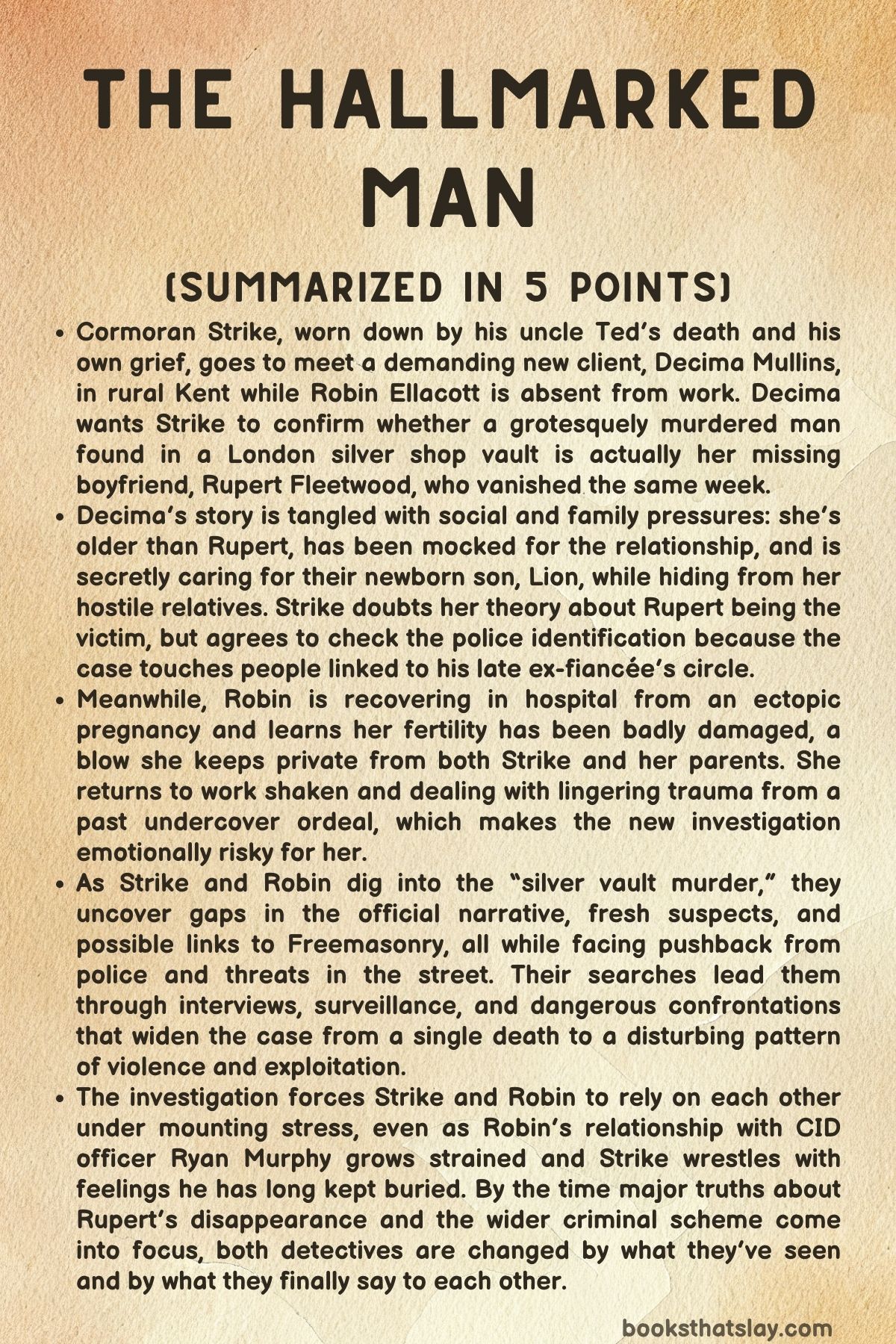
Summary
Cormoran Strike drives through heavy rain to meet a new client because Robin Ellacott has called in sick. Strike is exhausted and raw from ten bleak days in Cornwall, where he has just buried his uncle Ted and helped his sister clear a lifetime’s worth of grief out of Ted’s house.
His body aches, especially around his prosthetic leg, and his mood is sharp. He expects a wealthy, demanding client.
Instead he finds Delamore Lodge, a crumbling Gothic house hidden behind weeds, and Decima Mullins, a frazzled, older woman living in secrecy. She makes him promise not to reveal her location, especially to her brother Valentine Longcaster, a stylist Strike loathes because of his ties to Strike’s late ex-fiancée Charlotte Campbell.
Decima also mentions Sacha Legard, Charlotte’s half-brother, making the job instantly personal.
Decima wants Strike to prove the identity of a dead man found in the vault of Ramsay Silver, a Holborn shop. The victim worked there briefly under the name William Wright before being killed, mutilated, and left naked in the vault while thieves stole a collection of rare “Murdoch silver” artifacts.
Police publicly identified the body as Jason Knowles, a convicted armed robber, but Decima insists the match was never fully confirmed. She says a retired commissioner told her the police were only “ninety-nine per cent certain,” and that sliver of doubt matters because she believes the victim was her missing boyfriend, Rupert Fleetwood.
She produces a notebook listing similarities between Rupert and the corpse—age, handedness, blood type, height, and a timeline that seems to align with Rupert’s last days. Midway through the meeting a baby cries under her poncho.
Decima panics, revealing a newborn strapped to her chest. She begs Strike not to tell anyone she has given birth.
Her son Lion, she says, is Rupert’s child.
Decima is thirty-eight; Rupert was twenty-six, a cousin of Sacha Legard. Orphaned young in an avalanche, he was raised in Zurich by a Swiss aunt, Anjelica Wallner, and later moved to London.
Decima met him through her father’s private club, where Rupert worked and she helped run the kitchen. She claims they fell in love and that he welcomed her pregnancy.
Rupert’s life, however, was unstable. He believed a drug dealer called Dredge was pursuing him over a housemate’s cocaine debts.
He was fired from the club after stealing a silver nef—a ship-shaped ornament—claiming it had once belonged to his parents and had been wrongly kept by Decima’s father. Decima says he refused her money because people accused him of using her.
She last saw him on May 15 and last spoke to him on May 22 after an argument about returning the nef. Then he vanished.
Decima thinks he tried to sell the nef at Ramsay Silver, got hired there under a false name, and was murdered in the vault by Dredge, who mutilated him to hide who he was. Rupert’s aunt told police he had phoned from New York with a new job, but Decima calls that a lie.
She wants Strike to confirm the corpse was Rupert, not to find him alive.
While Strike is dealing with Decima, Robin is not at home with a fever. She has collapsed at Victoria Station with severe abdominal pain and is recovering from emergency surgery for an ectopic pregnancy.
The operation leaves her with one fallopian tube removed and the other badly scarred. Her surgeon explains that untreated chlamydia years earlier likely caused the damage and that natural conception is unlikely.
IVF and egg freezing are suggested, and she is warned to be extremely careful about contraception. Robin asks her boyfriend, CID officer Ryan Murphy, to cover for her by telling Strike she has a virus and not to inform her parents.
She goes home grieving the loss of the pregnancy and shaken by the news about her fertility.
Back in London, Strike researches Decima, Rupert, Valentine, and Sacha online and initially wants no part of the case. It feels messy, and the police seem almost sure the body was Knowles.
Still, he asks Robin to quietly check her police contacts. Robin, struggling with nightmares and lingering trauma from a previous undercover job, becomes absorbed in press coverage of the “silver vault murder.
” The story spiraled in the tabloids: first the gruesome discovery and theft, then the false identity, then speculation about Freemason ritual because CCTV showed men approaching the shop and the stolen items had Masonic significance, and finally the police naming of Knowles despite public doubt.
Robin asks Murphy what he knows. He agrees to speak to a friend on the case, though he dislikes Strike’s involvement.
Their conversation turns tense when Murphy pushes her about freezing her eggs and implies her work is reckless. In anger and pain, Robin reveals that her past rape has shaped many of her medical and emotional choices.
They argue, and Murphy promises to get information anyway.
Murphy later meets Strike and Robin and shares the confidential truth: police believe the corpse is Jason Knowles, but they cannot officially confirm it because the National Crime Agency has an undercover agent inside Knowles’ family. Two sources told the agent Knowles was ambushed by relatives who suspected him of talking to police, and the NCA asked the Met to delay DNA confirmation until it was safe to test family members.
The lead detective, Malcolm Truman, ignored that instruction and publicly named Knowles, earning a suspension. For now, the identification remains unofficial, and two other missing men—Tyler Powell and Niall Semple—hover as distant possibilities.
Despite Strike’s doubts, Robin persuades him they should take Decima’s case, at least to settle the question properly. Strike agrees.
Robin interviews Valentine Longcaster, hoping to trace Rupert’s last movements. Valentine is hostile and evasive, calling Rupert a freeloader who stole the nef and claiming Decima is manipulating the situation.
He insults both detectives and storms out. Soon after, Robin is followed on a dark street by a man in a latex gorilla mask who throws a ceremonial dagger at her feet before fleeing.
The blade carries a Freemason symbol. Robin links this threat to earlier harassment and hides the dagger, rattled but determined.
Strike and Robin travel to Ironbridge to investigate Tyler Powell, one of the other missing men. They learn from Tyler’s grandmother Dilys and neighbor Ian “Griff” Griffiths that Tyler was chased out of town after being blamed for a fatal crash involving a rich newcomer.
Dilys shows messages from Tyler’s phone numbers that suggest someone else may have been posing as him. The trail points to Wynn Jones at a nearby farm, raising Strike’s suspicion that Ironbridge is tied to the silver shop crime.
As pressure builds, they search Ramsay Silver’s basement and uncover the stolen Murdoch silver hidden behind a boarded-up wall, along with the victim’s bloodstained clothing. The find proves an inside link and blows apart the neat police story.
Around the same time, Niall Semple’s body is recovered from Regent’s Canal. Strike follows the Ironbridge lead, breaks into Griffiths’s house, and discovers Wynn Jones trafficking a starving young woman named Sapphire, chained in a cellar.
Strike fights off Griffiths and Jones and holds them until police arrive. Evidence in the house shows the men used burner phones and online traps to lure victims.
Under interrogation, one accomplice admits they set Tyler up through a men’s grievance forum. Sapphire reveals another girl may be hidden under the concrete floor, widening the case into a larger network.
Tyler’s severed hands and personal belongings are later found, confirming he was the vault victim.
With the victim identified as Tyler Powell, the original question returns: where is Rupert Fleetwood? Robin travels to Sardinia and finds him working quietly in a hotel.
Rupert fled not from a drug dealer but from a shocking discovery: after a drunken confession and a DNA test, he realized Decima is his half-sister, both children of Dino Longcaster. Horrified, he stole and sold the nef he believed was his mother’s, then disappeared.
Robin persuades him to call Decima, reminding him he has a son.
Decima meets Strike and Robin in London, grateful yet devastated. They agree to keep the family secret to protect Lion.
After she leaves, Robin heads to Murphy’s birthday dinner, aware he plans to propose. Strike follows her downstairs and finally confesses that he loves her.
Robin explodes, furious that he waited years and chose this moment, accusing him of acting from fear. Strike insists his feelings are real and asks her to marry him.
Robin refuses, saying she will not betray Murphy. She leaves in anger, and Strike is left alone in the office, knowing he has crossed a line that cannot be undone and that the next choice belongs to her.
Characters
Cormoran Strike
Cormoran Strike enters this portion of The Hallmarked Man worn down in body and spirit, and that exhaustion colors almost every decision he makes. The recent death of his uncle Ted reopens old family wounds and pushes him into a quieter, more reflective grief than he usually allows himself; his mourning is private, stoic, and laced with guilt that he did not say or do more while Ted was alive.
Physically, Strike’s prosthetic-side pain becomes a metaphor for how he carries trauma—always present, sometimes manageable, sometimes flaring at the worst moments—and his irritability with Decima on the drive to Kent shows how thin his emotional skin is after loss. Professionally he remains razor-sharp and skeptical, refusing to be seduced by a client’s dramatic narrative, and he tries to protect his agency from getting dragged into a case tied to police opacity and dangerous high-status networks.
Yet his professionalism is complicated by his personal world: his hidden love for Robin, anxiety about Murphy’s place in her life, and fear of missing his chance make him impulsive in ways he hates. The confession at the end is both an act of courage and a lapse in timing, exposing Strike’s deepest flaw here—he can face violence, corruption, and grief, but he struggles to read the emotional weather of someone he loves when his own fear peaks.
Robin Ellacott
Robin Ellacott moves through these events with a double life of suffering and control. On the surface she is the capable partner Strike relies on, but privately she is recovering from a traumatic ectopic pregnancy and infertility news that shatters assumptions about her future.
Her decision to conceal the hospital crisis from Strike and her parents reflects a fierce independence and a desire not to become fragile in other people’s eyes, but it also shows how she isolates herself when scared. She is still haunted by previous undercover trauma—nightmares, panic in crowds, hypervigilance—yet she refuses to slow her investigative momentum, which underscores a central tension in her character: work is both her calling and her coping mechanism.
Robin’s relationship with Murphy reveals her growing unwillingness to shrink herself for a partner, and when she explodes during their argument, it is less about a single fight than about years of being underestimated or morally policed for the job that gives her purpose. Her encounter with Valentine and the masked stalker highlights her courage and instinct; she keeps her head under threat, gathers evidence, and internalizes the danger rather than dramatizing it.
By the time Strike confesses love, Robin’s anger is not the rejection of feeling but the rage of someone who endured uncertainty while he delayed, and her reaction frames her as emotionally honest, ethically loyal, and unwilling to let another man rewrite her timeline.
Decima Mullins
Decima Mullins begins as a figure of suspicion—secretive, disheveled, seemingly manipulative—and gradually becomes one of the most tragic portraits in this section. Her paranoia about being found, especially by Valentine, signals a lifetime of family power imbalances, and her demand for confidentiality suggests both real fear and a habit of hiding truths.
Decima’s love story with Rupert appears at first like a desperate older woman’s fantasy, yet her grief is palpable, grounded in the lived reality of pregnancy, abandonment, and social mockery. What makes her compelling is how she clings to a narrative that allows her to survive: Rupert was murdered, not gone; he loved her, not disgusted by her; her child will have a father in memory if not in life.
Even when her theory seems far-fetched, Decima is not framed as foolish so much as wounded by forces that have always controlled the story around her. The eventual revelation of incest retroactively transforms her desperation into horror, making her both victim and unknowingly entangled participant in a family secret that poisons intimacy.
Her final gratitude to Strike and Robin, and willingness to protect the truth for Lion’s sake, shows resilience and a fierce maternal instinct emerging from humiliation and loss.
Rupert Fleetwood
Rupert Fleetwood functions like a ghost at the narrative’s center, and his disappearance drives others’ obsessions. The summary positions him as charming, vulnerable, and adrift, a young man who carries early trauma from his parents’ deaths and who has been shuffled between guardians and social expectations.
Rupert’s apparent theft of the nef and his fear of Dredge paint him as someone cornered by circumstance, but the deeper crisis is identity: discovering that Decima is his half-sister detonates his sense of self and turns love into taboo overnight. His flight to Sardinia is a moral panic response, not cowardice; he cannot stay in a life that has become unthinkable, and he tries to erase himself rather than face the incestuous truth.
At the same time, Rupert’s secrecy and avoidance cause real harm, leaving Decima in despair and his child fatherless, so he embodies a tragic contradiction—he is both victim of family sins and agent of new pain. When Robin finds him, his willingness to listen suggests that beneath his shock he still has empathy and a conscience, even if he needed distance to access them.
Valentine Longcaster
Valentine Longcaster is the volatile face of Longcaster family dysfunction, performing dominance through cruelty, mockery, and intimidation. His hostility toward Rupert and Decima reads as less about facts and more about control—he wants to own the family narrative and punish anyone who destabilizes it.
Valentine’s tired, high demeanor suggests self-destructive habits and a fragile ego propped up by celebrity-adjacent glamour, making his aggression feel like defensive theatre. His insults toward Strike and Robin, especially the gendered contempt aimed at Robin, reveal a man who weaponizes social status to humiliate others and who sees women as props in men’s conflicts.
The later revelation that his drunken confession helped Rupert discover the truth adds an unintended moral weight: Valentine is both perpetrator of harm and accidental catalyst for exposing it. He represents how family secrets rot from within, producing outward cruelty that masks buried shame.
Sacha Legard
Sacha Legard is a shadow-presence here, but the summary frames him as a connective tissue between multiple worlds—Charlotte’s lineage, Rupert’s family, and elite social circles. His involvement in the party where Rupert last appeared gives him an aura of gatekeeping privilege, and the way others orbit him implies influence that is casual yet dangerous.
Even without direct scenes, Sacha functions as a symbol of inherited power and the quiet violence of reputations: people like him can shape outcomes simply by being at the center of a room.
Ryan Murphy
Ryan Murphy is portrayed as caring yet fundamentally misaligned with Robin’s inner world. His attentiveness at the hospital and gifts show genuine affection, and his willingness to share confidential police information suggests loyalty.
However, Murphy’s resentment of Strike and discomfort with Robin’s work expose insecurity that he frames as practicality, and his push toward egg freezing and cohabitation reads as an attempt to secure a future that comforts him more than her. His argument with Robin reveals a blind spot: he wants to protect her but also judge the choices that make her who she is.
Murphy is not villainous; he is a believable partner for someone who wants stability, but he cannot fully honor Robin’s need for risk, autonomy, and professional identity. His planned proposal at the end sharpens the emotional triangle, making him a real human stake rather than a simple obstacle.
Kim Cochran
Kim Cochran arrives as a competent ex-Met recruit, but her characterization is shaded by tension. She is useful to the agency and proactive in covering gaps, yet her flirtatious deference toward Strike and dismissiveness toward Robin suggest rivalry cloaked in professionalism.
Kim’s presence pressures Robin’s insecurities about being replaced and pressures Strike’s self-image as a leader who must be careful about boundaries. She represents an external test of the partnership’s trust and of Robin’s sense of belonging in her own workplace.
Ted Nancarrow
Though deceased, Ted Nancarrow’s influence saturates Strike’s emotional arc. He is remembered as the gentle breaker of a violent family cycle, the man who offered stability amid ancestral chaos.
Ted’s life stands in contrast to Trevik’s tyranny and Leda’s volatility, giving Strike a model of decency that he fears losing without guidance. His death triggers both grief and a quiet reckoning: Strike realizes that the moral anchor he leaned on is gone, and the loneliness of that realization pushes him toward decisive action in love and life.
Lucy Strike
Lucy appears in the aftermath of Ted’s death as the practical, grieving sibling who shares responsibility with Strike. Her role underscores Strike’s family obligations and the unresolved tensions of their upbringing.
Lucy’s presence highlights Strike’s caretaking instincts and the way he often becomes the silent worker in family crises, even when emotionally drained.
Leda Strike (Peggy)
Leda, remembered through family history, is Strike’s cautionary inheritance. Her renaming of herself and chaotic life are framed as an escape from violence but also a perpetuation of instability.
She represents the seductive danger of freedom without anchor, and Strike’s reflections on her choices show his fear of carrying her volatility into his own relationships.
Trevik Nancarrow
Trevik Nancarrow lives in Strike’s memory as a tyrant who embodied generational brutality. He functions as the family’s original wound: his cruelty shaped Ted into a kinder counterexample and pushed Leda into rebellion.
For Strike, Trevik is the specter of what men can become when power goes unchecked, and thinking about him deepens Strike’s commitment to not repeating that legacy.
Anjelica Wallner
Anjelica Wallner is a cold antagonist in Decima’s narrative, representing wealth, respectability, and denial. Her contempt for Decima and insistence that Rupert is elsewhere suggest either complicity in hiding him or a refusal to accept reality that tarnishes the family name.
She embodies the way privileged families rewrite inconvenient truths, and her hostility hints at deeper secrets she would rather bury than confront.
Eric Wardle
Eric Wardle is the weary conscience of the Met, struggling under institutional rot and personal burnout. His frank warning to Strike about police backlash and his admission of depression make him a portrait of a good cop ground down by a corruptible system.
Wardle’s vulnerability, and Strike’s offer of a job, also underline Strike’s loyalty to those he respects and his growing role as an alternative refuge for disillusioned officers.
Barclay
Barclay serves as Strike’s reliable field ally, practical and brave during the Ironbridge operation. His steadiness in crisis reinforces the agency’s competence and provides Strike with trust that is uncomplicated by romance or family.
Midge
Midge is depicted as alert and hands-on, actively supporting Robin during the Ramsay Silver search. Her role emphasizes the teamwork of the agency and Robin’s ability to lead others even while personally shaken.
Pat Chauncey
Pat provides the agency’s moral ballast and emotional candor. Her overhearing of Strike’s confession enables a rare outside judgment that he cannot dodge, and her rebuke is less scolding than protective—she wants him to face the consequences of his timing without retreating into pride or self-pity.
Shah
Shah’s brief arc highlights Strike’s leadership style. Shah apologizes for past doubt, and Strike’s forgiveness and promise of pay while injured show Strike’s loyalty and paternal care toward his staff, reinforcing the agency’s family-like ethos.
Sapphire
Sapphire is a survivor whose presence turns the investigation from mystery to rescue. When Strike finds her chained and starved, she becomes the embodiment of the trafficking horror behind the case, and her willingness to testify later shows courage forged in suffering.
Sapphire’s revelation about another girl under the concrete floor suggests both trauma’s lingering terror and her determination to make the truth whole, not partial.
Ian “Griff” Griffiths
Ian Griffiths is the charismatic predator who hides cruelty behind ordinariness. As a neighbor who offers helpful stories, he initially performs community warmth, but the mask drops as his manipulations are exposed.
Griffiths is shown to be methodical in exploitation—using burner phones, impersonation, and social media myths—making him a modern kind of villain who weaponizes narrative as much as violence. His role in Sapphire’s captivity and Tyler’s death marks him as the case’s moral core of evil: opportunistic, sadistic, and contemptuous of human autonomy.
Wynn Jones
Wynn Jones is a brutal accomplice, physically imposing and morally smaller than the violence he enables. His crude behavior toward Sapphire and his readiness to help Griffiths reflect complicity born of appetite and cowardice.
Yet when Strike proves he was manipulated, Wynn also illustrates how predators recruit lesser men through false loyalties, showing a hierarchy of guilt within the trafficking ring.
Darren Pratt
Darren Pratt appears as another cog in the exploitation network, cracking under pressure. His admission about the Abused and Accused website reveals how ordinary grievances and online hatred are repurposed into traps, linking his character to the theme of weaponized victimhood.
Mickey Edwards
Mickey Edwards is part of the same predatory ecosystem, reinforcing that trafficking is sustained by groups rather than lone monsters. His presence adds to the sense of organized cruelty and the banality of evil in shared spaces.
Tyler Powell
Tyler Powell is a missing man whose life story is reconstructed through others’ memories, making him both victim and symbol. He is portrayed as young, mechanically skilled, stigmatized by rumor, and driven away by community scapegoating after tragedy.
The fact that his identity becomes a plausible match for the vault murder shows how easily society forgets and erases the vulnerable. The discovery of his severed hands and personal items is a grim confirmation of his fate, turning the mystery into an indictment of those who exploited his isolation.
Niall Semple
Niall Semple’s disappearance and later funeral place him in the narrative as another casualty of the wider network. His death marks the case’s expanding scope and shows how multiple lives intersect in hidden violence.
The funeral also gives Strike a moment of sober closure amid chaos.
Jade Semple
Jade Semple, as Niall’s widow, represents the grief-stricken civilian caught in investigative ripples. Strike’s interview with her suggests she is a key emotional witness whose pain and partial knowledge help map the human cost of the case.
Dilys Powell
Dilys is a frail, irritable grandmother whose sharp edges are shaped by fear and helplessness. Her memory fragments and WhatsApp proof do more than provide leads—they show a family clinging to scraps of connection with someone the world has discarded.
Dilys’s exhaustion makes Tyler’s absence feel intimate and heartbreaking.
Ian Griffiths’s Daughter Chloe
Chloe is the threatened absence haunting the Ironbridge scenes. Even unseen, she functions as a potential additional victim, raising the stakes and exposing how abusers extend fear through family ties.
Hugo Whitehead
Hugo Whitehead is a past figure whose actions triggered a chain of tragedy around Tyler. As a wealthy outsider who borrowed Tyler’s car and caused a fatal crash, Hugo embodies privilege’s destructive carelessness, and the rumors about sabotage show how communities often blame the powerless rather than the protected.
Anne-Marie
Anne-Marie is remembered through the town’s rumor cache as the girlfriend lost in the crash, a silent reminder of how personal grief can be turned into public mythology that ruins survivors like Tyler.
Lord Oliver Branfoot
Lord Oliver Branfoot appears as an ominous institutional link, a Freemason tied to suspended detective Truman. His role suggests elite networks that blur lines between fraternity and power, feeding the story’s anxiety about corruption and hidden influence.
Malcolm Truman
Detective Malcolm Truman is characterized through absence and scandal. His suspension for going rogue in naming Knowles reveals a conflict between institutional caution and individual ambition, and he becomes a symbol of how investigations can be warped by ego or pressure.
Dominic Culpepper
Dominic Culpepper’s firing for a likely false story reinforces the media’s predatory role in this world. He stands for sensationalism that endangers real investigations and victims, paralleling other forms of narrative abuse.
Ilsa
Ilsa functions as Robin’s emotional lifeline and reality check. Her calm defense of Strike against Valentine’s accusations provides Robin with grounding when doubt and fear spike, and her presence shows the importance of trusted female friendship in Robin’s survival.
Linda Ellacott
Linda embodies maternal worry and the pull of family life that Robin cannot fully escape. Her repeated calls about Rowntree’s death and Carmen’s traumatic birth contrast with Robin’s hidden crisis, showing a household that depends on Robin emotionally while unknowingly being shut out.
Linda’s anxiety highlights Robin’s protective instinct but also the cost of secrecy.
Martin Ellacott
Martin is seen through family emergency, a brother whose anger at medical authority mirrors the Ellacott family’s intensity. His reaction to Carmen’s birth crisis shows a volatile protectiveness that adds pressure to Robin’s already crowded emotional world.
Carmen
Carmen’s traumatic delivery enlarges the story’s theme of bodily vulnerability and motherhood. Though peripheral, she becomes a mirror to Robin’s own fertility shock, intensifying Robin’s private grief.
Lion
Lion, Decima and Rupert’s newborn, is the living consequence of every secret in the case. He represents hope, but also the burden of inherited truth.
The adults’ decisions revolve around what story Lion will grow up with, making him the quiet future the characters are fighting for, or afraid of.
Themes
Grief, family legacy, and the effort to break old patterns
Loss shapes the emotional weather of The Hallmarked Man from its opening movement, and it does so in a way that is both private and professional for Strike. Ted’s death is not only a recent wound but also a reminder of how much of Strike’s stability came through one man’s steady presence.
Sitting alone with photographs, Strike measures the distance between Ted and Trevik Nancarrow, and that distance becomes a moral yardstick for the entire novel: what does it mean to inherit a family history that includes cruelty, chaos, and fear, and still choose a different kind of life? Ted represents a quiet revolution, a person who stepped out of violence without denying its existence, and his absence forces Strike to confront the fragility of that achievement.
This theme isn’t handled as a sentimental tribute; it appears as muscle pain, irritability, submerged sadness, and a reluctance to take on another person’s crisis when his own feels unmanageable. Yet grief also moves outward into the case, because Decima’s demand for certainty about death mirrors Strike’s own need to place Ted somewhere final and speakable.
Both characters are coping with the same basic human urge: to make loss legible in order to live on. The family legacy angle extends beyond Strike’s memories into the Longcaster–Fleetwood knot, where inheritance is genetic, social, and reputational.
Families here are not safe containers; they are engines that produce secrets, scapegoats, and sometimes kindness, depending on who resists the inherited script. Strike’s reflections on Leda’s reinvention through renaming herself show another way of handling legacy: to cut ties so sharply that you create new damage.
Against that backdrop, Strike’s own choice to keep working, to keep loving, and to keep trying to decide ethically in murky cases becomes a form of resistance to the past. Grief isn’t a side-note to the detective plot; it is a lens that reveals how people either repeat what hurt them or try, imperfectly, to stop the repetition.
Hidden identities, taboo truth, and the cost of secrets
The plot hinges on questions of who someone really is, and the novel treats identity as something that can be erased, manufactured, or accidentally revealed. The corpse labeled “William Wright,” the uncertainty around DNA confirmation, and the way public narratives harden around “ninety-nine per cent” certainty show how fragile official identity can be.
A person can be named wrongly and then trapped inside that mistaken label by institutional convenience, media sensationalism, and criminal strategy. Decima’s insistence on proof is therefore more than grief; it is a fight against being forced to accept an identity story that doesn’t fit her lived knowledge.
The case also lays bare how people use false names or masked lives to survive, to profit, or to hide shame. Rupert’s disappearance initially reads like betrayal, then becomes a different kind of terror: the discovery that his lover is also his half-sister.
The incest twist reframes everything that came before it. Love, in retrospect, is reclassified as a taboo act neither party knowingly consented to, and the emotional cruelty of that realization explains Rupert’s vanishing better than any drug-dealer chase.
The theme is not there for shock alone; it probes the way truth can be unbearable when it collides with one’s sense of self. Rupert’s identity as a partner, a cousin, a son, and a father collapses into a single polluted fact, and flight becomes his only way to keep living.
Decima’s secret motherhood runs parallel: she hides her baby and location not out of malice but fear of family control and social ridicule, yet her secrecy also distorts the investigation and leaves Strike uncertain whether he is dealing with reality or delusion. Around them, Valentine and Sacha weaponize gossip and partial truths, showing how people curate identity in public settings like fashion shoots and social media, then punish anyone who threatens the curated version.
Even the Freemason symbols and staged rituals around the murder function as identity theater, suggesting an organization that relies on secrecy to exert power. The novel keeps returning to the same pressure point: a secret can protect someone for a while, but it also corrodes relationships, delays justice, and creates fertile ground for exploitation.
When the truth finally surfaces—through DNA, confessions, recovered silver, and direct confrontation—it doesn’t restore innocence. Instead it demands a new identity story for everyone involved.
The cost of secrecy is not only that people suffer while the truth is hidden, but that once exposed, the truth permanently changes who they can be afterward.
Bodily vulnerability, reproductive harm, and the struggle for autonomy
Physical realities in The Hallmarked Man are not background details; they are central to character and conflict, especially through Robin’s medical crisis and ongoing trauma. Her ectopic pregnancy and the discovery of severely scarred fallopian tubes confront her with a stark recalibration of her future.
The novel treats this not as a melodramatic twist but as a lived rupture: surgical pain, clinical warnings, and the quiet horror of realizing that past violence and past neglect have lodged themselves inside the body as long-term consequence. Robin’s effort to keep the event secret—from Strike, from her parents, even from herself in some ways—exposes how reproductive harm can be socially loaded.
She anticipates judgment, pity, control, and unwanted life-planning advice, and her instinct is to secure a private zone where she can decide what the information means before others impose meaning on it. The conversations with Murphy about IVF and egg freezing are tense because they show competing claims over what her body implies.
Murphy’s push toward a reproductive timeline feels to her like another attempt to shrink her identity into domestic expectation, and her anger is sharpened by the fact that she is still bleeding emotionally from earlier violation. She blurts out her rape history not to weaponize it but because she needs him to understand that autonomy over her body was stolen once and she is unwilling to let anyone lightly assume authority over it again.
Strike’s physical pain from his prosthetic-side hamstring and damaged leg creates a male counterpart to this theme: a different kind of bodily vulnerability that shapes mood, capacity, and self-conception. Both characters live in bodies that have carried injury into the present, and that continuity is a reminder that heroism has a price paid daily, not only during dramatic moments.
The theme expands to Decima’s late pregnancy and secret newborn, showing how female bodies are policed by family and society. Decima hides to avoid being shamed for the age gap and for a pregnancy that threatens family reputation, while still longing for the legitimacy of a funeral for the baby’s father.
In each thread, the body is a site where history leaves marks, institutions make demands, and personal freedom must be defended repeatedly. The novel therefore links autonomy to truth-telling: the ability to name what happened, decide what comes next, and refuse narratives that reduce a person to their reproductive capacities or injuries.
Exploitation, coercion, and the machinery of violence
A current of menace runs through the novel’s criminal world, but it is not random carnage; it is structured exploitation, often targeting those with less power. The silver vault murder is staged to confuse, to manipulate public imagination with Masonic symbolism, and to conceal a trafficking network.
Hands removed from a corpse are not only evidence destruction; they are a metaphor for how victims are made unidentifiable, stripped of agency, and reduced to obstacles in someone else’s profit scheme. Sapphire’s captivity brings this theme into horrifying focus.
Her emaciated condition, chains, and sexual abuse show violence as routine rather than sensational—something men like Griffiths and Jones normalize through group complicity. Their house is a production site of cruelty, supported by burner phones, fake online identities, and a local culture willing to believe the liar who performs victimhood best.
The Abused and Accused website element highlights how exploitation now uses digital spaces as bait. Tyler Powell, already socially isolated and blamed for a tragedy, becomes vulnerable to targeting because he is desperate for community and validation.
The novel makes clear that violence is not just physical; it is psychological grooming, reputation sabotage, and the slow reshaping of reality until the victim can no longer trust themselves. Even Robin’s encounter with the gorilla-masked stalker draws on this theme.
The attacker’s use of costume and ceremonial dagger isn’t a goofy flourish; it is a calculated attempt to terrify, to remind her that she is watched, and to signal that power can approach her anywhere. The fact that the dagger is not sharp doesn’t reduce the threat; it underlines that intimidation itself is the point.
Against this machinery, the detectives’ work becomes an ethical practice of restoring personhood: finding a body’s true name, retrieving stolen artifacts, and physically rescuing a girl who has been treated as disposable. Yet the text resists easy triumph.
It acknowledges that these networks are wide, that police can be compromised or slow, and that public myth-making (from press theories to online commenters) often distracts from real suffering. By connecting elite secrecy, local predation, and institutional failure, the novel argues that exploitation persists because it is useful to people at multiple levels.
The story’s moral heat comes from insisting on seeing that structure clearly and refusing to treat victims as plot devices.
Love, timing, and the uneasy boundary between partnership and desire
Romantic feeling in The Hallmarked Man is not presented as a clean subplot; it is entangled with work, loyalty, fear, and timing that never aligns. Strike’s love for Robin sits under years of mutual reliance and suppressed confession, and his decision to act after Ted’s death shows how grief can reorder priorities.
He doesn’t suddenly develop feelings; instead, loss strips away some of his patience for delay and persuades him that waiting is another way of letting life decide for him. Robin’s situation complicates this because she is not an available figure in a romantic vacuum.
She has a boyfriend who is both emotionally present and professionally threatened by her bond with Strike, and she is dealing with medical news that makes any talk of future family feel like a trap. The theme turns on the contrast between what partnership looks like in public versus in private.
Robin and Strike function as an exceptionally synchronized investigative unit; they trust each other with danger, strategy, and intuition. That working intimacy creates a kind of love already lived, even before it is spoken.
But the novel also shows the cost of deferring the truth. Strike’s silence has allowed another relationship to take up space in Robin’s life, and it has forced her to interpret his care as something ambiguous or opportunistic.
When Strike finally confesses—right before Murphy’s likely proposal—his timing is emotionally honest but socially disastrous. Robin’s anger is therefore not a rejection of love itself; it is a rebellion against the sense that he is claiming her only once she is about to commit elsewhere.
Her outburst that he wasted years while she was free is a demand for accountability: affection that is never risked is not neutral; it shapes the other person’s choices by omission. The novel holds both positions sympathetically.
Strike’s fear of burdening her during media storms is real, and Robin’s insistence on not betraying Murphy is grounded in her desire to be decent, not merely dutiful. Their moment on the stairs becomes a referendum on what love is supposed to do: reassure, possess, liberate, or simply tell the truth regardless of outcome.
By ending with Strike waiting in uncertainty, the story refuses the fantasy of romantic resolution as reward for heroism. Instead it treats love the way it treats investigation—something that demands courage, clarity, and acceptance that the other person may still choose a path you cannot control.