The Hearth Witch’s Guide to Magic and Murder Summary, Characters and Themes
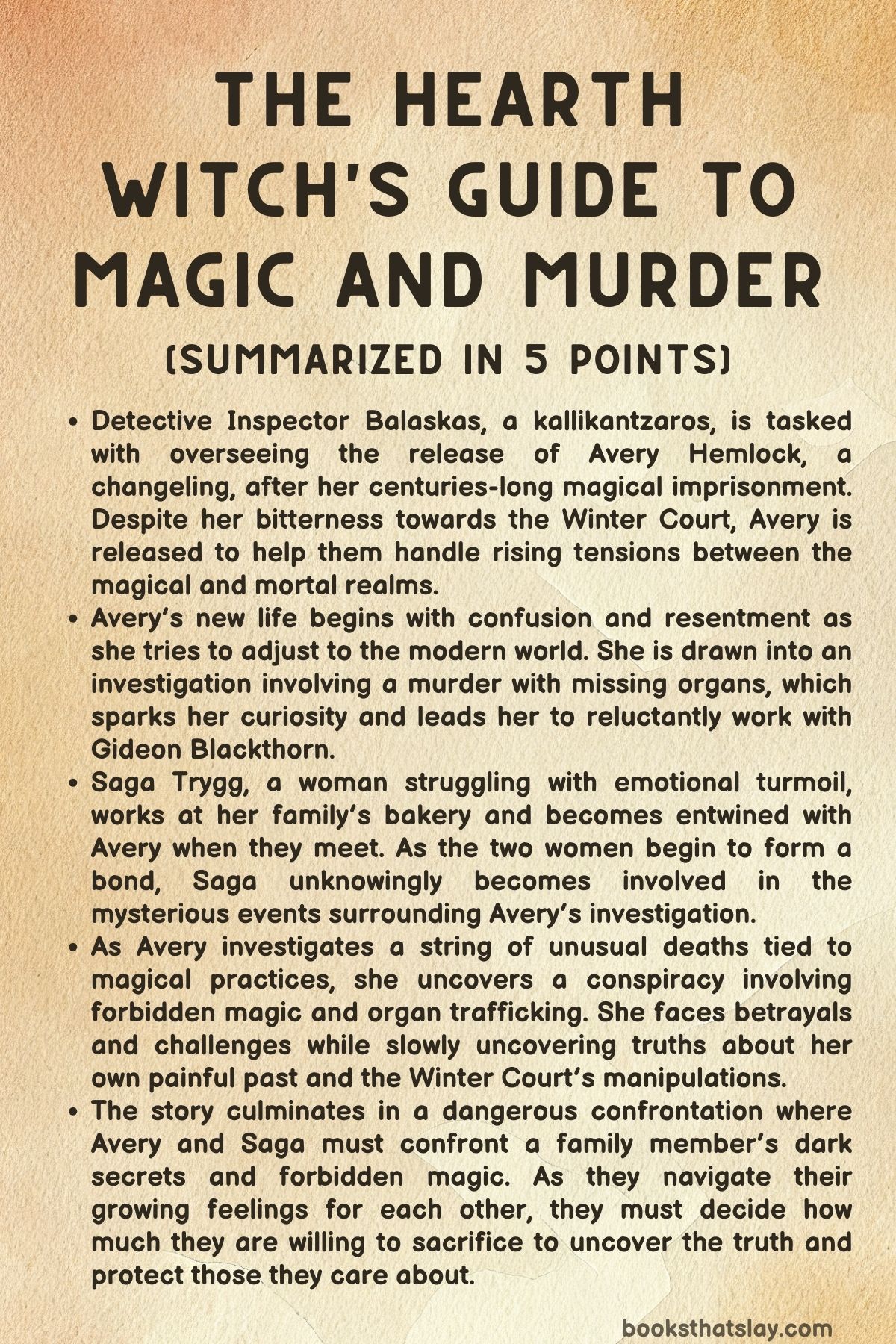
The Hearth Witch’s Guide to Magic and Murder by Kiri Callaghan is a thrilling urban fantasy novel that combines elements of magic, mystery, and intrigue. Set in a world where the mortal realm and magical realms are in constant tension, the story follows Avery Hemlock, a changeling released from centuries of imprisonment, and Saga Trygg, a woman struggling with emotional turmoil.
Together, they navigate a series of murders involving magical rituals, uncovering dark secrets, forbidden magic, and complex relationships. As they work to solve the case, their paths intertwine, and they confront the power of the Winter Court and their own emotional struggles. A mix of detective work and personal discovery, this book explores themes of trust, betrayal, and the consequences of living between two worlds.
Summary
The Hearth Witch’s Guide to Magic and Murder begins with Detective Inspector Balaskas, a kallikantzaros, working at Blackthorn Correctional. One night, Gideon Blackthorn, an Archfey, arrives to oversee the release of Avery Hemlock, a changeling imprisoned for high treason.
Despite her violent outburst, Avery is freed and placed under the custody of the Winter Court, a powerful faction in the magical realm. Avery, still reeling from centuries of magical imprisonment, is bitter about her past with the Winter Court and reluctant to cooperate.
As Avery steps into the modern world, she is overwhelmed by the changes that have taken place in the centuries she was imprisoned. Gideon attempts to recruit her to help the Winter Court with rising tensions between the mortal world and the magical realm.
He suggests that assisting the court might lead to a reduction in her sentence, but Avery remains defiant. However, when Gideon presents her with a strange case involving a missing brain from a human corpse, Avery is intrigued enough to consider his offer.
Meanwhile, Saga Trygg, a woman working at her family’s bakery, is dealing with emotional pain and unresolved issues from her past, including a failed marriage and a strained relationship with her mother. Saga’s life becomes entangled with Avery’s when they meet at the bakery.
Avery, newly released and adjusting to the world, is intrigued by Saga’s warmth and kindness, though Saga is unaware of the deeper magical forces at play.
Avery’s investigation into the mysterious death of a woman named Valentina LaRosa leads her to suspect organ trafficking and dark magic. As she and Gideon delve deeper into the case, Avery discovers that the murders are connected to ancient, forbidden magic.
The victims have had their organs replaced with artificial organs made from straw, herbs, and oil, suggesting a ritualistic purpose. Avery’s knowledge of fey magic is put to the test as she uncovers the dark secrets surrounding the murders.
As Avery continues to investigate, she grows closer to Saga, whose kindness and empathy stand in stark contrast to the cold, calculating world Avery has known. The two women form an unexpected bond, and their relationship deepens as they work together to unravel the mystery.
Saga, though initially unaware of Avery’s true nature, becomes increasingly involved in the investigation as they uncover the twisted motives behind the murders.
Avery’s search for answers leads her to a meeting with Fiore, a mysterious figure who reveals that the Winter Court has their own agenda and that Avery’s freedom is not entirely her own. Fiore introduces Avery to Bimo Shinwell, a fey who provides Avery with crucial information about the magical nature of the murders.
As the investigation progresses, Avery uncovers a web of betrayal, forbidden magic, and the dangerous consequences of crossing the Winter Court.
The case becomes even more complicated when Avery discovers that the murders are linked to her own past. The killer, Osian Goff, is revealed to be a member of the Goff family, with ties to Avery’s own bloodline.
Osian is trying to resurrect his daughter, Eira, using forbidden magic, including the harvesting of organs from the living. Osian’s plan to use Saga’s body as a vessel for his daughter’s resurrection puts both women in grave danger.
In a climactic confrontation, Avery and Saga face off against Osian in a hidden basement where he is performing a dark ritual. Osian reveals that he killed several people, including Valentina, in an attempt to bring Eira back to life.
The ritual requires the heart of a loved one, and Osian had planned to use Saga’s heart to complete the spell. With her life at risk, Saga uses the magic of her bloodline to command Osian to stop, forcing him to obey her will.
Avery and Saga manage to escape the deadly ritual with the help of police reinforcements. Osian is arrested and will face trial for his crimes, including murder and the use of forbidden magic.
The story concludes with a funeral for Saga’s grandmother, Saoirse, where Avery and Saga reflect on their journey together. Avery, though still wary of the Winter Court, is given the opportunity to continue working with Saga, forming an unlikely partnership that will undoubtedly lead to more challenges in the future.
Through its blend of magic, mystery, and complex character relationships, The Hearth Witch’s Guide to Magic and Murder offers a compelling tale of discovery, trust, and the struggles between personal freedom and loyalty to powerful forces. The novel explores the emotional depth of its characters, particularly the evolving bond between Avery and Saga, while navigating the dangerous world of the fey and the dark magic that threatens both the mortal and magical realms.
Characters
Avery Hemlock
Avery Hemlock is the central character in The Hearth Witch’s Guide to Magic and Murder, and her complex journey of self-discovery and emotional turmoil propels much of the story. Released after being imprisoned for over two centuries due to her betrayal of the Winter Court, Avery is a changeling who is forced to navigate the intricacies of both the magical and mortal worlds.
She has a deep-seated bitterness and mistrust toward those who have wronged her, especially the Winter Court, which she holds responsible for her imprisonment. Despite her initial reluctance, Avery becomes involved in a series of mysterious deaths that suggest a larger conspiracy at play, involving magical elements like stolen organs and forbidden rituals.
Avery’s past trauma, which includes betrayal and manipulation by powerful fey, influences her decisions and interactions throughout the book. Her complexity lies in her internal struggle between wanting revenge and seeking redemption, as well as in her growing feelings for Saga, a human woman who gradually becomes a key figure in her life.
Saga Trygg
Saga Trygg is another pivotal character in The Hearth Witch’s Guide to Magic and Murder. She serves as a counterbalance to Avery’s more chaotic and mystical nature.
Saga is a woman who is deeply haunted by her past, particularly her traumatic experience of being left at the altar. This emotional baggage is compounded by her strained relationship with her mother and her unresolved feelings about her father’s death.
Saga’s life is marked by a quiet turmoil that she tries to manage through her work as the manager of her family’s bakery. When she meets Avery, Saga’s world begins to shift, as Avery’s mysterious presence and otherworldly aura draw her into a world of magic and danger.
Saga’s attraction to Avery is clear, although she is initially unaware of the depth of their connection. Her practical, grounded nature contrasts with Avery’s otherworldly and sometimes erratic behavior, but over time, Saga proves to be a reliable ally, helping Avery navigate both the investigation into the murders and the intricacies of the fey world.
Gideon Blackthorn
Gideon Blackthorn is an enigmatic Archfey and a representative of the Winter Court. His role in The Hearth Witch’s Guide to Magic and Murder is that of a manipulator and instigator.
Gideon is responsible for Avery’s release from magical imprisonment and initially appears to be a figure of authority who offers her the opportunity to regain her freedom in exchange for her cooperation. While he presents himself as a helpful ally, there is an underlying tension between him and Avery, as she harbors deep resentment for the Winter Court due to her past experiences.
Gideon’s motives are not entirely clear, and his relationship with Avery is fraught with manipulation and unspoken agendas. He often hints at a greater purpose, but his true intentions remain ambiguous, leaving Avery to question whether he is truly on her side or simply using her to achieve his own ends.
His presence in the story creates a constant sense of intrigue, as he pushes Avery into situations that she may not fully understand, while always reminding her of the strings attached to her newfound freedom.
Osian Goff
Osian Goff, also known as Bowen, is a key antagonist in The Hearth Witch’s Guide to Magic and Murder, and his motives are rooted in deep personal loss and a desire for resurrection. Osian’s ultimate goal is to bring back his daughter, Eira, using forbidden magical practices such as organ harvesting and the creation of fetches.
His obsession with defying death leads him down a dark path, where he is willing to sacrifice innocent lives to achieve his ends. Throughout the story, Osian is revealed to be both a powerful and tragic figure, haunted by his own grief and loss.
He is initially portrayed as the lawyer handling the Goff family’s estate, but as the plot unfolds, his true identity as Eira’s father and his involvement in the murders become clear. Osian’s actions highlight the theme of forbidden magic and the consequences of trying to manipulate life and death.
His connection to the fey world and the power he wields make him a dangerous figure, and his final confrontation with Avery and Saga serves as a climactic moment in the story, where his plans are thwarted, but not without significant cost.
Fiore
Fiore is a mysterious and shadowy character in The Hearth Witch’s Guide to Magic and Murder who operates behind the scenes, often providing Avery with critical information. Fiore is one of the council members involved in the larger political landscape of the fey world, though their true loyalties are unclear.
Fiore’s actions are often calculated, and they seem to possess a deep understanding of the inner workings of the fey courts and the dangerous magic that governs them. They are shown to have a direct influence on Avery’s actions, guiding her toward certain decisions and urging her to investigate the dark deeds surrounding the missing organs and the murders.
Despite their ambiguous role, Fiore proves to be a crucial ally to Avery, though it is unclear whether Fiore’s actions are motivated by a sense of loyalty or by a desire to maintain control over the situation. Their interactions with Avery are always laced with hidden meaning, and their true intentions remain one of the more intriguing mysteries in the book.
Benjamin
Benjamin is a secondary character in The Hearth Witch’s Guide to Magic and Murder, and his role serves to further complicate the investigation into the mysterious deaths. He is introduced as a lover of Eira Goff and is later revealed to have been close to the Goff family.
Benjamin is charming and flirtatious, but as the plot develops, it becomes evident that he has more to hide. His knowledge of Eira’s final years, including her meetings with her lawyer and her thoughts on death, becomes crucial in solving the mystery behind the organ harvesting and the fey rituals.
Benjamin’s relationship with Saga, which begins with flirtation, soon takes on a more serious tone as the investigation deepens. Though initially appearing to be a secondary character, Benjamin’s connections to the Goff family and his involvement in the mysterious events surrounding Eira’s death make him an essential part of the unfolding drama.
Saoirse
Saoirse is a key figure in Saga’s life and plays a significant emotional role in The Hearth Witch’s Guide to Magic and Murder. As Saga’s grandmother, Saoirse represents a sense of stability and tradition amidst the turmoil in Saga’s life.
While she is not directly involved in the investigation, her influence on Saga’s personal growth is profound. Saoirse’s loss is deeply felt by Saga, and her presence in the narrative provides a grounding force for Saga as she navigates the chaos brought by the fey world.
Saoirse’s memories, especially the connection she had with the lawyer Bowen (revealed as Osian), are crucial in piecing together the mystery of Eira’s death and the subsequent events. In the end, Saoirse’s death and her funeral mark a significant emotional turning point for Saga, offering her a moment of reflection and closure amid the ongoing investigation.
Themes
Identity and Transformation
In The Hearth Witch’s Guide to Magic and Murder, the theme of identity and transformation plays a pivotal role, particularly through Avery’s journey. As a changeling, Avery has spent over two centuries imprisoned, and upon her release, she finds herself in a modern world that is completely unfamiliar.
Her struggle to reconnect with a society that has evolved beyond her grasp highlights the central conflict of personal reinvention. Avery’s internal conflict is rooted in her past betrayal of the Winter Court, and the emotional scars she carries from both her imprisonment and her complex heritage.
The changes in the world around her – from technology to social norms – exacerbate her sense of alienation, making it difficult for her to find a clear sense of self in a world that no longer feels like home. This transformation is not just physical, as Avery’s body is freed from her magical imprisonment, but also psychological, as she contemplates her place in the fey world and her complicated relationship with the Winter Court.
The transformation of her identity is compounded by her interactions with Saga, who herself is on a journey of emotional self-discovery. The complex dynamics between the characters, their histories, and the pressures of their respective worlds serve to reflect the tension between personal reinvention and the weight of past actions and decisions.
Avery’s journey becomes one of coming to terms with her past while attempting to forge a new path forward, revealing how identity is fluid and often shaped by external forces beyond one’s control.
Betrayal and Trust
Betrayal is a recurring theme in the novel, affecting both Avery and the other characters in profound ways. Avery’s betrayal of the Winter Court – the very institution that she now finds herself entwined with once again – is a central point of tension in the story.
This act of betrayal haunts her throughout the narrative, as she grapples with her feelings of anger, guilt, and disillusionment. Her complicated relationship with Gideon Blackthorn, who is both a representative of the Winter Court and a person from her past, demonstrates the deep layers of mistrust and suspicion that color their interactions.
Avery’s hesitation to trust Gideon, even as he offers her the chance for freedom and redemption, underscores the theme of how betrayal can shape relationships, making it difficult for characters to open themselves up to others. On the other hand, Saga’s own struggles with trust are highlighted by her emotional trauma and the history of abandonment by her mother.
Her unease is evident in her interactions with Avery, as she wrestles with the idea of allowing someone new into her life, especially someone as enigmatic and potentially dangerous as Avery. As the story unfolds, the concept of trust becomes a key element in navigating the dangerous and mysterious world that both women are immersed in, as alliances are tested, and the consequences of betrayal become more apparent.
Ultimately, both Avery and Saga are forced to decide whether they can trust each other, despite their pasts, in order to overcome the obstacles they face.
Loss and Grief
The theme of loss and grief is intricately woven into the emotional arcs of the characters, particularly Avery and Saga. Avery’s grief is rooted in the time stolen from her during her imprisonment.
The loss of centuries, combined with the pain of her previous betrayals, shapes her worldview and her actions throughout the novel. Her encounter with Fiore in the graveyard, where she is shown a monument with the names of people she once cared for, highlights the deep emotional scars that remain from her long period of isolation.
This moment of grief serves as a turning point for Avery, pushing her to confront the magnitude of the personal sacrifices and losses she has endured. For Saga, grief manifests in the loss of her mother’s approval and the emotional wounds left by the abandonment she suffered at the altar.
Saga’s unresolved pain from these past experiences shapes her interactions with others, especially as she tries to make sense of her complex relationship with her mother and the sense of betrayal she feels from her wedding day. The novel explores how grief affects both characters differently, driving them toward self-reflection and growth, while also complicating their ability to connect with others.
The shared theme of loss forms a common thread between them, linking their emotional experiences despite the differences in their backgrounds. As the characters confront the grief that binds them to their pasts, they must also face the reality that moving forward requires both the acknowledgment of their pain and the courage to let go of what they cannot change.
Power and Control
Power and control are significant themes that shape the narrative of The Hearth Witch’s Guide to Magic and Murder, especially in the context of the magical and political structures that govern both the mortal and fey worlds. Avery’s release from her magical imprisonment is not a simple act of freedom but rather a transaction tied to the Winter Court’s need for her assistance.
Throughout the story, Avery is forced to navigate the complex dynamics of power between the different factions, including the Winter Court, the mysterious council, and the fey world, all of whom seek to control her for their own ends. Avery’s struggle for agency becomes a central conflict in the book, as she must reclaim control over her own life while resisting the forces that wish to manipulate her for their own purposes.
This theme is also reflected in the character of Osian Goff, whose desire for power and control leads him down a dark and destructive path. His attempts to use forbidden magic to bring back his daughter at any cost highlight the dangers of unchecked ambition and the lengths to which individuals will go to regain power.
In parallel, Saga’s journey is also one of gaining control over her own emotional landscape, particularly in terms of confronting her past and learning to trust herself and others. The theme of power and control extends beyond the political intrigue of the fey world, deeply influencing the personal and emotional struggles that both Avery and Saga face as they work to assert their autonomy in a world full of manipulation and deceit.
Through these dynamics, the novel explores the consequences of power, both in the external, political sense and in the internal, personal realm, demonstrating how the fight for control can be both a source of strength and a potential path to destruction.
Love and Connection
Love, both romantic and platonic, plays an integral role in the emotional development of the characters, with Avery and Saga’s budding relationship at the heart of the story. The connection between the two women evolves as they confront the mysteries surrounding the murders and their shared involvement in the fey world.
Avery’s attraction to Saga is subtle yet undeniable, emerging alongside her curiosity and deepening emotional bond with her. For Saga, the evolving connection with Avery challenges her emotional boundaries, particularly as she begins to trust and care for someone who carries such a complicated past.
The theme of love in this context is not just about romantic attraction but also about the way love can be a source of strength and vulnerability. Saga’s relationship with her grandmother, Saoirse, is also central to her emotional journey, as she reflects on the complexities of family and the lasting bonds that love creates.
The theme of love is not confined to idealized notions of romance but also touches on the more painful and complicated aspects of relationships, such as forgiveness, sacrifice, and healing. Through the emotional development of both Avery and Saga, the novel explores how love can drive characters to make difficult choices and how connections – whether through friendship, family, or romance – can offer a sense of purpose and belonging in a world full of uncertainty and danger.