The Hedgewitch of Foxhall Summary, Characters and Themes
The Hedgewitch of Foxhall by Anna Bright is a historical fantasy set in early medieval Wales, where border politics and old magic strain against each other. It follows Ffion, a hedgewitch who survives by small cures, stubborn compassion, and the fierce loyalty of her fox familiar, Cadno.
When a brutal act shatters her quiet life, Ffion is pulled into the schemes of princes and the cold bargains of a powerful coven that controls access to magic. As Mercia tightens its grip and Wales’s enchantment fades, Ffion must decide what she’s willing to risk to bring wonder back—and what she refuses to surrender.
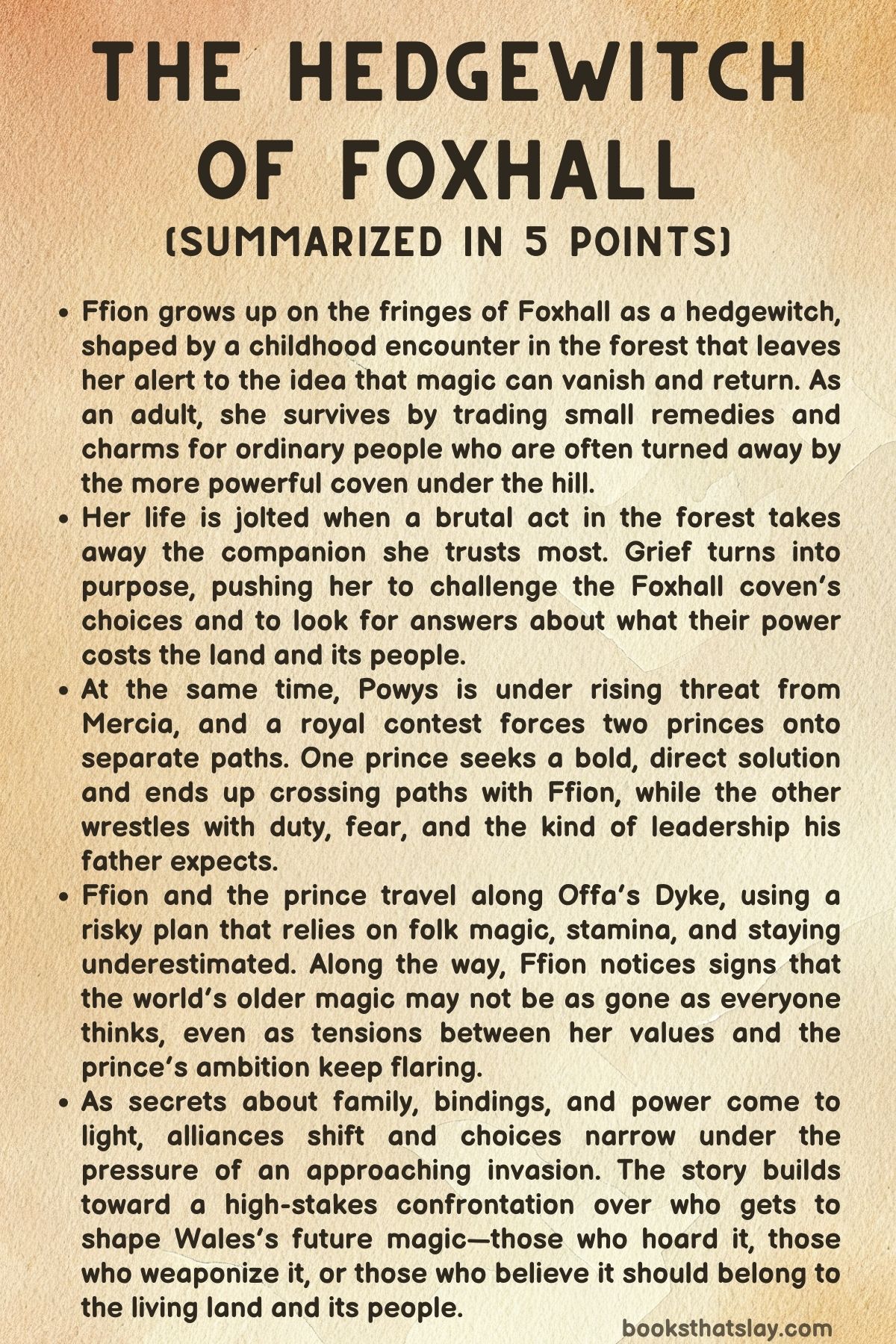
Summary
Ffion’s earliest memory of magic is not a lesson, but an encounter. At seven years old, she slips into Foxhall Forest at midnight to find amber for protection charms, her fox familiar, Cadno, padding after her.
In a birch glade, she comes face to face with red dragons—six of them, close enough that one young dragon steps forward to sniff her leg and study her as if it recognizes something in her. Then the largest dragon calls it back, and the dragons vanish into the trees.
The moment marks Ffion. From then on, she becomes someone who keeps looking for what the world has lost.
Years later, in the spring of AD 796, Ffion lives on the margins of Foxhall as a hedgewitch, sleeping under hedges when she must, trading charms and cures for bread, eggs, or a corner to rest. On the morning of the Spring Equinox, she spots Mercian soldiers deep inside Welsh land.
A stag on the ridge becomes their sport; an arrow bites into its hind leg. Ffion hides and makes a quick ward: a shallow trench, stones set just so, a sung charm that turns the forest itself into a warning.
The soldiers hesitate, call the trees “the witches’ wood,” and retreat.
Ffion follows the wounded stag into the forest and finds it collapsed by a brook. Speaking softly, she draws out the arrow, eases fever with a simple charm, and binds the leg with linen and felt, sealing the injury with amber.
As she works, she remembers a childish spell from when she was five—jealous and lonely, making a crude poppet and offering scraps to the woods. The forest answered that day by sending her a fox kit.
That kit grew into Cadno, her familiar and constant companion.
Foxhall itself is hungry and strained. Ffion bargains for food by promising to charm mice out of a wealthy house’s well.
She treats a baby’s cough in Olwen’s home with steam and a sung spell, giving away the last of her elder cordial because the family can’t pay. Above all of this looms the Foxhall coven under the hill, a circle of witches with the power and status Ffion has never wanted—and never been allowed.
On Petitioners’ Days, townspeople line up at their door with pennies, begging for help that often comes too late, or not at all.
When Ffion sneaks into her mother’s cottage for supplies, she’s caught by her sister Arianrhod. The cupboards are stocked, the cordial plentiful—proof of how different life is when you are inside the coven’s protection.
Arianrhod urges her to come home, to eat, to stop living like a stray. Ffion refuses, leaving behind a protective charm and noticing the coven’s growing appetite for resources: trees marked and cut, the land quietly claimed.
Far from Foxhall, at Mathrafal Castle, King Cadell of Powys calls his sons, Dafydd and Taliesin. His magician, Osian, delivers a grim vision: a Mercian attack is coming, and Cadell dies on a spear.
Worse, Osian says his own magic has vanished because Pendwmpian Forest—tied to his power—has been felled by Mercia. Cadell responds with a ruthless challenge.
Whoever can break Offa’s Dyke and restore Wales’s magic will inherit Powys; the loser will be cast down into service as the king’s candler, sent away to cleanse blighted places. The contest turns brother against brother immediately.
Taliesin tries to ransom an imprisoned prince, Angws, to raise an army; Dafydd secretly frees Angws first, wrecking Tal’s plan. Cadell sends them in opposite directions and forbids them to cross paths.
In Foxhall, Ffion’s life breaks open. After a long day helping petitioners, she smells smoke and runs into the forest.
By the brook she finds scorched earth: a chalk circle burned into the ground, trees still smoldering, and Cadno dead within it—blackened beside a deliberate offering of foxgloves. Ffion searches her spellbook for any way to bring him back, but nothing fits.
Grief turns into fury. Convinced the coven is responsible, she storms to their hall beneath the hill.
At the same time, Taliesin arrives in Foxhall with guards, chasing Angws and desperate for aid. He pushes through the Petitioners’ Day line and insists on seeing the coven’s leader, Rhiannon.
Inside the hall, Tal offers wealth and court power in exchange for help destroying Offa’s Dyke. Rhiannon refuses, saying the coven wants no part of princes’ wars and that Wales’s magic has been thinning for longer than any dyke.
Then Ffion bursts in, muddy and shaking, accusing the coven of killing Cadno in a sacrifice. Her rage spills onto everyone: the coven for taking pennies and choosing favorites, the town for accepting it, Tal for bringing court demands to the same door.
Outside, her mother Catrin tries to pull her away and silence her, but the argument only exposes deeper wounds—how the coven’s comfort has always come at someone else’s expense. Ffion returns to the hall and makes a vow against the coven, forcing poison ivy up through the floor as a warning.
She tells Tal she helps the people the coven ignores and invites him to meet her at the Dead Man’s Bells.
At the inn, Tal offers sympathy, and Ffion lays out what she wants: dinner, payment, and purpose. Tal explains the stakes—Osian’s power gone, a Mercian attack tied to the new moon, and Cadell’s contest.
Ffion hears one thing clearly: if Wales’s magic can be restored, it might also open a path to save Cadno before he passes fully into Annwn. She agrees to help Tal for a steep price, and they set out.
Ffion begins a long spell along the dyke. She buries a pouch of ingredients, wraps ivy from the dyke around her ankles, coats her feet with ditch mud, and walks beside the earthwork while singing harmless household songs.
Mercian soldiers laugh, and Tal’s men bristle, but the mockery keeps them from being stopped. Early in the journey, Ffion senses something she doesn’t tell Tal: the dyke carries strong magic, far more than she expected, as if it is an engine, not merely a barrier.
As they travel north, Ffion keeps finding signs that old beings may be stirring. One night, drawn by a strange presence, she follows huge prints near a stream and discovers the resting place of a water leaper.
The find thrills her—proof that wonder has not died, only hidden. Tal is less pleased; he thinks of the damage such creatures can do.
Their arguments sharpen into personal truths: Tal’s hunger for control and victory, Ffion’s refusal to belong to anyone’s plan.
Meanwhile, Dafydd travels his own harsh road. He shelters where he can, bargains with what little he has, and reaches King Bleddyn of Gwynedd to seek alliance.
Bleddyn agrees quickly—but wants repayment in kind. Dafydd, burdened by the contest and by the fear of becoming his father, keeps moving forward anyway.
Near Mathrafal, Tal and Ffion are ambushed. Ffion’s thorns and tree-magic slow the thieves, but the spell burns out fast.
Then Dafydd appears, frightening the attackers into flight. Osian arrives soon after and reveals a truth that knocks the ground out from under Ffion: she is meant to be Dafydd’s magician, bound by an old arrangement—her grandmother’s service repeating through bloodlines.
Worse, Osian is her father. Dafydd admits he has seen her in visions since childhood because Osian bound them when they were young.
Ffion is sickened by the violation, realizing Dafydd has carried a closeness she never consented to.
At Mathrafal, tensions stack like dry wood. Osian pushes to install Ffion as court magician to block the Foxhall coven from taking the position.
Tal finds his mother’s protection weakened at court and explodes at the carelessness. The Foxhall arrive offering aid that would win the war while tightening their hold on magic, making it harder for hedgewitches and outsiders to access anything at all.
Ffion argues for a different path: to break the dyke and restore magic broadly, she needs three powerful blades made by her grandmother. Dafydd refuses, claiming one of Powys’s blades is lost, and his fear of sighted ravens—creatures that force brutal truth—becomes obvious.
The political room tightens further when Offa’s representative arrives: a woman who announces herself as Offa’s magician. She is Catrin—Ffion’s mother.
The revelation strikes like a slap. Catrin insists she worked with Offa to prevent war and save lives.
Accusations erupt. Then Catrin exposes another betrayal: Rhiannon first offered the Foxhall’s services to Offa, and only came to Mathrafal when his price insulted her.
Cadell wavers—until Rhiannon takes a lance and drives it through his stomach, killing him in front of everyone.
In the chaos, Tal, Ffion, and Dafydd flee, stunned by the prophecy fulfilled in the worst way. Ffion believes she has failed.
To restore magic and bring Cadno back, she needed three relics—raven feather, unicorn horn, and dragon scale—and she thinks she only has two. Dafydd, forced at last into leadership, returns to secure the alliance and face the coming attack.
In a private moment, he confronts the sighted ravens, endures what they show him, and finds what was missing: the unicorn’s horn.
Offa’s forces arrive earlier than expected, and the night turns unreal with smoke and fire. Ffion feels the ground shake and knows the dyke is about to become a grave for Wales.
Tal reminds her of her grandmother’s rule for breaking spells: a piece of what must break, fuel, and contact. Ffion realizes her cauldron—packed with everything she gathered to save Cadno—can be the fuel.
She runs to the sea and begins the breaking spell, ready to spend her last hope if it means saving the land.
Catrin arrives and adds her own hoard of powerful ingredients, calling it payment of a blood debt. As Ffion sings the spell that will crack the dyke, Catrin sings a different one—the old summoning song that once brought Cadno to a jealous child.
Cadno appears on the beach, alive, and Ffion clutches him as if she can stitch time back together with her hands.
Then Wales answers. Wind tears away the smoke.
Earth rises, fungi and roots seize soldiers, ivy and hedge drive them apart, and animals surge into the battle. Magical creatures return in force—ravens, unicorns, and more—until the dyke itself fractures along its length.
Dragons burst free, chained and furious, turning fire on Mercia’s army while sparing the land that called them back. Offa dies.
Rhiannon dies. The dyke is destroyed, and magic floods back into Wales like breath into lungs.
Afterward, succession is decided not by victory speeches, but by quiet choice. Tal refuses the throne, taking only his lands and the duty of protecting the people he loves.
Ffion supports Dafydd as king, and Dafydd accepts, determined to rule without becoming Cadell. Months later, at Midwinter, Ffion and Tal host a crowded gathering full of warmth, family, and new beginnings.
At the door, the Mari Lwyd appears in the snow, acknowledging the secret work that has been done to restore forest and enchantment. Tal welcomes her inside, and the story ends with a home bright with voices—and a Wales where wonder has returned.
Characters
Ffion
Ffion is the emotional and moral center of The Hedgewitch of Foxhall, embodying a kind of magic that grows from empathy rather than power. She lives as a hedgewitch on the margins of society, trading humble charms and healing for food and shelter, and her life reflects a deliberate refusal to belong to systems that hoard magic or authority.
What defines her most is stubborn compassion: she gives away her last elder cordial to help a sick child and risks angering powerful figures simply to defend the people the coven ignores. Her connection to the land and its hidden magic is instinctive rather than institutional, which allows her to perceive things others cannot—old creatures stirring, the deeper magic buried in Offa’s Dyke, and the fading spirit of Wales itself.
The death of her fox familiar, Cadno, fractures Ffion’s quiet existence and becomes the catalyst that pushes her into a wider political struggle. Her grief quickly transforms into fierce determination, revealing that beneath her gentle nature lies a capacity for rage when injustice strikes.
This rage is not reckless destruction but a demand for accountability—toward the coven, the princes, and even the structures of magic itself. Throughout the story, Ffion repeatedly rejects attempts to control or claim her, especially the revelation that she is meant to serve Dafydd as a hereditary magician.
The violation of that expectation reinforces her central belief that magic should belong to the land and its people, not to dynasties or courts.
Ffion’s arc is about reclaiming agency in a world that assumes her place has already been decided. By the time she confronts the breaking of the dyke, she understands that restoring magic requires sacrifice and trust in forces larger than herself.
Her willingness to risk the cauldron meant to save Cadno proves that her loyalty extends beyond personal grief to the future of Wales. When Cadno returns and magic floods back into the land, it affirms that her way of practicing magic—humble, communal, and rooted in care—was never weaker than the coven’s structured power.
Instead, it becomes the foundation of renewal.
Cadno
Cadno, Ffion’s fox familiar, functions as both companion and symbolic anchor to the natural magic of the land. Their relationship began in childhood when Ffion’s lonely spell unexpectedly called a fox kit from the forest.
From that moment onward, Cadno becomes more than a magical helper; he is a partner who shares her wandering life and her quiet acts of healing. His presence grounds Ffion emotionally and spiritually, reinforcing her identity as a hedgewitch whose magic grows from living relationships rather than formal rituals.
Cadno’s death early in the story carries enormous emotional weight because it represents the severing of that connection. The burned circle and deliberate sacrifice signal that the struggle over magic has become cruel and transactional.
His loss strips away Ffion’s sense of safety and pushes her into confrontation with forces she had previously avoided. In narrative terms, Cadno’s absence creates a void that shapes her motivations for much of the story: she seeks not only justice but also a way to reverse what has been taken.
When Cadno reappears during the climactic ritual, his return symbolizes the restoration of balance between human magic and the living world. The spell that once summoned him as a fox kit echoes again, reinforcing the idea that magic tied to love and belonging cannot be fully destroyed.
His presence at the end of the story confirms that the bond between witch and familiar is not merely magical but deeply relational, rooted in loyalty and shared survival.
Taliesin
Taliesin begins the story as a prince defined by ambition and calculation. As one of King Cadell’s sons, he enters the contest to break Offa’s Dyke with the mindset of a strategist who sees political advantage in every opportunity.
His first instinct is to secure alliances and resources, even attempting to ransom a captured prince to raise an army. This approach reflects his upbringing within a ruthless court where victory and power determine legitimacy.
Tal believes control is the only reliable way to shape the future.
His encounter with Ffion gradually challenges that worldview. She confronts him openly, refusing to treat him with the deference expected of a prince, and her independence unsettles him.
Through their travels together, Tal begins to recognize the limits of political manipulation. Magic, nature, and the unpredictable creatures returning to Wales cannot be managed through strategy alone.
His frustration with these forces reveals the tension between his desire for order and the chaotic vitality of the world he hopes to rule.
Over time, Tal evolves into a character capable of humility. Witnessing Ffion’s commitment to ordinary people and the land reshapes his priorities.
By the end of the story, he rejects the throne not out of defeat but from a clearer understanding of his role. He chooses to protect the communities he cares about rather than chase the abstract authority of kingship.
This decision marks his growth from a prince obsessed with victory into a guardian who values stability, relationships, and responsibility.
Dafydd
Dafydd, Taliesin’s brother, represents a contrasting form of leadership shaped by introspection and reluctance rather than ambition. From the beginning, he carries a heavy burden: visions of Ffion tied to him through magic and the knowledge that his father’s challenge will force him into conflict with his brother.
Unlike Tal, Dafydd moves through the world with caution, negotiating alliances and enduring hardships quietly. His journey reflects a person trying to avoid becoming the ruthless figure his father expects him to be.
The revelation that Ffion is meant to serve him as a hereditary magician complicates his character significantly. Although he did not initiate the arrangement, he has grown up with the expectation of her presence in his life.
When she reacts with horror to the magical bond imposed on them as children, Dafydd must confront the ethical consequences of traditions he once accepted without question. This moment forces him to reevaluate what authority means and whether inherited power can coexist with genuine consent.
By the end of the story, Dafydd emerges as a ruler defined not by conquest but by accountability. Facing the sighted ravens—creatures that reveal harsh truths—becomes a turning point where he accepts the responsibilities of leadership without denying his fears.
His decision to become king is grounded in a desire to govern differently from his father, emphasizing balance and justice rather than domination. Supporting Ffion’s vision for restoring magic signals that he understands the kingdom must evolve alongside the land itself.
Osian
Osian occupies a morally ambiguous role as both royal magician and Ffion’s father. His prophetic vision of Cadell’s death sets the story’s political conflict in motion, demonstrating his power and the weight his words carry at court.
At the same time, the revelation that his magic has vanished due to the destruction of Pendwmpian Forest reveals how deeply his abilities depend on the health of the land. This dependence hints at a broader theme: even powerful magicians are vulnerable when the natural sources of magic are damaged.
Osian’s relationship with Ffion is deeply complicated. His decision to bind her magically to Dafydd when they were children exposes a willingness to manipulate lives for political stability.
While he may believe the arrangement ensures protection or continuity, it strips Ffion of her autonomy. This action reveals the darker side of court magic, where individuals become pieces in dynastic strategies.
His paternal identity therefore exists alongside actions that undermine trust and freedom.
Despite these flaws, Osian is not portrayed as entirely villainous. His efforts to keep the Foxhall coven from seizing control of court magic suggest that he understands the dangers of centralized magical authority.
In many ways, he represents an older generation trying to manage a collapsing system of power. His choices reflect both genuine concern for the kingdom and a tragic inability to imagine solutions that do not rely on control.
Rhiannon
Rhiannon, leader of the Foxhall coven, embodies institutional magic and its potential for corruption. She presides over a system that promises aid to petitioners yet frequently withholds help unless payment or advantage is involved.
Under her leadership, magic becomes a controlled resource distributed according to status and political calculation. This structure places the coven above ordinary people, reinforcing social hierarchies rather than alleviating suffering.
Rhiannon’s motivations appear rooted in maintaining authority and expanding the coven’s influence. Her negotiations with both Taliesin and Offa reveal a willingness to align with whichever power structure benefits the coven most.
She presents herself as pragmatic, arguing that Wales’s magic has been fading for years and that involvement in royal conflicts would only weaken her order. However, this pragmatism masks a deeper hunger for dominance over magical practice.
Her assassination of King Cadell exposes the extent of her ruthlessness. By fulfilling the prophecy in such a brutal manner, she attempts to seize control of the kingdom’s magical future through shock and fear.
Yet her death during the climactic conflict underscores the collapse of the system she represents. The restoration of wild magic renders her tightly controlled structure obsolete, suggesting that authority built on hoarding power cannot survive when magic returns to the land itself.
Catrin
Catrin, Ffion’s mother, is one of the most complex figures in the narrative because her loyalties exist on multiple sides of the conflict. Initially she appears as a member of the Foxhall coven who has chosen security and influence over the precarious life Ffion lives outside their protection.
Her attempts to silence her daughter during confrontations suggest both embarrassment and genuine concern, revealing the emotional tension between maternal instinct and political allegiance.
The revelation that she serves as Offa’s magician dramatically reframes her character. Rather than a simple traitor, Catrin claims she worked with the enemy to prevent greater bloodshed.
From her perspective, collaboration offered a way to limit the devastation of war. This justification highlights the difficult choices individuals face when navigating power structures that threaten their homeland.
Her actions force readers to question whether survival sometimes requires compromise with oppressive forces.
In the final confrontation, Catrin’s decision to assist Ffion with the spell demonstrates that her deepest loyalty remains with her daughter and the land. By contributing powerful ingredients and singing the old summoning spell, she repays what she calls a blood debt.
This moment reveals that beneath her political maneuvering lies a desire to repair what has been broken. Her involvement in the restoration of magic becomes a form of redemption.
King Cadell
King Cadell represents the harsh realities of medieval rulership, where authority is maintained through strength and fear rather than compassion. His reaction to Osian’s prophecy illustrates this mindset clearly.
Instead of seeking ways to prevent his death peacefully, he turns the vision into a brutal contest between his sons. By declaring that the winner will inherit the throne while the loser becomes a servant exiled to cleanse cursed places, he weaponizes prophecy to test their ambition and loyalty.
Cadell’s leadership style prioritizes dominance and control above stability. He believes that only a ruler capable of breaking Offa’s Dyke deserves to lead Powys, revealing a worldview shaped by constant warfare.
This philosophy influences the rivalry between Taliesin and Dafydd, forcing them into opposition even when cooperation might have strengthened the kingdom. Cadell therefore functions as both a father and a catalyst for conflict.
His death at Rhiannon’s hands fulfills the prophecy but also exposes the fragility of the power structures he relied upon. Despite his attempts to manipulate destiny, he becomes another victim of the struggle for magical and political control.
The aftermath of his death allows his sons to redefine leadership in ways that reject his ruthless example.
Angws
Angws plays a smaller yet strategically important role within the political landscape. As an imprisoned prince whose ransom could secure military alliances, he becomes a bargaining piece in the competition between Taliesin and Dafydd.
Tal initially intends to use him as leverage to raise an army, treating him as a political asset rather than an individual. Dafydd’s decision to free Angws disrupts this strategy and demonstrates a willingness to undermine his brother’s plans through cunning rather than direct confrontation.
Through this dynamic, Angws represents the human cost of royal maneuvering. His captivity and potential ransom highlight how easily people become tools in struggles for power.
Although he does not dominate the narrative, his presence underscores the tension between personal agency and political exploitation that shapes many characters’ decisions.
King Bleddyn
King Bleddyn of Gwynedd appears during Dafydd’s journey to secure allies, embodying the pragmatic politics of regional rulers. His quick agreement to support Dafydd suggests that he recognizes the growing threat posed by Mercia and the instability created by Offa’s Dyke.
However, his willingness to demand repayment in kind reveals that alliances are rarely altruistic. Even in moments of apparent cooperation, rulers calculate the advantages they might gain.
Bleddyn’s character illustrates the broader political environment surrounding the central conflict. Wales is not a unified entity but a collection of competing kingdoms where loyalty often depends on negotiated benefit.
His support for Dafydd contributes to the fragile coalition needed to resist Mercia, yet it also reminds readers that unity is always provisional in a landscape shaped by ambition and survival.
Offa
Offa, the Mercian ruler whose dyke divides the land, serves as the primary external antagonist. His massive earthwork represents both a literal barrier and a symbol of imperial ambition.
By reshaping the landscape to assert dominance, Offa attempts to control not only territory but also the flow of magic tied to the land. The dyke becomes an instrument of suppression, weakening Wales’s enchantment while strengthening Mercian authority.
Offa’s reliance on magicians and strategic alliances reveals a ruler who understands the importance of both military and supernatural power. His collaboration with figures like Catrin demonstrates that he is willing to exploit internal divisions within Wales to achieve his goals.
Through these tactics, he embodies the threat of cultural and magical erasure imposed by conquest.
His death during the climactic uprising marks the collapse of that imperial project. When dragons and ancient creatures emerge to defend the land, they symbolize forces beyond human control rejecting the imposed boundary.
Offa’s downfall reinforces the story’s central idea that domination over nature and magic cannot endure when the land itself rises to resist.
Olwen
Olwen represents the ordinary people whose lives form the moral foundation of the narrative. As a mother seeking help for her sick child, she illustrates the vulnerability of communities living under economic and magical scarcity.
Her interaction with Ffion reveals the stark difference between the coven’s distant authority and the hedgewitch’s personal care. Even though Olwen cannot pay, Ffion still provides healing, demonstrating that compassion rather than profit drives her magic.
Through characters like Olwen, the story grounds its larger political conflicts in everyday survival. The restoration of magic at the end therefore carries meaning beyond royal succession.
It promises relief and hope for families who depend on small acts of healing and protection to endure harsh circumstances.
Themes
Wild magic, land, and ecological justice
Foxhall Forest is treated as a living authority rather than a backdrop, and the story keeps returning to the idea that magic is not an unlimited resource to be extracted. What happens to Pendwmpian Forest clarifies that power has a source and a cost: when Mercia cuts it down, Osian’s magic fails, and the political crisis accelerates because Wales has been treating the land as something it can afford to lose.
The dyke becomes the clearest symbol of this problem. It isn’t only an earthwork dividing territories; it carries “strong magic” of its own, suggesting that domination can be ritualized and reinforced, not merely enforced by soldiers.
Against that, Ffion’s craft is small-scale and place-based—amber, feverfew, felt, egg white, stones, songs—methods that assume the land responds to care, attention, and restraint. Her healing of the stag shows a relationship to nature built on repair, not conquest; she takes what she needs, and she gives work back.
The coven beneath the hill represents an opposite stance: centralized control, heavy requisitions, trees marked and taken, sacrifices that scorch living ground. The conflict isn’t “magic versus no magic,” but what kind of magic is allowed to exist and who gets to decide.
When the final breaking happens, the land’s response is not a tidy miracle performed by elites; the earth, fungi, ivy, animals, and returned creatures become agents. The victory is framed as ecological rebalancing: the border scar is cracked, the chained dragons are released, and Mercian force is stopped by a landscape that refuses to stay passive.
This theme pushes a moral argument that protection of territory without protection of the living systems inside it is hollow, and that restoring The Hedgewitch of Foxhall’s Wales requires restoring the land’s autonomy alongside human sovereignty.
Grief, attachment, and the ethics of what we’re willing to pay
Cadno’s death is not a brief tragedy; it becomes the engine of Ffion’s decisions, and the story treats grief as both vulnerability and power. Her understanding that he will linger until the new moon puts a ticking structure on mourning: she has a limited window to act, which turns love into urgency.
The temptation is to interpret her goal—bringing him back—as selfish, especially because it risks larger political consequences, but the narrative complicates that easy judgment. Cadno is not a pet; he is an anchor, a companion tied to her identity and magic, the living proof of the forest answering her as a child.
Losing him collapses more than comfort; it threatens her sense that the world is responsive and fair. That is why the coven’s suspected role feels like a personal assault and a moral outrage at once.
The later revelation of the missing relics and the dragon scale’s manipulative use shows how grief can be exploited: Rhiannon tries to reduce Ffion to attachment, dismissing her as “driven” by love and therefore controllable. Instead, grief becomes clarifying.
Ffion is willing to bargain hard, confront institutions, and refuse the safety of home because the loss has taught her what complacency costs. The most important ethical moment arrives when she decides to use her cauldron—everything gathered to save Cadno—as fuel for breaking the dyke.
That choice reframes attachment as something capable of sacrifice rather than something that always demands it from others. She is prepared to lose her best hope in order to restore Wales, which undercuts the accusation that she only cares about her own pain.
At the same time, the eventual return of Cadno does not cancel the moral weight of the decision; it validates the idea that love does not have to be opposed to responsibility. In The Hedgewitch of Foxhall, grief is treated as a force that can narrow the world into desperation or expand it into fierce commitment, and the story keeps asking what kind of person you become when the thing you most want back is also the thing you may need to let go.
Borders, identity, and resistance to imperial control
Offa’s Dyke is the story’s central political object, and it operates on multiple levels: a physical barrier, a psychological warning, and a mechanism for shaping identity through separation. The dyke’s watchtowers and camps create a sense of inevitability—crossing becomes “nearly impossible”—and that impossibility feeds the characters’ fear that history is being decided by the occupier’s infrastructure.
Yet the dyke also makes resistance legible: it is a single scar that concentrates anger, hope, and strategy. Tal views it primarily as a military and dynastic obstacle, because his father’s contest forces him into a timeline where success equals legitimacy.
Ffion experiences it differently. Walking its length while singing domestic songs is a form of resistance that uses invisibility as armor; she performs harmlessness to avoid interference, turning the occupier’s contempt into a shield.
That tactic reveals a deeper theme about who is allowed to be seen as dangerous: soldiers mock what reads as peasant work and women’s labor, and in doing so, they fail to recognize the threat. The dyke’s “reek” of magic also suggests that imperial power is not only enforced but narrated as destiny, built into the land to make opposition feel unnatural.
Breaking it, then, is not merely winning a battle; it is reclaiming the right to define the border, or to refuse it altogether. The return of magical creatures at the moment of rupture reinforces this reclamation.
Creatures that had vanished under pressure—ravens, unicorns, dragons—reappear as if the border had been choking the world’s imagination as well as its movement. By tying national survival to the survival of wonder, The Hedgewitch of Foxhall suggests that occupation destroys not only lives and trees but the sense of what a people believes is possible.
Resistance becomes both practical and cultural: the fight is for land, safety, language, and the right to a future that isn’t designed by Mercia.
Leadership, inherited roles, and choosing a different kind of authority
Nearly every major character is trapped in a role someone else designed: Tal as heir-in-waiting, Dafydd as the reluctant alternative, Ffion as a hedgewitch pushed toward court service, Osian as the magician whose function matters more than his ethics, and the coven as a governing body that resembles the courts it claims to avoid. The story tests whether leadership is defined by blood, by competence, by moral clarity, or by willingness to bear consequences.
Cadell’s rule models a coercive version of authority—threats, contests, punishments—where even love is used as leverage. Under that model, leadership is obedience to a system that demands harshness.
Dafydd’s arc resists this. His fear of the sighted ravens is not simple superstition; it represents dread of self-knowledge, the fear that power will reveal something unacceptable inside him.
When he finally faces it, the message he receives—that he is not darkness—creates a foundation for leadership rooted in accountability rather than domination. Tal’s path offers another alternative.
He begins as someone who expects to negotiate with institutions using wealth and status, but over time he learns that legitimacy cannot be purchased from people who see politics as a marketplace. His refusal of the throne later is not an abdication of responsibility; it is a rejection of a role that would replicate the same coercive machinery.
Ffion, meanwhile, embodies authority without title: she acts because she must, not because she is permitted, and she measures success by protection and repair rather than prestige. The coven’s behavior becomes a cautionary mirror.
Their desire to remain untouched by royal games gradually curdles into manipulation, gatekeeping, and violence, culminating in direct murder when their influence is threatened. That moment exposes how “stability” can be maintained through brutality while still being framed as necessary stewardship.
The ending, where Dafydd accepts kingship and Tal chooses limits, proposes that good governance may require both: a leader willing to face hard truths and a refusal to treat rule as the only form of meaningful power. In The Hedgewitch of Foxhall, authority is constantly weighed against consent, care, and the land’s wellbeing, and the narrative favors leaders who can choose restraint even when they have the capacity to control.