The Hounding Summary, Characters and Themes | Xenobe Purvis
The Hounding by Xenobe Purvis is a historical novel centered on the five Mansfield sisters and the fear that gathers around them in the drought-stricken village of Little Nettlebed.
What begins with ordinary resentment, village gossip, and discomfort toward girls who refuse to behave submissively develops into accusations that the sisters can transform into dogs. Through the Mansfield family, the novel examines misogyny, superstition, social conformity, masculine violence, religious certainty, and the danger of communities that prefer exciting accusations to difficult truths. The strange events are never reduced to a single comfortable explanation, allowing freedom, transformation, and persecution to exist beside one another.
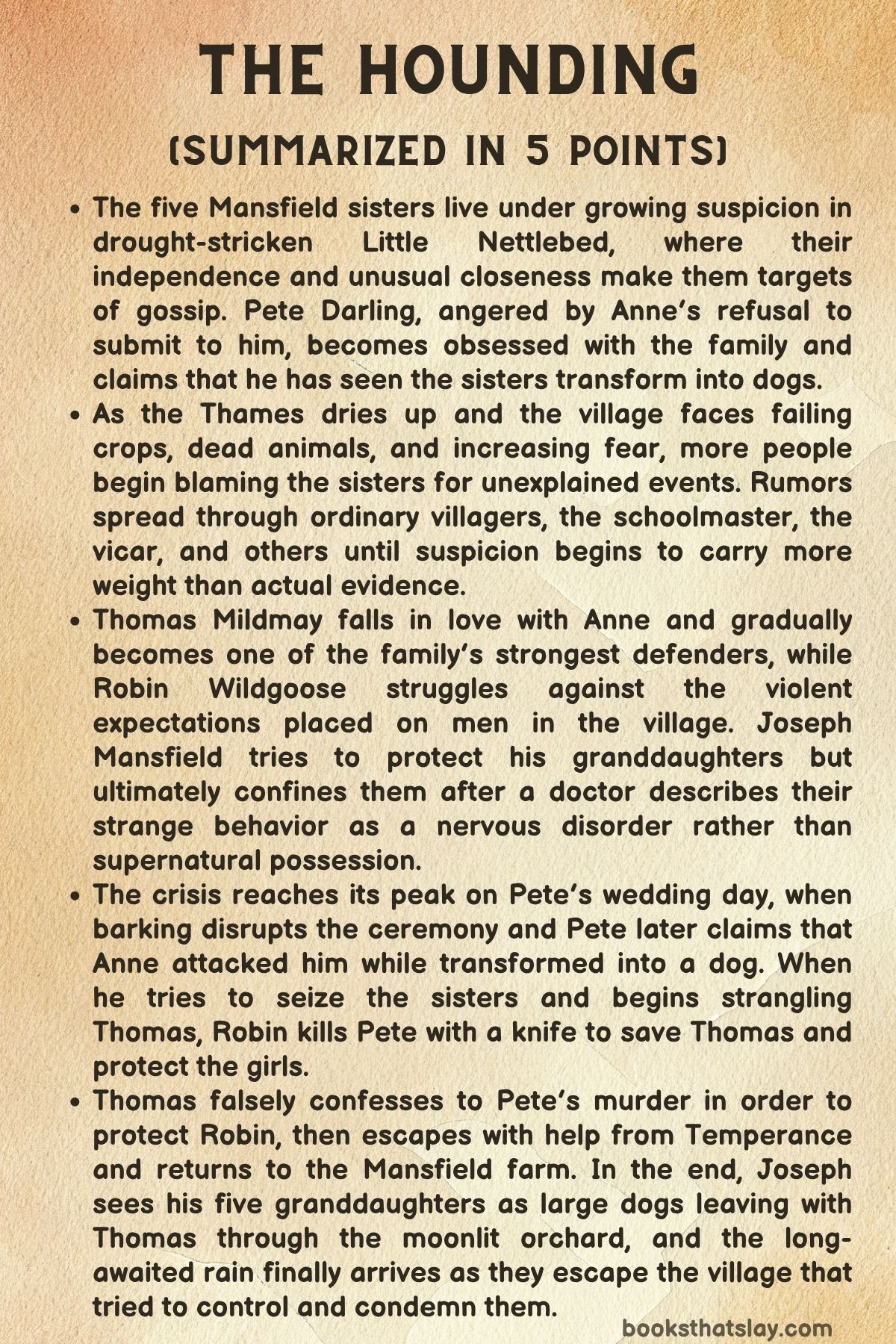
Summary
Little Nettlebed is already unsettled when the Mansfield sisters return from having their mourning clothes dyed black after the death of their grandmother. Anne, Elizabeth, Hester, Grace, and Mary attract attention because of their closeness, independence, and refusal to perform the obedience expected from young women.
Pete Darling, the village ferryman, develops an immediate hostility toward them. When the sisters fail to respond to him with the warmth and deference he expects, he interprets their reserve as deliberate humiliation, and Anne becomes the main focus of his resentment after she refuses to tolerate his attempt to intimidate them on the river.
The village itself is entering a period of physical crisis. The Thames is unusually low, the weather remains brutally dry, and Pete recognizes that the disappearing river threatens his livelihood because people may soon be able to cross without using his ferry.
The drought produces another unsettling event when an enormous sturgeon becomes trapped in the shallow water. Villagers celebrate the unexpected source of food, but Hester and Mary desperately try to save the creature before Pete kills it, creating another confrontation between the sisters and a community that increasingly regards their behavior as strange.
Thomas Mildmay arrives to work at Joseph Mansfield’s farm during haymaking. Pete immediately warns him that the sisters are dangerous, especially Anne, but Thomas discovers a household filled with teasing, noise, affection, and unconventional behavior rather than the threatening place Pete has described.
Thomas becomes especially fascinated by Anne. At first he observes her with uncertainty, but his curiosity develops into attraction as he watches her strength, independence, and devotion to her sisters.
Joseph Mansfield, the girls’ grandfather, is nearly blind and depends heavily on Anne. He recognizes that she has taken on responsibilities far beyond what should be expected of someone her age, while also worrying about the vulnerability of five young women living in a society determined to control their movements and choices.
A playful fortune-telling game adds an ominous note when Hester predicts that Anne will know a brief love before being hunted and frightened. Soon afterward, someone leaves the remains of the enormous sturgeon outside Joseph’s property, suggesting that the family’s conflict with the village is becoming more personal.
Pete’s obsession continues to intensify. He combines attraction toward Anne with anger that she will not submit to him, turning even ordinary politeness into imagined insults and persuading himself that resistance from women is evidence of moral failure rather than a challenge to his own sense of entitlement.
Robin Wildgoose offers a contrast to Pete. Gentle and uncomfortable with cruelty, Robin nevertheless lives in a culture where men are expected to be violent, hard-drinking, and emotionally severe, causing him to participate in the brutal killing of a badger simply to avoid appearing weak.
His shame deepens when he later scolds Anne and Elizabeth for walking outside after dark, imitating the controlling behavior he dislikes in other men. After turning back to check on them, Robin hears a strange barking sound and sees Pete nearby, leaving him worried that something serious may have happened.
At the Mansfield home, Joseph realizes that the girls are hiding something. Anne and Elizabeth appear deeply distressed, while Hester, Grace, and Mary refuse to explain what occurred, creating the sense that the sisters have experienced an event they do not believe the adults around them can safely understand.
Thomas also observes Anne comforting Elizabeth and becomes convinced that the sisters’ sadness cannot be explained simply by their grandmother’s death. His concern for Anne strengthens alongside his attraction until he recognizes that he has fallen in love with her.
Then Pete makes the accusation that changes everything. After seeing the sisters from across the river, he claims that he watched them fall onto all fours and transform into dogs.
Temperance Shirly, who works at the Swan alehouse, initially dismisses the story because Pete is known for drunkenness and extravagant claims. Nevertheless, she tells her husband John, and Pete soon tells his fiancée Agnes, allowing the accusation to travel through the village despite promises that it will remain private.
Each retelling adds new details. Villagers begin claiming that the Mansfield sisters possess sharp teeth, glowing eyes, and animal characteristics, even when the people repeating such stories have witnessed nothing themselves.
The accusation succeeds partly because the Mansfield family was already regarded as unusual. The rumor gives villagers a way to transform discomfort with independent girls into apparent evidence of supernatural danger.
When the Wildgoose family’s hens are slaughtered, suspicion quickly falls on the sisters despite the lack of proof. Temperance becomes increasingly alarmed and asks the village vicar to stop Pete from spreading the story, but the vicar instead becomes fascinated by the possibility of possession.
The drought worsens at the same time. Wells empty, crops suffer, animals become stranded in the shrinking Thames, and the community grows more frightened, creating conditions in which unexplained misfortune can easily be blamed on convenient outsiders.
The vicar visits Joseph and openly raises the possibility that the girls are possessed by the devil. During the confrontation, he claims to see one of the sisters momentarily transform, and Thomas reluctantly admits that Anne’s face also appeared altered to him for an instant.
Thomas becomes frightened enough to consider leaving Little Nettlebed. Temperance, however, makes him understand that nearly every local problem is being attached to the Mansfield sisters, and he decides that abandoning them would mean surrendering them to a hostile community.
The Thames eventually becomes so shallow that Pete effectively loses his occupation. Drinking more heavily and increasingly uncertain about his approaching marriage to Agnes, he searches for another source of importance and begins encouraging young Richard Wildgoose to bring him village information.
Meanwhile, Joseph invites Doctor John Friend from Oxford to examine his granddaughters in hopes of disproving the supernatural rumors. During the examination, all five sisters suddenly howl together, alarming everyone present.
The doctor rejects demonic possession and instead diagnoses a nervous disorder involving disturbed animal spirits, possibly produced by trauma, fear, or imitation. Although this medical explanation prevents an immediate declaration that the girls are possessed, it still treats them as abnormal and leads Joseph to accept the doctor’s recommendation that they be confined inside the house.
Furniture is placed outside their bedroom doors, turning the Mansfield home into a prison. Anne protests that the sisters are being punished despite having done nothing wrong, but Joseph believes confinement is necessary to protect them from the village.
Connie and Amie, the household servants, eventually leave because Connie fears the sisters’ strange behavior might represent contagious illness. Their departure leaves the Mansfields increasingly isolated at precisely the moment when the village’s suspicion is becoming most dangerous.
Richard then reports seeing five large dogs near the Mansfield property. Soon afterward, numerous rabbits, birds, rodents, and even a deer are found dead near the fields, and Pete treats the slaughter as proof that the sisters escaped their rooms in animal form.
Temperance struggles with a different transformation after Pete forces her bare fingers into his ale. Having spent years avoiding alcohol because of her father’s death, she discovers that she enjoys the taste and begins craving the substance she has treated as a source of corruption.
On Pete’s wedding day, he convinces himself that he has received another divine sign confirming both his marriage and his judgment of the Mansfield sisters. The villagers lock up their dogs to test whether ordinary animals are responsible for the killings, but Pete refuses to consider any explanation that might weaken his accusations.
Joseph finally acknowledges how serious the danger has become. Anne insists that the sisters’ true offense is not transforming into dogs but behaving too freely as girls, and she refuses to accept that they should abandon their home merely because the village wants them frightened into obedience.
Joseph briefly permits the sisters to go outside because most villagers are attending Pete and Agnes’s wedding. During the ceremony, barking is suddenly heard outside the church, causing the congregation to rush after Pete in pursuit of whoever has disrupted the event.
Pete is soon discovered bleeding from his hand. He claims that Anne bit him while transformed into a dog, but Robin immediately questions whether an ordinary dog could have attacked him instead.
The searchers eventually find all five sisters beneath a willow with Thomas. Thomas insists that he has been with them and that none could have attacked Pete, while Anne directly accuses Pete of lying.
Pete nevertheless tries to seize the sisters and take them back for punishment. When Thomas refuses to surrender them, the argument becomes violent and Pete begins strangling him.
Robin sees that Thomas may die and takes Hester’s knife from Richard. The young man who has spent much of the story resisting violence stabs Pete repeatedly in the back, killing him while saving Thomas and the sisters.
Robin is horrified by his own action. He fears that committing violence has made him indistinguishable from the brutal men he despises, but the others insist that he acted because Pete was prepared to kill.
A mob soon arrives and immediately assumes that the Mansfield sisters murdered Pete. Before Robin can confess, Thomas claims responsibility.
Thomas publicly declares his love for Anne and says he killed Pete because Pete would never have stopped persecuting her. His false confession protects Robin and temporarily redirects the villagers’ anger away from the sisters.
Temperance later discovers that Thomas is lying. Now struggling with her own drinking, she secretly gives him access to a sharp shell that can cut his restraints, allowing him to escape before authorities arrive.
Thomas returns secretly to the Mansfield property. Joseph learns that Pete is dead, that Thomas confessed and escaped, and that Anne is hiding the truth, but he chooses not to force a full explanation.
Instead, Joseph indirectly tells Anne where money can be found, effectively helping Thomas and his granddaughters flee. His decision marks a final shift from trying to protect the sisters through restriction to helping them seek freedom on their own terms.
During the night, Joseph’s failing eyesight suddenly clears. Looking into the moonlit orchard, he sees five large dogs circling Thomas before all six figures race across the property and disappear beyond the wall.
Joseph understands the animals as his granddaughters. Rather than reacting with horror, he feels grief at losing them and relief that they have escaped the confinement, fear, and punishment imposed upon them.
As the girls disappear, a cloud appears above Little Nettlebed and carries the smell of rain. The long drought is finally ending just as the sisters leave the village that tried to define their independence as monstrosity, leaving open the question of whether their transformation was supernatural fact, shared experience, deliberate resistance, or something that cannot be confined to one explanation.
Characters
Anne Mansfield
Anne is the eldest Mansfield sister and the emotional center of The Hounding. After the deaths of her parents and grandmother, she carries responsibilities that would normally belong to an older adult, caring for her younger sisters while also assisting Joseph with the treatments required for his failing eyesight.
Her strength appears most clearly in her refusal to accept humiliation as normal female behavior. When Pete attempts to intimidate the sisters on the ferry, Anne simply leaves the boat and crosses the shallow water herself, an action that exposes how little real authority Pete possesses when someone refuses to cooperate with his performance of power.
Anne’s independence becomes dangerous because Pete experiences it as a personal attack. His attraction to her is inseparable from his need to control her, and every refusal convinces him further that she deserves punishment.
Her relationship with Thomas reveals another side of her character. She is capable of tenderness and romantic attachment, yet love never replaces her loyalty to her sisters or her determination to resist the village.
Anne also understands the social meaning of the accusations more clearly than most adults. She eventually tells Joseph that the real offense is not that she and her sisters may become dogs but that they behave with freedoms normally denied to girls.
That insight makes Anne central to the book’s examination of gender and authority. Whether her transformation is literal or symbolic, she represents a form of female existence that refuses to remain safely contained.
Elizabeth Mansfield
Elizabeth is more emotionally exposed than Anne, and her distress becomes one of the earliest signs that something serious has happened to the sisters. Thomas observes Anne comforting her while she cries, while Joseph notices that she strips roses from the garden and avoids explaining her behavior.
Her sensitivity does not make her weak. Elizabeth participates fully in the sisters’ private solidarity and repeatedly refuses to betray what they have experienced simply to satisfy adult curiosity.
She also plays an important role after Robin kills Pete. When Robin fears that a single violent action has transformed him into the kind of man he hates, Elizabeth reminds him that one act cannot erase the rest of his identity.
That response reveals her capacity for moral distinction. She understands that context, intention, and character matter more than simplistic labels, which directly opposes the village’s tendency to define people through rumor.
Hester Mansfield
Hester is rebellious, mischievous, imaginative, and particularly hostile toward the social expectations attached to femininity. Early in the story, she tricks Thomas into climbing into a well by claiming that a kitten has fallen inside, showing both her sense of humor and her willingness to test newcomers.
Her fortune-telling game also carries unusual significance. She predicts ordinary futures for some sisters but tells Anne that love will be followed by fear and pursuit, an unsettling prediction that later resembles Anne’s actual experience.
Hester’s distress after beginning menstruation gives her rebellion a deeper social meaning. She resents the bodily change because she understands that becoming a woman will bring restrictions, dangers, and expectations she does not want.
Her declaration that she would rather be a boy, Joan of Arc, or even a pebble expresses more than childish frustration. She is rejecting a social order in which female maturity means losing freedom.
Grace Mansfield
Grace is quieter than Anne or Hester but is deeply aware of the threat surrounding the family. Her private conversation with Hester suggests that she understands more about the sisters’ strange experiences than Joseph realizes.
She later approaches Thomas because she wants an honest account of what villagers are saying. Rather than simply hiding from the accusations, Grace actively gathers information about the danger facing her family.
Her fear before Doctor Friend’s examination is especially revealing. Grace is not merely frightened that outsiders believe the sisters are abnormal; she is frightened that the examination may discover something real.
That uncertainty allows the novel to preserve ambiguity around the sisters’ transformations. Grace behaves neither like someone confidently performing a deception nor like someone who completely understands what is happening to her.
Mary Mansfield
Mary is the youngest sister, and her playful imagination often allows her to speak truths that the older characters avoid. She imitates animals, pretends to be a cat, and expresses herself through strange remarks that adults can easily dismiss as childish behavior.
Yet Mary understands the emotional atmosphere within the household. When Joseph questions her about her sisters’ behavior, she refuses to betray them and firmly insists that whatever happened is not meaningless.
Her loyalty is instinctive rather than carefully argued. She belongs completely to the private world of the sisters and recognizes that adult authority is not automatically entitled to every truth.
Mary’s later references to Thomas returning to the moon show how she continues to convert dangerous realities into imaginative language. Her fantasy protects secrets while also making the boundary between play, transformation, and reality increasingly difficult to define.
Joseph Mansfield
Joseph is one of the most sympathetic adult figures in The Hounding, but his love for his granddaughters does not prevent him from making harmful decisions. Nearly blind and still grieving his wife, he depends heavily on Anne and worries constantly about protecting all five girls.
His great difficulty is that protection gradually becomes confinement. After Doctor Friend recommends isolation, Joseph accepts the diagnosis and physically imprisons the sisters even though they have committed no offense.
Joseph’s mistake comes from fear rather than cruelty. He believes the outside world is dangerous, but instead of challenging that world, he initially attempts to make the girls smaller and less visible.
His later development reverses that decision. By helping Anne access money and refusing to expose Thomas, Joseph finally recognizes that genuine protection may require allowing those he loves to choose freedom even when he cannot control the consequences.
His final vision of the five dogs is therefore emotionally important. Instead of seeing monstrosity, Joseph sees the possibility that his granddaughters have become powerful enough to escape the forces trying to contain them.
Pete Darling
Pete is the principal human antagonist of The Hounding, and his danger comes less from supernatural belief than from wounded entitlement. He expects women to be deferential and interprets resistance as humiliation, especially when Anne refuses to treat him as an authority.
His fixation combines sexual attraction, resentment, religious certainty, and a desire for control. Pete repeatedly recognizes his own drinking and anger as sins but finds excuses for his hostility toward women, allowing him to preserve an image of himself as morally righteous.
Losing his livelihood during the drought worsens his instability. As the Thames disappears and his role as ferryman becomes unnecessary, he loses both income and the social importance that came from carrying people across the river.
The accusations against the Mansfield sisters give him a new form of authority. By presenting himself as the man who witnessed their supposed transformation, he becomes central to village conversation at the same moment his practical usefulness is disappearing.
Pete’s religious visions intensify his certainty rather than encouraging humility. He interprets ambiguous experiences as proof that God agrees with him, making disagreement feel like rebellion against divine truth.
His death completes the logic of his behavior. He attempts to turn rumor into physical punishment, attacks Thomas, and dies because Robin finally uses violence to stop him.
Thomas Mildmay
Thomas becomes the romantic and moral ally of Anne in The Hounding. He arrives carrying memories of childhood poverty and initially wonders whether he should resent Joseph because the Mansfield family prospered during years when poorer families struggled to afford food.
Living at the farm complicates those assumptions. Thomas becomes attached to the Mansfield household, fascinated by the sisters, and deeply in love with Anne.
His feelings do not make him immediately fearless. When he thinks he sees Anne’s face change, he becomes frightened enough to leave, showing that he is still vulnerable to the same uncertainty affecting the village.
What distinguishes Thomas is his willingness to reconsider fear rather than turning it into persecution. After learning how broadly the sisters are being blamed, he returns because he recognizes that abandoning them would make him part of the injustice.
His false confession after Pete’s death is his greatest sacrifice. Thomas knowingly accepts the possibility of execution to protect Robin and prevent the sisters from carrying the blame.
His eventual escape allows his love for Anne to become part of her movement toward freedom. By the conclusion, Thomas is not rescuing Anne from her sisters or transforming her into a conventional romantic heroine; he joins them as they leave the village together.
Robin Wildgoose
Robin provides one of the most complicated moral journeys in The Hounding. Naturally gentle and compassionate toward animals, he lives in a society where masculinity is measured through violence, drinking, dominance, and the suppression of tenderness.
His participation in the badger killing reveals the cost of conformity. Robin acts against his own values because he fears that refusing will expose him as weak.
He later repeats the same pattern when he criticizes Anne and Elizabeth for being outside at night. His immediate regret shows that his conscience remains active even when social pressure temporarily controls his behavior.
Robin’s insistence on evidence becomes increasingly important as rumors spread. He teaches Richard to question authority and refuses to treat repetition as proof, positioning him against the village’s collective certainty.
Killing Pete nevertheless creates a severe moral crisis. Robin saves Thomas’s life, but the speed with which he uses violence horrifies him because he fears that necessity has revealed something brutal inside himself.
The book refuses to reduce him either to murderer or hero. His action is protective and violent at the same time, forcing him to live with a moral complexity that the village’s simpler judgments cannot accommodate.
Richard Wildgoose
Richard is younger and more impressionable than Robin, making him especially vulnerable to Pete’s attention. Pete offers him alcohol, conversation, and the flattering idea that he can become a valuable source of information.
Richard is attracted to the feeling of adult importance. He therefore begins feeding Pete details about the dogs, the Mansfield property, and village events without fully understanding how those details will be used.
His relationship with Robin becomes a struggle between two forms of authority. Robin asks him to question claims and demand evidence, while Pete encourages suspicion and presents himself as someone who already understands the hidden truth.
Richard eventually recognizes that Pete manipulated him. His apology after Pete’s death shows that he understands how easily curiosity and insecurity can make someone participate in persecution.
Temperance Shirly
Temperance is one of the novel’s strongest observers of gendered injustice. Working at the Swan with her husband John, she sees how alcohol, gossip, male authority, and public spectacle shape the behavior of Little Nettlebed.
Her father’s death after a drunken accident causes her to treat alcohol almost as contamination. The gloves she wears while serving customers symbolize the distance she tries to maintain between herself and the substance she fears.
Temperance also recognizes the danger facing the Mansfield sisters earlier than many villagers. She understands that even an absurd rumor can become deadly once enough people want to believe it.
Her attempt to involve the vicar tragically strengthens the accusation instead of stopping it. This experience teaches her that respectable authority can intensify hysteria just as easily as drunken gossip.
Her own drinking introduces an important contradiction. Temperance is neither morally destroyed nor simply liberated by alcohol; instead, she discovers an appetite she had spent her life denying.
Helping Thomas escape shows her courage at its clearest. She learns the truth about Pete’s death and quietly chooses justice over obedience to the village authorities.
John Shirly
John is Temperance’s husband and the publican of the Swan. Although less central than Temperance, he contributes to the social environment in which information, alcohol, and rumor circulate together.
His willingness to continue serving Pete despite Temperance’s objections creates tension in their marriage. John represents the ordinary accommodation that allows dangerous behavior to continue because confronting it would be inconvenient.
He does not create the persecution, but his passivity helps maintain the conditions in which it grows. Through characters such as John, the novel shows that communal harm depends not only on aggressive leaders but also on people who continue business as usual.
Agnes Bullock
Agnes is Pete’s fiancée and later wife, although their marriage is immediately overshadowed by violence and his death. Pete claims to have chosen her partly because he interpreted a dream of her as Eve as a divine instruction.
Their relationship reveals how little Pete understands marriage as mutual affection. He increasingly regards the wedding as an obligation and fears that Agnes will gain control over him.
Agnes does question Pete’s transformation story rather than accepting it instantly. His wounded response shows how dependent he is on unquestioning agreement.
She consequently functions as another example of a woman Pete expects to confirm his authority. Even the woman he plans to marry becomes threatening to him whenever she thinks independently.
Connie and Amie
Connie and Amie are servants in the Mansfield household and have genuine affection for the sisters. Their early explanations help Thomas understand the family’s history and the losses that shaped the girls.
Their departure after Doctor Friend’s examination demonstrates the power of fear. Connie does not believe the sisters are supernatural, yet she fears they may carry an illness and refuses to remain near them.
Amie is much more reluctant to leave. Her emotional messages to the girls reveal how strongly she cares for them and how painful the decision is.
Together, the two women show that people can abandon others without hatred. Fear of disease, social danger, or uncertainty can produce isolation even among people who otherwise feel affection.
The Vicar
The vicar represents religious authority that mistakes fascination for responsibility. Temperance approaches him hoping he will calm the situation, but he becomes interested in the possibility of demonic possession.
His visit to the Mansfield farm gives the village rumor greater legitimacy. Once a religious authority treats the accusation seriously, it becomes easier for others to present suspicion as moral concern.
His claim that he witnesses a transformation strengthens this effect. The novel leaves room for uncertainty about what he actually sees, but his interpretation is shaped by an expectation that something supernatural may already be occurring.
Doctor John Friend
Doctor Friend offers a medical explanation for the sisters’ behavior, rejecting the claim that they are possessed. His diagnosis of disturbed animal spirits appears more rational than the villagers’ supernatural accusations, but it does not necessarily restore the sisters’ freedom.
Instead, he recommends strict confinement. The language of medicine therefore replaces the language of possession while producing a similar practical result: the girls are treated as objects requiring control.
His character demonstrates that supposedly rational institutions can participate in restriction even when they reject superstition. Naming behavior scientifically does not automatically mean understanding the people experiencing it.
Samuel Tubb
Samuel Tubb is the local schoolmaster, a position that gives his words additional credibility. His willingness to repeat the transformation story as fact illustrates how rumor gains strength when people associated with knowledge endorse it.
He later reports the dead animals discovered near the hayfields, helping connect another unexplained event to the growing panic surrounding the sisters. Temperance eventually uses his fondness for drink to gain access to Thomas after the murder.
Samuel is therefore not a great ideological villain. He is more useful as an example of how careless certainty from socially respected individuals can help turn speculation into communal belief.
Humphrey Bullock
Humphrey Bullock is Agnes’s father and one of the adults who recognizes Pete’s drinking and behavior as dangerous. Before the wedding, he orders Pete to reduce his drinking and distance himself from the stories about the Mansfield sisters.
His intervention shows that not every villager accepts Pete without question. Nevertheless, after Pete’s death, Humphrey participates in the search for Thomas and the Mansfield household according to the information available to him.
He operates largely through conventional authority rather than personal obsession. His character helps distinguish Pete’s extreme hostility from the broader social machinery that follows once murder has occurred.
Themes
Misogyny, Female Freedom, and Social Control
The treatment of the Mansfield sisters repeatedly shows how female independence can be reclassified as danger when it challenges established expectations. In The Hounding, the sisters are not initially hated because anyone has proved that they possess supernatural abilities; they attract resentment because they are loud, private, self-directed, physically adventurous, and insufficiently deferential.
Pete embodies the most aggressive form of this resentment. Anne’s refusal to obey him damages his sense of masculine authority, and he gradually transforms wounded pride into moral accusation.
The village then supplies a wider social structure for the same impulse. Boys bark at the sisters, adults repeat stories about their bodies, religious authorities discuss possession, and medical authority recommends confinement.
Hester’s hatred of menstruation gives the theme another dimension. She understands becoming a woman not simply as biological maturation but as entry into a category burdened by restrictions, childbirth dangers, and expectations of obedience.
Anne eventually articulates the conflict directly when she argues that the sisters’ real offense is behaving too freely as girls. Her observation reframes the supernatural accusation as a political and social mechanism: calling the sisters animals gives the village permission to deny them ordinary human freedom.
Their final escape as dogs reverses that attempted control. The identity used to condemn them becomes associated with speed, physical power, solidarity, and the ability to cross boundaries no locked bedroom can contain.
Rumor, Fear, and Collective Belief
The accusation against the Mansfield sisters develops through repetition rather than evidence. Pete begins with a personal claim, Temperance reluctantly repeats it to John, Pete tells Agnes, respected villagers add their own versions, and soon people who witnessed nothing speak confidently about glowing eyes, sharp teeth, possession, and transformations.
Each repetition produces greater certainty while moving farther from anything directly observed. The process shows how communities can manufacture apparent truth from accumulated confidence.
The drought intensifies this tendency because fear requires explanation. As the river disappears, crops suffer, animals die, Pete loses his livelihood, and ordinary routines break down, the sisters become a convenient answer to problems nobody can control.
The dead hens and slaughtered animals demonstrate the same mechanism. Rather than beginning with evidence and moving toward a conclusion, villagers begin with a conclusion and reinterpret every new event to support it.
Even institutional authority does not stop the process. The schoolmaster repeats rumors, the vicar investigates possession, and the doctor confirms that something unusual is happening even while rejecting a supernatural explanation.
The novel therefore distinguishes between uncertainty and ignorance. Robin’s willingness to admit that he does not know is presented as more responsible than the certainty of people who possess little evidence.
Collective belief becomes dangerous precisely because individuals surrender responsibility for examining what they repeat. Once everyone has heard the same accusation from someone else, repetition itself begins to look like proof.
Masculinity, Violence, and Moral Choice
Masculinity in The Hounding is repeatedly associated with pressure to display hardness. Robin dislikes cruelty but joins a badger killing because refusing would expose him to ridicule, while Pete treats dominance, drinking, sexual entitlement, and control over women as signs of male authority.
Thomas and Robin offer alternative possibilities, though neither is presented as perfectly free from the culture surrounding him. Thomas initially becomes frightened by Anne’s apparent transformation, and Robin temporarily imitates other men’s controlling behavior when he scolds the sisters for walking outside.
What matters is their capacity to question themselves. Both men recognize moments when fear or social pressure has distorted their judgment and choose to act differently afterward.
Pete moves in the opposite direction. Whenever uncertainty appears, he protects his ego by becoming more certain, more self-righteous, and eventually more violent.
Robin’s killing of Pete makes the theme especially difficult. Robin has spent much of his life rejecting violence, yet he ultimately uses lethal force to save Thomas.
The act cannot be comfortably categorized as either proof of corruption or uncomplicated heroism. Robin kills because a man is being strangled and the sisters are in immediate danger, but he must still live with the knowledge that he was capable of killing.
Thomas’s false confession creates another version of masculine courage. Instead of proving himself through domination, he accepts vulnerability and possible punishment to protect others.
The novel therefore separates strength from aggression. Moral courage appears not in the absence of fear or violence but in the willingness to examine one’s actions, accept responsibility, and protect others without turning power into entitlement.
Transformation, Identity, and Liberation
Transformation operates simultaneously as accusation, possibility, fear, and freedom. The villagers use the image of girls becoming dogs to strip the Mansfield sisters of ordinary human status, turning difference into supposed evidence that they are dangerous creatures.
Yet the meaning of animal identity changes depending on who is looking. Pete sees monstrosity, Joseph eventually sees power, and the sisters themselves appear increasingly comfortable with forms of behavior that refuse the boundary the village wants to impose.
The uncertainty surrounding whether the transformations are literally real is essential. Thomas thinks he sees Anne’s face change, the vicar claims a similar experience, barking is repeatedly heard, dogs appear near unexplained events, and Joseph finally sees five large dogs leaving with Thomas.
At the same time, darkness, fear, alcohol, expectation, performance, and rumor complicate every apparent piece of evidence. The story never needs a simple declaration that explains all of these events.
That ambiguity makes transformation more meaningful rather than less. The sisters have already been changed socially before any physical transformation can be confirmed: they are turned from grieving girls into village monsters through other people’s stories.
Their final departure reverses that process. Joseph no longer understands the dogs as evidence that his granddaughters have become less human.
He recognizes them as beings capable of escaping confinement and choosing their own future. Transformation therefore becomes a language for identity that cannot be completely controlled by family, medicine, religion, gender rules, or communal judgment.
The arrival of rain reinforces that release. As the drought finally breaks, the sisters leave behind the village that tried to decide what they were, ending the story with movement, uncertainty, and freedom rather than a final explanation.