The House Guest Summary, Characters and Themes
The House Guest by Penelope Ward is a contemporary romance that explores love, loss, and second chances through the intertwined lives of Primrose Gallagher, a young art student, and Dorian Vanderbilt, the heir to a vast fortune. Set against the backdrop of a grand California mansion, the story unfolds as two broken souls—one an idealist shaped by tragedy, the other a reclusive billionaire haunted by his past—find solace in each other.
What begins as an uneasy cohabitation slowly grows into an emotional journey filled with passion, secrets, betrayal, and redemption, ultimately becoming a meditation on forgiveness and the enduring power of love.
Summary
Primrose Gallagher, a struggling art student, has been living in her late aunt Christina’s luxurious mansion in California while attending art school. Her quiet life changes when Dorian Vanderbilt, Christina’s stepson, returns after his parents’ unexpected deaths in a carbon monoxide accident.
Shocked to find a stranger in his family home, Dorian confronts Primrose, mocking her and her art before demanding that she leave. She stands her ground, explaining that her aunt had invited her to stay.
Though their first encounter is tense, their dynamic begins to shift when Primrose saves Dorian from his father’s aggressive Dobermans the next day. Humbled, he apologizes and proposes she stay to help maintain the estate.
Living under the same roof, they gradually move from hostility to understanding. Late-night conversations and shared loneliness begin to erode their emotional walls.
They discuss their childhoods, the losses of their mothers, and the burdens of their parents’ choices. Dorian confides that his father’s infidelity scarred him deeply, making him wary of relationships.
Primrose, haunted by her own past, admits her fear of intimacy and abandonment. Their mutual vulnerability strengthens their bond, sparking an unspoken attraction.
The chemistry between them intensifies after a night spent laughing over movies and sharing tea. A false fire alarm triggers Primrose’s trauma from a childhood blaze, and Dorian’s care comforts her.
However, when Dorian brings home a date, jealousy stirs between them. Afterward, Dorian bakes apple crisp—his mother’s recipe—as an apology, and they share a heartfelt conversation about art, ambition, and grief.
Primrose begins to see a softer side of him beneath the aloof exterior.
Tension rises when Patsy, the housekeeper, warns Primrose not to fall for Dorian, recalling her own painful past with his father, Remington. Patsy reveals that Remington had seduced and abandoned her before marrying Christina, cautioning Primrose that men like the Vanderbilts cannot be trusted.
Though Primrose insists nothing romantic is happening, Patsy’s story unsettles her.
Soon, Dorian invites an old friend, Chandler, and Chandler’s wife, Candace, over for a visit. Candace’s warmth and humor bring lightness to the mansion, and her friendship with Primrose deepens.
During a playful afternoon by the pool, Candace teasingly hints that there’s chemistry between Primrose and Dorian. That night, after their guests leave, Dorian and Primrose’s suppressed feelings erupt when they play a flirtatious game by the pool.
Their attraction nearly turns physical, but Dorian stops himself, leaving Primrose confused and embarrassed.
Avoiding him for days, Primrose finally confronts Dorian when he finds her sorting through her aunt’s belongings. He admits that he’s drawn to her but doesn’t want to complicate their living situation.
He calls his restraint a sign of respect rather than rejection. Their emotional honesty mends their friendship, and they decide to keep things platonic.
As they share memories of their parents, their bond grows stronger. He later promises to attend her art show, but when he arrives late and sees her talking to another artist, Brandon, he leaves, sparking a misunderstanding.
The following evening, at a double date with Dorian and Brandon, jealousy resurfaces. When Brandon belittles Primrose’s art, Dorian defends her passionately, exposing his true feelings.
That night, he confesses that he can’t stop thinking about her. Their emotions finally overflow into a passionate kiss, marking the start of their romance.
Years pass, and Primrose’s life changes dramatically. Now a mother to a young daughter, Rosie, and engaged to a man named Casey, she lives far from California.
Her calm domestic life is shattered when Dorian—whom she believed to be dead—appears at her doorstep. He explains that years earlier, after his parents’ mysterious deaths, he discovered they had been murdered by a scientist named Alfred Mills, whom his father had wronged.
Fearing Primrose’s life was in danger, Dorian faked his own death to protect her and lived in hiding in Greece until Mills’s death.
Though relieved he’s alive, Primrose is torn between love, anger, and confusion. Their reunion rekindles old emotions, but she feels trapped between her past with Dorian and her present with Casey.
Dorian urges her to be honest with herself about what she truly wants. Despite their connection, Primrose insists she must stay faithful to her current life.
Heartbroken, Dorian leaves for California after assuring her that he’ll always love her.
Primrose tries to move on but realizes she’s still deeply in love with him. Learning that Dorian is dating another woman, Liv, she breaks down.
During her final wedding dress fitting, she can no longer deny the truth—she cannot marry Casey while her heart belongs to Dorian. When she confesses everything, Casey releases her kindly, urging her to find closure.
Primrose flies to California and visits Dorian’s mansion, only to find him with Liv. Devastated, she hides in the guesthouse, where Benjamin, Dorian’s loyal friend, comforts her.
The next morning, Dorian confronts her, stunned by her arrival. When she explains that she ended her engagement and still loves him, Dorian admits he never stopped loving her but warns that trust will take time to rebuild.
He breaks things off with Liv and invites Primrose to stay for a week so they can talk.
Their week together is filled with nostalgia and rekindled affection. They revisit old haunts, share laughter, and rediscover the connection they once had.
One night, unable to resist any longer, they give in to their passion, symbolizing their emotional and physical reunion. Despite lingering uncertainty, Dorian expresses his desire to build a future with her.
He soon follows Primrose to Ohio, where she lives with Rosie. When Casey meets Dorian, he warns him to be cautious but ultimately accepts that Primrose belongs with him.
Dorian, respectful and sincere, vows not to misuse his wealth or influence. Gradually, he becomes part of Rosie’s life, earning her affection and trust.
Their growing family bond signifies healing and renewal after years of pain and loss.
Two years later, Dorian and Primrose return to California with Rosie to say farewell to the mansion that had once been both a prison and a sanctuary. Dorian surprises Primrose by revealing he’s tracked down and bought her old college paintings, displaying them as a tribute to her talent.
Finally, he proposes with the same ring that once belonged to her aunt Christina, completing the circle of love and legacy. Overwhelmed with joy, Primrose accepts, and they prepare to welcome their second child—a son.
Their journey from grief and separation to love and family closes with hope, proving that even after heartbreak, true love endures and finds its way home.
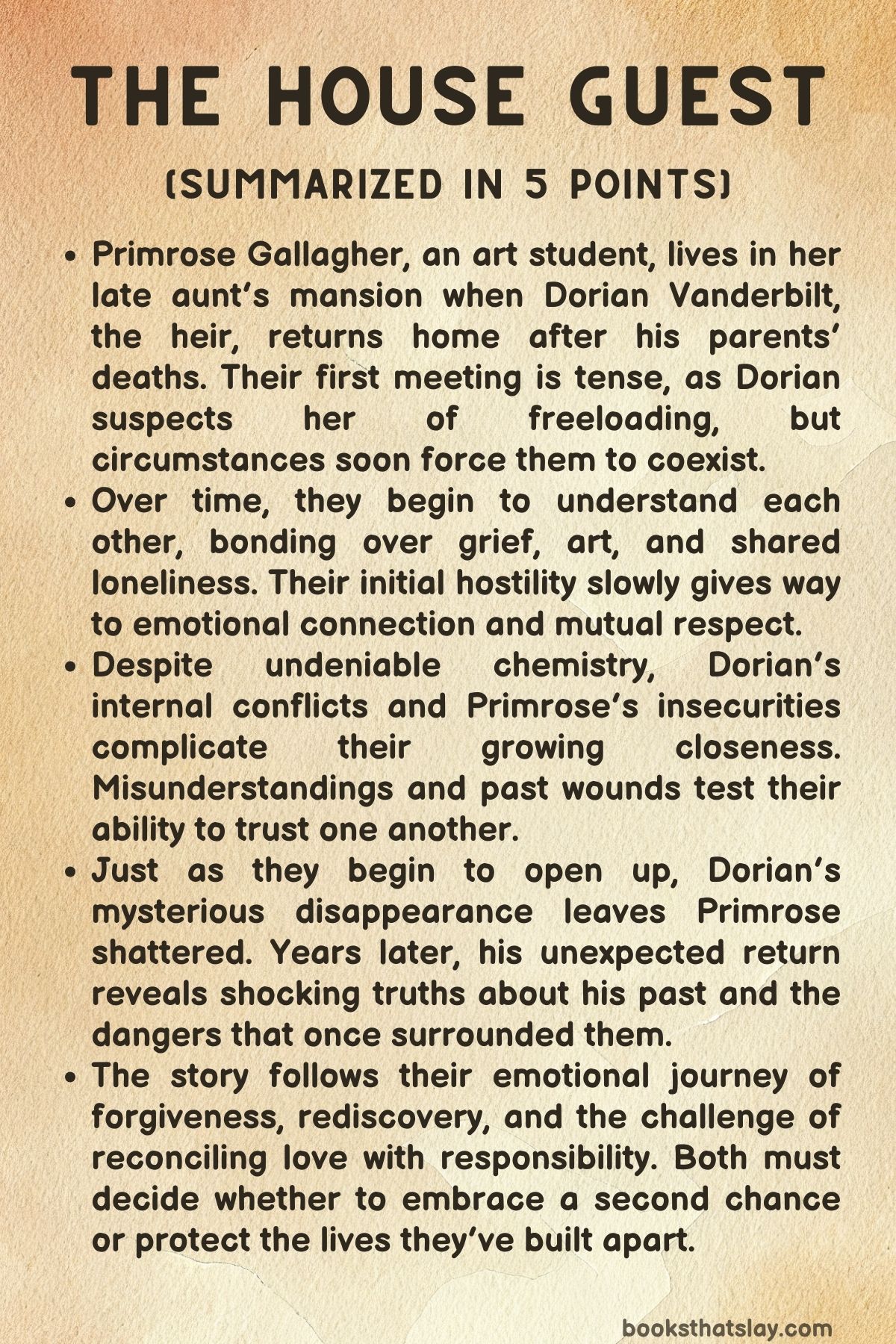
Characters
Primrose Gallagher
Primrose Gallagher is the emotional and moral center of The House Guest, a young art student whose life is defined by loss, self-discovery, and resilience. Orphaned at a young age and raised largely by her late aunt Christina, Primrose represents the archetype of the wounded dreamer—vulnerable yet quietly determined.
Her artistic pursuits mirror her internal struggles, particularly her “Primates in Power” series, which critiques authority and hypocrisy, revealing her intellectual depth and quiet rebellion against societal expectations. When Dorian Vanderbilt enters her life, Primrose’s strength is tested against her fear of abandonment.
Initially insecure about her place in the Vanderbilt mansion, she evolves into a woman who stands her ground and demands respect. Her journey, spanning from dependent student to independent mother, charts emotional maturity and self-acceptance.
Primrose’s love for Dorian becomes both her greatest risk and her redemption, challenging her to reconcile idealism with reality. Ultimately, she embodies emotional authenticity—choosing love not as escape, but as truth, even when it costs her comfort and security.
Dorian Vanderbilt
Dorian Vanderbilt is a complex figure—a man forged by grief, guilt, and privilege. The son of a morally ambiguous billionaire, Dorian inherits not only his father’s wealth but also the emotional wreckage of betrayal and disillusionment.
When he first returns home, he is distant and arrogant, his cynicism a shield for deep pain. His interactions with Primrose strip away these defenses, revealing a man capable of tenderness and vulnerability.
Dorian’s internal conflict lies between inherited duty and personal longing. His faked death and self-imposed exile mark the extremes of his protective instinct, sacrificing love to save the woman he cannot forget.
His return years later exposes his emotional endurance—still in love, still seeking redemption. Through Dorian, the novel explores the interplay between power and morality; he redefines masculinity not through dominance but through emotional accountability and courage.
By the story’s end, his transformation—from the grieving son of a corrupt legacy to a devoted partner and father—reflects the triumph of conscience over inheritance.
Patsy
Patsy, the housekeeper of the Vanderbilt mansion, serves as both guardian and moral commentator within The House Guest. Her life embodies quiet endurance, shadowed by past heartbreak and constrained by class boundaries.
Once romantically entangled with Remington Vanderbilt, Patsy represents the lingering scars of unfulfilled love and the cost of emotional dependency. Her relationship with Primrose is protective yet tinged with caution; her warnings against men like the Vanderbilts come from bitter experience rather than cynicism.
Patsy’s honesty and resilience make her a grounding force amid the emotional chaos surrounding Dorian and Primrose. She functions symbolically as a reminder of the dangers of mistaking charm for love and the necessity of self-respect.
Her presence adds depth to the novel’s exploration of power dynamics between wealth and vulnerability, showing how emotional exploitation transcends class and time.
Remington Vanderbilt
Remington Vanderbilt, though deceased at the novel’s opening, looms large as a symbol of corrupted ambition and moral failure. His dual life—successful entrepreneur and serial adulterer—haunts both his son and those who loved him.
Through the revelations of his infidelities and the theft of Alfred Mills’ invention, Remington’s character becomes a cautionary echo of unchecked greed. His legacy drives much of the conflict: Dorian’s guilt, Patsy’s pain, and even Christina’s disillusionment stem from his deceit.
Yet, his complexity lies in the charisma that allowed him to inspire love despite his moral flaws. In death, Remington becomes an invisible antagonist—his choices setting in motion the tragedy and emotional rebirth that define the living characters.
Christina Gallagher Vanderbilt
Christina, Primrose’s aunt and Dorian’s stepmother, embodies grace shadowed by sadness. Though she dies early, her influence pervades the story through memories and emotional inheritance.
Her decision to take Primrose in shows compassion that contrasts sharply with her husband’s moral failings. Christina represents quiet strength, a woman who survives betrayal with dignity.
For Primrose, she becomes a model of selflessness and artistic encouragement, shaping her niece’s worldview. Christina’s tragic death reinforces the novel’s recurring theme of love’s fragility and the endurance of emotional legacies.
She is the unspoken link between Primrose and Dorian—her generosity creating the circumstances for their eventual bond.
Benjamin
Benjamin, the loyal butler and later Dorian’s confidant, provides wisdom and stability amid chaos. He bridges the gap between the Vanderbilt family’s fractured past and its tentative future.
His loyalty to Dorian extends beyond servitude, embodying quiet mentorship and paternal warmth. Benjamin’s decision to aid Dorian in his years of hiding reveals not only loyalty but moral conviction—he becomes an accomplice in both deception and redemption.
In contrast to the moral corruption of his former employer, Benjamin represents decency and steadfast integrity. His reappearance in Dorian’s later life underscores themes of forgiveness and faithfulness, grounding the novel’s emotional turbulence in human decency.
Casey
Casey, Primrose’s fiancé, serves as a counterpoint to Dorian—steady, kind, and safe, yet emotionally restrained. He represents the life Primrose builds in Dorian’s absence: stable but passionless.
Through Casey, the novel examines the tension between comfort and desire. His eventual decision to let Primrose go, despite the pain, elevates him as a figure of quiet heroism.
Casey’s acceptance of truth, rather than clinging to illusion, reinforces the story’s moral axis—authentic love requires honesty, even when it leads to loss.
Candace and Chandler
Candace and Chandler function as the emotional chorus of The House Guest, offering perspective, humor, and humanity. Candace, battling cancer with grace and wit, contrasts mortality with joy; she encourages both Dorian and Primrose to embrace love while they can.
Chandler’s steadfast devotion to her provides a template for the kind of enduring partnership Dorian ultimately seeks. Their presence punctuates the novel’s more somber tones with moments of warmth, illustrating that love, at its best, is compassionate and fearless.
Liv
Liv, introduced later as Dorian’s romantic partner in California, symbolizes the possibility of moving on. Her relationship with Dorian is sincere yet ultimately superficial—a necessary bridge between loneliness and renewal.
When Dorian ends things with her, it is not out of cruelty but honesty, reaffirming his emotional evolution. Liv’s character highlights the novel’s broader exploration of timing and fate: some loves exist to heal, others to last.
Rosie
Rosie, Primrose’s daughter, embodies innocence and continuity. Though young, she represents the redemptive cycle of life and love.
Her presence softens the lingering sorrow between Primrose and Dorian, symbolizing hope and renewal. The tenderness with which Dorian approaches Rosie, and her immediate trust in him, completes his transformation from emotionally distant heir to nurturing father figure.
Rosie’s existence turns the story’s central romance into a generational one—where love, once lost and scarred, is reborn through family.
Themes
Love and Redemption
In The House Guest, love is portrayed as a transformative force that redefines the lives of both Primrose and Dorian. What begins as an uncomfortable living arrangement between two emotionally bruised individuals slowly evolves into a deep and redemptive bond that allows both to confront the shadows of their pasts.
Dorian’s grief, guilt, and cynicism form the hard shell that isolates him from others, while Primrose’s loneliness and fear of abandonment mirror his emotional imprisonment. Their connection gradually becomes an act of mutual salvation—she brings warmth and empathy into his sterile, grief-laden mansion, and he reignites her sense of purpose and artistic passion.
Yet, love in this narrative is not an effortless or purely romantic experience; it is bound to moral dilemmas, sacrifice, and time’s painful distortions. Years later, when Dorian returns after faking his death, their reunion forces both to reconsider what love means beyond passion—whether it can survive deception, distance, and the scars of loss.
The novel treats love as an evolving, imperfect redemption rather than a flawless union. It heals through confrontation rather than comfort, requiring the characters to reckon with who they’ve become.
By the end, love achieves its fullest expression not in youthful attraction but in acceptance, forgiveness, and the willingness to rebuild trust. It is through this long emotional odyssey that both characters reclaim their sense of wholeness, proving that love, however wounded, can become the most profound form of redemption.
Loss and Healing
The story unfolds in the shadow of loss—of family, innocence, and self. Primrose’s grief over her mother’s death and her aunt’s passing leaves her emotionally suspended, unable to form lasting attachments.
Dorian’s pain runs parallel: the sudden deaths of his parents and the betrayal of his father’s legacy leave him burdened with guilt and anger. Their shared grief becomes the unspoken language through which they first connect.
The house itself—grand, silent, and filled with memories—acts as a physical manifestation of mourning, holding both comfort and torment. Healing, in this context, does not arrive through forgetting but through remembrance and acceptance.
When Dorian reveals his deception years later, the emotional devastation forces Primrose to reprocess not only the loss of him but also the illusion of closure she had built. Healing becomes cyclical; it involves confronting the same pain from different stages of life until it no longer defines them.
By revisiting their old memories and confronting truths long buried, both characters achieve emotional release. The final scenes, filled with renewal and new beginnings, show that grief need not vanish—it can coexist with hope.
The ability to create new love, to build a family, and to find peace in memories signals that healing is not about erasing pain but learning to live fully despite it.
Forgiveness and Moral Complexity
Forgiveness operates as one of the novel’s most morally complex themes, testing the boundaries between empathy and accountability. Dorian’s decision to fake his death to protect Primrose, though made from love, shatters her life and raises questions about the morality of deception.
His return forces both to confront not only what was done but why it was done. The narrative refuses to romanticize forgiveness; it is shown as an arduous process requiring vulnerability, confrontation, and an acceptance of imperfection.
Primrose must weigh her anger against understanding, just as Dorian must confront the consequences of his choices. The forgiveness that ultimately emerges is not blind absolution—it is an acknowledgment of shared pain and flawed humanity.
The novel also expands this theme beyond the protagonists: the revelations about Remington’s infidelity, Patsy’s bitterness, and the moral failings of the elder Vanderbilts reveal how betrayal and remorse ripple across generations. Each act of wrongdoing carries emotional residue that the younger characters must navigate.
Forgiveness thus becomes both an individual act and a generational reckoning, suggesting that true moral clarity comes only when one can confront the full truth and still choose compassion.
The Pursuit of Identity and Purpose
Throughout The House Guest, both Primrose and Dorian grapple with who they are beyond the roles and expectations imposed upon them. Primrose’s journey as an artist reflects her internal struggle for authenticity in a world that often undermines creative and emotional vulnerability.
Her “Primates in Power” series subtly critiques social hierarchies, mirroring her own resistance against wealth and privilege. Dorian’s struggle, meanwhile, lies in the weight of inheritance—heir to a corrupt legacy and a company tainted by his father’s misdeeds.
His longing to pursue music, abandoned in favor of familial obligation, becomes symbolic of suppressed identity. Their interactions challenge both to rediscover purpose outside of duty or trauma.
By the end, Dorian’s support for Primrose’s art and her encouragement of his emotional openness signal mutual liberation. The novel suggests that identity is fluid, forged through experience, loss, and love rather than lineage or societal status.
When Dorian finally displays her paintings in their home years later, it represents not just devotion but the recognition of her creative identity as essential to their shared life. Their union thus stands as the culmination of self-discovery—two individuals who, by embracing each other’s truths, learn to live authentically.
The Intersection of Class and Power
Class differences underlie nearly every interaction in the early parts of the story, shaping how characters perceive worth and legitimacy. Primrose’s modest background and her dependence on the Vanderbilt estate place her in a position of vulnerability, constantly judged by those around her as an opportunist or outsider.
Dorian’s inherited wealth and initial arrogance highlight the moral blindness that privilege can produce. Yet, as the story progresses, these boundaries blur.
Dorian’s world of luxury proves emotionally barren, while Primrose’s humility and work ethic give her a grounded strength that money cannot replicate. Their evolving relationship dismantles class-based prejudices, revealing how emotional depth and moral integrity often exist beyond social status.
Even side characters like Patsy serve as reminders of the quiet exploitation embedded in wealthy households—the unseen labor and emotional sacrifices that sustain opulence. By portraying love and understanding across these divides, the novel critiques the illusion of superiority tied to wealth.
In the end, when Dorian chooses a life with Primrose in Ohio, away from corporate grandeur, the act symbolizes liberation from the corrupting power of class. It marks his moral realignment toward values rooted in love, honesty, and emotional equality, affirming that real richness lies not in inheritance but in human connection.