The Incredible Kindness of Paper Summary, Characters and Themes
The Incredible Kindness of Paper by Evelyn Skye is a contemporary novel about connection, loss, and the quiet ways kindness can change lives. It follows Chloe Hanako Quinn, a high school guidance counselor who begins folding origami roses with encouraging messages to lift others’ spirits.
What starts as a small gesture turns into a citywide phenomenon, unknowingly linking her to Oliver Jones, her long-lost childhood pen pal who once shared a mysterious bond through letters that carried whispered secrets. Through a series of chance encounters, rediscovered memories, and acts of compassion, both Chloe and Oliver find their way back to hope—and to each other.
Summary
The story begins with seven-year-old Chloe Hanako Quinn in Lawrence, Kansas, who writes to her first pen pal as part of a school project. Shy and uncertain, she whispers her secrets into the paper before mailing it off.
The letter reaches Oliver Jones, a quiet boy who, upon opening it, can hear everything she whispered. Their magical correspondence grows into a deep friendship that defines their childhoods.
Twenty-five years later, Chloe is living in New York City, working as a guidance counselor. She’s cheerful and caring but feels lonely beneath her optimism.
On the last day of school, she comforts a worried student, Xander, giving him a yellow origami rose with a note of encouragement. Soon after, she learns she’s being laid off due to budget cuts.
Returning home, she tries to soothe her sadness by folding another rose, writing “Chin up, buttercup” inside it. She accidentally leaves it in the mailroom, where an elderly neighbor, Thelma, finds it.
Thelma believes the message is a sign from her late husband and regains the will to fight eviction, inspiring the people in her building to rally together.
Meanwhile, Oliver Jones has become a mathematical prodigy and financial analyst. Though brilliant, he lives a solitary life governed by logic.
At work, his colleague Zac Billings undermines him, taking credit for his ideas. That evening, Oliver rescues Xander—Chloe’s student—from being hit by a taxi after the boy chases a paper rose into the street.
Oliver retrieves the crushed rose and learns it came from Ms. Quinn, though he doesn’t realize she is his childhood Chloe.
Chloe’s small act of kindness begins to ripple across the city. A baker named Giovanni finds one of her roses and, motivated by its message, decides to save his struggling bakery.
Thelma’s story spreads through the apartment building, transforming her despair into hope. Realizing how her words have reached people, Chloe begins distributing more roses around the city—on buses, in parks, and at libraries—leaving them anonymously for strangers to discover.
Her personal life, however, is less steady. She’s casually dating Zac, the same man who works with Oliver, but he dismisses her creative efforts as childish.
Their relationship feels shallow and unbalanced, highlighting Chloe’s yearning for something real.
At the same time, Oliver’s orderly world is shaken when he encounters Chloe by chance on a Manhattan street. She doesn’t recognize him, but he knows immediately who she is.
Overcome by memories and guilt from the past, he pretends not to know her. The novel flashes back to their youth, revealing how abruptly Oliver disappeared from Chloe’s life after his mother, Jennifer, fled Kansas to escape arrest for fraud.
The trauma of that flight fractured his childhood, leaving him emotionally guarded.
As Chloe’s roses gain attention, stories emerge of how her messages touch lives across the city: a hearing-impaired woman finds comfort in one; a weary driver rediscovers warmth toward strangers; and a park volunteer finds purpose again. Chloe’s growing community of helpers includes Thelma, Xander, and two elderly sisters who set up a rose-folding station in Central Park.
Together they spread messages of encouragement that begin to knit the city together.
Oliver’s life becomes entangled with Chloe’s again through coincidence and shared connections. When his estranged mother appears at his apartment asking for money, he turns her away but feels haunted by her reappearance.
Days later, Chloe meets Jennifer through her volunteer group, not realizing who she is. Jennifer tells her about her son Oliver, unaware that she’s speaking to the same Chloe from his past.
Through flashbacks, readers learn that Chloe had written countless letters to Oliver after he vanished, never receiving a reply. She eventually rebuilt her life, finding strength through kindness after her mother’s illness.
Fate draws Chloe and Oliver together again at a charity gala hosted by his firm. Dressed in blue, Chloe catches Oliver’s eye across the ballroom.
They dance, and the old bond between them resurfaces. On the rooftop, rain begins to fall as they finally recognize each other fully.
Before they can resolve their past, Zac arrives, leading to a confrontation between the two men. Humiliated and confused, Chloe asks for time to think, while Oliver is left grappling with regret.
After the gala, their paths diverge. Chloe focuses on expanding her Paper Roses initiative, turning it into a nonprofit foundation aimed at spreading hope worldwide.
Unbeknownst to her, Jennifer embezzles the foundation’s start-up funds in a misguided attempt to “help” and loses them. When Chloe discovers this, she’s heartbroken and returns to Kansas to recover.
Meanwhile, Oliver learns of his mother’s actions and feels responsible. He decides to make amends by secretly filing the foundation’s paperwork himself and writing a long, heartfelt explanation to Chloe.
He folds his confessions into twelve yellow origami roses, each containing part of his story—from his disappearance and years in hiding to his enduring love for her. He leaves the roses for her to find.
Back home in Kansas, Chloe opens the roses one by one, reading Oliver’s words of apology, pain, and love. Inside the first rose, she finds the clover and infinity charms he once gave her as a child.
Realizing the depth of his remorse and devotion, she returns to New York immediately.
In the final scene, she steps into an airport terminal decorated with thousands of yellow paper roses suspended above travelers. Among them stands Oliver, waiting.
They exchange apologies, reaffirm their love, and share a simple celebration—cake and a candle dedicated to “risks and wishes. ” As they kiss beneath the cascade of roses, Chloe and Oliver finally come full circle, their lives bound again by kindness and the written word that first connected them as children.
The Incredible Kindness of Paper ends on a note of renewal, showing that even the smallest acts of care—words folded into paper—can carry extraordinary power to heal and bring people together.
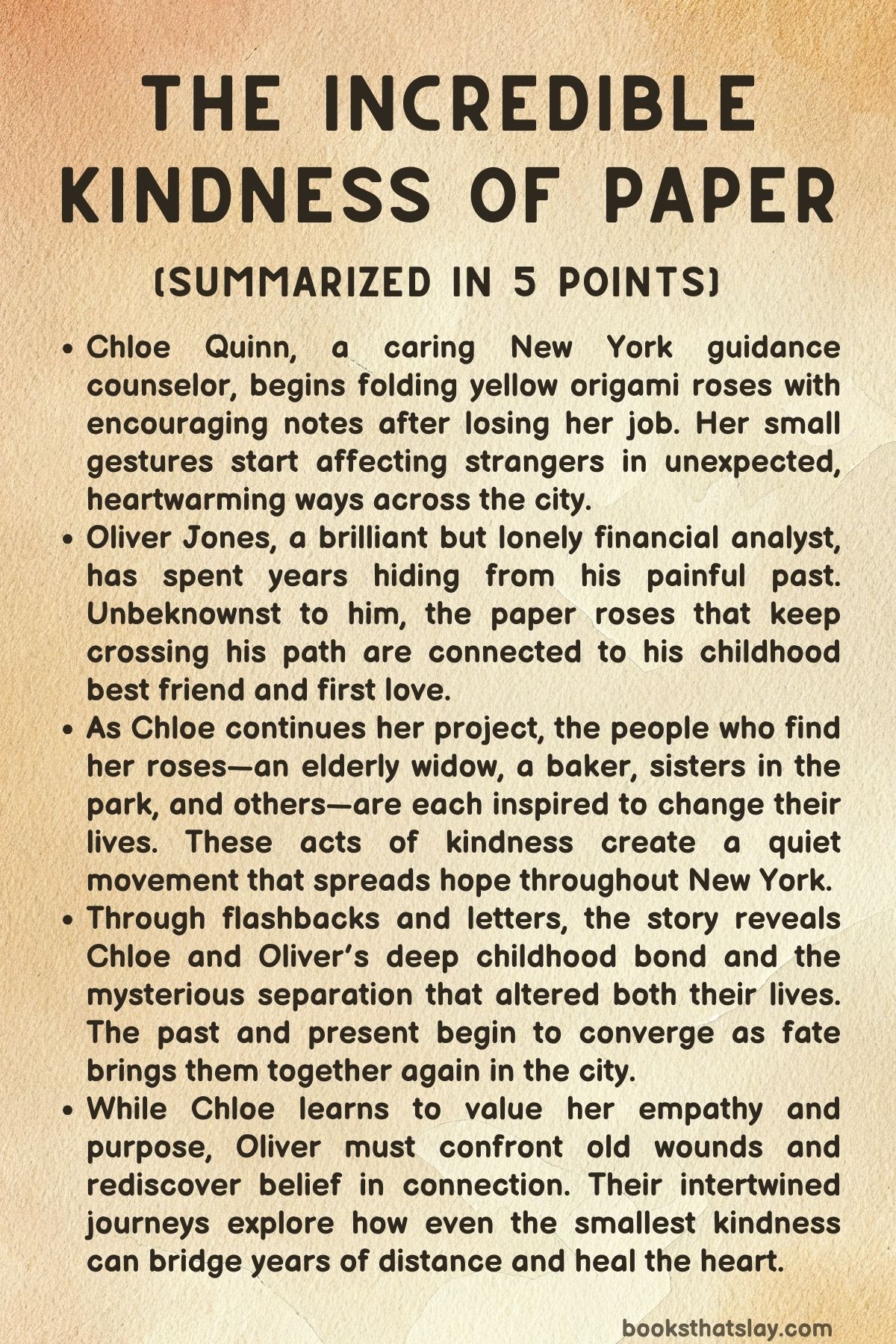
Characters
Chloe Hanako Quinn
Chloe Hanako Quinn is the emotional heart of The Incredible Kindness of Paper, a woman whose innate warmth and resilience illuminate every page. As a child, Chloe’s instinct to whisper her secrets to a sheet of paper reflects her inability to fully articulate the depth of her feelings.
That act of quiet confession becomes both a metaphor for her lifelong struggle with loneliness and the seed of her unique way of connecting with the world. As an adult, Chloe transforms that instinct into something extraordinary—her origami roses, each bearing a message of hope that ripples across lives.
Despite personal loss and disappointment, she chooses compassion over cynicism, making her the embodiment of quiet strength. Her journey—from an uncertain guidance counselor facing unemployment to a woman who inadvertently sparks a global kindness movement—illustrates the transformative power of empathy.
Yet Chloe is not idealized; her vulnerability, her loneliness in a city that often feels indifferent, and her need for validation make her deeply human. Through her, the novel celebrates the beauty of small gestures and the unseen threads that bind lives together.
Oliver Jones
Oliver Jones is Chloe’s counterpart in both intellect and emotion—a man who hides a wounded heart behind the armor of logic and precision. As a child, he is sensitive and fiercely protective of Chloe, their connection forming a sanctuary from the chaos of his mother’s fraudulent schemes.
His abrupt disappearance, forced by circumstance, defines his adult life. As an analyst steeped in data and predictability, Oliver clings to the measurable because emotions have brought him only pain and uncertainty.
Yet beneath his stoic exterior, his love for Chloe never diminishes; it manifests instead as guilt, repression, and quiet longing. His arc is one of reconnection—not only with Chloe but with his own capacity for belief and vulnerability.
Oliver’s journey from skepticism (“Wishing absolutely does not make dreams come true”) to hope mirrors the novel’s central message: that reason and wonder can coexist. His reunion with Chloe completes a circle that began with whispered childhood letters, affirming that love, like paper, can be fragile yet enduring.
Zac Billings
Zac Billings represents the superficial charm and transactional nature of modern relationships. As a British financier and Oliver’s professional rival, he is polished, confident, and emotionally evasive.
His interactions with Chloe are marked by subtle condescension—he views her paper roses as a quaint hobby rather than a meaningful act of generosity. Zac embodies the tension between success and substance; he is surrounded by wealth yet hollow at the core.
His need to dominate, both in romance and career, stems from insecurity and a narrow definition of achievement. In contrast to Oliver’s emotional repression and eventual redemption, Zac remains static, unable to perceive the intangible value of empathy.
Through him, the novel critiques a culture obsessed with appearances and dismissive of quiet idealism.
Becca
Becca, Chloe’s roommate and confidante, serves as the novel’s grounding presence. A quintessential New Yorker—sharp-tongued, practical, and fiercely loyal—she balances Chloe’s idealism with realism.
While she initially treats Chloe’s optimism with wry amusement, Becca’s steadfast support during moments of crisis underscores her deep affection. Her cynicism is a shield for her own vulnerabilities, yet she becomes one of the first to recognize the profound effect Chloe’s roses have on others.
Becca’s role highlights the importance of chosen family and friendship as anchors in a world often defined by impermanence.
Thelma “The Threadbare Countess”
Thelma’s transformation is one of the most touching subplots in The Incredible Kindness of Paper. Once a faded figure on the verge of eviction, she rediscovers hope through Chloe’s “Chin up, buttercup” rose.
Her rebirth—turning her apartment into a doggy daycare and rallying her neighbors—symbolizes the redemptive power of kindness. Thelma’s journey reminds readers that hope can arrive unexpectedly, folded inside a scrap of paper, and that even lives at the margins can bloom again when touched by compassion.
Jennifer Jones
Jennifer Jones, Oliver’s mother, is both antagonist and tragic figure. A lifelong grifter, she drags her son through instability and deceit, leaving emotional scars that shape his adulthood.
Yet Evelyn Skye portrays Jennifer with complexity rather than condemnation. Her eventual reappearance—followed by her efforts to help Chloe and her subsequent relapse into fraudulent behavior—reveals a woman torn between love and compulsion.
Jennifer’s arc embodies the tension between redemption and self-destruction, showing how love can be sincere even when flawed. Her final act of confession, though devastating, allows both Chloe and Oliver to reclaim their past and move forward.
Xander
Xander represents the next generation touched by Chloe’s kindness. Introduced as a worried student seeking reassurance about his future, he becomes both a recipient and a carrier of her generosity.
His near-accident with the rose and later involvement in the rose-folding circle show how compassion multiplies when shared. Xander’s storyline reinforces the idea that small kindnesses can echo far beyond their origin, shaping lives and communities in ways unseen.
Giovanni
Giovanni, the struggling baker who rediscovers his purpose after finding one of Chloe’s roses, is a testament to the healing potential of hope. His revival parallels Chloe’s own journey from despair to purpose, illustrating how art—be it baking or folding paper—can become an act of resilience.
Giovanni’s bakery, inspired by childhood flavors linked to Chloe and Oliver, serves as a symbolic meeting ground between past and present, love and memory.
Mary and Bonnie
The elderly sisters Mary and Bonnie infuse the narrative with humor and tenderness. Their decision to join Chloe in Central Park, folding and distributing roses, embodies the joy of intergenerational connection.
Mary’s struggle with hearing loss and her comfort in a rose’s message about serenity add emotional resonance, showing how Chloe’s kindness bridges solitude and community. Together, they transform a simple park table into a space of shared humanity.
Felix Bautista
Felix begins as a bureaucratic obstacle, enforcing rules against unpermitted park tables, yet his discovery of a rose reshapes him. The message thanking him for small, unseen acts of service reawakens his empathy.
Felix’s quiet change of heart—deciding to let the women continue their work—illustrates one of the novel’s central themes: that kindness, once received, often compels one to pass it forward.
Ricky
Ricky’s story, though brief, captures the novel’s universal reach. A former chemist turned driver, he is adrift between past ambitions and present realities.
When he finds a rose left behind by a passenger, its message rekindles his sense of worth and connection. Ricky’s renewed openness toward his riders, especially Claire, reinforces Evelyn Skye’s belief that compassion can restore dignity and meaning in even the most ordinary lives.
Themes
The Transformative Power of Kindness
In The Incredible Kindness of Paper, Evelyn Skye portrays kindness not as a passive virtue but as an active, transformative force that ripples through people’s lives, changing destinies in unexpected ways. Chloe’s origami roses, each carrying a handwritten message of encouragement, become the novel’s living symbol of this transformation.
What begins as her small act of comfort after personal loss spreads outward—first touching Thelma, an elderly neighbor on the verge of eviction, and then igniting hope in strangers across New York. These gestures demonstrate how the smallest expressions of compassion can travel beyond their origin, linking people through invisible threads of empathy.
Skye illustrates how kindness often emerges from pain; Chloe begins her project out of heartbreak and job loss, yet her generosity brings meaning to her own life even as it heals others. The novel also explores how kindness challenges cynicism—Oliver, rooted in logic and self-protection, dismisses such acts as naïve until he witnesses their impact and feels their emotional truth.
Through him, the story argues that kindness is not weakness, but courage—the decision to remain open and generous in a world that often rewards detachment. Ultimately, Skye envisions kindness as a quiet revolution, reshaping both giver and receiver, showing that every small, genuine act carries the potential to rebuild communities, mend relationships, and redeem broken lives.
Connection and Loneliness
The novel’s emotional core lies in its exploration of human connection and the persistent ache of loneliness. Chloe and Oliver’s childhood bond, born through letters that whisper secrets and emotions across distance, embodies the fragile yet profound ways people reach toward one another.
Their separation and eventual rediscovery in adulthood echo how time and circumstance fracture connections, yet also how memory and emotion can keep them alive. Chloe’s life in New York reflects the paradox of modern isolation—surrounded by people yet deeply alone.
Her paper roses become both a response to and a remedy for that solitude, forging unseen relationships among strangers who never meet but share in a collective healing. The novel suggests that loneliness is not merely the absence of company but the hunger to be understood.
Oliver, brilliant yet emotionally barricaded, lives behind walls of logic built to protect himself from the chaos of human feeling. His eventual reconnection with Chloe dismantles that isolation, revealing that authentic connection requires vulnerability.
Skye emphasizes that every human being, no matter how withdrawn, yearns for acknowledgment and belonging. Through letters, chance encounters, and acts of compassion, the book celebrates connection as both fragile and resilient—a force that binds people across cities, years, and even silence.
Healing from the Past
Throughout The Incredible Kindness of Paper, the past functions as both a wound and a compass. Chloe and Oliver’s childhood experiences—her loneliness and his trauma from his mother’s criminal life—shape who they become, yet healing only begins when they confront what they’ve long avoided.
The novel traces the way buried pain festers in the absence of closure: Oliver’s flight from Kansas severs him from the only person who truly knew him, and his years of silence harden into emotional detachment. Chloe, in turn, rebuilds her life through service to others, transforming her own heartbreak into a source of empathy.
Healing, Skye suggests, is not achieved through forgetting but through acknowledgment and reconnection. When Oliver finally writes the series of origami letters explaining his disappearance, his act of confession becomes an offering of reconciliation—not only to Chloe but to his own fractured self.
The paper roses, originally symbols of kindness, evolve into instruments of healing, embodying the idea that mending requires communication and courage. The narrative insists that one cannot fully step into the present without tending to the pain that lingers from the past.
In the end, Chloe and Oliver’s reunion beneath a cascade of roses signifies not the erasure of old sorrow but its transformation into something redemptive—a shared understanding that forgiveness and love can coexist with loss.
The Intersection of Logic and Emotion
Evelyn Skye sets up Oliver and Chloe as embodiments of two opposing worldviews: logic and emotion. Oliver’s life as a mathematical prodigy and financial analyst represents a devotion to control, predictability, and order.
Numbers, for him, are safe—they never lie or abandon. Chloe, on the other hand, thrives in the uncertain realm of feeling, art, and human connection.
Her paper roses are spontaneous, heartfelt, and driven by intuition rather than reason. The tension between these two perspectives shapes their relationship and the book’s philosophical heart.
Skye uses Oliver’s journey to question the illusion of safety that comes from rational detachment. His initial dismissal of the roses as illogical reflects his fear of unpredictability, yet as he witnesses their power, he begins to grasp that emotion, though messy, holds truths numbers cannot quantify.
Chloe’s compassion shows him that love and faith require risk—that beauty often emerges from what cannot be measured. Conversely, Oliver’s precision and discipline also offer Chloe stability and grounding.
The novel thus finds harmony between logic and emotion, suggesting that a balanced life embraces both the analytical and the heartfelt. Through their reunion, Skye asserts that understanding the world requires both calculation and compassion, and that genuine fulfillment arises when intellect serves empathy rather than suppresses it.
Fate, Chance, and the Power of Choice
Fate hovers over the novel like an unseen hand guiding its coincidences—the stray roses that reach those who need them most, the chance meetings that reconnect long-separated souls. Yet Skye refuses to present destiny as a fixed script.
Instead, The Incredible Kindness of Paper proposes that fate and choice coexist in a delicate dance. The recurring motif of paper—fragile, foldable, endlessly transformable—embodies this duality.
Just as paper can be shaped into countless forms, lives too can be refolded through decisions born of courage and hope. Chloe’s chance encounters with strangers who find her roses feel serendipitous, yet they arise from her deliberate act of generosity.
Oliver’s eventual reunion with her seems destined, but only happens because he chooses honesty over avoidance. Skye’s narrative suggests that life’s “miracles” often spring from human intention intersecting with random chance.
The theme deepens through the novel’s many small acts that create large consequences, reinforcing the idea that the future is both gift and responsibility.
By the time Chloe and Oliver stand beneath the shower of paper roses, their reunion feels fated not because destiny demanded it, but because each of them finally chose faith—faith in love, in forgiveness, and in the belief that even fragile things, when tended with care, can endure.