The Intruder Summary, Characters and Themes | Freida McFadden
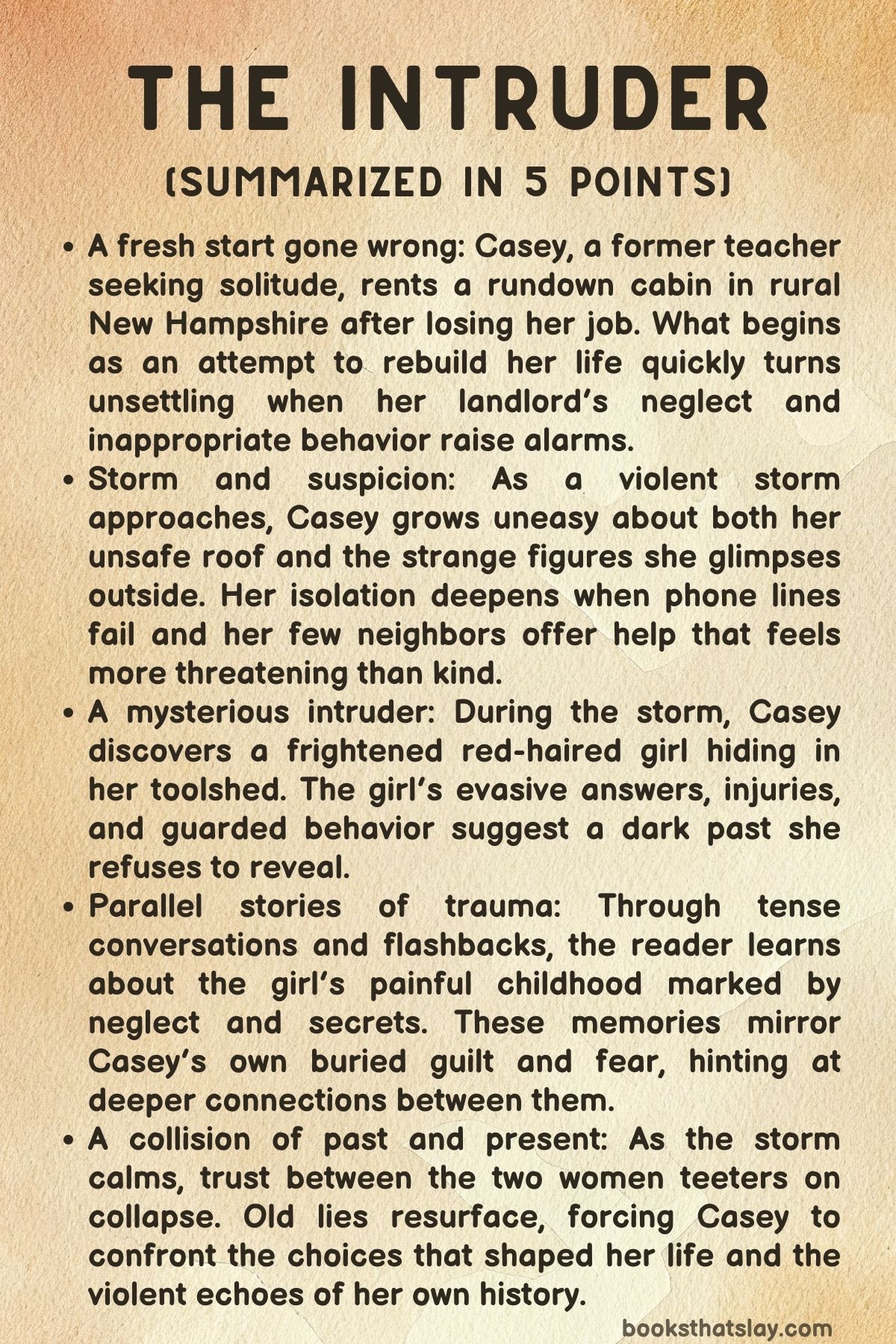
The Intruder by Freida McFadden is a fast, claustrophobic thriller that starts with a simple problem—cheap housing in the woods—and turns it into a night of fear, secrets, and shifting trust. Casey, newly unemployed and isolated in rural New Hampshire, is already on edge when a storm bears down on her failing cabin.
Then she discovers someone hiding on her property: a starved, bloodstained girl with a knife and a talent for getting under Casey’s skin. As the night unfolds, the story keeps forcing one question: who is really dangerous here—and what happens when “helping” someone crosses a line?
Summary
Casey, recently fired from her teaching job, leaves Boston and rents a rundown cabin in rural New Hampshire because it’s all she can afford. The place is falling apart, and the roof is shedding shingles at the worst possible time: a violent storm is predicted, with strong winds and flooding.
Casey repeatedly calls her landlord, Rudy, demanding repairs before the weather hits. When he finally arrives, he barely checks the roof, makes excuses about not having tools, and tries to postpone everything until after the storm.
He also ignores Casey’s concern about a large tree near the cabin that sways in a way that feels unsafe.
Rudy’s visit gets uglier. He makes inappropriate comments, pushes Casey to go out with him, and suggests she should stay at his house during the storm.
When she refuses, he becomes physical and acts like her “no” doesn’t matter. Casey reacts decisively, using self-defense skills she learned from her father.
She forces Rudy to back off and makes him promise to return after the storm to fix the roof. Rudy leaves furious, but his parting words carry a threat that sticks with her.
As the storm rolls in, Casey prepares to ride it out alone. She secures loose items outside, briefly steps into a nearby toolshed, and notices something glinting in a corner but doesn’t stop to investigate.
Back inside, she locks the doors, tapes the windows, and sets out candles in case the power fails. While in her bedroom, she looks toward the window and sees a pale face staring in at her.
When she recoils and looks again, the face is gone. She tries to explain it away, but the sense of being watched won’t leave.
Soon after, Casey hears pounding at her door. It’s Lee Traynor, the nearest neighbor, a contractor who has been unusually attentive since she moved in.
Lee warns her the storm will be severe and tells her taping windows can make shattered glass more dangerous. He looks at her roof and offers to fix it or have her stay at his sturdier place, which has shutters and a generator.
Casey, already shaken and suspicious of everyone, refuses. Lee leaves but insists she call if she needs help—though he mentions the phone lines might go down.
That warning proves true. Rudy calls again through heavy static, claiming he booked Casey a room at a bed-and-breakfast for safety.
Before he can give details, the line dies. With no phone service and the storm worsening, Casey decides it’s safer to stay put than drive through flooded roads or trek through the woods to Lee’s cabin.
Then she sees something that removes any doubt about her earlier fear: a light shining from inside the toolshed. Someone is in there.
With no way to call for help, Casey chooses to face the situation. She puts on rain gear, retrieves her Glock, and crosses the yard in darkness as the wind lashes the trees.
When she reaches the shed, the light vanishes. A gust tears the shed door off its hinges, and Casey steps inside to find a small figure huddled under a thin covering.
When the figure finally reveals herself, Casey sees a thin red-haired girl with wide blue eyes—holding a knife.
Casey tries to keep her voice calm and nonthreatening. The girl is terrified, defensive, and clearly expecting betrayal.
Casey offers food and promises not to report her. The girl eventually follows Casey into the cabin, still wary.
As she dries off, Casey notices troubling details: the girl is covered in blood that doesn’t match her explanation, and her backpack appears soaked through with something dark. Casey cooks spaghetti, and the girl eats with desperate hunger.
When the girl removes her outer layers, Casey sees old circular scars on her arms that look like burns. The girl gives her name as Eleanor, though she hates it and insists she goes by something else.
To gain her trust, Casey makes what she calls an “infinity promise”: she will not tell anyone Eleanor is there without Eleanor’s permission. They play cards in the dark when the power goes out, and Casey keeps trying—carefully—to learn more about who Eleanor is and what she’s running from.
Eleanor stays guarded, but she watches Casey closely, as if judging every move.
The story begins to alternate between the storm-night present and Eleanor’s past. In those earlier scenes, Eleanor—who once went by Ella—lives with a mother whose hoarding and cruelty have made their home filthy, unsafe, and suffocating.
Ella is mocked at school, starved of basic needs, and punished for small acts of survival. She finds brief relief in an unexpected friendship with a boy named Anton, who comes to understand how bad her situation is.
But even kindness brings consequences: when Ella’s mother suspects her of breaking rules, she burns her with a cigarette, leaving scars that last.
Ella’s obsession with escape leads her to search for her father. She discovers a birth certificate and convinces herself that a respected man named John Carter is her dad, linking her to a privileged classmate, Brittany Carter.
She confronts that world and is crushed when the truth emerges: the John Carter she targeted is not her father at all. Her mother reveals the real father was a violent man with a similar name—someone who went to prison and disappeared.
The revelation leaves Ella humiliated, furious, and hopeless.
Back in the present, Casey’s attempt to help Eleanor turns into a trap. Eleanor can’t sleep and asks Casey for a story.
When Casey tries, Eleanor criticizes it, then tells her own “scary story” about a woman who shelters a girl and promises not to betray her—then snoops anyway and pays for it. The message is obvious.
Casey later finds Eleanor’s notebook and sees disturbing drawings of a woman being tortured and killed. Casey becomes convinced the drawings depict her.
When she tries to retrieve her gun, she discovers it’s gone. Eleanor appears, wearing Casey’s clothes, and points the gun at her.
A loud crash outside interrupts the confrontation: the large tree has fallen, smashing the toolshed. Eleanor realizes that if she had stayed there, she would have died.
Shaken, she returns inside with Casey—but now she fully takes control. She forces Casey into a chair and binds her with duct tape, immobilizing her.
Eleanor claims it isn’t personal, then leaves Casey helpless and terrified.
As more truths surface, the identities and motives twist. Casey reveals her own history: she was once Ella, and she set a fire that killed her abusive hoarder mother.
She reinvented herself, but the anger never fully left. Eleanor’s story is also bigger than it first appeared—connected to Lee and to a violent home she fled.
Casey, convinced she understands Eleanor’s rage because it mirrors her own, decides to “solve” the threat permanently by hunting down Eleanor’s abusive mother rather than involving police. When Casey finds the woman alive and injured, she uses deception and brutality to confirm the abuse—and then kills her, satisfied that she has delivered justice.
After the storm, Casey learns Lee has been asking questions about her using her old name, and she realizes he knows far more about her past than he should. Lee later hints he understands exactly what Casey did, and instead of exposing her, he quietly offers protection.
Months pass. Eleanor—now safer and recovering—lives under Lee’s care, and Casey becomes a constant presence in their lives, homeschooling the girl and growing attached to both of them.
But Lee’s secrecy continues, and a final discovery ties everything together: a photo reveals Eleanor’s father is Anton, the boy from Ella’s past.
The ending reframes Lee entirely. His real name is Bradley, Anton’s brother.
Anton is alive, in prison for killing their abusive father, and Bradley has been raising Eleanor while keeping Anton’s survival hidden. Years earlier, Anton asked Bradley to watch over Ella after seeing news of what happened to her.
Bradley moved nearby to keep that promise—and fell in love with her along the way. The story closes with family loyalty, buried violence, and the unsettling idea that Casey and Bradley may be perfect for each other precisely because they share the same dangerous definition of justice.
Characters
Casey (Elizabeth Casey / Ella)
Casey is the complex and morally ambiguous protagonist of The Intruder. Once a troubled teenager named Ella, she endured an abusive, hoarder mother and a traumatic childhood that shaped her into a woman obsessed with justice and control.
Her transformation into “Casey” represents both escape and self-reinvention. After killing her mother in an act of rage and survival, she adopts a new identity, becomes a teacher, and tries to live a quiet life, yet her internalized violence never fully disappears.
She is haunted by guilt and driven by a distorted sense of righteousness taught by her father — the belief that dispensing her own version of justice is acceptable. Casey’s compassion for Nell stems from deep empathy; she sees her younger self in the girl and projects her need for redemption onto her.
However, her protective instincts easily slide into dangerous moral territory, as seen when she murders Jolene, justifying it as saving Nell. Casey’s character embodies the fine line between savior and sinner, compassion and vengeance, and portrays how trauma can perpetuate cycles of violence even when disguised as justice.
Eleanor (Nell)
Eleanor, also known as Nell, is a teenage girl marked by years of neglect and abuse, much like Casey once was. When she appears in Casey’s shed, bruised, bloodied, and armed with a knife, she represents both danger and vulnerability.
Her guarded demeanor, quick temper, and macabre stories reflect deep psychological scars and an ingrained distrust of adults. Through her backstory — growing up with an abusive mother, Jolene, and a distant father figure — Nell’s trauma mirrors Casey’s youth, creating a haunting generational parallel.
Despite her hostility, she craves love, protection, and validation, which Casey provides. Over time, Nell softens, allowing glimpses of her intelligence, humor, and need for family to surface.
However, her early exposure to violence has normalized it, making her capable of cruelty and threats, such as when she binds Casey to a chair during the storm. Nell’s journey from feral survivalist to a child finding safety under Lee’s guardianship underscores the novel’s exploration of broken innocence and the possibility — however fragile — of redemption.
Lee Traynor (Bradley)
Lee Traynor, introduced as Casey’s helpful neighbor, initially seems like a stabilizing force — calm, resourceful, and protective. Yet his character slowly unravels to reveal hidden layers of guilt, deception, and loyalty.
His real name, Bradley, and his connection to Casey’s past — as the younger brother of her childhood friend Anton — reframe his actions entirely. Lee’s presence near Casey is not coincidence but an act of quiet duty, fulfilling a promise to Anton to watch over her.
His growing affection for her complicates his motives, turning his guardianship into something both tender and morally gray. Lee also shoulders responsibility for Nell, raising her after his brother’s imprisonment and the death of her mother.
His dual roles as protector and deceiver make him both comforting and unsettling. Ultimately, Lee embodies the novel’s theme of hidden truths and the bonds of family — his loyalty to Anton, his compassion for Nell, and his love for Casey converge into a single, complex portrayal of sacrifice and secrecy.
Rudy
Rudy, Casey’s landlord, is a minor but significant character symbolizing predatory male entitlement. His lewd comments, unwanted advances, and dismissive attitude toward Casey’s safety highlight the everyday threats women face.
Rudy’s character sets the stage for the story’s central conflict by amplifying Casey’s sense of isolation and vulnerability. He is a man driven by power and control, manipulating situations to exploit Casey’s dependence on him for housing.
Although his role is brief, it serves as a catalyst for Casey’s defensive instincts — both physical and psychological — revealing her capacity for assertive violence when threatened. Rudy’s later apology and conversation about Lee’s prior interest in Casey function as a narrative device to expose key secrets, but his character remains emblematic of corruption and moral decay.
Anton Peterson
Anton is a pivotal figure in both Ella’s past and the novel’s emotional core. Once Ella’s only friend in high school, Anton provided her with moments of companionship and understanding amid her chaotic life.
His complicated relationship with Ella oscillated between tenderness and youthful cruelty, shaped by his own exposure to violence and a broken home. His later imprisonment for killing his abusive father reflects the destructive environment from which both he and Ella emerged.
Anton’s enduring loyalty — asking his brother Lee to protect Ella even from behind bars — adds depth to his character, portraying him as someone seeking redemption for his own sins. He represents both what Ella lost and what she could have become under slightly different circumstances.
Through Anton, the novel intertwines themes of trauma, familial abuse, and the human capacity for both love and violence.
Jolene
Jolene, Nell’s mother, mirrors Ella’s own abusive mother, forming a cyclical reflection of generational trauma. She is depicted as cruel, negligent, and vindictive — a woman who physically and emotionally tortures her daughter under the guise of discipline.
Jolene’s justification for her actions, claiming to “teach lessons,” reveals her deeply ingrained sadism and inability to nurture. Her encounter with Casey near the novel’s end is a confrontation between two damaged women: one shaped by abuse, the other still perpetuating it.
Jolene’s death at Casey’s hands serves as both climax and commentary — a symbolic act of vengeance against all abusive mothers, yet also an ethical collapse that binds Casey further to her past sins. Through Jolene, The Intruder underscores how unchecked trauma and resentment can fester into monstrosity, ensuring that victims and abusers remain trapped in the same tragic cycle.
Themes
Isolation and Fear
The sense of isolation in The Intruder operates on both a physical and psychological level. Casey’s remote cabin in the woods becomes a tangible manifestation of her emotional detachment from the world after losing her job and her sense of identity.
The storm that rages outside mirrors her internal chaos, trapping her in a space where every creak of the roof and flicker of the lights amplifies her loneliness. Her fear is not just of the external intruder but also of the ghosts of her own past—her suppressed guilt, trauma, and the moral compromises that define her.
The cabin, surrounded by dark woods and cut off from communication, becomes a crucible for these fears, forcing her to confront both literal and figurative threats. Freida McFadden uses the storm and the isolation to explore how fear distorts perception; Casey’s paranoia about Rudy, Lee, and eventually Eleanor blurs the boundary between danger and imagination.
This pervasive isolation extends to Eleanor as well, who has lived her entire life on the margins, unwanted and unseen. Both characters, though from different generations, share a common exile—from safety, from understanding, and from society itself.
Their encounter becomes a collision of two broken individuals who mirror each other’s loneliness and distrust. The theme of isolation thus magnifies not only the external suspense but also the emotional devastation that drives people to the edge of sanity.
Trauma and the Cycle of Abuse
The novel explores how trauma perpetuates itself across generations and relationships, creating a vicious cycle of violence and emotional damage. Casey’s childhood as Ella is scarred by the cruelty of her hoarder mother, whose abuse leaves deep psychological wounds.
Her act of setting fire to the house—a desperate rebellion against her mother’s control—marks the moment she becomes both victim and perpetrator. The transformation from Ella to Casey is an attempt to escape that identity, yet the past continues to define her, manifesting in her fierce protectiveness toward Eleanor.
Eleanor’s own history of neglect and violence from her mother, Jolene, mirrors Casey’s upbringing, illustrating how trauma replicates itself when left unresolved. When Casey kills Jolene, she believes she is saving the girl, but in doing so, she continues the very pattern of vengeance and control that ruined her own childhood.
McFadden uses these mirrored experiences to examine how victims of abuse often internalize the logic of their oppressors, mistaking violence for justice and control for care. The “infinity promise” between Casey and Eleanor symbolizes the longing for unbreakable trust but also highlights how such vows can become dangerous when shaped by damaged minds.
The theme ultimately suggests that trauma, if not confronted with empathy and accountability, mutates into obsession, repeating its own horrors through those who think they are ending it.
Justice, Morality, and Retribution
Throughout The Intruder, the idea of justice is deeply subjective, distorted by personal pain and moral ambiguity. Casey’s understanding of right and wrong has been molded by a father who taught her that dispensing justice sometimes means taking life into one’s own hands.
This warped moral education drives her actions as an adult, from confronting predatory men like Rudy to murdering Jolene in the name of protection. Her justifications reveal the tension between vengeance and righteousness—she sees herself as correcting wrongs that institutions fail to address.
Yet every act of “justice” she commits pulls her further into moral decay, blurring the line between savior and killer. Eleanor, too, has inherited this confusion, believing that betrayal deserves violence and that fear is the only reliable form of power.
McFadden constructs a world where traditional notions of law and morality crumble under emotional extremity. The novel asks whether moral clarity can survive personal suffering, or whether pain inevitably reshapes ethics into a self-serving creed.
By the end, Casey’s satisfaction in killing Jolene contrasts sharply with the quiet complicity of Lee, who conceals the truth. Their silence reinforces how morality becomes negotiable when bound by personal loyalty.
Justice, in this story, is not about truth or fairness—it is about survival and emotional closure, even when bought with blood.
Identity and Reinvention
Casey’s life is defined by reinvention, yet every version of herself—Ella, Elizabeth Casey, and finally the adult “Casey”—carries remnants of her old identity. Her move to rural New Hampshire is not just a change of place but an attempt to erase a self built on guilt, shame, and secrecy.
However, the arrival of Eleanor forces her to confront what she has suppressed. Eleanor’s youth, anger, and emotional volatility mirror Casey’s lost self, compelling her to recognize the continuity of identity despite efforts to bury the past.
McFadden portrays identity not as a fixed construct but as a survival mechanism, reshaped by trauma and necessity. Casey’s reinvention also raises questions about authenticity: whether change is possible without reckoning with one’s origins.
The revelation that Lee knew about her history destabilizes her newly built identity, reminding her that reinvention can never fully protect against exposure. Similarly, Eleanor’s shifting names—Eleanor, Ella, Nell—echo Casey’s own fragmented sense of self, suggesting that names and personas are fragile shields against reality.
In the end, both characters’ attempts to redefine themselves are thwarted by the persistence of memory and consequence. The theme underscores that identity, no matter how artfully reconstructed, remains haunted by the shadows of what one has been forced to endure and the choices one has made to survive.
Trust and Betrayal
Trust operates as both a yearning and a weapon in The Intruder, driving the relationships that spiral into violence. Casey’s desire to protect Eleanor is built on an “infinity promise,” a symbolic gesture of absolute faith.
Yet within this promise lies the seed of betrayal, for Casey repeatedly violates boundaries in the name of protection. The act of reading Eleanor’s notebook and later lying about Jolene’s death reflects how even care can become a form of control.
Eleanor’s own paranoia about betrayal is justified by her history—she has been abandoned, abused, and manipulated by every adult in her life. Her violent outburst when she senses deceit from Casey is not madness but a learned defense mechanism.
The novel consistently shows that trust is an illusion sustained only until fear intervenes. Lee’s role adds another layer; he presents himself as a protector but conceals truths that undermine the fragile trust between him and Casey.
Every bond in the story—whether familial, romantic, or moral—is tested by deception. McFadden’s portrayal of betrayal is not rooted in malice but in human weakness and the impossibility of perfect honesty.
Trust, in this universe, is both the most necessary and the most dangerous human impulse, capable of binding people together yet just as capable of destroying them once secrets begin to surface.