The Irish Goodbye Summary, Characters and Themes
The Irish Goodbye by Heather Aimee O’Neill is a contemporary family novel about grief that never stays in the past. Set in the seaside town of Port Haven, it follows the Ryan siblings as they gather for Thanksgiving twenty-five years after a boy dies in an accident involving their brother, Topher.
The visit reopens old wounds: a mother locked in faith and regret, sisters who have taken on rigid roles to survive, and Maggie, returning with her new girlfriend, trying to build an honest life on ground shaped by loss. The book explores how guilt travels through a family, and what it takes to finally speak what has been avoided.
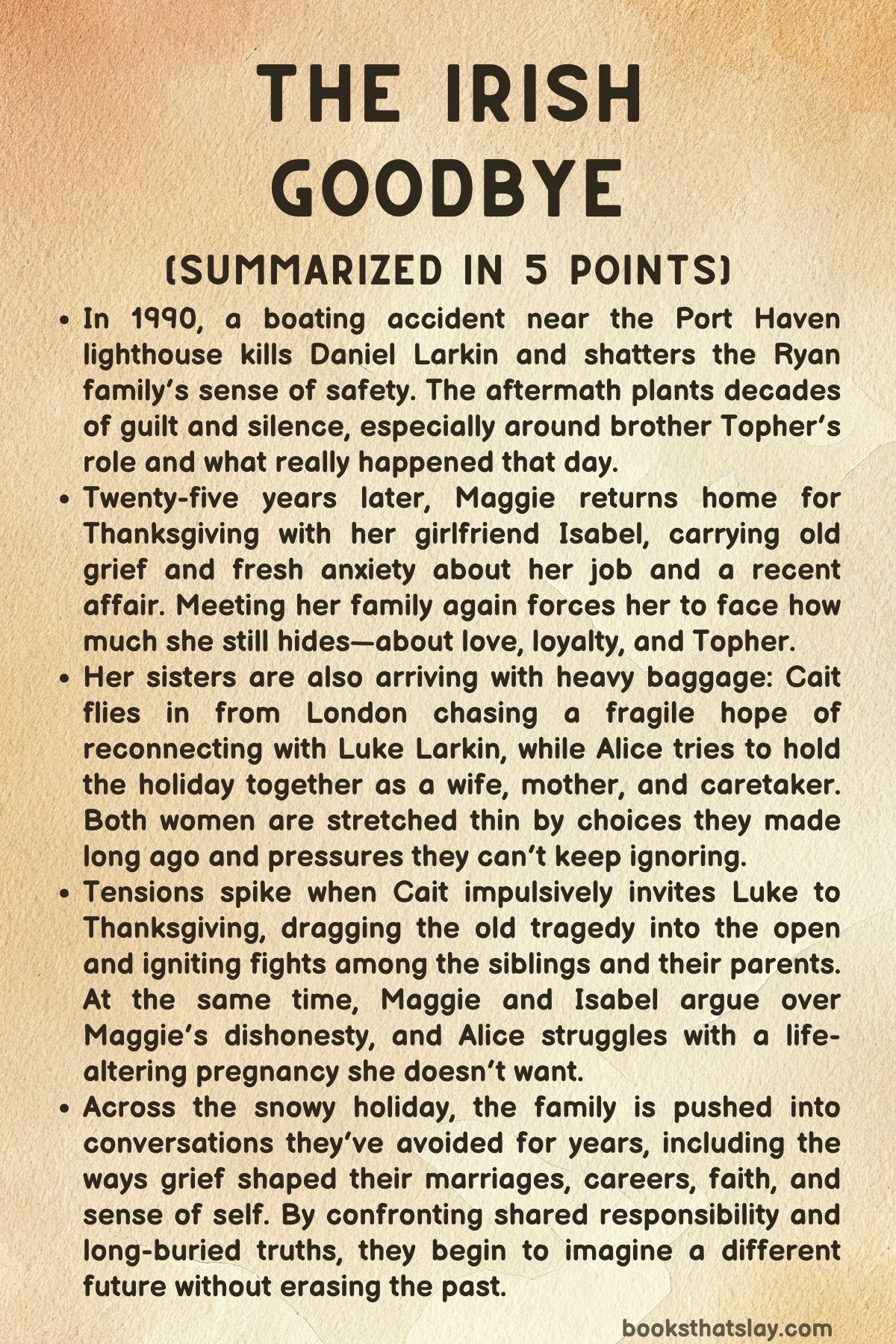
Summary
In August 1990, Port Haven’s calm summer afternoon breaks apart when young Maggie Ryan hears a crash from the bay. She sees her brother Topher dive from his skiff near the lighthouse rocks and surface holding Daniel Larkin, a younger boy who had been on Topher’s boat.
Panic spreads across the beach club. Maggie runs for their mother, Nora, cutting her ankle on the jetty.
By the time she drags Nora back to the dock, Topher is doing CPR while his friend Luke Larkin—Daniel’s older brother—stands frozen. An ambulance takes Daniel away, Luke riding with him.
The police arrive, photograph Topher’s boat, and question him. The bow is dented, proof of impact.
Maggie’s father, Robert, appears in a suit and steps into the official circle. Back in the stunned quiet after the sirens fade, Maggie’s oldest sister, Cait, admits what happened: Daniel had been driving the boat, the steering jammed, and they struck a rock by the lighthouse, throwing him into the water.
Not long after, Cait tells Maggie the truth she can barely say out loud—Daniel is dead, and nothing will be the same.
Twenty-five years later, the day before Thanksgiving 2015, Maggie drives from Vermont back to Port Haven, bringing her girlfriend Isabel home for the first time. A snowstorm and holiday traffic stretch the trip into a tense crawl.
To pass time, Isabel asks Maggie to describe each family member in one word. Maggie calls Cait “fiery,” Alice “Mom,” Nora “opaque,” and Robert “obliging.
” When Isabel asks about Topher, Maggie stiffens; her brother is almost never discussed. She answers with a single word that carries years of bitterness: “liar.
” During the drive the reader learns Maggie’s adult life. She teaches English at Grove Academy and recently ended a long affair with Sarah, a married parent of one of her students.
She now has a steadier relationship with Isabel, a writer-in-residence Maggie helped hire. The two fell together through summer runs, quiet dinners, and the kind of ease Maggie hasn’t known in years.
But Maggie still feels guilty because she recently saw Sarah in Boston and kissed her again. That same morning, her headmaster asked to meet with her after the holiday, leaving Maggie worried the affair finally reached the school.
Cait, meanwhile, flies from London to New York with her five-year-old twins, Augustus and Poppy. She is exhausted, newly divorced, and angry at the shape her life has taken.
She quit her law firm after being passed over for partner and now feels unmoored. She has taken Xanax to get through the flight, hoping to read an email from Luke Larkin, but the plane’s Wi-Fi fails.
When it returns, Poppy accidentally drops Cait’s phone into the toilet, destroying it and erasing photos and contacts, including Luke’s messages. Cait drinks airline whiskey and clings to the thought of seeing Luke again.
After Luke’s mother died, he contacted Cait; they met in London, drank together, and fell back into a charged familiarity. He invited her to Port Haven for Thanksgiving while he packed up his mother’s house.
Cait booked the trip partly for her family, partly for him, and partly to escape the life she no longer wants.
At home in Port Haven, Alice prepares for the holiday while running her interior-design work and managing her two sons, Finn and James. She resents Cait for hiring an expensive catering crew to cook at the family house, the Folly, a Victorian place stuffed with memory.
While packing for the day, Alice finds a Hustler magazine hidden in James’s duffel. James claims their father, Kyle, last used the bag.
Furious, Alice brings it to Saint Mary’s gym during Finn’s basketball game to confront Kyle. Kyle denies it is his, explaining later that Finn stole it from a friend and he tried to hide it to protect their son.
The argument frays their already stressed marriage. In the middle of the confrontation, Alice becomes violently nauseated and vomits into the bag.
She brushes it off as stress or something she ate, but fear flickers underneath.
Maggie and Isabel reach the Folly in falling snow. Inside, James blurts that he saw girls kissing in a magazine and isn’t supposed to tell Grammy.
Nora greets Isabel with polite distance, Robert with warm humor. Maggie feels a guarded relief; the meeting is not a disaster.
Topher’s old bedroom, left untouched since his death, waits upstairs like a sealed room in the family’s mind.
Maggie’s memories snap back to the day Topher died, years after Daniel’s accident. At twenty, she waited after dental surgery for Topher to pick her up.
He never came. At home, she found his Jeep in the driveway and a note taped across his bedroom door: “Maggie, don’t come in—call Father Kelly.
I’m sorry. ” She panicked, ignored the warning, picked the lock, and found him hanging in a small storage den off his room.
She tried to lift him, failed to untie the cord, and felt the terrible clarity that she couldn’t save him. She called 911, sat on his bed, and stared at the lighthouse through the window until EMTs arrived.
Ever since, guilt has lived in her body like an ache: if she had not been at the dentist, if she had understood sooner, if she had listened to him.
Back in the present, Nora assigns Isabel to sleep in the drafty cottage out back, a gesture that feels both controlling and quietly shaming. Maggie bristles but says nothing.
Isabel tries to be gracious, and Maggie feels herself splitting between loyalty to Isabel and old habits of keeping peace. A text from Sarah arrives, apologizing and asking to talk.
Maggie replies anyway, unable to stop herself from reaching toward the damage.
The next day, Alice slips to a gas-station bathroom, takes a pregnancy test, and sees two pink lines. She is nearly forty, does not want another baby, and remembers how close she came to dying during a past pregnancy.
The news lands as doom, not joy, and she hides the test before returning to the Folly.
Cait arrives with the twins, reenters the family orbit, and meets Isabel. Wanting privacy, Cait offers to get pizza and wine; Maggie comes along, and Poppy insists too.
In town, Cait borrows Maggie’s phone to access Luke’s email, then impulsively drives to his house and honks. Luke appears grief-struck but willing, and Cait invites him to Thanksgiving dinner at the Folly without warning anyone.
Maggie argues, alarmed that Luke’s presence will crack open everything their family has buried. Cait admits she and Luke reconnected in London.
On the way back, she remembers a teenage night when Luke warned her that Topher was mixed up with a dealer named Marcus, a hint of the secrets that surrounded Topher even before the accident.
When Cait announces Luke is coming, Alice explodes. She reminds everyone of Daniel’s death and the lawsuit that followed, a legal fight that bathed their family in anger and shame.
Nora tries to hold the room together, but old grief is already moving like a storm through the house.
Maggie and Isabel fight later that night. Isabel senses the hidden contact with Sarah and feels shut out.
Maggie, ashamed and defensive, retreats into silence. Isabel goes to the cottage.
In the morning, Maggie walks there and finally tells Isabel the story of her first teenage romance, how Nora caught her kissing a girl in that same cottage, called the girl’s parents, cut off contact, and sent Maggie to Father Kelly for “counseling. ” Maggie remembers his hypocrisy and the way guilt was pressed onto her while her family was already raw from tragedy.
She admits she apologized for being gay when she came out in college and has regretted that apology ever since. Isabel listens, comforts her, and asks for honesty if they are going to stay together.
Thanksgiving brings a bigger crowd at the Ryan relatives’ house. Maggie hides in the pantry and receives another text from Sarah saying she can’t talk now.
In a spike of fear and rage, Maggie tells Sarah never to contact her again. Isabel discovers the thread and confronts Maggie in the bathroom.
Maggie admits the Boston visit, reveals Sarah is a student’s mother, and concedes she hid the truth. Isabel storms out, taking Maggie’s phone.
Humiliated and desperate, Maggie tells her family Isabel is leaving. Isabel refuses to pretend everything is fine and walks away.
Maggie drives her to the station, then impulsively jumps onto the train after her to plead for another chance. Frozen tracks stall service, forcing passengers onto buses.
Maggie calls Kyle for a ride, hoping the delay gives her time to repair what she broke.
At the Folly, Luke arrives for dinner with Nicole Shirley, a former schoolmate and coworker. Cait assumes betrayal and feels flicked back into teenage insecurity.
She awkwardly handles a tantrum from Poppy in front of Luke, then gives her Benadryl to force a nap, ashamed of herself. When Cait finally corners Luke, he explains Nicole is only a coworker and Cait herself had told him to bring someone.
The tension simmers anyway.
Dinner turns sharp. Cait, drinking fast, mocks Luke’s reinvention of himself and brings up the settlement money his family received after Daniel’s death.
Nora blurts the exact amount, and Robert slams his hand on the table, stopping the fight. Luke stands, wounded, and insists he never wanted the money, then asks Cait to step outside.
In the snowy dark they face what has never been faced. Cait confesses her own buried guilt: on the day Daniel died, she had pressured Topher to leave a boat party and take Daniel with him so she could be alone with Luke before he left for college.
When Topher hesitated, she threatened to expose his drug dealing. Hurt, Topher threw Daniel the keys.
Daniel drove drunk. Cait rode off with Luke, thinking she had arranged a perfect goodbye, unaware she had set the fatal chain in motion.
Luke admits his guilt too: he didn’t stop Daniel, and he once drank with Topher not long before Topher died, hearing despair in his jokes and ignoring it. Their conversation shifts something.
The romance that once haunted Cait evaporates into a clearer, sadder friendship and shared responsibility.
During the chaos of the day, Finn suffers a concussion, and Alice and Kyle end up at the hospital. There Alice finally admits she is pregnant and does not want to be.
Kyle is stunned; neither of them can pretend this is happy news. They are frightened by the risks and by how thin their lives already feel.
Later that night, Alice drives Nora home through storm-damaged roads. Nora insists they stop at Saint Mary’s church.
In the quiet, Alice prays for Finn and then for forgiveness for the decision she is preparing to make. She asks Nora if she has ever done something she couldn’t forgive herself for.
Nora answers that she can never forgive herself for failing to protect Topher. Hearing her mother’s endless self-punishment, Alice’s resolve hardens.
Back at the Folly, Maggie receives an email from Headmaster Cunningham. The meeting she feared is not a firing but an offer: she is being considered for English department chair.
Relief washes through her, and she tells Isabel. The two talk openly about Topher’s lies, his death, and the family’s habit of avoiding truth.
Isabel says their future depends on Maggie choosing honesty over old reflexes.
Alice tells Kyle she is going to see Dr. Chen on Monday for an abortion.
She says she can’t keep shaping her life around seeking forgiveness. Kyle, shaken, says he will go with her and admits he doesn’t want more distance between them.
They hold each other, frightened but aligned.
Late that night Cait tells Alice she is moving back to Port Haven with the twins. She quit her London job and wants to help their parents and be present.
The next morning she announces it to the whole family. Alice worries about the pressure this will add, but Cait insists she is coming home for real.
After breakfast, Alice brings Cait and Maggie to their parents’ room and shows them a box of sympathy cards from Topher’s death, including one never opened—Mrs. Larkin’s.
They open it and find only sorrow, not blame. Together the sisters sort the cards, keeping what matters and burning the empty ones in the fireplace.
Alice tells them about her pregnancy and her plan; Maggie supports her immediately, and Cait offers practical help with Finn. Outside, the children chase geese in the snow.
The geese rise in a V, circle the Folly, and fly away as the sisters stand together, not cured, but finally moving forward with fewer secrets between them.
Characters
Maggie Ryan
Maggie stands at the emotional center of The Irish Goodbye, carrying both the family’s long grief and the story’s present-day tensions. As a child, she witnesses the boat accident that kills Daniel Larkin and learns early that catastrophe can arrive without warning, a lesson that shapes her adult vigilance and guilt.
Twenty-five years later she presents as steady—teaching at Grove Academy, building a life in Vermont, dating Isabel—but her steadiness is cracked by secrecy and unresolved shame. Her affair with Sarah shows how she uses intimacy as escape while fearing the consequences of truth, and her instinct to conceal reflects the Ryan family’s broader habit of avoiding the unbearable.
Maggie’s relationship to Topher is especially defining: she calls him a “liar,” yet her memories are saturated with love, terror, and a lifelong sense that she failed him. Finding his body brands her with a trauma that becomes part of her identity, leaving her trapped between wanting to move on and feeling responsible for keeping the dead present.
Across the weekend she begins to choose honesty over avoidance, not because she is suddenly healed, but because she finally sees how silence has kept her family and herself frozen in the same moment for decades.
Cait Ryan
Cait is the family’s storm front—fierce, charismatic, and volatile, but also the sister most visibly shaped by grief into ambition and exile. She fled Port Haven for London after Topher’s death, building a high-achieving career and family partly as a way to outrun the past, yet the bitterness of her divorce and professional disappointment exposes how fragile that constructed life feels.
Beneath her sharp edges is deep guilt: she remembers pressuring Topher to take Daniel on the boat, an action that makes her feel complicit in Daniel’s death and, by extension, in the chain of tragedies that followed. Her reconnection with Luke reveals her hunger for something that resembles forgiveness or a re-written ending, but her oscillation between flirtation, resentment, and cruelty shows how grief has trained her to attack before she can be vulnerable.
By the end, Cait’s decision to move home is not a neat redemption; it is a surrender to reality and to the people she has kept at arm’s length. She is trying to stop living as if survival requires distance, and instead to accept that repair, if it comes at all, must happen inside the mess she once escaped.
Alice Ryan
Alice functions as the family’s practical backbone, the sister who stayed, managed, and absorbed the parents’ needs, even as it narrowed her sense of self. Her outward life is busy and competent—interior design work, two sons, a marriage that looks stable from afar—but her internal world is crowded with resentment, exhaustion, and fear of being erased by caretaking.
The surprise pregnancy crystallizes everything she has been swallowing: the terror of losing bodily autonomy again, the dread of another dangerous pregnancy, and the rage at how care always defaults to her. Her sharp confrontation with Cait about Luke’s invitation is less about the dinner guest and more about years of feeling abandoned in the aftermath of Topher and Daniel, when Cait left and Alice was left holding the emotional and logistical weight.
Yet Alice is also capable of tenderness and clarity; her conversation with Nora in the church is a turning point where she recognizes the cost of inherited guilt and refuses to pass that burden into her own future. Choosing an abortion is her reclaiming of agency, and her openness with her sisters afterward shows a quiet courage: she will love her family, but not at the price of disappearing inside them.
Topher Ryan
Topher exists in the story as both absence and gravitational force, the brother whose life and death define the family’s emotional weather. As a teenager he is already orbiting danger—drugs, reckless boating, secret despair—yet he is also presented through the sisters’ memories as magnetic and complicated, someone who could be protective and destructive in the same breath.
His lie-filled exterior, hinted at by Maggie’s bitterness and Cait’s flashbacks of his drug dealing, suggests a young man who learned to hide himself to survive the expectations and grief around him. The boat accident with Daniel becomes the moral wound he never escapes; even if responsibility is shared, Topher seems to internalize the event as proof that he ruins what he touches.
His suicide note to Maggie is cruel and loving at once: it tries to protect her from seeing him, yet ensures she is the one who finds him, binding her to his final moment. Topher embodies the novel’s darkest question—what happens when guilt becomes identity—and his preserved bedroom at the Folly shows how the family keeps him fixed in time, unable to decide whether letting go would be betrayal or mercy.
Nora Ryan
Nora is an “opaque” presence in Maggie’s words, and that opacity is her armor. She is a painter and a mother whose faith and distance coexist, a woman who learned to survive grief by compartmentalizing it into silence, ritual, and self-blame.
After Topher’s death, religion becomes both her refuge and her instrument of control, especially toward Maggie’s sexuality; the cottage incident and sending Maggie to Father Kelly reveal Nora’s fear of losing another child to a world she cannot manage. Yet she is not a simple antagonist—her politeness to Isabel, her quiet worry about family health, and her nighttime painting show a person who feels deeply but expresses it indirectly.
Nora’s confession to Alice in church—that she cannot forgive herself for failing Topher—exposes the core of her character: she interprets tragedy as maternal failure, and that belief has shaped every boundary she sets. Her brief, gentle conversation with Maggie late in the book suggests the beginning of a different kind of motherhood, one that might finally choose presence over protection-through-distance.
Robert Ryan
Robert is the family’s soft-spoken stabilizer, the parent who tries to smooth sharp moments with warmth, humor, and a kind of helpless kindness. Maggie describes him as “obliging,” and the story supports that: he attends crises without dominating them, welcomes Isabel with genuine curiosity, and often stands as the buffer between Nora’s rigidity and the children’s volatility.
His obliging nature can read as passivity—he seems to let conflicts happen around him rather than intervening decisively—but it is also a survival strategy within a household defined by grief. Even his appearance with the police after Daniel’s accident suggests a man who moves toward duty when chaos erupts.
Robert’s aging and the family’s concern about the parents’ future place him as a figure of impending transition; he represents the approaching moment when the sisters must decide what they inherit besides sorrow.
Isabel
Isabel enters the Ryan family as both outsider and mirror, someone whose steadiness throws Maggie’s evasions into high relief. As a writer-in-residence and playwright, she is attuned to story, symbolism, and the hidden narratives people refuse to name, which makes her especially allergic to Maggie’s half-truths.
Isabel’s warmth with the kids, patience with Nora’s cottage arrangement, and willingness to keep trying after fights show that her love is not naïve—it is chosen with eyes open. At the same time, she has firm boundaries: when she leaves after the shower confrontation, it is not punitive as much as self-protective, a refusal to be folded into the Ryans’ culture of silence.
Isabel pushes Maggie toward adulthood in the deepest sense, insisting that intimacy requires honesty, not just affection. By the end she becomes part of the family not by performing politeness, but by staying present through conflict and making truth the price of continuing.
Sarah
Sarah is the catalyst for Maggie’s present-day unraveling, representing temptation, power imbalance, and the way old patterns reassert themselves under stress. As a married parent at Maggie’s school, she embodies danger from the start—both ethically and emotionally—yet Maggie’s prolonged affair with her suggests Sarah offered something Maggie craved: secrecy that felt like refuge and intensity that felt like being seen.
Sarah’s ability to remain composed during the Boston incident, even while her husband realizes the truth, hints at her compartmentalizing skill and perhaps her selfishness; she has learned to protect her life by letting others bear the fallout. For Maggie, Sarah is less a fully shared love than a loop of self-sabotage, and the “goodbye” text Maggie sends is as much a desperate attempt to cut off her own addiction to secrecy as it is anger at Sarah’s waffling.
Luke Larkin
Luke is the story’s living bridge to the original tragedy, carrying his own grief while forcing the Ryans to confront what they have tried to bury. As Daniel’s older brother, he embodies loss that is both personal and legal, and his later return after his mother’s death reopens the wound in a way no family-only conversation could.
Luke is weary, grieving, and somewhat adrift, shown through drinking and the task of packing up a dead parent’s home. His relationship with Cait is complicated by history, attraction, and shared guilt; he wants connection but also carries the weight of being the reminder everyone fears.
At dinner he is drawn into conflict over the settlement, revealing that he too feels alienated by the money meant to compensate for the unfixable. His late-night bar conversation with Cait is one of the novel’s most honest exchanges, showing a man who no longer wants vengeance, only recognition that blame was never as simple as the family’s silence made it.
Daniel Larkin
Daniel is present mostly through memory and consequence, but his character still matters because the story refuses to make him only a symbol. In Cait’s recollection he is reckless, drunk, eager to impress, and drawn to Topher’s dangerous orbit, suggesting a teenager testing limits without understanding mortality.
His death is the first fracture in the Ryan family’s timeline, the event that plants guilt in Cait, secrecy in Topher, and shock in Maggie. Daniel’s absence also shapes Luke’s adult life and the family’s legal history, making him a quiet but constant force in the narrative.
Kyle
Kyle, Alice’s husband, is a fundamentally decent man who nevertheless represents the gaps that open when empathy does not keep pace with responsibility. He tries to be supportive—handling the porn magazine situation, comforting Alice in the hospital, offering to accompany her to Dr.
Chen—but he often needs crises to be explicitly named before he recognizes their weight. His confusion about Alice’s refusal to continue the pregnancy is not cruelty; it is an inability to grasp the cumulative exhaustion of caretaking and bodily risk that Alice lives with daily.
Kyle functions as a portrait of a loving partner who still benefits from the invisible labor his wife shoulders, and his growth is gradual, tied to finally hearing what Alice has been too tired—or resentful—to say.
Finn Ryan
Finn is the older of Alice’s sons, a sensitive observer caught between child innocence and the adult tensions that leak into the holiday. His distress during his parents’ argument and his later concussion position him as one of the story’s reminders that family trauma does not stop at one generation.
Finn’s injury also becomes a narrative pressure point that forces Alice and Kyle into honesty about fear, care, and the future, making him a quiet agent of change even without intending to be.
James Ryan
James, the younger son, brings the chaos of childhood into a house heavy with secrets. His blurting about the magazine and kissing girls is comic on the surface, but it also reflects how children stumble into adult worlds without understanding their stakes.
James’s presence sharpens Alice’s anxiety about another baby and underscores the story’s theme that the family’s private grief always lives alongside the noisy ordinary life that keeps going.
Augustus and Poppy
Cait’s twins are both emotional anchors and stress multipliers for her. They highlight Cait’s exhaustion, her fear of being judged, and her deep love that survives her bitterness.
Poppy’s tantrums and the phone-in-toilet incident show how Cait’s life is constantly at the mercy of small disasters, mirroring the larger uncontrollable tragedies she still carries. The twins also act as a lens through which the Ryan family sees Cait anew—not just as the fiery sister who left, but as a mother trying to rebuild a home for her children.
Nicole Shirley
Nicole appears briefly but significantly as the unexpected complication in Cait’s fantasy of Luke. She is competent, friendly, and connected to Luke’s current life, which Cait has tried to romanticize into a private past reclaimed.
Nicole’s presence forces Cait to confront her own possessiveness and insecurity, and her calm professionalism at the table contrasts with the Ryans’ emotionally charged history, showing how the world outside Port Haven has moved on even if this family has not.
Father Kelly
Father Kelly represents institutional authority used as emotional containment. In Maggie’s youth he is the enforcer of Nora’s fear, offering “spiritual counseling” that is hypocritical and shaming rather than compassionate.
His later appearance at Thanksgiving is a reminder of how religion has functioned in this family—not necessarily as comfort, but as a tool to police grief and desire. He symbolizes the way adults can mistake control for care, leaving children to sort out the damage decades later.
Bram
Bram, Cait’s ex-husband, is mostly offstage but essential to understanding her present state. Their bitter divorce and the strain of co-parenting show Cait’s life unraveling in ways she did not plan, reinforcing that her earlier escape to London did not protect her from pain.
Bram functions less as a character in the plot and more as evidence that Cait’s grief-driven life choices did not deliver the stability she hoped for.
Frank, Hope, and Oliver Thompson
Frank, Sarah’s husband, appears at the Boston flashback as the embodiment of ethical reality intruding on fantasy. His slow realization and firm demand that Maggie leave expose the stakes Maggie has tried to ignore.
Hope, Frank and Sarah’s young daughter, registers tension through crying, emphasizing the collateral harm of secrecy. Oliver, Maggie’s former student, is a haunting figure for Maggie because his cheerful recognition after the incident collapses her professional and personal selves into one moment of shame.
Together this family shows how Maggie’s affair is not just a private risk but a breach that touches children and power dynamics.
Marcus
Marcus, the dealer Topher was involved with, is a shadow figure pointing to the deeper dangers Topher flirted with. He never enters directly, but his mention makes clear that Topher’s recklessness was not confined to youthful partying; it had real criminal weight and a threat of consequences the family may never have fully understood.
Headmaster Cunningham
Headmaster Cunningham represents Maggie’s fear of exposure and the adult world’s judgment. The summons she receives becomes a symbol of looming punishment for her affair, and her dread around it shows how guilt makes her expect ruin even when none is coming.
When the meeting turns out to be a promotion, Cunningham shifts into a figure of unexpected mercy, emphasizing the theme that the harshest judge in Maggie’s life has been herself.
Mukesh
Mukesh, Kyle’s friend and a minor presence at the gathering, serves as part of the social chorus of the holiday—evidence that the Ryans’ internal drama unfolds inside a wider community. His presence contributes to Cait’s sense of being watched and judged and highlights how family performance intensifies around outsiders.
Themes
Grief as a living presence
The story carries grief not as a past event but as something that still occupies rooms, habits, and bodies. The death of Daniel Larkin in 1990 is the first rupture, yet the family never treats it like a closed chapter; it becomes a reference point for how they interpret risk, love, and responsibility.
When Topher later dies by suicide, grief gains a second, more intimate shape. His preserved bedroom at the Folly is not just a memorial; it functions like a physical proof that time stopped in one corner of the house, and that everyone has been walking around that freeze for years.
Maggie’s memories show grief as sensory and repetitive: the foghorn, the knots in the cord, the smell of the room, the way her mind keeps replaying the moment she could not undo what was already done. That recurrence explains why returning home is so destabilizing for her; she is stepping into an atmosphere where loss is still active.
The parents’ grief is quieter but no less consuming. Nora’s turn toward religion and her relentless self-blame suggest a need to impose meaning on a death that felt random, and a need to punish herself for not preventing it.
Robert’s “obliging” nature reads as a grief response too: smoothing over conflict to keep the family from breaking further. Even the Larkins’ settlement money, brought up at dinner, shows how grief is tied to social fallout; pain becomes legal, monetary, and publicly argued over.
The final act of burning generic sympathy cards underlines that grief can be processed only when it is faced directly, sorted, and given a place. What remains after the fire is not erasure but a clearer outline of what matters, implying that grief is survivable when it is named instead of stored away.
Guilt, responsibility, and the hunger for absolution
Guilt in the novel is communal and layered, with no single person able to claim innocence or total blame. Cait’s late confession that she pushed Topher to take Daniel on the boat reframes the original tragedy, showing how a teenage desire for time with Luke spiraled into irreversible consequences.
Her guilt has shaped her adulthood in hidden ways: the drive to succeed, the move to London, the guarded distance from family, and even her divorce and career dissatisfaction feel tied to a life built while running from one defining mistake. Luke’s guilt mirrors hers but with a different texture; he is both bereaved brother and someone who participated in the reckless culture around Topher and Daniel.
Their late-night conversation in the bar finally permits a kind of mutual recognition: guilt is shared because failure was shared. Maggie’s guilt is quieter but more corrosive.
She believes she should have saved Topher, even though the scene makes it clear she was physically unable to. The counselor’s exercise of listing the ways she supported him reveals a truth Maggie struggles to accept: guilt often attaches to the survivor not because of real causality, but because helplessness is unbearable.
Nora’s guilt is the most entrenched, lasting decades. Her line about never forgiving herself for not protecting Topher suggests that guilt becomes identity when grief is not metabolized.
The church scene with Alice shows guilt being transmitted across generations; hearing her mother’s self-accusation hardens Alice’s resolve to choose abortion, not from coldness, but from refusing to live under inherited expectations of sacrifice. In this world, absolution does not arrive through grand apologies or moral verdicts.
It comes through painful honesty, shared witnessing, and accepting that responsibility can exist without requiring lifelong punishment. The unopened card from Mrs.
Larkin is crucial here: it offers sorrow without blame, disrupting the family’s long assumption that they are permanently condemned. By ending with gestures of care and forward movement rather than full redemption, the novel suggests that guilt may never vanish, but it can stop ruling the present.
Silence, secrecy, and the cost of avoiding truth
The Ryans are bound together by a pattern of not saying what needs to be said, and the plot keeps showing how that avoidance compounds harm. The 1990 accident is surrounded by confusion and half-stated facts; even as children, the sisters sense that adults are forming a narrative they are not fully invited into.
Over time, silence becomes family habit. Topher’s struggles are not openly discussed, and his death is treated as something to preserve rather than interpret, with his life reduced to an untouched room instead of a story with painful questions.
Maggie models the same pattern in her adult life: she hides her renewed contact with Sarah, minimizes the seriousness of the affair, and keeps Isabel at arm’s length when it matters most. Her dishonesty is not presented as simple cruelty; it is a learned emotional reflex from growing up where truth felt dangerous.
Cait’s long absence and selective communication widen the family’s rifts, while Alice carries private dread about pregnancy and caretaking until her body forces the issue through nausea and exhaustion. Nora’s “opaque” quality fits here: she participates in silence through politeness, through spiritual framing that sidesteps direct conversation, and through her reluctance to acknowledge Maggie’s sexuality without awkward detours.
The Thanksgiving dinner becomes the arena where silence breaks, not neatly but explosively. Cait’s baiting of Luke, the parents’ accidental disclosure of settlement money, and Isabel’s refusal to pretend that she is leaving for a trivial reason all show that truth tends to surface in messy forms when suppressed too long.
The sisters sorting and burning sympathy cards is the clearest symbolic reversal of silence: they literally open what was kept shut, decide what has meaning, and discard what only maintains the performance of grief. By tying forgiveness, intimacy, and healing to moments of speech, the novel presents honesty as risky but necessary.
The cost of avoidance is not just tension; it is missed chances to protect loved ones, to be known, and to prevent old pain from repeating in new shapes.
Queer identity, love, and the struggle to belong
Maggie’s sexuality is not treated as a subplot but as a key way the novel examines belonging. Her teenage experience in the cottage, where her mother’s reaction turns discovery into exile, shows how family love can be conditional even when it is not openly hostile.
Nora’s decision to send Maggie to Father Kelly for “spiritual counseling” links queerness to shame in the household’s moral language, and Maggie’s later regret about apologizing in college reveals how deeply that shaming embedded itself. In the present, bringing Isabel home represents more than introducing a partner; it is a test of whether Maggie can exist fully within her family without shrinking.
The awkward kitchen interaction, James’s accidental blurting about the magazine, and Cait’s blunt announcement at dinner all show a family still learning how to hold Maggie’s life without recoil or avoidance. There is progress, but it is uneven and often mediated through discomfort.
Maggie’s affair with Sarah also sits inside this theme. The relationship is secret, unequal, and destabilizing, illustrating what happens when desire is pushed into shadow: it becomes entangled with power, guilt, and self-division.
Isabel, by contrast, offers a chance at honesty and steadiness, but she demands openness as a condition of staying. Her refusal to perform politeness in the foyer, and her insistence that Maggie stop hiding parts of herself, positions queer love as requiring truth not just to survive, but to be dignified.
Importantly, the novel does not idealize queer relationships as inherently healthier; it shows them as vulnerable to the same failures as any other bond, especially when the partners inherit a culture of silence. By the end, Isabel helping with Poppy and rejoining the family circle suggests that belonging is possible, but only when Maggie stops editing herself for others’ comfort.
Queer identity here becomes a lens for examining what any person needs to be whole in a family: not tolerance alone, but real acceptance that allows love to be visible.
Motherhood, bodily autonomy, and unequal caretaking
Alice’s storyline places motherhood in direct tension with selfhood and survival. Her life is already saturated with care: managing children, household logistics, work, and now the creeping realization that her parents are aging into dependence.
The hospital lounge conversation with Kyle makes explicit what the narrative has been showing all along: caretaking in this family falls disproportionately on women, and the emotional labor is treated as default rather than shared responsibility. Alice’s pregnancy lands inside that reality like a threat.
It is not framed as a moral puzzle but as a practical and existential crisis, tied to her memory of a dangerous past pregnancy and her fear that another child would erase the fragile independence she has begun to reclaim. The quiet dread between her and Kyle, and their inability to say “unwanted” aloud, captures how reproductive decisions are often shaped by cultural expectations even when private feelings are clear.
The church visit with Nora complicates the theme rather than simplifying it. Alice seeks forgiveness not because she doubts her decision, but because she knows she is stepping outside the moral script her mother now lives by.
Nora’s confession about failing Topher becomes the turning point: Alice recognizes the trap of letting guilt dictate a life, and refuses to repeat it. Her decision to have an abortion is therefore not only about her body; it is about resisting inherited patterns of sacrifice and choosing a future where care does not mean self-erasure.
Kyle’s response, while shaken, moves toward partnership rather than judgment, suggesting that shared responsibility is possible when truth is spoken clearly. The theme expands to include Cait’s motherhood too: exhausted single parenting, the loss of her phone’s photos, and her decision to return home underline how maternal identity can be both anchoring and isolating.
Across these arcs, motherhood is shown as loving, heavy, and often poorly supported. Autonomy is not presented as selfishness but as the condition that makes care sustainable.
Homecoming, time, and the possibility of change
The return to Port Haven is structured as a confrontation between who the characters were and who they might still become. Time in the novel is not smooth; it is broken by memory and by the way places hold history.
The lighthouse, foghorn, and Folly are recurring anchors that make the past feel near enough to touch. For Maggie, driving back with Isabel exposes how much of her adult self has been built around avoidance: she returns to the site of trauma at the same moment her current relationship is fragile and her job feels uncertain.
Cait’s homecoming is more reluctant and chaotic, marked by travel exhaustion, alcohol, and the desperate hope that Luke might offer an escape from her stalled London life. Alice never really left, so her version of “homecoming” is internal—she is being forced to return to her own unmet needs after years of prioritizing everyone else.
What makes this Thanksgiving different is not that the past disappears, but that the family finally engages with it directly. Luke’s presence pulls old wounds into the open.
The sisters’ late-night conversations and shared tasks replace isolation with solidarity. Even small shifts—Robert’s warmth toward Isabel, Nora asking Maggie if she is happy, Cait deciding to move back—signal that the family is not locked into the roles formed by tragedy.
The geese lifting into formation at the end is a quiet emblem of this theme: movement does not mean forgetting where one started, but it does mean choosing a direction together. By closing on forward motion rather than neat resolution, the novel argues that homecoming is less about reclaiming a lost past and more about testing whether change is still possible inside the same walls.
The past remains, but it no longer has to be the only map.