The Isle in the Silver Sea Summary, Characters and Themes
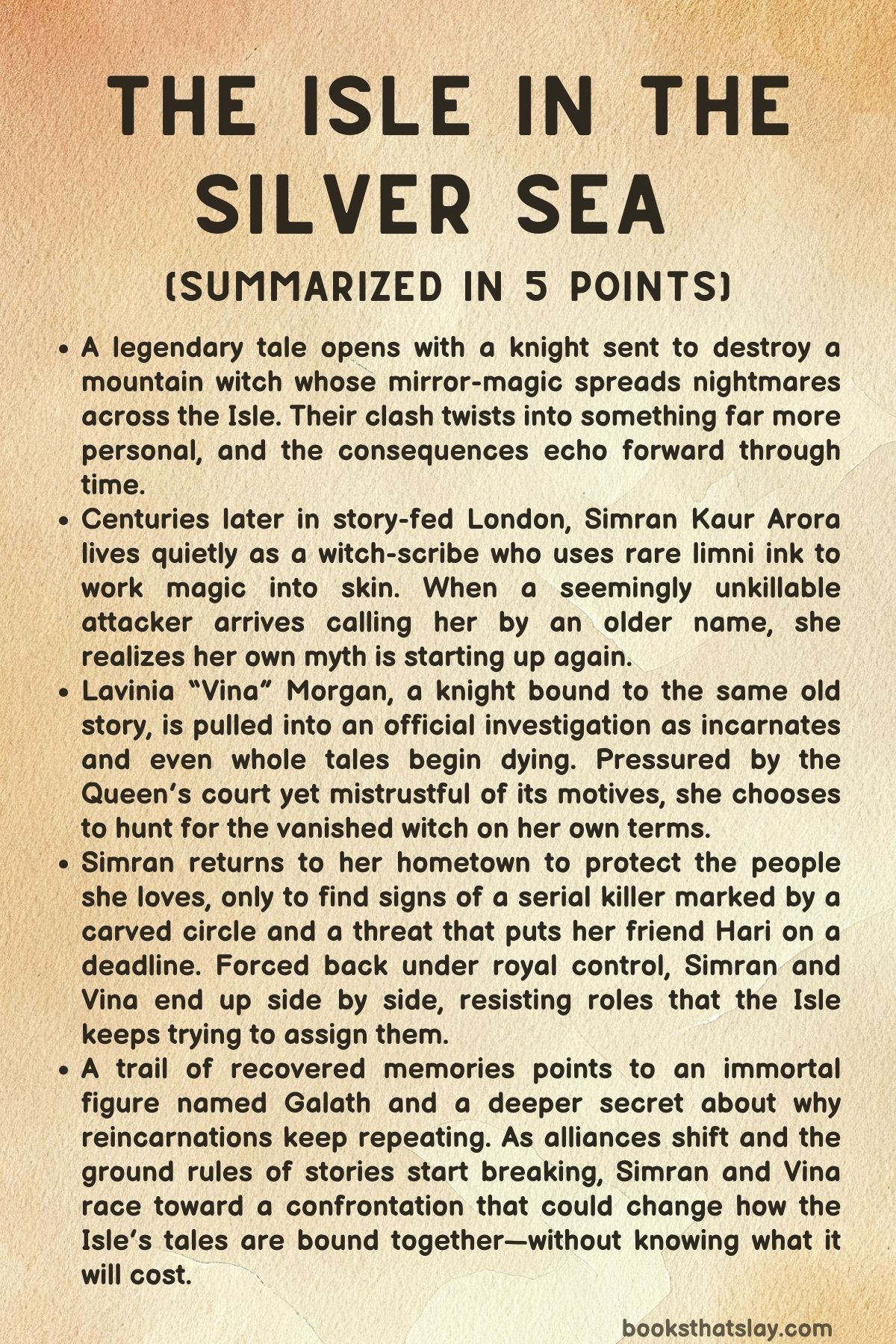
The Isle in the Silver Sea by Tasha Suri is a sweeping fantasy about memory, reincarnation, and the fragile bond between love and destiny. Set in a world where stories have power and the land itself breathes through tales, it follows a witch, Simran Kaur Arora, and a knight, Lavinia Morgan, who are reborn across centuries to replay the same tragic legend—the Knight and the Witch.
As the Isle begins to unravel and ancient forces stir, their paths cross once again in a modern London haunted by dying stories. Bound by fate yet defiant of it, they must decide whether to end their cycle or reshape the tale that has ruled their lives.
Summary
Long ago, a knight of pure heart was sent by the Queen to destroy a witch whose bronze palace on the mountains spread nightmares through enchanted mirrors. The knight, blindfolded to resist her magic, struck at her illusions until she lured him into trust.
When he removed his blindfold, her magic poisoned him, twisting his love and hate. The witch, moved by his devotion, freed the Isle but enslaved him with her spell, making him her weapon of destruction.
Yet her own heart turned, and realizing the ruin they had become, he fulfilled his vow by killing them both. Their deaths birthed an immortal tale—one that bound their souls to relive their story endlessly across time.
Centuries later, the Isle has become a living world where tales shape reality. Simran Kaur Arora, a witch from Elsewhere, works as a magical scribe in London, etching spells into skin using limni ink.
When she encounters three knights under the Queen’s banner, she uses illusions to steal ink, but one of them, Lavinia Morgan, recognizes her as the witch from the old story. Simran flees, unsettled by the realization that her ancient curse is returning.
That night, a wounded stranger appears at her door, revealing himself as an incarnate—one who lives within a story. He calls her “Isadora,” the witch from legend, and tries to kill her, claiming to end her curse.
Their battle leaves her home in ruins and her mind filled with dread: her old story has awakened once more.
Simran’s friend Lydia and companion Hari help her recover, but Simran decides she must flee London to find answers. Meanwhile, Lavinia, the knight Simran encountered, delivers the stolen ink to royal archivists at the Tower of London.
The archivists use it to repair a dying story, but the spell backfires, causing chaos and revealing that a tale has truly perished—a terrifying omen. They discover the corpse of an incarnate marked with a red circle on the forehead, the same mark borne by Simran’s attacker.
Lavinia suspects the Isle’s stories are collapsing and vows to find the witch linked to her own tale.
When Lavinia reports to her father, Minister Morgan, he warns her to stay within the safety of Westminster, but she senses deception. Summoned by the Queen’s Spymaster, she learns the Queen’s agents already know about the missing witch.
The Spymaster’s magical compass reacts violently in her hand, confirming her fate is tied to Simran’s. Forbidden to leave the grounds, Lavinia defies orders, slipping into the London night to follow the invisible pull of her tale.
Simran, meanwhile, travels toward her birthplace, Gore, with Hari. Along the way, witch hunters ambush them, forcing them to flee.
She confides in Hari that she is cursed to live and die as the Witch in countless reincarnations. When they reach Gore, she finds her old mentor Bess dead, the woods corrupted by dark energy.
Lavinia, following the same pull, reaches the same woods. When they meet, Simran attacks, but the forest itself turns hostile, forcing them into an uneasy truce.
Working together, they discover a ruined temple where Bess’s body lies marked with the same sigil that haunted Simran’s attacker. A spectral man appears, declaring he has captured Hari and challenging Simran to find him before the winter solstice.
Simran returns home to find her family’s shop destroyed and Hari missing. The Queen’s agents soon capture her and Lavinia, bringing them before the Eternal Queen.
Amused by their reunion, the Queen celebrates their destined pairing and declares them the perfect Knight and Witch reborn, binding them again into the old tale.
At the palace, they find a magical chalice that thrusts them into visions of their past lives. Lavinia relives centuries of incarnations, learning that Simran, once named Elayne, had loved and raised a boy named Galath, later cursed to immortality.
He is the same assassin who has haunted them across lifetimes. Simran, shaken, realizes she must confront him to save Hari.
She journeys to the Copper Mountains where their story began, finding the witch’s old tower still standing. Drawn into the roles of their tale, she dons the witch’s gown and enchants nearby villagers.
Lavinia finds her there, and despite Simran’s insistence on facing her destiny alone, they reconcile and admit their love. For one brief night, they share peace before tragedy returns.
Simran wakes to find Hari alive but bound to Galath by a magical tether. Lavinia confronts Galath in the mirrored hall, offering her life for Simran’s.
Galath reveals that Simran once made him immortal and that he has been killing incarnates who begged for release from endless rebirth. Their confrontation erupts into chaos when royal knights and archivists storm the tower, attacking with limni ink meant to destroy incarnates.
Galath protects Hari, and Simran discovers she can resist the ink’s deadly effects. In the struggle, Vina is captured and taken to the Tower, while Simran escapes with Hari and Galath.
Simran encounters the spirit of Elayne—her original self—who reveals that centuries ago, she bound the Isle’s fate to an imprisoned being beneath the sea called the Eternal Prince. His chains preserve the Isle’s stories, and freeing him will release all incarnates from their curse.
Determined to finish what her past self began, Simran sets out to free the Prince.
Vina, imprisoned, faces her father, who admits he cannot save her. She accepts her fate quietly as the archivists prepare her execution.
Meanwhile, Simran gathers allies to storm the Tower and rescue her. She and her companions infiltrate the fortress, battling warders and confronting Meera, an archivist who despises her.
Inside the archives, they discover the chained Beast—Adder—who is not a monster but the living essence of all stories. As the Palace above collapses under the rebirth of the Eternal Prince, the Queen and her Spymaster try to control the chaos.
Simran and Vina reunite as the Queen confronts the Eternal Prince, who kills her and crowns himself the Eternal King. He rides toward the Tower to slay the Beast and seize control of the Isle.
Galath stands to face him, knowing it may cost his life. Simran frees the Beast, and Vina helps Galath battle the King.
When the King strikes Galath down, Vina kills the King in turn, ending the cycle. The Isle trembles as the Beast dissolves into countless freed stories that flow across London, restoring balance and ending the monarchy’s dominion.
Galath, mortally wounded, is taken to the abbey where Simran removes the limni mark that made him immortal, returning him to mortal life. Months later, the Isle begins to heal.
Simran helps rebuild the archives, while Vina returns at the winter solstice to claim her promise. Choosing each other freely, no longer bound by fate, they finally begin a life beyond the stories that once ruled them.
Characters
Simran Kaur Arora
Simran Kaur Arora stands at the heart of The Isle in the Silver Sea as both the reincarnated witch from the ancient tale and a modern woman struggling between destiny and selfhood. Her dual identity—Simran the immigrant scribe and Isadora or Elayne the immortal witch—embodies the novel’s exploration of cycles, memory, and redemption.
Simran’s past lives shadow her present, and her existence becomes a metaphor for colonized identity and inherited guilt. Having crossed the magical sea from Elsewhere, she lives in London crafting spells into ink—a symbol of control over narrative—but her life remains written by forces beyond her.
When the story of “The Knight and the Witch” begins to repeat, Simran’s refusal to surrender her agency marks her transformation from victim of fate to its author. Her compassion, particularly toward Hari and even her enemy Galath, redefines witchcraft not as corruption but as creation.
Simran’s love for Vina, layered with the sorrow of their repeated tragedies, becomes her act of rebellion against both the Eternal Queen and the determinism of tales. By the novel’s end, her ability to rewrite the rules of limni ink and liberate incarnates elevates her to a mythic redeemer—one who frees the world not through purity but through acceptance of imperfection.
Lavinia “Vina” Morgan
Lavinia Morgan, the knight reincarnated across centuries, is a mirror and counterpoint to Simran. As the daughter of Minister Morgan, she straddles the worlds of duty and desire—bound to the Crown yet haunted by the morality of its rule.
Vina’s knightly nature is defined by discipline, courage, and faith in justice, but her story exposes how these virtues can be exploited by systems of power. Her encounters with Simran dismantle her obedience to hierarchy, awakening her to a truth deeper than loyalty: love as resistance.
The Spymaster’s manipulation and her father’s complicity force Vina to question whether service to the Queen preserves the Isle or merely chains it to its decay. Her pursuit of Simran—across forests, prisons, and collapsing tales—reveals a soul both steadfast and tender, whose strength lies not in conquest but in choice.
When she finally chooses love over command, Vina redefines knighthood as an act of faith in another person, not an institution. Her survival, and her reunion with Simran at the end, signify that courage rooted in empathy can outlast any crown or curse.
Galath
Galath, the pale assassin marked by the circle on his forehead, embodies tragedy in perpetual motion. Once a frightened boy raised by the witch Elayne—an earlier incarnation of Simran—he is both her victim and her creation.
His immortality, gifted and cursed through limni ink, traps him in endless life without peace, making him the living symbol of consequence. Every act of violence he commits is driven not by cruelty but by longing for release—from pain, from memory, from the endless retelling of his own suffering.
His role as both killer and savior of witches complicates morality itself, questioning whether mercy lies in death or forgiveness. Through his final sacrifice against the Eternal King, Galath achieves the redemption denied him for centuries, his mortality reclaimed as freedom.
In him, the novel locates its deepest sorrow: that love, twisted by power and fear, can imprison as easily as it can save.
Hari Arora
Hari Arora, Simran’s steadfast friend and surrogate brother, represents the novel’s moral grounding—a mortal among incarnates who confronts myth with humanity. His humor, loyalty, and protective instinct make him a constant reminder of ordinary love amidst extraordinary chaos.
Though initially ignorant of Simran’s true nature, Hari’s choice to stay with her after learning of her curse reflects his capacity for unconditional acceptance. His eventual bond with Galath—first as captive, then as savior—creates a redemptive symmetry that softens the novel’s darker cycles.
Hari’s role expands from companion to participant in magic, as his blood becomes the conduit for the witch’s spells, symbolizing how even the powerless can influence destiny. Through him, the novel underscores that courage is not born from prophecy or tale but from compassion freely chosen.
Minister Morgan
Minister Morgan, Vina’s father and the weary statesman of Westminster, personifies institutional decay. Torn between paternal love and political duty, he upholds the Crown’s control over incarnates while watching his daughter question everything he believes.
His silence and evasions expose the moral cowardice of those who serve oppressive systems for the illusion of stability. Morgan’s interactions with Vina—tinged with regret and repression—reveal a man aware of his complicity yet incapable of rebellion.
He is a tragic figure of a different kind, one whose faith in order blinds him to justice. Through him, the book critiques bureaucratic governance over imagination, where stories become tools of empire rather than sources of freedom.
Bess
Bess, the forest witch of Gore, represents maternal magic and defiance against erasure. Her death—marked by the same circle that brands Galath—catalyzes Simran’s return to power and the reconnection of witchcraft with grief.
Bess’s presence lingers through her axe, her familiar deer, and the forest itself, symbolizing nature’s resistance to consumption by tales. In death, she becomes a guardian spirit guiding Simran toward self-knowledge.
Through Bess, the novel honors women’s intergenerational legacy of resistance—craft, mentorship, and love that survives even state violence.
Ophelia and the Beast (Adder)
Ophelia, the librarian of the great archive, embodies the preservation of knowledge in a decaying world. Her compassion for incarnates and understanding of the Isle’s magic align her with Simran’s quest for liberation.
The Beast, or Adder, is her counterpart—a monstrous fusion of all burned books and forgotten stories. Once feared, it becomes the ultimate symbol of renewal: the idea that destruction and creation are inseparable.
When Simran frees the Beast, she restores balance between chaos and control, ensuring that stories breathe again. Together, Ophelia and the Beast encapsulate the novel’s thesis—that memory, even when monstrous, must be free.
Themes
Cycles of Story, Fate, and the Cost of Being Remembered
In The Isle in the Silver Sea the world itself depends on stories continuing, which turns narrative into a kind of law that governs bodies, geography, and even identity. The opening legend establishes the logic: the Isle is fed by a tale so powerful that its characters are trapped inside it long after their deaths, condemned to repeat the same emotional beats until “stories end” and the land sinks.
That sets up a central tension: immortality is not a gift but an obligation enforced by collective memory. When Simran learns she has lived as “the witch” countless times, her fear is not only of death but of repetition—of being forced into a role that erases present choice.
The more the Isle relies on familiar tales, the more it punishes deviation, using supernatural pressure to push incarnates back into expected actions, gestures, and outcomes. The Queen’s court turns this into policy, treating incarnates as resources to be managed for stability, and the archivists reduce living people to “books” that can be chained, repaired, or destroyed.
Even rebellion gets absorbed into the system: the knight and witch reunite, the court celebrates, and the machinery of spectacle attempts to lock them into the old pattern again.
The theme grows sharper when tales begin to die and parts of the land vanish. If stories sustain reality, then the loss of a story becomes a kind of ecological collapse, and the characters are caught between two terrors: continuing the old tale forever or letting the narrative foundations break.
Galath embodies the most brutal version of this trap—made immortal through limni ink, he becomes a tool for “mercy” killings, delivering death as the only escape from reincarnation. Yet even his violence is shaped by the same story-logic he wants to defeat.
The book treats fate not as metaphor but as an institution with guards, archives, and enforcement, and then asks what freedom would require. The eventual breaking of the archive’s chains and the release of stories into the world argues that liberation cannot come from selecting a better script under the same system; it demands changing who controls narrative, how memory is stored, and whether people can exist without being forced to perform for the land’s hunger.
Power, Government, and the Policing of Living Narratives
Authority in The Isle in the Silver Sea is not merely political; it is metaphysical administration. The Queen, her Spymaster, and the archivists act like custodians of reality, justifying coercion as “prosperity” and safety while quietly treating lives as replaceable components in a grand structure.
Vina’s position exposes how control works: she is a knight under command, yet also an incarnate who represents a story the state wants to regulate. Her “house arrest,” the expectation that all new incarnates be presented at court, and the Spymaster’s calculated permission to pursue Simran “quietly” show an apparatus that speaks in orders while encouraging deniable outcomes.
This is governance through managed uncertainty—official rules exist, but the real power lies in those who interpret and bend them behind closed doors.
The archive system is the clearest image of institutional violence. Limni ink, the most valued magical substance, becomes a weapon and a chain: it repairs dying tales, destroys incarnates, and binds the Beast.
The language of procedure—duty, recognition, containment—masks the fact that the state is deciding which stories deserve to exist. When a tale dies and the land stains black, the response is not grief but triage, investigation, and punishment.
The Queen’s festivities for the knight and witch are especially chilling because celebration becomes another tool of control: public ritual seals private captivity. Even Vina’s father, Minister Morgan, represents a softer face of the same machine—paternal warnings and withheld truths that still funnel her toward obedience.
His inability or refusal to save her shows how the system consumes even those who believe they are protecting their children.
The emergence of the Eternal Prince, then the Eternal King, does not solve this theme by replacing a bad ruler with a good one. The narrative makes a harder point: power reshapes itself to fit the next story requirement.
The Spymaster’s readiness to become the new regime’s wizard and kingmaker reveals a survival instinct embedded in institutions—when the crown changes, the bureaucracy changes costumes. What finally challenges this structure is not a clean transfer of authority but the destruction of the archive’s monopoly on stories and the breaking of the monarchy’s mystique.
The fall of the Queen and the ending of culling suggest that stability built on imprisonment is only stability for those in charge. By freeing the books and letting stories move again, the book imagines a reality where narrative is not policed by a single court, and where public life can continue without turning certain bodies into state property.
Identity, Reincarnation, and the Struggle to Own a Self
The characters’ inner lives are shaped by the fact that identity is both personal and inherited. Simran is not only Simran; she is also Isadora, Elayne, and a line of witches who left emotional residue like fingerprints across time.
This makes the usual question—“Who am I?”—much more dangerous, because remembering can become a form of possession. The chalice visions show how memory returns with force, and the past is not presented as distant history but as an active pressure that can dictate present behavior.
Simran has the unusual ability to speak to past selves, which gives her insight but also isolates her. It means she cannot fully rest inside a single lifetime; she must live with the knowledge that certain choices were made before she was born and that her body might be used to complete plans started centuries earlier.
Vina’s identity conflict is different but equally sharp. As a knight, she has training, duty, and a social role that appears stable, but being an incarnate undermines that stability by introducing destiny.
The “pull” toward Simran functions like an internal compass that bypasses rational decision-making, and the flashes of past lives show that even her emotions have predecessors. Yet Vina’s resistance—disobeying orders, seeking the witch, bargaining for Simran’s safety—demonstrates the book’s insistence that identity can be authored even inside constraints.
Her arc argues that a self is not simply discovered through memory; it is built through chosen actions under pressure.
This theme becomes most intense with Galath, whose identity is warped by being made immortal through another person’s desperation. As a child he was sheltered, loved, and then used as an anchor for a spell meant to break a cycle.
That origin creates a life defined by contradiction: he kills to free others, yet his killing also perpetuates the story that made him. His scar mark is a literal brand of narrative ownership, and removing it is symbolically the most direct act of reclaiming personhood in the book.
When he becomes mortal, the change is not only biological; it is the restoration of a future that is not pre-written. Across these characters, the book frames selfhood as something constantly threatened by external authorship—by states, stories, past lives, and magical substances—and then insists that the most meaningful identity is the one formed when a person can finally say “I choose,” without a crown or a tale forcing the words.
Migration, Belonging, and the Violence of “Safe” Lands
Simran’s immigrant background reframes the Isle’s story-world as a place that offers refuge while also demanding assimilation into its myths. She crosses a magical sea with her family seeking safety, carrying the hope that English tales will not touch them.
That promise fails almost immediately when she glimpses a spectral woman on the voyage, recognizing that the land’s stories can reach across borders and claim those who thought they had escaped. This is a powerful portrait of how “safe” places can still be dangerous when they require newcomers to surrender parts of themselves.
Simran’s life in London—quiet work as a scribe, careful survival, dependence on people like Lydia—shows an immigrant’s constant calculation: how visible to be, which authorities to avoid, which communities offer protection without becoming another trap.
The witch hunters intensify this theme by turning identity into a target. They do not simply hunt criminals; they hunt categories of being.
Their arrival at the inn, their readiness to seize an incarnate, and their willingness to misidentify Hari reveal how easily marginalized people are treated as interchangeable suspects. Even the archivist who corrects the hunters does so within a system that still wants Simran contained and presented at court.
Safety becomes conditional: you are protected only if you submit to recognition, registration, and the control that follows. The Queen’s court, with its ceremonies and demands, reads like a hostile bureaucracy dressed in glamour.
The Elsewhere community offers an alternative form of belonging, but it is not romanticized. Lydia shelters people and understands the rules of survival, yet she also scolds, bargains, and makes pragmatic choices that show how survival communities can mirror the harshness around them.
Hari’s loyalty highlights another layer: family and friendship become chosen homes when nations and stories refuse to provide one. Ultimately, the theme suggests that belonging is not granted by the land that claims to be a refuge; it is created through relationships and through the right to live without being turned into an artifact.
By the end, as the archive’s chains break and the monarchy collapses, the possibility of a more honest safety appears—not a safety that depends on hiding or submitting, but one rooted in dismantling the mechanisms that turn migrants and outsiders into controllable narrative objects.
Love as a Force That Changes Roles Rather Than Fulfilling Them
The ancient legend begins with love as catastrophe: the knight’s love becomes the witch’s weapon, the witch’s repentance comes too late, and their double death turns into an endlessly repeated ending. That setup makes love seem like just another story lever—an emotion that triggers predictable outcomes.
What The Isle in the Silver Sea does with that expectation is far more complicated. Simran and Vina are pulled together by destiny, but the text repeatedly tests whether their connection is only the tale restarting or something capable of resisting the tale.
Their early encounters are marked by suspicion, anger, and necessity, not romance. They cooperate because the woods are collapsing and because Hari is in danger.
This matters because it frames intimacy not as an inevitable script but as something that must be negotiated through trust, fear, and risk.
When they finally come together in the tower, the scene carries the weight of historical repetition—old rooms, mirrors, the pressure of the witch-role activating. Yet the emotional center is their mutual decision to see each other as people rather than archetypes.
Simran uses mirrors to ease Vina’s pain, which reverses the original legend’s mirror-poison. Instead of reflections corrupting love, care interrupts the damage fate tries to impose.
Their bond does not erase danger; it increases it, because love gives the state and the tale more leverage. Vina is imprisoned partly because she becomes a bargaining chip, and Simran’s desperation makes her vulnerable to coercion.
The book treats this honestly: love is not presented as a magic key that solves the plot, but as a commitment that creates new responsibilities and new forms of grief.
The most significant shift is how love ends up changing roles rather than completing them. In the legend, love locks the pair into destruction.
In the present, love pushes them into choices that contradict the expected ending: Vina bargains, refuses to abandon Simran, and later returns not as a conqueror or savior but as someone claiming a freely chosen life. Simran’s final acceptance is not framed as surrender to destiny but as selecting a person over a crown, an archive, or a story’s demand.
Love becomes a political and existential decision: to treat another being as real when the world insists they are only a character. That decision does not remove the past, but it breaks the idea that the past must dictate the future.
Moral Transformation and the Question of What Counts as Freedom
The book constantly challenges the idea that freedom is simply escape from death or from enemies. Galath’s philosophy initially looks like a grim liberation: if reincarnation is a prison, then killing incarnates ends the sentence.
But as the narrative reveals, that “freedom” is still defined by the same system because it accepts the premise that the only exit is annihilation. Simran’s past self Elayne sought a larger release by unchaining the Eternal Prince, believing that ending the old order would end the cycles for everyone.
Yet this introduces a moral problem: the plan uses a child, creates immortality through harm, and risks replacing one cage with another. The arrival of the Eternal Prince and his transformation into the Eternal King proves the danger of liberation through absolute power.
He intends to slay the Beast and seize the archives, which would only reorganize control under a new ruler. Freedom that depends on a single “right” monarch is shown as another version of the same dependency.
Moral transformation is also personal, not only political. Simran’s confrontation with her past actions—raising Galath, stabbing him, making him immortal—forces her to reckon with how love and desperation can become violence.
Her inability to explain “why” she did it is important because it shows how trauma and fear can drive choices that later selves cannot justify. The book refuses easy redemption, but it does allow change through accountability and repair.
The act of removing the living ribbon of ink from Galath’s forehead is both magical surgery and moral reversal: it undoes a curse created by someone who loved him, and it does so without pretending the harm never happened.
The Beast and the library extend this theme into the realm of communal ethics. The Beast is not a simple monster; it is a living accumulation of stories that have been burned, re-formed, and chained.
Treating it as an enemy repeats the cycle of control; speaking to it with remembered kindness and breaking its chains reframes freedom as restoration rather than domination. The ending argues that moral progress is measured by what kind of freedom is offered: not death as mercy, not kingship as salvation, but a world where stories are not held hostage and where beings shaped by narrative can still choose their own lives.