The Keeper of Magical Things Summary, Characters and Themes
The Keeper of Magical Things by Julie Leong is a charming and imaginative fantasy novel about growth, companionship, and the quiet strength found in imperfection. Set in a richly detailed world where magic infuses even the most ordinary objects, the story follows Certainty Bulrush, a modest novice mage with the rare ability to communicate with things—blankets, wagons, even wells.
Her mundane assignment to relocate surplus magical artifacts becomes a transformative adventure that challenges hierarchies, heals a broken village, and forges an unlikely partnership with the brilliant but guarded Mage Aurelia Mirellan. Together, they uncover how empathy and understanding can be the truest forms of magic.
Summary
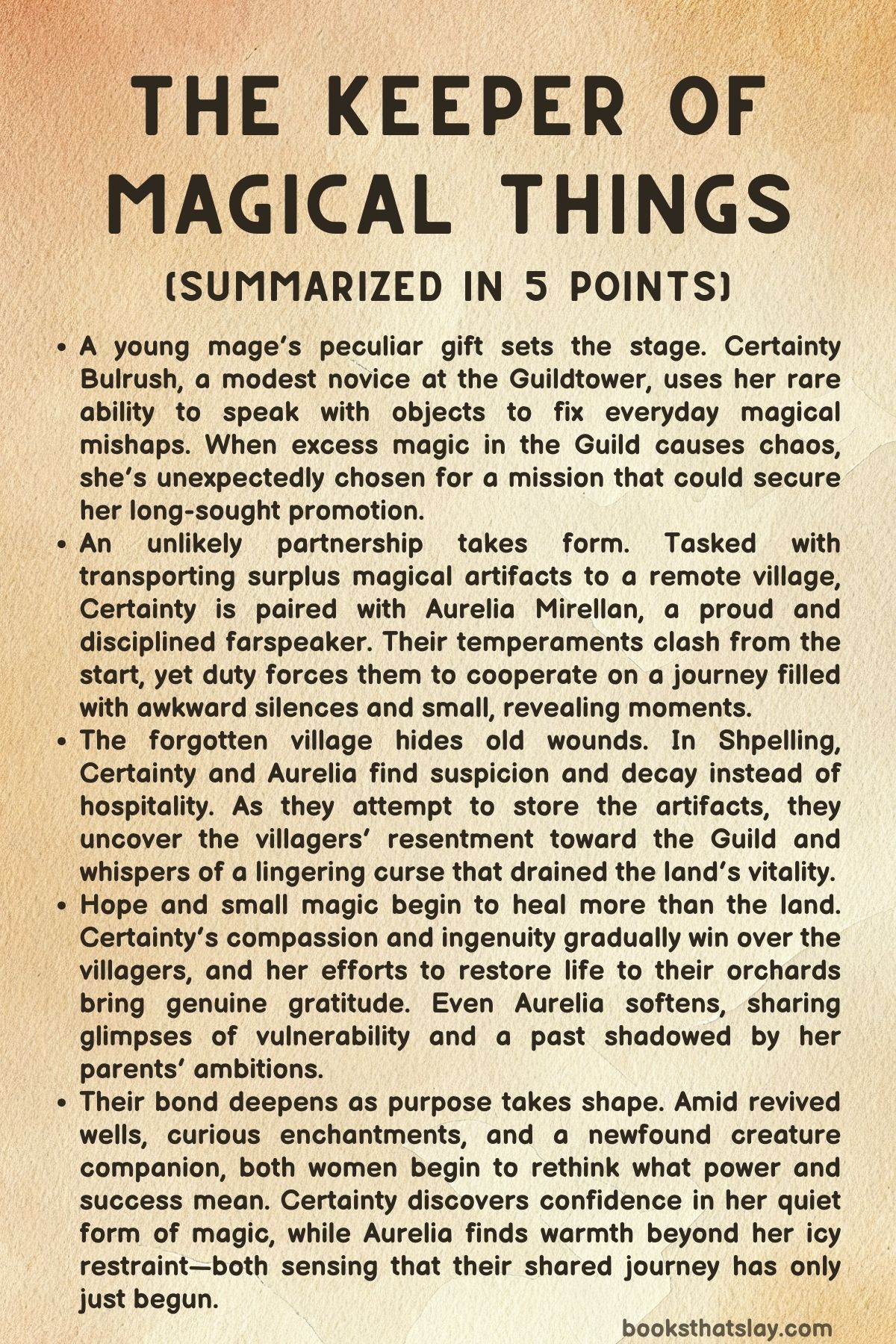
Certainty Bulrush, a sixth-year novice at the Guildtower, has one modest magical ability—she can talk to objects. While others conjure storms or mend bones, Certainty spends her days coaxing stains from linens and listening to the chatter of enchanted tools.
Her life takes a strange turn when a burst of “extra magic” shakes the Guildtower, transforming the kitchen staff into vegetables and causing magical chaos throughout the halls. Investigation reveals that the Guild’s overcrowded vaults are leaking energy from stockpiled artifacts.
To solve the problem, High Mage Melea assigns Certainty a peculiar mission: she must relocate a batch of lesser magical items to the distant, non-magical village of Shpelling. The task seems simple but offers Certainty a rare chance to prove her worth—and perhaps finally earn her magehood.
To assist her, Melea assigns Mage Aurelia Mirellan, a talented farspeaker whose brilliance is matched only by her frosty temperament. Their first encounters are tense: Aurelia sees the assignment as beneath her, while Certainty, awkward and earnest, tries to befriend her.
Despite their differences, they set off in two enchanted wagons loaded with relics, guided by magic along the road to Shpelling. Along the journey, Certainty’s gift draws Aurelia’s curiosity.
When Certainty demonstrates her power by reading Aurelia’s pendant, she is overwhelmed by whispers of doubt and disapproval—echoes of Aurelia’s inner turmoil. The experience unsettles both, revealing glimpses of Aurelia’s hidden pain beneath her perfection.
Upon reaching Shpelling, they find a decaying village and villagers wary of mages. The innkeeper Gertha, barkeep Ferdinand, and others treat them with suspicion, viewing the Guild as a distant, indifferent power.
Their assigned lodgings are a crumbling stable, and even the local secretary, Tobias, mocks their presence. Still, the two mages begin their work: Aurelia repairs the building with precision, while Certainty catalogs the magical objects.
When villagers complain of failing crops and a long-dry well, Certainty feels compelled to help, despite Aurelia’s insistence that they must focus on Guild duties. Using an old bee-summoning wand, Certainty secretly revives a villager’s orchard, earning gratitude—and the first stirrings of pride in her ability.
Gradually, Shpelling changes. Certainty’s quiet compassion wins the villagers’ trust, and even Aurelia begins to soften.
Together, they restore the town’s well by combining an enchanted battering ram and a giant pike, cleverly using magic to pierce the earth and release water. Their success turns them into local heroes.
Strange phenomena follow: crops flourish overnight, livestock behave oddly, and wild magic stirs. Amid the growing warmth of the village, a winged “catdragon” appears, which they name Hope.
The creature’s playful presence cements their bond with Shpelling and with each other.
As the Spring Fair approaches, Aurelia and Certainty’s relationship deepens. They share small moments of laughter and honesty, revealing past wounds—Aurelia’s strict upbringing and parental rejection, and Certainty’s lifelong struggle to feel adequate among stronger mages.
When a letter from Certainty’s father arrives, full of pride and love, Aurelia confides her own parents see her as a failure. One evening, their unspoken closeness culminates in a kiss—an admission of affection neither expected.
Yet their peace is soon disrupted. During a trip to a nearby town, Aurelia encounters Scholar Yorvick, a sneering acquaintance who mocks their assignment and threatens to report her to her parents.
His words rekindle Aurelia’s old insecurities. She withdraws emotionally, convincing herself that their work in Shpelling is trivial and that she must return to the Guild to regain respect.
Certainty, hurt but determined, refuses to let that belief diminish the good they’ve done.
Tragedy strikes soon after. An artifact mishap causes a surge of magical energy known as skyfire, damaging the tavern and forcing an inquiry by the Guild.
Aurelia is taken away by her influential parents, while Certainty is blamed for negligence. Disheartened, she returns home to Potshire, where her family’s love begins to restore her confidence.
Yet rumors reach her that Aurelia has signed a statement condemning her. Despite heartbreak, Certainty cannot believe Aurelia would betray her willingly.
She writes letters seeking answers but receives none. When her hearing is announced, she resolves to face it head-on.
At the Guildtower, Certainty stands trial before High Mage Melea, the magistrate, and Tobias—now her accuser. Tobias presents evidence portraying Certainty as careless, citing her use of artifacts for mundane village tasks and the keeping of Hope as a “dangerous beast.” Just as she prepares to accept expulsion, the villagers of Shpelling arrive.
One by one, they testify to her kindness and the miracles she performed: Hull’s revived orchard, the restored well, the bakery saved by Hope’s rodent-catching, and the spirit of the community she helped rebuild. Their voices sway the court, but Tobias remains adamant.
Suddenly, Certainty’s lingering headaches erupt into a burst of farspeech—Aurelia’s voice calling her name. Moments later, Aurelia bursts into the hall, disheveled but resolute, holding documents that expose Tobias’s deceit.
She reveals he caused the skyfire himself, manipulating records to ruin Certainty. With clever questioning from Melea and Aurelia’s evidence, Tobias is caught and confesses in anger.
The court absolves Certainty of all charges, reinstates her standing, and acknowledges the villagers’ support.
In the aftermath, Melea meets the two mages privately. She admits Aurelia’s parents tried to protect their reputation by scapegoating Certainty and commends both women for their integrity.
Certainty earns her mage circles at last and is appointed Deputy Keeper of the vaults. Aurelia’s farspeaking returns, her connection to Certainty now restored.
Offered a high post as the Queen’s farspeaker, Aurelia instead proposes creating a public library of magical artifacts—a place where knowledge and magic can be shared freely. Melea agrees to consider the plan, recognizing its political promise.
In the closing chapters, the vision becomes reality. Months later, the Royal Library of Minorly Magical Artifacts opens its doors.
Certainty oversees operations with the same care she once gave laundry duty, helping citizens find practical uses for forgotten enchantments. Aurelia visits daily, often with Hope draped around her shoulders, and their partnership—personal and professional—thrives.
Together, they transform the Guild’s cold hierarchy into something more human and hopeful. The novel ends where it began—with Certainty speaking to the objects around her—but now, her voice carries authority, confidence, and the quiet joy of someone who finally belongs.
Characters
Certainty Bulrush
Certainty Bulrush stands at the heart of The Keeper of Magical Things, embodying humility, perseverance, and emotional intelligence in a world where raw magical power defines one’s worth. A sixth-year novice mage with the modest talent of communicating with objects, Certainty begins her journey as an underdog within the Guildtower.
Her magic—dismissed by others as trivial—becomes a metaphor for empathy and understanding, qualities that eventually elevate her above those who rely solely on might or prestige. Through her assignment to transport surplus magical artifacts, Certainty grows from an insecure apprentice into a figure of quiet strength and conviction.
Her ability to listen—to both people and enchanted objects—reveals her compassion and resourcefulness. Even when she faces injustice and betrayal, particularly during her Guild hearing, she never abandons her integrity or kindness.
By the novel’s conclusion, Certainty emerges not just as a mage but as a leader who bridges the magical and non-magical worlds, creating harmony where arrogance once reigned.
Aurelia Mirellan
Aurelia Mirellan serves as Certainty’s foil and eventual counterpart. A gifted farspeaker known for her aloofness and rigid self-control, Aurelia initially represents the elitism and emotional repression fostered by the Guild’s culture.
Raised by powerful, status-conscious parents, she masks her vulnerability behind intellect and discipline. Her early disdain for the mission to Shpelling and her condescending attitude toward Certainty expose her insecurities—chiefly her fear of inadequacy and her need for approval.
Yet, through her partnership with Certainty, Aurelia slowly learns to value empathy and authenticity over perfection. The relationship between the two women evolves from reluctant cooperation to deep emotional intimacy, culminating in love that challenges both social norms and institutional rigidity.
By the novel’s end, Aurelia’s transformation is profound: she rejects political advancement for a purpose-driven vision—the creation of the Royal Library of Magical Artifacts. In doing so, she reclaims her agency and redefines what it means to be a mage guided by conscience rather than ambition.
High Mage Melea
High Mage Melea is a figure of authority and wisdom, representing the Guild’s balance between tradition and progress. Though initially stern and pragmatic, Melea’s actions suggest a nuanced understanding of human nature.
Her decision to assign Certainty a seemingly menial yet vital task reflects her belief in unconventional talent. Melea acts as both mentor and moral compass, testing her subordinates’ resilience while quietly advocating for reform within the Guild’s hierarchical structure.
Her subtle manipulation of the hearing’s proceedings—especially her bluff with Tobias’s “magical signature test”—reveals her strategic brilliance and compassion. She sees the potential for a new generation of mages like Certainty and Aurelia to reshape the Guild’s relationship with the world beyond its towers.
Mage Mortimer
Mage Mortimer, the anxious Keeper of the Vaults, offers comic relief but also thematic depth to the story. His nervous disposition and obsession with order mask a genuine dedication to his craft.
Mortimer’s interactions with Certainty underscore the Guild’s bureaucratic dysfunction—hoarded artifacts, unsafe storage, and fear-driven management. Yet he also becomes a symbol of overlooked competence, mirroring Certainty’s own struggle for recognition.
By the end, his acceptance of Certainty as Deputy Keeper signals a generational shift toward inclusivity and trust in new approaches to magic.
Gertha
Gertha, the formidable matriarch of Shpelling, embodies the skepticism and resilience of common folk in the face of magical institutions. Initially brusque and distrustful of the mages, she gradually warms to Certainty’s sincerity.
Her transformation from cynic to ally mirrors the novel’s larger theme of reconciliation between magic and everyday life. Gertha’s sharp tongue and practical wisdom provide grounding for the story’s magical excesses.
In standing up for Certainty during the Guild hearing, she demonstrates that courage and moral clarity are not confined to those with magical gifts.
Tobias
Lord Godfrey’s secretary, Tobias, serves as the novel’s primary antagonist. His bitterness toward the Guild and manipulative tendencies stem from his own failed magical potential.
Jealousy and resentment drive him to sabotage the Shpelling mission, culminating in the skyfire incident and his deceitful attempt to frame Certainty. Tobias personifies the destructive side of ambition—the hunger for validation turned to vengeance.
Yet his exposure and downfall ultimately reinforce the book’s moral center: that true power lies not in domination but in honesty, empathy, and collaboration.
Hope
Hope, the winged catdragon adopted by Certainty and Aurelia, functions as both a literal and symbolic embodiment of renewal. Initially a mischievous creature drawn to warmth and sweetness, Hope evolves into a beloved companion whose presence bridges human and magical realms.
Her name and nature encapsulate the story’s emotional heartbeat—hope born from kindness, curiosity, and the courage to nurture what others would discard. Through Hope, the narrative celebrates small, magical wonders that restore balance to a weary world.
Ferdinand, Hull, Orrin, and the People of Shpelling
The villagers of Shpelling form the emotional and moral backbone of The Keeper of Magical Things. Each embodies a facet of rural endurance: Ferdinand’s pride and storytelling, Hull’s quiet hope, and young Orrin’s dreams of a better future.
Their interactions with Certainty and Aurelia reveal how ordinary lives are touched—and sometimes healed—by acts of small magic. In standing by Certainty during her trial, they redefine what community and gratitude mean in a world stratified by magical privilege.
Their voices, once dismissed as provincial, become the decisive force that restores justice and inspires systemic change.
Themes
The Nature of Power and Humility
In The Keeper of Magical Things, the narrative consistently contrasts different understandings of power—its possession, expression, and restraint. Through Certainty Bulrush, power is redefined as empathy and dialogue rather than dominance.
Her ability to “speak” with objects, viewed as trivial by her peers, ultimately becomes a model for a more harmonious and responsible magic. The Guildtower represents institutional authority that values spectacle and measurable potency, while Certainty’s quiet magic depends on listening and understanding.
This opposition exposes how arrogance and hierarchy often blind powerful institutions to subtle forms of wisdom. Aurelia’s transformation from a rigid, perfection-obsessed mage into someone capable of admitting vulnerability mirrors the same journey: learning that mastery without compassion leads to isolation.
The villagers of Shpelling, stripped of magic yet full of resourcefulness, further challenge the Guild’s monopoly on power, proving that strength can emerge from collaboration and care. When the artifacts begin to overflow and chaos ensues, it symbolizes how unbalanced, hoarded magic corrupts its own keepers.
True mastery, the book suggests, requires humility—the recognition that power must serve rather than subjugate. Certainty’s eventual promotion as Deputy Keeper, not for her destructive capacity but for her ability to understand and restore balance, reinforces this moral center.
Power, in Julie Leong’s vision, becomes meaningful only when guided by empathy and self-restraint, revealing that humility is the highest form of strength.
Class, Privilege, and the Value of Ordinary Lives
The divide between the lofty Guild mages and the struggling villagers of Shpelling highlights the theme of social stratification. The Guild, with its rituals and ranks, treats magic as a commodity—measured, classified, and hoarded by the elite.
Certainty’s background as a farmer’s daughter positions her as an outsider within that system, someone whose worth is questioned because her origins do not align with the aristocratic norms of magehood. Her journey to Shpelling becomes an act of reconciliation between the magical and the mundane worlds, showing that magic divorced from common life loses its meaning.
Through Shpelling’s residents—Gertha, Ferdinand, and Hull—the story illustrates the quiet dignity of work, perseverance, and local wisdom, qualities dismissed by the urban Guild. Aurelia’s disdain for “rustics” and her gradual softening expose the fragility of privilege; her education and birthright shield her from hardship but also deprive her of connection.
When the mages restore the village well and revive the orchards, their success is measured not by spectacle but by nourishment and renewal. The villagers’ testimony during Certainty’s trial—offering apples, bread, and dandelions as proof of her good—underscores the moral that everyday labor and kindness possess transformative power.
Julie Leong dismantles the illusion of meritocracy within magical hierarchies, revealing that true worth emerges not from lineage or title but from one’s willingness to serve others selflessly.
Identity, Self-Doubt, and the Search for Belonging
Certainty’s name itself encapsulates her inner conflict: she lives under the weight of a virtue she does not feel. Her repeated failures in the Guild’s trials and her modest magical talent leave her trapped between worlds—too gifted to live as a commoner, yet too limited to thrive as a mage.
The story becomes a meditation on self-acceptance, tracing her evolution from insecurity to quiet confidence. Her ability to converse with objects is symbolic of her relational nature: she listens, negotiates, and empathizes, qualities that mirror her personal struggle to be heard within the Guild.
Aurelia’s journey parallels hers—though she outwardly embodies perfection, she is haunted by her parents’ disapproval and her own emotional repression. Their growing bond is a mutual act of recognition; each sees in the other the reflection of unacknowledged pain.
The love that develops between them defies institutional and familial expectations, becoming a sanctuary where vulnerability is no longer weakness. Certainty’s confrontation with betrayal and her ultimate vindication in the Guild hearing complete this arc.
By choosing integrity over ambition, she earns belonging not through conformity but authenticity. The closing image of the Royal Library—where ordinary people can access minor magical artifacts—serves as a metaphor for inclusive identity: a space where every form of magic, no matter how small, has a rightful place.
Redemption, Reconciliation, and the Healing of Divides
Throughout The Keeper of Magical Things, healing takes both literal and symbolic forms. From restoring Shpelling’s water supply to mending broken relationships, the narrative insists that repair is a moral act.
The partnership between Certainty and Aurelia transforms from mistrust to affection, embodying the possibility of reconciliation between difference—class, temperament, and ideology. Similarly, the villagers’ skepticism toward the Guild softens as they witness genuine help untainted by arrogance.
Even Aurelia’s eventual defiance of her manipulative parents reflects the redemptive power of love and moral courage. The Guild itself, initially depicted as rigid and bureaucratic, begins to evolve under the influence of figures like High Mage Melea, who recognizes the need for compassion within governance.
Certainty’s clearing at the trial and her reinstatement as a mage symbolize the restoration of justice in a flawed system. Redemption here is not achieved through grand gestures but through small, sustained acts of goodness—mending a roof, tending a beehive, or teaching a friend to listen.
The establishment of the Royal Library of Minorly Magical Artifacts at the end signifies institutional healing: magic is no longer hoarded but shared, and knowledge becomes a bridge between the powerful and the powerless. Leong frames redemption not as erasure of the past but as its transformation into understanding, turning pain into purpose and failure into wisdom.
Love as Transformation
The relationship between Certainty and Aurelia functions as the emotional core of the narrative, illustrating how love—romantic, platonic, and communal—acts as a catalyst for change. Their bond begins amid distrust and hierarchy but evolves through shared labor, vulnerability, and courage.
Each teaches the other a vital lesson: Aurelia learns empathy and humility, while Certainty learns confidence and self-worth. Their affection is not portrayed as idealized passion but as patient understanding, grounded in mutual respect and the daily act of choosing to care.
Around them, smaller forms of love also sustain the story—the villagers’ affection for their home, Melea’s stern mentorship, and Certainty’s family’s unconditional acceptance. Even Hope, the catdragon, becomes a symbol of joy and companionship that brings people together.
The narrative treats love not as distraction from duty but as its fulfillment, arguing that genuine connection gives purpose to all creation, magical or otherwise. By the novel’s conclusion, love reshapes not only personal lives but institutions: the Royal Library becomes the living embodiment of their shared vision of openness and care.
Through this, Leong suggests that love, in its broadest sense, is the most transformative force of all—capable of restoring trust, healing divisions, and redefining what it means to wield magic with grace.