The Kill Clause Summary, Characters and Themes
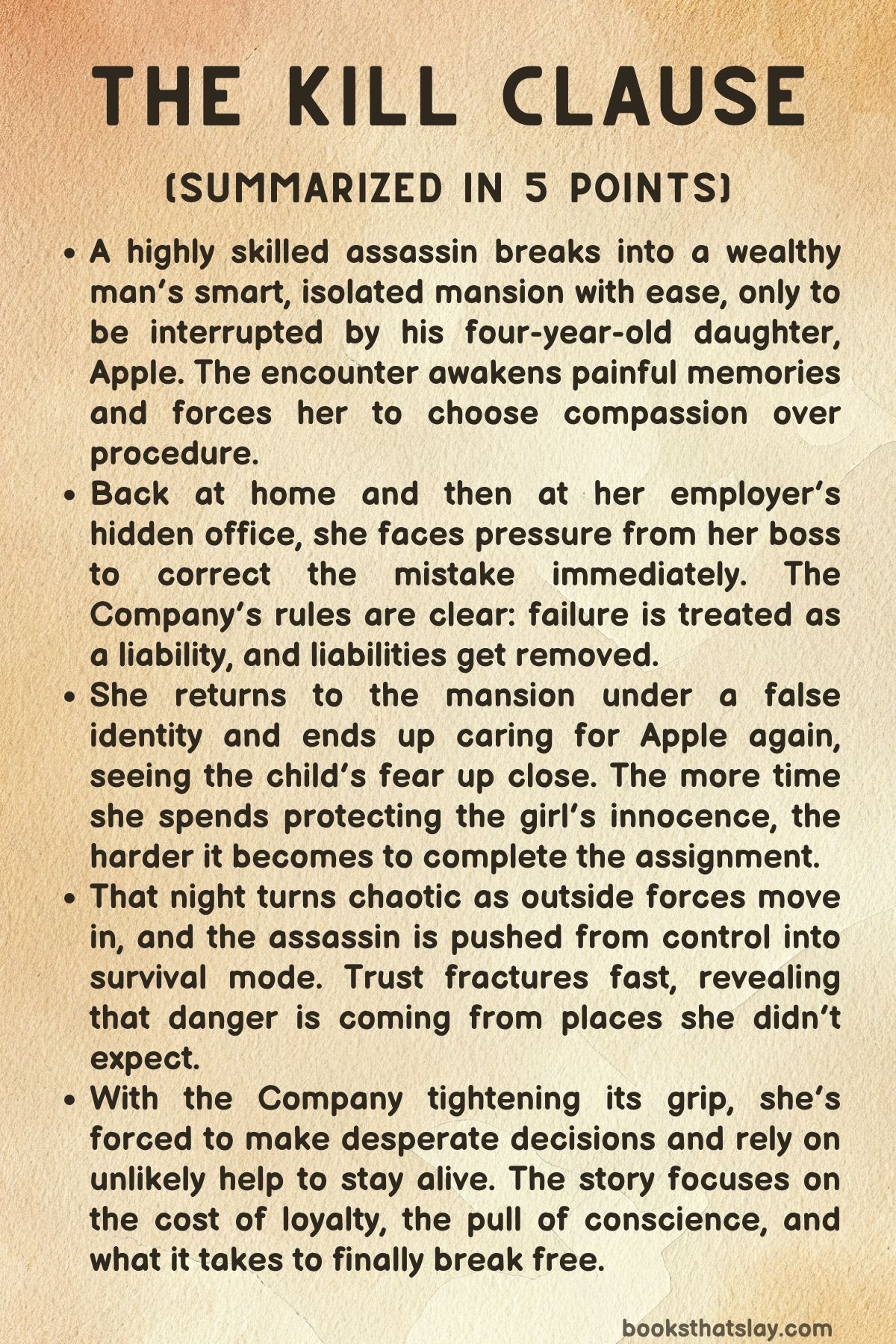
The Kill Clause by Lisa Unger is a fast-paced psychological thriller about a professional assassin who begins to question the violent life she has built. The story follows Paige, a highly trained operative working for a secret organization that carries out dangerous “solutions” for powerful clients.
Paige has spent years believing in the mission of the Company and in the authority of its leader, Nora. But when a job involving a wealthy man and his young daughter goes wrong, Paige’s moral boundaries begin to surface. As she struggles with guilt, loyalty, and survival, she discovers that the organization she trusted may already have decided that she must die.
Summary
The story centers on Paige, a skilled assassin who works for a covert organization known simply as the Company. The Company carries out operations for powerful clients, eliminating people or creating scandals when necessary.
Its leader, Nora, recruits damaged young people with exceptional abilities and trains them to become highly efficient operatives. Paige was one of those recruits.
After a traumatic childhood marked by violence and the murder of her mother by her father, she grew up in foster care and eventually found purpose under Nora’s guidance. Nora trained her in combat, weapons, hacking, and infiltration, shaping her into one of the Company’s most capable agents.
The novel begins with Paige breaking into the home of a wealthy hedge fund manager named Bryce. Her assignment is to kill him.
She has carefully planned the entry, bypassing security and moving silently through the house. Bryce is asleep in his bedroom.
Paige prepares to kill him with an ice pick, a method that is quick and quiet.
Just as she is about to complete the job, Bryce’s young daughter Apple appears in the doorway. The child has woken up from a nightmare and asks for water.
Paige is immediately shaken by the unexpected witness. Apple’s presence reminds Paige of her own childhood and the trauma she endured while hiding in a closet as her father murdered her mother.
Instead of continuing with the assassination, Paige comforts the girl, brings her water, and puts her back to bed. She then leaves the house without completing the mission.
Paige knows that the Company’s rules are strict and that failing an assignment is dangerous, but she cannot bring herself to kill Bryce while the child is present.
When Paige reports the problem to Nora, she senses tension. Nora reminds her that the Company has clear rules: finish the job within the assigned time and leave no witnesses.
Paige insists she will correct the mistake by returning the next night when Apple will be staying with her mother. Nora allows her another chance, though Paige senses her patience is wearing thin.
Paige’s personal life is complicated. She lives with Drake, another Company operative whom she mentors.
Their relationship is both professional and romantic, though Paige knows it violates the rules. Drake is loyal and methodical, but he follows Nora’s commands without question.
Paige is also haunted by memories of Julian, another assassin she once loved. They met during an early assignment in Las Vegas when they posed as a married couple while eliminating a wealthy pair involved in shady business dealings.
Their chemistry led to a secret relationship that lasted for years. However, their moral differences created tension.
Julian treated their work as just a job, while Paige struggled with the human cost of their actions.
As Paige prepares to return to Bryce’s house, she receives strange messages from Julian. He repeatedly calls her and sends a cryptic text containing a knife and a Santa emoji.
Paige does not understand the message at first.
That night she goes back to Bryce’s house intending to finish the assignment. However, Apple is unexpectedly there again.
Her mother has dropped her off for the holiday. Seeing the unhappy child makes Paige realize she cannot kill Bryce while Apple is in the house.
Paige decides she will abandon the mission and run away from the Company instead. She knows Nora will consider her a liability and will likely order her death.
While she is putting Apple to bed and preparing to leave, a gunshot suddenly rings out. Bryce has already been killed.
A sniper outside the house begins shooting through the windows. Paige grabs Bryce’s gun and hides with Apple in a closet.
The attacker enters the house. Paige prepares to fight, but when the intruder comes into the room she realizes it is Drake.
Drake has been sent by Nora to eliminate Paige after her repeated failures. In a violent struggle he overpowers her and begins strangling her.
Apple witnesses the confrontation from the closet and runs away while Paige fights for her life.
Just as Drake is about to kill Paige, another gunshot rings out. Julian appears and shoots Drake, saving Paige.
Julian reveals that Nora had activated the “kill clause,” a secret rule in their contracts allowing the Company to eliminate any operative who becomes a risk. He was originally assigned to kill Paige but refused and came to warn her.
Paige and Julian escape together, leaving the scene before the police arrive. Apple is found alive by authorities, and the media reports Bryce’s death as a home invasion.
The two fugitives drive to a remote safe house Paige owns in the snowy wilderness. They know Nora will hunt them down, but for the moment they have a chance to plan.
Julian reveals he has kept journals detailing the Company’s operations, which could expose Nora if necessary.
Their hope is to use this information as leverage to secure their freedom. However, Nora soon finds them.
She arrives at the cabin with armed agents and confronts them directly. Nora claims Paige and Julian have outlived their usefulness and cannot be allowed to walk away with what they know.
A violent attack follows. Explosions destroy the cabin as Paige and Julian escape through a hidden tunnel leading away from the property.
They run through the forest while Nora’s agents pursue them.
Eventually they are surrounded and forced to surrender. Nora appears ready to execute them both.
At the last moment, Buz, Nora’s longtime associate, suddenly shoots Nora. He announces that the Company is now under new leadership and that Paige and Julian are being released from service.
The operatives surrounding them disappear into the woods.
Buz warns them that their nondisclosure agreements still apply. If they reveal the Company’s secrets, the kill clause will be enforced again.
However, he also gives them a vehicle and money so they can leave and start a new life.
Shaken but alive, Paige and Julian drive away together through falling snow. For the first time in years they are free from the organization that shaped their lives.
Though their future remains uncertain, they finally have the chance to build a life that is not defined by violence and secrecy.
Characters
Paige
Paige is the central character of The Kill Clause, and her story forms the emotional and moral core of the novel. She is a highly trained assassin working for a secretive organization known as the Company.
Paige grew up in a traumatic environment where her father brutally murdered her mother while she hid nearby as a child. This event shaped her entire life, leaving deep psychological scars and a complicated relationship with violence.
When Nora later recruits her from a troubled foster care background, Paige sees the opportunity as a form of rescue and purpose. She becomes an exceptionally capable operative, skilled in combat, infiltration, and surveillance.
However, unlike many of her colleagues, Paige never becomes completely numb to the moral weight of killing.
What defines Paige most strongly is the conflict between the ruthless professional she has been trained to be and the empathy she cannot erase. Over time she begins to question the work she does and the ideology Nora promotes.
Her hesitation to kill Bryce when his daughter Apple appears shows that her moral instincts are stronger than the loyalty she feels toward the Company. Paige often reflects on the humanity of the people she targets, which makes every job emotionally complicated for her.
She is introspective and burdened by guilt, constantly examining her actions and motivations. This self-awareness separates her from many of the other operatives who treat their assignments purely as business.
Paige’s emotional complexity also appears in her relationships. She forms a conflicted bond with Drake, mixing mentorship, affection, and attraction.
At the same time she carries unresolved feelings for Julian, the man she once loved and never fully moved on from. Her struggle throughout the story is not only about survival but about reclaiming her own sense of identity.
When she ultimately decides not to complete the assassination of Bryce, she reaches a turning point. That decision places her life in danger but allows her to reclaim a moral boundary she once thought she had lost.
By the end of The Kill Clause, Paige transforms from a loyal operative into someone determined to escape the violent system that shaped her. Her journey represents the possibility of change even after years of participating in darkness.
She moves from being a weapon in someone else’s mission to a person seeking freedom and responsibility for her own life.
Julian
Julian is one of the most important figures in Paige’s life and serves as both a romantic partner and a mirror to her internal conflicts. He is also a Company assassin and, like Paige, was recruited by Nora from a difficult background.
Julian first meets Paige during an early assignment in Las Vegas where they pose as newlyweds while carrying out a lethal mission. Their shared profession and intense circumstances create a powerful connection that quickly becomes romantic.
Unlike Paige, Julian initially appears more comfortable with their work. He treats assassination as a professional task and rarely dwells on the emotional consequences.
His attitude toward killing is pragmatic and detached. He focuses on strategy, efficiency, and survival rather than morality.
This difference becomes one of the main sources of tension in their relationship. Paige feels haunted by the humanity of their targets, while Julian prefers not to think about them as people at all.
Despite this difference, Julian is not as cold as he sometimes appears. His actions later reveal that he does possess deep loyalty and emotional attachment.
When Nora orders him to execute Paige under the kill clause, he refuses to follow through. Instead he tries to warn her and ultimately saves her life by killing Drake during the confrontation at Bryce’s house.
This moment reveals that Julian’s connection to Paige is stronger than his allegiance to the Company.
Julian also demonstrates foresight and survival instinct by secretly documenting the Company’s operations in journals. These records serve as a potential bargaining chip if he ever needs protection from Nora.
This decision shows that he understands the danger of their profession and the possibility that the organization might eventually turn against its own agents.
His character evolves through his renewed relationship with Paige as they flee from the Company. The two rediscover their connection while hiding together, and Julian expresses a desire for a life beyond assassination.
His willingness to risk everything for Paige proves that he is capable of emotional growth and moral reflection. By the end of the story he stands beside her not as a Company operative but as someone hoping to build a different future.
Nora
Nora is the powerful and enigmatic leader of the Company. She is the architect behind the organization’s operations and the person responsible for recruiting and training many of its assassins.
Nora often presents herself as a mentor and protector to the troubled young people she recruits. She finds individuals who have experienced trauma, abandonment, or violence and offers them a sense of belonging, purpose, and financial security.
To recruits like Paige and Julian, Nora initially appears almost like a savior.
However, Nora’s leadership is built on manipulation and control. She shapes her operatives into loyal instruments of the Company’s goals while keeping the true nature of those goals largely hidden.
She insists that their work contributes to progress or justice, but she rarely explains who hires the Company or why certain targets are chosen. The operatives are expected to obey orders without questioning the larger picture.
Nora’s authority relies on strict rules and harsh consequences. The kill clause is the most extreme example of this system.
It allows the Company to eliminate any operative who becomes a liability, whether through mistakes, disobedience, or potential exposure. Nora views her agents as expendable assets whose usefulness eventually expires.
This philosophy reflects her belief that survival in their world requires absolute discipline and emotional detachment.
Even though Nora sometimes speaks to Paige with warmth and claims to see her as a daughter figure, these moments are overshadowed by her willingness to order Paige’s execution. Her relationship with her operatives is therefore deeply contradictory.
She offers guidance and opportunity while simultaneously maintaining total power over their lives and deaths.
Nora’s downfall occurs when Buz ultimately kills her, revealing that her authority was not as secure as it appeared. Her character represents the dangerous blend of charisma, control, and ideology that can shape vulnerable people into tools for a hidden agenda.
Drake
Drake is another Company operative who lives with Paige and works under her mentorship. He is younger than Paige and shares a similar background of instability and hardship.
Nora recruited him from the foster care system, recognizing his natural talent with firearms and combat skills. Drake sees the Company as a structure that gave him purpose, stability, and belonging.
Drake’s personality is disciplined and methodical. He follows instructions carefully and rarely questions the orders given by Nora.
Unlike Paige, he does not openly struggle with the ethical implications of their work. His focus remains on performing his assignments efficiently and proving himself as a reliable operative.
This obedience makes him valuable to the Company but also makes him vulnerable to manipulation.
His relationship with Paige is complicated because it combines mentorship, partnership, and romance. Paige cares about him and often tries to guide him, but there is always an imbalance of experience and authority between them.
Drake admires her and looks up to her as both a teacher and a partner.
When Nora orders Drake to eliminate Paige after her failure to complete the Bryce mission, he carries out the command without hesitation. This moment reveals how deeply he has internalized the Company’s rules.
He treats the assignment as a necessary duty rather than a personal betrayal. During the confrontation at Bryce’s house, Drake’s emotional detachment becomes clear as he attempts to kill Paige without remorse.
His death at Julian’s hands marks the tragic end of a character who never managed to step outside the system that shaped him. Drake represents what Paige might have become if she had completely suppressed her doubts and empathy.
Buz
Buz is Nora’s long-time associate and the operational backbone of the Company. He plays the role of enforcer, trainer, and coordinator for many of the organization’s activities.
Physically imposing and emotionally reserved, Buz initially appears to be one of Nora’s most loyal supporters.
However, Buz also shows moments of quiet concern for Paige throughout the story. During training and operations he sometimes acts as a stabilizing presence who helps recruits recover from mistakes or emotional strain.
His behavior suggests that he understands the harshness of Nora’s system even while continuing to serve within it.
The most significant revelation about Buz occurs near the end of the story. When Nora prepares to execute Paige and Julian, Buz unexpectedly turns his weapon on Nora and kills her.
He then announces that the Company is now under new management and releases the two fugitives from service. His actions indicate that he has his own vision for how the organization should operate.
Buz’s motivations remain somewhat mysterious. He may have grown tired of Nora’s extreme control or decided that Paige and Julian deserved a chance at freedom.
His final gesture of providing them with a vehicle and money suggests a quiet sympathy that contrasts with the ruthless environment of the Company.
Apple
Apple is the young daughter of Bryce and serves as one of the most important moral catalysts in the story. She is only four years old and represents innocence within a world dominated by manipulation and violence.
Apple’s unexpected appearance during Paige’s assassination attempt forces Paige to confront the human consequences of her actions.
The child’s presence triggers Paige’s memories of her own traumatic childhood. Seeing Apple alone and vulnerable reminds Paige of the moment she witnessed her mother’s death.
This emotional connection becomes the reason Paige refuses to complete the assignment. Apple therefore becomes the turning point that pushes Paige toward rebellion against the Company.
Throughout the story Apple is portrayed as gentle, trusting, and emotionally neglected by her parents. Despite her young age, she senses tension around her and seeks comfort from the adults nearby.
Her interactions with Paige are simple and sincere, which contrasts sharply with the deception and secrecy surrounding the assassins.
Although Apple plays a relatively small role in terms of screen time, her impact on the narrative is enormous. She represents the innocence that Paige ultimately chooses to protect rather than destroy.
Bryce
Bryce is the hedge fund manager targeted by Paige in the opening events of the story. He represents the type of wealthy client or victim frequently involved in the Company’s operations.
Bryce lives in a luxurious house and appears to enjoy a life of privilege and excess.
Despite his wealth and status, Bryce is portrayed as a flawed and somewhat careless individual. His parenting is inconsistent, and he often prioritizes his own comfort over the emotional needs of his daughter.
His reliance on sleeping medication and his inattentiveness to Apple suggest that he is not fully aware of the responsibilities that come with being a parent.
Bryce’s role in the story is less about his personal characteristics and more about the situation he creates. His presence as the target sets the entire chain of events in motion.
When Paige refuses to kill him because of Apple, the Company’s reaction leads to betrayal, violence, and ultimately Paige’s escape.
Bryce ultimately dies when another assassin kills him before Paige can complete the mission. His death underscores the brutal reality of the world these operatives inhabit, where individuals can become disposable pieces in a larger game controlled by unseen forces.
Themes
Moral Conflict and the Weight of Violence
Violence in The Kill Clause is not presented simply as action or spectacle but as a moral burden carried by the characters, especially Paige. Her role as a professional assassin forces her into situations where the line between duty and conscience becomes increasingly difficult to maintain.
Although she has been trained to eliminate targets efficiently, she never fully accepts the emotional consequences of these acts. Each assignment carries psychological weight, reminding her that the people she kills are not just names in a file but individuals with families and lives.
This tension becomes most visible when she refuses to kill Bryce in front of his daughter Apple. The moment forces Paige to confront a truth she has long tried to suppress: that even in a system built on orders and rules, personal responsibility still exists.
Paige’s internal struggle highlights how long-term exposure to violence can erode a person’s sense of identity. She often reflects on her past and questions whether she has become the very kind of person she once feared.
The Company encourages its operatives to view targets as problems to be solved rather than human beings. Paige resists this idea, which makes her emotionally vulnerable but also morally aware.
Her reactions contrast sharply with characters like Drake, who treat assignments as routine tasks without questioning their implications.
The novel uses this conflict to explore the psychological cost of living in a world where killing is normalized. Paige’s hesitation is not weakness but evidence that her humanity remains intact.
Her eventual decision to abandon the mission and risk her life rather than continue following orders marks a turning point. The theme suggests that even people who have participated in violence can reach a moment when conscience overrides obedience.
That realization becomes the first step toward reclaiming a moral identity.
Power, Control, and Manipulation
The structure of the Company illustrates how power can be maintained through secrecy, fear, and manipulation. Nora stands at the center of this system, presenting herself as a mentor who rescues vulnerable young people and gives them purpose.
Many recruits, including Paige, initially view her as a savior because she offers stability and belonging after difficult childhoods. However, this relationship is built on control rather than genuine care.
Nora deliberately selects individuals who feel isolated or indebted so that their loyalty will remain unquestioned.
Control within the Company is reinforced through strict rules and the constant threat of punishment. The most extreme example is the kill clause, which allows the organization to eliminate its own operatives if they become liabilities.
This rule ensures that members remain obedient, because failure or disobedience could result in death. The system also prevents operatives from leaving the organization voluntarily, effectively trapping them within its structure.
Nora’s leadership style demonstrates how authority can be disguised as mentorship. She offers encouragement and guidance while withholding crucial information about the organization’s true goals.
Operatives are taught to trust her judgment without asking questions. This dynamic creates a hierarchy in which knowledge equals power.
The fewer details agents know about the larger mission, the easier it becomes to control them.
The eventual betrayal of Paige reveals the reality behind Nora’s promises. Despite claiming that Paige is like a daughter to her, Nora quickly orders her execution once she becomes inconvenient.
This shift exposes the transactional nature of Nora’s relationships. Loyalty is valued only as long as it serves the Company’s interests.
Through this structure, the story examines how systems built on secrecy and authority can manipulate individuals into sacrificing their autonomy and morality.
Trauma and the Long Shadow of the Past
The past plays a powerful role in shaping the motivations and behavior of the characters. Paige’s childhood trauma becomes the foundation of her emotional world.
Witnessing her father murder her mother left deep psychological wounds that influence how she views violence, safety, and relationships. The memory of that moment remains vivid in her mind and resurfaces whenever she encounters situations involving vulnerable children or abusive authority figures.
This trauma also explains why Nora’s recruitment was so effective. After years of instability in foster care, Paige was searching for protection and direction.
Nora’s training program provided both, creating a sense of belonging that Paige had never experienced before. The Company became a replacement for the family she lost.
However, the same environment that offered structure also reinforced the cycle of violence she was trying to escape.
The story shows how trauma can shape a person’s identity in complex ways. Paige becomes highly skilled at fighting and surviving, yet she continues to carry emotional scars that affect her decisions.
Her reaction to Apple illustrates how unresolved memories can influence present choices. The child’s presence forces Paige to confront the younger version of herself who once hid in fear during a violent attack.
Protecting Apple becomes a symbolic attempt to protect that frightened child she once was.
Other characters share similar histories. Julian and Drake also come from backgrounds marked by instability and hardship.
Nora intentionally recruits people with painful pasts because they are easier to mold into loyal operatives. This pattern reveals how trauma can be exploited by powerful figures who promise purpose and belonging.
The story ultimately suggests that healing requires confronting the past rather than allowing it to dictate the future.
Freedom, Identity, and the Possibility of Change
A central question running through The Kill Clause is whether people who have spent years living in violence can truly escape and redefine themselves. Paige and Julian both struggle with the idea that their past actions might permanently define who they are.
Their profession has required them to hide behind false identities, follow strict orders, and suppress personal desires. Over time this lifestyle blurs the boundary between the roles they perform and their true selves.
The desire for freedom becomes stronger as Paige begins to question the Company’s authority. Her refusal to complete Bryce’s assassination marks the first step toward breaking away from Nora’s control.
However, leaving the organization is not as simple as walking away. The existence of the kill clause means that the Company will treat any attempt at independence as a threat.
Paige and Julian must therefore confront the reality that freedom might require risking their lives.
Their relationship becomes an important symbol of this search for identity. When they worked together as operatives, their connection was shaped by secrecy and temporary meetings after assignments.
Even their marriage in Las Vegas began as part of a cover story. As they run from the Company, they begin to imagine a life where their choices are not dictated by orders.
The possibility of building a normal existence together represents a chance to reclaim control over their own futures.
The ending suggests that change is possible, though it does not erase the past. Paige and Julian cannot undo the actions they have taken or the lives that were lost during their years as assassins.
What they can do is choose a different path moving forward. Their escape from the Company creates an uncertain but hopeful future where they can attempt to live without being defined solely by violence.
The theme emphasizes that identity is not fixed; it can evolve when individuals choose to confront their past and pursue a different life.