The Killing Stones Summary, Characters and Themes
The Killing Stones by Ann Cleeves is a return to the world of Detective Jimmy Perez, now settled in Orkney after years of cases in Shetland. Set against midwinter storms, the novel uses the islands’ tight-knit communities and ancient history to frame a modern tragedy.
When Perez’s oldest friend, farmer Archie Stout, disappears on Westray and is soon found murdered with a carved Neolithic “story stone,” the death cuts through personal bonds and island life. With Perez shaken by loss and Detective Willow Reeves leading parts of the inquiry, the case opens into buried rivalries, stolen scholarship, and a family secret that turns fatal.
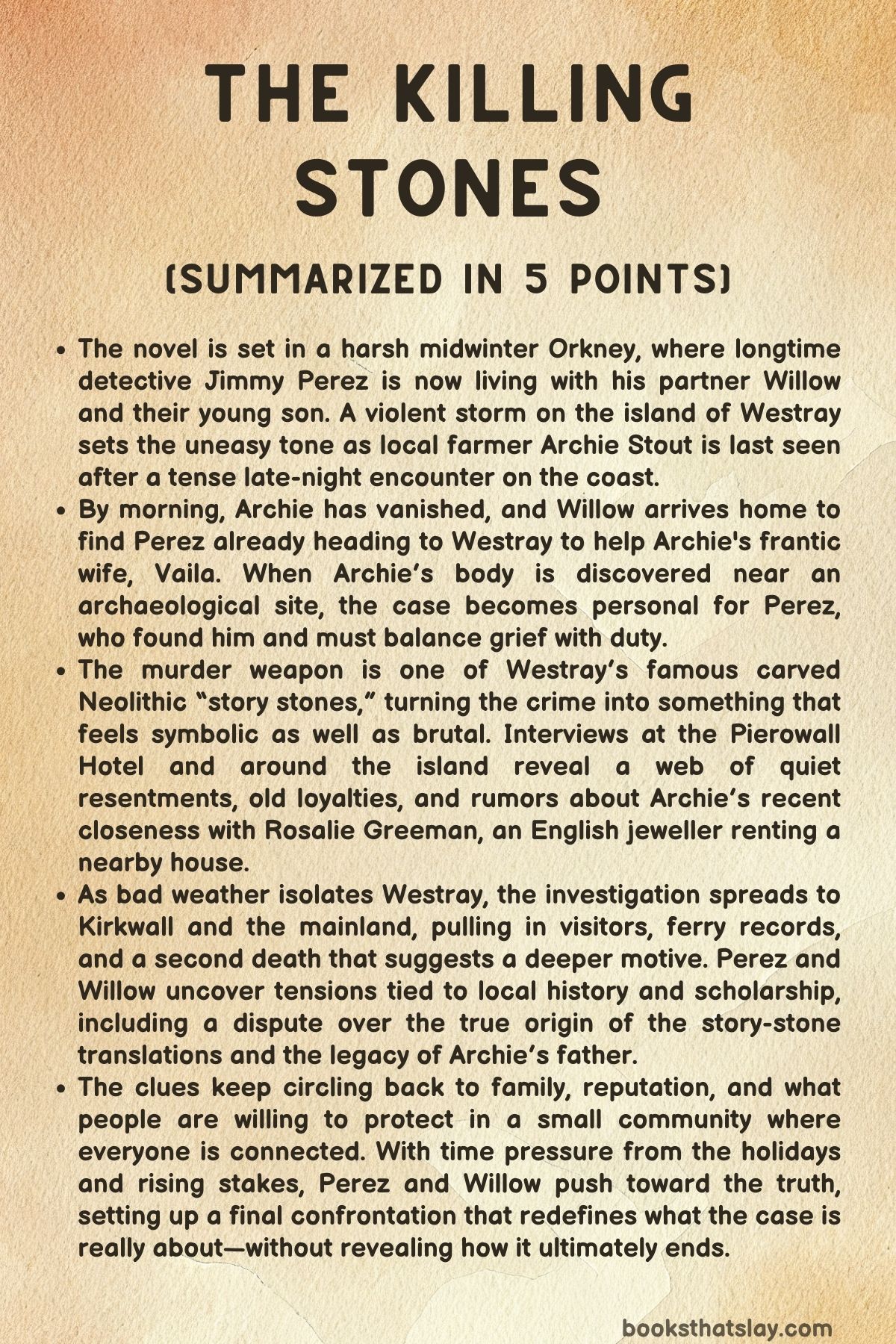
Summary
A fierce winter gale batters Orkney when Archie Stout walks the Westray coastline late at night, angry after a tense encounter with someone who slips away into the dark. Archie is usually steady and rooted in island life, but this evening he feels trapped by a problem he cannot solve alone.
He decides that in the morning he will call his closest friend, Detective Jimmy Perez, for advice. Before he can leave the shore, another light approaches through the storm.
A figure comes close, and when Archie shines his torch on them, he recognizes who it is. His last words are calm but loaded: “Ah.
So it’s you.
The next day, Willow Reeves returns to Orkney from Aberdeen, heavily pregnant and traveling with her young son James. She expects quiet domestic life at the old manse she shares with Perez, but finds a note explaining that Archie has gone missing and that Perez has rushed to Westray to help Archie’s frantic wife, Vaila.
Willow assumes it is a routine emergency, until Perez calls her at dawn, shocked and short of breath. Archie’s body has been found near the Links of Noltland, close to an exposed archaeological site.
The death is clearly violent, with blunt trauma to the head. Beside him lies the weapon: a carved Neolithic stone, one of Westray’s famous story stones.
Perez admits he discovered Archie himself.
Perez stands guard over the scene in the pale morning light, overwhelmed by grief and memory. Local officers, Sergeant Ellie Shearer and constable Phil Bain, arrive, and Perez goes to Nistaben Farm to tell Vaila.
She is devastated and not yet ready to tell their teenage sons, Lawrie and Iain. She explains Archie’s last day: he was restless, taking calls, heading out to secure the farm against the storm, and later delivering firewood around the island.
He drank a little, ate supper at home, then said he would meet friends at the Pierowall Hotel bar. His car was later found parked nearby, but he never appeared.
Through the night Vaila and islanders searched in the gale before she called Perez.
Dr. James Grieve, brought from Aberdeen, confirms that Archie was killed where he fell, not moved.
The use of a story stone feels deliberate, almost staged, and both stones from the heritage centre are now missing. At the hotel, landlord Bill MacBride and his wife Annie list the guests still on Westray: elderly birdwatcher Godfrey Lansdown, and an English couple, Tony and Barbara Johnson, former archaeology students.
They also share gossip that Archie had grown infatuated with Rosalie Greeman, an English jeweller renting Quoybrae House. When Perez and Willow question Rosalie, she admits a close friendship with Archie and that he seemed troubled when last delivering wood to her, but she insists they were not lovers in the physical sense and that she expected him later that night, in vain.
Because Archie was family to Perez by friendship and history, Willow urges him to step back from the island investigation and work the mainland angle instead. Perez agrees and returns to Kirkwall with Phil to check ferry records for outsiders who might have arrived before the storm.
On Westray, Willow and Ellie continue interviews. Lansdown says he kept to himself during the storm and went to bed early.
The Johnsons explain the story stones’ inscriptions and their academic importance. They say Archie seemed distracted when they saw him that afternoon, and they provide an alibi: they dined early at Hillhead with Vaila’s parents, Tom and Evelyn Angel, leaving when Vaila called to say Archie was missing.
Willow also talks with Archie’s sons. Lawrie is angry and guarded; Iain is younger in spirit and openly grieving.
Nothing they say points clearly to danger, though both confirm Archie had seemed quieter than usual.
The ferry records provide new threads. A mainland schoolteacher, George Riley, traveled to Westray that day and stayed overnight because the storm halted sailings.
Another passenger, Nat Wilkinson, has a troubled past marked by addiction and the childhood trauma of witnessing his father’s drowning, but Nat describes Archie as his protector and employer, not an enemy. Perez tries to find Riley, but learns he has already flown to Inverness.
Then the case widens sharply: George Riley is found dead on Orkney mainland near Maeshowe. The timing suggests a link.
As Perez and Willow compare notes, they realize Archie’s murder weapon and Riley’s island trip may point toward the same conflict.
Perez meets archaeologist Paul Rutherford, who reveals that George had been furious about Tony Johnson, calling him a fraud. Johnson’s celebrated work on the story stones may have stolen material from Magnus Stout, Archie’s late father, who had translated the runes years earlier in private notebooks.
George had planned a children’s history book that would credit Magnus properly and expose Johnson’s theft, and he had been ready to share proof with journalists. Miles Chambers, George’s partner, confirms this: Archie had shown George Magnus’s dated notebooks, and George had carried the originals to Westray for safekeeping.
The notebooks were placed in the heritage centre archive, with George holding the key.
Willow finds the box of notebooks in the centre, locks it away, and returns the next morning to review it before interviewing Johnson. The box is gone.
The Johnsons have checked out at dawn and left on the early ferry. Under pressure, Tom and Evelyn finally confess they gave Vaila’s key to the Johnsons after Tony demanded last-minute access, portraying himself as unfairly targeted.
The theft and flight make the Johnsons prime suspects, and police alert the mainland to intercept them.
Before that happens, Tony Johnson turns up on Orkney mainland, desperate and enraged, confronting Miles Chambers. Tony demands that George’s book be stopped and that his own name be protected.
Miles shuts him out, while Paul Rutherford arrives to support him. Later that night, Tony is found stabbed to death at the Stones of Stenness.
Perez briefly wonders if Miles acted out of revenge, but Miles’s shocked reaction and Paul’s presence that evening weaken the idea.
On Christmas morning, Kirkwall gathers for the boys’ Ba’ game. Islanders from Westray come to support Vaila and her sons.
Vaila asks Willow to stand with her, and Rosalie arrives to offer comfort, the two women sharing grief instead of rivalry. Perez notices Barbara Johnson trying to disappear into the crowd.
Lucy Martindale, George Riley’s head teacher, pulls Perez aside: she has found disturbing emails in George’s school account involving safeguarding concerns about a pupil. The messages point to a hidden scandal, not academic revenge, as George’s real crisis.
The detail Belinda Thorne, a dog-walker, remembered about George’s last day fits the same pattern. Perez and Willow see the shape of the truth and decide they have enough to act.
At the station, Perez interviews Lawrie Stout with Tom Angel present. He lays out the case clearly.
George had uncovered that Lawrie had been grooming hostel girls, coercing explicit images and using blackmail. George intended to confront Archie quietly and seek family intervention rather than start a public process.
Archie, horrified, confronted Lawrie during the stormy night and threatened to send him away and cut him off from the farm. Lawrie, panicked and furious, followed Archie to Noltland on a quad bike.
Archie was there meeting Tony Johnson about the stolen translations. After Johnson left, Lawrie fought with his father.
Archie turned away in disgust, and Lawrie struck him with the story stone, killing him. He hid traces, moved Archie’s car, and cleaned himself before the search began.
Perez continues, pressing about George Riley’s death. Lawrie admits he went by bus to Maeshowe carrying the second story stone, planning to kill George and make it look like a symbolic attack tied to the runes.
He hit George from behind and concealed the body. Finally, Lawrie explains Tony Johnson’s murder: Tony had seen him at Noltland and later tried to blackmail him into signing over Magnus’s notebooks and keeping silent.
Lawrie met Tony at Stenness and stabbed him, then returned by bus.
With the confession secured, Perez informs Vaila, who collapses under the shock of losing both husband and son to the same violence. Yet she agrees to see Lawrie, even as the reality of prison settles in.
Perez returns home to Willow and their son, drained by grief and resolution. Christmas ends quietly, with the family holding each other close while the islands begin to absorb what happened: a murder born not from strangers or history, but from a boy terrified of shame and a father who could not look away from the truth.
Characters
Detective Jimmy Perez
Jimmy Perez is the emotional and moral center of The Killing Stones, a seasoned detective whose deep roots in the Northern Isles shape the way he investigates and grieves. His friendship with Archie Stout is not just backstory but a living force that complicates the case: Jimmy is both the man tasked with discovering truth and the boy who once depended on Archie’s fearless spirit.
This duality makes him vulnerable, yet also intensely human, as he tries to remain professional while being pulled by loyalty, sorrow, and memory. Perez’s instincts lean toward people over procedure; he reads silences, family rhythms, and island histories as carefully as forensic reports.
His journey through the novel is one of painful recalibration, accepting that intimate knowledge of a community can both illuminate and distort justice, and that love for family and place does not exempt anyone from darkness.
Willow Reeves
Willow Reeves functions as both partner and counterbalance to Perez, bringing pragmatic clarity into a case that threatens to consume him. Heavily pregnant and managing motherhood alongside police work, she embodies steadiness under strain; her competence is quiet but relentless.
Willow sees instantly that Jimmy’s closeness to Archie could unravel the investigation, and she forces hard choices not out of coldness but to protect both the case and Jimmy himself. What makes her compelling is that she is not merely a supporting investigator — she is emotionally invested in Orkney, in their shared home, and in the fragile structure of their family life.
Her interviews are marked by empathy that never slips into indulgence, and her growing suspicion of the respectable and the familiar shows her understanding that island communities can shelter secrets behind politeness. Willow’s presence keeps the narrative grounded in lived reality: pregnancy, weather, domestic routines, and grief all exist alongside murder, not separate from it.
Archie Stout
Archie Stout is the novel’s absent presence — dead early, yet his life and choices radiate through every suspect and motive. A lifelong Orcadian shaped by land and storm, Archie is portrayed as bold, dramatic, and fiercely island-proud, the kind of man who feels ownership not just over his farm but over Westray’s identity.
His warmth is real, especially in the way he protects people like Nat Wilkinson and invests in his family’s future, yet he also carries human faults: restlessness, a tendency toward romantic infatuations, and perhaps a blindness to the simmering crisis inside his own home. Archie’s true role in the plot is as a moral hinge: he stands for integrity in local history and for a father’s expectation of decency.
His confrontation with Lawrie reveals his unwillingness to excuse cruelty, even from his own son, making his murder not random violence but a tragic collision between values and betrayal.
Vaila Stout
Vaila Stout is a portrait of endurance under sudden catastrophe. As Archie’s widow, she moves through waves of shock, practicality, and grief while still trying to protect her children and her dignity within the tight gaze of island life.
She is emotionally honest about Archie’s failings — particularly his infatuations — yet she does not reduce him to them, suggesting a marriage built on long familiarity rather than illusion. Vaila’s responses to the investigation show restraint and a deep sense of community expectation; she does not perform grief for others, but she also cannot escape island gossip or family pressure.
Her devastation at the end is sharpened by the double loss she experiences: the death of her husband and the moral destruction of her son. Vaila becomes one of the novel’s strongest symbols of how violence fractures not only bodies but entire family stories.
Lawrie Stout
Lawrie Stout is the narrative’s most unsettling figure because his public mask and private brutality exist so close together. Outwardly he is a charismatic teenage island boy, admired for ba’ games and seemingly positioned as heir to his father’s legacy.
Beneath that, he wields power through grooming and blackmail, revealing a predatory hunger for control that thrives in the blind spots of a trusting community. His murders are not impulsive accidents but escalating acts of self preservation and domination: first silencing Archie when confronted, then killing George to prevent exposure, and finally stabbing Johnson to erase a witness and secure leverage.
Lawrie’s psychology is built on entitlement and panic — he believes he deserves the future Archie promised, and when that future is threatened, he annihilates the threats. He represents the novel’s harshest truth: evil can grow inside the familiar, and community pride can sometimes hide rot.
Iain Stout
Iain Stout serves as a quiet contrast to his brother and a lens on what the family might have been without corruption. Still childlike despite his teenage years, he clings to innocence and emotional openness, reacting to his father’s death with genuine grief rather than anger or defensiveness.
His memories of Archie being subdued at dinner highlight his sensitivity and the small domestic clues that adults overlook. Iain’s presence underscores the tragedy of the Stout household: he is collateral damage, a boy who loses his father and then watches his brother become the monster who took him away.
The tenderness around Iain also exposes the cruelty of Lawrie’s actions more starkly, because it shows what kind of family love was available — and what was betrayed.
Sergeant Ellie Shearer
Ellie Shearer is a steady local officer whose strength lies in her knowledge of Westray’s social terrain. She works as a bridge between mainland policing structure and island reality, aware of who is connected to whom, what history matters, and how rumor flows.
Ellie does not dominate the spotlight, but her calm competence and quiet loyalty to the investigation make her essential. She respects Perez while also accepting Willow’s authority when the case demands distance from personal ties.
Ellie’s role illustrates how police work in small communities is as much about cultural fluency as it is about evidence.
Constable Phil Bain
Phil Bain is young, diligent, and still growing into the emotional weight of island policing. He represents the procedural backbone of the case, doing ferry checks, legwork, and formal statements while senior detectives handle strategy.
Phil’s presence also emphasizes generational contrast: he is competent but not yet hardened, and he learns quickly that Orkney crimes are never detached from family knots and island memory. His respectful partnership with Perez shows his potential, and his willingness to follow Willow’s direction indicates a commitment to justice over ego.
Dr James Grieve
Dr James Grieve is the forensic anchor, arriving from Aberdeen with the cool precision that tragedy demands. He is professional without being callous, understanding when to allow Vaila her farewell and when to hold firm to investigative necessity.
Grieve’s confirmation of blunt force trauma, the murder location, and the theatrical weapon turns the death from accident to deliberate statement. His role reminds the reader that even in remote places where everyone knows each other, death must still be interpreted through hard physical truth.
Rosalie Greeman
Rosalie Greeman enters as an outsider yet refuses to be reduced to stereotype. An English jeweller renting Quoybrae House, she is calm under suspicion and speaks with frank awareness of Archie’s affection for her.
Rosalie’s relationship with him is complicated: she accepts emotional closeness but draws boundaries, implying she admired Archie without wishing to dismantle his family. Her poised demeanor unsettles Willow and Jimmy because it reads as controlled rather than performative, making her both plausible suspect and thoughtful mirror to island assumptions about “visitors.
” Rosalie ultimately embodies the theme that intimacy does not always equal guilt, and that island narratives about outsiders can be as misleading as they are compelling.
Bill MacBride
Bill MacBride, landlord of the Pierowall Hotel, is a community figure tied to both business and legacy. His desire to buy Archie’s hotel share reveals practical tensions beneath island conviviality: money, inheritance, and control of local institutions matter deeply.
Bill gives information readily and seems cooperative, but he also represents the subtle self interest that runs through respectable faces in small places. His character helps show how community pillars can be both helpful and potentially compromised by financial entanglement.
Annie MacBride
Annie MacBride is sharper than the warm hotel role might suggest. She is attuned to island gossip, tracks who is where, and notices power dynamics, including Archie’s infatuation with Rosalie and the suspicious movement around the heritage centre.
Annie becomes an informal intelligence hub, yet she is also vulnerable to being manipulated by authority and charm, as seen in the Johnsons’ access to the key and notebooks. She reflects how even capable community members can be pulled into wrongdoing through trust, pressure, or fear of scandal.
Professor Anthony Johnson
Anthony Johnson is the novel’s emblem of intellectual vanity and theft masked as prestige. A respected archaeologist in public, he is privately frantic, defensive, and ruthless once his plagiarism is threatened.
His theft of Magnus Stout’s work is not just academic misconduct but cultural exploitation: he profits from island history while erasing an islander’s contribution. Johnson’s confrontations with George and Miles show a man who believes reputation is worth intimidation, and perhaps worth violence from others in return.
His murder later in the story feels like the inevitable collapse of a fraud sustained by entitlement and the assumption that authority protects him.
Barbara Johnson
Barbara Johnson is quieter than her husband but not invisible. She moves through the novel as a partner in his life and travels, and her presence at the ba’ games after Anthony’s death signals grief mixed with disorientation and possible shame.
Barbara is never framed as the mastermind; instead she reads as someone swept along by Anthony’s ambition, benefiting from it while perhaps not fully confronting its moral cost. Her character adds complexity to the Johnson scandal by reminding us that wrongdoing often drags loved ones into its wreckage.
Godfrey Lansdown
Godfrey Lansdown, the elderly naturalist and birder, carries melancholy rather than menace. His return to Westray to honor his late wife places him in the story as a figure of memory, landscape, and quiet observation.
He offers a plausible alibi and little motive, yet his presence enriches the atmosphere: he represents how the islands draw people back through grief and love, and how personal pilgrimages intersect unexpectedly with public tragedy.
Tom Angel
Tom Angel, Vaila’s father, embodies protective island patriarchy and the pressure of reputation. He is defensive when questioned, eager to shield family honor, and slow to admit decisions that place them under suspicion.
His complicity in handing over the key to the Johnsons reveals the weakness that can live inside respectability: a willingness to bend rules to avoid scandal or confrontation. Tom is not villainous, but his choices show how the desire to preserve family standing can actively obstruct justice.
Evelyn Angel
Evelyn Angel is more perceptive than her initial politeness suggests. She senses the island’s undercurrents — Archie’s infatuations, possible marital strain, the delicate balance of rumor — and her hesitation in interviews hints she is weighing truth against consequence.
Evelyn’s phone record becomes a crucial factual anchor, but her later admission about the key reveals her own vulnerability to manipulation by educated outsiders. She mirrors the tension many islanders face: loyalty to family versus responsibility to truth.
George Riley
George Riley is a posthumous force similar to Archie, yet different in flavor: where Archie is land and lineage, George is conscience and reform. A charismatic teacher and pastoral leader, he fights for vulnerable students and cannot tolerate injustice, whether academic plagiarism or teenage predation.
His plan to credit Magnus Stout and expose Johnson springs from moral outrage, not ego, and his decision to handle Lawrie’s behavior through family confrontation rather than bureaucracy reveals compassion intertwined with risk. George’s murder is particularly tragic because it silences someone trying to protect others, and it exposes how predators often target those who see them clearly.
Miles Chambers
Miles Chambers is shaped by grief and fierce love. As George Riley’s partner, he moves from shock to simmering fury, imagining revenge while still holding himself together through gardening, ritual, and community duty.
Miles’s emotional honesty makes him briefly plausible as a vengeful killer, yet his openness also becomes proof of his innocence. His role at the ba’ games, honoring the dead and guiding Jimmy’s missing son, shows a man who channels pain into caretaking rather than destruction.
Miles hints at a deeper theme of the novel: that love can survive loss without becoming violence.
Paul Rutherford
Paul Rutherford, the island archaeologist, is the credible scholarly counterpoint to Johnson. He values truth over acclaim and becomes a key source for understanding the story stones and the plagiarism scandal.
His friendship with George and his protective presence around Miles position him as quietly moral, someone who sees how history and personal integrity are intertwined. Rutherford helps tether the investigation to the cultural stakes of the islands, showing that heritage is not neutral but deeply personal.
Lucy Martindale
Lucy Martindale acts as an institutional conscience once George is dead. As head teacher, she initially remembers George as gifted and beloved, but when she uncovers safeguarding emails, she chooses transparency over denial.
Her decision to bring the evidence to Perez is pivotal, highlighting her courage to confront horror inside her own school’s walls. Lucy represents the uncomfortable but necessary role of leaders who must face the failures of systems they oversee.
Nat Wilkinson
Nat Wilkinson is one of the novel’s most vulnerable figures, embodying the long tail of childhood trauma and addiction in a small community where everyone remembers your worst years. Anxious and fragile, he carries gratitude toward Archie for protecting him as a boy and helping him as an adult.
Nat’s life shows Archie’s generosity and the island’s capacity for care, but also the precariousness of those who live on the margins. His interactions with Willow illuminate how grief and suspicion can fall unfairly on the visibly broken, even when they are innocent.
Magnus Stout
Though deceased, Magnus Stout is a powerful shadow throughout The Killing Stones. An amateur scholar whose translations of the story stones were stolen, Magnus represents local intelligence dismissed by outside authority until it becomes exploitable.
His work is the moral spark for George’s crusade and Archie’s potential outrage, and thus the hidden engine behind the murders. Magnus symbolizes heritage as something lived, not displayed, and his erasure by Johnson becomes a cultural wound that ignites personal catastrophe.
James Perez
James, Jimmy and Willow’s four year old son, provides the story’s fragile heart. His small presence anchors the detectives in ordinary love and responsibility, and his temporary disappearance during the ba’ games crystallizes the theme that danger is not confined to crime scenes — it can erupt in communal celebration, in parental distraction, in the rush of grief.
James is also a reminder of what Jimmy and Willow are fighting for: a future where children are safe from the kinds of secrets that destroyed the Stout family.
Belinda Thorne
Belinda Thorne appears briefly but decisively, a local dog walker whose belated memory jolts the case into clarity. She represents the way small, seemingly casual witnesses in island life can hold the missing key, and how truth in such communities is often scattered through ordinary people rather than neatly stored in records.
Her contribution underlines the novel’s insistence that attention to the everyday is what finally breaks open the extraordinary lie.
Themes
Community, belonging, and the weight of place
Winter Orkney is not a backdrop in The Killing Stones so much as a living pressure on everyone inside the story. The islands’ geography and weather set the limits of movement, communication, and even imagination.
Storms cancel ferries, darkness stretches the hours, and a coastline can hide a body as easily as it exposes one. That physical isolation translates into a social closeness where every relationship has a history and every action echoes.
Archie Stout is not just a victim; he is a known quantity, a childhood friend, a farm owner, a benefactor, a man whose moods are read by neighbors as part of the island’s shared rhythm. When he disappears, the search is communal in instinct even before it is procedural, and his death sends a shock through an entire network rather than a single household.
This belonging carries comfort and danger at the same time. It offers rootedness: Willow’s return by ferry feels like returning to the only life that makes sense to her, and Perez’s home on Orkney is framed as the answer to long years of emotional drift.
But the same closeness breeds surveillance and rumor. Annie MacBride’s quick inventory of hotel guests, the chatter about Archie and Rosalie, and the way old stories are traded at the bar show a society where privacy is thin.
People are protected, but also trapped inside what others think they are. Nat Wilkinson survives because Archie’s loyalty to a vulnerable boy becomes a long-term commitment, demonstrating the best of island solidarity.
Yet Lawrie’s secret sins survive partly because community politeness and family pride make direct confrontation hard.
The theme is sharpened by movement between island and mainland. The ferry records, outside forensic help, and the delayed investigation team illuminate the uneasy line between local self-sufficiency and dependence on broader systems.
Islanders want their world respected on its own terms, but a murder forces them to accept external scrutiny. The story keeps returning to that tension: a community that sees itself as a family must still face the truth that families can harm their own.
In the end, the solution to the case is not imported from elsewhere; it comes from understanding the island’s relationships, rituals, and silences. Place shapes identity, but it also shapes the kinds of crimes that can happen, and the kinds of truths people can bear.
Grief, loyalty, and moral conflict in investigation
Perez’s role is split from the first moment he sees his friend’s body. He is a detective trained to observe, secure evidence, and stay disciplined, but he is also a man whose childhood is stored in the same landscape where Archie lies dead.
His private grief does not wait politely outside the case; it saturates his thinking, his self-doubt, and his fear of failing the dead. The investigation becomes a test of whether loyalty is a strength or a liability.
Willow’s insistence that he leave Westray is practical, but it is also a recognition that love can distort judgment and that the justice system can punish emotional entanglement. The theme is not about whether he cares too much, but about what care demands when a friend is murdered.
It pushes Perez into an uncomfortable honesty: he must accept that the person killed Archie may be someone he has watched grow up, someone he has trusted, and someone he still wants to protect.
Willow represents another angle on loyalty. She is devoted to Perez and their family, yet she is also firm about boundaries that protect the integrity of the case.
Her steadiness under pressure shows how grief can be held without being allowed to hijack duty. Her pregnancy heightens the emotional stakes: she is physically carrying future life while staring at sudden death, and that contrast makes her urgency feel grounded rather than sentimental.
The teamwork between Perez and Willow shows loyalty as mutual correction, not mutual indulgence. They keep each other honest, sharing theories while checking each other’s blind spots.
Grief extends beyond the investigators into the community. Vaila’s controlled collapse, Lawrie and Iain’s raw reactions, and Miles’s garden ritual under fairy lights each display different ways of surviving pain.
The Ba’ game on Christmas Day becomes an arena where grief is both public and restrained. People gather not for a formal memorial but for a communal act that refuses to stop being itself.
That refusal is a kind of love, but it also creates moral friction. When tragedy is folded quickly into tradition, the question arises: who gets space to mourn, and who is expected to keep playing?
This theme culminates in the revelation that grief and loyalty can be exploited. George’s decision to address Lawrie’s grooming quietly, out of care for a family and a student, sets the stage for his own death.
Archie’s loyalty to the island’s reputation and to his sons blinds him to the immediacy of danger. The investigation shows that moral conflict is not a side issue — it is the engine of the plot.
People act out of love, and those actions can still lead to catastrophe. The story refuses the comfort of tidy emotions; it shows how doing the “right” thing is often tangled with fear, tenderness, and the wish to protect someone who may not deserve it.
Heritage, truth, and the misuse of history
The carved story stones and the Neolithic landscape are not only clues; they are symbols of how the past is claimed, defended, and weaponized in the present. The murder weapon being a celebrated artifact is a statement made by the killer, but it is also a way the novel asks what history is worth to a community.
For Westray, the stones are prestige, identity, and the promise that their small island matters in a long human story. Archie’s pride in that heritage is personal and civic at once.
He is a farmer, but he is also the heir of Magnus Stout’s scholarship and reputation. When it appears that Tony Johnson built his career on Magnus’s work without credit, the issue is not academic vanity; it is a theft of island voice.
The theme looks at two kinds of truth. One is scholarly truth: who translated the runes, what the inscriptions mean, and how knowledge should be attributed.
The other is moral truth: what people do when their standing is threatened. Johnson represents a polished, mainland-facing authority that benefits from the romance of “discovering” the islands.
His fame depends on an audience that seldom checks where insight came from. Magnus is an amateur in title only; his notebooks carry the real labor, but he lacks institutional power.
The conflict between them exposes how history can be taken from those who live with it and repackaged by those who profit from it.
The heritage centre becomes an arena for this struggle. Keys, archives, and missing boxes show that controlling the story of the past is as concrete as locking a door.
When the notebooks vanish, it is another kind of violence, and the Johnsons’ flight underlines the panic that comes when borrowed authority is about to be exposed. Yet the story avoids turning heritage into a simple good.
The same stones that anchor identity also become tools for murder. Their inscriptions about death gain a bitter literalness, suggesting that reverence for the past does not prevent brutality in the present.
Lawrie’s use of the stone is especially telling. He chooses an object tied to legend and threat, then imitates the logic of spectacle.
By trying to stage killings as history-themed attacks, he shows how symbols can be twisted to hide uglier motives. The past provides him cover, a dramatic mask.
In doing so, he mirrors Johnson’s plagiarism on a darker level: both steal meaning from history for selfish survival. The novel makes a clear point that heritage is not safe just because it is old.
It can illuminate truth, but it can also be recruited into lies. The real respect for history requires accountability, and that accountability is what brings the case to resolution.
Power, secrecy, and violence within family and masculinity
The killings at the center of The Killing Stones are driven less by outsider menace than by the decay of trust inside a family that appears solid from the outside. The Stouts are seen as a successful Orcadian household: farm expanded, sons growing, photos and medals suggesting pride and continuity.
But beneath that surface sits a hierarchy shaped by masculinity, inheritance, and reputation. Archie’s authority on the farm and in the community carries an expectation of respect, especially from his sons.
His refusal to sell his share of the hotel, “for the boys’ future,” frames him as a provider who links love to legacy. That legacy becomes a pressure cooker.
Lawrie’s grooming of hostel girls is a form of dominance that he learns to hide behind charm and the assumption that a promising local boy cannot be dangerous. His behavior is not random teenage mischief; it is a calculated use of secrecy, shame, and entitlement.
The theme shows how power can be practiced quietly long before it erupts into open violence. George Riley sees the risk and chooses a private approach, wanting to protect the girls and also avoid destroying a family.
His pastoral instinct is compassionate, but it also reveals how communities sometimes treat sexual harm as a problem to be managed discreetly rather than confronted publicly. That discretion, meant to prevent collateral damage, gives Lawrie time and motive to escalate.
The violence that follows is rooted in fear of exposure and loss of status. Archie’s confrontation threatens Lawrie with exile, disinheritance, and moral condemnation.
In Lawrie’s mind, this is not just punishment; it is annihilation of identity. The murder becomes his desperate attempt to preserve a future built on unearned privilege.
His later killings of George and Johnson follow the same logic. Each victim represents a different kind of threat: George is the moral witness, Johnson the opportunist who sees a way to profit from Lawrie’s secret, and Archie the father figure who withdraws approval.
Lawrie’s actions show how toxic masculinity can fuse shame with aggression, turning accountability into an enemy to be destroyed.
The theme also examines the cost to women. Vaila bears the wreckage of a marriage shaped by Archie’s pattern of infatuations, managing humiliation with a practiced toughness.
The gossip about Rosalie is not only prurient; it is a reminder that women often carry the social consequences of male restlessness. The hostel girls are the quiet center of the story’s moral gravity, their exploitation forcing the reader to recognize that the murders are downstream of earlier, hidden violence.
Even Willow’s perspective, as a pregnant partner and investigator, highlights the contrast between care-giving labor and the destructive pride driving the crimes.
By setting the final truth inside the family, the novel insists that danger does not require a stranger. It can grow inside the very structures meant to protect: fatherhood, community respect, and the myths of male inheritance.
What looks like stability can shelter cruelty, and silence can be mistaken for safety.