The King’s Ransom Summary, Characters and Themes
The King’s Ransom by Janet Evanovich is a fast, globe-trotting caper built around high-stakes theft, insurance fraud, and a heroine who solves problems with nerve, improvisation, and the occasional left hook.
Gabriela Rose is an elite investigator who recovers what powerful people insist is “gone for good.” When a banking scandal and a string of impossible museum thefts point to a carefully protected conspiracy, Gabriela is pulled into a chase that jumps from mansions to museums to deserts and private fortresses. With her ex-husband Rafer and the perpetually unlucky Harley Patch in tow, she follows the money, the lies, and the missing masterpieces. It’s the 2nd book in the Recovery Agent series.
Summary
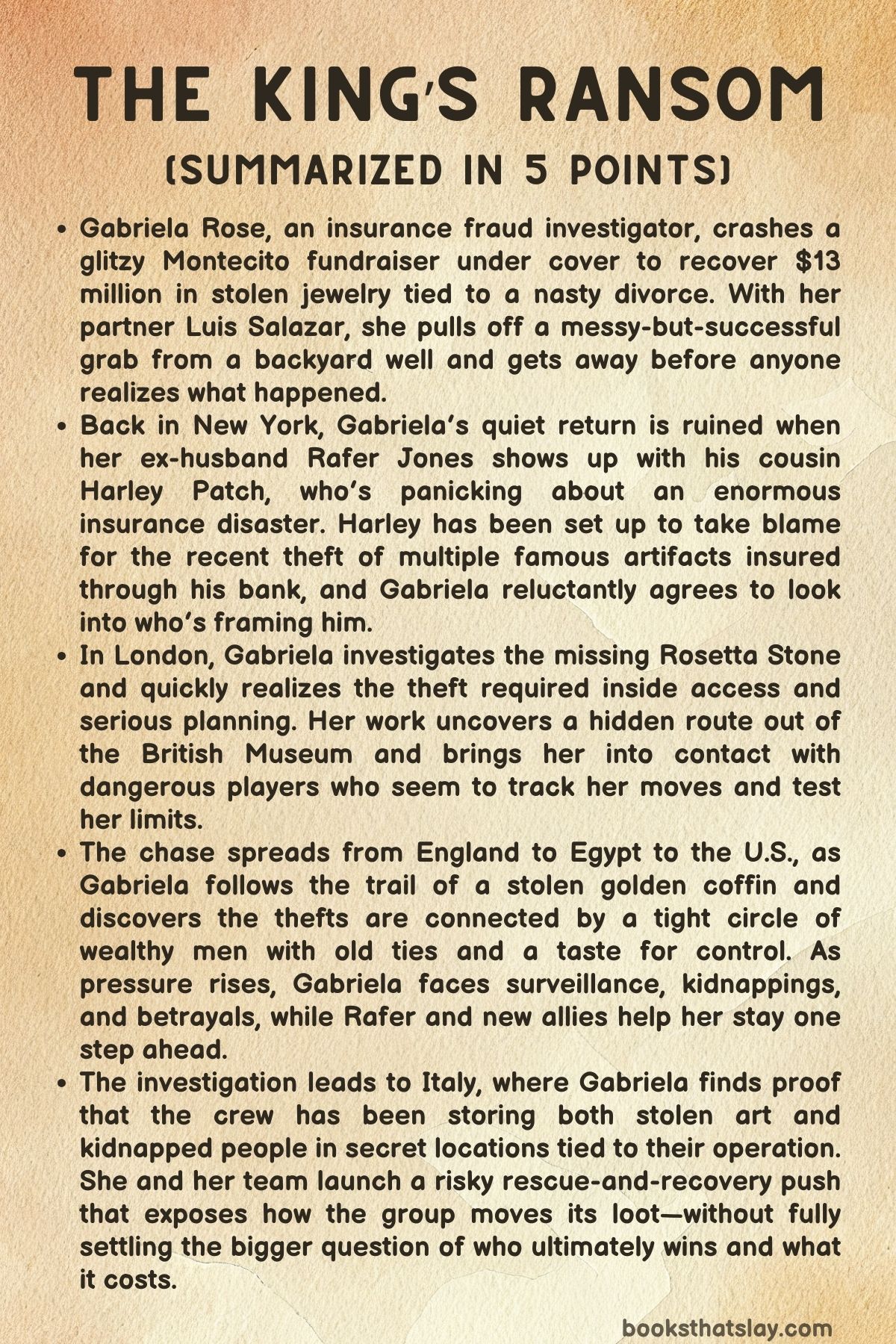
Gabriela Rose arrives at a lavish Montecito fundraiser posing as a wealthy guest, but she is really on assignment to recover $13 million in stolen jewelry tied to a vicious divorce. Eldridge Rollings, the host, has claimed the jewels vanished during his split from his ex-wife Olga, and he has already collected the insurance payout.
Gabriela believes Rollings hid the jewelry on his property, and she has memorized blueprints, camera placements, and security habits to time her move during the politician’s speech. With help from her partner Luis Salazar, a retired cop who is useful precisely because he bends rules, she slips away from the party and crosses the dark grounds toward an old cottage and a well.
Luis retrieves tools he previously stashed while disguised as a gardener. Gabriela removes the well’s capstone, ties off a rope, and climbs down into shallow, filthy water.
Beneath the muck she finds a sealed bag packed with glittering pieces—exactly what she came for. She climbs out, cleans up as best she can, and hides the recovered jewelry in her handbag.
On the way back, a territorial peacock attacks, turning their careful exit into a ridiculous sprint. Gabriela loses a designer shoe, but she and Luis make it out with the jewels and a plausible excuse for their disheveled appearance.
Two days later, Gabriela returns to her SoHo apartment in New York expecting quiet. Instead, she finds her ex-husband Rafer Jones showering like he still lives there, and his cousin Harley Patch asleep on the couch in a state of undress and bad decisions.
Gabriela is furious, but Rafer insists Harley needs protection. Over a makeshift snack and too much explanation, Harley reveals how he stumbled into a nightmare at Searl and Junkett Bank.
After a personal scandal got him fired from his last job, he landed at the bank in a nonsense position related to insuring antiquities. Then the bank’s president was assassinated, and through absurd corporate logic Harley became acting president—and then the permanent one.
Harley explains the larger disaster: under pressure from influential board members, the bank insured priceless objects and artworks. Within weeks, those treasures were stolen—quietly, efficiently, and without public alarm.
Museums kept the crimes secret by displaying replicas to avoid panic, while the bank faced insurance exposure far beyond its liquidity. With no paper trail pointing to the board, Harley is being positioned as the fall guy.
A private investigator tried to grab him in St. Vincent, convincing Gabriela that someone wants Harley contained or silenced. Gabriela doesn’t like being dragged into chaos, but she also doesn’t like setups.
She agrees to investigate, starting with the most famous missing object: the Rosetta Stone.
Gabriela, Rafer, and Harley travel to London and check into a hotel. At the British Museum, Gabriela studies the exhibit and quickly confirms the displayed Rosetta Stone is a replica.
The theft happened without alarms or usable footage, suggesting inside access and technical sabotage. Gabriela reconnects with curator Steven Kilchester, who confirms the museum is keeping the theft secret and shares rumors of odd distractions on the night it vanished.
He also mentions Ahmed El Ghaly, a former Egyptian official with a reputation for dangerous connections—someone questioned and cleared but still suspected in whispers.
When Gabriela tries conventional inquiries at the Egyptian embassy, she gets nowhere. Then Ahmed contacts her directly and proposes a meeting at Harrods, where he plays the role of polished, untouchable operator.
He denies having the stone, but he speaks comfortably about ransom as a concept, as if it’s merely business. The encounter convinces Gabriela he is either involved or close to the people who are, and that he is not someone to underestimate.
Back in the investigation, Gabriela focuses on museum staffing changes around the theft. Three new hires stand out, including Leon Blake, who quit almost immediately afterward, and John Mackey, who was murdered the same week.
Gabriela visits Mackey’s widow in Brixton and learns small details that don’t fit a normal life. A later call from Kilchester provides a critical piece: the security cameras were looped at 1 a.m., and guards were pulled away by a bizarre distraction involving green slime near another exhibit.
Gabriela returns to the gallery, notices an unusual floor grate, and finds a forgotten tunnel network beneath the museum. Down there she discovers evidence of a heavy load moved on a dolly, and a decomposed body that suggests the thieves killed one of their own.
The tunnel leads to a trapdoor that opens into the storeroom of a nearby noodle shop, revealing the escape route.
The next morning, Gabriela follows up on Mackey’s personal trail and learns he kept a truck in a rented garage. She picks the lock, opens the unit—and finds the real Rosetta Stone hidden under blankets in the truck bed.
Armed men arrive immediately to reclaim it. Gabriela fights her way out, escapes in the truck with Rafer and Harley riding in the back, and survives a chase through London traffic.
She drives straight to the British Museum and delivers the stone to leadership for authentication, forcing the museum to confront what was stolen and recovered. Soon after, she discovers someone planted a tracker in her bag and dumps it, realizing her moves are being monitored.
A board member, Harry Bench, requests a meeting. At a café in Piccadilly, Bench shifts from polite questions to accusations, implying Gabriela is working with Harley and is part of the theft ring.
When men in black suits close in, Gabriela escapes through the back and concludes Bench isn’t investigating—he’s managing threats. She leaves London and heads to Cairo to pursue the next missing object: a newly discovered solid gold coffin linked to a royal burial, nicknamed “Brendan.”
In Cairo, Gabriela meets scholars and curators and reconstructs the theft. The coffin was shipped from New York to Cairo, and the crate arrived sealed and apparently intact, yet it contained a convincing fake when opened at the museum.
Gabriela deduces the switch happened mid-flight. She digs into cargo records and finds a suspicious shipment of excavation equipment tied to British archaeologist Edgar Merrick, large enough to hide the real coffin or facilitate a swap.
Gabriela travels into the desert to Merrick’s site with local help, finds the dumped crate with a false bottom, and realizes the thieves used clever container tricks to move the coffin off the books. When a drone appears overhead, she shoots it down, confirming she is under active surveillance.
Clues pull Gabriela back to New York, where she examines bank histories and discovers personal links: Bench, Rocky Mausud, and Theodore Searl share an old Harvard lacrosse connection. Beckett Searl, Theodore’s father, once co-ran Searl and Junkett before a split, and now Theodore lives extravagantly in Florida.
Gabriela travels there with Rafer, attempts infiltration disguised as pest control, and searches for evidence. Instead, she is ambushed, abducted, and interrogated by Bench and Theodore, who demand the golden coffin.
Gabriela realizes they don’t have it and may be panicking. After Rafer rescues her from an explosion meant to erase the scene, Gabriela regroups and gets a breakthrough from Harley: he kept a backup computer with hidden messages.
The emails point to Castello Blanco in Italy as a storage hub for stolen goods and captives.
In Italy, Gabriela and her allies track shipments disguised through local commerce—down to goat sausages bought by only a handful of influential customers. Their suspicion lands on wealthy Antonio Tartoni, whose estate includes serious security and a helipad.
In Milan, Gabriela befriends Tartoni’s wife Gloria, who drunkenly reveals the inner circle: Tartoni, Bench, Theodore Searl, and Rocky Mausud call themselves the “Kings,” and their hobby of prank kidnappings evolved into real ransom operations. They stored people and stolen items in a vast wine cave beneath the country house, but recently moved everything after climate control failed.
When Gabriela returns to investigate further, Rafer and their local ally Jacko are taken at gunpoint. Gabriela forces Bench into a negotiation window, then calls Ahmed for muscle and leverage.
Together they storm Tartoni’s estate, find the hidden stair behind a rotating bookcase, and rescue Rafer and Jacko from the underground cellar. Tartoni’s laptop reveals a planned meeting with a buyer, Vladimir Alexi Oleski.
Gabriela and her team raid Oleski’s operation, uncovering stolen artifacts and evidence of the trafficking network. They find Bench being tortured, and after a violent confrontation Oleski dies, leaving behind a mansion filled with looted treasures—including the items tied to Harley’s insurance disaster.
The only remaining problem is the missing golden coffin. The answer arrives in an almost absurd place: Gloria’s apartment.
Gabriela notices a gold mummy-shaped “coffee table” with a glass top—something Gloria claims she ordered as decorative furniture from Cairo. Ahmed inspects it, removes a gemstone, and reveals a hidden marker that confirms it is authentic and contains what he calls a “treasure map.” With the conspiracy exposed, the stolen cache located, and Harley finally released, Gabriela closes in on the final missing piece—proving that the Kings’ arrogance was their greatest weakness, and that nothing stays hidden forever when Gabriela Rose is hunting.
Characters
Gabriela Rose
Gabriela Rose stands at the heart of The King’s Ransom as a brilliant, daring, and unrelentingly composed insurance fraud investigator. She is highly skilled in deception, surveillance, and fieldwork, capable of infiltrating high-society fundraisers and unearthing jewels buried in a well as easily as decoding global criminal conspiracies.
Gabriela’s professionalism masks an undercurrent of vulnerability — especially in her turbulent personal relationships. Her complex connection with her ex-husband, Rafer Jones, reveals her struggle between independence and emotional attachment.
Despite her frustration with Rafer’s impulsive charm, their shared history and complementary talents make them a formidable team. Gabriela’s moral compass, though flexible, consistently points toward justice.
She’s willing to break the law, pick locks, or use disguises to serve a larger ethical purpose. Her sharp intellect is matched by her physical endurance and quick instincts; whether battling attackers in London or surviving an explosion in Florida, she embodies both strength and elegance.
Yet beneath her confidence lies fatigue from a life of constant danger, suggesting a longing for stability she never allows herself to pursue fully.
Rafer Jones
Rafer Jones, Gabriela’s ex-husband, is a charismatic, roguish adventurer whose blend of humor and recklessness adds vitality and unpredictability to the story. A former military man with a streak of mischief, Rafer thrives on risk and improvisation, contrasting Gabriela’s calculated precision.
His return to Gabriela’s life reignites both chaos and chemistry, reminding her of their passionate but unstable past. While Rafer’s charm often serves as a shield for his insecurities, he proves repeatedly loyal, brave, and resourceful, especially when Gabriela’s life is endangered.
His devotion to her becomes evident through his persistence and heroism — rescuing her from captivity and facing armed criminals without hesitation. Rafer’s moral outlook is pragmatic rather than principled; he breaks laws when necessary but always aligns himself with Gabriela’s mission.
His humor and warmth balance the novel’s tension, turning moments of peril into scenes of humanity. Together, Rafer and Gabriela form a partnership defined by trust, friction, and undeniable affection.
Harley Patch
Harley Patch, Rafer’s cousin, is an endearing but deeply flawed character whose naivety propels much of the novel’s conflict. Initially portrayed as an unlucky fool who stumbles into catastrophe, Harley’s misjudgment sets off the international crisis involving billions in stolen artifacts.
His career missteps — from workplace affairs to unwittingly insuring the world’s most valuable antiquities — paint him as a man whose intellect is undermined by carelessness. Yet Harley’s vulnerability evokes empathy.
He is not malicious, merely out of his depth in a world of corruption and greed. Throughout the story, Harley evolves from a bumbling liability to a reluctant participant in Gabriela’s dangerous quest.
His survival depends on Gabriela’s protection and Rafer’s support, underscoring his dependence on stronger figures. However, by the end, his awareness of betrayal and manipulation deepens, hinting at personal growth.
Harley represents the everyman caught in the crossfire of global power plays, his flaws serving as both comic relief and a cautionary emblem of corporate incompetence.
Ahmed El Ghaly
Ahmed El Ghaly is one of the most enigmatic figures in The King’s Ransom. A former Egyptian official with deep ties to the black market of antiquities, Ahmed exudes a magnetic combination of intellect, menace, and moral ambiguity.
His interactions with Gabriela oscillate between cooperation and manipulation, making him both an ally and a potential threat. Ahmed’s calm confidence conceals a ruthless pragmatism; he navigates corruption and danger with the ease of a man who has long accepted moral compromise as survival.
Despite his shadowy dealings, Ahmed displays moments of integrity, especially when he aids Gabriela in rescuing her allies and confronting the art-smuggling cartel. His interest in the golden coffin, and particularly in the hidden silver disc within it, suggests motives beyond greed — a pursuit of history, power, or redemption.
Ahmed serves as the novel’s mirror to Gabriela: both are professionals operating in gray zones, driven by intelligence, pride, and a code known only to themselves.
Harry Bench
Harry Bench embodies corporate corruption and moral decay. As a powerful board member of Searl and Junkett Bank, he personifies greed hidden behind respectability.
Bench’s intelligence and authority make him a dangerous antagonist, especially as he manipulates investigations to conceal his role in the art theft conspiracy. His interactions with Gabriela are laced with menace, cloaked in the civility of business negotiations.
When his mask slips — during his attempt to have Gabriela captured and tortured — his ruthlessness becomes undeniable. Bench is motivated not by ideology or passion but by the pursuit of power and wealth, even at the cost of human life.
His ultimate downfall at the hands of the very criminals he sought to control illustrates the destructive cycle of greed. Bench’s duplicity contrasts sharply with Gabriela’s reluctant morality, positioning him as her intellectual equal but ethical inverse.
Theodore Searl
Theodore “Teddy” Searl is the polished face of privilege gone rotten. As the heir to one of the banks entangled in the theft scheme, Teddy presents himself as refined and sophisticated but hides a sadistic streak beneath his charm.
His involvement with the secret group known as “The Kings” marks him as one of the story’s central villains. Teddy’s confidence and cruelty manifest most vividly during Gabriela’s kidnapping and torture, where his enjoyment of control and dominance reveals his true nature.
He is intelligent but driven by ego rather than purpose, loyal only to his wealthy conspirators. Unlike Bench, whose ambition is grounded in strategy, Teddy’s villainy stems from entitlement — a belief that his power places him above accountability.
His fall from grace, orchestrated by Gabriela’s resilience and Ahmed’s intervention, symbolizes the collapse of a generation of corrupt elitists who treated heritage and humanity as commodities.
Antonio Tartoni
Antonio Tartoni emerges as the European anchor of the conspiracy — a suave, cultured man whose sophistication masks criminal depravity. His opulent lifestyle in Valgenico and his art gallery in Milan make him appear legitimate, yet he is deeply involved in trafficking stolen treasures.
Tartoni’s membership in “The Kings” group ties him to Bench, Searl, and Mausud, creating an elite brotherhood of greed that thrives on secrecy and exploitation. Despite his intelligence and refinement, Tartoni underestimates Gabriela’s cunning, leading to his downfall.
His character highlights the intersection of art, crime, and vanity: he treats stolen antiquities as trophies rather than cultural treasures. The grotesque irony of his demise — losing his hand and later dying at a clinic — underscores the fragility of his false grandeur.
Tartoni represents the moral rot of aristocratic privilege, where taste and wealth coexist with corruption.
Rocky Mausud
Rocky Mausud operates as the logistical backbone of the smuggling network, managing the operational side of the stolen artifact trade through his freight company. Unlike the more polished members of “The Kings,” Mausud’s persona blends streetwise cunning with business acumen.
His warehouses and transport routes across Egypt form the arteries of the international theft ring. Though he seldom acts with open violence, his complicity in the conspiracy makes him one of its indispensable figures.
His background and Harvard connection to the others suggest he rose through charm and opportunism rather than inherited wealth. Rocky’s role bridges the worlds of elite banking and underground crime, demonstrating how corruption flows seamlessly from boardrooms to back alleys.
His eventual downfall, orchestrated through Gabriela and Ahmed’s intervention, illustrates how greed blinds even the most resourceful conspirators.
Gloria Tartoni
Gloria Tartoni is both comic and tragic — a lonely, indulgent woman drowning her disillusionment in vodka and gossip. Her drunken candor provides Gabriela with critical intelligence about the secret society of “The Kings” and their activities.
Gloria’s character serves as the novel’s window into the world of wealth and moral decay. Despite her frivolity, she is not entirely foolish; she understands her husband’s corruption but chooses ignorance for comfort.
Her home, filled with luxury and emptiness, becomes the ironic resting place of the missing golden coffin — repurposed as a coffee table. This absurd yet poignant image encapsulates Gloria’s character: surrounded by priceless beauty she does not recognize, numbed by excess, and oblivious to the danger around her.
She is a tragicomic figure, emblematic of the collateral damage wrought by greed and deception.
Themes
Power, Privilege, and the Sense of Entitlement
Money and status shape nearly every corridor Gabriela walks through in The King’s Ransom, from the fundraiser with expensive tickets and cheap champagne to the private estates, exclusive galleries, and boardrooms where decisions get made without public scrutiny. The story treats privilege as more than background scenery; it becomes a working tool for the people who have it and an obstacle for those who don’t.
Eldridge Rollings can treat marital property like a private battlefield and still look respectable in front of donors and political guests. Museum leadership hides thefts behind replicas because reputation matters more than transparency.
The bank’s upper ranks and board members treat billion-dollar risk as a game, casually shifting blame to a convenient fall guy when the numbers stop working. Even the “Kings” themselves embody a particular kind of entitlement: they began with prank kidnappings as young elites and matured into ransoming cultural treasures, as if the world is their playground and consequences are for other people.
That escalation exposes a core idea: privilege often creates a belief that rules exist for display, not restraint. Gabriela’s work constantly runs into this wall.
She can be skilled, prepared, and brave, yet she still has to push against institutions that protect the powerful by default. The theme becomes sharper when the story shows how privilege recruits systems—legal, financial, and social—to sanitize wrongdoing.
Insurance claims, discreet museum policies, and corporate governance aren’t neutral; they are the camouflage. In that environment, theft isn’t just a crime, it is a business strategy practiced by people who are used to getting what they want, then outsourcing the damage to someone else.
Corruption, Plausible Deniability, and Institutions That Protect Themselves
The plot keeps returning to the ways organizations respond when the truth is inconvenient: they don’t expose it, they manage it. The bank’s internal structure is portrayed as a machine designed to preserve the board, not to protect the public or even the institution’s own long-term stability.
Harley is placed into leadership not because he is the right person, but because he is disposable. He becomes the human shield that allows decision-makers to keep their hands clean while still benefiting from the chaos they helped create.
Museums, too, participate in this logic. By displaying replicas and keeping thefts secret, they trade honesty for control, assuming the public cannot be trusted with reality.
Security failures—looped cameras, staged distractions, erased trails—suggest that corruption is not always loud; often it’s quiet coordination, small permissions granted, and corners that “just happen” to be cut. Even when violence appears, the institutional response is still a form of containment: redirect attention, minimize publicity, preserve donor confidence, avoid panic.
Gabriela’s investigations show how corruption thrives when systems value reputation over responsibility. Evidence exists—dead bodies in tunnels, murdered workers, vanished staff, swapped cargo, hidden emails—yet the machine keeps running because the people with authority can decide what counts as “official.” The theme also highlights how corruption becomes easier when each participant holds only a piece of the operation.
Hackers loop cameras, staff look away, board members apply pressure, transport records appear normal, and the final story always has a ready-made villain. This structure is why Gabriela must operate outside ordinary channels.
The book’s world suggests that playing by the rules is admirable but often ineffective when the rules are part of the disguise.
Performance, Disguise, and Identity as a Professional Weapon
Gabriela’s work depends on the ability to become someone else at will: a fundraiser guest, a harmless observer, a pest-control worker, a polite professional in a café, a tourist in a museum, a social companion sharing drinks. Identity in The King’s Ransom is treated as a set of adjustable signals—clothes, tone, body language, timing—used to open doors that would otherwise remain locked.
The story repeatedly shows that the success of a mission can hinge on how convincing a role looks to the people guarding a space. The fundraiser scene makes this idea immediate: the environment is built for appearances, so the best way to move within it is to blend into the appearance.
Later, the museum investigation echoes the same principle. The Rosetta Stone exhibit is a performance of security and heritage for visitors, while the real artifact is moved through service routes, forgotten tunnels, and the unseen infrastructure beneath the public display.
That contrast—front-stage respectability versus back-stage reality—mirrors Gabriela’s own method. She operates in the hidden layer of social systems, where the real transactions happen.
Rafer and Harley also carry shifting identities: charming nuisance, unreliable ally, frightened target, accidental executive. Harley’s title inflation at the bank shows how identity can be manufactured by institutions, not earned, and how that manufactured identity becomes a trap when blame is assigned.
Even villains practice performance: the “Kings” present themselves as respectable elites while functioning like organized criminals. This theme keeps asking what a person “is” when roles can be swapped so easily.
In Gabriela’s case, the answer is competence and purpose rather than any single mask. Her disguises are not lies for ego; they are tools that expose other people’s lies, especially the polished lies that wealthy and powerful environments depend on.
Trust, Betrayal, and the Cost of Needing Other People
The story constantly forces Gabriela into uneasy partnerships, and each partnership carries risk. Luis is useful but “flexible,” which makes every shared plan a calculation.
Rafer is an ex-husband with charm and history, meaning he can help in ways few others can, yet he also brings unpredictability and emotional friction. Harley is both problem and responsibility: his chaos drags danger to Gabriela’s door, but his vulnerability also triggers her sense of duty.
Trust here is never a simple moral choice; it’s a survival decision made under pressure. The villains exploit that.
The bank’s board and associates rely on betrayal as a standard operating method—placing Harley in charge, then preparing to sacrifice him, accusing Gabriela, staging captures, setting traps in public spaces. Even within the criminal group, betrayal is a constant threat, shown by a thief killed by his own team and by the shifting control of stolen goods between different players.
The theme gains weight because betrayal isn’t only personal; it is systemic. Institutions betray their employees, leaders betray the public, friends betray friends when leverage appears.
Against that backdrop, the trust Gabriela gradually extends becomes more meaningful. She doesn’t trust easily, and she rarely trusts completely.
Instead, she builds provisional trust based on observed behavior: who shows up, who protects others, who keeps their nerve, who tells the truth when lying would be easier. Rafer’s rescue after the explosion is a pivotal example of trust becoming action, not talk.
The bond with Jim and the reliance on Ahmed—dangerous, transactional, yet sometimes reliable—shows that even questionable allies can become essential in a world where official protections fail. The cost is emotional and strategic: every relationship is another point of entry for surveillance, kidnapping, and coercion.
Trust can get someone killed. Yet refusing trust can also get someone killed.
The theme treats this tension as a defining feature of Gabriela’s life: competence keeps her alive, but connection keeps her from becoming as cold as the people she’s chasing.
Cultural Heritage as Commodity and the Violence of Ownership
Priceless artifacts in The King’s Ransom are not merely objects to be recovered; they are symbols of identity, history, and collective memory that become distorted when treated as financial instruments. The Rosetta Stone, a golden coffin, paintings, and other treasures are insured, priced, swapped, shipped, and stored like luxury inventory.
That handling strips them of context and turns them into tokens in a power struggle among elites. The museums’ choice to hide thefts behind replicas shows how heritage can be reduced to the appearance of heritage: visitors get the display, the institution keeps its prestige, and the truth stays buried.
Meanwhile, the thieves treat cultural property as leverage. Ransom transforms history into a bargaining chip, and the use of secret storage locations—wine caves, warehouses, private mansions—turns shared human legacy into private trophies.
The theme is sharpened by the international routes: London, Cairo, New York, Italy. These objects cross borders through loopholes and corruption, suggesting that global systems meant to protect heritage can also enable its theft when the right people pull the right strings.
The violence around the artifacts makes the point even harder. People die in tunnels and rivers.
Workers are murdered or disappear. Gabriela is tortured for information that she does not even have.
The objects attract harm because they concentrate value, and that value invites people who are willing to hurt others to control it. Even the eventual discovery of the coffin base as a coffee table under glass carries an uncomfortable message: a sacred object can be casually repurposed into décor when its meaning is ignored.
The story doesn’t treat this as an abstract tragedy; it shows the practical chain reaction—insurance fraud, institutional secrecy, criminal ransoms, and physical danger—that follows when heritage is priced like a stock. Gabriela’s role becomes more than recovery for an insurer; she ends up acting as a guardian for things that institutions failed to protect, in a world where “ownership” often belongs to whoever can afford the best deception.
Surveillance, Technology, and the Fragility of Control
Security systems appear everywhere—blueprints, camera layouts, sensors, impact glass, tracking devices—and yet the plot repeatedly demonstrates how control can be faked. Hackers loop museum footage.
Diversions pull guards away at the critical moment. An AirTag turns Gabriela herself into a tracked object.
Drones hover over desert investigations, turning remote landscapes into monitored zones. The story treats surveillance as a contest rather than a guarantee: whoever understands the system best can defeat it, and whoever assumes the system is enough will be blindsided.
This theme also shows how modern crime is less about brute force alone and more about coordinating information. The thieves’ success depends on timing, inside access, and the ability to manipulate what others see and record.
Even the museum’s impressive protection becomes mostly ceremonial when an insider or a skilled team attacks the weak points. Gabriela responds by becoming equally information-driven.
She studies blueprints, uses prior footage, notices small irregularities like a floor grate, tracks vehicles, plants devices, reads hidden emails, and builds a map of the operation from small data fragments. The theme highlights the psychological side of surveillance too.
Being watched changes how people behave. Gabriela must assume that meetings, movements, and even casual lunch conversations might be monitored or used as traps, as shown by the café ambush and the later abduction.
The presence of tracking and monitoring devices creates constant pressure, pushing characters into improvisation and quick risk assessment. Importantly, the story also critiques the comfort people take in “security theater.” Museums believe secrecy protects them.
The wealthy believe gates, guards, and cameras make them untouchable. Criminals believe their hidden facilities will stay hidden.
Each belief fails at some point because surveillance tools do not create integrity; they only create a record that can be altered, avoided, or weaponized. The result is a world where technology raises the stakes without guaranteeing safety, and where the true advantage belongs to the person who stays alert, notices what doesn’t fit, and refuses to confuse equipment with protection.
Justice, Legality, and Moral Ambiguity in Pursuit of the Truth
Gabriela’s work sits in the gap between what is legal, what is effective, and what is right. She is an investigator, but she regularly crosses into actions that institutions would not endorse: breaking into garages, infiltrating private property, staging identities, engaging in violent self-defense, and operating internationally with allies whose methods are blunt.
This isn’t presented as reckless thrill-seeking; it is portrayed as a response to a reality where official channels are compromised, slow, or easily manipulated by the powerful. The criminals hide behind boardroom language, insurance structures, and social respectability, which means playing “properly” often serves the criminals more than the victims.
Yet the story doesn’t romanticize lawlessness either. Every shortcut comes with consequences: escalated retaliation, public danger during chases, collateral risk to bystanders, and the emotional toll of living on the edge of violence.
Rafer and Luis add further complexity because they are useful precisely because they can bend rules, and Gabriela must constantly decide how much compromise she can accept without becoming what she is fighting. Ahmed’s presence is the sharpest example.
He offers resources and protection, but his interests are not purely aligned with justice; he has his own agenda and uses hostage-like leverage with Harley. Working with him can solve problems quickly, yet it also risks creating new ones.
The theme becomes a running question: when systems fail, who gets to define justice?
Gabriela’s answer is practical rather than philosophical.
She prioritizes preventing harm, recovering what was stolen, and exposing the machinery behind the thefts. Sometimes that means bending laws to correct larger wrongs.
The villains, meanwhile, use legality as a costume, treating contracts and corporate roles as shields. By contrasting these approaches, The King’s Ransom suggests that morality is not determined by whether someone wears a suit or carries a badge.
It is determined by what they protect, who they sacrifice, and whether they accept responsibility for the damage they cause.