The Last Letters of Sally and Walter Summary, Characters and Themes
The Last Letters of Sally and Walter by Cammie McGovern is a warm, late-life story about loneliness, talent, illness, family repair, and the surprise of finding companionship when a person thinks their most important years are behind them. The book follows Sally Reynolds, a widow newly settled in a senior living facility, and Walter Kretzer, a difficult but brilliant Scrabble player whose life has narrowed around grief and regret.
Through the game, both rediscover parts of themselves they had lost: confidence, purpose, desire, patience, and the ability to be needed without being consumed. It is a story about aging without surrendering the self.
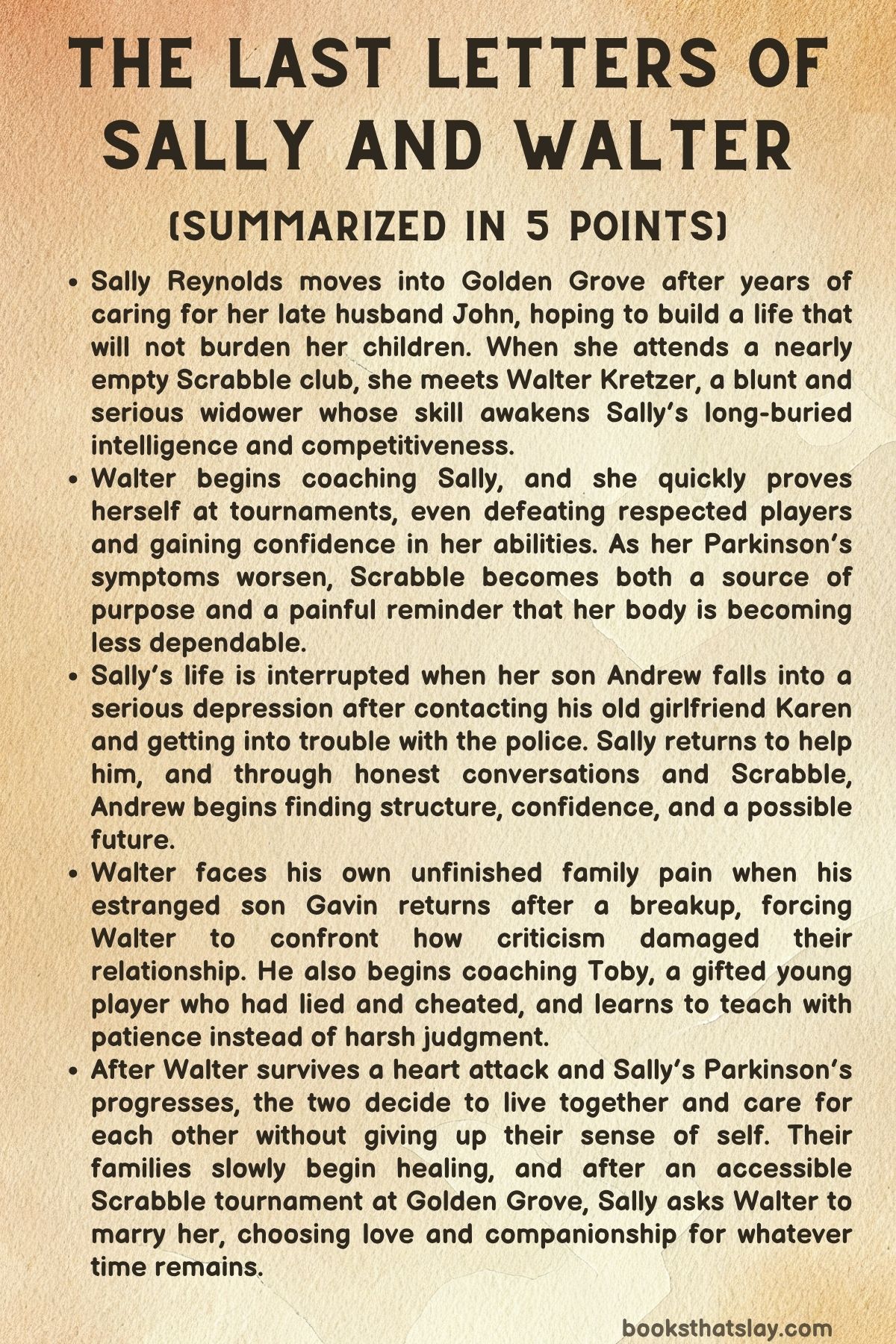
Summary
Sally Reynolds has recently moved into Golden Grove, an independent senior living facility, and she is still learning how to live as someone who is no longer a wife or caregiver. For years, her life had been shaped by her husband John’s needs, especially during his illness, and after his death she made the practical decision to move somewhere that would keep her from becoming a burden to her children, Rachel and Andrew.
The adjustment is harder than she expected. Golden Grove offers activities, flyers, meals, and polite social possibilities, but Sally does not yet feel rooted there.
When she notices an announcement for a Scrabble club, she decides to attend, partly out of curiosity and partly because she needs something that belongs to her.
At the club, she finds only one other person: Walter Kretzer. Walter is a widower with a reputation for being difficult, intense, and socially awkward.
Sally initially stays because she feels sorry for him, but the game quickly changes her impression. Walter is not interested in making Scrabble easy or friendly in the casual retirement-home sense.
He plays by serious rules, uses strategy, studies words, and beats her badly. Yet Sally is not humiliated in the way someone else might be.
Instead, she is intrigued. Walter explains parallel plays, two-letter words, and the logic of tournament scoring, and Sally begins to understand that Scrabble is not simply a word game but a system of memory, calculation, nerve, and placement.
By the end of the evening, Walter recognizes that she has unusual instincts.
The next morning, Walter sends Sally an email filled with advice, tournament information, and study suggestions. His tone is formal and overexcited, but Sally finds it amusing rather than off-putting.
She agrees to practice with him, and their games become a regular rhythm in both their lives. Walter tells her about his repeated failures to fit into the Golden Grove community.
He had tried to start a proper club, but people left when he enforced official rules and refused to soften his style. Sally begins to see the loneliness underneath his bluntness.
He is not cruel exactly, but he has spent so long protecting himself with criticism and expertise that he barely knows how to welcome another person.
As Sally plays more, her own past begins to return to her. She remembers being a bright, competitive girl who learned to hide her intelligence because it made men uncomfortable.
Marriage to John further reduced that part of her. John’s moods, depression, and later heart illness took up more and more space, and Sally became skilled at managing him, anticipating him, and making herself smaller.
Scrabble gives her a way back to the sharp, capable self she had buried. Walter’s seriousness, though sometimes exhausting, treats her mind as something worth challenging.
That respect matters to her.
Sally enters her first tournament and surprises herself by improving from game to game. Walter, too, performs better than he has in years because her presence steadies him.
At the tournament, Walter’s final opponent is Toby Weir, a young player with obvious talent. Walter likes the boy and senses how much potential he has, but after the match Walter’s wallet disappears, and he suspects Toby stole it.
Sally urges him to report the theft, but Walter refuses. He does not want to ruin a young player’s future on suspicion, especially one who may be gifted.
The choice shows both his rigidity and his capacity for mercy.
Walter later brings Sally to the VFW Scrabble club, where she faces Jack Trotter, one of the best players in New England. Jack expects to dominate her, but Sally beats him.
When he demands a rematch, she accepts and beats him again after he loses composure under pressure. The club reacts as if something remarkable has happened, and Walter becomes convinced that Sally could become a serious competitive player.
He begins coaching her more intensely, aiming toward a major casino tournament.
During this training period, Sally tells Walter that she has Parkinson’s disease. She has been managing it privately with medication, not wanting to alarm her family or lose control over her choices.
Walter is shaken by the news, but he does not withdraw from her. Instead, he continues to believe in her ability.
At the casino tournament, Sally plays with remarkable focus. She wins game after game, but the strain on her body increases.
Her leg freezes, and Walter helps her move. She defeats Winston Pryor, a major champion, after successfully challenging a false word, proving that she can hold her own against elite competition.
But as the tournament continues, tremors spread into her right hand, making it difficult to place tiles. Sally keeps pushing herself until she faces Toby and loses.
Walter later tells her he saw Toby cheating by pocketing tiles. He had reported it, but the officials acted too late.
The tournament ends with Sally exhausted and Walter furious at the authorities. For Sally, the event is both a triumph and a warning.
She has proven her talent, but her body’s limits can no longer be ignored.
After the tournament, Sally returns to her old house because Andrew is in crisis. Rachel tells her that Andrew, unemployed and depressed, contacted his old girlfriend Karen, drank too much, went to her house, and was stopped by police after damaging her mailbox.
Sally realizes that while she has been discovering a new life, Andrew has been falling apart. Andrew is diagnosed with clinical depression, and Sally wonders whether he may also be autistic.
As she stays with him, mother and son begin speaking with more honesty than before. They talk about John’s depression, Andrew’s fixation on Karen, and the ways Sally failed to see what Andrew needed.
Scrabble becomes a bridge between them. Andrew starts playing with Sally and discovers that he enjoys the structure, rules, and challenge of the game.
It gives him confidence and a way to organize his mind.
Meanwhile, Walter withdraws after the casino tournament. He writes angry letters he does not send and sinks into old patterns of isolation.
Then his estranged son, Gavin, visits unexpectedly after his relationship with James falls apart. Walter and Gavin’s relationship has long been damaged by Walter’s fear, criticism, and emotional clumsiness.
Their reunion is awkward, but it opens a door. Walter begins to understand how much harm he caused by trying to shape Gavin through judgment rather than love.
Toby also comes to Golden Grove and returns Walter’s wallet. He admits that he lied and cheated and asks Walter to coach him.
Walter agrees, but only on the condition that Toby stop lying. Coaching Toby becomes another chance for Walter to change.
He realizes he can teach without humiliating, controlling, or pressuring someone the way he once did with Gavin. Through Toby, Walter practices patience.
Through Gavin, he begins to practice humility.
Sally and Walter eventually reconnect by phone. Sally tells him about Andrew’s depression and her fears, while Walter tells her about Gavin and Toby.
Their bond survives the separation because it has become more than Scrabble. Andrew grows increasingly serious about the game and enters the Baltimore Nationals.
Sally, Walter, Andrew, and Toby travel together. Andrew performs surprisingly well, while Toby struggles under the pressure.
Walter uses a wheelchair to help Sally through the event and worries about the progression of her Parkinson’s. During the trip, Walter experiences what he thinks is indigestion, but it is actually a heart attack.
He calls 911 and collapses. Toby helps the paramedics and contacts Gavin.
Sally reaches Walter before surgery by claiming to be his wife, trying to confess what he means to her, but Gavin arrives before she can fully say it. Walter survives serious heart surgery and spends weeks recovering in rehab.
When Walter returns to Golden Grove, he is frail, using a walker and oxygen, but he tries to remain cheerful and active. Sally has also declined and needs more help with daily tasks.
Walter suggests that they live together so they can care for each other. Sally refuses at first because she spent so many years caring for John and fears losing the independence she has only recently found.
Then a power outage changes her mind. Alone in the dark, frightened by her own vulnerability, she joins other residents in the hallway.
Walter appears with a flashlight and a Scrabble board, having made the effort to reach her. Sally realizes she does not want to face what remains of life alone.
She agrees to live with him.
They begin sharing Sally’s apartment, become physically intimate, and settle into a life that is joyful but marked by increasing physical limitations. Their relationship is not a fantasy of youth restored; it is love shaped by pill bottles, walkers, tremors, oxygen, and dependence.
Yet it is also full of humor, touch, competition, and companionship.
Their children begin moving forward as well. Andrew continues Scrabble, works toward a teaching credential, helps start a school games club, and rebuilds a careful friendship with Karen.
Rachel separates from Barry and grows closer to Charlie, an old classmate. Gavin reconciles with James and continues repairing his relationship with Walter.
Later, Andrew and Toby bring Sally and Walter back to the VFW Scrabble club, where everyone learns the club is losing its meeting space. Walter and Sally help organize an accessible Scrabble tournament at Golden Grove to support the club and show that players with physical limitations can still compete meaningfully.
The tournament brings together Sally, Walter, Andrew, Toby, Gavin, Jack Trotter, and other players. Sally plays with assistance and performs well, proving again that illness has changed her methods but not erased her mind.
During the event, Connie collapses and is taken away by ambulance, forcing the tournament to end early. The sudden crisis reminds everyone how fragile their lives are.
That night, moved by Connie’s collapse and by Andrew’s quiet care during their game, Sally tells Walter she wants to marry him. Walter joyfully accepts.
They lie together afterward, joking about wedding plans, Scrabble, and the need to keep playing for as long as they can.
Characters
Sally Reynolds
Sally Reynolds is the emotional center of the book, a woman who begins the story believing that her strongest years are behind her and gradually discovers that parts of herself are still alive, hungry, and capable. Her move to Golden Grove is practical, but it is also an attempt to avoid burdening Rachel and Andrew after years of being consumed by John’s needs.
Sally’s life has taught her to manage other people’s discomfort. As a young woman, she learned to hide her intelligence because it unsettled men, and in marriage she learned to make herself smaller around John’s moods and illness.
Scrabble reawakens her competitive mind, and Walter’s blunt seriousness gives her a strange kind of freedom: he does not flatter her, but he takes her ability seriously. Her Parkinson’s disease adds urgency to her growth because she knows her body is becoming less reliable.
Sally’s journey in The Last Letters of Sally and Walter is not about pretending illness does not matter; it is about refusing to let illness define the entire meaning of her remaining life. She is also a mother forced to confront what she missed in Andrew.
Her love for him deepens when she stops trying to smooth over his pain and begins listening to it. By the end, Sally’s decision to marry Walter shows that she has redefined independence.
She no longer sees love only as sacrifice or caregiving. She understands that needing someone and choosing someone can be acts of courage.
Walter Kretzer
Walter Kretzer is difficult, brilliant, lonely, and deeply wounded by his own failures as a husband, father, teacher, and friend. At Golden Grove, he is known as intense because he treats Scrabble with a seriousness that alienates casual players.
His harshness comes partly from pride, but also from fear. Rules, strategy, and expertise give Walter control in a life where emotional connection has often defeated him.
He is not naturally gentle, and his instinct is to correct, instruct, and judge. This has cost him dearly, especially in his relationship with Gavin, who grew up under the pressure of Walter’s criticism.
Sally changes Walter not by fixing him but by meeting him in the one place where he knows how to communicate: the board. Through her, he learns that teaching can be an offering rather than a test.
Toby further challenges him because the boy’s dishonesty could easily trigger Walter’s worst instincts, but instead Walter chooses to coach him with conditions and patience. Walter’s heart attack and recovery strip away some of his defensive superiority.
Frailty makes him dependent, and dependence teaches him humility. His proposal to live with Sally is both practical and romantic, revealing how far he has moved from isolation.
In the book, Walter becomes a man who learns late, but not too late, that love requires more than intelligence.
Andrew Reynolds
Andrew Reynolds is one of the story’s most quietly affecting figures because his crisis reveals how pain can go unnoticed inside a family that has spent years organizing itself around someone else’s illness. At first, Andrew appears to Sally as a struggling adult son whose problems are worrying but manageable from a distance.
His unemployment, depression, fixation on Karen, and drunken confrontation force Sally to see that he is in real danger. Andrew’s diagnosis of clinical depression helps explain some of his despair, while Sally’s question about autism suggests a deeper pattern in how he experiences the world.
He needs structure, honesty, and patient attention rather than vague encouragement. Scrabble becomes important for him because it gives his mind a system in which concentration, rules, and pattern recognition are strengths rather than burdens.
His growth is gradual and credible. He does not suddenly become healed, but he starts to build a life through teaching, games, and a cautious reconnection with Karen.
Andrew also helps Sally change as a mother. Their relationship improves because she stops seeing him only through worry and begins recognizing his intelligence, sensitivity, and need for direct communication.
His quiet care during the later tournament shows how much he has matured. He becomes not simply someone Sally must rescue, but someone capable of tenderness and responsibility.
Rachel Reynolds
Rachel Reynolds represents the competent adult child who has carried her own frustrations while trying to keep the family functioning. She is practical, observant, and often the person who alerts Sally to what is happening with Andrew.
Her role in the story is not as central as Sally’s or Walter’s, but she helps expose the uneven emotional patterns within the Reynolds family. Rachel has likely spent years watching Sally devote herself to John, then worrying about Andrew, while her own dissatisfaction remained secondary.
Her separation from Barry suggests that she, too, reaches a point where maintaining appearances is no longer enough. Her growing closeness with Charlie shows her desire for a life that feels more honest and responsive to who she is now.
Rachel’s character also helps define Sally’s maternal guilt. Sally does not want to burden her children, but Rachel’s presence reveals that emotional distance can become its own kind of burden.
Rachel needs her mother to be present without being swallowed by guilt. By the end, Rachel’s movement toward a new relationship and a different future mirrors the larger pattern of the story: even late or after disappointment, people can still revise the shape of their lives.
John Reynolds
John Reynolds is dead before the main emotional changes of the story unfold, but his presence remains powerful because Sally’s habits were formed around him. He was a husband marked by depression, moods, and later serious heart illness, and Sally spent much of her adult life managing the atmosphere around him.
John is not presented simply as a villain; he was ill, unhappy, and dependent in ways that affected everyone close to him. Still, his needs consumed space that Sally and Andrew both needed for themselves.
Sally learned to anticipate his moods, quiet her own mind, and make caregiving the center of her identity. Andrew’s depression also forces Sally to think differently about John, not only as a difficult husband but as part of a family pattern of emotional suffering that was never properly addressed.
John’s importance lies in what he left behind: guilt, exhaustion, tenderness, resentment, and the fear that love always becomes duty. Sally’s relationship with Walter is shaped by her memory of John because she does not want to repeat a life where she disappears into care.
Her eventual choice to live with Walter shows that she has separated love from self-erasure.
Toby Weir
Toby Weir is a gifted young Scrabble player whose talent is mixed with dishonesty, insecurity, and a hunger for recognition. When Walter first meets him, Toby appears to be a prodigy, someone with the quickness and instinct that serious players respect.
But the missing wallet and later cheating reveal a boy who has learned to survive through lies and manipulation. Walter’s reaction to Toby is important because he could easily condemn him, especially given Walter’s respect for rules.
Instead, Walter sees both the damage and the potential. Toby’s return of the wallet is a major moment because it shows shame, conscience, and a desire to be taught properly.
Under Walter’s coaching, Toby becomes a test of whether Walter can guide someone without crushing him. Toby also plays a crucial role during Walter’s heart attack, helping the paramedics and contacting Gavin.
That action shows that he is more than his worst behavior. He may struggle with honesty and pressure, but he is capable of loyalty and quick responsibility.
In The Last Letters of Sally and Walter, Toby helps connect the older characters to a younger generation, proving that mentorship can repair both the student and the teacher.
Gavin Kretzer
Gavin Kretzer is Walter’s estranged son, and his relationship with Walter reveals the long-term cost of criticism disguised as guidance. Gavin’s life has been shaped by a father who was more comfortable correcting than comforting, and the damage between them is not easily repaired.
His visit after his relationship with James falls apart creates an opening for father and son to face each other as vulnerable adults. Gavin is not merely a symbol of Walter’s guilt; he is a person with his own pain, pride, and need to be accepted without judgment.
His reconciliation with James and renewed connection with Walter suggest that he is willing to rebuild, but only when Walter becomes less defensive and more honest. Gavin’s presence during Walter’s surgery is especially meaningful because it interrupts Sally’s attempted confession but also confirms that Walter is not as alone as he once seemed.
Gavin becomes part of the wider chosen and repaired family that forms around the game, the tournaments, and Golden Grove. His arc shows that family wounds may not vanish, but they can become less controlling when people stop demanding perfection from one another.
Karen
Karen is important mainly through Andrew’s emotional attachment to her and the crisis that follows his attempt to reconnect with her. To Andrew, she represents a lost possibility, a relationship or friendship he cannot release because his life has become stalled.
His fixation on her is not romantic in a healthy sense; it is tied to depression, longing, and the fear that he has missed his chance at happiness. When he drinks, goes to her house, and damages her mailbox, Karen becomes part of the incident that forces the family to recognize how serious his condition is.
Her later cautious friendship with Andrew matters because it does not reward obsession, but it allows a more grounded form of connection. Karen’s role shows how loneliness can distort memory and desire.
She is less developed than Sally or Walter, but her presence helps measure Andrew’s growth. When he can relate to her with more restraint and maturity, it suggests that he is beginning to live in the present rather than clinging to an imagined version of the past.
Jack Trotter
Jack Trotter is a top New England Scrabble player whose defeat by Sally marks a turning point in how others see her and how she sees herself. He enters the story as a respected competitor, someone whose status at the VFW club gives weight to Sally’s victory.
His reaction to losing and his collapse under pressure in the rematch reveal the ego and fragility that can exist even in experienced players. Jack is not simply an opponent; he represents the competitive world Walter wants Sally to enter.
By beating him twice, Sally proves that her talent is not a sentimental late-life hobby but a real force. Jack’s later participation in the Golden Grove tournament also shows how the Scrabble community, despite its rivalries and pride, can gather around a shared purpose.
His character helps make Sally’s rise feel public and measurable. He gives the story a benchmark for skill, pressure, and reputation.
Connie
Connie has a smaller role, but her collapse during the Golden Grove tournament has strong emotional force. The tournament is meant to be a celebration of accessibility, resilience, and continued competition despite physical limitations.
Connie’s sudden medical emergency cuts through that optimism and reminds everyone that age and illness remain unpredictable. Her collapse changes the emotional temperature of the event.
It pushes Sally toward clarity, making her understand that waiting for the perfect time is foolish when time itself has become uncertain. Connie’s crisis helps lead Sally to tell Walter she wants to marry him.
In that sense, Connie’s role is not defined by long personal development but by the way her vulnerability reveals the truth everyone is living with. The residents and players can plan, compete, joke, and love, but they cannot control the body’s final terms.
James
James appears through Gavin’s life and relationship struggles, and his importance lies in what he represents for Gavin and Walter. Gavin’s breakup with James brings him back into Walter’s orbit, creating the chance for father and son to reconnect.
The later reconciliation between Gavin and James suggests that Gavin is also learning how to repair rather than abandon damaged bonds. For Walter, James’s presence is connected to the broader need to accept Gavin’s adult life without judgment or control.
Even though James is not deeply foregrounded, he helps show that the younger characters are also negotiating love, pride, conflict, and forgiveness. His relationship with Gavin parallels Sally and Walter’s in a quieter way: both relationships require people to return after hurt and decide whether love can be rebuilt.
Charlie
Charlie functions as a sign of Rachel’s new beginning. As an old classmate who becomes closer to her after her separation from Barry, he represents the possibility that Rachel’s life can move beyond duty, frustration, and an unsatisfying marriage.
His role is understated, but that understatement suits Rachel’s arc. The story does not need to turn Charlie into a grand romantic solution.
Instead, he suggests that Rachel is allowing herself to be seen again outside the roles of daughter, sister, wife, and family problem-solver. Through Charlie, the book extends its interest in late or unexpected second chances beyond Sally and Walter.
People at different ages can reach a point where they admit that the life they have been maintaining no longer fits.
Barry
Barry, Rachel’s husband, is mostly significant as part of the life Rachel chooses to leave. His separation from Rachel suggests that their marriage has become emotionally unsatisfying or untenable, even if the details are not central to the story.
Barry’s role helps show that Sally’s family is not only dealing with Andrew’s crisis or Sally’s illness; each adult child has private strain. Rachel’s decision to separate from him parallels Sally’s decision to choose a new kind of companionship with Walter.
Both women confront the difference between staying because a life is familiar and changing because honesty demands it. Barry remains a secondary figure, but his presence helps explain Rachel’s movement toward independence and renewal.
Winston Pryor
Winston Pryor is a major Scrabble champion whose match against Sally becomes one of her most important competitive victories. He represents the highest level of the game, the world Walter believes Sally can enter if she trusts her talent and trains seriously.
Sally’s successful challenge against his false word shows not only skill but courage. She is willing to question a champion and rely on her knowledge under pressure.
The victory matters because it happens while her Parkinson’s symptoms are worsening, making the scene a clear example of mind and will continuing to assert themselves even as the body becomes unreliable. Winston’s role is brief but important because he validates the scale of Sally’s ability.
Beating him proves that she is not merely impressive for a beginner or for an older woman; she is impressive by serious competitive standards.
Themes
Late-Life Love and the Refusal to Become Invisible
Sally and Walter’s relationship rejects the idea that old age is only a period of decline, waiting, and polite routine. Their love grows through Scrabble, illness, irritation, fear, and practical care, which makes it feel rooted in the actual conditions of their lives.
Neither character becomes young again through romance. Sally still has Parkinson’s, Walter still suffers a heart attack, and both face increasing dependence.
Yet their bond gives them a reason to remain fully present. The romance matters because it includes desire, companionship, competition, humor, and the daily realities of physical vulnerability.
Sally’s hesitation to live with Walter comes from a real fear: she spent years caring for John and does not want love to become another form of self-loss. Walter’s proposal is meaningful because it offers mutual care rather than one-sided sacrifice.
The power outage becomes a turning point because Sally sees that independence without connection can become loneliness. Their decision to marry near the end is not sentimental escape from mortality.
It is a practical and emotional claim that even limited time can be chosen boldly.
Illness, Dependency, and the Search for Dignity
Physical illness shapes the story without reducing the characters to their diagnoses. Sally’s Parkinson’s disease affects how she moves, plays, eats, competes, and imagines the future, but it does not erase her intelligence or her need for joy.
Walter’s heart attack similarly changes his body and daily life, forcing him to accept frailty after years of relying on mental sharpness and control. The book treats dependency as frightening because it threatens privacy, pride, and autonomy.
Sally resists help because she remembers how caregiving consumed her marriage to John. Walter tries to remain cheerful after surgery, but his walker and oxygen reveal how much has changed.
The Last Letters of Sally and Walter is especially thoughtful in showing that dignity does not mean doing everything alone. Sometimes dignity means accepting help without surrendering personhood.
Sally playing Scrabble with assistance during the Golden Grove tournament becomes a powerful image of adaptation. She cannot compete exactly as before, but she can still think, decide, risk, and participate.
The story argues that illness changes the terms of life, but it does not automatically cancel purpose.
Games as Structure, Language, and Repair
Scrabble is far more than a pastime in the story. It becomes a language through which characters who struggle emotionally can communicate safely and honestly.
Walter is awkward in ordinary conversation, but through the board he can teach, admire, and connect. Sally rediscovers her buried intelligence through the game, finding proof that her mind remains quick and valuable.
Andrew, whose depression and possible autism leave him stuck and ashamed, finds in Scrabble a structure that makes sense to him. The rules, patterns, and measurable progress give him confidence at a time when the rest of life feels disordered.
Toby’s cheating shows the darker side of competition, where talent without honesty becomes destructive, but his later training with Walter shows that games can also teach discipline and accountability. The accessible tournament at Golden Grove expands the meaning of play even further.
It becomes a statement that competition should make room for bodies that need help. Scrabble offers these characters a way to test themselves, build relationships, and repair damaged trust without having to explain every feeling directly.
Family, Regret, and the Possibility of Repair
The story is filled with damaged family bonds, but it does not treat regret as a dead end. Sally must face the fact that her devotion to John and her own habits of emotional management kept her from fully seeing Andrew’s suffering.
Her guilt becomes useful only when it leads to honest conversation rather than self-punishment. Andrew’s crisis forces mother and son into a more truthful relationship, where depression, fixation, and family history can be named.
Walter faces a different but related failure with Gavin. His criticism and fear damaged their bond, and he has to learn that being right is not the same as being loving.
Gavin’s return gives Walter a chance to respond differently, especially as Walter becomes more vulnerable after his heart attack. Toby also becomes part of this theme because Walter’s coaching allows him to correct a younger person without repeating the emotional harshness he used with Gavin.
Rachel’s separation from Barry and movement toward Charlie shows that repair sometimes means leaving an old arrangement rather than preserving it. Across these relationships, forgiveness is not instant.
It comes through changed behavior, patience, and the willingness to keep showing up.