The Late-Night Witches Summary, Characters and Themes
The Late-Night Witches by Auralee Wallace blends domestic life with supernatural danger, following Cassie Beckett—a tired mother juggling her family, her sister’s chaos, and her own hidden powers. Living in the small seaside town of Burrow, Prince Edward Island, Cassie’s ordinary world unravels after eerie events on a foggy October night.
When a neighbor vanishes, her sister’s “stories” start coming true, and a vampire emerges from local legend, Cassie learns she’s part of an ancient witch lineage. With her family and eccentric aunt, she must awaken her magic to face the Deliverer—a centuries-old vampire seeking to destroy her bloodline.
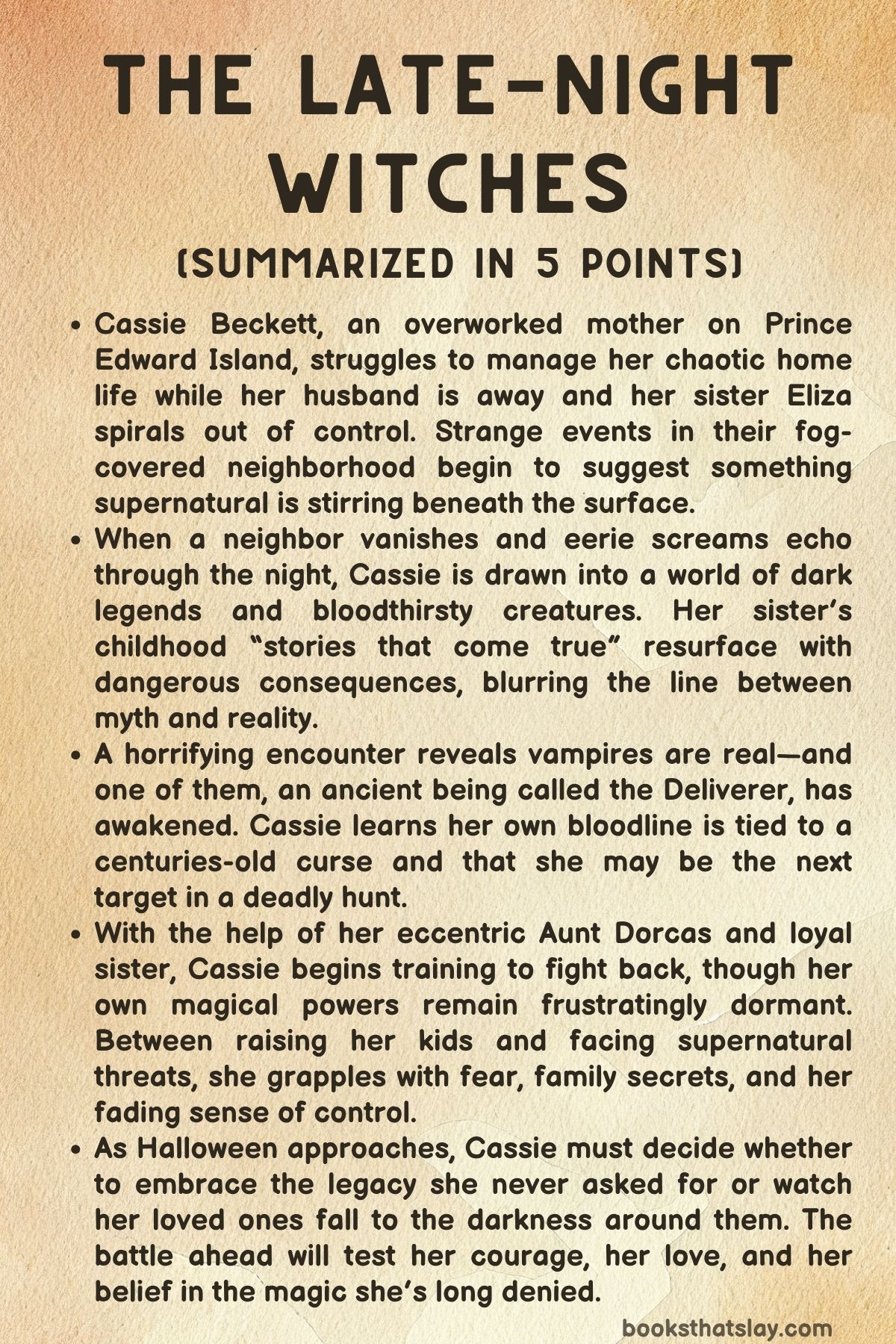
Summary
Cassie Beckett lives a strained, lonely life in the quiet Burrow neighborhood on Prince Edward Island. With her husband Matt abroad for work, she shoulders the chaos of raising three children alone.
Her younger sister Eliza, impulsive and unpredictable, often adds to the turmoil. On a foggy October night, Cassie’s world begins to change.
She notices a sinister jack-o’-lantern on her porch, encounters her disheveled sister after a drunken outburst, and hears an unearthly cry in the fog. Her cat reacts violently to something unseen, and Cassie senses that something ancient and wrong is stirring around her.
The next day, Cassie learns that her neighbor Gary vanished during his nightly run. At work, a coworker named Patty suggests Cassie contact her estranged Aunt Dorcas, a woman long associated with local witch rumors.
Uneasy, Cassie returns home only to receive a panicked call from Eliza. Her sister claims that her boyfriend Tommy is acting strangely after she “told him a story,” a habit from childhood that once seemed to make her words come true.
As Cassie rushes to help, she witnesses something horrifying—Tommy, bloodied and dazed, stands before a woman named Joanne, Cassie’s hairdresser, who reveals herself as a vampire. Cassie and Eliza barely survive the encounter when Joanne is struck by a car driven by their new neighbor, Ben, but her body mysteriously vanishes.
Back at Cassie’s home, the sisters try to make sense of what they saw. Tommy, now craving raw meat, begins to transform into a vampire.
Ben, calm but curious, helps them investigate. They uncover clues from island folklore about a vampire called the Deliverer of Fear, Sorrow, and Death.
According to legend, a powerful witch once trapped him in a cycle of sleep and awakening, and to break free, he must kill thirteen witches from her bloodline—each called the Thirteenth Witch in her generation. Cassie realizes with horror that she is the latest in this cursed line.
Aunt Dorcas soon appears, confirming their worst fears. She wields real magic and decapitates a vampire messenger before revealing that Cassie is the Deliverer’s current target.
Dorcas urges them to seek shelter at Sea House, a coastal haven tied to their family’s history. Cassie resists at first but eventually joins her aunt and sister there for safety and training.
At Sea House, Cassie struggles to awaken her powers while Eliza flourishes, discovering she can move objects with her mind. Dorcas pushes Cassie through exhausting physical and magical training, insisting her strength will come from within.
Yet nothing works—Cassie can’t summon even the simplest spell. As days pass, she feels overshadowed by Eliza’s progress and doubts her role in the coming battle.
One day, Cassie stumbles upon the ruins of a burned house and falls into underground tunnels filled with decaying remains—an old vampire burrow beneath her own property. Trapped in the dark, she hears whispers calling her name and narrowly escapes an attack from a reanimated corpse when sunlight destroys it.
The encounter confirms that the Deliverer’s minions are already active. Dorcas warns that Cassie’s magic is bound to emotion and intention, urging her to find faith in herself before it’s too late.
On October 13th, Cassie meets the Deliverer, known as Del, in a seaside bar. Calm, arrogant, and terrifyingly human in appearance, he taunts her with truths she isn’t ready to face.
He claims that her mother—not Dorcas—was the witch who fought him twenty-five years ago and died in the process. He mocks Cassie’s lack of power, boasting that he’s nearly free.
Before she can attack him with a poison potion, he vanishes, leaving chaos outside as vampires under his control battle her family. Among them is Patty, newly turned and heartbroken.
Cassie rescues her, realizing that the vampire’s reach extends through the entire town.
Ben later reveals a devastating discovery: only Cassie, as the Thirteenth Witch, can kill Del. The others can fight, but they cannot end him.
The revelation breaks her spirit. Dorcas admits she never knew the full curse and confesses that she erased Cassie’s childhood memories to protect her from their past.
When Cassie drinks a potion restoring those memories, she recalls that she once found a magical coin forged to destroy vampires—the same weapon her mother used against Del. That coin is now Cassie’s last hope.
Determined to fight, Cassie reconciles with Eliza. They share their fears and hopes, realizing that their love for each other is their greatest weapon.
They agree on a plan: Eliza will distract Del with her storytelling magic while Cassie delivers the killing blow. As battle erupts in the streets, Del and his vampires descend.
Cassie fights fiercely, using every trick she learned, though Del quickly overpowers her. Eliza’s stories ignite bursts of blue flame that scatter the vampires, but Del’s strength is immense.
In a climactic moment, Cassie channels the sea itself, unleashing a storm that sweeps away Del’s army. When she collapses, Del strikes back, believing he’s won—but Cassie and Eliza unite one final time.
With Eliza’s words shaping reality, Cassie drives a stake through Del’s heart. Dorcas, poisoned but conscious, completes the spell by calling down fire, and Del explodes in a storm of blood.
The surviving witches, half-vampires, and townsfolk rejoice. The curse is broken.
Cassie’s children arrive safely, revealing that Sadie, her eldest, had secretly brewed the potion that helped melt Del’s face earlier. The family reunites as their community celebrates victory.
Even the no-nonsense neighbor Mrs. MacDonald joins in, humorously decapitating a lingering vampire with garden tools.
Weeks later, Cassie, Eliza, Dorcas, and their family celebrate Yule at Sea House. Life has returned to a fragile normalcy.
Cassie’s magic now feels steady and natural, and she accepts her role as protector of her family’s legacy. When she throws the enchanted coin into the sea to destroy its dangerous power, distant howls echo on the wind—new creatures stirring beyond the horizon.
Dorcas jokingly mentions werewolves, and the sisters ready themselves once again. Standing on the frozen beach with her daughter, Cassie embraces both her power and her purpose, knowing that whatever darkness returns, she will face it as a witch, a sister, and a mother.
Characters
Cassie Beckett
Cassie is the reluctant center of power in The Late-Night Witches—a sleep-deprived mother who would rather color-code a family calendar than carry a destiny. Her arc moves from denial to ownership: the woman who insists she is ordinary becomes the Thirteenth Witch who can command the sea.
Cassie’s core trait is protectiveness; every choice is measured against the safety of Sadie and the twins, which is why she initially resists Dorcas, distrusts magic, and clings to routines. Shame over her “failed” powers fuels self-sabotage, yet she keeps showing up—training, missing, trying again—until endurance itself becomes competence.
Her magic expresses her values: when it finally awakens, it manifests as stormcraft that shelters allies while uprooting enemies, a maternal version of wrath that is precise rather than wantonly destructive. Cassie’s moral compass also rejects shortcuts; even when tempted by the coin’s absolute solution, she chooses effort and partnership, turning a prophesied victim into the decisive executioner of Del.
Eliza Beckett
Eliza is chaos with a heartbeat, the sister who arrives out of the fog dragging a bat and a lifetime of messes—and then blindsides everyone by levitating cutlery like it’s air. She externalizes what Cassie suppresses: appetite, impulse, bravado, and a reckless tenderness that insists people can be saved, even when that faith is inconvenient.
Her storytelling quirk, once a childhood game, becomes a perilous gift that can bend events, and the book tests whether she will weaponize it or ground it in responsibility. Eliza’s deepest fear is abandonment, especially by Cassie, so her swagger hides a plea to be chosen as family, not tolerated as trouble.
She evolves from comic relief and catalyst to a tactical partner who creates openings in battle, then trusts Cassie to finish the work—a sisterhood shaped into strategy.
Dorcas
Dorcas is the family’s storm-scarred matriarch, equal parts iron and remorse. She is competence personified—scythes, glamours, potions, and plans—and also the keeper of omissions.
By withholding history and even Cassie’s memories, she repeats an old witch’s mistake: mistaking secrecy for protection. Her love is practical and occasionally tyrannical, but never theatrical; she feeds children, sets drills at dawn, and stands between the living and whatever crawls out of tunnels.
The revelation that only Cassie can kill Del punctures her stoicism, exposing grief for past misjudgments and a willingness to learn tenderness late. Her magic is elemental and old, yet her greatest contribution is pedagogical: she teaches discipline until Cassie’s power has something solid to inhabit.
Del, the Deliverer
Del is the ancient predator built for modern subtlety. He is frightening not because he rants but because he barely registers; the mind slides off him, which turns charisma into camouflage.
His method is attrition—erase memory, return with the fog, isolate the target, and repeat the generational cull. He exploits family fractures and self-doubt, telling just enough truth to salt every wound.
Del’s fixation on the Thirteenth Witch reveals his blind spot: he understands bloodlines better than relationships. He can count generations, but he cannot account for sisters who improvise or a mother who turns love into weather.
In the end, the tyrant who believes only in inevitability is beaten by contingency, collaboration, and a stake delivered through timing rather than brute force.
Ben
Ben is the narrative’s ballast, an archivist-dad with a baby carrier and a researcher’s persistence. He translates folklore into field intel, turning island legends into playbooks and giving the witches a map when all they have is fog.
His steadiness counters volatile magic; he listens, verifies, and brings sources rather than slogans. Ben’s courage is domestic and exact: he drives, he carries, he babysits, and he keeps asking better questions.
As a neighbor-turned-ally, he models how non-witches matter in a witch war—by noticing patterns, lending skills, and believing women who sound impossible.
Sadie Beckett
Sadie is competence in sneakers, the teen who cooks dinner, manages twins, and brews a potion that melts half of Del’s face. She inherits Cassie’s protectiveness and Dorcas’s curiosity, and she expresses both as craft—reading, mixing, testing.
Sadie’s stealthy bravery, from stowing away to steering her siblings to safety, reframes “kid” as contributor. Her relationship with Cassie closes a generational loop; she wants honesty more than spectacle and offers back pride without illusion, anchoring the family’s future practice of magic in transparency.
Sly and Eddie
The twins embody everyday stakes—the noise, wonder, and logistics that never pause for apocalypse. They motivate Cassie’s refusal to romanticize danger and anchor scenes in tactile reality: boots that still need buying, games by the fire, and sand dollar expeditions.
Their presence keeps the book’s magic calibrated to caregiving, reminding everyone that heroism includes snacks, bedtime, and repaired porch lights.
Tommy
Tommy is a moral litmus test for the story’s rule about the newly turned. As Eliza’s ex and early victim, he sits at the hinge between culpability and contamination.
The narrative refuses to flatten him into a cautionary corpse; housed in a stone basement on raw meat, he embodies the question of whether monstrosity is a destination or a detour. His survival and partial redemption validate Eliza’s insistence that people are not only what the curse makes of them.
Patty
Patty is the island’s memory in an apron—the kindly coworker who knows which dates matter and which names people forget every twenty-five years. Her turning into a vampire hurts because it collapses the distance between folklore and the cashier who bags your nails.
She personalizes the cost of delay and sharpens Cassie’s resolve to end Del’s cycles so ordinary goodness can remain ordinary.
Joanne
Joanne is horror’s betrayal of the everyday—your hairdresser with a perfect posture and a mouth that can unhinge. She dramatizes the book’s thesis that evil often arrives styled, smiling, and on schedule.
As the first visible monster, she shocks Cassie awake, but even in death she teaches a rule: in this world, aesthetics lie, and survival requires looking past polish to pattern.
Mrs. MacDonald
Mrs. MacDonald functions as a cranky sibyl, the neighbor who trims hedges and destinies.
Her blunt warnings cut through Cassie’s denial, and her last-act decapitation of Del’s butler with a hedge trimmer turns lawn care into myth. She represents the island’s fierce, practical witches-adjacent population—people who may not fling spells but will swing tools, keep watch, and tell you to get yourself together.
Gary
Gary’s disappearance is the summary’s first siren. A runner who fades into the fog, he becomes a touchstone for what the town forgets and what the sisters are forced to remember.
When he reappears as a turned combatant, he underscores Del’s habit of converting the familiar into the weaponized.
Hank
Hank is the hardware escalation—a purveyor of real weapons in a story that begins with spatulas and school lunches. He legitimizes Cassie’s shift from defensive denial to armed readiness and later becomes Dorcas’s caretaker, proving that competence can be both martial and tender.
Matt
Matt, the absent husband doing good elsewhere, sharpens the book’s exploration of invisible labor. His absence isn’t villainy, but it creates a vacuum that exposes how much of family survival is carried by the person who stays.
By the finale, it’s clear that partnership, not proximity, defines contribution; the network Cassie builds locally is the marriage that matters to the plot.
Ben’s baby Olive
Olive is vulnerability in its purest form—and a quiet plot device that keeps Ben in the narrative’s heartspace. The image of a man racing toward carnage with a baby strapped to his chest reframes bravery as childcare in motion and keeps the stakes stubbornly human whenever fangs and legends threaten to abstract them.
Janet the Cat
Janet is the domestic familiar who senses the uncanny before the humans admit it. Her reactions—hissing at the fog, bristling at the scream—act as organic barometers of the supernatural, reminding the reader that nature often notices first.
Themes
Family and Responsibility
Cassie Beckett’s life in The Late-Night Witches revolves around her family, and the strain of responsibility is present in nearly every moment she experiences. Her husband’s absence forces her into a single-handed battle with domestic chaos—raising three children, maintaining a job, and caring for her reckless sister, Eliza.
The novel portrays the emotional toll of being the stabilizing force for others while receiving little support in return. Cassie’s exhaustion and quiet resilience become the emotional foundation of the story, showing how familial duty can both ground and suffocate a person.
The book presents motherhood not as an idealized role but as an unending negotiation between sacrifice and self-preservation. Cassie’s interactions with her children are laced with love, frustration, and protectiveness, particularly when supernatural danger invades their home.
Her sense of responsibility expands beyond her immediate family to her sister, aunt, and even her cursed bloodline, as she comes to realize she must defend generations of women before her. The family theme matures into a recognition that shared history—whether magical or mundane—binds people together even through anger and distrust.
Cassie’s evolving relationship with Dorcas, her estranged aunt, and Eliza shows that family connections are complex, capable of betrayal and redemption alike. Ultimately, the story transforms responsibility from a burden into a source of empowerment: Cassie’s capacity to endure for her family becomes the very essence of her magic.
Female Power and Identity
The journey of power in The Late-Night Witches is deeply intertwined with womanhood and the rediscovery of self. Cassie begins as an overworked mother who doubts her worth, her confidence eroded by years of invisibility and exhaustion.
The supernatural awakening of her lineage mirrors her personal awakening—her growth from self-doubt to self-definition. Her magic, dormant at first, symbolizes her suppressed individuality.
Each failure during her training with Dorcas exposes the emotional scars left by years of caretaking without acknowledgment. Through Eliza’s effortless levitation and Dorcas’s commanding authority, the novel explores different expressions of feminine strength: raw talent, inherited wisdom, and patient endurance.
Cassie’s eventual realization that her magic is rooted in love rather than control underscores the book’s assertion that power for women often arises from emotional depth rather than aggression. The narrative also subverts traditional depictions of witchcraft as dark or forbidden, reclaiming it as an inheritance of resilience, protection, and generational knowledge.
By the end, Cassie’s acceptance of her role as the Thirteenth Witch is not an embrace of destiny forced upon her but a declaration of autonomy. She stops seeing her identity as something defined by others—mother, wife, witch—and instead fuses all those selves into a unified strength.
Her triumph is not only over the vampire Del but also over the internalized belief that she was never enough.
The Burden of Legacy and Memory
Legacy haunts every corner of The Late-Night Witches, shaping the destinies of its women across generations. The Beckett bloodline carries both magical potential and tragic responsibility, with each eldest daughter bound to face the Deliverer.
This hereditary curse symbolizes the inescapable weight of family history—the idea that the past is never truly past. Cassie’s initial ignorance of her lineage reflects how families often conceal painful truths to protect younger generations, only for those secrets to resurface stronger than ever.
The recovery of her childhood memories through Dorcas’s spell represents more than magical revelation; it is an act of reclaiming identity from erasure. Memory in the novel is both weapon and wound—those who remember carry unbearable grief, while those who forget lose their connection to truth.
Cassie’s journey to understanding her mother’s sacrifice deepens her awareness of how trauma, loss, and courage pass silently through bloodlines. Dorcas’s decision to remove Cassie’s memories, while protective, also mirrors the destructive nature of secrecy within families.
The book uses supernatural inheritance as a metaphor for emotional inheritance—the traits, fears, and strengths passed down without consent. By confronting her past and accepting her family’s history, Cassie breaks the cycle of denial and guilt that has trapped her ancestors.
The resolution, where she throws the magical coin into the sea, becomes both literal and symbolic cleansing—a refusal to let legacy dictate her children’s future.
Courage and Transformation
Courage in The Late-Night Witches manifests not through fearlessness but through perseverance in the face of exhaustion, grief, and disbelief. Cassie’s transformation from an ordinary woman to a warrior witch is gradual, grounded in emotional authenticity.
Her courage is born not from destiny but from love—her instinct to protect others even when she feels powerless. Throughout the novel, she repeatedly chooses action over surrender, despite her constant self-doubt.
This portrayal reframes heroism as something rooted in persistence and compassion rather than grand gestures. The book also examines courage as a communal force: Eliza’s reckless bravery, Dorcas’s quiet determination, and even Ben’s human loyalty all contribute to Cassie’s evolution.
The climactic battle with Del is less a supernatural showdown than a testament to human resilience—the willingness to confront darkness, literal and emotional, without certainty of victory. Cassie’s rediscovery of her magic through connection to the sea encapsulates this idea: her strength flows from her acceptance of vulnerability, from letting herself feel everything she once suppressed.
The transformation theme thus extends beyond magic—it reflects emotional rebirth. By the novel’s end, Cassie has not escaped fear but learned to move through it, embodying a form of courage that values endurance, empathy, and belief in one’s own worth.
Her journey from invisibility to empowerment closes the story with quiet triumph, showing that the most profound transformations begin not with spells or prophecies but with the decision to keep standing when everything feels impossible.