The Lies that Summon the Night Summary, Characters and Themes
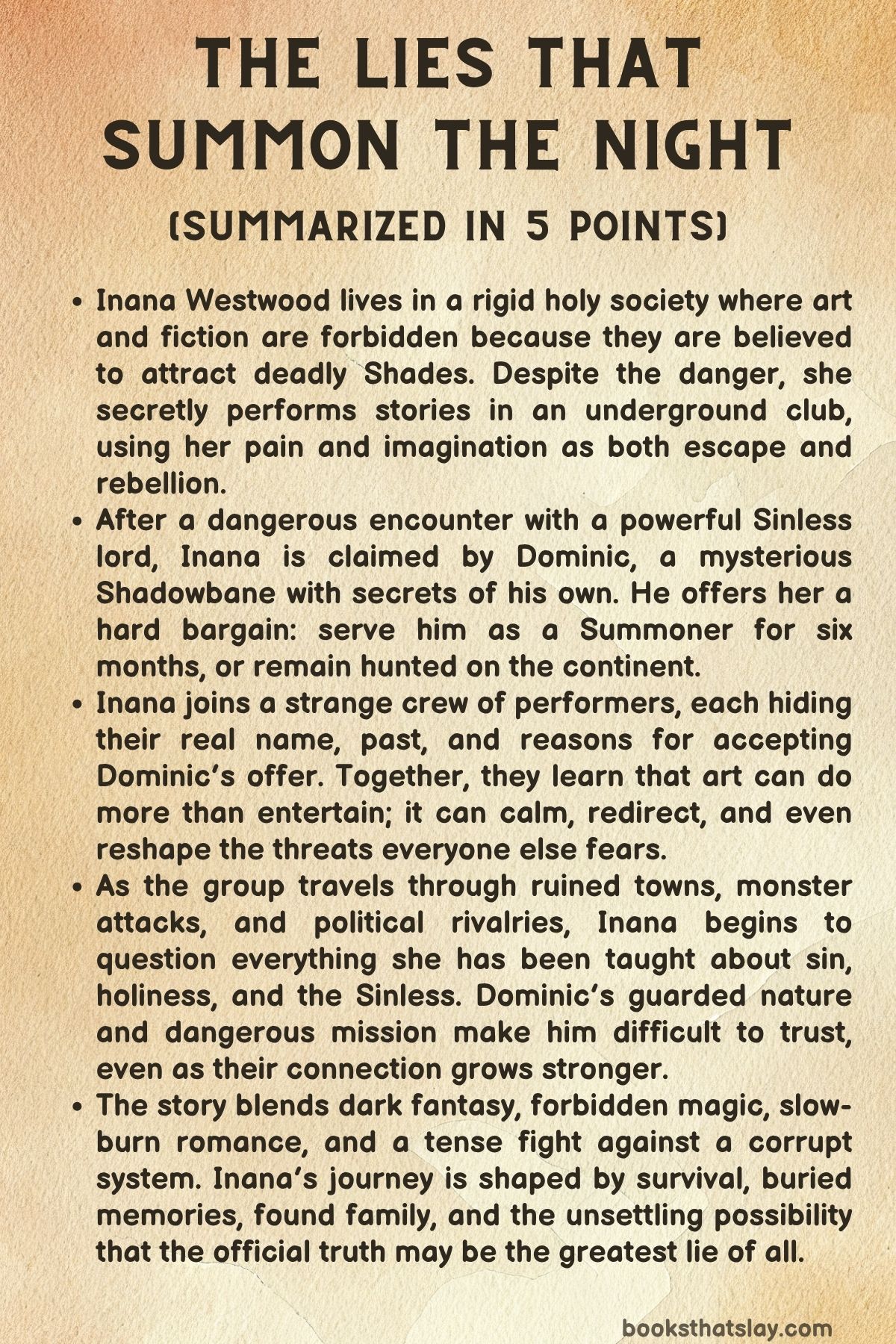
The Lies that Summon the Night by Tessonja Odette is a dark fantasy romance set in a holy empire built on secrets, fear, and controlled faith. The story follows Inana Westwood, a forbidden storyteller living in a world where art is treated as sin because it draws deadly shadow creatures called Shades.
When a dangerous Shadowbane named Dominic claims her service, Inana is pulled into a mission that challenges everything she has been taught about sin, immortality, and salvation. The book blends danger, rebellion, magic, desire, and identity as Inana learns that the monsters outside the light may not be the true enemy. It’s the 1st book of the Songs for the Sinless series.
Summary
Inana Westwood lives on the Holy Continent, a land ruled by the Sinless. These immortal rulers were once human but have undergone Absolution, a sacred process that supposedly purifies them and places them above ordinary people.
Their rule is justified by the threat of Shades, shadow creatures said to be born from human sin. Because art, fiction, music, and performance are believed to attract Shades, creative expression is outlawed.
For Inana, this law has always been impossible to obey. She is a storyteller by nature, and the urge to shape pain into performance has survived even fear, punishment, and loss.
After being caught more than once for forbidden art, Inana is forced into indentured service under Mr. Rockefeller. She secretly performs at the Wretched Lair, an underground club in Nalheim where rich patrons pay to enjoy the very sins they publicly condemn.
During one performance, she uses stitched silk hearts to tell a story drawn from her own trauma: a woman whose heart was torn apart and sewn back together. The act draws the attention of Lord Wheaton, a Sinless noble who tries to expose and control her.
Before he can fully corner her, a Shadowbane named Dominic steps in.
Dominic claims Inana as his own and reveals that he knows who she really is. Inana had once been chosen as a sacrifice by Henry Berkham, a Sinless duke and her former fiancé.
Henry intended to cut out and consume her heart as part of the ritual needed to light a Holy Brazier. Inana escaped him, but the experience left her hunted, hidden, and afraid of being found.
Dominic has bought her contract from Rockefeller, and he offers her a harsh bargain. She can run and be pursued by his Shades, or she can serve him for six months as a Summoner.
If she survives that service, he promises to send her away from the continent by ship.
Inana agrees to go with him. Two other performers are also recruited: Bard and Harlot, who later reveal their real names as Rykar and Harlow.
Dominic’s own secret becomes clear as the journey begins. He commands three Shades named Sloth, Lust, and Pride.
They resemble parts of him, speak with distinct personalities, and seem especially aware of Inana. Unlike the others, Inana can hear them, which makes her connection to Dominic and his shadows feel strange from the start.
The group also collects Calvin, Dominic’s blood source. Calvin suffers from a disease that prevents his blood from clotting, and Dominic’s blood helps keep him alive.
In return, Calvin provides blood when Dominic needs power. Their arrangement shows that Dominic’s work as a Shadowbane depends not only on holy duty but on blood magic, loyalty, and physical cost.
At a ruined cottage, Dominic begins teaching the newly recruited Summoners what their work really involves. Inana tells her full history.
Henry had returned to her village as a newly made Sinless duke, already married to another woman, and selected her as the sacrifice for Dunway’s Holy Brazier. He blamed her storytelling for attracting Shades and treated her life as the price of cleansing the village.
Inana survived by distracting him with a story and running, though her memory of what happened afterward remains broken.
As she tells this story, Shades gather around the clearing, drawn by the force of her art. Dominic does not order the Summoners to stop.
Instead, he teaches them to stay calm and use creativity to soothe the creatures rather than provoke them. This moment begins to undo Inana’s understanding of Shades.
They are dangerous, but they are not mindless beasts in the way the church claims. Dominic then captures a Shade that wears his face using solar astrotheurgy, a form of magic linked to light and blood.
The sight raises Inana’s suspicion that Dominic is keeping far more from her than he admits.
Dominic soon receives an urgent magical message from the church, and the crew hurries toward Thornfal. Calvin explains that Dominic is trying to earn a nomination for full Absolution during the coming Year of Bastien.
A failure at his post could destroy that chance. When the group reaches Thornfal, the town is under attack by a vast dragon-shaped Shade formed from many smaller Shades.
Dominic prepares to fight, but Inana, Rykar, and Harlow act differently. Through storytelling, music, and drawing, they transform the creature into harmless flying-squirrel Shades and scatter the threat without mass killing.
Thornfal rewards and shelters them afterward. Inana and Dominic grow closer, though neither fully trusts the other.
Dominic is meant to be disciplined, holy, and detached, yet his feelings for Inana threaten that image. Their uneasy bond is tested further when another Shadowbane, Henderson, arrives with his own Summoner.
Henderson needles Dominic, hints at old hostility, and may have played a role in the creation of the dragon Shade. Dominic suspects sabotage but has no proof strong enough to use.
The crew leaves Thornfal and travels toward Eldeen. Along the way, they find abandoned wagons and slaughtered travelers.
One of the bodies still moves, revealing itself as an Incarnate, a Shade that has consumed and copied a human identity. Dominic gives the others the choice to stay back or help.
Inana and Rykar go with him. Dominic approaches carefully, but once the Incarnate realizes the identity it copied is false, it attacks.
Dominic uses blood and astrotheurgy to ignite his sword, Rykar plays music to control the surrounding panic, and Shades surge from the trees. Dominic kills the Incarnate by cutting off its head, but a shadow spear pierces him beneath the collarbone.
The wound is serious because injuries caused by Shades do not heal normally. Back at the wagon, Inana, Harlow, and Calvin try to save him.
Calvin cannot help directly because Dominic’s blood affects him too strongly, so Inana stitches Dominic’s wound herself. While caring for him, she discovers an astrotheurgical scar carved into his chest.
When Dominic wakes, he explains that he has vowed not to reveal it, but because she saw it by accident, the vow remains unbroken. He then gives her a disturbing hint: the holy texts may be false, and he is the only one among them whose sin has created Shades.
The journey grows more dangerous. Inana encounters one of the small squirrel-like Shades created during the Thornfal attack, and Sloth reacts with jealousy.
Later, Dominic notices Shades moving in one shared direction. The wagon reaches a bridge where Henderson waits with armed Summoners and a prepared trap.
Henderson reveals that he knows Dominic offers his Summoners freedom instead of Absolution, a dangerous secret that could condemn him. Dominic responds with a blood-fueled ritual circle, kills two of Henderson’s Summoners, wounds Henderson’s favored Summoner, and escapes with his crew.
The bridge collapses because Henderson’s diagram includes a heat glyph, and Inana falls into the freezing river. Dominic dives after her, aided by his Shades, and pulls her to shore.
They take refuge in a cave during a blizzard. To keep her from freezing, Dominic removes their wet clothes and uses his body heat to warm her.
Their closeness leads to a vivid sensual dream, and when they wake, both are shaken by the attraction they can no longer deny.
In the cave, Inana asks about Henderson’s accusation that she destroyed Dunway. Dominic tells her that Dunway was destroyed by Shades after Henry Berkham died, though official records falsely claim Henry never became Sinless.
Inana realizes the Sinless can be killed and fears she may have killed Henry, even though her memories remain incomplete. Dominic then reveals the deeper truth.
Shades are not born from ordinary human sin. They are created by Absolution itself, which cuts lunar energy from the souls of the Sinless.
Dominic’s Shades, Pride, Lust, and Sloth, are pieces of his own soul. Other captured Shades are severed parts of Sinless souls.
Dominic also confesses that he is part of a rebellion. His goal is to kill King Kaelum by gathering the king’s severed Shades and reversing his Absolution, making him mortal again.
This truth changes everything Inana thought she knew. The holy order is not protecting humanity from sin; it is built on a process that creates the very monsters it claims to fight.
Inana gives Dominic blood so he can use astrotheurgy to fell a tree and cross the river. They reunite with the crew, and Dominic eventually tells the others the truth.
Rykar reveals his own reason for joining Dominic: he is searching for the Shadowbane who gave his daughter to Lord Doan. The mission becomes more personal for everyone, joining rebellion with private loss.
When the group reaches Eldeen, Dominic includes the Summoners in patrols, treating them less like servants and more like allies. Inana meets Tera, a survivor from Dunway, who suggests that the survivors know “the truth.” Inana also receives a note urging her to turn herself in, which pushes her to seek the missing pieces of her memory.
The final revelation is devastating. Inana herself is an Incarnate, created from one of King Kaelum’s severed Shades after Henry’s death.
Dominic understands this when she reacts to the scent of the king’s blood. The discovery threatens his entire mission, because if Inana carries one of Kaelum’s missing soul pieces, then the plan to make the king mortal may already be broken.
More painfully, it forces Inana to question what she is, whether her memories and feelings are truly her own, and whether Dominic can love someone tied to the enemy he intends to destroy.
Characters
Inana Westwood
Inana Westwood is the emotional center of The Lies that Summon the Night and one of the most layered figures in the book. She begins as a woman trapped between fear and longing: fear of being found by the Sinless world that has already tried to destroy her, and longing for the forbidden beauty of stories, art, and performance.
Her attraction to storytelling is not a shallow rebellion but a core part of her identity. In a society that teaches people to fear imagination because it supposedly summons Shades, Inana’s creativity becomes both her danger and her resistance.
Her stitched silk-heart performance shows how deeply she transforms pain into art. She does not simply remember heartbreak; she reshapes it into a symbolic act of survival, suggesting that even when she has been torn apart, she refuses to become silent.
Inana’s past with Henry Berkham defines much of her early fear and distrust. She was not merely betrayed by a former fiancé; she was chosen as a sacrifice by someone who once represented love, safety, and social legitimacy.
This makes her wary of powerful men, especially those connected to the Sinless system. When Dominic claims her contract, her suspicion is understandable because he initially appears to be another figure of control.
Yet Inana is not passive. Even when cornered, she weighs her options, observes carefully, and chooses the path most likely to preserve her future.
Her decision to serve Dominic for six months is not surrender but survival under pressure.
Her development is closely tied to the gradual collapse of everything she has been taught. She learns that art does not simply create evil, that Shades are more complicated than church doctrine allows, and that the Sinless may be the true source of corruption.
This discovery forces Inana to question not only society but also her own memories. The revelation that she is Incarnate makes her character especially tragic and powerful.
She is forced to confront the possibility that her identity, body, and memories may be connected to King Kaelum’s severed Shade rather than ordinary humanity. Yet this does not make her less real as a character.
Instead, it deepens the book’s questions about personhood, sin, memory, and the soul. Inana’s struggle is not only about escaping danger but about deciding whether she can still claim herself when the world tells her she is something unnatural.
Dominic
Dominic is one of the most morally complex characters in the book because he stands at the intersection of oppression, rebellion, violence, and tenderness. As a Shadowbane, he appears at first to be an agent of the same religious order that has criminalized art and hunted people like Inana.
He is powerful, secretive, and intimidating, and his first major act toward Inana is possessive: he buys her contract and gives her limited choices. Yet beneath this harsh exterior is a man actively working against the system he seems to serve.
His role as a Shadowbane is both mask and burden, allowing him to collect knowledge, power, and Shades for a rebellion aimed at undoing Absolution itself.
Dominic’s control over Sloth, Lust, and Pride reveals that his inner life has been physically externalized. These Shades are not just magical companions; they are fragments of his severed self.
Through them, the book makes his emotional repression visible. Pride reflects his command, arrogance, and wounded dignity.
Lust reflects the desire he tries to deny, especially as his bond with Inana grows. Sloth suggests exhaustion, avoidance, and the part of him that may long to stop carrying impossible burdens.
Dominic’s struggle is therefore not simply political. He is literally divided by the same system he seeks to destroy.
His relationship with Inana brings out his contradictions. He threatens her at the beginning, yet repeatedly protects her.
He claims authority over her, yet promises her freedom. He is capable of brutal violence, especially during the confrontation with Henderson, but he is also careful with Inana in moments of vulnerability.
The cave scene after the river incident reveals the emotional tension beneath his restraint. Dominic wants connection but believes his nature, vows, and mission make that desire dangerous.
His hidden scar and forbidden knowledge suggest a man shaped by vows, pain, and rebellion. By the time he reveals the truth about Absolution and King Kaelum, Dominic becomes less a dark captor and more a damaged revolutionary whose methods remain morally uneasy even when his cause appears justified.
Rykar, also known as Bard
Rykar, first known as Bard, represents the wounded artist whose music carries both beauty and grief. At first, he appears as part of the underground performance world, someone who survives by participating in forbidden entertainment.
Like Inana, he is drawn into Dominic’s service because his art has value in dealing with Shades. His music is not decoration in the story; it becomes a force that can influence, soothe, and redirect dangerous creatures.
This makes Rykar important to the book’s larger argument that art is not inherently sinful or destructive. In the right hands, it can heal, transform, and save lives.
Rykar’s personality is marked by sorrow that gradually becomes clearer. His reason for joining Dominic is deeply personal: he is searching for the Shadowbane who gave his daughter to Lord Doan.
This gives him a private motive that is separate from Dominic’s rebellion and Inana’s survival. Rykar is not simply a side companion; he is a father shaped by loss, guilt, and unresolved rage.
His art likely carries the emotional weight of that loss, which makes his music feel connected to memory and mourning.
He also functions as one of the first members of the group to stand beside Inana in danger. When Dominic gives the crew a choice after the ruined camp, Rykar chooses to go with him and Inana.
This shows courage, but it also suggests that Rykar understands the cost of looking away. He has already lost too much to be innocent, and his presence adds emotional gravity to the group.
He is a character whose softness and pain coexist with bravery, making him one of the most quietly tragic figures in the story.
Harlow, also known as Harlot
Harlow, introduced under the stage name Harlot, embodies the way society reduces people to roles while the story slowly restores their fuller humanity. Her performance identity suggests sensuality, scandal, and survival within the forbidden world of the Wretched Lair.
However, once she is brought into Dominic’s crew and her real name is revealed, she begins to emerge as more than the persona assigned to her. This shift from Harlot to Harlow matters because it marks the difference between how the world consumes her and who she is among people who begin to know her.
Harlow’s art, particularly drawing, becomes essential during the Thornfal attack. Alongside Inana’s storytelling and Rykar’s music, her visual creativity helps transform the dragon-shaped Shade into harmless flying squirrels.
This moment shows that her imagination is not merely ornamental or provocative; it has real power. She participates in one of the clearest examples of art saving lives without violence.
Through Harlow, the book challenges the belief that sinful expression must lead to destruction.
She also contributes to the group’s emotional and practical survival. When Dominic collapses from the Shade wound, Harlow is part of the urgent response to keep him alive.
Her presence helps create the feeling that Dominic’s recruited performers are becoming a crew rather than a collection of captives. Harlow may not receive the same central focus as Inana or Dominic, but she is important because she represents resilience, adaptability, and the hidden dignity of people dismissed by a judgmental society.
Calvin
Calvin is a fragile yet significant character whose relationship with Dominic reveals the strange intimacy and dependency created by blood, illness, and power. He suffers from a disease that prevents his blood from clotting, making his body vulnerable in a world already filled with violence.
Dominic keeps him alive by giving him blood, while Calvin provides blood to Dominic when needed. Their arrangement could easily seem exploitative, but the details suggest something more complicated: mutual dependence, loyalty, and a shared history built around survival.
Calvin often serves as a source of information for Inana and the others. He explains Dominic’s ambitions regarding Absolution and helps the group understand what Dominic stands to lose if he fails.
This makes Calvin a bridge between Dominic’s secrecy and the crew’s confusion. He knows enough to clarify parts of Dominic’s world, yet he is not always strong enough to act physically in moments of crisis.
His inability to help when Dominic is bleeding emphasizes the limits imposed by his condition and the danger of their bond.
As a character, Calvin adds vulnerability to Dominic’s circle. He reminds readers that the rebellion and the fight against the Sinless are not only carried by warriors and artists but also by people whose bodies are compromised and whose survival depends on trust.
His presence makes Dominic appear less isolated and less monstrous, because Dominic’s care for him suggests a capacity for loyalty that complicates his harsher actions.
Henry Berkham
Henry Berkham is one of the most important figures in Inana’s trauma, even though much of his role is filtered through memory, fear, and revelation. He begins as the former fiancé who once represented a possible future for Inana, but he returns transformed by power and Absolution.
As a newly made Sinless duke, married to another woman, he chooses Inana as the sacrifice for Dunway’s Holy Brazier. His betrayal is intimate and ideological at the same time.
He condemns her storytelling as sinful and uses that accusation to justify trying to cut out and consume her heart.
Henry represents the cruelty of righteousness when it is fused with power. He does not see Inana as a beloved person anymore; he sees her as a symbolic offering, a sinner whose destruction can serve a supposedly holy purpose.
This makes him frightening not only because he is violent, but because he believes his violence has sacred meaning. His attempted sacrifice of Inana shows how the Sinless system turns human beings into tools for maintaining religious and political order.
The later revelation that Dunway was destroyed after Henry died complicates his role further. If Inana’s lost memories are connected to his death, then Henry becomes the center of a hidden truth about the mortality of the Sinless and the false records used to protect their image.
He is both a personal villain in Inana’s past and a clue to the larger lie sustaining the Holy Continent. His death, disappearance from official truth, and connection to Inana’s transformation make him a key figure in the story’s mystery.
Henderson
Henderson is Dominic’s rival and a representative of the corrupt ambitions within the Shadowbane order. He is antagonistic from the moment he appears, using intimidation, accusation, and public pressure to undermine Dominic.
His rivalry with Dominic is not just personal jealousy; it reflects a larger conflict over power, obedience, and control. Henderson appears to understand enough about Dominic’s methods to threaten him, especially when he exposes that Dominic offers his Summoners freedom rather than Absolution.
Henderson’s use of armed Summoners and traps shows that he is strategic and ruthless. He is willing to endanger Dominic’s crew and manipulate the battlefield through prepared diagrams and destructive glyphs.
His confrontation at the bridge reveals a man who hides cruelty behind institutional authority. Unlike Dominic, whose violence is tied to rebellion and desperate purpose, Henderson’s violence feels rooted in domination and self-interest.
He also functions as a foil to Dominic. Both are Shadowbanes, both command danger, and both operate within the same brutal world.
However, Henderson appears more fully aligned with the system’s corruption, while Dominic secretly works to overturn it. Their conflict helps the reader see that the Shadowbanes are not a unified moral category.
Some are tools of oppression, some are rivals within the hierarchy, and Dominic is something more unstable: a weapon turned against its makers.
Mr. Rockefeller
Mr. Rockefeller represents the exploitative underworld that exists beneath the Holy Continent’s public morality. As the person to whom Inana is indentured, he profits from forbidden entertainment while remaining part of a system that punishes the vulnerable.
His connection to the Wretched Lair shows the hypocrisy of wealthy patrons who publicly benefit from a society that condemns sin but privately seek out sinful pleasures in controlled spaces.
His role in the book is important because he shows that oppression does not only come from the church or the Sinless. It also comes from ordinary systems of ownership, debt, and labor.
Inana’s indenture to him means she is not free even before Dominic enters her life. Rockefeller’s world allows the rich to consume art and danger while performers bear the consequences.
He profits from the very talents that society criminalizes.
Although he is not as central as Henry, Henderson, or Dominic, Rockefeller helps establish the moral landscape of the story. He is part of a chain of control over Inana’s body, labor, and identity.
Dominic buying her contract from him is troubling, but it also transfers Inana from one form of captivity into a more complicated arrangement that eventually opens the possibility of freedom.
Wheaton
Wheaton is a Sinless lord whose brief but threatening presence reveals the predatory entitlement of the immortal ruling class. When he notices Inana during her performance and tries to force her to expose herself, he acts as though his status gives him ownership over her vulnerability.
His behavior is important because it shows how dangerous performance is for Inana, not only because art attracts Shades but because powerful spectators can turn attention into coercion.
Wheaton’s role also helps introduce Dominic as a protector, though an ambiguous one. Dominic’s intervention saves Inana from Wheaton, but it also leads into Dominic claiming her for himself.
This creates a deliberate tension in the story: rescue and possession are placed uncomfortably close together. Wheaton is clearly predatory, while Dominic is more complex, but the scene makes Inana’s lack of safety painfully clear.
As a character, Wheaton represents the everyday menace of the Sinless elite. He does not need to be the main villain to matter.
His entitlement helps explain why Inana lives in constant danger and why the world of The Lies that Summon the Night feels so suffocating for anyone without power.
Tera
Tera is significant because she connects Inana to the buried truth of Dunway. As a survivor, she carries knowledge that official records have tried to suppress.
Her implication that the survivors know “the truth” makes her a living contradiction to the Sinless version of history. She suggests that Inana’s past is not merely a private trauma but part of a larger cover-up.
Tera’s presence destabilizes Inana at a crucial point. By the time Inana meets her, she has already learned that the church’s teachings about Shades and Absolution may be false.
Tera adds another layer by suggesting that Inana herself may not understand what happened in Dunway. This pushes Inana toward recovering her memories and confronting the missing parts of her identity.
Although Tera is not described as a major active player in the conflict, her importance lies in what she represents: memory that survived destruction. In a world built on false doctrine and altered records, survivors like Tera become dangerous because they remember what power wants erased.
King Kaelum
King Kaelum is the distant but central force behind the book’s political and magical conflict. He may not dominate the immediate scenes in the same way Dominic or Inana does, but his existence shapes the stakes of the rebellion.
Dominic’s plan to kill him by collecting the king’s severed Shades and reversing his Absolution reveals that Kaelum’s immortality is not divine purity but a constructed condition maintained through violence against the soul.
Kaelum represents the highest level of the Sinless lie. If Absolution creates Shades by cutting lunar energy from souls, then the king’s rule is founded on spiritual mutilation rather than holiness.
This makes him more than a political tyrant. He becomes the embodiment of a system that turns its own corruption into sacred law and then blames ordinary humans for the monsters it creates.
The revelation that Inana is Incarnate and created from one of Kaelum’s severed Shades makes him personally relevant to her identity. He is no longer only Dominic’s target or the ruler of a corrupt order; he may be tied to the very substance of Inana’s existence.
This connection makes the rebellion more complicated because killing Kaelum or reversing his Absolution may affect Inana in ways neither she nor Dominic fully understands.
Pride
Pride is one of Dominic’s three personal Shades and appears to embody his authority, ego, and controlled intensity. As a severed piece of Dominic’s soul, Pride is not simply a pet or servant but a manifestation of something Dominic has lost and weaponized.
Pride’s existence shows the cost of Dominic’s own relationship to sin and Absolution. The parts of himself that should be internal have become external companions and tools.
Pride also helps reveal Dominic’s divided nature. Dominic often tries to appear composed and commanding, and Pride reflects that part of him in a more direct form.
Because Inana can hear the Shades when others cannot, her interactions with Pride give her access to truths about Dominic that he might not willingly express. Pride therefore becomes part of the emotional and symbolic language through which the book explores Dominic’s hidden self.
Lust
Lust represents Dominic’s desire, especially the desire he tries to suppress because of his vows, role, and dangerous mission. This Shade becomes increasingly meaningful as Dominic and Inana grow closer.
The attraction between them is not simple romance; it is burdened by power imbalance, trauma, secrecy, and the fear that Dominic’s nature makes intimacy unsafe. Lust externalizes the part of Dominic that wants what he believes he should not have.
As a character-like presence, Lust also complicates the meaning of sin in the story. The society of the Holy Continent treats desire as dangerous and corrupting, but the book presents desire as something more human and morally complex.
Lust is not purely evil. It is part of Dominic, separated and made strange by the same system that claims to purify people.
Through Lust, the story suggests that denying or severing human feeling may be more monstrous than feeling desire itself.
Sloth
Sloth is one of the most distinctive of Dominic’s Shades because it often brings out a more oddly personal and emotional side of the supernatural world. Sloth’s jealousy over the small flying-squirrel Shade shows a strangely possessive, almost petulant quality.
This makes Sloth feel less like an abstract monster and more like a fragment of personality with its own impulses and attachments.
Symbolically, Sloth may represent Dominic’s exhaustion, avoidance, or buried wish to stop fighting. Dominic is a character driven by duty and rebellion, but such relentless purpose has a cost.
Sloth’s existence hints at the part of him that has been severed from rest, softness, or surrender. Like Pride and Lust, Sloth makes Dominic’s inner fractures visible.
Sloth also helps soften the reader’s understanding of Shades. If Shades were only mindless horrors, Sloth would be easier to categorize.
Instead, Sloth reacts, speaks, desires, and forms attachments. This supports the book’s larger revelation that Shades are not simple products of ordinary sin.
They are wounded remnants of souls, and Sloth’s behavior makes that truth feel emotionally real before it is fully explained.
Lord Doan
Lord Doan is important through his connection to Rykar’s lost daughter. Although he is not described in direct detail, the fact that Rykar’s daughter was given to him makes him a figure of dread and injustice.
He represents the powerful people who benefit from systems that treat vulnerable lives as transferable property.
His significance lies in the emotional motivation he gives Rykar. Rykar’s search for the Shadowbane involved in his daughter’s fate suggests that Lord Doan is part of a larger network of abuse, trafficking, or exploitation enabled by authority.
Even without appearing prominently, he expands the world’s cruelty beyond Inana’s personal story. He shows that many people have been harmed by the same structures Dominic’s rebellion seeks to challenge.
Themes
Art as Resistance and Survival
Inana’s forbidden storytelling becomes more than personal expression; it becomes a way to survive under a system that treats imagination as a crime. The ban on art and fiction is meant to keep people obedient by making them fear their own creativity, yet Inana repeatedly turns to stories when she is trapped, threatened, or powerless.
Her performance with stitched silk hearts shows how art can reshape pain into meaning, allowing her to speak about betrayal without naming it directly. Later, storytelling, music, and drawing become practical tools against Shades, proving that art is not the danger society claims it to be.
In The Lies that Summon the Night, creativity exposes the weakness of a religious order built on control. The authorities call art sinful because it awakens emotion, memory, and desire, but those are exactly the qualities that help the characters calm destruction rather than increase it.
Art becomes a form of truth that survives censorship.
Lies, Religious Control, and Manufactured Truth
The ruling order depends on carefully maintained lies: that Absolution is holy, that the Sinless are protectors, that ordinary sin creates Shades, and that forbidden art threatens humanity. These ideas shape every part of life on the Holy Continent, forcing people to accept fear as faith.
Inana’s journey gradually reveals how official truth is created by those in power, not by what is morally right or factually real. Records are altered, deaths are hidden, and entire disasters are explained away to protect the reputation of the Sinless.
Dominic’s revelations break the foundation of what Inana has been taught, showing that the supposed saviors are actually the source of the monsters they claim to fight. The theme is powerful because it shows how oppression survives through language, law, and doctrine.
Once people believe the lie, they police themselves and each other. Truth becomes dangerous not because it destroys society, but because it threatens those who benefit from deception.
Identity, Memory, and the Fear of the Self
Inana’s struggle is not only about escaping external enemies; it is also about discovering what she is and what her missing memories may contain. Her past with Henry already makes her feel marked by guilt and trauma, but the possibility that she may have killed him forces her to question the story she has told herself about survival.
This fear deepens when she learns she is Incarnate, created from one of King Kaelum’s severed Shades. That revelation turns identity into something unstable and frightening.
In The Lies that Summon the Night, the self is shaped by memory, body, soul, and choice, but none of these are simple. Inana may not be fully human in the way she believed, yet her compassion, courage, and need for freedom remain real.
The theme asks whether identity comes from origin or action. Inana’s horror at the truth matters, but so does the life she has built beyond it.
Freedom, Choice, and Moral Rebellion
Freedom is treated as something dangerous by the dominant world because free people can question, create, remember, and disobey. Inana begins as someone with almost no control over her life: she is indentured, hunted, and threatened by both human and supernatural forces.
Dominic’s offer is complicated because it is partly coercive, yet it also opens a path outside the system that has trapped her. His rebellion against the Sinless is morally risky, but it is rooted in the belief that a corrupt order cannot be repaired through obedience.
The Summoners also represent different forms of resistance, since each has been damaged by the same structure and still chooses to act. Freedom here is not presented as easy escape; it requires painful knowledge, danger, and responsibility.
The characters must decide whether survival alone is enough or whether they are willing to oppose the lies that made their suffering possible. Choice becomes meaningful precisely because every option carries a cost.