The Locked Ward Summary, Characters and Themes
The Locked Ward by Sarah Pekkanen is a psychological thriller that explores the fragile boundary between truth and madness, and the secrets families bury to preserve their image. The novel follows Georgia Cartwright, a once-successful wedding planner who wakes up restrained in a psychiatric ward, accused of murdering her younger sister, Annabelle.
Meanwhile, bartender Mandy Ravenel learns she is Georgia’s long-lost twin, setting off a chain of revelations that uncover corruption, deceit, and buried crimes among the powerful Cartwright and Dawson families. Through alternating perspectives, Pekkanen crafts a chilling story about identity, betrayal, and the price of survival.
Summary
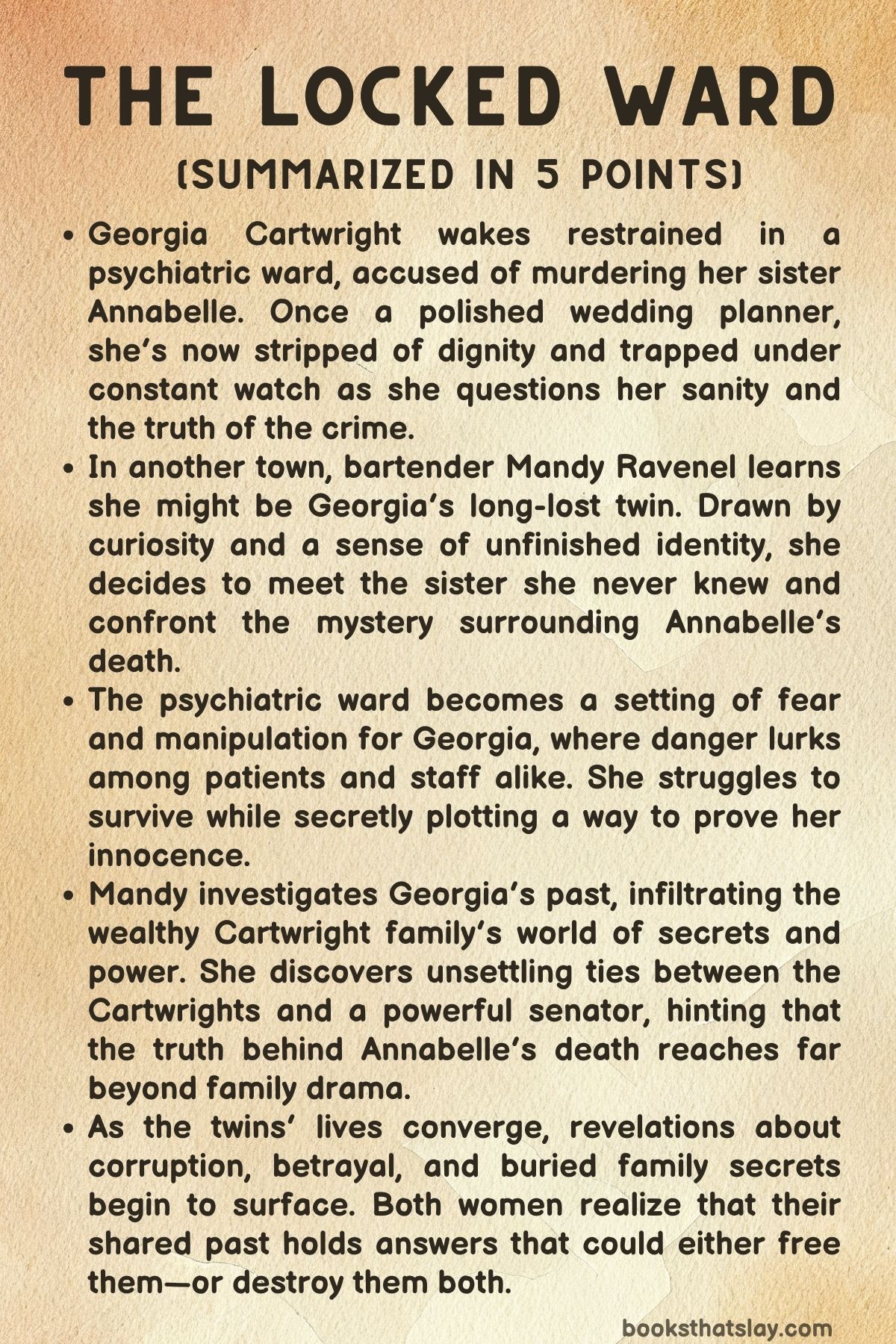
Georgia Cartwright wakes in a locked psychiatric ward, confused, restrained, and stripped of her former life. Once a prominent wedding planner in Charlotte, she is now confined as a patient accused of murdering her younger sister, Annabelle.
Under constant watch and deprived of privacy, Georgia learns that the outside world views her as a monster. Her only ally is her public defender, Milt Daniels, who insists she undergo psychiatric evaluation.
The man overseeing her confinement is familiar to her, and when she recognizes him, memories of the murder night begin to resurface—she was found at the scene, her hands drenched in Annabelle’s blood.
Elsewhere, Mandy Ravenel, a bartender from a neighboring town, reads about Georgia’s case. The media calls it the “Crime of the Decade,” describing a privileged woman who killed her sister in cold blood.
Mandy’s life changes when Milt Daniels contacts her, claiming Georgia is her twin sister. Adopted as a baby, Mandy is stunned but curious.
Her parents, now gone, told her little about her origins. Despite her doubts, she investigates and soon learns Georgia has requested to see her.
Inside the psychiatric facility, Georgia endures the harsh routines of institutional life. Every movement is monitored; meals are bland, patients unpredictable, and her dignity is constantly stripped away.
She is reduced to a number, NC-0416729, in a sterile world that denies her humanity. Meanwhile, Mandy meets her therapist, Dr.
Lisa Galper, and together they dig into Georgia’s background. Photos and records confirm Mandy’s resemblance to her twin, and a DNA test later proves the connection.
Against professional advice, Mandy decides to visit Georgia in person.
Their meeting is tense and emotional. Georgia appears subdued, but when their eyes meet, an unspoken recognition passes between them.
Georgia whispers that she didn’t kill Annabelle and that someone in the hospital wants her dead. She urges Mandy to test their DNA to prove they are sisters.
Mandy complies, and when the results confirm their bond, she feels compelled to uncover what truly happened.
Determined to understand her sister’s world, Mandy attends Annabelle’s funeral at the Cartwright estate. The service is lavish but cold, attended by the elite, including the family’s matriarch Honey Cartwright and influential Senator Michael Dawson.
Mandy senses tension beneath the refined surface, suspecting hidden alliances and corruption. Back at the ward, Georgia faces Dr.
Dave Winters, the psychiatrist tasked with assessing her competence. She pretends to suffer from a severe dissociative disorder to avoid being declared sane and sent to prison, believing it would mean certain death.
Mandy infiltrates the Cartwrights’ post-funeral gathering, pretending to be one of Annabelle’s friends. Her purpose is to observe and gather clues.
She notes Senator Dawson’s discomfort when the topic of justice arises, reinforcing her suspicion that the murder involves political and family secrets. Meanwhile, Georgia grows increasingly paranoid within the ward, convinced she is being targeted.
The isolation, combined with her memories, makes it hard to distinguish fear from reality.
As Mandy investigates further, she sneaks into the Cartwright mansion, photographing the guest book to collect potential leads. Reece DuPont, a family associate, nearly catches her, but she escapes undetected.
Georgia, aware that Mandy is now deeply entangled, arranges for Milt Daniels to ask Mandy to collect her belongings. Inside a silver clutch that escaped police custody, Mandy finds Georgia’s keys and personal effects.
When she visits her sister’s penthouse, she discovers it eerily mirrors her own apartment, suggesting their twin connection runs deeper than blood.
In the psychiatric ward, Georgia survives constant threats from violent patients like Josh, relying on the protection of others such as Patty, another inmate. Her fear of being killed feels increasingly justified.
Mandy, meanwhile, explores Georgia’s apartment, learning more about her clients and uncovering a lead involving a bride named Caroline Evers and a missing family Bible. Caroline’s urgency to retrieve it hints that the item holds hidden significance.
Mandy begins to suspect the Bible may tie into the murder or the family’s secrets.
In flashbacks, Georgia remembers hiring private investigator Tony Wagner to trace her birth mother, only to discover the shocking truth—she had a twin sister who vanished at birth. Mandy’s ongoing discoveries lead her deeper into Georgia’s life: she finds herself wearing her clothes, staying in her home, and even impersonating her.
When she agrees to meet Colby Dawson, the senator’s son, she uses the encounter to probe for answers. Colby reveals bitter resentment toward his father, who once sabotaged his life to pursue an affair with Annabelle.
This revelation shifts Mandy’s perception—Annabelle’s death may have been tied to the senator’s actions.
Mandy later finds a USB drive mailed to Georgia the day of Annabelle’s death. The files include surveillance footage of Mandy herself, proving she had been watched for weeks.
The final video shows Senator Dawson leaving Annabelle’s apartment the night she died. Enraged, Mandy confronts Georgia, who admits she hired Tony Wagner to find proof of their sisterhood and the senator’s involvement.
Before Georgia can explain further, Mandy learns Tony has been murdered, and she realizes how dangerous the truth has become.
Pursuing her investigation, Mandy visits Honey Cartwright, pretending to have evidence of Annabelle’s affair with the senator. When she reveals the video, Honey dismisses it, revealing chilling indifference.
Pressed by Mandy, Honey confesses a hidden history: when both her adoption and pregnancy resulted in two babies, she decided to keep one—Annabelle—and paid off her butler, Ray Ravenel, to take the other away. That child was Mandy.
Honey insists she acted out of kindness, but her words drip with cruelty.
When Mandy threatens to expose her, Honey retrieves a gun from a hollow book and fires. Mandy is struck but survives, protected by a small metal statue she carried—a token that matches Georgia’s childhood charm.
Senator Dawson, caught in the act of betrayal, intervenes and forces Honey to admit her crimes. She confesses to killing Annabelle to prevent exposure of her daughter’s true paternity—Annabelle had discovered through DNA that the senator was her biological father.
With Honey’s confession, Georgia is released from the hospital. The senator publicly acknowledges his paternity and helps exonerate her.
Mandy, recovering in the hospital, reunites with her sister. They move into Georgia’s apartment, beginning to rebuild their bond.
Georgia visits Annabelle’s grave, seeking closure and preparing to confront those responsible for the cruelty within the ward.
In the final scenes, the twins discuss lingering questions about the senator’s fixer, Patty, who may have killed Tony Wagner to protect the senator’s reputation. Mandy secretly retrieves the hidden USB drive and a set of old photographs that prove she once took justice into her own hands—punishing a man who assaulted her friend.
As the world continues to debate which sister holds the darker truth, Mandy reflects that only one of them truly got away with murder—and it wasn’t Georgia.
Characters
Georgia Cartwright
Georgia Cartwright stands at the core of The Locked Ward, a woman who once epitomized grace and professional success as a high-society wedding planner but is now stripped of identity and freedom. Her descent from the glittering world of Charlotte’s elite into the sterile confines of a psychiatric ward symbolizes the fragility of appearances and mental stability.
Georgia is initially portrayed as disoriented, frightened, and bound both physically and emotionally, a prisoner of her own past and the accusations against her. However, beneath this fractured surface lies an intelligent, calculating woman who uses her knowledge of psychology to feign dissociation and survive the brutal environment around her.
Her duality—both vulnerable and fiercely strategic—makes her deeply compelling. As her backstory unfolds, readers see that Georgia’s life was shaped by manipulation and emotional cruelty from her mother, Honey Cartwright.
She grew up internalizing blame, guilt, and rejection, which left her desperate for affection and belonging. The discovery of her twin, Mandy, becomes her psychological lifeline; Georgia’s request for Mandy’s help is as much a plea for survival as it is a yearning for connection.
Through her, Sarah Pekkanen explores themes of identity, inherited trauma, and the haunting power of secrets. By the novel’s end, Georgia emerges not as the villain the world believes her to be, but as a survivor—scarred, flawed, yet finally free from the suffocating control of her family and the institution that mirrored it.
Mandy Ravenel
Mandy Ravenel serves as the emotional and moral counterweight to Georgia, though she carries her own shadows. A bartender from a modest background, Mandy’s introduction into the Cartwright family’s twisted web thrusts her into a world of wealth, corruption, and deception that contrasts sharply with her own grounded existence.
Initially skeptical of her connection to Georgia, Mandy’s curiosity quickly transforms into obsession, driving her to unravel her family’s dark history. She represents the everywoman who steps into chaos and refuses to be consumed by it.
As she investigates, her character shifts from empathetic outsider to a figure of cunning resilience. Mandy’s transformation mirrors her sister’s—both women are forced to confront the manipulative power structures that defined their fates.
Her moral ambiguity surfaces near the end when readers learn she once orchestrated a man’s death to avenge her friend’s rape. This revelation redefines her not as a simple savior but as a complex antihero capable of ruthless justice.
Despite her dark past, Mandy’s loyalty and courage shine through; her survival after Honey’s gunshot solidifies her as the emotional center of the narrative. Ultimately, Mandy embodies the blurred line between victim and avenger, showing how trauma can breed both compassion and vengeance.
Honey Cartwright
Honey Cartwright is the embodiment of aristocratic cruelty and maternal manipulation. Cold, controlling, and deeply narcissistic, she views her daughters not as individuals but as extensions of her image and social standing.
Her psychological warfare against Georgia begins early in their childhood, as she constructs false narratives that paint Georgia as unstable and dangerous. Honey’s behavior is driven by her pathological need for control and reputation maintenance; even murder becomes an act of self-preservation for her.
The revelation that she arranged for one twin to be secretly given away underlines her moral depravity—she literally divides her children to protect her social world. Honey’s eventual downfall comes through her own arrogance; her willingness to shoot Mandy exposes the monstrous truth she’s long hidden.
Through Honey, Pekkanen critiques the moral decay lurking beneath privilege and the destructive effects of maternal narcissism. She is not merely an antagonist but a tragic symbol of what unchecked vanity and emotional repression can create.
Annabelle Cartwright
Annabelle, though dead when the story begins, haunts the narrative as both victim and catalyst. Her murder drives every major event, yet her character is gradually revealed through flashbacks and memories.
Annabelle represents the favored child—beautiful, compliant, and seemingly perfect—but beneath this veneer lies the same damage that shaped Georgia. She is the product of Honey’s conditioning, molded to uphold the family’s image even as it destroys her authenticity.
Her affair with Senator Dawson reveals her search for validation and love in all the wrong places, echoing the emotional starvation inflicted by her mother. Annabelle’s death—provoked by her discovery of her true parentage—serves as the novel’s tragic pivot.
She becomes both martyr and mirror, forcing the surviving characters to confront the cost of secrecy and deceit. Though she never speaks in the present, Annabelle’s memory holds immense narrative weight, representing innocence lost to the machinery of privilege and manipulation.
Senator Michael Dawson
Senator Michael Dawson personifies political power corrupted by personal sin. Outwardly, he is the image of authority and virtue, promising justice for Annabelle’s murder while privately concealing his own involvement in her life and death.
His affair with Annabelle—and the later revelation that he is her biological father—unmasks the hypocrisy of his moral posturing. Dawson’s manipulation of his son, Colby, further demonstrates his need for dominance and control; he ruins his son’s relationship to pursue his own desires.
His character operates as a parallel to Honey Cartwright—both powerful, both self-serving, and both destroyers of their children. Yet, unlike Honey, Dawson experiences a degree of remorse, especially when confronted with the truth.
His eventual confession and cooperation mark a partial redemption, though it arrives too late to undo the devastation he caused. Dawson’s character underscores Pekkanen’s recurring theme: that the institutions of power—whether familial or political—often mask deep rot beneath their polished surfaces.
Colby Dawson
Colby Dawson is one of the novel’s most tragic secondary figures, caught between loyalty to family and a desire to do what’s right. As the senator’s son, he lives in the shadow of corruption and manipulation.
His past humiliation, orchestrated by his father, leaves lasting scars that shape his relationship with Georgia and, later, Mandy. Colby’s bond with Georgia is rooted in mutual pain; both are victims of toxic legacies they didn’t choose.
His sincerity and gentleness contrast sharply with the deceit around him, yet his entanglement with the Cartwrights makes him both ally and potential threat. Through Colby, Pekkanen explores the cyclical nature of trauma—how children of the powerful inherit not privilege but the poison of their parents’ moral failings.
His tentative redemption comes through his empathy toward Georgia and Mandy, proving that compassion can exist even amid corruption.
Reece DuPont
Reece DuPont operates in the shadows of the Cartwright estate as Honey’s loyal enforcer and fixer. Cold, menacing, and efficient, he represents the machinery of wealth and control that keeps the Cartwright empire intact.
His presence injects constant tension into the narrative; he appears at key moments, a silent reminder that power has eyes everywhere. Though he rarely acts openly, his menace is psychological—his recognition of Mandy at the party and his quiet surveillance of her movements suggest he is always several steps ahead.
Reece symbolizes the faceless servants of privilege, those who carry out immoral orders for their masters and erase inconvenient truths. His moral ambiguity mirrors the novel’s larger theme: that in the world of The Locked Ward, evil often operates under the guise of loyalty.
Dr. Winters
Dr. Winters, Georgia’s psychiatrist, occupies a complex moral space within the ward.
Calm and observant, he becomes a silent adversary to Georgia’s manipulative brilliance. His clinical detachment borders on coldness, but it also reflects the institutional apathy of the system he represents.
To Georgia, he is both threat and potential savior—a man who can determine whether she lives freely or dies imprisoned. His measured demeanor and insistence on procedural correctness underscore how psychiatric systems can both protect and dehumanize.
Winters serves as a reflection of Georgia’s internal struggle between sanity and survival, and his character raises unsettling questions about the ethics of mental health institutions.
Milt Daniels
Milt Daniels, the public defender assigned to Georgia’s case, embodies both pragmatism and quiet compassion. Though initially seen as another cog in the legal system, he proves instrumental in connecting Georgia and Mandy, setting the narrative’s emotional core into motion.
His faith in Georgia’s potential innocence and his willingness to involve Mandy show a rare sense of moral courage. Milt’s understated presence grounds the story in realism, contrasting the melodrama of the Cartwrights and Dawsons.
Through him, Pekkanen illustrates that integrity can exist even within flawed systems, though it often goes unnoticed.
Patty and Tony Wagner
Patty, the senator’s ruthless fixer, and Tony Wagner, the doomed investigator, form two sides of the same coin. Patty represents institutional corruption—a remorseless enforcer of power who eliminates threats without conscience.
Her suspected involvement in Tony’s death reinforces her role as the hidden hand behind the novel’s violence. Tony, by contrast, is the seeker of truth, a man who exposes secrets at the cost of his life.
His death is both a plot catalyst and a symbol of how truth-tellers are silenced in worlds built on deception. Together, they encapsulate the moral tension between revelation and repression that drives The Locked Ward.
Themes
Identity and Self-Perception
The exploration of identity in The Locked Ward is grounded in the contrasting lives of Georgia and Mandy, twin sisters separated at birth and raised in vastly different circumstances. Georgia, once a poised and successful wedding planner, finds her identity dismantled within the confines of the psychiatric ward.
The sterile institution strips her of agency, individuality, and dignity—reducing her to a case number and a patient profile. Her confinement forces a confrontation with the fragility of constructed identity, exposing how easily social standing and reputation can dissolve when external validation is removed.
Mandy, on the other hand, has built a life grounded in independence and resilience but remains haunted by an undefined void—the absence of her biological origins. Her discovery of Georgia’s existence, and by extension her own displacement, ignites a crisis of self-recognition.
Both women face mirrored struggles: Georgia’s identity is publicly destroyed while Mandy’s is privately destabilized. Pekkanen uses their convergence to question whether identity stems from nurture, genetics, or personal will.
As the story unfolds, identity becomes less about who they were and more about what they choose to believe about themselves despite manipulation and deceit. Ultimately, the sisters reclaim their sense of self not through external affirmation but through confronting buried truths.
Their intertwined journey transforms identity from a label assigned by others into a hard-won understanding forged through endurance, vulnerability, and truth.
Power, Control, and Corruption
Power in The Locked Ward is depicted as both overt and insidious, shaping every layer of the narrative—from the psychiatric ward’s claustrophobic authority to the political manipulation of the Cartwright and Dawson families. Within the institution, Georgia experiences a microcosm of systemic control where personal autonomy is stripped under the guise of medical necessity.
Every movement, word, and even thought is monitored, echoing how power exerts itself through surveillance and psychological subjugation. Beyond the hospital walls, Pekkanen extends this theme into the social and political realm, where wealth and influence dictate justice and morality.
Senator Dawson and Honey Cartwright wield power not merely through their positions but through their ability to distort truth, weaponize reputation, and silence dissent. Mandy’s entry into their world exposes how corruption seeps through privilege—justice bends to protect the elite while the powerless are confined or erased.
The murder of Annabelle becomes less a personal tragedy and more a manifestation of systemic decay, where manipulation and secrecy sustain dominance. Even familial power is toxic: Honey’s control over her daughters distorts their perceptions of love and worth, teaching them compliance and fear.
By contrasting institutional and domestic control, Pekkanen reveals how corruption operates under civility’s mask. The eventual exposure of truth and Honey’s downfall serve as a moral inversion—an assertion that control, no matter how absolute, cannot contain the persistence of truth or the reclamation of personal agency.
Sisterhood and Betrayal
The bond between sisters in The Locked Ward evolves from suspicion and distance into an emotional anchor that defines the story’s emotional core. Georgia and Annabelle’s relationship, poisoned by maternal manipulation, demonstrates how love can be reshaped into rivalry when nurtured by deceit.
Honey’s psychological warfare, pitting them against one another from childhood, corrupts natural affection into competition. Georgia’s subsequent estrangement and the murder accusation crystallize this dynamic—the ultimate betrayal framed as a sister’s crime.
In contrast, the connection between Georgia and Mandy, though initially rooted in distrust, grows into a redemptive force. Their shared trauma becomes the bridge through which understanding replaces resentment.
Mandy’s journey from skepticism to solidarity mirrors the rediscovery of familial loyalty untainted by manipulation. Yet Pekkanen avoids sentimentality—this sisterhood is hard-earned, tempered by lies, fear, and sacrifice.
Their final alliance against Honey redefines sisterhood as a chosen act of faith rather than mere biology. Even betrayal, particularly Annabelle’s silence about her affair and Honey’s deceit about Mandy’s adoption, becomes a means of exposing the moral rot within the family structure.
The theme underscores that true sisterhood is not inherited but forged in truth, mutual recognition, and courage to confront shared pain. Through reconciliation, the sisters reclaim a bond that outlasts betrayal, transforming kinship into both weapon and shield against the forces that sought to destroy them.
Trauma and Psychological Survival
The novel’s psychological intensity centers on trauma as both a destructive and transformative force. Georgia’s incarceration within the psychiatric ward symbolizes not only external punishment but internal collapse—a mind fractured by guilt, fear, and memory.
Pekkanen portrays trauma as an omnipresent force, one that blurs reality and delusion, isolating the sufferer within layers of self-defense. Georgia’s feigned dissociation becomes a paradoxical act of survival, her only means of retaining control in a system designed to erase her.
Mandy’s trauma, though less visible, is equally corrosive—abandonment, deception, and moral compromise define her sense of self. Her vigilante act of vengeance in the past reflects a coping mechanism born of powerlessness, foreshadowing the moral ambiguity that shadows both sisters.
Throughout the story, trauma is inherited, sustained, and weaponized. The Cartwright family’s generational cruelty perpetuates cycles of emotional mutilation, teaching repression as endurance.
Yet within this pain lies resilience. The sisters’ eventual confrontation with their past marks the shift from endurance to healing.
Survival, Pekkanen suggests, is not about escaping trauma but integrating it—recognizing it as evidence of humanity rather than weakness. The ward, the family estate, and even the mirror-image twins become spaces where trauma reshapes identity, revealing how strength is not the absence of fear but the refusal to be defined by it.
Truth, Justice, and Moral Ambiguity
In The Locked Ward, truth operates as both salvation and weapon. The narrative dismantles the notion of clear moral binaries by exposing how truth is often buried beneath layers of manipulation, power, and self-interest.
Georgia’s supposed insanity, Honey’s fabricated narratives, and the senator’s moral hypocrisy demonstrate how easily facts can be distorted to serve those in control. Justice, therefore, becomes subjective—less about legality and more about moral reckoning.
Mandy’s hidden past, in which she indirectly caused a rapist’s death, contrasts with Georgia’s wrongful confinement, forcing readers to question who truly deserves punishment. Pekkanen’s portrayal of justice reflects a world where righteousness and guilt coexist, where redemption is earned through self-confrontation rather than institutional decree.
The exposure of Honey’s crimes restores factual truth but does not cleanse the moral chaos left behind. Even at the conclusion, Mandy’s concealment of evidence and Georgia’s quiet complicity reveal that truth, once known, carries its own burdens.
Justice in this world is not absolute—it is fractured, partial, and deeply human. The novel closes with a haunting equilibrium: one twin freed by law yet scarred by experience, the other guilty in silence yet morally awakened.
In exploring this tension, Pekkanen transforms truth from a static revelation into a living force—messy, subjective, and inseparable from the flawed people who bear it.