The Lost by Sarah Beth Durst Summary, Characters and Themes
The Lost by Sarah Beth Durst is a contemporary fantasy about what happens when a person runs far enough from fear that the road stops behaving like a road. Lauren, rattled by the possibility of losing her mother, drives out of Los Angeles and ends up in a desert town literally called Lost.
The place runs on strange rules, traded goods, and the promise of a figure known as the Missing Man—someone who can return people to their lives once they recover what they’re missing. It’s a story about survival, guilt, and the dangerous power of hope.
Summary
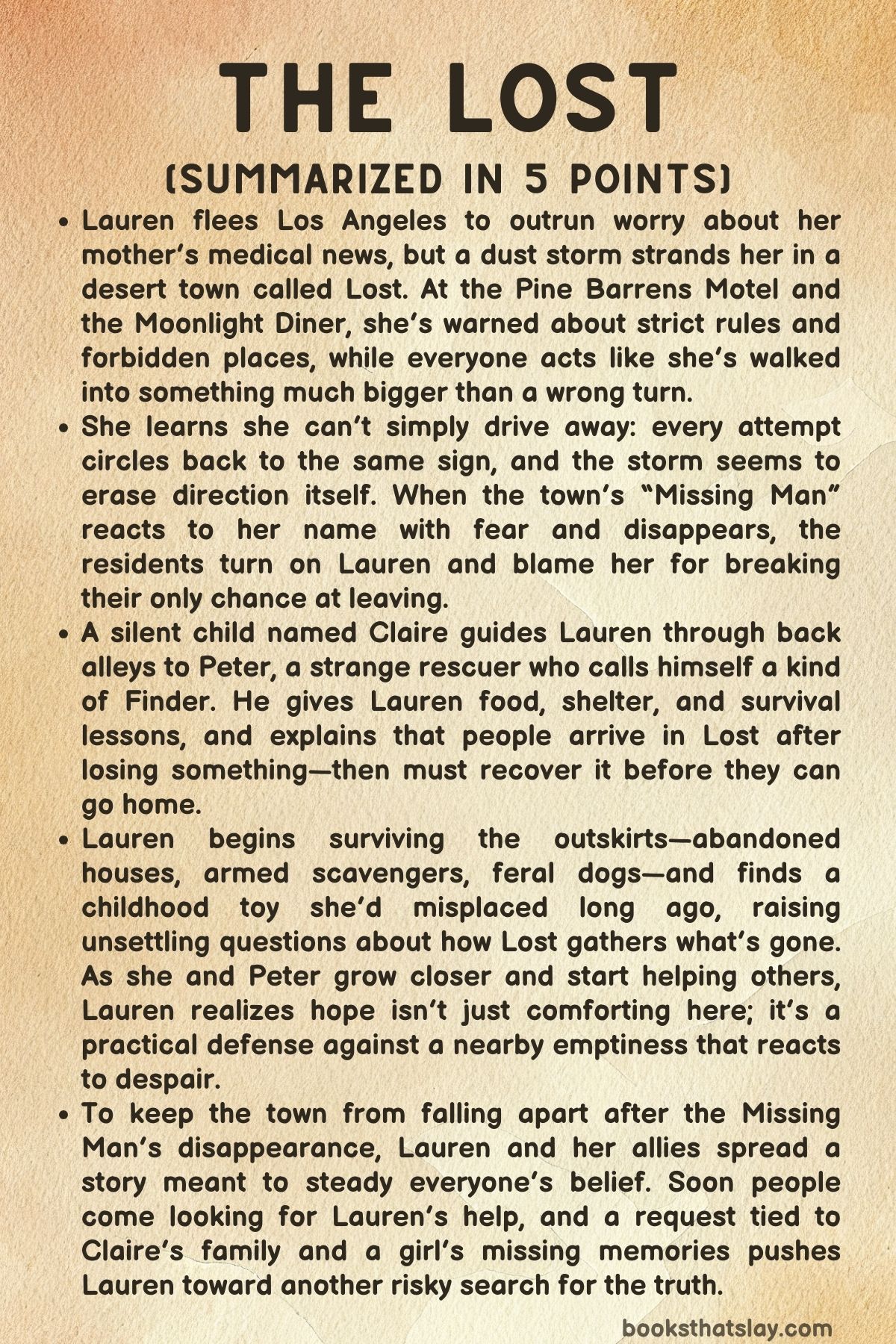
Lauren, twenty-seven and exhausted by worry, leaves Los Angeles and drives east without a plan, trying to outrun the dread of her mother’s new medical tests. Miles of empty desert stretch ahead until the highway feels cut off from the real world: no towns, no other cars, and only radio static.
A dust storm rolls in at dusk, swallowing the road in red haze. In the storm, Lauren sees a man in a black trench coat, his bare chest marked with feather tattoos.
When she brakes, he’s gone. Soon after, she finds an unmarked exit and follows it to a small town with a wooden sign: “Welcome to Lost.”
The town looks half-abandoned. Lauren stops at the Pine Barrens Motel, drawn by a flickering “Vacancy” sign.
Inside, she meets Tiffany, a teenage clerk with a sharp, morbid sense of humor who acts as if death is a casual topic. Tiffany gives Lauren a key and warns her away from certain rooms, especially room twelve.
Lauren takes a dusty room and crosses the street to the Moonlight Diner for food. The moment she enters, the diners go quiet and stare.
A waitress named Victoria seats her, and an older woman named Merry slides into the booth without being invited. Merry insists Lauren order pie and repeats the warning: stay out of room twelve.
Lauren’s confusion grows when Victoria brings her a steak she didn’t order and refuses payment. The diner, Victoria explains, runs on barter, not money, and the “Missing Man” will explain the rules.
Lauren returns to the motel uneasy, locks her door, and watches the town sit unnaturally still.
By morning, the place is worse. Lauren looks out to see Tiffany standing on the trunk of Lauren’s car, auctioning off suitcases to townspeople.
Lauren fights through the crowd and demands her belongings and a way out. Tiffany tosses her a carry-on bag—claiming it’s Lauren’s—in exchange for a roll of Life Savers.
Lauren drives away, but the dust returns, and the road bends back on itself. Every attempt to escape loops her to the same “Welcome to Lost” sign.
Eventually, her car runs out of gas in the swirling grit.
The trench-coat man reappears, this time perched on the car roof. He calls Lauren “Little Red,” jokes that he’s “the wolf,” and needles her with riddles.
Yet he also saves her: he pushes the car through the storm until it returns to the town’s edge. Before disappearing with a strange, birdlike leap from fence post to fence post, he tells her to learn the rules and stay out of the “void.”
Back in town, Lauren learns the name that everyone repeats: the Missing Man. People say he “finds what you can’t find” and can send you home once you recover what you lost.
Phones don’t work—every number fails, even 911—so the town’s rules feel final. When the Missing Man finally appears in the diner, he seems almost revered: an older man in a gray suit with white hair, a cane, and a practiced warmth.
He greets Merry with familiarity, then turns to Lauren. The moment she tells him her name, his expression flips to terror.
He backs away, repeating “Lauren,” and flees the diner.
The town reacts like a body losing its heartbeat. People spill into the streets, calling after him, desperate.
Victoria blames Lauren and bans anyone from helping her. A mob gathers at the motel, pressing at windows, breaking glass.
In the chaos, a silent little girl holding a teddy bear takes Lauren’s hand and leads her away. The girl’s name is Claire, and she guides Lauren through a maze of alleys to a hidden basement door.
After Claire knocks in a coded pattern, the trench-coat man opens it. His name is Peter.
Peter offers shelter and food from a trunk that seems able to produce exactly what’s needed. His underground space is crowded with odd treasures—photos, toys, and relics that suggest many lives have been misplaced.
Peter explains more than the town ever did: Lost is where people arrive after losing something, and the “void” is a dangerous force that feeds on despair. Peter is a “Finder,” someone who can pull people back from the void, but only the Missing Man can send them home.
Claire confirms she ended up here after losing her parents, and she treats Peter like a protector.
Peter takes Lauren and Claire to the town’s abandoned outskirts and tells Lauren to choose a house. Claire picks a crumbling yellow one, and inside, power and water still work.
In an upstairs room, Lauren finds Mr. Rabbit, a childhood toy she lost years ago. The discovery shakes her: the town isn’t just trapping people; it is stocking itself with their missing pieces.
Peter begins training Lauren to survive: keep moving, keep your hands free, climb when threatened, and don’t assume help is coming. They scavenge supplies, dodge armed teens who treat the abandoned neighborhood like a hunting ground, and encounter death that no one can fix.
Lauren’s fear keeps colliding with responsibility—she wants to call the police, to make the world behave normally—but Lost has no systems left to appeal to.
When Lauren later steps into the dust on purpose, the void turns into a blank, muffled world where direction and sound disappear. Her panic escalates until she feels herself fading, as if despair is making her less real.
She forces herself to stop spiraling and notices a ring at her feet: silver with a dark blue stone. Then a black steam engine thunders through the void on invisible tracks.
Peter hauls her aboard, and together they ride out.
The train bursts into town and crashes into Lauren’s yellow house. In the engine’s cab, Lauren finds Sean, the diner cook, shaken and withdrawn.
When Victoria arrives, Sean recognizes the ring: it’s his long-lost star sapphire engagement ring, tied to a past hurt. With the ring returned, he proposes to Victoria again, and this time she accepts.
Lauren notices a faint glow around them, like a visible sign that something inside them has been repaired.
Afterward, an ocean appears where desert used to be—waves against scrub, salt air in a place that should be dry. Lauren realizes the void can shape itself from what a person carries in their mind.
She swims, briefly feeling at home, and Peter joins her. Their connection deepens, complicated by his evasiveness and her urgency to get back to her mother.
Knowing the town is close to collapse without the Missing Man, Lauren helps Victoria and Sean craft a lie: the Missing Man left temporarily and will return. The story spreads, and the town calms; the void retreats.
But need quickly replaces anger. People begin arriving at Lauren’s house asking for help finding what they’ve lost.
Tiffany comes with a sharper demand—she wants her missing memories of how she ended up in Lost—and she dangles bait: information about Claire’s parents. Lauren enters the void again and returns with a newspaper revealing the truth Tiffany couldn’t face: Tiffany died on prom night in a drunk-driving crash.
Tiffany reads it, goes pale, whispers that she’s dead, gives Claire a location—Scottsdale, Arizona—and runs back toward town.
As the ocean rises and ships appear in its waters, Claire tells Lauren a crowd is gathering outside, not to hurt her, but to ask her to do for them what she did for Victoria, Sean, and Tiffany. Peter watches from the roof, wary, while Lauren steels herself to step outside and face what Lost now expects from her.
Characters
Lauren
In The Lost by Sarah Beth Durst, Lauren begins as someone running on pure avoidance: she’s physically fleeing Los Angeles, but emotionally she’s fleeing the dread of her mother’s medical uncertainty and the guilt of not being able to fix it. Lost traps her in a landscape that externalizes anxiety—endless loops, static, and storms—so every attempt to “drive away” only returns her to the same fear.
What makes Lauren compelling is that her denial cracks in layers rather than all at once: she insists she hasn’t “lost” anything, yet the town’s rules keep proving that loss isn’t just about objects; it’s about what grief, fear, and responsibility have hollowed out inside her. Her near-fading in the void shows how close she is to letting despair erase her sense of self, and her recovery in that moment becomes a turning point—she learns that survival in Lost is as much mental discipline as it is physical courage.
As she bonds with Claire and navigates Peter’s volatile protection, Lauren shifts from a solitary mindset to a relational one, discovering that helping others find what they lost is also a way of confronting her own unfinished love and guilt about her mother.
Peter
Peter is introduced as an impossible figure—part rescuer, part predator, part riddle—appearing in storms with feather tattoos and an animal-like grace that makes him feel less like a man and more like a rule of the place wearing human skin. His “wolf” persona and his habit of teasing Lauren aren’t just theatrics; they’re armor and strategy, a way to keep emotion at a distance while still pulling people back from the brink.
As the Finder, Peter’s function is hope with teeth: he can retrieve people from the void, feed them, hide them, and teach them how not to die, but he cannot grant the one thing everyone craves—release. That limitation shapes his personality into contradiction: playful yet guarded, tender yet evasive, intimate yet ready to vanish the moment closeness threatens to expose old wounds.
His feud-history with the Missing Man suggests a past where hope and authority collided, and his refusal to answer certain questions reveals how much he believes that truth can be lethal if it collapses the fragile scaffolding holding Lost together. With Lauren, Peter is drawn to her “interesting” defiance because she refuses to be only a victim; she challenges his role, resists being used, and forces him to feel rather than merely function.
Claire
Claire is quiet in a way that reads as eerie at first, but her silence is less emptiness than vigilance; she has adapted to Lost by conserving emotion, attention, and trust like scarce resources. She moves like someone raised by danger—watching, listening, carrying a teddy bear and a knife as if comfort and threat must coexist to keep her safe.
Claire’s loyalty is profound but selective, and her decision to lead Lauren through the mob to Peter is a major act of agency: she isn’t merely “saved” by older figures, she chooses alliances that increase her survival odds and her sense of belonging. The details of what she has lost—parents, a tooth, the ordinary certainty of childhood—give her a strangely practical innocence: she can enjoy cookies and games, yet she trains with blades and understands the town’s brutal economics.
Her emotional core shows most clearly in moments of fear around abandonment; when Peter disappears and Lauren might leave, Claire’s attachment surfaces, revealing that what she most needs isn’t only safety, but permanence—someone who won’t vanish the way everyone does in Lost.
Tiffany
Tiffany performs despair like a comedy routine, using morbid jokes and theatrical outfits to control how others see her and to keep her own terror from becoming unbearable. At the motel she wields power through misdirection—auctioning suitcases, inventing rules, threatening exposure—because in Lost, information is a currency as real as food or gas.
Her demand that Lauren retrieve her “missing memories” reframes her as more than a snide gatekeeper; Tiffany is someone whose identity is fractured, and she knows that without her own story she can’t understand what she is or why she’s trapped. The prom-night reveal is devastating because it turns her edgy posture into a tragedy: Tiffany isn’t just lost geographically, she is lost ontologically, living in a space where death didn’t end her needs, cravings, or loneliness.
Her sprint back toward town after realizing she’s dead reads like panic and denial colliding—she can’t stay still with that truth, and the speed of her exit suggests she may either break open into something new or be consumed by the void’s hunger for despair.
Victoria
Victoria appears first as a rigid enforcer—cold service, no money accepted, quick blame—yet her hardness is a survival ethic shaped by loss and betrayal. She represents the town’s fragile social order: barter, rules, punishment, and the belief that the Missing Man’s presence is the only thing preventing collapse.
When Lauren becomes the perceived reason he flees, Victoria’s anger is partly political and partly personal; a community built on hope can’t tolerate a perceived hope-killer. Her relationship with Sean reveals the softer truth beneath her severity: she is capable of deep loyalty and a hunger for renewal, and the faint glow around her after the engagement ring returns suggests she is literally and spiritually “refilled” when what she lost is restored.
Victoria’s past—being cheated on, burning the diner—casts her as someone who once chose destruction rather than helplessness, which explains both her fear of the town unraveling and her willingness to gamble on Lauren’s lie once she sees a path that preserves hope. She becomes a bridge character: not fully trusting Lauren, but willing to work with her if it protects the community from despair.
Sean
Sean’s presence is quiet until it becomes pivotal, and that pattern fits what he symbolizes: the buried, aching losses people carry until something forces them into the open. Found curled inside the train engine, he seems like a man shaken down to his core, as if the void stripped him of performance and left only raw fear.
Yet he also expresses himself through competence—cooking, providing, making a meal out of scraps—which suggests that care is his language and his anchor. The star sapphire ring is the clearest window into his past: he lost not merely jewelry but a promise, a future that never completed, and the intensity of his reaction shows how long that absence has lived inside him.
His decision to propose to Victoria after the ring returns turns him into proof of the book’s central mechanism: when the right loss is confronted and restored, people don’t just survive—they reattach to life.
Merry
Merry functions as the first real human warmth Lauren encounters in Lost, but she isn’t naïve comfort; she’s a seasoned witness to the town’s patterns and dangers. Her insistence on pie and her warnings about room twelve feel like superstition until the larger structure of Lost becomes clear—Merry is someone who has learned that rules are the only protection against forces that don’t care about fairness.
She speaks in riddles and half-reassurances because certainty is rare in a place built on missing pieces, and her calm presence hints at long endurance: she has likely been waiting, watching people cycle through hope and despair, and trying to keep newcomers from making fatal mistakes. The reverence the Missing Man shows her suggests she is important within the town’s emotional economy—either as a long-timer, a symbol, or someone whose loss ties closely to the town’s purpose.
Even when she isn’t central to later events, her early guidance shapes how Lauren understands Lost: not as a puzzle to solve quickly, but as a system to survive long enough to understand.
Themes
Loss and Recovery
Throughout The Lost, Sarah Beth Durst explores the concept of loss not merely as an emotional absence but as a state of being that reshapes identity and purpose. Every person trapped in the town of Lost is defined by something they have lost—a loved one, a memory, a dream, or a part of themselves.
The town becomes a manifestation of collective disconnection, a physical space where grief takes form. Lauren’s own journey begins with her fleeing from fear of her mother’s illness and uncertainty about her future.
Her arrival in Lost forces her to confront the deeper meaning of loss—not only the potential of losing her mother but also the way she has lost direction, agency, and emotional grounding in her own life. The Missing Man’s power to help people “find what they lost” mirrors the process of self-confrontation and acceptance, suggesting that recovery cannot happen without acknowledging pain.
Peter and Claire represent alternate stages of this process: Peter has turned his loss into control and rebellion, while Claire still embodies the innocence that struggles to make sense of abandonment. The novel suggests that recovery is not about restoring what once was, but about understanding the void that remains.
Lauren’s actions—helping others find closure, facing her guilt, and navigating between despair and hope—reveal that healing arises from the courage to redefine oneself after loss. The motif of “finding” extends beyond physical discovery; it symbolizes emotional renewal and acceptance of impermanence.
Hope and Despair
The struggle between hope and despair drives the emotional core of The Lost, forming a moral and psychological battleground for the characters. The void represents absolute despair—a consuming force that feeds on surrender and hopelessness.
Those who lose faith begin to fade or vanish, their existence devoured by their own emptiness. This phenomenon parallels real human experiences of depression and emotional paralysis, where despair feels endless and self-perpetuating.
Peter, who identifies himself as the servant of hope, offers resistance against this consuming void, though his methods are often ambiguous and manipulative. Through Lauren’s evolution, hope transforms from a passive wish into active resilience.
At first, she clings to the belief that someone or something will rescue her, but later she realizes that hope must be sustained through action, compassion, and courage. The train scene, where she saves Sean from the void, symbolizes the redemptive strength of determined hope; it restores balance to Lost and rekindles faith among its people.
Even her creation of a lie about the Missing Man’s return underscores the paradox of hope—it may not always rely on truth but is necessary to preserve meaning. Durst’s depiction of hope is grounded, acknowledging its fragility but affirming its indispensability.
In this world, despair is natural but fatal, while hope—however imperfect—becomes the force that sustains life and connection.
Identity and Transformation
Lauren’s passage through Lost becomes a psychological odyssey of self-definition. Before entering the town, her identity is defined by avoidance—she runs from her responsibilities, her fear of loss, and her uncertainty about who she is.
Lost functions as both a mirror and a crucible, stripping her of external labels and forcing introspection. The people she meets embody fragments of identity frozen in time: Tiffany clings to her teenage self, unaware of her death; Claire remains an eternal child, unable to grow past her trauma; and Peter hides his vulnerability behind a role of savior and trickster.
Lauren, however, undergoes transformation by confronting her fears and acting despite them. Her rediscovery of childhood relics like Mr. Rabbit and her confrontation with the void symbolize the reconciliation of past and present selves.
Identity, in Durst’s narrative, is not static—it is forged in struggle and reshaped through empathy. Lauren’s eventual acceptance of her flaws and her decision to help others show that identity matures through connection, not isolation.
The town itself mirrors this process; as Lauren grows stronger, the environment around her becomes more dynamic—oceans appear, ships gather, and life stirs again. Transformation in The Lost is not about returning to who one was, but becoming someone capable of carrying loss without being consumed by it.
Isolation and Connection
Isolation in The Lost operates on both physical and emotional levels. The town exists as a liminal space cut off from the world, where the radio emits only static and the roads lead nowhere.
This reflects the inner isolation of those who inhabit it—each trapped within personal grief, guilt, or confusion. Lauren’s initial solitude, wandering through dust storms and empty streets, mirrors the internal emptiness she carries.
Yet the story continuously juxtaposes this loneliness with the human impulse to connect. Every interaction—whether with Tiffany’s cynical humor, Merry’s cryptic comfort, or Claire’s childlike trust—challenges Lauren’s detachment.
Connection, however, is fraught with risk: emotional intimacy can reopen wounds, as seen in her complex bond with Peter, whose mixture of protection and manipulation tests her boundaries. Despite this, connection emerges as the only force that counters the stillness of Lost.
When Lauren helps others recover what they have lost, she reawakens both their humanity and her own. The glow surrounding those who find peace—like Merry, Victoria, and Sean—symbolizes reconnection, a spiritual light that dispels isolation.
Durst portrays community not as a cure-all but as a fragile, vital web of shared vulnerability. In this sense, The Lost becomes a meditation on how reaching out to others, even amid despair, restores meaning and affirms existence.
The Boundary Between Life and Death
A haunting undercurrent of The Lost lies in its ambiguous space between life and death. The town operates as a purgatorial realm where the dead and the living coexist in uncertainty.
Tiffany’s revelation that she died decades earlier redefines Lost as more than a psychological state—it becomes a metaphysical threshold. The void, devouring those who succumb to despair, resembles oblivion, while Peter’s and Lauren’s roles as rescuers evoke psychopomps guiding souls toward acceptance or release.
The shifting landscape—desert turning to ocean, storms dissolving into calm—reflects the instability of this boundary. Death here is not portrayed as finality but as a continuation of emotional struggle.
The lost are those who have not yet learned to let go, who linger in limbo because of unfinished grief or guilt. Lauren’s confrontation with the fading of her own body marks her proximity to death and her decision to live despite it.
The narrative suggests that acknowledging mortality—her mother’s, Tiffany’s, her own—is essential to reclaiming life’s vitality. In the end, the presence of the ocean, a timeless symbol of both death and rebirth, affirms the cyclical nature of existence.
Through its exploration of this boundary, The Lost offers a profound reflection on mortality as an inseparable part of transformation, suggesting that only by facing death can one truly choose to live.