The Lost Story of Eva Fuentes Summary, Characters and Themes
The Lost Story of Eva Fuentes by Chanel Cleeton is a dual-timeline mystery and family drama that moves between London in 2024, Havana in the 1960s, and Boston at the turn of the twentieth century. At its center is a vanished novel, A Time for Forgetting, and the Cuban author who wrote it under a cloud of betrayal and loss.
When rare-objects broker Margo Reynolds is hired to find the only surviving copy, the search pulls her into danger, a murder, and a history that refuses to stay buried. As past and present collide, the book becomes a key to identity, exile, and the long echoes of love and power.
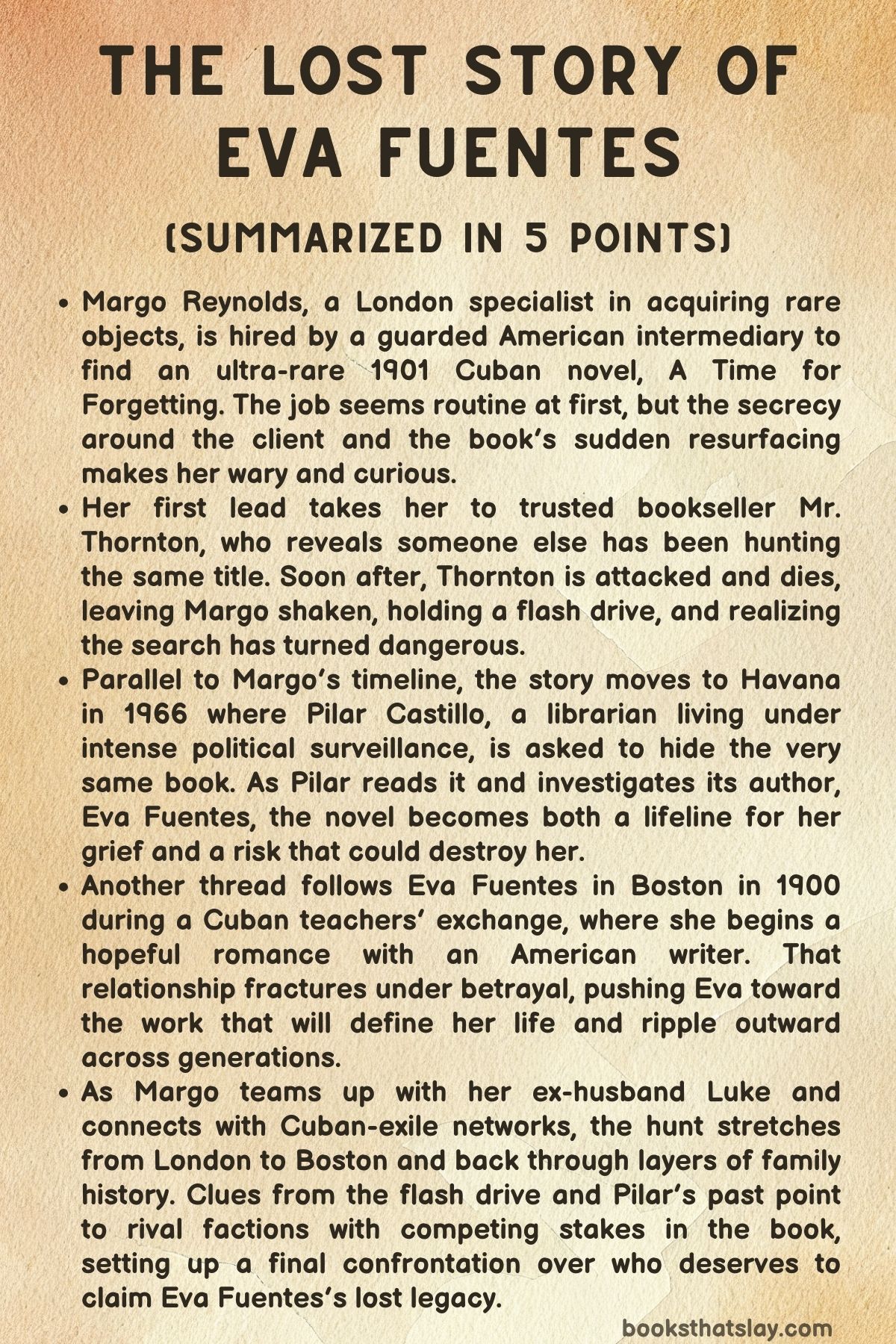
Summary
In London in December 2024, Margo Reynolds, a discreet broker who locates rare art and collectibles for wealthy clients, attends a secretive meeting at an exclusive club. Recently divorced and determined to keep her business afloat, she listens as William Greer, an American intermediary, offers her an urgent assignment.
His employer wants a book so rare that only one copy is believed to exist: A Time for Forgetting by Cuban author Eva Fuentes, published in 1901 and presumed lost after the Cuban Revolution. Greer offers twenty thousand pounds and hints that success could mean steady, high-paying work.
Margo insists she won’t handle anything illegal or unethical; Greer assures her the request is legitimate. Intrigued by the challenge, she accepts.
Margo heads to Notting Hill to consult Mr. Thornton, a trusted rare-bookseller.
On the way she notices a large blond man in a black jacket shadowing her at a distance. The feeling of being watched lingers.
Thornton confirms the book’s near-mythic status and mentions that another stranger had asked about the same title the previous month. The competition raises the stakes, and Margo leaves unsettled.
On the Tube ride home, she spots the blond man again, scanning the platform as if searching for her.
The story shifts to Havana in 1966. Pilar Castillo, a librarian, lives in fear after her husband Enrique was taken by secret police for opposing the regime.
A neighbor, Zenaida, arrives late at night with a bundle. Her family is fleeing Cuba, and she begs Pilar to safeguard a worn maroon volume: A Time for Forgetting.
The book belonged to Zenaida’s mother, who had been close to Eva Fuentes and was entrusted with the manuscript. Zenaida never read it, but her mother’s last request was to keep it from the authorities and, if possible, return it to Eva.
Pilar, aware of the danger, promises to hide the book and look for the author. Alone afterward, she begins reading, sensing that the novel carries someone else’s unfinished life.
Back in London, Margo arrives for a follow-up at Thornton’s shop and finds chaos: books scattered, a shattered coffeepot, and Thornton lying in blood, stabbed near the heart. He’s barely alive.
Margo calls emergency services, presses on the wound, and hears suspicious noises suggesting the attacker may still be nearby. Thornton grips her hand, warns, “They want the book,” and slips a flash drive into her palm.
Paramedics arrive, but Thornton dies before they can save him. Police treat it like a burglary gone wrong and doubt Margo’s claim that the attack is tied to the missing novel.
Shaken, Margo calls Greer. He seems surprised but guarded, refuses to explain more, and offers to double her fee.
Furious that secrecy may have cost a man his life, Margo threatens to quit. Greer sends a photo of someone leaving the shop; Margo recognizes the man as her ex-husband, Luke.
She storms to Luke’s flat, where she finds him with another woman. Luke lets her in, and Margo demands to know why he was at Thornton’s.
Though their marriage ended badly, Luke senses the danger and listens as she describes being followed and the murder.
Margo contacts Natalia Evans, who runs a site tracking Cuban items stolen during the revolution. Natalia doesn’t know the title but agrees to help quietly and meets Margo and Luke at her Knightsbridge home.
Natalia explains her parents fled Cuba in 1959, losing everything to state seizures. Her mother documented the stolen property, hoping one day it could be recovered; Natalia has turned those records into a network for tracing lost Cuban heritage.
She finds no trace of the novel but promises to ask trusted contacts. Margo warns her about Thornton’s death.
Luke, still a detective at heart, decides to stay involved, partly out of concern for Margo.
They travel north on the Caledonian Sleeper, and during the night Margo and Luke talk honestly for the first time in years. Luke admits he never stopped worrying about her and has ended his casual relationship.
Margo confesses she panicked during their marriage because of her parents’ toxic relationship, and she never knew how to explain her fear. They apologize and accept that they both loved each other but let silence make decisions for them.
The talk feels like closure, even if neither is sure what comes next.
In Havana, Pilar’s world collapses when she learns Enrique has been killed. She spends days numb, rereading A Time for Forgetting, especially the ending in which a character returns to Cuba after a romance in Boston.
While reading, Pilar finds a hidden letter signed “Eva,” filled with longing for someone left behind. Determined to fulfill Zenaida’s request, Pilar researches Eva Fuentes using pre-revolution directories and discovers a single address near her own neighborhood.
Her hope is fragile, but real. At the same time, danger tightens: a new tenant, a cold army major, moves into Zenaida’s old apartment, and Pilar receives warnings that she is being watched.
A third timeline opens in Boston in 1900. Eva Fuentes arrives with Cuban teachers for a Harvard summer program meant to rebuild Cuba’s schools after the war.
She is overwhelmed by public attention and the pressure to represent her country. At a dance, she meets James Webber, an American who presents himself as a fellow writer and student.
He is charming, attentive, and curious about her ideas. A romance grows quickly, giving Eva a sense of freedom she has never known.
Back in Boston months later, Eva discovers James has been lying: he is a journalist covering the program, and he has been drafting an article quoting her private words. She confronts him, furious at being used.
James insists he fell in love and promises to destroy the piece. Eva demands honesty from now on, and they continue, though trust is damaged.
The consequences arrive brutally. Eva travels to Boston again, pregnant and desperate after James stops replying to her letters.
She finds him at his newsroom and learns he is married. Worse, he calls their relationship only a summer affair and refuses responsibility.
Humiliated and alone, Eva retreats to her hotel and begins writing with a fierce purpose. She abandons her earlier manuscript and pours her rage and grief into a new novel: A Time for Forgetting.
With no support and no way to raise a child in Cuba without losing her position, she stays at a church-run home in Massachusetts, gives birth to a daughter, holds her briefly, and surrenders her for adoption. She returns to Havana, publishes the novel in English through a small Boston press, and spends her life thinking of the child she lost and the letters she can never send.
In 1966, Pilar finally meets an elderly Eva Fuentes, accompanied by Eva’s granddaughter, Evita. Eva reveals the real story behind the book, confirming much of what Pilar suspected.
Pilar gives her the long-hidden copy and confides her own losses. The bond between them is immediate: both women have been shaped by betrayal and survival.
Pilar later flees Cuba, carrying secrets that put her in danger from the regime and from the major’s family.
In 2024, Margo and Luke continue the hunt and travel to Boston, where old feelings reignite and they sleep together. Greer finally reveals his employer: Bennett Baskin.
Bennett explains that a DNA test from his daughter uncovered Cuban ancestry, leading him to learn his adopted mother was Eva Fuentes’s surrendered child. He believes his biological grandfather was Senator James Webber, and he wants the book to understand the grandmother he never knew.
He suspects the Webber family is trying to secure the novel first to control the story.
A flashback to Key West in 1970 shows Pilar in exile receiving the novel from Evita after Eva’s death. Evita warns that the major’s relatives still want revenge, and Pilar must stay hidden.
Back in London, Pilar is in the city and the novel is rumored to be heading to auction. Margo and Luke inspect a copy at the auction house, but something feels wrong.
That night Margo finds Natalia in her flat holding a gun and Thornton’s flash drive. Natalia admits she works for Cuban intelligence and is the major’s daughter.
She spread the auction rumor and planted a fake copy to lure Pilar out, because she wants a hidden list of rare books Pilar once smuggled for exiles. Margo fights Natalia until police arrive and arrest her.
In the aftermath, Margo brings Bennett together with Pilar and Evita. They reveal the real A Time for Forgetting.
Bennett and Evita recognize each other as cousins, a living proof of the family fracture Eva endured. Pilar explains that she hid the smuggling list inside the book, then gave it to Eva when she escaped.
Eva and Evita later helped return the stolen books to their rightful owners, leaving nothing for Natalia to claim. Pilar finally hands Bennett his grandmother’s novel.
Bennett plans to republish it with Pilar’s foreword and to honor Thornton with donations. With the mystery settled and the past acknowledged, Margo and Luke choose to try again, this time with honesty instead of fear.
Characters
Margo Reynolds
Margo Reynolds is the present-day spine of The Lost Story of Eva Fuentes, a woman who has built her identity on competence, discretion, and control. Recently divorced and running a tiny but elite acquisitions firm, she lives with the constant pressure of proving she can stay afloat in London on her own terms.
That need for control shows up in how she approaches Greer’s job: she is firm about ethical boundaries, skeptical of secrecy, and motivated as much by professional pride as by money. Yet the hunt for A Time for Forgetting pushes her into territory where control is impossible—murders, surveillance, and political ghosts—forcing her to act on instinct and conscience rather than polished procedure.
Her empathy is a quiet engine throughout: she intervenes to save Thornton, she refuses to be bought off after his death, and she keeps digging not for profit but because leaving the truth buried feels like surrender. Emotionally, Margo is guarded, shaped by fear of becoming trapped in a marriage like her parents’, and she tends to flee before she can be vulnerable.
The investigation becomes a parallel journey in which she relearns trust—first in herself under pressure, and then in Luke—so by the end she is someone who can choose intimacy without reading it as a loss of self.
Luke
Luke is Margo’s ex-husband and a detective whose professional world has trained him to read danger, but not always to name his own feelings. At first he represents the past Margo ran from: a marriage that collapsed under silence and unspoken fear.
His presence in the case is complicated because he is both protector and possible suspect, and that ambiguity mirrors the emotional confusion he and Margo still carry. Luke’s arc is about peeling away stoicism; on the sleeper train their conversation reveals how grief and love were hidden behind “relief” and withdrawal during the divorce.
He is fundamentally loyal—he stays with Margo despite the escalating threat, ends the hollow relationship with Sasha, and helps pursue leads even when it costs him personal safety. What makes him compelling is his mix of competence and weariness: he’s good at the work, but burned out by what policing and betrayal have taught him about people.
Through Margo, he regains a reason to care not just about solving a case but about choosing a life that includes tenderness. By the close, his decision to try again with Margo is less a romantic reset and more a hard-won act of honesty.
William Greer
Greer enters The Lost Story of Eva Fuentes as the classic gatekeeper figure: polished, controlled, and trained to reveal only what serves the mission. His guardedness and security-operative vibe signal that the job is more than a collector’s whim, and his secrecy becomes an early source of tension with Margo.
Greer is not villainous so much as instrumental; he is loyal to his employer and shaped by a worldview where information is currency and danger is assumed. His offer to double Margo’s fee after Thornton’s death shows his reflex to solve moral crisis with money, but it also hints at genuine alarm and the limits of what he knows or can say.
He functions as the novel’s pressure valve, escalating stakes while forcing Margo to choose whether she’s an employee or an independent moral actor. In the end, his role is revealed as part of a larger family-truth pursuit, making his earlier urgency feel less manipulative and more like a protective attempt to keep a fragile legacy from being weaponized by others.
Mr. Thornton
Mr. Thornton is the story’s first true casualty and a symbol of old-world integrity.
As a veteran bookseller and Margo’s trusted expert, he represents knowledge rooted in care, not in power. He takes delight in difficulty, treats rare books as living histories, and approaches Margo with warmth that suggests a long friendship built on mutual respect.
His murder is shocking precisely because he is gentle and seemingly outside the political and criminal games swirling around the book. Yet his dying warning—“They want the book”—and the flash drive he presses into Margo’s hand reveal that he understood the stakes better than anyone else in London’s rare-book circles.
Thornton’s presence after death continues through that flash drive and through Margo’s guilt, becoming the moral catalyst that turns a paid assignment into a personal crusade. He also embodies the theme that stewardship of culture can be dangerous when regimes and heirs want ownership rather than truth.
Bea
Bea is Margo’s assistant and the quiet stabilizer of Reynolds Acquisitions. Though she appears briefly, her role matters because she reflects the normal life and professional structure Margo fights to preserve.
Bea’s efficient confirmation of the wire transfer grounds the opening in reality and highlights Margo’s loneliness at the top of her small firm; there’s no corporate safety net, only Bea and Margo. Bea also represents trust without complication—someone Margo can rely on without fear of betrayal.
In a story saturated with secrets, Bea’s understated loyalty is a reminder of how rare uncomplicated support can be.
Natalia Evans
Natalia is one of The Lost Story of Eva Fuentes’s most layered antagonists, because she begins as an ally and ends as the embodied aftershock of revolution. Publicly she is a glamorous exile-descendant running a restitution website, casting herself as defender of families whose lives and treasures were stolen by Castro’s regime.
That persona is convincing because it aligns with real historical trauma, and it draws Margo in. The reversal—that Natalia is actually Cuban intelligence and the major’s daughter—reframes her as someone who has inherited state loyalty as identity.
Her obsession with the hidden list of smuggled books shows a hunger not just for artifacts but for control over narrative: she wants to reclaim what the regime believes belongs to it and punish those who defied it. Natalia’s violence toward Margo and her manipulation of the auction rumor reveal how far she will go to restore a version of history that validates her father and her country’s authority.
Yet the tragedy beneath her villainy is that she, too, is driven by lineage and loss; she simply chooses power over reconciliation.
Pilar Castillo
Pilar is the emotional heart of the 1966 timeline and a portrait of courage forged in grief. As a librarian, her relationship to books is intimate and sacred; they are not objects but vessels of memory, love, and resistance.
Her husband Enrique’s disappearance and death leave her hollowed out, and at first A Time for Forgetting is a lifeline because reading it awakens feeling when survival has numbed her. Pilar’s defining trait is quiet defiance: she safeguards forbidden texts, accepts Zenaida’s request despite enormous risk, and continues searching for Eva even as the regime tightens around her.
Her grief is not passive; it becomes purpose, and the mission to return the novel gives her a reason to step back into life. Pilar also learns the painful complexity of survival under dictatorship through Ignacio’s coerced betrayal, which forces her to see how fear can corrode even decent people.
By the time she reaches exile and later London, she has evolved from a frightened widow into a protector of cultural truth, someone whose moral clarity outlasts borders, decades, and threats from the major’s family.
Enrique
Enrique exists largely through Pilar’s memory, yet he shapes her entire arc. He is the absent center of her grief: a man arrested for anti-regime activity, representing the way political systems obliterate private happiness.
The books he leaves behind become Pilar’s physical connection to him, and his fate defines her psychological landscape—fear, sorrow, and simmering rage. Enrique also functions as the moral spark for Pilar’s resistance; his death makes the regime’s violence personal, turning her protection of books into a form of living defiance.
Even in absence, he is portrayed as someone worth mourning deeply, suggesting kindness, intellectual passion, and a quiet bravery that Pilar inherits.
Zenaida
Zenaida is the catalyst who places the lost novel into Pilar’s hands. She is a neighbor driven by maternal terror and political realism, willing to uproot her life to save her outspoken son.
Her act of distributing possessions before fleeing is both practical and mournful, and giving Pilar A Time for Forgetting reveals deep trust in Pilar’s integrity. Zenaida’s family tie to Eva Fuentes through her mother makes her a bridge between private female networks and public history; she is part of the hidden chain of women who preserve stories when institutions collapse.
Though she leaves quickly, her urgency and faith in Pilar initiate the entire historical recovery that later reaches Margo and Bennett.
Ignacio
Ignacio is Pilar’s supervisor and one of the novel’s most morally complex figures. At first he reads as protective, warning Pilar that she is under scrutiny and trying to shield her inside the library system.
The revelation that he informed on Enrique under coercion to protect his sick wife turns him into a study of survival under tyranny. Ignacio is not malicious; he is frightened, trapped, and slowly hollowed out by a regime that forces ordinary people into impossible choices.
His confession is devastating because it shows how dictatorship weaponizes love and illness to fracture communities. By serving as both helper and betrayer, Ignacio embodies the theme that political terror doesn’t just kill people; it corrodes relationships and turns guilt into another kind of prison.
Esteban
Esteban appears as a battered messenger from Pilar’s past, representing the underground world Enrique belonged to. Fresh from prison and still wounded, he brings Pilar information about betrayal and surveillance, making him a living warning of what resistance costs.
Esteban’s courage is evident in returning to Pilar despite danger, suggesting loyalty to Enrique and to their shared cause. He is also the voice that confirms Pilar’s fears are real, transforming her vague dread into clear urgency.
In narrative terms, Esteban tightens the noose around Pilar’s life, pushing her toward decisive action.
Eva Fuentes
Eva Fuentes is the story’s namesake and the origin point of nearly every emotional current in The Lost Story of Eva Fuentes. In 1900 she is a young Cuban teacher caught between national duty and personal longing, idealistic about education and eager to contribute to Cuba’s future.
Her romance with James Webber begins as awakening and promise, making her later betrayal all the more shattering. Eva’s reaction to that betrayal is the act that defines her legacy: she writes A Time for Forgetting out of humiliation, grief, and anger, turning personal ruin into art.
Her decision to surrender her baby is portrayed not as lack of love but as an agonizing collision between social constraints, economic reality, and shattered trust. In old age, Eva becomes a keeper of painful truth; she confesses her story to Pilar, acknowledging both her love and her mistakes without sentimentality.
She is a woman whose life is scarred by lies but who refuses to let lies be the final word, and her long-hidden authorship becomes a reclaimed voice that her descendants can finally hear.
James Webber
James Webber is both romantic lead and betrayal engine in Eva’s timeline, a man whose charm masks self-interest. Initially he appears open-hearted, intellectually curious, and supportive, embodying for Eva the possibility of a future not defined by war.
The revelation that he is a journalist chasing a story cracks that image, exposing a pattern of using intimacy for career advancement. His later exposure as a married man who frames their relationship as “only a summer affair” cements him as the human face of patriarchal privilege: he can indulge desire without consequence while Eva bears the ruin.
James’s cowardice is as important as his deception; he refuses public acknowledgement, refuses responsibility, and retreats behind family power. Yet he is not written as cartoonish evil—he is a believable opportunist shaped by ambition and entitlement, which makes the damage he does feel historically and emotionally true.
His legacy haunts the present because his status and family wealth are what make the fight over the book so vicious.
Bennett Baskin
Bennett is the present-day heir who reframes the hunt from treasure-seeking to identity-seeking. He initially uses Greer and Margo as intermediaries, which makes him look like another rich collector, but the reveal that he is Eva’s grandson transforms his desire into something raw and human.
Bennett’s life has been shaped by a gap in origin; his daughter’s DNA test becomes a door into a past that was stolen not by revolution, but by James’s betrayal and adoption’s anonymity. He wants A Time for Forgetting not for profit but to meet his grandmother through her words and to understand the forces that shaped his family.
His willingness to republish the book with Pilar’s foreword and to honor Thornton shows a restorative impulse: he wants to turn a history of loss into a future of recognition. Bennett represents the possibility of healing through truth, using privilege not to hoard the past but to share it.
Evita
Evita, Eva Fuentes’s granddaughter, is a conduit of memory and compassion. She accompanies Pilar to meet Eva in 1966 and later entrusts Pilar with the book in exile, showing deep trust across generations.
Evita’s life is shaped by her grandmother’s pain, yet she chooses care rather than bitterness, helping return smuggled books to their rightful owners and protecting Pilar from danger. Her recognition of Bennett as family is one of the story’s emotional fulcrums, because she embodies the bridge between branches of a family severed by betrayal and adoption.
In character, Evita is steady, loving, and quietly brave, someone who turns inheritance into responsibility.
The Major
The unnamed major who moves into Zenaida’s apartment is the regime made flesh in Pilar’s daily life. His coldness, intimidation, and intrusive questioning turn a neighborhood corridor into a surveillance state.
He is not explored deeply as a person because he functions as a force—an instrument of Fidel’s system that erases privacy and safety. The later revelation that Natalia is his daughter and that his family still seeks vengeance years later shows how authoritarian violence echoes through bloodlines, producing future conflicts even in exile.
The major symbolizes how power embeds itself not only in institutions but in families that inherit the need to defend its honor.
Sasha
Sasha is a small but sharp mirror for Margo’s emotional limbo. She appears as Luke’s casual partner, answering the door in his sweatshirt, a visual sign that Luke tried to move on without truly moving forward.
Sasha isn’t villainized; she is simply evidence of the shallow, temporary connections both Luke and Margo have settled for since the divorce. Her exit from Luke’s life marks his shift from avoidance to honesty, clearing space for real reconciliation.
Ana
Ana is the protagonist of A Time for Forgetting, the novel within The Lost Story of Eva Fuentes, and her storyline acts as a coded reflection of Eva’s life. Pilar’s fixation on Ana’s ending—returning to Cuba after a Boston romance—signals how fiction can hold emotional truth even when names and details are altered.
Ana represents Eva’s attempt to rewrite her own story into something she could bear to publish, and for Pilar she becomes a companion in grief, proving that invented characters can still guide real people toward hope and action.
Themes
Memory, Erasure, and the Fight to Hold on to a Past
From the first moment Margo is handed the title of a vanished book, the story frames memory as something fragile that powerful people try to bury and ordinary people try to protect. The lost novel is not just a collectible; it’s a container for what history wants to forget.
In London, the hunt for A Time for Forgetting shows how memory can be commodified, turned into a prize for the rich or a weapon for the ruthless. Yet in Havana, the same object becomes a lifeline.
Pilar’s grief for Enrique is inseparable from her reading, because the book offers a kind of continuity when the state has stolen her husband, her safety, and any public way to mourn. The hidden letter inside the book makes memory literal: a personal truth is tucked in a place where the regime cannot reach it, mirroring Pilar’s own quiet resistance through preserving banned texts.
The narrative also highlights how memory operates across generations. Eva’s heartbreak and forced adoption of her child do not remain locked in the past; they echo forward into Bennett’s life through DNA tests, half-known family stories, and the desire to understand where he comes from.
The book’s survival becomes proof that even carefully engineered forgetting can fail. Characters are constantly forced to ask who gets to control the record of a life: a government that arrests and intimidates, a family that hides scandals for status, or the people who lived the truth.
This makes memory both personal and political. The title A Time for Forgetting is almost ironic in context, because the plot argues that forgetting is never neutral.
It can be survival, as when Eva tries to keep going after humiliation. It can be cruelty, as when James’s family uses silence to protect power.
Or it can be enforced through fear, as under Castro’s Cuba. Against all of that, the throughline is persistence: Pilar hiding books, Eva writing instead of collapsing, Margo refusing to step away even when threatened.
By the time Bennett receives the real copy, memory has shifted from private pain into shared inheritance. The story suggests that the past does not disappear just because it was hidden, renamed, or exiled; it waits in objects, letters, and bodies until someone is ready to face it.
Love, Betrayal, and the Costs of Silence
Romantic love in this story is never presented as simple comfort; it is a force that exposes character and can either enlarge a life or ruin it depending on whether truth is allowed inside it. Eva’s relationship with James starts with excitement and possibility, but it is built on a lie he chooses every day to keep telling.
The betrayal is not only that he is married; it is that he uses intimacy as a tool for ambition while letting Eva believe she is safe. Her confrontation in the newsroom shows the brutal mismatch between what she risked emotionally and what he was willing to give.
The consequences of that betrayal are lifelong: pregnancy, abandonment, loss of her child, and a reshaping of her identity into someone who survives by turning pain into art. The story treats silence as the real destroyer.
James’s silence in failing to answer her letters, the secrecy around his marriage, and the social silence that allows his public standing to remain untouched all turn love into harm. Pilar’s marriage to Enrique shows a different angle.
Their bond is loving, but the world around them makes open speech dangerous. Enrique’s arrest begins because words were overheard and reported; afterward, Pilar’s inability to speak freely about her loss cages her grief, leaving her to seek companionship in a novel instead of in people.
Silence becomes both shelter and prison. Margo and Luke replay this theme in modern form.
Their divorce comes from fear that is never translated into honest conversation. Margo’s terror of repeating her parents’ marriage and Luke’s inability to show vulnerability create a void where assumptions grow.
Their late-night talk on the sleeper train proves how different things might have been if they had risked honesty earlier. Even then, truth is not presented as a magical fix; it is hard, humiliating, and uncertain.
But it is the only path that stops love from rotting into resentment. The parallel timelines show that betrayal does not always look like villainy.
Ignacio’s coerced informing is a betrayal born from desperation, which complicates Pilar’s pain and underlines how oppressive systems force people into moral collapse. Natalia’s deception toward Margo also sits within this theme: she mimics friendship while pursuing control, making trust lethal.
Across all these relationships, the story argues that love without truth becomes a stage for exploitation, while love anchored in honesty becomes a form of resistance. By the end, Bennett’s desire to honor Eva’s legacy through republishing the novel is a kind of reparative love that refuses silence.
It acknowledges what was done to her rather than smoothing it over for comfort. In The Lost Story of Eva Fuentes, the painful lesson is consistent: silence protects the powerful and punishes the vulnerable, and every act of speaking — even late, even imperfectly — is a step toward reclaiming dignity.
Power, Oppression, and Everyday Resistance
The plot places personal lives directly against political and institutional power, showing how oppression doesn’t only operate through grand events but through constant, suffocating pressure. In 1966 Havana, the regime’s presence is felt in the knock on the door, in the new major moving in overnight, in the librarian being questioned at work, and in Ignacio’s terror for his wife.
Power is not abstract; it is a shadow that enters homes and workplaces, turning neighbors into watchers and love into liability. Enrique’s arrest and death underline how quickly a state can erase someone, leaving behind no appeal and no safe public mourning.
Pilar’s fear isn’t paranoia; it is a reasonable response to a system built to punish the wrong glance or rumor. What makes the theme compelling is the way resistance is shown as ordinary, quiet, and human rather than heroic spectacle.
Pilar doesn’t lead a protest; she preserves books, hides them, moves them, and carries their stories across borders. Those actions are risky precisely because they are small and hard to detect.
She resists by refusing to let the regime control what people read and remember. Zenaida’s flight and her trust in Pilar show another kind of resistance: choosing to survive outside the system rather than be crushed inside it.
In the 2024 timeline, power shifts form. It’s no longer only government; it’s wealth, global networks, and the protected status of famous families.
The Webbers’ ability to bury James’s scandal, and the threat that wealth might still be deployed to seize the book quietly, shows that oppression can thrive in polished spaces as much as in police states. Natalia embodies the continuity of authoritarian tactics across generations.
She uses misinformation, surveillance, and intimidation, not because she is a faceless monster, but because she inherited a mission and a worldview shaped by state power and family grievance. Her attempt to retrieve the smuggling list reframes the book hunt as a battle over who gets to claim moral authority: the regime’s heirs who want to punish past dissidents, or the exiles and librarians who tried to save culture.
The theme also reveals how power corrupts the meaning of objects. A novel becomes a lure, a trap, and a tool of leverage.
The murder of Mr. Thornton is a reminder that violence is what power resorts to when secrecy fails.
Yet the story refuses to let oppression have the last word. Pilar’s exile does not end her work; she continues returning books to rightful owners, transforming survival into restitution.
Margo’s refusal to step aside after threats is another modern echo of resistance: she insists on understanding the truth even when institutions dismiss her. Luke’s detective instincts and eventual alliance with her show how resistance can also be relational, rooted in choosing to protect rather than retreat.
In The Lost Story of Eva Fuentes, oppression is constant, but resistance is too — enacted through preservation, solidarity, and the stubborn choice to act as if truth still matters.
Identity, Inheritance, and the Long Reach of Family Secrets
The story frames identity as something shaped not only by what we know about ourselves, but by what has been hidden from us. Eva’s life is marked by a secret that she never asked to carry: the loss of her child and the forced rewriting of her future.
That hidden history doesn’t end with her. It travels silently through time until it surfaces in Bennett’s life, not through a family anecdote but through genetic evidence.
This modern discovery shows how identity can be interrupted and later repaired, even when the people who caused the rupture are gone. Bennett’s desire for the book is rooted in this hunger for coherence.
He wants to understand the woman who is his grandmother, the circumstances of his mother’s adoption, and the kind of man James Webber truly was. The search becomes an emotional genealogy project, where an object might answer questions that living relatives cannot.
The theme is also visible in Pilar’s relationship to identity. She is a librarian, a wife, a neighbor, and later an exile, but the regime and fear try to reduce her identity to a suspect, someone to be watched.
Saving books allows her to hold on to who she is when everything else is being stripped away. Exile complicates identity further: Pilar’s life in Key West is safer, but the warning that the major’s family still seeks her shows that a past identity, labeled as enemy, can follow a person long after borders change.
Margo’s arc adds another layer. Her professional identity is built on competence and discretion, and her personal identity is shaken by divorce and by the realization that her instincts about danger were right when others doubted her.
The hunt forces her to decide whether she is simply a broker following a client’s request or someone with her own moral line. Her refusal to keep playing along without answers is an identity choice as much as a plot turn.
Luke’s presence complicates this too. Their unfinished history shows how intimate relationships can become part of self-definition: who they were together, who they tried to be, and who they might still become.
Family secrets in this story do not stay contained within a generation. They distort relationships and awaken new ones.
James’s secrecy protects his status in 1900, but it creates a century of confusion and loss; the adopted child grows up without knowing her mother, and Bennett grows up without knowing his roots. Eva’s letters she never sent show how identity is also about the stories we don’t get to tell.
The final reunion of Bennett and Evita as cousins provides a counterpoint: inheritance can also be a bridge, connecting people who were separated not by choice but by shame, politics, and fear. The plan to republish the novel with Pilar’s foreword symbolizes identity restored publicly rather than hidden privately.
In The Lost Story of Eva Fuentes, identity is not static; it is something that can be stolen, reshaped, and finally reclaimed through truth.
Art, Objects, and the Moral Weight of Ownership
The narrative insists that objects are never just objects. A rare book, a flash drive, a hidden letter, even the rumored auction catalog all carry human stakes.
Margo’s profession already places her in a world where value is assigned through scarcity and desire, but the hunt for A Time for Forgetting pushes her into a more uncomfortable question: who deserves to own a thing that holds someone else’s pain? The collector’s market treats the novel as a trophy, a twenty-thousand-pound acquisition that can be locked behind glass.
Yet the Havana timeline shows that the book’s true value is emotional and ethical. Pilar protects it not because it is rare, but because it is a vulnerable piece of someone’s life that could be destroyed in political cleansing.
Zenaida’s request that Pilar return the book to Eva frames ownership as responsibility rather than possession.
This theme connects to the larger history of Cuban dispossession after 1959.
Natalia’s website project began as an archive of what was seized from her family, reflecting a broader exile experience of losing homes, heirlooms, and cultural artifacts. Her personal story explains why missing objects can feel like missing selves.
But the twist that Natalia is working for Cuban intelligence and is hunting a smuggling list shows how ownership can be twisted into control. She wants the list not to restore heritage but to reclaim power for the state and to punish those who defied it.
In that sense, ownership becomes a political act.
The moral tension is clearest in the fate of the smuggled books.
Pilar once risked everything to move rare works out of Cuba so they wouldn’t be lost or weaponized. Later, she and Eva’s family return those books to rightful owners, rejecting any profit.
That choice redefines the role of art and literature: not commodities for the highest bidder, but links between people dispersed by violence. Bennett’s intention to republish the novel continues this ethical view.
Instead of hoarding the only copy, he wants to share it, letting a private artifact become public memory. His plan to honor Mr.Thornton through donations ties ownership to accountability. Even Margo’s arc is shaped by this theme.
She begins as someone who believes in clean transactions, legality, and client service. The murder of Thornton and the revelations around Bennett force her to see that the ethics of acquisition depend on context.
Finding the book is no longer a job but a choice about what kind of world she wants to participate in. Luke’s detective lens reinforces that objects can be evidence, bait, or heritage, depending on who holds them.
By the end, the book rests with a descendant who seeks understanding, not dominance, and the story presents this as the most just form of ownership. In The Lost Story of Eva Fuentes, art is a moral test: the people who treat it as a prize cause harm, and the people who treat it as a trust help repair what history broke.