The Mad Wife Summary, Characters and Themes
The Mad Wife by Meagan Church is a mid-century suburban psychological drama about Lucy “Lulu” Mayfield, a young mother trying to survive the rigid expectations of 1950s domestic life. Set in an immaculate Ohio neighborhood where smiles are mandatory and suffering is quietly medicated, the novel follows Lulu as she juggles marriage, motherhood, grief, and a growing fear that her mind is slipping.
When unsettling new neighbors arrive and tragedy strikes her own home, Lulu is pulled into a spiral of suspicion and self-doubt. The book examines how women’s pain is dismissed, controlled, and mislabeled—and what it costs to reclaim one’s reality.
Summary
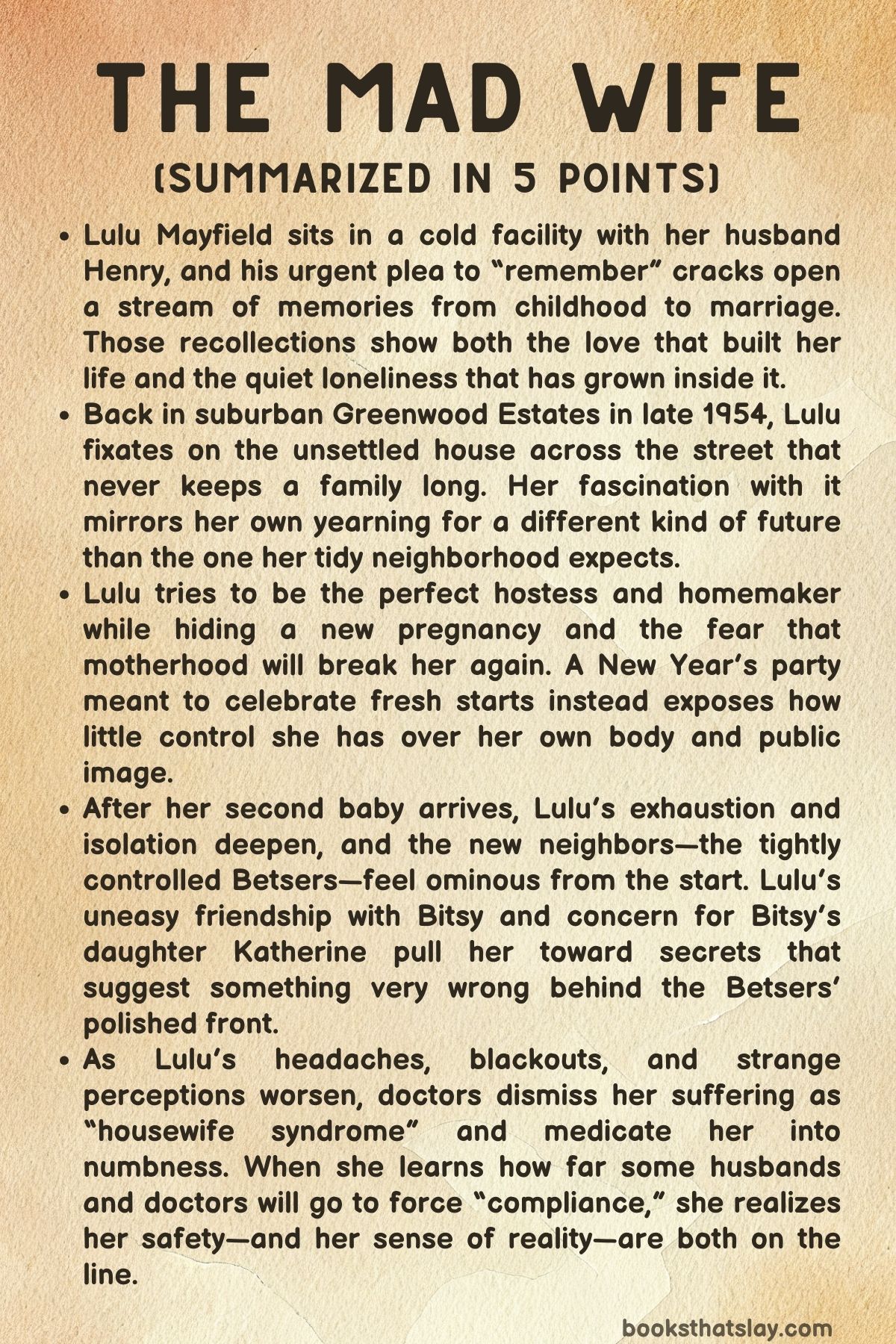
Lucy Mayfield sits in a cold treatment facility while her husband, Henry, visits her and urges her to “remember. ” His aftershave and touch set off a rush of images: her childhood on a farm, her father’s warmth, her mother’s pressures, her beloved brother Georgie before illness changed him, and her early romance with Henry at university.
She remembers their marriage, their son Wesley’s birth, and the way affection between her and Henry has thinned into distance. When Henry leaves with polite restraint instead of love, Lucy hides her panic behind a practiced calm, already trained to mask anything messy.
Months earlier in late 1954, Lucy lives in Greenwood Estates, where she believes houses hold moods and intentions. The home across the street has a reputation for never keeping a family long.
Each set of owners leaves after a year with a flimsy excuse, as if the place refuses to be settled. Lucy becomes fixated on it—its big picture window and sycamore trees feel like an invitation toward another life, one less pinched by routine.
Her own house is full of memories of “firsts”: Henry carrying her over the threshold, bringing Wesley home, and the early days of motherhood that exhausted and frightened her more than anyone knows.
As New Year’s Eve approaches, Lucy prepares for the neighborhood party she hosts every year. She should be cleaning, but instead she sits pasting S&H Green Stamps into booklets, hoping to trade them for small freedoms: replacement furniture not chosen by her controlling mother-in-law, and maybe a Kodak camera that could become something belonging only to her.
Yet practical needs and Henry’s opinions always win. Lately she feels nauseated, bone tired, and uneasy in her own skin.
She keeps a secret: she is pregnant again. She hasn’t told Henry because she is terrified of going through infancy a second time and of losing herself the way she did after Wesley’s birth.
Her neighbor Nora Gray, stylish and blunt but kind, stops by and notices Lucy still in pajamas at midday. Lucy insists she is fine.
Nora reminds her of the neighborhood’s cleaning schedule and warns her to at least put on lipstick. The reminder sharpens Lucy’s dread that she is already slipping behind the standard of “good wife” she is expected to meet.
She promises herself this baby will be different and that she will not break down again.
The New Year’s party arrives. Lucy lays out elaborate molded gelatin dishes—towering salads and mousse shapes that have earned her the nickname “Queen of Molded Food.” The women admire her work and the men drink and smoke. Lucy takes photos, refusing champagne because of the pregnancy and fighting waves of sickness.
She steps outside into the cold to breathe and watches the guests through the glass. Wesley wanders out, overwhelmed by noise, and climbs into her lap.
Holding him, she worries about how another child will change his world and about Henry’s breezy ignorance of how hard babies can be.
After midnight, Henry—drunk and glowing—pulls Lucy close. As guests leave, he notices her hand on her stomach.
Before she can stop him, he makes a loud toast calling her “the most perfect wife” and announces to everyone that a new baby will “complete” their family. The room erupts in cheers.
Lucy freezes with humiliation. Nora watches with a quiet, serious look that suggests she sees more than she says.
When the guests are gone, Lucy cleans alone, hearing Henry’s words echo as a warning instead of a blessing.
Weeks later, at Wesley’s fourth birthday, Lucy hosts family and close neighbors while heavily pregnant, swollen and drained. Her mother judges the cake she made as excessive, while her mother-in-law undercuts Lucy’s effort with dismissive comments.
Georgie visits, older now and disabled, and he and Lucy share a moment of gentle truth about their mother’s relentless attempts to “fix” him and the farm being sold to pay for treatments. While they talk, a couple arrives to view the house across the street: Bitsy Betser and her husband, Gary.
Something about them makes Lucy feel chilled, especially Bitsy’s stiff smile and tight grip on her daughter Katherine. Lucy hopes they won’t buy the house, but they do.
Lucy’s labor begins early and is harsher than with Wesley. She begs for twilight sleep and drifts through days of pain and sedation.
On the summer solstice she delivers a baby girl, Esther, into a tense hush. She is told Esther hasn’t survived, likely because of the cord.
Lucy goes home hollowed out, holding an unused pink blanket as her only physical link to her daughter.
At home, a moving truck sits across the street. The Betsers have moved in.
Lucy is exhausted, suffering headaches, and barely managing Wesley’s needs. She watches Bitsy with wary fascination.
Bitsy appears rigid and watchful, and Gary’s presence feels controlling in a way Lucy can’t fully name. Still, suburban etiquette demands a welcome dish, so Lucy tries to bring her usual lime Jell-O salad.
It collapses on her counter in a green mess, and she crosses the street with a peach pie instead.
Inside the Betsers’ house, everything looks arranged for display, yet feels strange. Bitsy corrects Lucy’s smallest movements, makes Katherine recite rules about sugar, and talks about her sons away at boarding school.
Lucy notices a family portrait where Bitsy looks tense and turned away. As sunlight hits new butterfly wallpaper, Lucy thinks she sees a wing flutter.
She leaves shaken, telling herself she imagined it.
Sleep becomes a blur. One night a fat gray cat appears at her patio door.
Lucy feeds it sour milk, names it Luna, and feels briefly comforted. Then a whisper seems to float through the dark house: “It was your fault.” She can’t explain it, but the words cling.
Trying to reclaim a piece of herself, Lucy goes out alone and somehow finds herself in a camera store without remembering walking there. She touches a Kodak Pony camera longingly.
Outside she spots Bitsy and Katherine, and the sight jolts her back to duty. At the grocery store she is overwhelmed and buys TV dinners.
Bitsy appears and needles her about Gary preferring home-cooked meals. Lucy takes it as another small humiliation.
Back home she learns Nora has actually planned a spades game at Lucy’s house and was cleaning to help her host, but Lucy remains unsettled.
Henry comes home drinking and stressed about work. He forces Wesley to finish his TV dinner and mentions a new secretary, Alice, who comforts him at the office.
Lucy feels an old fear of being replaced. That night she watches Bitsy’s window; Bitsy stands stiffly in the light until Gary appears, grabs her, and pulls her away.
Lucy’s unease hardens into dread.
At the spades game, Bitsy arrives late with a fancy dessert and a sick Katherine. Conversation turns to a local story about a woman in Bitsy’s former neighborhood who killed herself by turning on the gas oven while her child slept.
Lucy blurts that many women feel trapped sometimes. Bitsy reacts with sudden panic, bolts outside to find the children, yanks Katherine home, and leaves her salad behind.
Wesley later says they were playing a pretend search for Katherine’s missing mother. The detail gnaws at Lucy.
Lucy starts fainting, itching with rashes, and suffering relentless headaches. Dr. Collins says she’s physically healthy and diagnoses “hysteria,” calling it a common suburban wife problem. He prescribes Miltown, promising it will smooth her moods and please her husband.
Lucy takes it, hoping it will stop Henry drifting toward Alice, but the pills only numb her.
At another cards night in Bitsy’s spotless home, Lucy notices there are no photos of Katherine. When she sneaks down the hallway, she finds hidden disorder in the Betsers’ private rooms, a bottle of phenobarbital in Bitsy’s name, and boxes labeled like evidence.
One holds a newspaper story about the Knollwood suicide. Another includes a discharge form listing Bitsy’s treatment-resistant depression and a lobotomy authorized by Gary, with the goal of “compliant behavior.” Katherine catches Lucy reading and quietly escorts her away, saying her mother won’t let her play with Wesley because he gets her into trouble. Lucy leaves terrified.
That night Lucy overhears Henry drinking with Gary. Gary talks about Bitsy once being unable to cope and hints at a specialist who can “help” wives who are “out of sorts.” Henry listens. Lucy feels her world tilt: if she fails to perform happiness, someone can take her mind from her.
She stops taking Miltown and breaks into the Betsers’ home with a spare key while the women are shopping. She confirms the dead woman was Ellen Craske, Katherine’s mother and Bitsy’s sister.
The files show Gary arranged Bitsy’s surgery after Ellen’s death and speaks of similar plans for Katherine. Lucy barely escapes when Bitsy returns.
Gary later corners Lucy in her kitchen, calm and menacing, warning that stray cats disappear and that he will do anything to keep “hysterics” out of his life. Lucy hears the threat clearly.
She finds a folded note in Henry’s suit with a doctor’s name and number—Dr. Ruthledge—and realizes Henry may be contacting the same specialist.
In panic, she pushes herself into a frantic performance of order and cheer. Then a terrible crack forms: Henry finds her asleep in the nursery with the pink blanket and reminds her Esther died weeks ago.
Lucy realizes she has been caring for an imagined living baby, hearing cries that never existed. She flees barefoot down the street with the empty blanket and Luna, certain Henry and Gary are about to erase her.
Now in the sanatorium, Lucy meets Dr. Ruthledge, who calls her visions grief-based delusion and plans psychoanalysis plus stronger drugs.
Lucy plays polite while fearing a lobotomy. Alone at night, she unravels Esther’s blanket and is forced to accept that her memories of feeding and rocking Esther were inventions built over unbearable loss.
She recalls Esther’s silent birth and the shock of being sent home with the unused blanket.
Henry visits for a joint session, and Dr. Ruthledge pushes electroconvulsive therapy.
Lucy refuses, but they proceed anyway. The treatment leaves her sick and foggy but still aware of what she’s losing.
Nora visits afterward and, with steady compassion, repairs the blanket, admits she too once lost a baby, and tells Lucy the truth: Gary arranged Bitsy’s lobotomy and intended one for Katherine, but the Betsers are leaving town. Nora insists Henry never had an affair and bluntly urges Lucy to save herself.
Lucy decides to act compliant while planning escape. She showers, eats, and skips tranquilizers before another session.
When told she needs many more shocks, she slips away, retrieves Esther’s blanket, and steals Henry’s car. She drives to her childhood farm, where Georgie and her mother find her.
Her mother recognizes Lucy’s rash and exhaustion immediately: it is lupus, the same illness that killed Lucy’s father. The sanatorium mistakes her real disease for madness.
Henry arrives at dawn, shaken and ashamed. He explains his mother recommended Dr. Ruthledge and admits he didn’t understand what was happening to Lucy. He confirms the Betsers are moving away and that his promotion is secured.
Sitting beneath Lucy’s childhood tree, they grieve Esther openly for the first time. Lucy insists she will not return to the institution, and Henry agrees, horrified by the misdiagnosis and what he almost allowed.
In the epilogue, lupus remains a part of Lucy’s life, treated now with cortisone rather than tranquilizers. Greenwood keeps changing around her, but Lucy begins to live inside her own truth again.
At their next New Year’s Eve party she photographs the gathering with a new camera. When she develops the film, she finds the image of Esther’s blanket resting over the rocking chair—a quiet memorial rather than a fantasy.
Lucy accepts that Esther will stay with her as memory and grief she chooses to carry, not as a story forced on her by fear or by others.
Characters
Lucy “Lulu” Mayfield
Lucy Mayfield, called Lulu for much of the story, is the emotional center of The Mad Wife. She begins as an intelligent, sensitive woman who has been shaped into the ideal 1950s suburban wife, but the persona is a costume she’s learned to wear for survival.
Lulu’s inner life is fierce and imaginative—she believes houses have souls, senses atmospheres, and clings to small private dreams like photography as a way to keep a self intact beneath domestic repetition. Her pregnancy, exhaustion, and nausea reveal how alone she feels in motherhood, especially because the brutal realities of caring for Wesley were never truly shared by Henry or acknowledged by the community.
Lulu’s breakdown is not sudden madness but a slow erosion caused by grief, sleep deprivation, pressure to perform happiness, and a medical system eager to label unhappiness as “hysteria. ” Her delusion that Esther is alive is both heartbreaking evidence of trauma and a desperate act of love—her mind refusing to surrender what her body and world have taken.
What makes Lulu compelling is her double vision: she can see the rot under polite suburbia while still wanting belonging, intimacy, and beauty. By the end, when she names her illness correctly and chooses grief over illusion, she doesn’t become a “fixed” wife so much as a more honest version of herself, one who can live with pain without being erased by it.
Henry Mayfield
Henry is presented at first through Lulu’s longing and disappointment: a husband who once represented safety and romance but has drifted into emotional absence. He is not a cartoon villain; he’s a man deeply formed by his era, comfortable with the gendered bargain of a perfect home created invisibly by a perfect wife.
His New Year’s toast, publicly announcing Lulu’s pregnancy, shows how he confuses praise with possession—adoring Lulu as an idea rather than listening to her as a person. Henry’s work stress and reliance on Alice’s reassurance highlight how easily he seeks emotional ease elsewhere while ignoring Lulu’s spiraling isolation.
Yet Henry is also fallible rather than cruel: he is frightened by Lulu’s fragility, influenced by Gary and his mother, and desperate to delegate her pain to doctors. His complicity in the sanatorium and ECT is appalling because it is so ordinary—he trusts authority and wants order, not recognizing that those impulses can destroy the woman he loves.
The revelation of lupus shocks Henry into humility; he finally understands that Lulu’s suffering wasn’t moral failure but illness and grief. His arc is a move from complacent patriarch to a man who begins to grieve with his wife instead of managing her, suggesting love can grow only after the illusion of control dies.
Wesley Mayfield
Wesley is both a child character and a moral mirror for the adults. He embodies innocence and vulnerability living inside a world of strict appearances.
His sensitivity to noise at the New Year’s party, his need for Lulu’s soothing, and his confusion during neighbors’ tensions reveal how adult repression leaks into children’s emotional lives. Wesley’s make-believe game about a missing mother is striking because it shows children intuiting truths adults refuse to name; even without full facts, he plays at loss and fear.
Wesley is also a tether for Lulu, one of the few reasons she keeps performing normalcy when she is unraveling. Later, Nora’s description of Wesley being kind and protective suggests he is absorbing Lulu’s gentleness more than Henry’s hardness, and that the next generation may carry forward a quieter resistance to cruelty.
He is a living stake in the story’s argument that mental health, grief, and family power dynamics are not private—they shape children’s inner worlds too.
Esther Mayfield
Esther is physically absent for most of the narrative but spiritually central. Her silent birth is the trauma that fractures Lulu’s reality, and her existence becomes the battlefield between grief and denial.
Esther stands for the unbearable truth that some losses are too large for the roles society hands women; a “good wife” is expected to recover quietly and resume service, but Esther’s death refuses to fit that script. The unused baby blanket becomes Esther’s symbol, carrying the weight of everything Lulu couldn’t process: the hours of labor, the shock of silence, the hospital’s briskness, and the loneliness of returning home without the child she imagined.
Esther’s presence in Lulu’s delusion is not merely a psychotic break; it is Lulu’s love given a body so she can survive another day. When Lulu finally acknowledges Esther’s death, she doesn’t stop loving her.
Instead, Esther transforms into a chosen memory rather than a tyrannical hallucination, allowing Lulu to mourn as a mother rather than be punished as a patient.
Nora Gray
Nora is Lulu’s most vital ally and the story’s clearest alternative model of womanhood. She is stylish, brisk, and socially fluent, but her real power comes from empathy without sentimentality.
Nora is the sort of neighbor suburbia pretends to produce—helpful, composed, capable—but she is also quietly subversive: she sees Lulu’s cracks before Lulu can admit them, and she refuses to judge her for them. Her practical support with Esther and her cleaning is not a performance of superiority; it is fellowship.
Nora’s knowledge of Miltown and lobotomy culture shows her as a woman who understands the system’s violence even while navigating it. When she visits Lulu in the sanatorium, she becomes a lifeline by speaking truth plainly, including rejecting Lulu’s fear of Henry’s affair and pointing out how delusion works.
Nora’s own confession of losing a baby deepens her role: she is not a savior standing above Lulu but a fellow survivor who has learned to function inside grief. She represents the possibility of female friendship as a form of resistance against medical and marital control.
Bitsy Betser
Bitsy is the unsettling double of Lulu, a warning about what happens when a woman is forcibly reshaped into compliance. Her fixed smile, precision, and odd stillness convey a life of terror arranged into neatness.
The immaculate house hides disorder the way her behavior hides injury; both are evidence of a psyche managed rather than healed. Bitsy’s watchfulness over Katherine, her panic when the children disappear, and her harshness toward her daughter are all shaped by trauma and by fear of Gary’s power.
The revelation that Bitsy is Katherine’s aunt, not her mother, and that she has already undergone a lobotomy reframes her strangeness as the aftermath of a sanctioned violence. She becomes a symbol of how patriarchal medicine can erase grief, desire, mess, and complexity, leaving behind a woman who performs normalcy because she has been punished into it.
Bitsy is tragic because the story doesn’t treat her as monstrous; it shows her as a casualty of the same world that is closing in on Lulu.
Gary Betser
Gary is the clearest antagonist in the book, not through melodrama but through cold ideological certainty. He speaks in the language of rationality and protection, but what he protects is his own comfort and authority.
His casual discussion of wives being “out of sorts,” his hints about “a guy” who can fix them, and his signature on Bitsy’s lobotomy consent expose him as a man who views women’s minds as household tools that must function smoothly. Gary’s menace is intensified by his calmness; he doesn’t rage, he decides, and decision is his weapon.
The threat in his kitchen conversation with Lulu spirals into something larger than personal cruelty—he embodies a culture that medicalizes female unhappiness into compliance. His hatred of “hysterics” is fear of disorder, and disorder, to him, is feminine.
In Gary, The Mad Wife shows how violence can wear a polite face and live right across the street.
Katherine Betser
Katherine is a child trapped between the residue of her mother’s death and the cage of her father’s and aunt’s control. She presents as polite and eager, almost rehearsed, suggesting a lifetime of being trained to be palatable.
Her illness during the spades game and her careful recitation of rules about sugar show a girl whose body and behavior are monitored constantly. Katherine’s quiet intervention when she catches Lulu snooping is one of her most revealing moments: she is perceptive, careful, and already skilled at protecting herself and her family’s secrets.
Her comment that her mother won’t let her play because Wesley “gets her into trouble” hints at scapegoating dynamics in the house, with Katherine blamed for emotional disturbances she can’t control. She is the next potential victim of compliance culture, the future Bitsy that Gary is already planning.
Katherine’s fragility and intelligence underline what’s at stake when adult power disguises itself as care.
Hatti Brooks
Hatti plays a smaller role in plot but a significant one in theme. As a pregnant neighbor and fellow spades player, she represents the communal expectations surrounding motherhood and feminine cheerfulness.
Her visible unease when the women discuss lobotomy reflects the fear that lives beneath suburban smiles: every wife knows the rules, but few say them aloud. Hatti functions as a chorus of anxious normalcy, someone who wants to believe the system is safe because she is about to entrust her body and mind to it again.
Her presence emphasizes that Lulu and Bitsy are not anomalies; they are possible outcomes for any woman in the neighborhood.
Georgie
Georgie, Lulu’s brother, is tied to her earliest experiences of love, loss, and guilt. His childhood illness and lasting disability are part of Lulu’s emotional foundation, a reminder that life can unravel without permission or logic.
Georgie’s quiet conversation with Lulu about their mother’s attempts to “fix” him parallels the later attempts to fix Lulu, reinforcing the theme that families and institutions often treat suffering as a defect to be erased rather than a reality to be lived with. Georgie is gentle, observant, and resigned in ways that contrast Lulu’s frantic denial; he’s a figure of grounded truth, and his presence reconnects Lulu to a world before suburban performance.
Mama
Mama is stern, practical, and emotionally complicated, but she is also the person who ultimately rescues Lulu’s life. Her criticism at Wesley’s birthday party shows how she enforces certain standards, yet her reaction to Lulu’s escape reveals a deeper, fiercer love.
When she recognizes lupus immediately, she punctures the entire architecture of Lulu’s supposed madness. Mama embodies a different kind of authority than the doctors’—not institutional and male, but experiential and maternal.
She is the keeper of family medical history and of the blunt truth that grief and illness are real, not moral failings. Her farm kitchen becomes the book’s counter-space to suburban houses: a place where pain is named plainly, and naming is healing.
Dr. Collins
Dr. Collins symbolizes the medical culture that translates women’s suffering into pathology of temperament rather than body.
His quick dismissal of Lulu’s symptoms as “housewife syndrome” and his easy prescription of Miltown show a system more interested in smoothing domestic function than understanding illness. He is not malicious so much as representative, which makes him more frightening: he believes he is helping, but his help is calibrated entirely around making Lulu productive, calm, and sexually pleasing to her husband.
Dr. Collins is one of the book’s clearest critiques of mid-century psychiatry’s gendered assumptions.
Dr. ruthledge
Dr. Ruthledge is the sharper edge of that same system.
Unlike Dr. Collins’s paternal breeziness, Ruthledge is clinical, evasive, and powerfully coercive.
His refusal to discuss lobotomy details, his pre-arranged agreement with Henry about ECT, and his framing of Lulu’s grief as delusion to be corrected rather than mourned reveal a man who believes psychological control is synonymous with treatment. Ruthledge is terrifying because he operates within legitimacy; he needs no threats, only procedures and consent forms.
He embodies the institutional machinery that turns women’s pain into compliance and calls it cure.
Alice
Alice, Henry’s secretary, never becomes a full character onstage, which is fitting for her function in Lulu’s psyche. She is less a romantic rival and more a symbol of Lulu’s fear of replacement and of Henry’s emotional outsourcing.
The very fact that Henry mentions Alice as reassurance is what wounds Lulu, because it highlights how little reassurance he provides at home. Alice represents the external validation Henry seeks when domestic life feels hard, and she intensifies Lulu’s belief that she must be perfect or be discarded.
Jack Ellis
Jack is Henry’s boss and a loud reinforcement of masculine workplace culture bleeding into domestic space. His jokes about his own wife being away to “steady her nerves” normalize the idea that women are unstable and men are practical managers of that instability.
His presence at dinner forces Lulu into frantic performance and reveals how even professional hierarchies leverage wives’ labor in private. Jack isn’t central to Lulu’s breakdown, but he is part of the social atmosphere that makes such breakdowns likely.
Henry’s mother (Lucy’s mother-in-law)
Lucy’s mother-in-law is a domineering figure whose influence haunts the Mayfield home. Through her etiquette books, furniture choices, and assumptions about proper domestic behavior, she represents the inherited standards Lulu is always trying to satisfy yet quietly resist.
Her automatic judgment of Lulu’s cake and her presumption that Lulu’s efforts must be store-bought show how she diminishes Lulu’s competence while demanding perfection. She also serves as a conduit for patriarchal medicine, recommending Dr. Ruthledge and reinforcing the idea that a wife’s distress is an inconvenience to be corrected. She is the polite face of control, making her power hard to challenge.
Lucy’s father
Though absent in the present timeline, Lucy’s father shapes her inner world through memory. He represents warmth, rural freedom, and a childhood before performance became survival.
His death from lupus becomes the key to Lucy’s salvation, positioning him as both a lost refuge and a lingering protector through the medical truth he leaves behind. The recurring memory of him taking away the dying rabbit echoes Lulu’s adult grief, teaching her early how adults soften death with euphemism, and foreshadowing her later refusal to accept soft lies about Esther.
Emily Donahue
Emily Donahue, mentioned early as Lulu’s close friend who moves away, reinforces Lulu’s loneliness and the transient, surface-level stability of Greenwood Estates. Her absence mirrors how quickly suburban networks can dissolve, leaving women stranded in roles without support.
Mrs. Reilly, who rushes to welcome the Betsers first, highlights the competitive performativity of neighborhood womanhood—kindness as status contest.
Both are minor figures, but they help define the social ecosystem that pressures Lulu toward silence.
Themes
Domestic expectations and the performance of wifehood
Lulu’s daily life is ruled by a neighborhood script that treats a woman’s value as identical to her usefulness and pleasantness. The routine of breakfast, party preparation, lipstick reminders, and the Good Housekeeping cleaning schedule is not just background detail; it is the social system that keeps her watched and corrected.
Even when she is sick, newly postpartum, or quietly terrified, she must look “fine,” host properly, and keep her home as a public proof of competence. The story shows how this expectation turns marriage into a stage where Lulu is required to play a role rather than live a relationship.
Henry’s toast calling her the “most perfect wife” is a cruel example: he praises a version of Lulu that exists for friends’ applause, not for her inner reality. She is reduced to an emblem of domestic success, while her own experience of pregnancy, exhaustion, and fear is treated as irrelevant.
The molded foods, admired as cute neighborhood spectacle, capture the same pressure. Lulu becomes “Queen of Molded Food” because she can shape herself and her labor into forms that others find delightful.
Yet these elaborate dishes are also a quiet cry for recognition within the narrow space allowed to her. The S&H Green Stamps underline this struggle.
She uses them to slowly reclaim her home from her mother-in-law’s taste and to chase a small dream of photography, but the system pushes her to spend every resource on practical needs and implied obligations. In The Mad Wife, domestic life is portrayed as a velvet cage: comfortable in appearance, punishing in practice, and structured so that the woman inside learns to hide pain behind a smile.
Lulu’s outward calm becomes survival, but it also shows how a culture that worships cheerful households can produce loneliness and breakdown by refusing women any honest space to be tired, angry, or unsure.
Grief, maternal trauma, and the mind’s last shelter
Loss in the novel is not a single moment, but a force that rearranges perception. Lulu’s earlier memories already contain grief: her brother’s illness, the fading warmth in her marriage, and the quiet erosion of hope.
When Esther dies, the shock is so total that her mind creates a temporary refuge where the baby is still alive. This is not presented as fantasy for its own sake; it is a desperate method of staying functional inside a world that offers no language for a mother’s devastation.
Lulu cannot openly fall apart in Greenwood Estates. She is expected to bounce back, keep the house running, and let others decide what is “normal.
” The delusion becomes the only place where her love still has a living recipient. The blanket she clutches works as a substitute body, a physical anchor for a relationship that ended before it could begin.
The slow realization that the blanket was unused, and that the memories of nursing and rocking were not real, is crushing precisely because it strips away the last soft barrier between Lulu and the fact of death. Her panic at the sanatorium, her refusal to let Esther go in speech, and her recoil from ECT all grow from this same root: the terror that grief will be treated as illness and erased rather than honored.
The book also layers grief across women’s lives. Nora’s confession of her own lost baby, Bitsy’s collapse after her sister’s suicide, and Katherine’s quiet knowledge of what happened to her mother show how maternal sorrow echoes through a community that prefers silence.
Lulu’s eventual acceptance does not mean forgetting; it means choosing how to carry memory without letting it distort reality. The final photograph of the blanket as a memorial captures this shift: grief is still present, but now it is held consciously rather than as a trap.
In The Mad Wife, maternal trauma is shown as both deeply personal and socially shaped, and the mind’s breaking point is portrayed as a human response to love interrupted and pain denied a rightful place.
Medical authority, misogyny, and the search for “compliance”
The medical world Lulu encounters is less about healing and more about enforcing a social order. Dr.
Collins’s diagnosis of “hysteria” translates her insomnia, fainting, and despair into a cliché used to dismiss suburban women. His questions about happiness are posed like a test with only one acceptable answer, and Lulu’s lie is a learned reflex because truth would invite punishment.
The prescription of Miltown is framed as a tool to make her relaxed and sexually available, not to understand the cause of her suffering. The novel portrays tranquilizers as chemical etiquette: they flatten emotion to help women keep performing.
The horror deepens when Lulu learns what happened to Bitsy. The lobotomy paperwork, stamped with words like “compliant behavior,” exposes the real goal of that treatment.
A grieving woman who fails at housework becomes a problem to be corrected, not a person to be supported. Gary’s calm talk about wives being “fragile” and his hint of “a guy” who handles women “out of sorts” show how easily medical language merges with male control.
Henry’s drift toward Dr. Ruthledge is especially chilling because he does not think of it as cruelty; he thinks he is doing what responsible husbands do.
That is part of the theme’s power. The story does not paint every husband or doctor as a cartoon villain.
Instead, it shows a culture where authority figures sincerely believe that women’s emotions are dangerous and must be managed for family stability. The sanatorium, with its fogging drugs, secrecy, and forced ECT, becomes an institution that teaches obedience through fear and memory damage.
Lulu’s misdiagnosis of lupus completes the critique: even her physical illness is filtered through sexist assumption, so her body’s real pain is ignored until her mind collapses. By the time her mother recognizes the signs, the reader sees how much suffering could have been prevented if women were believed.
The Mad Wife uses Lulu’s ordeal to show that “treatment” can be a disguised form of discipline, and that the line between care and coercion is thin when society views female distress as a threat to be quieted.
Identity, agency, and the meaning of home
Lulu’s sense of self is built in constant tension with the spaces around her. She believes houses have souls, and this belief works as more than superstition; it expresses her intuition that environments absorb the moods and power struggles of the people inside them.
The restless house across the street reflects Lulu’s own restlessness. Each family that leaves it feels like a warning about lives that cannot stay contained.
When the Betsers arrive, the house becomes a mirror of what Lulu fears: a home that looks perfect in daylight but hides disorder, secrets, and violence behind closed doors. Lulu’s fixation on picture windows, wallpaper, and furniture is therefore an effort to read the truth of lives that are otherwise masked by politeness.
This theme also connects to photography. Lulu’s desire for a camera is a desire to fix her own viewpoint in a world that keeps rewriting her story.
Taking pictures at parties and birthdays lets her record meaning on her terms, not just as a helper in other people’s scenes. The irony that Henry buys her a new camera only after catastrophe suggests how women’s agency is repeatedly postponed until it is safe for others.
Yet Lulu’s eventual use of photography in the epilogue becomes a quiet reclamation. She no longer shoots images to meet a neighborhood ideal; she shoots to remember Esther honestly and to see her life as it is, not as others demand it to be.
Even her escape from the hospital is an act of agency tied to identity. She retrieves the blanket before leaving because she refuses to let the institution decide what memories she may keep.
Returning to her childhood farm reinforces the same point. In that place, her mother names her illness accurately, feeds her, and recognizes her as a whole person beyond wifehood.
That recognition helps Lulu rebuild a self that can live with grief and illness without surrendering to control. In The Mad Wife, home is both danger and possibility: a site where identity can be smothered by performance, but also a place where truth, memory, and chosen love can help a woman stand upright again.